
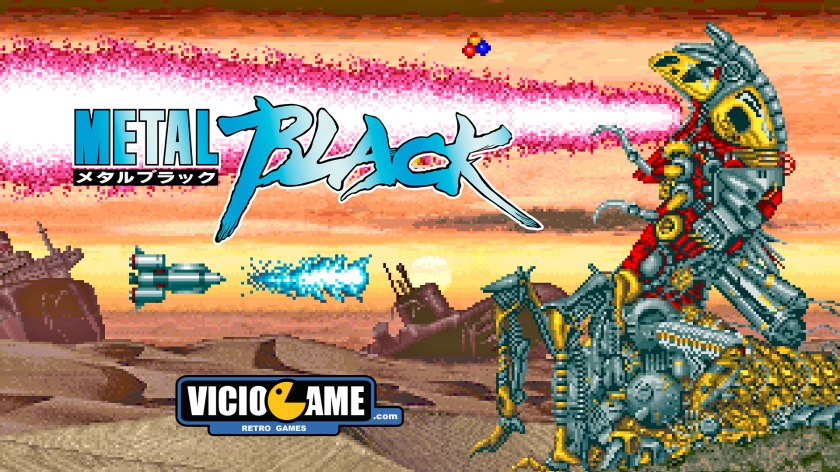
Metal Black is a shoot ’em up game released in 1991 for arcades. Earth has been devastated by an alien invasion, leading to the creation of the powerful Black Fly spacecraft to fight back. You embark on a suicide mission to save the planet.
Developer/Publisher: Taito
Release date: 1991
Platform: Arcade Taito F3 Cybercore System board version.
Metal Black: The Ultimate Guide
Metal Black was released by Taito in arcades in November 1991, having been previously shown in a playable state to visitors at the 1991 Amusement Machine Show. Developed and published by Taito itself, this horizontal shoot’em up stands out as one of the company’s most atmospheric and technically impressive titles, running on the Taito F1 System hardware with expansion chips that allowed for special graphical effects, including multiple scrolling layers and scaling effects. The game was conceived by Takatsuna Senba, who had worked as a graphic artist on various Taito games, including Darius II, Cadash, Cameltry, and SCI. Gun Frontier, released in 1990, was the first game where Senba served as producer, director, and game designer, in addition to working on the graphics. Metal Black became his second project in this role, followed by the dinosaur fighting game Dino Rex, which closed out the trilogy of games known internally as “Project Gun Frontier”.
The most enigmatic element of Metal Black lies in its designation as “Project Gun Frontier 2” on the startup screen. Gun Frontier is a vertical shooter with a “cosmic western” setting that demonstrated the graphical power of Taito’s advanced hardware. Despite sharing part of the development team, the games are completely different in style and gameplay. The plot connection used in Metal Black‘s internal pitch was tied to Gun Frontier due to the involvement of the Wild Lizards criminal gang in both titles. This story was written only as a placeholder for internal use, as there were concerns that management would consider Metal Black‘s post-apocalyptic themes excessively dark. This “fictional story” ended up being published in various forms, including in magazine previews. The official story of Metal Black, however, as told in a mini-manga and on the arrangement CD “The First”, is completely different.
The official story sets the action in the dystopian future of 2052. In the year 2042, a companion star to the planet Jupiter emerges a few astronomical units away from the planet, propelling asteroids along Jupiter’s orbit toward Earth, creating a meteor wave. While Earth struggles to survive, extraterrestrial cybernetic invaders from the distant star use the meteorites as cover to invade with little resistance, intending to plunder Earth for inorganic materials necessary to sustain their forms. Both the aliens and the star they came from were quickly dubbed Nemesis. The resistance that the aliens faced from Earth’s combined international defense forces was quickly obliterated by the aliens’ powerful beam weapons.
Earth’s scientists studied the molecules that powered the alien weaponry, which began to spread across Earth, and the molecule was given the name “Newalone”. With Newalone in hand, scientists quickly initiated Project Metal Black, focused on developing at least twenty thousand human spacecraft capable of wielding the same beam weaponry as the aliens. The spacecraft became known as the CF-345 Black Fly, named for its method of using Newalone energy. However, ten years after the invasion, Earth’s remaining diplomats signed a treaty with the Nemesis forces outlining a peaceful surrender, which promised to prevent all of Earth’s remaining forces from attacking. This applied to Project Metal Black, preventing the use of the Black Fly ships. With the planet’s population dwindling and natural resources depleting, it was only a matter of time before someone discovered Metal Black and counterattacked.
The rogue pilot who steals one of the ships is identified in supplemental materials as John Ford. He commands the Black Fly in direct violation of the treaty, intending to fight against Nemesis and save what remains of humanity. The events within the game unfold over six stages as Ford pilots the Black Fly and travels to Jupiter, confronting powerful Nemesis ships along the way. In the final two stages, Ford invades Nemesis itself, gaining a crucial chance to defeat the invading forces once and for all.
Metal Black was initially conceived as part of the Darius series. A sketch demo was found on Takatsuna Senba’s website, showing both Proco and Tiat, characters from the Darius series, and indicating the name as “Darius Part 22”. However, it was never initially announced as such. Taito slowly revealed plans for a “Darius III”, but this ended up being renamed as Darius Gaiden. The game was developed simultaneously with Dino Rex, referred to by Senba as “sibling games”. Both games had troubled developments, with substantially reduced budgets and tight deadlines compared to Gun Frontier, which itself was made on a comparatively low budget. The title METAL BLACK is actually an acronym: Military Enforce Totalwar for Absolute Liberty, Beam, Lesson, Aircraft, Carrier: Kill off.
Metal Black‘s control system is straightforward but requires mastery. The player uses the eight-direction joystick to move the CF-345 Black Fly ship across the screen. The control has two action buttons: one for the main shot (twin blaster) and another for the energy beam attack (beam). The main shot fires continuously while the button is held down, being a rapid-fire weapon that serves as the base attack. The energy beam button, on the other hand, releases the powerful Newalone attack, whose intensity depends on the energy level accumulated in the meter at the bottom of the screen.
The central mechanic of Metal Black revolves around collecting Newalone molecules, which appear as colored round particles in red, blue, and yellow floating across the screen. These molecules serve two simultaneous purposes: they increase the power of the main shot and fill the energy meter at the bottom of the screen. There are five power levels for the shot, with the highest being called MAX. As the player collects more Newalone, the standard shots become larger and stronger, and the meter fills up. When the meter is completely full at MAX level, the player can execute two different types of beam energy attacks.
The first type is the Focused Beam, which creates a concentrated forward attack while the energy shot button is pressed and held. This beam pierces through all enemies and causes devastating damage to bosses. When the meter is at maximum, this fires the MAX lasers, the most powerful form of the attack. The second type is the Release Beam, which can only be used when the beam meter is at MAX level. By pressing the energy shot button without holding it down, the player releases a beam attack that spreads in all directions, damaging all enemies on screen. This attack functions like a traditional shoot’em up “bomb”, clearing the screen of projectiles and smaller enemies.
However, using either of the beam attacks causes the beam meter to decrease, and once it’s empty, the energy beam attack cannot be used, returning the player to the weaker basic shot. This mechanic creates an unusual difficulty balance among shooters. The game is not so much about shooting and dodging everything that moves, but rather about resource management. Newalones only appear at certain points in the stages, and the player will face several enemies that “eat” these molecules, preventing the player from collecting them. The game induces the player to use the beam against bosses, but using the beam for crowd control is actually wiser, since “beam duels” will always be against the player’s odds if the energy level is not at 75% or higher.
Beam duels are one of Metal Black‘s most distinctive mechanics. The game’s bosses fire attacks that resemble those of the Black Fly, but are pink. For simple laser attacks that resemble the standard shot, these can be canceled with the player’s shot. However, for larger beams, these can be countered using the Black Fly’s own Super Beam, which initiates a beam duel. If the player’s and the boss’s large beams are fired simultaneously, one dominates the other depending on how high each level is. During the “beam duel”, the player must rapidly tap the shot button to keep the opposing beam at bay, accumulating destructive energy matter that changes color based on which beam carrier is stronger. If the player can dominate the boss’s beam, they can cause heavy damage. However, if the player’s energy level is below 75%, the boss will almost certainly win the duel, making careful Newalone management essential.
An advanced technique known as “Scraping” takes advantage of a peculiarity of the Black Fly’s shot. The ship’s shot appears approximately at the ship’s midpoint and, at high power, has a large hitbox, allowing the player to hit enemies just below and above the ship in a pseudo-melee attack. The player can use this to destroy enemies while remaining in a relatively safe position, as long as they maintain rapid fire.
The game is divided into six main stages. After the first and third rounds, a bonus stage occurs to indicate the players’ advance to space. Each bonus stage presents a first-person perspective, using scaled sprites and impressive parallax effects to create a sense of dynamic camera angles. During these sequences, the player moves a cursor across the screen to lock onto moving targets and launch cluster missiles under a time limit to gain extra points. The player must surround a group of enemies that must be destroyed by locking onto moving targets and launching cluster missiles. The more enemies the player hits, the more points are scored. These bonus stages not only function as graphical showcases, but also as playable cutscenes, showing the Black Fly exploding into space and penetrating the alien dimension, respectively. The player is not in danger during these stages.
Stage 1, titled “Down To Earth”, is one of the most iconic in shooter history. The stage presents itself as a slow flyover of a ruined coastal city, with only the smallest traces of civilization remaining. Among the elements that remain are a still-functioning video billboard and a fallen warship. Suddenly, the ship’s movement reveals the hermit crab boss from Darius II hidden underneath it, serving as a mini-boss. The stage culminates in a battle against the crawling kaiju Apartheid (yes, that’s really the first boss’s name), whose alien roar is one of the game’s most distinctive sound effects. Apartheid is explicitly called a “chimera” of flesh and machine, essentially a cyborg. The name Apartheid comes from the Afrikaans word meaning “The state of being separate”, a reference to the former racial segregation system in South Africa. The stage’s musical theme, “Born To Be Free”, has become almost as popular as classic shooter anthems like “Challenger 1985” from Gradius or “Fly To The Leaden Sky” from Battle Garegga.
Stages 2 and 3 are the most typical of the set, but still feature impressive visual elements. Stage 2 presents a space setting with the Moon in the background. This stage’s boss, Fedoro, initially appears disguised as the Moon, revealing itself to be an “egg” shaped like Earth’s satellite. The real Moon slowly transforms into a cluster of colored spider web-like structures during the warp speed that leads to the next stage. The Fedoro boss has characteristics similar to Super Darius II‘s Heat Arrow and serves as a precursor to Darius Gaiden‘s Odious Trident. There are enemies in Stage 2 that resemble serpents and “eat” the Newalone molecules, preventing the player from collecting them. These enemies make resource management even more critical.
Stage 3 features space stations similar to those in Darius II, which may imply they are the colonies previously inhabited by the people of Darius after leaving the planet. This stage has two bosses: Daio and Gishiin. Daio, which may be an incorrect pronunciation of Dio (given that the boss theme is called “Dio Panic!”), is a giant beetle, while Gishiin is an opabinia-like chimera/cyborg. Feeder, one of this stage’s enemies, is the successor to Darius II‘s Driosawm. The dust clouds used by emerging enemies (hermit crab, Apartheid, and Gishiin) were later reused in Darius Gaiden, especially in Crusty Hammer emerging from the clouds.
Stage 4, “Crystal Lize”, is where things start to heat up. While the first three stages are relatively easy by shooter standards, Stage 4 presents a massive increase in difficulty. Enemies come from every possible corner of the screen, the game expects the player to know that the high-power shot’s hitbox is actually larger than the Black Fly’s, making the player nearly invincible on contact with enemies as long as they continue abusing rapid fire. The stage features annoying bubble-like obstacles that hinder movement and absorb shots, few Newalones to collect, and worst of all, narrow corridors to move through. The player typically spends a credit or two just on this stage. However, the battle against the boss Amazo, the obligatory R-Type-style mothership battle, set against an extremely psychedelic background and a beautifully oppressive musical composition, makes it all worthwhile. Amazo is the precursor to Darius Gaiden‘s Titanic Lance.
Stage 5, “Nemesis Crisis”, begins with a completely normal space flyover with Jupiter in the background before making the player enter Nemesis itself, although real-life natural satellites probably don’t contain organic-looking green flooring inside them. After a fight against a color-palette-swapped Apartheid that teleports in an asteroid field, the game drags the player into Stage 6. This stage’s boss is called Gaasuto (Ghost/Geist), and the similarities between Apartheid and Ghost imply that the creatures belong to the same species of giant creature used by the invaders. The boss’s musical theme, “Phantasm”, matches its disappearing capabilities, which may also owe as much to the creature’s chameleon inspirations.
Stage 6 is a very short recap of elements from the previous five stages, including more color-palette-swapped Apartheids, which quickly leads the player to the final boss battle. But what a boss battle! Apparently, the brain behind the alien invasion is a giant web-like being with a glowing heart that fires laser beams through its private parts, spreading Newalones everywhere after finishing. The player can only defeat it by damaging its core. Every few hits, the background changes to various digitized images, such as a primitive 2001-style man and a very scary-looking cat, with the music changing according to songs from earlier points in the journey. The final boss is officially called Omega Zone (technically “Ω Zoon” to maintain the original katakana). The name implies a place where all things end. Omega Zone is based on Carinaria cristata, better known as the Glass Nautilus. The dinosaur fossils depicted in the final boss battle background belong to Coelophysis, a dinosaur from the Late Triassic and Early Jurassic periods, 203-188 million years ago. The companion star Nemesis is based on the hypothetical red dwarf located beyond the Oort Cloud to explain a perceived cycle of mass extinctions in the geological record, which seem to occur more frequently at 26-million-year intervals.
The boss’s defeat leads to a massive explosion that cracks the Earth, but fortunately it’s also revealed that the entire space adventure was nothing but a fetus’s dream. This is the game’s true ending, achieved by defeating the final boss without using continues. The stage descriptions on Japanese Wikipedia refer to both the “Mother Universe” and the “Baby Universe” being visible after the “golden and silver moons”. The final stage’s theme is called “Time”, because, in any scenario, whatever is behind Nemesis has a negative opinion about time. Either the mother hates that the flow of time will lead to her end and succession by the baby (assuming the mother universe isn’t already undead) and therefore effectively wants to reverse it, or the baby thinks time isn’t flowing fast enough. The final stage is called “A Mirage of Mind Gaia”, a title that adds more ambiguity to the ending’s interpretation.
There is also a bad ending if the player receives a Game Over in Stage 6. Ford’s death incites a military coup d’état of the global government, and the 20,000 Black Fly ships depart for battle against Nemesis. This ending is bittersweet, as the hero dies, but inspires the rest of the military to resume the fight. Some interpret that perhaps it’s not “our” Earth dying in the true ending, but theirs, or that we’ve just witnessed death and rebirth on a cosmic scale, similar to Radiant Silvergun in its philosophical approach.
Under default settings, extra lives are awarded at 70,000 points, and then every subsequent 150,000 points (starting at 220,000). The scoring system rewards not only enemy destruction, but also performance in bonus stages. Being hit by enemy fire or colliding against solid stage obstacles will result in the loss of a life. Once all lives are lost, the game is over, unless the player inserts more credits into the arcade machine to continue playing. The game supports two players simultaneously, with each player having their own energy meter displayed at the bottom of the screen (lower left corner for Player 1, lower right corner for Player 2).
The arcade’s difficulty settings are adjusted through jumpers. Dip Switch A controls settings such as screen orientation (Normal or Reverse), mode (Game Mode or Test Mode), demo sound (Yes or No), and varied game and continue prices for North American and other markets. Dip Switch B controls difficulty and bonus intervals. Difficulty has four settings: Easy, Normal, Hard, and Hardest. Bonus intervals can be set to three different options: 70k, 220k, 370k, 520k, 670k, 820k and so on; 50k, 170k, 290k, 410k, 530k, 650k and so on; or 80k, 240k, 400k, 660k, 720k, 880k and so on. The difficulty setting affects not only the speed and quantity of enemy projectiles, but also the resilience of enemies and bosses.
Metal Black has a hidden stage selector that can be accessed through a specific sequence. While the game is booting up, the player must hold the Service Coin button until a “SERVICE SWITCH ERROR” message appears on screen. The next step depends on the Cabinet dip switch. If set to “4 Players / 4 Coin Slots”, press 1P Button 1 (x3), Service Coin, 1P Button 1. Otherwise, press 1P Start (x3), Service Coin, 1P Start. Press 1P Up/Down to select the round, then press 1P Button 1 to start a new game. There’s no way to change the area number, but the game doesn’t actually use that value anyway, so it doesn’t matter.
During the ranking screen with the sunfish, the player can enter names that have special effects. Three of the names have additional effects: UME plays three klaxon sounds after being entered; TEN generates five of the energy-eating serpents from the Stage 2 boss to chase the sunfish; AGA makes the sunfish turn toward the player.
Metal Black‘s graphics are impressive for a game released in 1991. The F1 board, much like the Super Nintendo, was built with hardware flexibility in mind, supporting various expansion chips that increased its capabilities in various ways. Metal Black uses a chip that adds varied graphical effects, such as extra scrolling layers and scaling, and they all work together in brilliant ways, adding life and depth to a desolate 2D world. The most eye-catching are the psychedelic backgrounds, the Stage 2 boss introduction, and the huge flaming globe-shaped explosion that marks the end of each stage. The game relies heavily on digitized elements, from buildings and caves to the Moon itself, resulting in a photorealistic game. All of this is combined with pseudo-3D perspectives like the sky in Stage 1 or the screen effect at the beginning of Stage 3, where it changes as it enters the 3D-looking tunnel left by an abandoned space station.
One of the main aspects of Metal Black‘s graphics is the surrealism at every moment. The game slowly blurs the line between reality and fantasy as the world and universe around the ship become increasingly strange, beginning this effect in Stage 2, where the Moon that was in the background was actually the boss hidden in an “egg” shaped like Earth’s Moon. The game creates a deep, dark atmosphere through a fantastic combination of graphics, sound, and gameplay devices that perfectly channel the mood of a post-apocalyptic Earth and a lone pilot’s suicide mission to save it, while maintaining that classic, exuberant Taito charm.
Although the soundtracks of Darius Gaiden and G-Darius are the pinnacle of Zuntata’s repertoire (Taito’s internal sound team/band), Metal Black‘s OST also deserves special mention in the sound team’s history, as it perfectly complements the game’s atmosphere. The soundtrack was composed by Yasuhisa Watanabe. The rest of the soundtrack is consistently excellent, shifting between various styles while maintaining that classic Taito FM synthesizer flair. The versions on the arrangement album “The First” and at Zuntata’s live shows are also excellent. An album containing music from the game was co-published exclusively in Japan by Scitron and Pony Canyon on January 21, 1992. In 2012, a compilation album containing its soundtrack, as well as the music from Gun Frontier and Dino Rex, was released by SuperSweep in Japan.
Metal Black‘s sound is not limited to music. The sound effects are particularly effective in establishing the game’s alien atmosphere. The sounds of laser beams during beam duels create tension, especially when the destructive energy matter changes color indicating who is winning the confrontation. The ambient sounds of the stages, especially in Stage 1 when flying over the ruined city, contribute to the feeling of desolation and loss.
Several music tracks from Metal Black appeared in other Taito games after its release, most prominently “Dual Moon” in Taiko No Tatsujin, which replicates Stage 2’s background Moon in its note pattern. This reuse demonstrates the lasting impact of the game’s soundtrack on Taito’s gaming culture.
Metal Black was first ported to the Sega Saturn by Ving, published only in Japan on May 24, 1996 under the budget “Arcade Gears” line. Although the game itself is only a faithful arcade port with no extra features, the manual is very good, including not only the official plot, but also the planned “Gun Frontier 2” story, and various cool illustrations scattered throughout the manual. According to Famitsu, the Saturn version sold over 7,839 copies in its first week on the market. Four Famitsu reviewers gave the Sega Saturn version a score of 20 out of 40, indicating a mixed reception. The final credits in the Saturn version credit Ving instead of Taito as in the Arcade version.
The first (and only) port to reach Western shores was the emulated version present in the Taito Memories Joukan / Taito Legends 2 compilation for the PlayStation 2, PCs and original Xbox in 2006. Since MAME already fully supported F1 games at the time of its release, Metal Black runs almost perfectly on it, except for one glaring flaw: you can’t refocus your laser once it becomes the screen-clearing attack. This is one of many control quirks these compilations are known for and, while it doesn’t greatly affect normal gameplay, it makes it much harder to complete the game with a single credit. Strangely, this only affects the American and European PS2 releases. The laser works perfectly in the Japanese PS2, Xbox, and PC versions. The upscaled and filtered graphics also aren’t as sharp as the Saturn port, which runs natively at 240p.
The original arcade version was planned to be included as part of the Taito Egret II mini console. On November 17, 2022, Hamster released the game for the Nintendo Switch, PlayStation 4, and PlayStation 5 consoles as part of the Arcade Archives series, containing three versions of the game. The Arcade Archives series faithfully reproduced many classic arcade masterpieces, allowing players to change various game settings, such as game difficulty, and also reproduce the atmosphere of arcade display settings of the time. Players can also compete with each other from around the world with their high scores. The manual and options are available in Japanese, English, French, German, Italian, and Spanish.
On February 1, 2023, City Connection released an S-Tribute version for consoles, Steam, Xbox One, and Xbox Series X/Series S. The S-Tribute series is developed by City Connection with the Zebra Engine. Metal Black was originally released as a 2D side-scrolling arcade shooter game by Taito in 1991, and this S-Tribute version is a reproduction of the home console version released by Ving in 1996. This version contains some features and option settings available only in S-Tribute. There were plans for separate PlayStation 4 and Switch versions of S-Tribute, but they were canceled due to the game’s release as part of Hamster’s Arcade Archives series.
There is also an extremely rare version of the game called Metal Black: Tarabar Edition. The name comes from one of the game’s programmers (Tomo Tarabar), who created this alternative version exclusively for Taito’s internal use, as it was not released to arcades. It lacks most of the game, with only three stages in total, but there is an exclusive extra stage that appears after the first stage. Some of the music is different, with an exclusive track, in addition to the enemy patterns being more difficult. The copyright notice says “For Use in Tomo Only”. In the first stage, there are strange characters. There are no third and fourth stages. The second stage’s title is “Extra Stage” and the BGM used is “Happy New Year”. In the final stage (third level), a different pattern and different enemies are used. The ending is different. Only one unit exists and was saved by the programmer himself, making it one of the rarest versions of any arcade game.
In Japan, Game Machine magazine listed Metal Black in its February 1, 1992 edition as being the thirteenth most popular arcade game at the time. Critical reception was positive, with praise for the unique atmosphere, impressive graphics, and innovative beam duel mechanics. However, some critics noted that the game doesn’t explain its mechanics adequately, leaving players to discover the beam duel system through trial and error.
Metal Black‘s influence extends far beyond its original release. A similar “beam duel” system was featured in G-Darius, another Taito title. Hiroyuki Maruyama of G.rev stated that Metal Black was a major inspiration during the development of Border Down, including its “beam level” system and also features references to the former in other ways. Border Down can be considered a spiritual successor, as G.rev was formed primarily by former Taito employees and the music was again composed by YACK (Yasuhisa Watanabe). YACK’s studio bears this name.
The CF-345 Black Fly appears as a downloadable ship in Dariusburst: Chronicle Saviours for PC, PlayStation 4, and PlayStation Vita. In 2016, a Metal Black DLC was added to Dariusburst Chronicle Saviors, featuring the return of the Black Fly spacecraft with simplified and more user-friendly gameplay mechanics, and a set of stages inspired by the game. In G-Darius, Newalone appears as the Triple Power Up special item that appears when the player continues the game (replacing yellow with green). In version 2.0, the item is replaced by a sphere of each color. The beam duel mechanic is also referenced in G-Darius as the Alpha Beam button to tap rapidly to dominate the boss’s Beta Beams.
The Black Fly also appears in the mobile/downloadable title Space Invaders Infinity Gene as a DLC ship, with the game-breaking Newalone Laser as its only weapon, and two extra stages included together. The ship and its weaponry are so powerful in this context that they completely unbalance the game.
In addition to the arrangement album “The First”, other merchandise pieces linked to Metal Black include a mini-manga explaining the plot in detail that was distributed to arcade owners at the time of the game’s release. A large, expensive, and overly detailed metal figure (like those mainly reserved for anime and manga mecha) of the Black Fly was released in 2008, among several other famous shoot’em up spaceships, such as the R-9, Vic Viper, R-GRAY, and Silver Hawk. A cheaper figure can be found in the Shooting Game Historica gashapon series. These figures demonstrate the cult status that Metal Black has achieved among shoot’em up enthusiasts.
Metal Black remains one of the most atmospheric and technically impressive shoot’em ups of the 16-bit arcade era. Its combination of innovative resource management mechanics, impressive graphics that blend digitized elements with traditional sprite art, exceptional Zuntata soundtrack, and dark post-apocalyptic narrative create a unique experience that still resonates with players decades after its release.
The game’s legacy lives on through its influence on later titles and its continued availability on modern platforms through the Arcade Archives and S-Tribute versions. For shoot’em up fans seeking something beyond the genre’s traditional clichés, Metal Black offers a dark, challenging, and deeply atmospheric journey through a devastated Earth and beyond, proving that even in 1991 Taito was willing to push the boundaries of what a shooter could be both mechanically and artistically.
Metal Black: O Guia Definitivo
Metal Black foi lançado pela Taito nos arcades em novembro de 1991, sendo exibido previamente em estado jogável para os visitantes da Amusement Machine Show de 1991. Desenvolvido e publicado pela própria Taito, este shoot’em up horizontal se destaca como um dos títulos mais atmosféricos e tecnicamente impressionantes da empresa, rodando no hardware Taito F1 System com chips de expansão que permitiam efeitos gráficos especiais, incluindo múltiplas camadas de rolagem e efeitos de escala. O jogo foi idealizado por Takatsuna Senba, que havia trabalhado como artista gráfico em diversos jogos da Taito, incluindo Darius II, Cadash, Cameltry e SCI. Gun Frontier, lançado em 1990, foi o primeiro jogo onde Senba atuou como produtor, diretor e designer de jogos, além de trabalhar nos gráficos. Metal Black tornou-se seu segundo projeto nessa função, seguido pelo jogo de luta com dinossauros Dino Rex, que fechou a trilogia de jogos conhecida internamente como “Project Gun Frontier”.
O elemento mais enigmático de Metal Black está em sua designação como “Project Gun Frontier 2” na tela de inicialização. Gun Frontier é um shooter vertical com um cenário de “faroeste cósmico” que demonstrava o poder gráfico do hardware avançado da Taito. Apesar de compartilharem parte da equipe de desenvolvimento, os jogos são completamente diferentes em estilo e jogabilidade. A conexão plotística usada no pitch interno de Metal Black estava vinculada a Gun Frontier devido ao envolvimento da gangue criminosa Wild Lizards em ambos os títulos. Esta história foi escrita apenas como um lugar reservado para uso interno, já que havia preocupações de que a administração considerasse os temas pós-apocalípticos de Metal Black excessivamente sombrios. Essa “história fictícia” acabou sendo publicada em várias formas, incluindo em prévias de revistas. A história oficial de Metal Black, no entanto, conforme contada em um mini-mangá e no CD de arranjos “The First”, é completamente diferente.
A história oficial situa a ação no futuro distópico de 2052. No ano de 2042, uma estrela companheira do planeta Júpiter surge a algumas unidades astronômicas de distância do planeta, impulsionando os asteroides ao longo da órbita de Júpiter em direção à Terra, criando uma onda de meteoritos. Enquanto a Terra luta para sobreviver, invasores cibernéticos extraterrestres vindos da estrela distante usam os meteoritos como cobertura para invadir com pouca resistência, com a intenção de saquear a Terra em busca de materiais inorgânicos necessários para sustentar suas formas. Tanto os alienígenas quanto a estrela de onde vieram foram rapidamente apelidados de Nemesis. A resistência que os alienígenas enfrentaram das forças de defesa internacional combinadas da Terra foi rapidamente obliterada pelas poderosas armas de raio dos alienígenas.
Os cientistas da Terra estudaram as moléculas que alimentavam o armamento alienígena, que começaram a se espalhar pela Terra, e a molécula recebeu o nome de “Newalone”. Com o Newalone em mãos, os cientistas rapidamente iniciaram o Projeto Metal Black, focado em desenvolver pelo menos vinte mil naves espaciais humanas capazes de manejar o mesmo armamento de raio dos alienígenas. A nave espacial ficou conhecida como CF-345 Black Fly, nomeada por seu método de uso de energia Newalone. No entanto, dez anos após a invasão, os diplomatas remanescentes da Terra assinaram um tratado com as forças Nemesis delineando uma rendição pacífica, que prometia impedir que todas as forças remanescentes da Terra atacassem. Isso se aplicava ao Projeto Metal Black, impedindo o uso das naves Black Fly. Com a população do planeta diminuindo e os recursos naturais se esgotando, restava apenas uma questão de tempo até que alguém descobrisse o Metal Black e contra-atacasse.
O piloto rebelde que rouba uma das naves é identificado em materiais suplementares como John Ford. Ele comanda o Black Fly em violação direta do tratado, com a intenção de lutar contra Nemesis e salvar o que resta da humanidade. Os eventos dentro do jogo se desenrolam ao longo de seis fases enquanto Ford pilota o Black Fly e viaja até Júpiter, confrontando poderosas naves Nemesis pelo caminho. Nas duas fases finais, Ford invade a própria Nemesis, ganhando uma chance crucial de derrotar as forças invasoras de uma vez por todas.
Metal Black foi inicialmente concebido como parte da série Darius. Uma demonstração de esboço foi encontrado no site de Takatsuna Senba, mostrando tanto Proco quanto Tiat, personagens da série Darius, e indicando o nome como “Darius Part 22”. No entanto, nunca foi anunciado inicialmente como tal. A Taito revelou lentamente planos para um “Darius III”, mas isso acabou sendo renomeado como Darius Gaiden. O jogo foi desenvolvido simultaneamente com Dino Rex, referidos por Senba como “jogos irmãos”. Ambos os jogos tiveram desenvolvimentos conturbados, com orçamento substancialmente reduzido e prazos apertados em comparação com Gun Frontier, que em si foi feito com um orçamento comparativamente baixo. O título METAL BLACK é na verdade um acrônimo: Military Enforce Totalwar for Absolute Liberty, Beam, Lesson, Aircraft, Carrier: Kill off.
O sistema de controle de Metal Black é direto mas exige domínio. O jogador utiliza o direcional de oito direções para movimentar a nave CF-345 Black Fly pela tela. O controle possui dois botões de ação: um para o tiro principal (twin blaster) e outro para o ataque de raio de energia (beam). O tiro principal dispara continuamente enquanto o botão é mantido pressionado, sendo uma arma de fogo rápido que serve como ataque base. O botão de raio de energia, por outro lado, libera o poderoso ataque Newalone, cuja intensidade depende do nível de energia acumulado no medidor na parte inferior da tela.
A mecânica central de Metal Black gira em torno da coleta de moléculas Newalone, que aparecem como partículas redondas coloridas em vermelho, azul e amarelo flutuando pela tela. Estas moléculas servem a dois propósitos simultâneos: aumentam o poder do tiro principal e preenchem o medidor de energia na parte inferior da tela. Existem cinco níveis de poder para o tiro, sendo o mais alto denominado MAX. À medida que o jogador coleta mais Newalone, os disparos padrão ficam maiores e mais fortes, e o medidor se enche. Quando o medidor está completamente cheio no nível MAX, o jogador pode executar dois tipos diferentes de ataques de energia de raio.
O primeiro tipo é o Focused Beam, que cria um ataque concentrado para frente enquanto o botão de disparo de energia é pressionado e mantido. Este raio atravessa todos os inimigos e causa dano devastador aos chefes. Quando o medidor está no máximo, isso dispara os lasers MAX, a forma mais poderosa do ataque. O segundo tipo é o Release Beam, que só pode ser usado quando o medidor de raio está no nível MAX. Ao pressionar o botão de disparo de energia sem mantê-lo pressionado, o jogador libera um ataque de raios que se espalham em todas as direções, danificando todos os inimigos na tela. Este ataque funciona como uma “bomba” tradicional de shoot’em ups, limpando a tela de projéteis e inimigos menores.
No entanto, usar qualquer um dos ataques de raio faz com que o medidor de raio diminua, e uma vez que esteja vazio, o ataque de energia de raio não pode ser usado, retornando o jogador ao tiro básico mais fraco. Esta mecânica cria um equilíbrio de dificuldade incomum entre os shooters. O jogo não é tanto sobre atirar e desviar de tudo que se move, mas sim sobre gerenciamento de recursos. Os Newalones só aparecem em determinados pontos das fases, e o jogador enfrentará vários inimigos que “comem” essas moléculas, impedindo o jogador de coletá-las. O jogo induz o jogador a usar o raio contra os chefes, mas usar o raio para controle de multidões é na verdade mais sábio, já que os “duelos de raio” sempre estarão contra as probabilidades do jogador se o nível de energia não estiver em 75% ou mais.
Os duelos de raio são uma das mecânicas mais distintas de Metal Black. Os chefes do jogo disparam ataques que se assemelham aos do Black Fly, mas são rosa. Para os ataques de laser simples que se assemelham ao tiro padrão, estes podem ser cancelados com o tiro do jogador. No entanto, para raios maiores, estes podem ser contra-atacados usando o próprio Super Beam do Black Fly, o que inicia um duelo de raio. Se os raios grandes do jogador e do chefe forem disparados simultaneamente, um domina o outro dependendo de quão alto cada nível está. Durante o “duelo de raio”, o jogador deve rapidamente apertar o botão de disparo para manter o raio adversário afastado, acumulando uma matéria de energia destrutiva que muda de cor com base em qual portador do raio é mais forte. Se o jogador conseguir dominar o raio do chefe, pode causar dano pesado. No entanto, se o nível de energia do jogador for inferior a 75%, é quase certo que o chefe vencerá o duelo, tornando essencial o gerenciamento cuidadoso do Newalone.
Uma técnica avançada conhecida como “Scraping” tira proveito de uma particularidade do tiro do Black Fly. O tiro da nave aparece aproximadamente no ponto médio da nave e, em alta potência, possui uma hitbox grande, permitindo que o jogador atinja inimigos logo abaixo e acima da nave em um pseudo-ataque corpo a corpo. O jogador pode usar isso para destruir inimigos enquanto permanece em uma posição relativamente segura, desde que mantenha o fogo rápido.
O jogo é dividido em seis fases principais. Após a primeira e terceira rodadas, ocorre uma fase bônus para indicar o avanço dos jogadores ao espaço. Cada fase bônus apresenta uma perspectiva em primeira pessoa, usando sprites escalonados e efeitos de paralaxe impressionantes para criar uma sensação de ângulos de câmera dinâmicos. Durante essas sequências, o jogador move um cursor pela tela para travar nos alvos móveis e lançar mísseis em cluster sob um limite de tempo para ganhar pontos extras. O jogador deve cercar um grupo de inimigos que devem ser destruídos travando nos alvos móveis e lançando mísseis cluster. Quanto mais inimigos o jogador acertar, mais pontos são marcados. Essas fases bônus não apenas funcionam como exibições gráficas, mas também como cutscenes jogáveis, mostrando o Black Fly explodindo para o espaço e penetrando a dimensão alienígena, respectivamente. O jogador não está em perigo durante essas fases.
A Fase 1, intitulada “Down To Earth”, é uma das mais icônicas da história dos shooters. A fase se apresenta como um sobrevoo lento sobre uma cidade costeira arruinada, com apenas os menores traços de civilização restantes. Entre os elementos que permanecem estão um outdoor de vídeo ainda funcionando e um navio de guerra caído. De repente, o movimento do navio revela o chefe caranguejo-eremita de Darius II escondido embaixo dele, servindo como mini-chefe. A fase culmina em uma batalha contra o kaiju rastejante Apartheid (sim, esse é realmente o nome do primeiro chefe), cujo rugido alienígena é um dos efeitos sonoros mais distintivos do jogo. Apartheid é explicitamente chamado de “quimera” de carne e máquina, essencialmente um ciborgue. O nome Apartheid vem da palavra africâner que significa “O estado de estar separado”, uma referência ao antigo sistema de segregação racial na África do Sul. O tema musical da fase, “Born To Be Free”, tornou-se quase tão popular quanto hinos clássicos de shooters como “Challenger 1985” de Gradius ou “Fly To The Leaden Sky” de Battle Garegga.
As Fases 2 e 3 são as mais típicas do conjunto, mas ainda apresentam elementos visuais impressionantes. A Fase 2 apresenta um cenário espacial com a Lua ao fundo. O chefe desta fase, Fedoro, inicialmente aparece disfarçado como a Lua, revelando ser um “ovo” em forma de satélite terrestre. A Lua real lentamente se transforma em um aglomerado de estruturas semelhantes a teias de aranha coloridas durante a velocidade de dobra que leva à próxima fase. O chefe Fedoro possui características semelhantes ao Heat Arrow de Super Darius II e serve como precursor do Odious Trident de Darius Gaiden. Existem inimigos na Fase 2 que se assemelham a serpentes e que “comem” as moléculas Newalone, impedindo o jogador de coletá-las. Estes inimigos tornam o gerenciamento de recursos ainda mais crítico.
A Fase 3 apresenta estações espaciais similares àquelas de Darius II, o que pode implicar que são as colônias antes habitadas pelas pessoas de Darius após deixarem o planeta. Esta fase possui dois chefes: Daio e Gishiin. Daio, que pode ser uma pronúncia incorreta de Dio (dado que o tema do chefe é chamado “Dio Panic!”), é um escaravelho gigante, enquanto Gishiin é uma quimera/ciborgue parecido com uma opabinia. Feeder, um dos inimigos desta fase, é o sucessor de Driosawm de Darius II. As nuvens de poeira usadas por inimigos emergentes (caranguejo-eremita, Apartheid e Gishiin) foram posteriormente reutilizadas em Darius Gaiden, especialmente no Crusty Hammer emergindo das nuvens.
A Fase 4, “Crystal Lize”, é onde as coisas começam a esquentar. Enquanto as primeiras três fases são relativamente fáceis para os padrões de shooters, a Fase 4 apresenta um aumento maciço de dificuldade. Os inimigos vêm de todos os cantos possíveis da tela, o jogo espera que o jogador saiba que a hitbox do tiro em alta potência é na verdade maior que a do Black Fly, tornando o jogador quase invencível ao contato com inimigos desde que continue abusando do fogo rápido. A fase apresenta obstáculos irritantes semelhantes a bolhas que dificultam o movimento e absorvem os tiros, poucos Newalones para coletar e, o pior de tudo, corredores estreitos para se mover. O jogador normalmente gasta um crédito ou dois apenas nesta fase. No entanto, a batalha contra o chefe Amazo, a obrigatória batalha de nave-mãe ao estilo R-Type, definida contra um fundo extremamente psicodélico e uma composição musical lindamente opressiva, faz tudo valer a pena. Amazo é o precursor do Titanic Lance de Darius Gaiden.
A Fase 5, “Nemesis Crisis”, começa com um sobrevoo espacial completamente normal com Júpiter ao fundo antes de fazer o jogador entrar na própria Nemesis, embora satélites naturais da vida real provavelmente não contenham piso verde de aparência orgânica dentro deles. Após uma luta contra um Apartheid com paleta de cores trocada e que se teletransporta em um campo de asteroides, o jogo arrasta o jogador para a Fase 6. O chefe desta fase é chamado Gaasuto (Ghost/Geist), e as semelhanças entre Apartheid e Ghost implicam que as criaturas pertencem à mesma espécie de criatura gigante usada pelos invasores. O tema musical do chefe, “Phantasm”, combina com suas capacidades de desaparecimento, que também podem dever tanto às inspirações de camaleão da criatura.
A Fase 6 é uma recapitulação muito curta de elementos das cinco fases anteriores, incluindo mais paletas de cores trocadas de Apartheid, que rapidamente leva o jogador à batalha final do chefe. Mas que batalha de chefe! Aparentemente, o cérebro por trás da invasão alienígena é um ser gigante semelhante a uma teia com um coração brilhante que dispara raios laser através de suas partes privadas, espalhando Newalones por toda parte depois de terminar. O jogador só pode derrotá-lo danificando seu núcleo. A cada poucos acertos, o fundo muda para várias imagens digitalizadas, como um homem primitivo ao estilo 2001 e um gato de aparência muito assustadora, com a música mudando de acordo com as canções de pontos anteriores da jornada. O chefe final é oficialmente chamado Omega Zone (tecnicamente “Ω Zoon” para manter o katakana original). O nome implica um lugar onde todas as coisas terminam. Omega Zone é baseado na Carinaria cristata, mais conhecida como Nautilus Vítreo. Os fósseis de dinossauros representados no fundo da batalha do chefe final pertencem ao Coelophysis, um dinossauro dos períodos Triássico Tardio e Jurássico Inicial, 203-188 milhões de anos atrás. A estrela companheira Nemesis é baseada na hipotética anã vermelha localizada além da Nuvem de Oort para explicar um ciclo percebido de extinções em massa no registro geológico, que parecem ocorrer com mais frequência em intervalos de 26 milhões de anos.
A derrota do chefe leva a uma explosão maciça que racha a Terra, mas felizmente também é revelado que toda a aventura espacial não era nada além do sonho de um feto. Este é o final verdadeiro do jogo, alcançado ao derrotar o chefe final sem usar continues. As descrições das fases na Wikipedia japonesa referem-se tanto ao “Universo Mãe” quanto ao “Universo Bebê” sendo visíveis após as “luas douradas e prateadas”. O tema da fase final é chamado “Time”, porque, em qualquer cenário, o que está por trás de Nemesis tem uma opinião negativa sobre o tempo. Ou a mãe odeia que o fluxo do tempo levará ao seu fim e sucessão pelo bebê (assumindo que o universo mãe já não esteja morto-vivo) e, portanto, efetivamente quer revertê-lo, ou o bebê pensa que o tempo não está fluindo rápido o suficiente. A fase final é chamada “A Mirage of Mind Gaia”, um título que adiciona mais ambiguidade à interpretação do final.
Existe também um final ruim se o jogador receber um Game Over na Fase 6. A morte de Ford incita um golpe de estado militar do governo global, e as 20.000 naves Black Fly partem para a batalha contra Nemesis. Este final é agridoce, pois o herói morre, mas inspira o resto dos militares a retomar a luta. Alguns interpretam que talvez não seja “nossa” Terra morrendo no final verdadeiro, mas a deles, ou que acabamos de testemunhar morte e renascimento em escala cósmica, similar a Radiant Silvergun em sua abordagem filosófica.
Sob as configurações padrão, vidas extras são concedidas aos 70.000 pontos, e depois a cada 150.000 pontos subsequentes (começando em 220.000). O sistema de pontuação recompensa não apenas a destruição de inimigos, mas também o desempenho nas fases bônus. Ser atingido por fogo inimigo ou colidir contra obstáculos sólidos da fase resultará na perda de uma vida. Uma vez que todas as vidas são perdidas, o jogo acaba, a menos que o jogador insira mais créditos na máquina de fliperama para continuar jogando. O jogo suporta dois jogadores simultaneamente, com cada jogador tendo seu próprio medidor de energia exibido na parte inferior da tela (canto inferior esquerdo para o Jogador 1, canto inferior direito para o Jogador 2).
As configurações de dificuldade do fliperama são ajustadas através de jumpers. O Dip Switch A controla configurações como orientação da tela (Normal ou Reversa), modo (Game Mode ou Test Mode), som de demonstração (Sim ou Não), e preços de jogo e continue variados para mercados da América do Norte e outros. O Dip Switch B controla a dificuldade e os intervalos de bônus. A dificuldade possui quatro configurações: Easy, Normal, Hard e Hardest. Os intervalos de bônus podem ser configurados em três opções diferentes: 70k, 220k, 370k, 520k, 670k, 820k e assim por diante; 50k, 170k, 290k, 410k, 530k, 650k e assim por diante; ou 80k, 240k, 400k, 660k, 720k, 880k e assim por diante. A configuração de dificuldade afeta não apenas a velocidade e quantidade de projéteis inimigos, mas também a resiliência dos inimigos e dos chefes.
Metal Black possui um seletor de fases oculto que pode ser acessado através de uma sequência específica. Enquanto o jogo está inicializando, o jogador deve manter o botão Service Coin pressionado até que uma mensagem “SERVICE SWITCH ERROR” apareça na tela. O próximo passo depende do dip switch Cabinet. Se configurado para “4 Players / 4 Coin Slots”, pressione o Botão 1 do 1P (x3), Service Coin, Botão 1 do 1P. Caso contrário, pressione Start do 1P (x3), Service Coin, Start do 1P. Pressione Up/Down do 1P para selecionar a rodada, depois pressione o Botão 1 do 1P para iniciar um novo jogo. Não há como alterar o número da área, mas o jogo na verdade não usa esse valor de qualquer maneira, então não importa.
Durante a tela de classificação com o peixe-lua, o jogador pode inserir nomes que têm efeitos especiais. Três dos nomes têm efeitos adicionais: UME toca três sons de klaxon após ser inserido; TEN gera cinco das serpentes comedoras de energia do chefe da Fase 2 para perseguir o peixe-lua; AGA faz o peixe-lua se virar em direção ao jogador.
Os gráficos de Metal Black são impressionantes para um jogo lançado em 1991. A placa F1, muito como o Super Nintendo, foi construída com flexibilidade de hardware em mente, suportando vários chips de expansão que aumentavam suas capacidades de várias maneiras. Metal Black usa um chip que adiciona efeitos gráficos variados, como camadas extras de rolagem e escalonamento, e todos trabalham juntos de maneiras brilhantes, adicionando vida e profundidade a um mundo 2D desolado. Os mais chamativos são os fundos psicodélicos, a introdução do chefe da Fase 2 e a enorme explosão flamejante em forma de globo que marca o fim de cada fase. O jogo depende muito de elementos digitalizados, desde prédios e cavernas até a própria Lua, resultando em um jogo fotorrealista. Tudo isso é combinado com perspectivas pseudo-3D como o céu na Fase 1 ou o efeito de tela no início da Fase 3, onde muda conforme entra no túnel de aspecto 3D deixado por uma estação espacial abandonada.
Um dos principais aspectos dos gráficos de Metal Black é o surrealismo a todo momento. O jogo lentamente borra a linha entre realidade e fantasia à medida que o mundo e o universo ao redor da nave ficam cada vez mais estranhos, começando esse efeito na Fase 2, onde a Lua que estava no fundo era na verdade o chefe escondido em um “ovo” em forma da Lua da Terra. O jogo cria uma atmosfera profunda e sombria através de uma combinação fantástica de gráficos, som e artifícios de jogabilidade que canalizam perfeitamente o clima de uma Terra pós-apocalíptica e a missão suicida de um piloto solitário para salvá-la, mantendo aquele charme Taito clássico e exuberante.
Embora as trilhas sonoras de Darius Gaiden e G-Darius sejam o ápice do repertório da Zuntata (a equipe de som interna/banda da Taito), a OST de Metal Black também merece menção especial na história da equipe de som, já que complementa perfeitamente a atmosfera do jogo. A trilha sonora foi composta por Yasuhisa Watanabe. O resto da trilha sonora é consistentemente excelente, mudando entre vários estilos enquanto mantém aquele flare clássico de sintetizador FM da Taito. As versões no álbum de arranjos “The First” e nos shows ao vivo da Zuntata também são excelentes. Um álbum contendo música do jogo foi co-publicado exclusivamente no Japão pela Scitron e Pony Canyon em 21 de janeiro de 1992. Em 2012, um álbum de compilação contendo sua trilha sonora, bem como a música de Gun Frontier e Dino Rex, foi lançado pela SuperSweep no Japão.
O som de Metal Black não se limita à música. Os efeitos sonoros são particularmente eficazes em estabelecer a atmosfera alienígena do jogo. Os sons dos raios laser durante os duelos de raio criam tensão, especialmente quando a matéria de energia destrutiva muda de cor indicando quem está vencendo o confronto. Os sons ambientes das fases, especialmente na Fase 1 ao sobrevoar a cidade arruinada, contribuem para o sentimento de desolação e perda.
Várias faixas de música de Metal Black apareceram em outros jogos da Taito após seu lançamento, mais proeminentemente “Dual Moon” em Taiko No Tatsujin, que replica a Lua de fundo da Fase 2 em seu padrão de notas. Esta reutilização demonstra o impacto duradouro da trilha sonora do jogo na cultura de jogos da Taito.
Metal Black foi primeiramente portado para o Sega Saturn pela Ving, publicado apenas no Japão em 24 de maio de 1996 sob a linha orçamentária “Arcade Gears”. Embora o jogo em si seja apenas um port fiel ao arcade sem recursos extras, o manual é muito bom, incluindo não apenas o enredo oficial, mas também a história planejada de “Gun Frontier 2”, e várias ilustrações legais espalhadas por todo o manual. De acordo com Famitsu, a versão Saturn vendeu mais de 7.839 cópias em sua primeira semana no mercado. Quatro revisores da Famitsu deram à versão Sega Saturn uma pontuação de 20 de 40, indicando uma recepção mista. Os créditos finais na versão Saturn creditam a Ving em vez da Taito como na versão Arcade.
O primeiro (e único) port a alcançar as costas ocidentais foi a versão emulada presente na compilação Taito Memories Joukan / Taito Legends 2 para o PlayStation 2, PCs e Xbox original em 2006. Uma vez que o MAME já suportava totalmente jogos F1 na época de seu lançamento, Metal Black roda quase perfeitamente nele, exceto por uma falha gritante: você não pode refocar seu laser uma vez que ele se torne o ataque que limpa a tela. Esta é uma das muitas peculiaridades de controle pelas quais essas compilações são conhecidas e, embora não afete muito o gameplay normal, torna muito mais difícil completar o jogo com um único crédito. Estranhamente, isso afeta apenas os lançamentos americanos e europeus do PS2. O laser funciona perfeitamente nas versões japonesas de PS2, Xbox e PC. Os gráficos upscaled e filtrados também não são tão nítidos quanto o port Saturn, que roda nativamente em 240p.
A versão de arcade original foi planejada para ser incluída como parte do mini console Taito Egret II. Em 17 de novembro de 2022, a Hamster lançou o jogo para os consoles Nintendo Switch, PlayStation 4 e PlayStation 5 como parte da série Arcade Archives, contendo três versões do jogo. A série Arcade Archives reproduziu fielmente muitas obras-primas clássicas de arcade, permitindo que os jogadores mudem várias configurações de jogo, como dificuldade do jogo, e também reproduzam a atmosfera das configurações de exibição de arcade da época. Os jogadores também podem competir entre si de todo o mundo com suas pontuações altas. O manual e as opções estão disponíveis em japonês, inglês, francês, alemão, italiano e espanhol.
Em 1º de fevereiro de 2023, a City Connection lançou uma versão S-Tribute para consoles, Steam, Xbox One e Xbox Series X/Series S. A série S-Tribute é desenvolvida pela City Connection com o Zebra Engine. Metal Black originalmente foi lançado como um jogo de arcade de tiro de rolagem lateral 2D pela Taito em 1991, e esta versão do S-Tribute é uma reprodução da versão de console doméstico lançada pela Ving em 1996. Esta versão contém alguns recursos e configuração de opções disponíveis apenas no S-Tribute. Havia planos para versões de PlayStation 4 e Switch separadas do S-Tribute, mas foram cancelados devido ao lançamento do jogo como parte da série Arcade Archives da Hamster.
Existe também uma versão extremamente rara do jogo chamada Metal Black: Tarabar Edition. O nome vem de um dos programadores do jogo (Tomo Tarabar), que criou esta versão alternativa exclusivamente para uso interno da Taito, já que não foi lançada para arcades. Falta a maior parte do jogo, com apenas três fases no total, mas há uma fase extra exclusiva que aparece após a primeira fase. Parte da música é diferente, com uma faixa exclusiva, além dos padrões de inimigos serem mais difíceis. O aviso de copyright diz “For Use in Tomo Only”. Na primeira fase, há caracteres estranhos. Não há terceira e quarta fases. O título da segunda fase é “Extra Stage” e o BGM usado é “Happy New Year”. Na fase final (terceiro nível), um padrão diferente e inimigos diferentes são usados. O final é diferente. Apenas uma unidade existe e foi salva pelo próprio programador, tornando-a uma das versões mais raras de qualquer jogo de arcade.
No Japão, a revista Game Machine listou Metal Black em sua edição de 1º de fevereiro de 1992 como sendo o décimo terceiro jogo de arcade mais popular na época. A recepção crítica foi positiva, com elogios à atmosfera única, gráficos impressionantes e mecânicas inovadoras de duelo de raio. No entanto, alguns críticos notaram que o jogo não explica suas mecânicas adequadamente, deixando os jogadores descobrirem o sistema de duelo de raio por tentativa e erro.
A influência de Metal Black se estende muito além de seu lançamento original. Um sistema de “duelo de raio” similar foi apresentado em G-Darius, outro título da Taito. Hiroyuki Maruyama da G.rev afirmou que Metal Black foi uma grande inspiração durante o desenvolvimento de Border Down, incluindo seu sistema de “nível de raio” e também apresenta referências ao primeiro de outras maneiras. Border Down pode ser considerado um sucessor espiritual, já que a G.rev foi formada principalmente por ex-funcionários da Taito e a música foi novamente composta por YACK (Yasuhisa Watanabe). O estúdio de YACK leva esse nome.
O CF-345 Black Fly aparece como uma nave para download em Dariusburst: Chronicle Saviours para PC, PlayStation 4 e PlayStation Vita. Em 2016, um DLC de Metal Black foi adicionado a Dariusburst Chronicle Saviors, apresentando o retorno da nave espacial Black Fly com mecânicas de jogabilidade simplificadas e mais amigáveis ao usuário, e um conjunto de fases inspirado no jogo. Em G-Darius, o Newalone aparece como o item especial Triple Power Up que aparece quando o jogador continua o jogo (substituindo o amarelo pelo verde). Na versão 2.0, o item é substituído por uma esfera de cada cor. A mecânica de duelo de raio também é referenciada em G-Darius como o botão Alpha Beam para apertar rapidamente para dominar os Beta Beams do chefe.
O Black Fly também aparece no título móvel/para download Space Invaders Infinity Gene como uma nave DLC, com o Newalone Laser que quebra o jogo como sua única arma, e duas fases extras incluídas juntas. A nave e seu armamento são tão poderosos neste contexto que desequilibram completamente o jogo.
Além do álbum de arranjos “The First”, outras peças de merchandise vinculadas a Metal Black incluem um mini-mangá explicando o enredo em detalhes que foi distribuído aos proprietários de arcades na época do lançamento do jogo. Uma figura de metal grande, cara e excessivamente detalhada (como as principalmente reservadas para mecha de anime e mangá) do Black Fly foi lançada em 2008, entre várias outras naves espaciais famosas de shoot’em ups, como o R-9, Vic Viper, R-GRAY e Silver Hawk. Uma figura mais barata pode ser encontrada na série de gashapon Shooting Game Historica. Estas figuras demonstram o status de culto que Metal Black alcançou entre os entusiastas de shoot’em ups.
Metal Black permanece um dos shoot’em ups mais atmosféricos e tecnicamente impressionantes da era de 16 bits dos arcades. Sua combinação de mecânicas inovadoras de gerenciamento de recursos, gráficos impressionantes que misturam elementos digitalizados com arte sprite tradicional, trilha sonora excepcional da Zuntata e narrativa pós-apocalíptica sombria criam uma experiência única que ainda ressoa com jogadores décadas após seu lançamento.
O legado do jogo vive através de sua influência em títulos posteriores e sua disponibilidade contínua em plataformas modernas através das versões Arcade Archives e S-Tribute. Para os fãs de shoot’em ups que buscam algo além dos clichês tradicionais do gênero, Metal Black oferece uma jornada sombria, desafiadora e profundamente atmosférica através de uma Terra devastada e além, provando que mesmo em 1991 a Taito estava disposta a ultrapassar os limites do que um shooter poderia ser tanto mecânica quanto artisticamente.
🤑💲Earn money without doing anything! Just leave the Honeygain app open: https://r.honeygain.me/CONTA9DB02
🤑💲1-Click button earns Bitcoin every 1 hour: https://freebitco.in/?r=53528449
⬛ 𝗧𝗶𝗸𝗧𝗼𝗸: https://www.tiktok.com/@viciogame
🟧 𝗜𝗻𝘀𝘁𝗮𝗴𝗿𝗮𝗺: http://www.instagram.com/viciogame
🟥 𝗬𝗼𝘂𝘁𝘂𝗯𝗲: http://www.youtube.com/viciogame
🟦 𝗙𝗮𝗰𝗲𝗯𝗼𝗼𝗸: http://www.facebook.com/viciogame
🔳 𝗧𝗵𝗿𝗲𝗮𝗱𝘀: https://www.threads.net/@viciogame
🟪 𝗧𝘄𝗶𝘁𝗰𝗵: https://www.twitch.tv/ViciogameRetroGames
🟨 𝗕𝗹𝗼𝗴: http://www.viciogameblog.com/
🟦𝗧𝘄𝗶𝘁𝘁𝗲𝗿: http://www.twitter.com/viciogame
#Viciogame #Gameplay #LetsPlay #Gamer #Playthrough #Games #News #Videogames #Review #Game #Detonado #Walkthrough #Ending #Reviews #Facts #Retro #Record #Roms #Emulator #Longplay #Speedrun #MetalBlack #Arcade #Taito #Shmup #ShootEmUp #Shooter #メタルブラック #fliperama #Drarius #アーケードゲーム
 VICIOGAME