
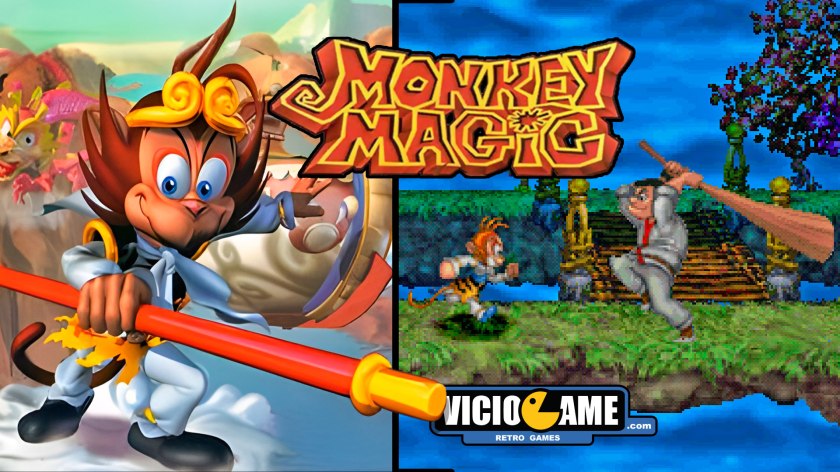
Monkey Magic is an action-platformer released in 1999 for the PlayStation. A being born from a meteor that crashed on Earth embarks on a journey to obtain elemental powers, challenging celestial armies and the villainous Lord of Chaos to save the universe.
Developer: Mpen
Publisher: SunSoft
Release date: 1999
Platform: Sony PlayStation
Monkey Magic: The Ultimate Guide
Monkey Magic is an action-platformer game developed by Mpen for the PlayStation, released on November 27, 1999 in the United States and on July 13, 2000 in Europe. Sunsoft handled both publishing and promotional support for the title. It was released with an E rating (suitable for all ages), with a warning for “Animated Violence”. The game is based on the anime series of the same name that premiered in September 1998 in the United States, airing until December of that year, with reruns continuing until September 1999.
The animated series, in turn, is essentially a very loose and simplified adaptation of “Journey to the West”, one of the four great classical novels of Chinese literature, written in the 16th century by Wu Cheng’en. The original story is an epic fantasy about the adventures of Sun Wukong (the Monkey King) accompanying the Buddhist monk Tang Sanzang on his journey to India to obtain sacred scriptures. The novel has been adapted countless times across various media, including films, TV series, comics, and games. The PlayStation version is one of many Western adaptations that attempted to bring this story to a non-Asian audience, albeit with significant simplifications and cultural changes.
The television version had an international production involving Japan and the United States, with distribution in the U.S. by Sachs Family Entertainment. In Japan it aired on TV Tokyo from December 31, 1999 to March 25, 2000, therefore after the American release. Bandai Entertainment released the series on VHS and DVD in the United States in mid-1999. The animation mixed traditional cels with computer-generated CGI for large landscapes and some creatures and characters, a technique still experimental for that time.
The game’s plot follows Kongo, the Stone Monkey, who was born from a meteorite that fell to Earth near Flower Fruit Mountain. The narrative establishes that since the dawn of time, the Celestial Heavens have been home to powerful beings who seek to create balance and peace throughout the universe. However, evil always exists where there is good. Dearth Voyd, the Lord of Chaos, strives to bring war and violence to the universe. These two forces have been in eternal conflict, with each being equal to the other, never gaining ground and never truly winning the war, until the Stone Monkey Kongo emerged.
Exploding from the sky, the meteorite strikes Earth. From the flaming wreckage emerges the Stone Monkey, Kongo. As soon as he realized where he was, he was made leader of the monkey tribe. Unbeknownst to him, Dearth Voyd saw in Kongo a power that could tip the scales in his favor. While the Lords of Chaos wanted him as an ally, the gods of the Celestial Heavens viewed Kongo as a threat. Never asking for his friendship, they decided to destroy him. At first, Kongo walks the dark path, but deep in his heart he realizes this is wrong. Now he is on the path to obtain divine power and right the wrongs. Unfortunately, besides having to deal with the Celestial Heavens, he must also face the Lords of Chaos.
Kongo’s journey begins alone, without family or friends, hungry and with the responsibility of saving the universe. The player must guide Kongo through more than 30 stages of complex puzzles and dangerous traps. The game structure is divided into large areas, each subdivided into multiple smaller sections or stages. Along the way, Kongo must collect crucial items like the Power Rod, the Jet Cloud, and, hopefully, the Divine Power. Kongo is trapped in the middle of the war between the chaotic Dearth Voyd and the powerful Celestial Gods, and which side he will choose and how powerful he can become depends on the player’s actions.
Monkey Magic is fundamentally a 2D side-scrolling platformer, but it incorporates RPG elements and 3D mechanics in certain sections. One of the game’s unique and most innovative features is the ability to switch between three planes of depth: foreground, middle ground, and background in some sections. This mechanic adds a three-dimensional layer to traditional 2D platforming gameplay, allowing Kongo to move forward and backward in the scenery, creating spatial puzzles that require strategic thinking about positioning and depth.
The game’s control system uses practically every button on the PlayStation controller. The square button is used to attack, allowing Kongo to execute basic martial arts moves with punches and kicks. The R2 and L2 buttons are used to cycle through the different available spells, functioning as a cyclical selection system. The L1 button allows the player to use magic on himself, while R1 fires the magic as a projectile against enemies. The circle button allows Kongo to look around, useful for examining the environment and planning movements. The triangle button has a dual function: skipping dialogue during cutscenes and using collected items. The X button is used to jump, and by pressing X twice consecutively, Kongo executes a double jump, essential for reaching higher platforms. The directional pad is used for basic movement, including walking, crouching, and standing.
When Kongo crouches, the player doesn’t need to hold down the directional button, just press it once and he remains crouched, requiring the player to press up to make him stand again. This can lead to problems in tricky situations where quick reactions are needed. The controls, while functional, are not the most precise, especially when it comes to jumping on small platforms or quickly switching and using spells, which can result in frustrating deaths.
At the beginning of the game, Kongo possesses only his martial arts abilities to defend himself, executing basic melee combat attacks. Early in his journey, he meets Master Subodye (also spelled as Subodeye or Subodai), a wise figure who becomes his master and teacher. Master Subodye teaches Kongo the four elemental powers that form the core of the gameplay mechanics: Shrink, Grow, Fire, and Ice.
The magic system is what sets Monkey Magic apart from other platformers of its era. Kongo learns to cast these spells both on himself and on enemies, with varying effects depending on the target. This versatility forms the basis for many of the game’s puzzles. For example, if Kongo encounters an area he can’t pass through, not even by crawling, he can simply shrink himself using the Shrink magic. However, if the player doesn’t make it to the other side before the spell wears off, Kongo will be crushed when he returns to normal size. If Kongo catches fire from some enemy or trap, the player can simply cast Ice on himself to cancel the effect. But doing this without reason or by mistake leaves Kongo vulnerable, as an enemy can destroy him in a single hit while he’s frozen. On the other hand, freezing enemies can be a great way to avoid them or kill them in a single hit.
The spells have limited duration before wearing off, requiring the player to cast them again or use the opposite magic to cancel the previous effect. This mechanic of using opposing magics to cancel effects adds a strategic layer to combat and puzzle solving. At the beginning of the game, Kongo has only a handful of magic charges, and the spells last only a short period of time. Careful management of magic use is crucial in the early stages, but as the game progresses, Kongo becomes more powerful.
Throughout his journey, Kongo acquires special items that increase his capabilities. The Power Rod is a significant weapon that Kongo obtains, a direct reference to the famous Ruyi Jingu Bang of the Monkey King in the original novel “Journey to the West”, a magic staff stolen from the Dragon King’s Palace. In the game, the only time the player can effectively use the Power Rod is by jumping in the air and attacking twice, which makes Kongo enter a wild spinning maneuver that is powerful but uncontrollable. Once the rotation is finished, Kongo becomes dizzy and unable to perform another feat until he recovers, leaving him completely vulnerable for a short period. Pressing the attack button twice in the air by mistake can spell disaster when you’re trying to carefully navigate moving platforms while also fighting flying enemies.
The Jet Cloud is another important item that Kongo acquires, allowing him to fly or glide over greater distances. This is a reference to the magical cloud Jindouyun that the Monkey King uses in the original story to travel great distances. The Pearl of Life is a particularly significant item that Kongo obtains later in the journey. After gaining the Pearl of Life, extra lives become infinite, dramatically transforming the game’s difficulty. By the fourth stage, Kongo will have infinite magic power and infinite lives, making the rest of the game significantly easier and almost impossible to lose.
The collectible item system includes fruits that function as health recovery, being Kongo’s primary method of restoring life points during stages. Extra lives are represented by peculiar-looking monkey heads, and each time the player collects an extra life (which happens approximately every two minutes), you hear a choir of women stereotypically sounding like an African-American gospel church choir screaming “MONNNNKKAAAAYYYYYY!!” This sound effect has become one of the criticized aspects of the game, as something that ranges from funny to extremely annoying after hundreds of repetitions throughout the countless stages. Extra lives are generously distributed throughout the game, which at first glance seems like too much, but soon the player discovers they may need many of them to reach the end of each stage, especially in the initial areas before obtaining the Pearl of Life.
Keys are needed to open locked doors, levers must be pulled to activate mechanisms, and there are various other items scattered throughout the game world. The progression structure involves collecting these items while navigating through complex mazes filled with traps and enemies.
Kongo is assisted from the beginning by Batty, a secondary character from the underworld who appears in cutscenes and offers advice and explanations about the game mechanics when the player gets stuck. Batty functions as a tutorial guide, explaining new elements and offering tips. However, after the first half of the game, Batty is revealed to be working for the evil Dearth Voyd, betraying Kongo. This narrative twist adds drama to the story and establishes Batty as a secondary antagonist. But Kongo will put an end to Dearth Voyd’s evil plans.
The game’s dialogue is fully voice-acted, an impressive feature for a 1999 platformer. The voice acting quality was widely praised, with talented actors bringing the characters to life. The Saturday morning cartoon style of Monkey Magic is perfectly reflected in the game, whether in the animated cutscenes or the vivid 2D sprites. The cutscenes contain talking pictures, featuring the characters in cartoon style with complete dialogue.
These interludes establish the narrative and introduce new characters throughout the journey. Among the mentioned characters are Master Subodai (the wise master), Lady White Bone (a villainess), Princess Iron Fan (a benevolent ally), and Pigsy (another formidable ally). However, many characters that appear in the original animated series are never seen in the game, as the game selectively adapted elements from the anime instead of faithfully following all episodes and characters.
The enemy cast is varied and creative. The official description promises a huge range of enemies, including living boogers, vampire bats, spitting fish, and hammer-wielding demons. Each enemy type presents different attack patterns and requires specific strategies to be defeated. Slime Lord is a large boss, a giant eel who prides himself on being the number 1 chef under Dearth Voyd’s command, demonstrating that the game’s bosses have distinct personalities and thematic designs.
Each combat is a true test of button-mashing patience. Enemies are encountered throughout the stages, sometimes trying to block Kongo’s progress, but the combat system is not particularly deep or refined. Enemies feel more like obstacles in the way than opponents truly designed to be defeated. The game’s emphasis is clearly on puzzles and platforming rather than complex combat.
Traps are abundant in the game and represent the biggest draw for playing: figuring out ways to get past these traps using magical powers. The player will constantly die from traps until discovering the proper use of magic, sometimes in combination, to overcome them. Traps range from spikes, moving platforms, crushing areas, fire, ice, poison, and various other environmental hazards that require precise timing and intelligent use of magic to navigate safely.
The puzzles in Monkey Magic range from simple to ingenious, but they are always fun. Surprisingly, some of the puzzles in the game require more thought than expected, which is strange given the juvenile nature of the game. Strange, but fun. Since the game is relatively simple, having a puzzle to change things up provides a pleasant shift. Puzzles can involve using specific spells on yourself or on environmental objects, activating levers in the correct order, navigating through multi-plane depth sections, shrinking to pass through tight spaces, freezing water to create platforms, burning obstacles, and many other creative mechanics.
The environments feature lush landscapes, including mountain waterfalls and rugged jungle terrain. The scenery is full of hidden secrets, collectible treasures, and environmental puzzles. Discovering new areas and unlocking exclusive rewards makes each playthrough of Monkey Magic a treasure for explorers.
The 2D sprites are vivid and colorful, but the overall quality of the visual presentation was hampered by a limited budget and restricted development time. The animated cutscenes are more impressive than the gameplay itself, using a cartoon style that captures the spirit of the animated series well. The implementation of 3D effects is not particularly impressive by the standards of the time.
The sound presentation of Monkey Magic is one of the most polarizing aspects of the game. The soundtrack delivers exotic melodies and rhythms from the Orient, with music ranging from cheerful and playful melodies in lighter moments to intense and dramatic scores during boss battles. Despite the opening theme music being quite praised, the game’s music is criticized for not being impressive or memorable at all. The sound effects are crisp and adequate, improving immersion by adding weight to each jump, swing, and magic attack.
To avoid religious implications, Buddha was renamed as “The Guardian” in both the animated series and the game. He represents the supreme power of the universe, equivalent to the Tathagata Buddha of the original story. Other important characters include Lady Blossom, the incarnation of Bodhisattva Guanyin, an important entity during the journey. Dearth Voyd is presented as similar to the Devil, given his desire to destroy the Guardian’s teachings and his deep hatred for everything that is good. He resides in an area of the underworld within a large castle-like area with a rotating sun-like blade behind him.
The legacy of Monkey Magic is that of a cult game, appreciated by a small but dedicated fan base that recognizes its unique qualities despite its obvious flaws. Players who can look past the dated graphics, forgettable background music, and occasionally irritating voice acting find a platformer with interesting puzzle mechanics, a versatile magic system, and satisfying progression. For collectors of obscure PlayStation games and fans of 2D platformers with hints of RPG, this title represents an interesting curiosity from the 32-bit era.
Both the anime and the game did not sell well, despite their merits. The lack of support and advertising from Bandai contributed significantly to the commercial failure. The fact that Sunsoft made the game instead of Bandai demonstrates the company’s negligence regarding the project. The title never received a sequel, despite the “To Be Continued” message at the end. Sunsoft never returned to the property, and Bandai continued to ignore the existence of both the animated series and the game. There have been no re-releases on modern platforms, remasters, or compilations, making the original PlayStation disc the only way to play the game legally.
This remains a fascinating example of how media adaptations can produce unexpected results. Although it did not achieve commercial success or mainstream recognition, the game possesses unique characteristics that distinguish it from other platformers of its era. For those willing to forgive its technical and presentation imperfections, Monkey Magic offers a solid gameplay experience that echoes the epic journey of its source material.
Monkey Magic: O Guia Definitivo
Monkey Magic é um jogo de ação e plataforma desenvolvido pela Mpen para o PlayStation, lançado em 27 de novembro de 1999 nos Estados Unidos e em 13 de julho de 2000 na Europa. A Sunsoft assumiu tanto a publicação quanto o suporte promocional do título. Foi lançado sob a classificação E (adequado para todas as idades), com advertência de “Violência Animada”. O jogo é baseado na série de anime homônima que estreou em setembro de 1998 nos Estados Unidos, transmitida até dezembro do mesmo ano, com reprises durando até setembro de 1999.
A série animada, por sua vez, é essencialmente uma adaptação muito livre e simplificada de “Jornada ao Oeste”, um dos quatro grandes romances clássicos da literatura chinesa, escrito no século XVI por Wu Cheng’en. A história original é uma fantasia épica sobre as aventuras de Sun Wukong (o Rei Macaco) acompanhando o monge budista Tang Sanzang em sua jornada à Índia para obter escrituras sagradas. O romance tem sido adaptado inúmeras vezes em diversas mídias, incluindo filmes, séries de TV, quadrinhos e jogos. A versão para PlayStation é uma das muitas adaptações ocidentais que tentaram trazer esta história para um público não-asiático, embora com simplificações significativas e mudanças culturais.
A versão televisiva teve uma produção internacional envolvendo Japão e Estados Unidos, com distribuição nos EUA pela Sachs Family Entertainment. No Japão foi transmitida pela TV Tokyo de 31 de dezembro de 1999 a 25 de março de 2000, portanto após o lançamento americano. A Bandai Entertainment lançou a série em VHS e DVD nos Estados Unidos em meados de 1999. A animação misturava células tradicionais com CGI gerado por computador para paisagens grandes e algumas criaturas e personagens, uma técnica ainda experimental para a época.
O enredo do jogo segue Kongo, o Macaco de Pedra, que nasceu de um meteorito que caiu na Terra próximo à Flower Fruit Mountain. A narrativa estabelece que desde o alvorecer dos tempos, os Céus Celestiais têm sido o lar de seres poderosos que buscam criar equilíbrio e paz em todo o universo. No entanto, o mal sempre existe onde há o bem. Dearth Voyd, o Senhor do Caos, esforça-se para trazer guerra e violência ao universo. Essas duas forças têm estado em conflito eterno, com cada uma sendo igual à outra, nunca ganhando terreno e nunca realmente vencendo a guerra, até que o Macaco de Pedra Kongo surgiu.
Explodindo do céu, o meteorito atinge a Terra. Dos destroços flamejantes emerge o Macaco de Pedra, Kongo. Assim que percebeu onde estava, foi feito líder da tribo de macacos. Sem que ele soubesse, Dearth Voyd viu em Kongo um poder que poderia inclinar a balança a seu favor. Enquanto os Lordes do Caos o queriam como aliado, os deuses dos Céus Celestiais viam Kongo como uma ameaça. Nunca pedindo sua amizade, eles decidem destruí-lo. No início, Kongo percorre o caminho obscuro, mas no fundo de seu coração percebe que isso está errado. Agora ele está no caminho para obter poder divino e corrigir os erros. Infelizmente, além de ter que lidar com os Céus Celestiais, ele também deve enfrentar os Lordes do Caos.
A jornada de Kongo começa sozinho, sem família ou amigos, faminto e com a responsabilidade de salvar o universo. O jogador deve guiar Kongo através de mais de 30 fases de quebra-cabeças complexos e armadilhas perigosas. A estrutura de jogo é dividida em grandes áreas, cada uma subdividida em múltiplas seções ou fases menores. Ao longo do caminho, Kongo deve coletar itens cruciais como o Power Rod, a Jet Cloud e, esperançosamente, o Divine Power. Kongo está preso no meio da guerra entre o caótico Dearth Voyd e os poderosos Deuses Celestiais, e qual lado ele escolherá e quão poderoso ele pode se tornar depende das ações do jogador.
Monkey Magic é fundamentalmente um jogo de plataforma 2D com rolagem lateral, mas incorpora elementos de RPG e mecânicas 3D em certas seções. Uma das características únicas e mais inovadoras do jogo é a capacidade de alternar entre três planos de profundidade: primeiro plano, plano médio e plano de fundo em algumas seções. Esta mecânica adiciona uma camada tridimensional à jogabilidade tradicional de plataforma 2D, permitindo que Kongo se mova para frente e para trás no cenário, criando puzzles espaciais que exigem pensamento estratégico sobre posicionamento e profundidade.
O sistema de controle do jogo utiliza praticamente todos os botões do controle do PlayStation. O botão quadrado é usado para atacar, permitindo que Kongo execute movimentos de artes marciais básicas com socos e chutes. Os botões R2 e L2 são usados para alternar entre as diferentes magias disponíveis, funcionando como um sistema de seleção cíclica. O botão L1 permite que o jogador use a magia em si mesmo, enquanto R1 dispara a magia como um projétil contra inimigos. O botão círculo permite que Kongo olhe ao redor, útil para examinar o ambiente e planejar movimentos. O botão triângulo tem dupla função: pular diálogos durante as cutscenes e usar itens coletados. O botão X é utilizado para pular, e ao pressionar X duas vezes consecutivamente, Kongo executa um salto duplo, essencial para alcançar plataformas mais altas. O direcional é usado para movimento básico, incluindo andar, agachar e ficar de pé.
Quando Kongo se agacha, o jogador não precisa manter o botão direcional para baixo pressionado, apenas pressionar uma vez e ele permanece agachado, sendo necessário pressionar para cima para levantá-lo novamente. Isso pode levar a problemas em situações complicadas onde reações rápidas são necessárias. Os controles, embora funcionais, não são os mais precisos, especialmente quando se trata de pular em plataformas pequenas ou alternar e usar magias rapidamente, podendo resultar em mortes frustrantes.
No início do jogo, Kongo possui apenas suas habilidades de artes marciais para se defender, executando ataques básicos de combate corpo a corpo. Logo no início de sua jornada, ele encontra Master Subodye (também grafado como Subodeye ou Subodai), uma figura sábia que se torna seu mestre e professor. Master Subodye ensina a Kongo os quatro poderes elementais que formam o núcleo das mecânicas de gameplay: Shrink, Grow, Fire e Ice.
O sistema de magia é o que diferencia Monkey Magic de outros jogos de plataforma da época. Kongo aprende a conjurar esses feitiços tanto em si mesmo quanto nos inimigos, com efeitos variados dependendo do alvo. Essa versatilidade forma a base para muitos dos quebra-cabeças do jogo. Por exemplo, se Kongo encontra uma área pela qual não consegue passar, nem mesmo rastejando, ele pode simplesmente encolher-se usando a magia Shrink. No entanto, se o jogador não chegar ao outro lado antes que o feitiço se desgaste, Kongo será esmagado ao voltar ao tamanho normal. Se Kongo pegar fogo por algum inimigo ou armadilha, o jogador pode simplesmente conjurar Ice em si mesmo para cancelar o efeito. Mas fazer isso sem motivo ou por engano deixa Kongo vulnerável, pois um inimigo pode destruí-lo em um único golpe enquanto está congelado. Por outro lado, congelar inimigos pode ser uma ótima maneira de evitá-los ou matá-los em um único golpe.
Os feitiços têm duração limitada antes de se desgastarem, exigindo que o jogador os conjure novamente ou use a magia oposta para fazer com que o efeito anterior seja cancelado. Esta mecânica de usar magias opostas para cancelar efeitos adiciona uma camada estratégica ao combate e resolução de puzzles. No início do jogo, Kongo possui apenas um punhado de cargas mágicas, e os feitiços duram apenas um curto período de tempo. O gerenciamento cuidadoso do uso de magia é crucial nas primeiras fases, mas conforme o jogo progride, Kongo se torna mais poderoso.
Ao longo de sua jornada, Kongo adquire itens especiais que aumentam suas capacidades. O Power Rod é uma arma significativa que Kongo obtém, uma referência direta ao famoso Ruyi Jingu Bang do Rei Macaco no romance original “Jornada ao Oeste”, um bastão mágico roubado do Palácio do Rei Dragão. No jogo, o único momento em que o jogador consegue usar efetivamente o Power Rod é pulando no ar e atacando duas vezes, o que faz Kongo entrar em uma manobra de giro selvagem que é poderosa mas incontrolável. Uma vez terminada a rotação, Kongo fica tonto e incapaz de realizar outra façanha até se recuperar, deixando-o totalmente vulnerável por um curto período. Pressionar o botão de ataque duas vezes no ar por engano pode significar desastre quando se está tentando navegar cuidadosamente em plataformas móveis enquanto também luta contra inimigos voadores.
A Jet Cloud é outro item importante que Kongo adquire, permitindo-lhe voar ou planar por distâncias maiores. Esta é uma referência à nuvem mágica Jindouyun que o Rei Macaco usa na história original para viajar grandes distâncias. A Pearl of Life é um item particularmente significativo que Kongo obtém posteriormente na jornada. Após ganhar a Pearl of Life, as vidas extras tornam-se infinitas, transformando dramaticamente a dificuldade do jogo. Pela quarta fase, Kongo terá poder mágico infinito e vidas infinitas, tornando o restante do jogo significativamente mais fácil e quase impossível de perder.
O sistema de itens colecionáveis inclui frutas que funcionam como recuperação de saúde, sendo o principal método de Kongo restaurar pontos de vida durante as fases. As vidas extras são representadas por cabeças de macaco com aparência peculiar, e cada vez que o jogador coleta uma vida extra (o que acontece aproximadamente a cada dois minutos), ouve-se um coro de mulheres estereotipadamente soando como um coral de igreja gospel afro-americana gritando “MONNNNKKAAAAYYYYYY!!” Este efeito sonoro tornou-se um dos aspectos criticados do jogo, como algo que varia de engraçado a extremamente irritante após centenas de repetições ao longo das inúmeras fases. As vidas extras são distribuídas generosamente pelo jogo, o que à primeira vista parece demais, mas logo o jogador descobre que pode precisar de muitas delas para alcançar o fim de cada fase, especialmente nas áreas iniciais antes de obter a Pearl of Life.
Chaves são necessárias para abrir portas trancadas, alavancas devem ser puxadas para ativar mecanismos, e há diversos outros itens espalhados pelo mundo do jogo. A estrutura de progressão envolve coletar esses itens enquanto navega por labirintos complexos cheios de armadilhas e inimigos.
Kongo é assistido desde o início por Batty, um personagem secundário do submundo que aparece em cutscenes e oferece conselhos e explicações sobre as mecânicas do jogo quando o jogador fica preso. Batty funciona como um guia tutorial, explicando novos elementos e oferecendo dicas. No entanto, após a primeira metade do jogo, Batty é revelado como trabalhando para o malévolo Dearth Voyd, traindo Kongo. Esta reviravolta narrativa adiciona drama à história e estabelece Batty como um antagonista secundário. Mas Kongo colocará um fim aos planos malignos de Dearth Voyd.
Os diálogos do jogo são totalmente dublados, uma característica impressionante para um jogo de plataforma de 1999. A qualidade da dublagem foi amplamente elogiada, com atores talentosos dando vida aos personagens. O estilo de sábado de manhã de desenho animado de Monkey Magic é perfeitamente refletido no jogo, seja nas cutscenes animadas ou nos sprites 2D vívidos. As cutscenes contêm imagens falantes, apresentando os personagens em estilo cartoon com diálogos completos.
Estes interlúdios estabelecem a narrativa e apresentam novos personagens ao longo da jornada. Entre os personagens mencionados estão Master Subodai (o sábio mestre), Lady White Bone (uma vilã), Princess Iron Fan (uma aliada benevolente) e Pigsy (outro aliado formidável). No entanto, muitos personagens que aparecem na série animada original nunca são vistos no jogo, pois o jogo adaptou seletivamente elementos do anime em vez de seguir fielmente todos os episódios e personagens.
O elenco de inimigos é variado e criativo. A descrição oficial promete uma gama enorme de inimigos, incluindo melecas vivas, morcegos vampiros, peixes cuspidores e demônios com martelos. Cada tipo de inimigo apresenta padrões de ataque diferentes e requer estratégias específicas para serem derrotados. Slime Lord é um grande chefe, um enguia gigante que se orgulha de ser o cozinheiro número 1 sob comando de Dearth Voyd, demonstrando que os chefes do jogo têm personalidades distintas e designs temáticos.
Cada combate é um verdadeiro teste de paciência de apertar botões. Os inimigos são encontrados ao longo das fases, às vezes tentando bloquear o progresso de Kongo, mas o sistema de combate não é particularmente profundo ou refinado. Os inimigos parecem mais obstáculos no caminho do que oponentes realmente pensados para derrotar. A ênfase do jogo está claramente nos puzzles e plataformas em vez de combate complexo.
As armadilhas são abundantes no jogo e representam o maior atrativo para jogar: elaborar maneiras de passar por essas armadilhas usando os poderes mágicos. O jogador morrerá constantemente de armadilhas até descobrir o uso adequado da magia, às vezes em combinação, para superá-las. As armadilhas variam de espinhos, plataformas móveis, áreas que esmagam, fogo, gelo, veneno e diversos outros perigos ambientais que exigem timing preciso e uso inteligente de magia para navegar com segurança.
Os puzzles em Monkey Magic variam de simples a engenhosos, mas são sempre divertidos. Surpreendentemente, alguns dos puzzles no jogo requerem mais pensamento do que o esperado, o que é estranho dada a natureza juvenil do jogo. Estranho, mas divertido. Como o jogo é relativamente simples, ter um puzzle para mudar as coisas proporciona uma mudança agradável. Os puzzles podem envolver usar magias específicas em si mesmo ou em objetos do ambiente, ativar alavancas na ordem correta, navegar através de seções de múltiplos planos de profundidade, encolher-se para passar por espaços apertados, congelar água para criar plataformas, queimar obstáculos, e muitas outras mecânicas criativas.
Os ambientes possuem paisagens exuberantes, incluindo cachoeiras de montanha e terreno de selva acidentado. Os cenários são cheios de segredos escondidos, tesouros colecionáveis e quebra-cabeças ambientais. Descobrir novas áreas e desbloquear recompensas exclusivas faz de cada partida de Monkey Magic um tesouro para exploradores.
Os sprites 2D são vívidos e coloridos, mas a qualidade geral da apresentação visual foi prejudicada por um orçamento limitado e tempo de desenvolvimento restrito. As cutscenes animadas são mais impressionantes do que o gameplay em si, utilizando um estilo cartoon que captura bem o espírito da série animada. A implementação dos efeitos 3D não é particularmente impressionante pelos padrões da época.
A apresentação sonora de Monkey Magic é um dos aspectos mais polarizadores do jogo. A trilha sonora entrega melodias e ritmos exóticos do oriente, com a música variando de melodias alegres e brincalhonas em momentos mais leves a partituras intensas e dramáticas durante as batalhas contra chefes. Apesar da música tema de abertura ser bastante elogiada, a música do jogo é criticada por não ser nada impressionante ou marcante. Os efeitos sonoros são nítidos e adequados, melhorando a imersão ao adicionar peso a cada pulo, balanço e ataque mágico.
Para evitar implicações religiosas, o Buda foi renomeado como “The Guardian” tanto na série animada quanto no jogo. Ele representa o poder supremo do universo, equivalente ao Tathagata Buddha da história original. Outros personagens importantes incluem Lady Blossom, a encarnação da Bodhisattva Guanyin, uma entidade importante durante a jornada. Dearth Voyd é apresentado como similar ao Diabo, dado seu desejo de destruir os ensinamentos do Guardian e seu profundo ódio por tudo que é bom. Ele reside em uma área do submundo dentro de uma grande área semelhante a um castelo com uma lâmina giratória semelhante ao sol atrás dele.
O legado de Monkey Magic é o de um jogo cult, apreciado por uma pequena mas dedicada base de fãs que reconhece suas qualidades únicas apesar de suas falhas evidentes. Jogadores que conseguem olhar além dos gráficos datados, da música de fundo esquecível e da dublagem ocasionalmente irritante encontram um jogo de plataforma com mecânicas de puzzle interessantes, um sistema de magia versátil e uma progressão satisfatória. Para colecionadores de jogos obscuros do PlayStation e fãs de jogos de plataforma 2D com pitadas de RPG, este título representa uma curiosidade interessante da era de 32 bits.
Tanto o anime quanto o jogo não venderam bem, apesar de seus méritos. A falta de suporte e publicidade da Bandai contribuiu significativamente para o fracasso comercial. O fato de a Sunsoft ter feito o jogo em vez da Bandai, demonstra o descaso da empresa no projeto. O título nunca recebeu uma sequência, apesar da mensagem “To Be Continued” no final. A Sunsoft não retornou à propriedade, e a Bandai continuou a ignorar a existência tanto da série animada quanto do jogo. Não houve relançamentos em plataformas modernas, remasters ou compilações, tornando o disco original do PlayStation a única maneira de jogar o jogo legalmente.
Este permanece como um exemplo fascinante de como adaptações de mídia podem produzir resultados inesperados. Embora não tenha alcançado sucesso comercial ou reconhecimento mainstream, o jogo possui características únicas que o distinguem de outros jogos de plataforma da época. Para aqueles dispostos a perdoar suas imperfeições técnicas e de apresentação, Monkey Magic oferece uma experiência de gameplay sólida que ecoa a jornada épica de seu material original.
🤑💲Earn money without doing anything! Just leave the Honeygain app open: https://r.honeygain.me/CONTA9DB02
🤑💲1-Click button earns Bitcoin every 1 hour: https://freebitco.in/?r=53528449
⬛ 𝗧𝗶𝗸𝗧𝗼𝗸: https://www.tiktok.com/@viciogame
🟧 𝗜𝗻𝘀𝘁𝗮𝗴𝗿𝗮𝗺: http://www.instagram.com/viciogame
🟥 𝗬𝗼𝘂𝘁𝘂𝗯𝗲: http://www.youtube.com/viciogame
🟦 𝗙𝗮𝗰𝗲𝗯𝗼𝗼𝗸: http://www.facebook.com/viciogame
🔳 𝗧𝗵𝗿𝗲𝗮𝗱𝘀: https://www.threads.net/@viciogame
🟪 𝗧𝘄𝗶𝘁𝗰𝗵: https://www.twitch.tv/ViciogameRetroGames
🟨 𝗕𝗹𝗼𝗴: http://www.viciogameblog.com/
🟦𝗧𝘄𝗶𝘁𝘁𝗲𝗿: http://www.twitter.com/viciogame
#Viciogame #Gameplay #LetsPlay #Gamer #Playthrough #Games #News #Videogames #Review #Game #Detonado #Walkthrough #Ending #Reviews #Facts #Retro #Record #Roms #Emulator #Longplay #Speedrun #MonkeyMagic #PlayStation #Sony #Mpen #SunSoft #Monkey #blackmyth #wukong #PSX #PsOne #Play1 #PS #PS1 #PS2 #PS3 #PS4 #PS5 #プレイステーション #ソニー #モンキーマジック #JourneyToTheWest #西遊記 #SunWukong
 VICIOGAME