
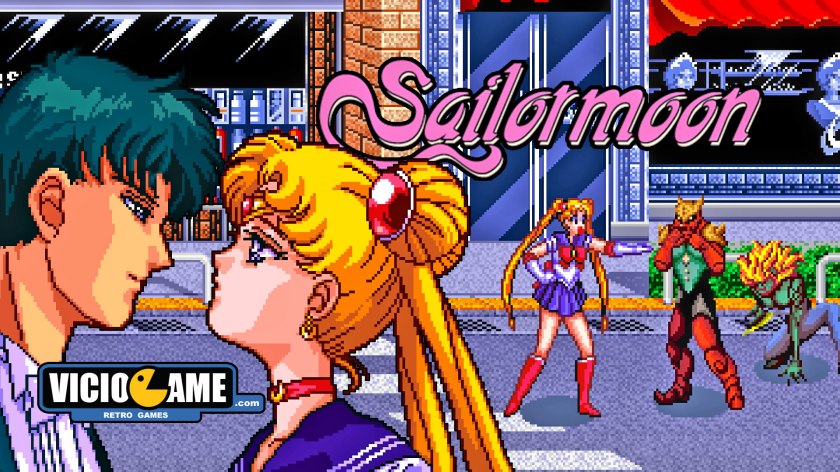
Bishoujo Senshi Sailor Moon, from 1994, complete gameplay.
Developer: Angel Studios
Publisher: Bandai
Super Nintendo / Super Famicom version.
Bishoujo Senshi Sailor Moon: The Ultimate Guide
The cultural phenomenon that is Sailor Moon transcended the pages of manga and television screens to also conquer the world of video games. In a golden era for 16-bit consoles, the arrival of the lunar warriors to the Super Nintendo represented an unforgettable encounter for fans of the series and beat ‘em up genre enthusiasts. This game style, characterized by frantic side-scrolling action where one or two players face waves of enemies in diverse scenarios, found in Sailor Moon an adaptation that captured the magical essence of the franchise.
Released in Japan on August 27, 1993, by developer Angel, with the original Japanese title of Bishoujo Senshi Sailor Moon, the game quickly became a coveted item for SNES owners. Later, in November 1994, Bandai published the game in France and Spain, under the title Sailor Moon in France, marking one of the few official international releases of a Sailor Moon game for home consoles of that era.
The difference of more than a year between the Japanese and European releases suggests an initial market strategy focused on the domestic audience, where Sailor Moon’s popularity was undeniable. Bandai’s decision to publish the game in France and Spain occurred due to distribution partnerships and a specific licensing agreement for those European regions, demonstrating recognition of the franchise’s market potential beyond Japan. This made the title more accessible to Western fans at the time, who often depended on imports to play anime adaptations of their favorite games.
The narrative faithfully follows the events of the first season of the acclaimed anime, which in turn adapts the first arc of the original manga by Naoko Takeuchi. Players are transported to the world of Usagi Tsukino and her friends, the Sailor Soldiers, in their relentless fight against the forces of evil that threaten peace on Earth.
The main plot revolves around the epic confrontation between the five original Sailor Soldiers and the antagonists of the Dark Kingdom, a nefarious organization led by the fearsome Queen Beryl. The story has its roots in a distant past, when Queen Serenity, sovereign of the Moon Kingdom, sensing a great threat, sends her beloved daughter, Princess Serenity, along with her loyal protectors – Sailors Mercury, Mars, Jupiter, and Venus – and her only love, Prince Darien (Mamoru) of Earth, to be reborn in a distant future, where they would again be needed to save the world from an evil force known as the Negaforce. Fast-forwarding to current times, the prophecy materializes with the return of Queen Beryl, who ambitions to dominate Earth. To achieve her dark objectives, she counts on the help of her powerful generals, the monstrous Zoicite and Malachite, in addition to having under her control a Prince who suffered a terrible brainwashing. The Sailor Soldiers’ journey culminates in a decisive battle in the heart of the Dark Kingdom, where the planet’s fate will be sealed in a final confrontation against Queen Beryl herself.
The decision to keep the narrative strictly tied to the anime’s first season certainly provided a strong dose of nostalgia for fans who followed the series from its beginning. The inclusion of prominent villains from this initial arc, such as Beryl’s generals, the corrupted Prince Darien, and Queen Beryl herself, reinforces this emotional connection with the original story, allowing players to experience in interactive format the crucial moments that marked the beginning of the Sailor Moon saga.
Players have the opportunity to take control of one of the five original Sailor Soldiers, each with their own characteristics and distinct combat abilities. This variety allows fans of the series to choose their favorite lunar warrior and experience the gameplay from different perspectives.
The series’ protagonist, Sailor Moon (Usagi Tsukino), is a heroine recognized for her long blonde pigtails and is described as a balanced character, ideal for players seeking a complete experience. Her iconic special attack is the “Moon Tiara Action,” where she hurls her tiara against enemies. Sailor Mercury (Ami Mizuno), with her short brown hair, is the brilliant mind of the group. She stands out for being the fastest of the five, although she has the shortest range in her attacks. Her special attack is the “Shabon Spray,” a fog of bubbles that can confuse her opponents. Sailor Mars (Rei Hino), with her long brown hair, is a passionate character and her attacks are predominantly fire-based. Her special attack is known as “Fireballs Charge” or “Fire Soul,” where she releases powerful flames against her adversaries. Sailor Jupiter (Makoto Kino), with her characteristic brown ponytail, is the team’s brute force, possessing the most powerful physical attacks among the playable characters. Her special attack is the “Thunder Clap” or “Supreme Thunder,” a devastating lightning bolt that strikes her enemies. Finally, Sailor Venus (Minako Aino), the other blonde of the group, uses a golden chain in battle, which gives her greater range than the others. Her special attack is the elegant “Crescent Beam,” a crescent-shaped light beam.
In addition to their unique special attacks, each Sailor Soldier possesses a set of basic moves that include punches, kicks, and the ability to throw enemies. The game also incorporates a charged special attack system, activated by holding the Y button, and a more powerful power attack, executed by simultaneously pressing the Y and B buttons, which consumes a small portion of the character’s life bar. The diversity of playable characters, each with their distinct strengths and weaknesses, not only reflects the unique personalities of the Sailor Soldiers but also enriches the gameplay, encouraging players to experiment with different fighting styles and, consequently, increasing the game’s replay value.
It’s important to contextualize the game within the panorama of other franchise adaptations for video games. An important comparison is with the version released for the Sega Mega Drive in 1994. Both versions share the same beat ‘em up genre and a similar general execution, with players controlling one of the five Sailor Soldiers in their fight against the forces of evil.
However, despite the similarities, there are significant differences between the versions. One of the most noticeable distinctions is in speed: the Mega Drive version operates at a considerably faster pace, which can provide a more agile and dynamic experience. In contrast, the level design tends to vary quite a bit between the two platforms. Regarding the soundtrack and sound effects, the Super Nintendo version is superior. The impact sound effects on Sega’s console are insignificant. Another advantage of the SNES version is the inclusion of a cooperative mode for two players.
A controversial aspect is the censorship present in the international version on Nintendo’s device compared to the Japanese Mega Drive version. This censorship manifests mainly in the characters’ transformation scenes. The SNES version doesn’t include the introduction sequence that appears after the theme music in the competing version. Additionally, the silhouettes of the naked characters during transformation were altered, with modifications for Sailor Mercury (Ami), where the pose was adjusted to not show her buttocks, Sailor Jupiter (Makoto), whose breasts were reduced, and Sailor Mars (Rei), who had her posture and some curves removed. Regarding the final bosses, the Mega Drive version presents all four of Beryl’s generals in the ultimate confrontation.
The Sailor Moon franchise also saw adaptations for other platforms of the era, such as Game Boy, TurboGrafx-CD, Game Gear, arcades, Windows, and Nintendo DS. The existence of multiple versions for a variety of platforms is a testament to the franchise’s enormous popularity during the 90s and developers’ attempt to reach audiences on all relevant consoles of the time.
The game’s controls are relatively simple and intuitive. The Y button is the main one for executing basic attacks, such as punches and kicks, and also for using Sailor Venus’s chain. The B button is dedicated to jumping, essential for navigating scenarios and dodging enemy attacks. To unleash each Sailor Soldier’s powerful elemental special attacks, the player needs to hold the Y button until an energy bar on screen fills up. An even more devastating power attack, capable of clearing the area of enemies, is executed by simultaneously pressing the Y and B buttons, although this action consumes a small portion of the character’s life bar. To stun enemies and leave them vulnerable to subsequent attacks, it’s necessary to press Down on the directional pad and the Y button. Additionally, after grabbing an opponent, pressing a direction on the directional pad along with the Y button results in a throw. In the air, pressing Down on the directional pad and the Y button executes a descending aerial attack.
There was collaboration between Angel’s team and important members of the original manga and anime production. Yukihiro Kitano, renowned artist responsible for character animations in the animated series, played a fundamental role in creating the game’s character animations. Kazuko Tadano, another prominent figure on the anime team, contributed with her beautiful illustrations for the game’s packaging cover, the character selection screen, the Sailor Soldiers’ post-transformation poses, and the ending sequence. The game’s soundtrack was composed by Takanori Arisawa, a name already familiar to Sailor Moon fans, as he was also the musical maestro of the anime adaptation. Project leadership was in charge of Jōji Yuno, from Angel, who supervised the entire development process.
The idea of having Naoko Takeuchi, Sailor Moon’s own creator, draw original youma (monsters) for the game came from Fumio Osano, the editor of Nakayoshi magazine, where the manga was published. His desire was to see a high-quality Sailor Moon title. The character animation process involved a meticulous technique, with Kitano creating hand-drawn sketches on paper, which were then digitized and transformed into pixel art for the game. During development, the team faced technical challenges, especially when trying to display four enemies simultaneously on screen, due to the relatively large size of the character sprites. However, they managed to overcome these difficulties and optimize the game for the Super Nintendo.
Originally, there were ambitious plans to include alternative costumes for the Sailor Soldiers, such as swimwear and casual clothes, but this functionality ended up being discarded due to time restrictions during development. A vestige of these plans survived in the form of a secret code that allows displaying the player character barefoot. To activate this visual peculiarity, the player must, on the screen where a light focus moves and briefly reveals Luna, press the following sequence on the controller: Down (three times), Right (three times), Up (three times), Left (three times), Up, Down, Right, Left.
One of the aspects that demonstrate the strong influence of the original material are the playable characters’ special attacks. Each of the five Sailor Soldiers possesses a unique attack that is taken directly from their appearances in the anime. Series fans will enthusiastically recognize all of them, faithfully reproduced in the game. Additionally, the game’s story culminates in a central and defining arc of the anime’s first season. This narrative choice ensures that players experience the most important and exciting moments of the beginning of the Sailor Moon saga.
The game presents a detailed scoring system that rewards players for their actions throughout the stages. Points are awarded for defeating enemies, collecting various items, and for the speed with which each stage is completed. At the end of each stage, the player’s performance is evaluated and presented on a report screen, where a grade ranging from A (the highest) to E (the lowest) is assigned based on the total accumulated points. To achieve the coveted A grade, it’s necessary to complete the stage without losing any lives and without suffering a significant amount of damage. If the player needs to use a continue after losing all their lives, the maximum grade they can obtain will be a C.
Throughout the stages, players will encounter various items that can assist them on their journey. Some of these items have the function of restoring the controlled character’s life bar, while others grant extra lives, increasing the chances of success against enemies. Additionally, there are food items that restore a variable amount of energy, allowing the Sailor Soldiers to continue fighting for longer. A particularly useful item is the iconic rose from the mysterious Tuxedo Mask, which has the power to completely restore the life bar of the character who collects it.
Throughout their journey in Bishoujo Senshi Sailor Moon for Super Nintendo, the Sailor Soldiers can encounter various items that assist them in their fight against the forces of evil. The most common items are those intended to restore life lost during combat, allowing the heroines to continue their mission even after suffering damage. Additionally, there are items that grant extra lives, offering an additional chance if they are defeated by enemies. To replenish energies and ensure that the Sailor Soldiers are always ready for action, the game also presents food items that restore a certain amount of energy. An especially valuable item is the rose thrown by the mysterious Tuxedo Mask, which possesses the power to completely heal the character who collects it, restoring their entire life bar.
There’s the possibility to adjust the adventure’s difficulty level through the options menu. Three distinct levels are available: Easy, Normal, and Hard. This flexibility allows players with different skill levels and experience in the beat ‘em up genre to find a challenge suitable to their capabilities. The game has only one ending, regardless of the character chosen for the adventure.
When selecting Easy difficulty mode, the gaming experience is somewhat limited, as only the first two of the game’s five total stages become accessible. This mode is primarily intended for players new to the genre or those who wish to have a first contact with the game in a smoother way and with a shorter duration. Generally speaking, the difficulty is just right, offering a balanced challenge without being excessively punitive.
For those who desire an even easier experience, there’s a secret difficulty mode called “Childish,” which can be activated on the options screen by holding the X button and pressing the A button. And for the most skilled players who manage to complete the game on Hard difficulty level, a special reward awaits: a secret final boss will be unlocked. This unique boss doesn’t have a visible life bar and can only be defeated by being hit multiple times in its giant eye.
The graphical presentation is marked by a visual style that directly references the anime universe, with vibrant colors and expressive characters. The sprites of the five playable Sailor Soldiers are large and rich in detail, occupying a significant portion of the screen and allowing players to appreciate each one’s unique characteristics.
The stage scenarios are quite varied, transporting players through different environments that include busy city streets, elevators in mysterious buildings, dark caves filled with dangers, abandoned factories, and even a magical world made of candy. This diversity of scenarios contributes to maintaining visual interest throughout the adventure. The animations of the characters’ special attacks are also a strong point, with visual effects that capture the essence of each Sailor Soldier’s powers. Some of the enemies showed a certain degree of repetition in their designs.
During the screen that precedes each stage, the game uses a common body model for the Sailor Soldiers, overlaying different sets of uniforms depending on the character chosen by the player. This technique was employed to optimize cartridge memory usage and save space.
Each of the game’s stages has its own unique theme music, contributing to the identity and atmosphere of each stage of the adventure. In addition to the music, the game also stands out for its use of recordings of the original voices of the Japanese anime voice actresses. Hearing Sailor Moon announce her special attack with the voice that fans know so well certainly added an extra layer of authenticity to the experience.
There are some distinct game mode options to suit the experience to your preferences. The main mode is “One Player Game,” where a single player takes control of their favorite Sailor Soldier to face the challenges of the Dark Kingdom.
For those who prefer to share the action with a friend, the game also provides “Two Player Game” mode, allowing two players to cooperate simultaneously in the fight against enemies. It’s possible to choose the same character for both players. To do this, on the character selection screen, player 2 must hold the L and R buttons on the controller and then press the Start button. On the “Options Screen,” players can customize various aspects of the experience, such as the game’s difficulty level, the number of available continues, the controller button layout (which can be configured individually for each player), and even listen to samples of the soundtrack, sound effects, and character voices.
This game represents a nostalgic and fun chapter in the history of anime-based games. Released during a period of great popularity for both the console and the franchise, the game managed to capture the essence of the anime’s first season in an accessible and engaging beat ‘em up format. The presence of the five original Sailor Soldiers as playable characters, each with their iconic special attacks, certainly pleased fans of the series. The fidelity to the first season’s narrative provided a familiar and gratifying experience.
Bishoujo Senshi Sailor Moon for Super Nintendo is a title that, despite its imperfections, remains as a nostalgic and fun adaptation for fans of the franchise and for appreciators of retro action games.
Bishoujo Senshi Sailor Moon: O Guia Definitivo
O fenômeno cultural que é Sailor Moon transcendeu as páginas do mangá e as telas da televisão para conquistar também o mundo dos videogames. Em uma era de ouro para os consoles de 16 bits, a chegada das guerreiras lunares ao Super Nintendo representou um encontro inesquecível para fãs da série e entusiastas do gênero beat ‘em up. Este estilo de jogo, caracterizado pela ação frenética de rolagem lateral onde um ou dois jogadores enfrentam ondas de inimigos em cenários diversos, encontrou em Sailor Moon uma adaptação que capturou a essência mágica da franquia.
Lançado no Japão em 27 de agosto de 1993 pela desenvolvedora Angel, com o título original japonês de Bishoujo Senshi Sailor Moon, o jogo rapidamente se tornou um item de desejo para os proprietários do SNES. Posteriormente, em novembro de 1994, a Bandai publicou o jogo na França e na Espanha, sob o título de Sailor Moon na França, marcando um dos poucos lançamentos internacionais oficiais de um jogo Sailor Moon para consoles domésticos da época.
A diferença de mais de um ano entre o lançamento japonês e o europeu sugere uma estratégia de mercado inicial focada no público doméstico, onde a popularidade de Sailor Moon era inegável. A decisão da Bandai de publicar o jogo na França e na Espanha aconteceu por conta da parceria de distribuição e um acordo de licenciamento específico para essas regiões europeias, demonstrando o reconhecimento do potencial de mercado da franquia além do Japão. Isso tornou o título mais acessível aos fãs ocidentais na época, que muitas vezes dependiam de importações para jogar adaptações de anime de seus games favoritos.
A narrativa acompanha fielmente os eventos da primeira temporada do aclamado anime, que por sua vez adapta o primeiro arco do mangá original de Naoko Takeuchi. Os jogadores são transportados para o mundo de Usagi Tsukino e suas amigas, as Sailor Soldiers, em sua luta incessante contra as forças do mal que ameaçam a paz na Terra.
O enredo principal gira em torno do confronto épico entre as cinco Sailor Soldiers originais e os antagonistas do Reino das Sombras, uma organização nefasta liderada pela temível Rainha Beryl. A história tem suas raízes em um passado distante, quando a Rainha Serenity, soberana do Reino da Lua, pressentindo uma grande ameaça, envia sua amada filha, a Princesa Serenity, juntamente com suas leais protetoras – as Sailors Mercury, Mars, Jupiter e Venus – e seu único amor, o Príncipe Darien (Mamoru) da Terra, para renascerem em um futuro distante, onde seriam novamente necessários para salvar o mundo de uma força maligna conhecida como Negaforce. Avançando para os tempos atuais, a profecia se concretiza com o retorno da Rainha Beryl, que ambiciona dominar a Terra. Para alcançar seus objetivos obscuros, ela conta com a ajuda de seus poderosos generais, os monstruosos Zoicite e Malachite, além de ter sob seu controle um Príncipe que sofreu uma terrível lavagem cerebral. A jornada das Sailor Soldiers culmina em uma batalha decisiva no coração do Reino das Sombras, onde o destino do planeta será selado em um confronto final contra a própria Rainha Beryl.
A decisão de manter a narrativa estritamente ligada à primeira temporada do anime certamente proporcionou uma forte dose de nostalgia aos fãs que acompanharam a série desde o seu início. A inclusão dos vilões proeminentes desse arco inicial, como os generais de Beryl, o Príncipe Darien corrompido e a própria Rainha Beryl, reforça essa conexão emocional com a história original, permitindo que os jogadores vivenciem em formato interativo os momentos cruciais que marcaram o começo da saga de Sailor Moon.
Os jogadores têm a oportunidade de assumir o controle de uma das cinco Sailor Soldiers originais, cada uma com suas próprias características e habilidades de combate distintas. Essa variedade permite que os fãs da série escolham sua guerreira lunar favorita e experimentem a jogabilidade sob diferentes perspectivas.
A protagonista da série, Sailor Moon (Usagi Tsukino), é uma heroína reconhecida por suas longas marias-chiquinhas loiras e é descrita como uma personagem equilibrada, ideal para jogadores que buscam uma experiência completa. Seu ataque especial icônico é o “Moon Tiara Action”, onde ela arremessa sua tiara contra os inimigos. Já Sailor Mercury (Ami Mizuno), com seu cabelo curto castanho, é a mente brilhante do grupo. Ela se destaca por ser a mais rápida das cinco, embora possua o menor alcance em seus ataques. Seu ataque especial é o “Shabon Spray”, uma névoa de bolhas que pode confundir seus oponentes. Sailor Mars (Rei Hino), com seus longos cabelos castanhos, é uma personagem apaixonada e seus ataques são predominantemente baseados em fogo. Seu ataque especial é conhecido como “Fireballs Charge” ou “Fire Soul”, onde ela libera poderosas chamas contra seus adversários. Sailor Jupiter (Makoto Kino), com seu característico rabo de cavalo castanho, é a força bruta do time, possuindo os ataques físicos mais poderosos entre as personagens jogáveis. Seu ataque especial é o “Thunder Clap” ou “Supreme Thunder”, um raio devastador que atinge seus inimigos. Por fim, Sailor Venus (Minako Aino), a outra loira do grupo, utiliza uma corrente dourada em batalha, o que lhe confere um alcance maior do que as demais. Seu ataque especial é o elegante “Crescent Beam”, um raio de luz em forma de crescente.
Além de seus ataques especiais únicos, cada Sailor Soldier possui um conjunto de golpes básicos que incluem socos, chutes e a habilidade de arremessar os inimigos. O jogo também incorpora um sistema de ataque especial carregado, ativado ao segurar o botão Y, e um ataque de poder mais potente, executado ao pressionar simultaneamente os botões Y e B, que consome uma pequena porção da barra de vida da personagem. A diversidade de personagens jogáveis, cada uma com seus pontos fortes e fracos distintos, não apenas reflete as personalidades únicas das Sailor Soldiers como também enriquece a jogabilidade, incentivando os jogadores a experimentarem diferentes estilos de luta e, consequentemente, aumentando o valor de replay do jogo.
É importante contextualizar o jogo dentro do panorama de outras adaptações da franquia para videogames. Uma comparação importante é com a versão lançada para o Sega Mega Drive em 1994. Ambas as versões compartilham o mesmo gênero beat ‘em up e uma execução geral similar, com os jogadores controlando uma das cinco Sailor Soldiers em sua luta contra as forças do mal.
No entanto, apesar das semelhanças, existem diferenças significativas entre as versões. Uma das distinções mais perceptíveis está na velocidade: a versão para Mega Drive opera em um ritmo consideravelmente mais rápido, o que pode proporcionar uma experiência mais ágil e dinâmica. Em contrapartida, o design dos níveis tende a variar bastante entre as duas plataformas. No que diz respeito à trilha sonora e aos efeitos sonoros, a versão para Super Nintendo é superior. Os efeitos sonoros de impacto no console da Sega são insignificantes. Outra vantagem da versão SNES é a inclusão de um modo cooperativo para dois jogadores.
Um aspecto controverso é a censura presente na versão internacional no aparelho da Nintendo em comparação com a versão japonesa de Mega Drive. Essa censura se manifesta principalmente nas cenas de transformação das personagens. A versão SNES não inclui a sequência de introdução que aparece após a música tema na versão concorrente. Além disso, as silhuetas das personagens nuas durante a transformação foram alteradas, com modificações para Sailor Mercury (Ami), onde a pose foi ajustada para não mostrar suas nádegas, Sailor Jupiter (Makoto), cujos seios foram reduzidos, e Sailor Mars (Rei), que teve sua postura e algumas curvas removidas. Em relação aos chefes finais, a versão Mega Drive apresenta todos os quatro generais de Beryl no confronto derradeiro.
A franquia Sailor Moon também viu adaptações para outras plataformas da época, como Game Boy, TurboGrafx-CD, Game Gear, fliperamas, Windows e Nintendo DS. A existência de múltiplas versões para uma variedade de plataformas é um testemunho da enorme popularidade da franquia durante os anos 90 e da tentativa das desenvolvedoras de alcançar o público em todos os consoles relevantes da época.
Os controles do jogo são relativamente simples e intuitivos. O botão Y é o principal para executar ataques básicos, como socos e chutes, e também para utilizar a corrente de Sailor Venus. O botão B é dedicado ao pulo, essencial para navegar pelos cenários e desviar de ataques inimigos. Para liberar os poderosos ataques especiais elementais de cada Sailor Soldier, o jogador precisa segurar o botão Y até que uma barra de energia na tela se encha. Um ataque de poder ainda mais devastador, capaz de limpar a área de inimigos, é executado ao pressionar simultaneamente os botões Y e B, embora essa ação consuma uma pequena porção da barra de vida da personagem. Para atordoar os inimigos e deixá-los vulneráveis a ataques subsequentes, é necessário pressionar Baixo no direcional e o botão Y. Além disso, após agarrar um oponente, pressionar uma direção no direcional juntamente com o botão Y resulta em um arremesso. No ar, pressionar Baixo no direcional e o botão Y executa um ataque aéreo descendente.
Houve colaboração entre a equipe da Angel e membros importantes da produção do mangá e do anime original. Yukihiro Kitano, renomado artista responsável pelas animações de personagens na série animada, desempenhou um papel fundamental na criação das animações dos personagens do jogo. Kazuko Tadano, outra figura proeminente na equipe do anime, contribuiu com suas belíssimas ilustrações para a capa da embalagem do jogo, a tela de seleção de personagens, as poses pós-transformação das Sailor Soldiers e a sequência de finalização. A trilha sonora do jogo foi composta por Takanori Arisawa, um nome já familiar aos fãs de Sailor Moon, pois ele também foi o maestro musical da adaptação para anime. A liderança do projeto ficou a cargo de Jōji Yuno, da Angel, que supervisionou todo o processo de desenvolvimento.
A ideia de ter Naoko Takeuchi, a própria criadora de Sailor Moon, desenhando youma (monstros) originais para o jogo partiu de Fumio Osano, o editor da revista Nakayoshi, onde o mangá era publicado. Seu desejo era ver um título de Sailor Moon de alta qualidade. O processo de animação dos personagens envolveu uma técnica meticulosa, com Kitano criando os desenhos à mão em papel, que eram então digitalizados e transformados em pixel art para o jogo. Durante o desenvolvimento, a equipe enfrentou desafios técnicos, especialmente ao tentar exibir quatro inimigos simultaneamente na tela, devido ao tamanho relativamente grande dos sprites dos personagens. No entanto, eles conseguiram superar essas dificuldades e otimizar o jogo para o Super Nintendo.
Originalmente, havia planos ambiciosos para incluir fantasias alternativas para as Sailor Soldiers, como trajes de banho e roupas casuais, mas essa funcionalidade acabou sendo descartada devido a restrições de tempo durante o desenvolvimento. Um vestígio desses planos sobreviveu na forma de um código secreto que permite exibir a personagem jogadora descalça. Para ativar essa peculiaridade visual, o jogador deve, na tela onde um foco de luz se move e revela brevemente Luna, pressionar a seguinte sequência no controle: Baixo (três vezes), Direita (três vezes), Cima (três vezes), Esquerda (três vezes), Cima, Baixo, Direita, Esquerda.
Um dos aspectos que demonstram a forte influência do material original são os ataques especiais das personagens jogáveis. Cada uma das cinco Sailor Soldiers possui um ataque único que é retirado diretamente de suas aparições no anime. Fãs da série reconhecerão com entusiasmo, todos reproduzidos fielmente no jogo. Além disso, a história do jogo culmina num arco central e definidor da primeira temporada do anime. Essa escolha narrativa garante que os jogadores vivenciem os momentos mais importantes e emocionantes do início da saga de Sailor Moon.
O jogo apresenta um sistema de pontuação detalhado que recompensa os jogadores por suas ações ao longo das fases. Pontos são concedidos ao derrotar inimigos, coletar diversos itens e pela rapidez com que cada fase é concluída. Ao final de cada estágio, o desempenho do jogador é avaliado e apresentado em uma tela de relatório, onde uma nota que varia de A (a mais alta) a E (a mais baixa) é atribuída com base no total de pontos acumulados. Para alcançar a cobiçada nota A, é necessário completar a fase sem perder nenhuma vida e sem sofrer uma quantidade significativa de dano. Caso o jogador precise utilizar um continue após perder todas as suas vidas, a nota máxima que poderá obter será um C.
Ao longo das fases, os jogadores encontrarão diversos itens que podem auxiliá-los em sua jornada. Alguns desses itens têm a função de restaurar a barra de vida da personagem controlada, enquanto outros concedem vidas extras, aumentando as chances de sucesso contra os inimigos. Além disso, existem itens de comida que restauram uma quantidade variável de energia, permitindo que as Sailor Soldiers continuem lutando por mais tempo. Um item particularmente útil é a icônica rosa do misterioso Tuxedo Mask, que tem o poder de restaurar completamente a barra de vida da personagem que a coleta.
Ao longo de sua jornada em Bishoujo Senshi Sailor Moon para Super Nintendo, as Sailor Soldiers podem encontrar diversos itens que as auxiliam em sua luta contra as forças do mal. Os itens mais comuns são aqueles destinados a restaurar a vida perdida durante os combates, permitindo que as heroínas continuem sua missão mesmo após sofrerem danos. Além disso, existem itens que concedem vidas extras, oferecendo uma chance adicional caso sejam derrotadas pelos inimigos. Para repor as energias e garantir que as Sailor Soldiers estejam sempre prontas para a ação, o jogo também apresenta itens de comida que restauram uma certa quantidade de energia. Um item especialmente valioso é a rosa lançada pelo misterioso Tuxedo Mask, que possui o poder de curar completamente a personagem que a coleta, restaurando toda a sua barra de vida.
Há a possibilidade de ajustar o nível de dificuldade da aventura através do menu de opções. Estão disponíveis três níveis distintos: Fácil, Normal e Difícil. Essa flexibilidade permite que jogadores com diferentes níveis de habilidade e experiência no gênero beat ‘em up encontrem um desafio adequado às suas capacidades. O jogo possui apenas um final, independentemente da personagem escolhida para a aventura.
Ao selecionar o modo de dificuldade Fácil, a experiência de jogo é um pouco limitada, pois apenas as duas primeiras das cinco fases totais do jogo se tornam acessíveis. Este modo é destinado principalmente a jogadores iniciantes no gênero ou àqueles que desejam ter um primeiro contato com o jogo de forma mais suave e com uma duração mais curta. De maneira geral, a dificuldade está na medida certa, oferecendo um desafio equilibrado sem ser excessivamente punitivo.
Para aqueles que desejam uma experiência ainda mais fácil, há um modo de dificuldade secreto chamado “Childish“, que pode ser ativado na tela de opções ao segurar o botão X e pressionar o botão A. E para os jogadores mais habilidosos que conseguirem completar o jogo no nível de dificuldade Difícil, uma recompensa especial aguarda: um chefe final secreto será desbloqueado. Esse chefe único não possui uma barra de vida visível e só pode ser derrotado ao ser atingido várias vezes em seu olho gigante.
A apresentação gráfica é marcada por um estilo visual que remete diretamente ao universo do anime, com cores vibrantes e personagens expressivos. Os sprites das cinco Sailor Soldiers jogáveis são grandes e ricos em detalhes, ocupando uma porção significativa da tela e permitindo que os jogadores apreciem as características únicas de cada uma.
Os cenários das fases são bastante variados, transportando os jogadores por diferentes ambientes que incluem ruas movimentadas de cidades, elevadores em edifícios misteriosos, cavernas escuras e repletas de perigos, fábricas abandonadas e até mesmo um mundo mágico feito de doces. Essa diversidade de cenários contribui para manter o interesse visual ao longo da aventura. As animações dos ataques especiais das personagens também são um ponto forte, com efeitos visuais que capturam a essência dos poderes de cada Sailor Soldier. Alguns dos inimigos apresentavam um certo grau de repetição em seus designs.
Durante a tela que antecede cada fase, o jogo utiliza um modelo de corpo comum para as Sailor Soldiers, sobrepondo diferentes conjuntos de uniformes dependendo da personagem escolhida pelo jogador. Essa técnica foi empregada para otimizar o uso da memória do cartucho e economizar espaço.
Cada uma das fases do jogo possui sua própria música tema única, contribuindo para a identidade e a ambientação de cada estágio da aventura. Além da música, o jogo também se destaca pelo uso de gravações das vozes originais das dubladoras do anime japonês. Ouvir Sailor Moon anunciar seu ataque especial com a voz que os fãs conhecem tão bem certamente adicionou uma camada extra de autenticidade à experiência.
Existem algumas opções distintas de modos de jogo para adequar a experiência às suas preferências. O modo principal é o “One Player Game“, onde um único jogador assume o controle de sua Sailor Soldier favorita para enfrentar os desafios do Reino das Sombras.
Para aqueles que preferem compartilhar a ação com um amigo, o jogo também disponibiliza o modo “Two Player Game“, permitindo que dois jogadores cooperem simultaneamente na luta contra os inimigos. É que é possível escolher o mesmo personagem para ambos os jogadores. Para isso, na tela de seleção de personagens, o jogador 2 deve segurar os botões L e R do controle e então pressionar o botão Start. Na tela de “Options Screen” os jogadores podem personalizar diversos aspectos da experiência, como o nível de dificuldade do jogo, o número de continues disponíveis, o layout dos botões do controle (que pode ser configurado individualmente para cada jogador) e até mesmo ouvir amostras da trilha sonora, dos efeitos sonoros e das vozes dos personagens.
Este jogo representa um capítulo nostálgico e divertido na história dos jogos baseados em anime. Lançado em um período de grande popularidade tanto para o console quanto para a franquia, o jogo conseguiu capturar a essência da primeira temporada do anime em um formato de beat ‘em up acessível e envolvente. A presença das cinco Sailor Soldiers originais como personagens jogáveis, cada uma com seus ataques especiais icônicos, certamente agradou aos fãs da série. A fidelidade à narrativa da primeira temporada proporcionou uma experiência familiar e gratificante.
Bishoujo Senshi Sailor Moon para Super Nintendo é um título que, apesar de suas imperfeições, permanece como uma adaptação nostálgica e divertida para os fãs da franquia e para os apreciadores de jogos retrô de ação.
🤑💲Earn money without doing anything! Just leave the Honeygain app open: https://r.honeygain.me/CONTA9DB02
🤑💲1-Click button earns Bitcoin every 1 hour: https://freebitco.in/?r=53528449
⬛ 𝗧𝗶𝗸𝗧𝗼𝗸: https://www.tiktok.com/@viciogame
🟧 𝗜𝗻𝘀𝘁𝗮𝗴𝗿𝗮𝗺: http://www.instagram.com/viciogame
🟥 𝗬𝗼𝘂𝘁𝘂𝗯𝗲: http://www.youtube.com/viciogame
🟦 𝗙𝗮𝗰𝗲𝗯𝗼𝗼𝗸: http://www.facebook.com/viciogame
🔳 𝗧𝗵𝗿𝗲𝗮𝗱𝘀: https://www.threads.net/@viciogame
🟪 𝗧𝘄𝗶𝘁𝗰𝗵: https://www.twitch.tv/ViciogameRetroGames
🟨 𝗕𝗹𝗼𝗴: http://www.viciogameblog.com/
🟦𝗧𝘄𝗶𝘁𝘁𝗲𝗿: http://www.twitter.com/viciogame
#Viciogame #Gameplay #LetsPlay #Gamer #Playthrough #Games #News #Videogames #Review #Game #Detonado #Walkthrough #Ending #Reviews #Facts #Retro #Record #Roms #Emulator #Longplay #Speedrun #BishoujoSenshiSailorMoon #SNES #SailorMoon #SuperNes #Bandai #SuperFamicom #BeatEmUp #Nintendo #SuperNintendo #Naruto #FinalFight #DragonBallZ #GoldenAxe #OnePiece #StreetsOfRage #kpop #美少女戦士セーラームーン #manga #セーラームーン #anime #スーパーファミコン #任天堂
 VICIOGAME