
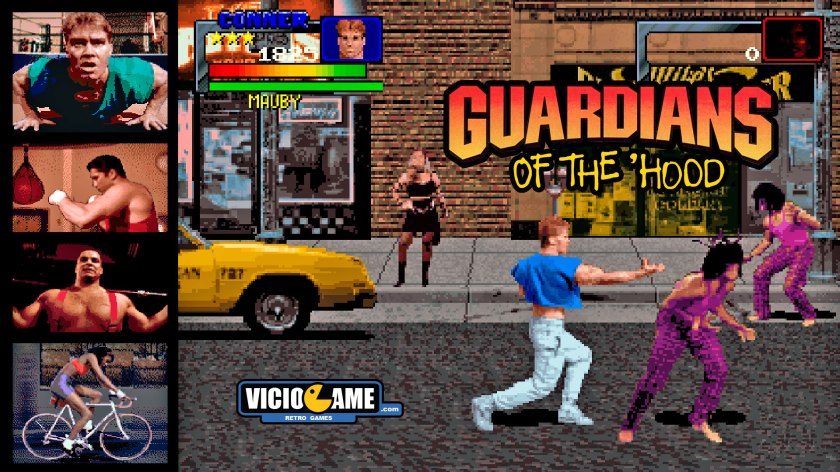
Guardians of the ‘Hood is a side-scrolling beat ‘em up arcade game released in 1992. Heavily inspired by the game Pit-Fighter, it features digitized www.viciogame.com graphics and scaling effects to create a sense of depth. Every defeated gang leader joins your team to help fight the gangs across the city.
Developer/Publisher: Atari Games
Release date: 1992
Platform: Arcade Atari GX2 board
[00:00] Intro
[00:54] City Slums
[02:40] Training Gym
[03:31] Back Alley
[05:40] Theater
[06:28] Dread’s Leader: Jay-Jay
[07:49] Training Gym
[09:11] Subway
[10:52] Metro
[11:34] Shaver’s Leader: Boris
[13:19] Training Gym
[14:12] Chinatown
[15:54] Nightclub
[16:52] Dragon’s Leader: Kwan
[17:56] Training Gym
[18:53] Amusement Park
[21:12] Fun House
[22:23] Final Boss: Mr. Big
[23:46] Ending
Unseen rare footage – The making of Guardians of the Hood:
🎮 Pit Fighter (Arcade) Complete Gameplay: https://youtu.be/5DNKuFocTWQ
🎮 Pit-Fighter (Genesis) Complete Gameplay: https://youtu.be/414jkOskLPE
🤑💲Earn money without doing anything! Just leave these apps open:
   ✓ https://r.honeygain.me/CONTA9DB02

   ✓ https://packetstream.io/?psr=1uPb
🤑💲1-Click button earns Bitcoin every 1 hour: https://freebitco.in/?r=53528449
⬛ 𝗧𝗶𝗸𝗧𝗼𝗸: https://www.tiktok.com/@viciogame
🟧 𝗜𝗻𝘀𝘁𝗮𝗴𝗿𝗮𝗺: http://www.instagram.com/viciogame
🟥 𝗬𝗼𝘂𝘁𝘂𝗯𝗲: http://www.youtube.com/viciogame
🟦 𝗙𝗮𝗰𝗲𝗯𝗼𝗼𝗸: http://www.facebook.com/viciogame
🔳 𝗧𝗵𝗿𝗲𝗮𝗱𝘀: https://www.threads.net/@viciogame
🟪 𝗧𝘄𝗶𝘁𝗰𝗵: https://www.twitch.tv/ViciogameRetroGames
🟨 𝗕𝗹𝗼𝗴: http://www.viciogameblog.com/
🟦𝗧𝘄𝗶𝘁𝘁𝗲𝗿: http://www.twitter.com/viciogame
#Viciogame #Gameplay #LetsPlay #Gamer #Playthrough #Games #News #Videogames #Review #Game #Detonado #Walkthrough #Ending #Reviews #Facts #Retro #Record #Roms #Emulator #Longplay #Speedrun #GuardiansOfTheHood #Arcade #Atari #PitFighter #BeatEmUp #StreetsOfRage #FinalFight #GoldenAxe #fight #fighting #fighter #luta #ufc #streetfighter #mortalkombat #fliperama #アーケードゲーム
ENGLISH REVIEW | ARTIGO EM PORTUGUÊS
Guardians of the Hood – The Definitive Guide
Released in 1992 by Atari Games, Guardians of the Hood stands as one of arcade history’s more curious experiments. Conceived as an unofficial successor to the hit Pit-Fighter, the game borrows heavily from its predecessor’s digitized actor style while trying to capture the raw energy of urban beat ’em ups. Set in the crime-plagued www.viciogame.com streets of Center City, the narrative is simple yet tongue-in-cheek: local gym enthusiasts band together to reclaim their neighborhood from rampant gangs and the nefarious Mr. Big. In an era dominated by titles like Street Fighter II and Mortal Kombat, Atari’s attempt to ride the beat ’em up wave was both a desperate bid for relevance and a bold, if flawed, creative venture.
Gameplay & Mechanics
At its core, Guardians of the Hood is a side-scrolling fighter that initially offers four distinct characters—Conner, Chief, Javier, and Tanya—each boasting unique fighting attributes and styles. The game’s structure is divided www.viciogame.com into multiple segments: classic street brawls punctuated by mandatory gym bouts where players face off against their own allies in best-of-three challenges. Unique to this title is its “recruitment” mechanic; defeat a gang leader from one of the three enemy cliques (The Dreads, The Shavers, or The Dragons) and they join your posse as a playable character.
The control scheme employs a five-button system (punch, kick, jump, muscle, and defend) and even incorporates “magic” moves—a nod to special attacks popularized by fighting games like Street Fighter II. However, despite the variety www.viciogame.com on offer, the controls are often described as confusing and unresponsive, with clunky hit detection and overly complex command inputs that demand precise timing and memorization.
Story & Setting
The narrative framework is as familiar as it is simplistic. Center City has fallen into chaos under the rule of street gangs and the shadowy Mr. Big. The player’s role as one of the “guardians” is to traverse the urban decay—from grimy www.viciogame.com back alleys and subway stations to rundown Chinatown locales and an abandoned boardwalk—cleaning up the streets one brawl at a time. Throughout the journey, the game peppers its storytelling with offbeat humor: from throwing bum characters as makeshift weapons to bizarre character voices and even a villain whose appearance strikingly recalls pop icons. This juxtaposition of gritty violence with irreverent comedy defines the game’s odd charm.
Visuals, Audio & Technical Aspects
Technically, Guardians of the Hood was built on Atari’s custom G42 hardware—a machine powered by the Motorola 68000 and Yamaha YM2151 sound chip. The digitized sprites, while an innovative choice meant to evoke realism, suffer from choppy animations and a noticeably frame-skipping quality. Backgrounds capture www.viciogame.com the decay of urban life with slum-like settings, though the overall graphical polish leaves much to be desired. On the audio front, while character sound effects and voice samples add moments of memorable impact (such as a well-timed “HEY MON!”), the background music and FM synthesis effects are widely regarded as subpar, creating an auditory experience that’s as jarring as the gameplay.
Development, Reception & Legacy
Led by project veterans Gary Stark and Mark Stephen Pierce, the title’s development reportedly spanned around nine months, during which it cycled through several potential names (including early candidates like “Warrior” and “Hood Guardians”). Despite an impressive cabinet presentation and the promise of innovative www.viciogame.com mechanics, the final product was met with harsh criticism. Reviewers lambasted its confusing controls, poor hit detection, and inconsistent gameplay—earning it scores as low as 2/10 to 3/10 in several retrospective evaluations.
Although Guardians of the Hood failed to leave a lasting mark in the competitive arcade market and never made it to home consoles, its blend of earnest ambition, bizarre humor, and the raw aesthetics of digitized sprites has earned it a cult following among collectors and retro enthusiasts. It remains a fascinating relic of an era when arcade developers were willing to take creative risks—even if the results were less than polished.
Notable Features
- Recruitment Twist: Unlike most beat ’em ups, defeated gang bosses can be converted into playable characters.
- Gym Battles: Midway “practice sessions” pit you against your own team in a bid to hone your skills.
- Easter Eggs & Oddities: From the ability to use non-combatants (like a homeless guy) as weapons to a villain with unexpected resemblances, the game is rife with quirky details.
- Hardware Innovations: Despite its gameplay flaws, the scaling effects and 3-D digitized graphics were technical feats for the time.
- Cultural Footprint: While largely forgotten by the mainstream, the game’s legacy lives on in collector circles and retrospective articles that lament its “what could have been” status.
Conclusion
This is a textbook example of ambition colliding with execution in the world of arcade gaming. Its blend of frenetic action, unrefined mechanics, and irreverent humor captures a unique moment in gaming history—a moment when developers www.viciogame.com dared to reimagine the beat ’em up formula, even if the final product was more of an acquired taste. For enthusiasts of retro arcades and collectors of oddball history, this title remains a must-know chapter in the evolution of digital brawling.
Guardians of the Hood offers a fascinating glimpse into a time when arcade developers dared to push boundaries—often with mixed results. Its legacy, www.viciogame.com however flawed, continues to spark discussion among retro gaming aficionados and serves as a reminder of an era when digital brawls were as much about attitude as they were about technique.
Guardians of the Hood – O Guia Definitivo
Lançado em 1992 pela Atari Games, Guardians of the Hood é uma das experiências mais curiosas do universo dos arcades. Criado como um sucessor não-oficial do consagrado Pit-Fighter, o jogo utiliza a técnica de sprites digitalizados para transmitir uma estética “realista” que, ao mesmo tempo, imita o estilo brutal dos www.viciogame.com beat ’em ups urbanos. Ambientado nas ruas degradadas de Center City, a premissa é simples – e carregada de humor ácido: membros assíduos de uma academia se unem para retomar o controle da vizinhança, enfrentando gangues de rua e o enigmático Mr. Big. Em um período dominado por gigantes como Street Fighter II e Mortal Kombat, a tentativa da Atari de se manter relevante surge como uma aposta ousada, embora cheia de falhas.
Jogabilidade e Mecânicas
No âmago do jogo, Guardians of the Hood apresenta uma ação de luta lateral, onde o jogador pode escolher entre quatro personagens iniciais – Conner, Chief, Javier e Tanya – cada um com atributos e estilos de combate únicos. A estrutura do jogo divide-se em fases de briga nas ruas intercaladas com desafios obrigatórios no ginásio, www.viciogame.com onde os combatentes se enfrentam em duelos de melhor de três rounds. Um dos diferenciais é o sistema de “recrutamento”: ao derrotar o chefe de uma das três gangues (The Dreads, The Shavers ou The Dragons), este se une à sua equipe e passa a ser jogável.
O esquema de controle utiliza um sistema de cinco botões (soco, chute, pulo, muscle e defesa) e até incorpora “movimentos mágicos” – ataques especiais inspirados em títulos do gênero, como Street Fighter II. Apesar da variedade e da tentativa de inovação, os controles são frequentemente criticados por sua confusão, baixa www.viciogame.com responsividade e comandos excessivamente complexos, o que dificulta a execução dos combos e torna a experiência frustrante para muitos jogadores.
História e Ambientação
A narrativa é tão familiar quanto simplória. Center City foi tomada pelo caos: gangues de rua e o misterioso Mr. Big instauraram o medo nas ruas. Como um “guardião”, o jogador percorre ambientes degradados – desde becos mal www.viciogame.com iluminados e estações de metrô até um decadente bairro chinês e um abandonado calçadão – para restaurar a ordem. O jogo mescla violência com humor irreverente, destacando momentos inusitados, como a possibilidade de utilizar um morador de rua como arma ou personagens com vozes marcantes. Essa mistura de brutalidade e sátira define o caráter peculiar do título.
Gráficos, Áudio e Aspectos Técnicos
Desenvolvido sobre o hardware personalizado Atari G42, que conta com o processador Motorola 68000 e o chip de som Yamaha YM2151, Guardians of the Hood aposta em sprites digitalizados para criar uma sensação de realismo. Contudo, essa abordagem resulta em animações truncadas e gráficos que muitas vezes parecem www.viciogame.com “cortados” ou com poucos frames. Os cenários, que retratam áreas urbanas degradadas – como favelas e subúrbios decadentes – ajudam a construir a atmosfera, mas não compensam a falta de polimento visual. No quesito áudio, enquanto alguns efeitos de som (como o emblemático “HEY MON!”) se destacam, a trilha sonora FM e demais efeitos se mostram repetitivos e de qualidade mediana.
Desenvolvimento, Recepção e Legado
Sob a liderança de Gary Stark e Mark Stephen Pierce, o desenvolvimento do jogo levou cerca de nove meses e passou por diversas mudanças de nome (entre os quais figuraram “Warrior” e “Hood Guardians”). Apesar de um gabinete de www.viciogame.com arcade que chamava atenção e uma proposta de gameplay inovadora, o produto final foi amplamente criticado. Especialistas e revistas de games apontaram problemas como controles confusos, detecção de colisão falha e uma jogabilidade inconsistente – o que se refletiu em notas baixas, variando entre 2/10 e 3/10 em diversas avaliações.
Embora Guardians of the Hood não tenha alcançado sucesso comercial e jamais tenha sido portado para consoles, seu humor bizarro e www.viciogame.com sua abordagem única garantiram um legado cult entre colecionadores e entusiastas dos arcades. O jogo é lembrado como um marco curioso da tentativa da Atari de inovar num mercado saturado.
Destaques
- Recrutamento Inovador: Ao derrotar os chefes das gangues, estes podem ser convertidos em personagens jogáveis.
- Lutas no Ginásio: Entre as fases de rua, os jogadores enfrentam duelos internos que funcionam como “treinos” obrigatórios.
- Easter Eggs e Peculiaridades: Desde o uso inusitado de personagens coadjuvantes (como o morador de rua) até um vilão que lembra Michael Jackson, o jogo está repleto de detalhes curiosos.
- Inovações Técnicas: Os efeitos de escalonamento e os gráficos em 3-D digitalizados foram feitos para impressionar, mesmo que o resultado final ficasse aquém das expectativas.
- Impacto Cultural: Embora ofuscado por títulos mais populares, o jogo ganhou notoriedade entre colecionadores e críticos que estudam a evolução dos beat ’em ups.
Conclusão
Este é um exemplo emblemático de como a ambição pode se chocar com a execução. Apesar de suas mecânicas problemáticas e da jogabilidade decepcionante, o título se destaca pelo seu humor excêntrico e pela coragem de www.viciogame.com experimentar novos conceitos num cenário arcade cada vez mais competitivo. Para os fãs de jogos retrô e colecionadores de relíquias dos arcades, este jogo permanece como um capítulo intrigante e, por vezes, divertido da história dos videogames.
Guardians of the Hood oferece um vislumbre fascinante de uma época em que os desenvolvedores de fliperamas ousavam ultrapassar os limites – geralmente com resultados mistos. Seu legado, embora falho, continua a www.viciogame.com gerar discussões entre os aficionados por jogos retrô e serve como um lembrete de uma era em que as brigas digitais eram tanto sobre atitude quanto sobre técnica.
 VICIOGAME