
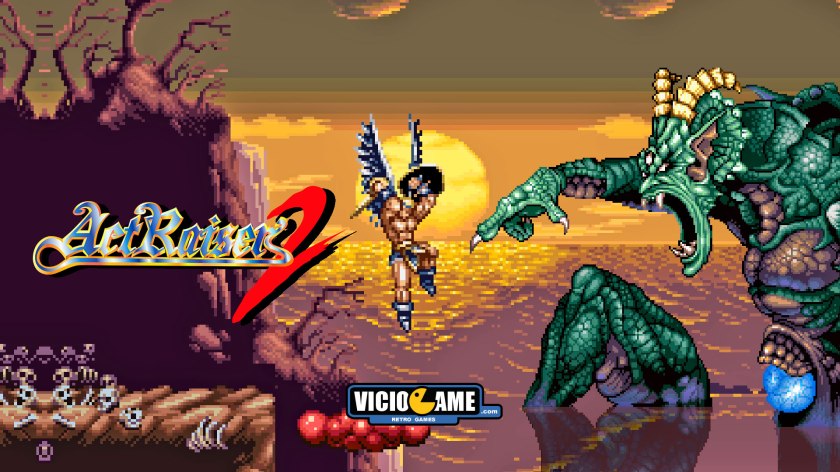
ActRaiser 2 is a side-scrolling platform game released in 1993 for the Super Nintendo. Going against the grain of its predecessor, this title features only action stages, leaving behind all the simulation and city-building elements. After a crushing defeat, Tanzra, the Evil One, is resurrected and vows revenge against the Master and his people, sending legendary demons to destroy the planet.
Developer: Quintet
Publisher: Enix America, Inc.
Release date: 1993
Platform: Super Nintendo / Super Famicom
ActRaiser 2 – Ultimate Guide
ActRaiser 2 is a 2D action-platformer that made its mark on the Super Nintendo, released in November 1993 by Enix America, Inc. In Japan, the title is known as ActRaiser 2: Chinmoku e no Seisen. The game’s development was handled by Quintet, a studio recognized for other influential titles in the 16-bit era, such as Illusion of Gaia, Robotrek, Soul Blazer, and Terranigma.
A distinctive characteristic of ActRaiser 2 compared to its predecessor is its shift in focus. The original ActRaiser, acclaimed for its unique fusion of platforming sequences with city-building simulation elements – a genre known as god game – paved the way for a hybrid experience. However, its sequel chose to focus exclusively on side-scrolling platform action, completely removing the simulation mode. This design decision was a directive from Enix’s American office, which, according to reports, believed that players wanted more action and challenge. Some considered the simulation part a waste of time, which influenced the elimination of this component. This choice, however, was later considered a mistake by a former American Enix producer, who acknowledged the importance of listening carefully to consumers.
The game’s difficulty was also significantly increased in Western versions, motivated by complaints that the first game was too short. This alteration impacted the game’s reception, alienating fans of the original who appreciated the genre mixing and making the gaming experience frustrating for many. All of this demonstrates a disconnect between developers and publishers and the player base, evidencing how market perception can drastically influence the design of a sequel.
The game features 14 distinct stages, introducing new monsters, abilities, and super powers for the player to master. A practical change from the first ActRaiser is the transition from a memory save system (battery in the cartridge) to a password system, using the Sky Palace to generate and enter codes, allowing the player to resume the game from where they left off.
The story of ActRaiser 2 doesn’t directly connect with that of its predecessor, but draws inspiration from religious epics like Paradise Lost and The Divine Comedy, giving it considerable thematic depth. In the prologue, the Evil Lord Tanzra is defeated by the Master, the divine entity that the player controls. His most powerful demons, the 13 Chosen, transport him back to the underworld. After millennia of peace, the 13 Chosen manage to resurrect Tanzra, who swears revenge against the Master and sends his demons to destroy everything. The player assumes the role of the Master, a divine spirit who now possesses functional wings and controls a floating “Cloud Palace,” used to inspect the world below and combat evil. The Master is aided by angelic associates known as Crystallis.
Each area of the game is divided into two “acts.” The first act of an area features monsters generated by a lesser demon, while the second act culminates with a main demon, representing one of the seven deadly sins, offering heightened challenge and danger. The stages are designed with irony regarding the corrupting nature of Tanzra’s demons, adding a layer of meaning to the experience.
The thematic depth, while perhaps not fully perceived by younger players at the time of release, adds a layer of sophistication and weight to the experience. The integration of theological and literary concepts elevates the story from a simple confrontation between good and evil to a richer allegory about human corruption and divine struggle, making the game more than just an action title.
The stages and their respective demons are:
Industen (Diligence): It was a beautiful country, covered by rivers and forests, where people worked hard to keep the land healthy. A bizarre storm, caused by the demon Fatigue, struck the region, causing people to lose the desire to live and work. In the stage, the player faces Trolls, Worms, and Dragonflies. The first boss is the Giant Plant (Vile Weed), and the final boss is the demon Fatigue himself, a giant skeleton warrior riding a cloud.
Tortoise Island (Devote / Envy): This island housed people devoted to one another. However, the island’s queen, taken by envy of the Master’s power, gave a precious gift to the demons. In response, the Master sank the island in the ocean, but part of it transformed into a giant turtle that now floats through the sea. The demon Envy is the vengeful spirit of this queen. The stage features enemies like swimming shark-men, giant fish, seahorses, and explosive snails. The stage boss is Giant Squid.
Modero (Temperance / Gluttony): Located in the plains of the Benefic river, Modero was a refined country where people lived in moderation. The demon Gluttony conquered the land and consumed all the food, resulting in the death of many people, who were transformed by the demons and began attacking travelers. Gluttony is described as a crop-devouring ant-demon. In the stage, the player faces golems, butterflies, and vultures. The mid-stage boss is Giant Bird, and the final boss is the demon Hunger (Gluttony), who summons golems when hit.
Favorian / Justania (Justice / Wrath): It was a small mountainous country, known for its army of warriors with a strong sense of justice and bravery. The demon Fury caused a volcano to erupt, covering the land with lava and making it infertile. This led the armies to attack neighboring villages, going to war with Favorian. Fury is a fire giant to be fought inside a volcano. The stage includes enemies like goblins, cyclops, and fire towers. The mid-stage boss is Knight, and the final boss is Giant Knight (Fury).
Lample City (Love / Deception): The people of this country were very loyal to the Master, and the king of Lample City was a great believer and a strong leader. The demon Deception defeated the king, causing people to lose faith in the Master, forget to give thanks, and begin serving their own desires, resulting in a land without love and covered in ice. Deception is a demon who corrupted the king’s mind with the image of a beautiful woman, trapping him in its belly. In the stage, the player faces golems, bats, and lizards. The mid-stage boss is the Ice Demon, and the final boss is the demon Deception.
Gratis (Greed): Although it wasn’t a rich land, the people of Gratis lived happily, avoiding luxury and always remembering to thank the Master. The new king, Kolunikus, imposed high taxes and conspired with the demon Greed to sacrifice people who couldn’t pay in exchange for money. The name “Gratis,” meaning “free,” is ironic for a prison where people are sent for not paying taxes. Greed is a demon who transformed King Kolunikus into a golden dragon. The stage features enemies like goblins, ghosts, and spiders. The mid-stage boss is Super Werebeast, and the final boss is the Wizard Boss (Goblin King).
Tower of Souls / Death Heim (Pride / Destruction): The people of this country lived without faith long before the demons’ arrival. Ignoring nature, they built miles of factories, polluting the sky and making the air almost unbreathable. Humility was replaced by arrogance, and people began building a tower to try to reach the Master. The demon Destruction took control. The Tower of Souls (originally Tower of Babel) is where the Master fights against Destruction, a machine representing human Pride. In the tower, the player faces more difficult versions of previous bosses (Giant Plant, Snake, Giant Bird, Knight, Ghost, Werebeast) before fighting the Mystical Boss, a giant head with floating objects. In Death Heim, the Master fights again against the seven sins and Tanzra himself, who is frozen in a lake of ice, just as Satan is depicted in Dante’s Inferno. The Death Heim stage cannot be accessed in Easy mode.
The basic Super Nintendo controls allow for a series of movements and attacks. The Up directional is used to guard against attacks coming from above, while the Down directional guards against low attacks. The Left and Right directionals control the Master’s horizontal movement. To attack with the sword, the player uses the X or Y buttons. The Master can attack the area above him by pressing the Up directional and the X or Y button, and the area below him by pressing the Down directional and the X or Y button. If the player presses the A or B and X or Y buttons simultaneously, the Master jumps and attacks at the same time. A downward sword thrust while in the air is performed by pressing the A or B button twice, the Down directional, and the X or Y button.
The defense system is centered on the Master’s shield, which is positioned in front. The player can move the shield up (Up directional) or down (Down directional) to deflect attacks. It’s important to note that the shield offers no protection while the Master is moving or attacking.
The Master possesses various types of jumps and aerial movements. A basic jump is performed by pressing the A or B button. For a higher jump, the player can press A or B twice. Landing slowly is possible by pressing A or B twice and the Up directional, which also allows gliding and moving horizontally to avoid traps or aim for platforms. For a quick landing, the player presses A or B twice and the Down directional.
The glide is activated by jumping once and holding the jump button in the air, making the Master glide diagonally to the ground. During the glide, it’s possible to attack with X or Y, or perform a Gliding Dive Attack with Down directional and X or Y. The Master slides slightly when landing after a glide.
The Dive Attack is a quick movement performed by jumping and pressing the Down directional and X or Y. The Master’s moveset is quite complex, including glide, hover, and the ability to cancel glide phases into an evasive double jump.
Normal sword attacks cause 1 damage, while the swordplant and glide attack cause 2 damage, and the dive attack is the most potent with 3 damage.
The Master relies heavily on magic to overcome challenges. To use magic, the player must hold the X or Y button until the Master turns red. Using each magic consumes a magic scroll, which is limited when entering an area. There are 7 different types of magic, each activated by a different position of the Master:
- Fire Breath: Used only in standing position. Causes 1 damage per hit, up to 4 hits.
- Earth Force: Used only while pressing the Down directional. Causes 1 damage per hit, up to 3 hits.
- Thunder Bolt: Used only in the air. Causes 2 damage.
- Spark Element: Used only while jumping. Causes 2 damage.
- Aura Shoot: Used only while gliding in the air. Causes 4 damage for direct hit and 2 after splitting.
- Raging Bomb: Used only while pressing the Up directional. Causes 3 damage per hit, up to 4 hits.
- Phoenix: Used only when making a quick landing. Causes 6 damage and can hit twice on some targets, offering the highest damage in the game.
Items are found in statues or after defeating enemies in action stages. They include HP recovery (2, 4, or 10 points), MP recovery (1 or 3 points), and extra lives.
The gameplay complexity and high difficulty of the game are not accidental, but rather a design choice that aims to offer substantial challenge. The use of magic, for example, requires precision. The “Hard” difficulty increases magic charging time and makes enemies deal more damage and have more health. The stages require mastery, and this leads to frustration and the need to memorize every corner. The learning curve is steep and contrasts with the accessibility of the first ActRaiser.
The graphics of ActRaiser 2 are impressive for a 16-bit game. The sprite work is excellent, and the background scenery is colorful and detailed, contributing to the game’s visual beauty. The title also stands out for its use of advanced visual effects for the time, such as parallax scrolling and the famous Mode 7 of the Super Nintendo.
Mode 7 is a graphics mode that allows a background layer to be rotated and scaled. By modifying scale and position values line by line, it’s possible to apply a perspective effect, transforming the layer into a textured 2D plane that simulates depth, creating the impression of three-dimensional graphics. Parallax scrolling, in turn, is a technique where background images move more slowly than foreground images, creating an illusion of depth in 2D scenes. The original ActRaiser already used this effect, and its sequel improves this technique to enrich the atmosphere.
The soundtrack and sound effects of ActRaiser 2 also receive praise. The orchestral music fits perfectly with the game’s atmosphere, and the boss music intensifies battles, contributing to immersion. Yuzo Koshiro, one of the most influential composers and audio programmers for video games, was responsible for the game’s soundtrack. Koshiro also composed for the original ActRaiser, whose soundtrack was even adapted for orchestra, demonstrating his talent. He is known for his versatility, producing music in various genres, including rock, jazz, symphonic, and electronic (house, electro, techno, trance).
To overcome the Super Nintendo‘s 64 KB memory limitation, which restricted the number of instruments and beat reloading, Koshiro developed an innovative loading system. It worked with the cartridge’s memory, dynamically swapping beats. This allowed loading parts of the music gradually as needed and swapping them quickly between stages or parts of a stage, overcoming the original system’s restrictions. The soundtrack of ActRaiser 2 is more experimental than in the first game, which not all listeners appreciate. Some critics consider it mediocre compared to the original’s energy, while others see it as a deeper artistic exploration.
The reception of ActRaiser 2 by the public and critics was mixed, generating polarized opinions. Some publications of the time, such as Ação Games and GamePro, gave high scores, with 100% and 90% respectively. However, others, such as Edge and Video Game Critic, attributed significantly lower scores, of 50% and 25%. The main negative criticisms focused on two points: the removal of the god game mode and excessive difficulty.
The game has a single ending, which shows the Master’s statue eroding over time, with the sword and right wing falling. This symbolizes the growth of civilization and humanity’s self-sufficiency, echoing the ending of the first ActRaiser, where the angel speculates that one day humanity would become so independent that it would forget the Master.
Enix (now Square Enix) abandoned the ActRaiser franchise after the second game. The absence of ActRaiser in modern collections, such as the SNES Classic Mini, may be related to licensing issues, despite the company having other games present on the platform.
The title did not achieve the same “great classic” status as its predecessor. The gameplay style ended up fragmenting its fan base and, in the long term, limited its legacy. The difficulty and absence of the simulation element, which defined the original, transformed the sequel into a game that couldn’t replicate the magic of the first, resulting in a lesser impact on video game history, with difficulty for its preservation and re-release on future platforms.
ActRaiser 2 is a complex example of how public expectations and design decisions can shape a sequel’s trajectory. Although technically impressive for its time, with graphics that explore the console’s capabilities and an innovative soundtrack by Yuzo Koshiro, the radical change in gameplay made it a generic title in the eyes of many players.
ActRaiser 2 maintains its value as a challenging game and a showcase for artistic and technical talent. Its legacy is marked by its boldness in trying something different, even if this cost the franchise’s continuity. The story serves as a reminder of the delicate balance between innovation, public expectations, and preserving a series’ identity in the competitive universe of video games.
ActRaiser 2: O Guia Definitivo
ActRaiser 2 é um jogo de ação e plataforma 2D que marcou presença no Super Nintendo, lançado em novembro de 1993 pela Enix America, Inc. No Japão, o título é conhecido como ActRaiser 2: Chinmoku e no Seisen. O desenvolvimento do jogo ficou a cargo da Quintet, um estúdio reconhecido por outros títulos influentes na era 16-bit, como Illusion of Gaia, Robotrek, Soul Blazer e Terranigma.
Uma característica distintiva de ActRaiser 2 em relação ao seu antecessor é a sua mudança de foco. O ActRaiser original, aclamado por sua fusão única de sequências de plataforma com elementos de simulação de construção de cidades – um gênero conhecido como god game -, abriu caminho para uma experiência híbrida. No entanto, sua sequência optou por focar exclusivamente na ação de plataforma de rolagem lateral, removendo por completo o modo de simulação. Essa decisão de design foi uma diretriz do escritório americano da Enix, que, segundo relatos, acreditava que os jogadores desejavam mais ação e desafio. Alguns consideravam a parte de simulação como uma perda de tempo, o que influenciou a eliminação desse componente. Essa escolha, no entanto, foi posteriormente considerada um erro por um ex-produtor da Enix americana, que reconheceu a importância de escutar atentamente os consumidores.
A dificuldade do jogo também foi significativamente aumentada nas versões ocidentais, motivada por reclamações de que o primeiro jogo era muito curto. Essa alteração impactaram a recepção do jogo, alienando fãs do original que apreciavam a mistura de gêneros e tornando a experiência de jogo frustrante para muitos. Isso tudo demonstra uma desconexão entre desenvolvedores e editores e a base de jogadores, evidenciando como a percepção de mercado pode influenciar drasticamente o design de uma sequência.
O jogo apresenta 14 fases distintas, introduzindo novos monstros, habilidades e super poderes para o jogador dominar. Uma alteração prática em relação ao primeiro ActRaiser é a transição de um sistema de gravação na memória (bateria no cartucho) para um sistema de passwords, utilizando o Sky Palace para gerar e inserir os códigos, permitindo que o jogador retome a partida do ponto em que parou.
A história de ActRaiser 2 não se conecta diretamente com a do seu predecessor, mas se inspira em épicos religiosos como Paradise Lost e A Divina Comédia, conferindo-lhe uma profundidade temática considerável. No prólogo, o Lorde Maligno Tanzra é derrotado pelo Mestre, a entidade divina que o jogador controla. Seus demônios mais poderosos, os 13 Escolhidos, o transportam de volta ao submundo. Após milênios de paz, os 13 Escolhidos conseguem ressuscitar Tanzra, que jura vingança contra o Mestre e envia seus demônios para destruir tudo. O jogador assume o papel do Mestre, um espírito divino que agora possui asas funcionais e controla um “Cloud Palace” flutuante, utilizado para inspecionar o mundo abaixo e combater o mal. O Mestre é auxiliado por associados angelicais conhecidos como Crystallis.
Cada área do jogo é dividida em dois “atos”. O primeiro ato de uma área apresenta monstros gerados por um demônio menor, enquanto o segundo ato culmina com um demônio principal, que representa um dos sete pecados capitais, oferecendo um desafio e perigo acentuados. As fases são projetadas com ironia em relação à natureza corruptora dos demônios de Tanzra, adicionando uma camada de significado à experiência.
A profundidade temática, embora talvez não totalmente percebida pelos jogadores mais jovens na época do lançamento, adiciona uma camada de sofisticação e peso à experiência. A integração de conceitos teológicos e literários eleva a história de um simples confronto entre bem e mal para uma alegoria mais rica sobre a corrupção humana e a luta divina, tornando o jogo mais do que apenas um título de ação.
As fases e seus respectivos demônios são:
Industen (Diligence): Era um país bonito, coberto por rios e florestas, onde as pessoas trabalhavam arduamente para manter a terra saudável. Uma tempestade bizarra, causada pelo demônio Fatigue, atingiu a região, fazendo com que as pessoas perdessem o desejo de viver e trabalhar. Na fase, o jogador enfrenta Trolls, Worms e Dragonflies. O primeiro chefe é a Giant Plant (Vile Weed), e o chefe final é o próprio demônio Fatigue, um guerreiro esqueleto gigante que cavalga uma nuvem.
Tortoise Island (Devote / Envy): Esta ilha abrigava pessoas devotadas umas às outras. No entanto, a rainha da ilha, tomada pela inveja do poder do Mestre, deu um presente precioso aos demônios. Em resposta, o Mestre afundou a ilha no oceano, mas parte dela se transformou em uma tartaruga gigante que agora flutua pelo mar. O demônio Envy é o espírito vingativo dessa rainha. A fase apresenta inimigos como homens-tubarão nadadores, peixes gigantes, cavalos-marinhos e caramujos explosivos. O chefe da fase é Giant Squid.
Modero (Temperance / Gluttony): Localizado nas planícies do rio Benefic, Modero era um país refinado onde as pessoas viviam com moderação. O demônio Gluttony conquistou a terra e consumiu toda a comida, resultando na morte de muitas pessoas, que foram transformadas pelos demônios, passando a atacar viajantes. Gluttony é descrito como um demônio-formiga devorador de plantações. Na fase, o jogador enfrenta golens, borboletas e abutres. O chefe do meio da fase é Giant Bird, e o chefe final é o demônio Hunger (Gluttony), que invoca golems ao ser atingido.
Favorian / Justania (Justice / Wrath): Era um pequeno país montanhoso, conhecido por seu exército de guerreiros com um forte senso de justiça e bravura. O demônio Fury causou a erupção de um vulcão, cobrindo a terra com lava e tornando-a infértil. Isso levou os exércitos a atacar vilas vizinhas, entrando em guerra com Favorian. Fury é um gigante de fogo a ser combatido dentro de um vulcão. A fase inclui inimigos como goblins, ciclopes e torres de fogo. O chefe do meio da fase é Knight, e o chefe final é Giant Knight (Fury).
Lample City (Love / Deception): As pessoas deste país eram muito leais ao Mestre, e o rei de Lample City era um grande crente e um líder forte. O demônio Deception derrotou o rei, fazendo com que as pessoas perdessem a fé no Mestre, esquecessem de agradecer e passassem a servir aos próprios desejos, resultando em uma terra sem amor e coberta de gelo. Deception é um demônio que corrompeu a mente do rei com a imagem de uma mulher bonita, prendendo-o em seu ventre. Na fase, o jogador enfrenta golens, morcegos e lagartos. O chefe do meio da fase é o Ice Demon, e o chefe final é o demônio Deception.
Gratis (Greed): Embora não fosse uma terra rica, as pessoas de Gratis viviam felizes, evitando o luxo e sempre lembrando de agradecer ao Mestre. O novo rei, Kolunikus, impôs impostos altos e conspirou com o demônio Greed para sacrificar pessoas que não podiam pagar em troca de dinheiro. O nome “Gratis”, que significa “grátis”, é irônico para uma prisão onde as pessoas são enviadas por não pagar impostos. Greed é um demônio que transformou o rei Kolunikus em um dragão dourado. A fase apresenta inimigos como goblins, fantasmas e aranhas. O chefe do meio da fase é Super Werebeast, e o chefe final é o Wizard Boss (Goblin King).
Tower of Souls / Death Heim (Pride / Destruction): As pessoas deste país viviam sem fé muito antes da chegada dos demônios. Ignorando a natureza, construíram quilômetros de fábricas, poluindo o céu e tornando o ar quase irrespirável. A humildade foi substituída pela arrogância, e as pessoas começaram a construir uma torre para tentar alcançar o Mestre. O demônio Destruction assumiu o controle. A Tower of Souls (originalmente Torre de Babel) é onde o Mestre luta contra Destruction, uma máquina que representa o Pride humano. Na torre o jogador enfrenta versões mais difíceis de chefes anteriores (Giant Plant, Snake, Giant Bird, Knight, Ghost, Werebeast) antes de lutar contra o Mystical Boss, uma cabeça gigante com objetos flutuantes. Em Death Heim, o Mestre luta novamente contra os sete pecados e o próprio Tanzra, que está congelado em um lago de gelo, assim como Satanás é retratado em O Inferno de Dante. A fase Death Heim não pode ser acessada no modo Easy.
Os controles básicos do Super Nintendo permitem uma série de movimentos e ataques. O direcional para Cima é usado para proteger contra ataques vindos de cima, enquanto o direcional para Baixo protege contra ataques baixos. Os direcionais para Esquerda e Direita controlam o movimento horizontal do Mestre. Para atacar com a espada, o jogador utiliza os botões X ou Y. O Mestre pode atacar a área acima dele pressionando o direcional para Cima e o botão X ou Y, e a área abaixo dele pressionando o direcional para Baixo e o botão X ou Y. Se o jogador pressionar os botões A ou B e X ou Y simultaneamente, o Mestre pula e ataca ao mesmo tempo. Uma estocada com a espada para baixo enquanto está no ar é realizada pressionando o botão A ou B duas vezes, o direcional para Baixo e o botão X ou Y.
O sistema de defesa é centrado no escudo do Mestre, que é posicionado à frente. O jogador pode mover o escudo para cima (direcional para Cima) ou para baixo (direcional para Baixo) para desviar ataques. É importante notar que o escudo não oferece proteção enquanto o Mestre está se movendo ou atacando.
O Mestre possui diversos tipos de salto e movimentos aéreos. Um salto básico é realizado pressionando o botão A ou B. Para um salto mais alto, o jogador pode pressionar A ou B duas vezes. Aterrissar lentamente é possível pressionando A ou B duas vezes e o direcional para Cima, o que também permite planar e mover-se horizontalmente para evitar armadilhas ou mirar plataformas. Para uma aterrissagem rápida, o jogador pressiona A ou B duas vezes e o direcional para Baixo.
O glide é ativado saltando uma vez e mantendo o botão de pulo pressionado no ar, fazendo o Mestre planar diagonalmente para o chão. Durante o glide, é possível atacar com X ou Y, ou realizar um Gliding Dive Attack com direcional para Baixo e X ou Y. O Mestre desliza um pouco ao aterrissar após um glide.
O Dive Attack é um movimento rápido realizado saltando e pressionando o direcional para Baixo e X ou Y. O conjunto de movimentos do Mestre é bastante complexo, incluindo glide, hover e a capacidade de cancelar fases de glide para um salto duplo evasivo.
Ataques normais com a espada causam 1 de dano, enquanto o swordplant e o glide attack causam 2 de dano, e o dive attack é o mais potente com 3 de dano.
O Mestre depende muito de magia para superar os desafios. Para usar magia, o jogador deve segurar o botão X ou Y até que o Mestre fique vermelho. O uso de cada magia consome um magic scroll, que é limitado ao entrar em uma área. Existem 7 tipos diferentes de magia, cada um ativado por uma posição diferente do Mestre:
- Fire Breath: Usado apenas em posição de pé. Causa 1 de dano por acerto, até 4 acertos.
- Earth Force: Usado apenas enquanto pressiona o direcional para Baixo. Causa 1 de dano por acerto, até 3 acertos.
- Thunder Bolt: Usado apenas no ar. Causa 2 de dano.
- Spark Element: Usado apenas enquanto pula. Causa 2 de dano.
- Aura Shoot: Usado apenas enquanto plana no ar. Causa 4 de dano para acerto direto e 2 após se dividir.
- Raging Bomb: Usado apenas enquanto pressiona o direcional para Cima. Causa 3 de dano por acerto, até 4 acertos.
- Phoenix: Usado apenas ao fazer uma aterrissagem rápida. Causa 6 de dano e pode acertar duas vezes em alguns alvos, oferecendo o maior dano do jogo.
Itens são encontrados em estátuas ou após derrotar inimigos nas fases de ação. Eles incluem recuperações de HP (2, 4 ou 10 pontos), recuperações de MP (1 ou 3 pontos) e vidas adicionais.
A complexidade da jogabilidade e a alta dificuldade do jogo não são acidentais, mas sim uma escolha de design que visa oferecer um desafio substancial. O uso de magia, por exemplo, exige precisão. A dificuldade “Hard” aumenta o tempo de carga da magia e faz com que inimigos causem mais dano e tenham mais vida. As fases exigem maestria, e isso leva à frustração e à necessidade de memorizar cada canto. A curva de aprendizado é íngreme e contrasta com a acessibilidade do primeiro ActRaiser.
Os gráficos de ActRaiser 2 são impressionantes para um jogo de 16 bits. O trabalho com sprites é excelente, e os cenários de fundo são coloridos e detalhados, o que contribui para a beleza visual do jogo. O título também se destaca pelo uso de efeitos visuais avançados para a época, como o parallax scrolling e o famoso Mode 7 do Super Nintendo.
O Mode 7 é um modo gráfico que permite que uma camada de fundo seja rotacionada e redimensionada. Ao modificar os valores de escala e posição linha por linha, é possível aplicar um efeito de perspectiva, transformando a camada em um plano 2D com textura aplicada que simula profundidade, criando a impressão de gráficos tridimensionais. O parallax scrolling, por sua vez, é uma técnica onde imagens de fundo se movem mais lentamente que as imagens de primeiro plano, criando uma ilusão de profundidade em cenas 2D. O ActRaiser original já utilizava esse efeito, e sua sequência aprimora essa técnica para enriquecer a ambientação.
A trilha sonora e os efeitos sonoros de ActRaiser 2 também recebem elogios. A música orquestral se encaixa perfeitamente na atmosfera do jogo, e a música dos chefões intensifica as batalhas, contribuindo para a imersão. Yuzo Koshiro, um dos mais influentes compositores e programadores de áudio para videogames, foi o responsável pela trilha sonora do jogo. Koshiro também compôs para o ActRaiser original, cuja trilha foi inclusive adaptada para orquestra, demonstrando seu talento. Ele é conhecido por sua versatilidade, produzindo música em diversos gêneros, incluindo rock, jazz, sinfônico e eletrônico (house, electro, techno, trance).
Para contornar a limitação de memória de 64 KB do Super Nintendo, que restringia o número de instrumentos e o recarregamento de batidas, Koshiro desenvolveu um sistema inovador de carregamento. Funcionava com a memória do cartucho, trocando batidas dinamicamente. Isso permitia carregar partes da música gradualmente conforme necessário e trocá-las rapidamente entre as fases ou partes de uma fase, superando as restrições do sistema original. A trilha sonora de ActRaiser 2 é mais experimental que no primeiro jogo, o que nem todos os ouvintes apreciam. Alguns críticos a consideram mediana em comparação com a energia do original, enquanto outros a veem como uma exploração artística mais profunda.
A recepção de ActRaiser 2 pelo público e pela crítica foi mista, gerando opiniões polarizadas. Algumas publicações da época, como Ação Games e GamePro, deram notas altas, com 100% e 90% respectivamente. No entanto, outras, como Edge e Video Game Critic, atribuíram notas significativamente mais baixas, de 50% e 25%. As principais críticas negativas se concentraram em dois pontos: a remoção do modo god game e a dificuldade excessiva.
O jogo possui um único final, que mostra a estátua do Mestre erodindo com o tempo, com a espada e a asa direita caindo. Isso simboliza o crescimento da civilização e a autossuficiência da humanidade, ecoando o final do primeiro ActRaiser, onde o anjo especula que um dia a humanidade se tornaria tão independente que esqueceria o Mestre.
A Enix (agora Square Enix) abandonou a franquia ActRaiser após o segundo jogo. A ausência de ActRaiser em coletâneas modernas, como o SNES Classic Mini, pode estar relacionada a questões de licenciamento, apesar de a empresa ter outros jogos presentes na plataforma.
O título não alcançou o mesmo status de “grande clássico” que seu predecessor. O estilo de jogo acabou por fragmentar sua base de fãs e, a longo prazo, limitou seu legado. A dificuldade e a ausência do elemento de simulação, que definiram o original, transformaram a sequência em um jogo que não conseguiu replicar a magia do primeiro, resultando em um impacto menor na história dos videogames, com dificuldade para sua preservação e relançamento em plataformas futuras.
ActRaiser 2 é um exemplo complexo de como as expectativas do público e as decisões de design podem moldar a trajetória de uma sequência. Embora tecnicamente impressionante para sua época, com gráficos que exploram as capacidades do console e uma trilha sonora inovadora de Yuzo Koshiro, a mudança radical na jogabilidade o tornou um título genérico aos olhos de muitos jogadores.
ActRaiser 2 mantém seu valor como um jogo desafiador e uma vitrine para o talento artístico e técnico. Seu legado é marcado por sua ousadia em tentar algo diferente, mesmo que isso tenha custado a continuidade da franquia. A história serve como um lembrete da delicada balança entre inovação, expectativas do público e a preservação da identidade de uma série no competitivo universo dos videogames.
🤑💲Earn money without doing anything! Just leave these apps open:
   ✓ https://r.honeygain.me/CONTA9DB02

   ✓ https://packetstream.io/?psr=1uPb
🤑💲1-Click button earns Bitcoin every 1 hour: https://freebitco.in/?r=53528449
⬛ 𝗧𝗶𝗸𝗧𝗼𝗸: https://www.tiktok.com/@viciogame
🟧 𝗜𝗻𝘀𝘁𝗮𝗴𝗿𝗮𝗺: http://www.instagram.com/viciogame
🟥 𝗬𝗼𝘂𝘁𝘂𝗯𝗲: http://www.youtube.com/viciogame
🟦 𝗙𝗮𝗰𝗲𝗯𝗼𝗼𝗸: http://www.facebook.com/viciogame
🔳 𝗧𝗵𝗿𝗲𝗮𝗱𝘀: https://www.threads.net/@viciogame
🟪 𝗧𝘄𝗶𝘁𝗰𝗵: https://www.twitch.tv/ViciogameRetroGames
🟨 𝗕𝗹𝗼𝗴: http://www.viciogameblog.com/
🟦𝗧𝘄𝗶𝘁𝘁𝗲𝗿: http://www.twitter.com/viciogame
#Viciogame #Gameplay #LetsPlay #Gamer #Playthrough #Games #News #Videogames #Review #Game #Detonado #Walkthrough #Ending #Reviews #Facts #Retro #Record #Roms #Emulator #Longplay #Speedrun #ActRaiser2 #SNES #Quintet #SuperNes #Enix #SuperNintendo #SquareEnix #SuperFamicom #ActRaiser #Nintendo #スーパーファミコン #任天堂
 VICIOGAME