
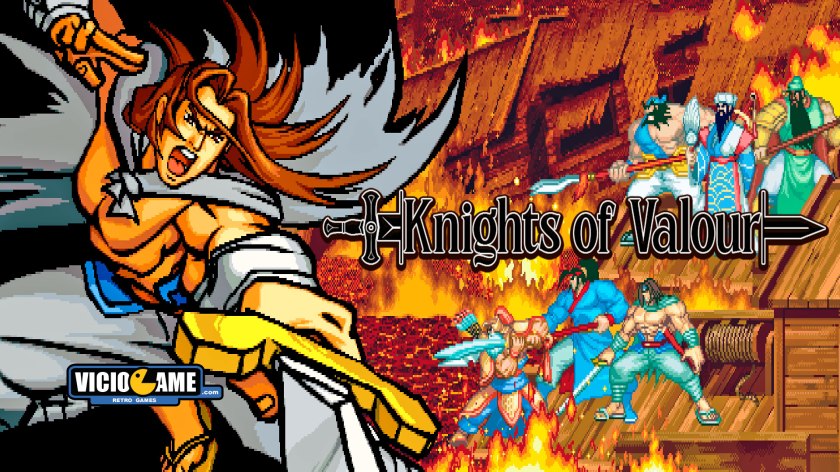
Knights of Valour is a 2D side-scrolling beat ‘em up arcade game featuring weapons combat, released in 1999. It blends Dungeons & Dragons-style fantasy themes with fighting moves inspired by The King of Fighters series. Based on a 14th-century Chinese novel, you play as one of the generals from the kingdom of Shu and must battle against the rival kingdoms of Wu and Wei.
Developer/Publisher: IGS
Release date: 1999
Platform: Arcade PolyGame Master board
Knights of Valour: The Ultimate Guide
Knights of Valour is a weapon-based side-scrolling beat ‘em-up originally released for IGS’s PolyGame Master (PGM) platform. The game hit the market on January 1, 1999, developed and published by IGS itself. It draws inspiration from genre classics like Capcom’s Dungeons & Dragons titles, but incorporates more intense action, similar to 2D fighting games. The gameplay stands out for its combination of devastating combos with special moves executed through joystick and button commands, plus a super power bar that allows powerful screen-clearing attacks. Additionally, the game introduces RPG elements, such as character progression, which increases their speed and power as they accumulate kills and experience.
This release at a time when the genre was already in decline demonstrates IGS’s attempt to revitalize the formula. By incorporating layers of complexity and progression, the intention was to offer depth and replayability that went beyond mere repetition, extending the title’s arcade lifespan and encouraging more spending from players. This represents an evolution in beat ‘em-up design, seeking to meet the expectations of players who wanted more than just the premise of “kill everyone until you reach the boss.”
This is an example of how arcades continued to produce high-quality titles even at the end of their golden era, maintaining the tradition of games that encouraged local cooperation and competition. The difficulty of some bosses, while frustrating, was a common characteristic of arcade games of the era, designed to maximize revenue. Here the complexity is almost unfair and requires multiple credits for bosses to be overcome, contrasting with the idea of RPG progression based on skill and strategy. If the player can simply “buy” victory with more tokens, the learning curve and mastery of gameplay mechanics lose part of their meaning.
International Games System (IGS), a Taiwanese developer that became a force worthy of recognition in the arcade scene, especially with its own hardware line.
IGS’s PolyGame Master hardware system aimed to compete with SNK’s Neo Geo MVS in Taiwan. The PGM specifications include a main Motorola 68000 processor running at 20 MHz, a Zilog Z80 sound processor at 8.468 MHz, and a 32-channel PCM ICS2115 sound chip. It also featured advanced graphics capabilities for the time, such as sprite scaling and multiple side-scrolling planes. IGS continued to develop the Knights of Valour series on PGM successors, such as the PGM2 (released in 2007) and PGM3 (released in 2012). The decision to develop their own arcade hardware, rather than licensing existing platforms, was a strategy of control over their games’ design and production, allowing specific optimizations for their titles and long-term cost reduction. This made it possible to adapt the game design to take maximum advantage of the platform’s technical capabilities. This resulted in more optimized graphics, fewer hardware problems, and smoother gameplay, such as the ability to display many enemies on screen without slowdown. This vertical integration in production (hardware and software) was a trend observed in successful companies seeking greater autonomy and innovation.
Knights of Valour‘s plot is based on the 14th-century Chinese historical novel Romance of the Three Kingdoms by Luo Guanzhong. The game features famous characters from the work, such as the Five Tiger Generals (Zhao Yun, Guan Yu, Zhang Fei, Ma Chao, Huang Zhong), Zhuge Liang, and Diaochan, as playable characters. Other characters like Liu Bei, Cao Cao, Sun Quan, and Lü Bu also appear. The gameplay involves the use of super powers and magical elements that are not characteristics of the original novel, adding a fantasy touch to the historical adaptation. The adaptation and inclusion of fantastic elements (magic, super powers) indicate a priority in creating a dynamic and visually attractive gameplay experience over strict historical fidelity. This is common in media adaptations for games, where creative license is taken to optimize entertainment. The popularity of the Three Kingdoms saga in Asian culture guarantees immediate recognition of the characters and setting, while the fantastic additions keep the gameplay current and exciting within the genre.
It’s inevitable to compare Knights of Valour to Capcom’s Tower of Doom and Shadow Over Mystara games, especially regarding the sub-weapon and item system. The special moves and complex combos, with joystick commands similar to 2D fighting games, were inspired by King of Fighters and Marvel vs Capcom titles. IGS not only replicated the basic beat ‘em-up formula but actively sought to incorporate the strengths of other popular arcade subgenres. This resulted in a richer experience, with a more technical system, which contributed to its longevity and appeal to a broader audience that appreciated strategic depth.
Players assume the role of generals from the Shu kingdom, engaging in battles against the Wu and Wei kingdoms. The general premise involves fighting through dungeons and dominating the Three Kingdoms battlefield. The game focuses on action and frenetic gameplay, without getting overly tied to historical details, making it accessible to a broader audience unfamiliar with the original work, but who appreciate the theme of warriors and epic battles. By detaching from a strictly faithful adaptation, IGS ensured that the narrative served as a backdrop for the action, not as an obstacle. This is crucial for an arcade game, where quick immersion and instant gratification are more important than plot depth. Familiarity with historical characters, even if superficial, still adds cultural appeal.
Each character possesses distinct abilities and fighting styles. Some characters can be unlocked through codes or specific gameplay conditions. For example, Xiahou Yuan can be obtained if Xiahou Dun delivers the final blow with a special phase attack.
| Character | Fighting Style | Ability |
|---|---|---|
| Zhao Yun | Agile and balanced warrior, known for his speed. | Quick attacks and fluid combos. |
| Guan Yu | Strong general, with powerful spear attacks. | Great range and area damage. |
| Zhang Fei | Brute with crushing physical strength. | Smashes the ground, causing flames to erupt from the earth. |
| Ma Chao | Swift cavalier, specialist in mounted combat. | Quick attacks and charges. |
| Huang Zhong | Master archer, capable of long-range attacks. | Jumps in the air, grabs his bow and fires ice spears across the screen. |
| Zhuge Liang | Strategist and magic user, with support abilities. | Charges the super power bar twice as fast. |
| Diaochan | Graceful and agile warrior, with focus on speed and combos. | Quick movements and multiple attacks. |
The action is frenetic, with the ability to face up to ten enemies on screen simultaneously without slowdown. Although the scenarios include warships, enemy complexes, forests, and mountains, the atmosphere of the phases is still somewhat repetitive. However, the game compensates for the lack of environmental variety with great enemy diversity and exciting encounters. The ability to maintain many enemies on screen without hurting speed ensures a fluid and intense experience, crucial for immersion in an arcade beat ‘em-up.
The controls consist of a joystick and three action buttons: A (normal attack), B (strong/secondary attack or jump), and C (open item menu). There’s also a D button to use items. Basic movements include normal attacks (typically 4 hits, 3 for Zhuge Liang, pressing A repeatedly), jump, crouch, and run. Special moves are executed with combinations typical of 2D fighting games. The title features a well-developed combo system, where players can chain normal attacks with special moves to maximize damage and scoring. A super power bar charges when hitting or being hit, allowing the use of special moves. Each character has two specials, one for normal use and another for berserk state. There’s a desperation attack (A+B) that deducts life even if it doesn’t hit the enemy. Blocking is possible, but for a short period, requiring counter-attack to avoid damage.
The score is the only factor that determines character status. They gain a new level when the score reaches a specific value, and each hero has their specific requirement. Every million points, the character gains an additional life. Gaining experience and levels increases the warrior’s speed and power, encouraging aggression and enemy elimination.
The game offers single-player and multiplayer modes. In single-player mode (known as One Coin to Win in some mobile versions), the player fights alone to complete the phases, without NPCs or help, focusing on fair competition. Multiplayer mode is a fundamental part of the experience, making the game simpler and more fun. Some versions also offer cross-server multiplayer and PK modes (1v1, 2v2, 3v3). The emphasis on multiplayer to simplify the experience and the inclusion of cooperative special attacks highlights the importance of social interaction and cooperation, a pillar of arcades that promoted community and friendly competition.
Although the difficulty is moderate, bosses are designed to consume many tokens, with long life bars and the ability to execute super powers that cause great damage and make them temporarily invincible. This creates an inconsistent gameplay experience, where the player can feel rewarded for mastery against standard enemies, but frustrated by the need to use many continues against the main guardians.
The game features a vast range of items, weapons, bonuses, and collectibles, which are divided into categories:
Normal Items: Include arrows, seeds, gas potions, poison dart, flying saws, bombs, and other explosive items. The effectiveness of these items increases with the character’s level and can have up to 3 power levels. For example, arrows can be level 1 (kills weak enemies in one hit), level 2 (three arrows), or level 3 (three arrows with fire).
Magic Items: Include hourglass, green sword, mystic plate, yellow scarf, bamboo, fairy pen, polymorph scroll, talisman, and armor. Not all characters can use all magic items, and their effectiveness also increases with character level. Armor, for example, grants temporary invincibility, lasting longer with Zhuge Liang or Red Zhang Fei.
Unique Magic Items: Stored on a second inventory page, with a limit of one each. Include the Fire Tablet (upgrades arrow, bomb, and other explosive items to level 3), Summon General (summons Wei Yan), Slow Scroll (enemy movement in slow motion), General Seal (increases duration of Summon General and Slow Scroll), Nameless Flame (immunity to ice damage), Doll (immobilizes enemies), Jade (allows entry into explosive locations), Medal (recruits Zhang Liao), Yellow and white wine (restores super power bar, berserk mode), Lightning Hammer (increases mystic plate effect and alternate route), Golden Scorpion (poison immunity for Huang Zhong), incandescent arrows (enhanced for Huang Zhong), Celestial Book (5 types with elemental effects that can be amplified by other players), White Book (heals 50% of life), Seven Star Lantern (heals 100% of life for specific characters), and Special Sword (Fire Sword, Ice Sword, Lightning Sword, Explosion Sword – exclusive to Zhuge Liang and Ma Chao, with elemental properties and level requirements).
The item system, with its multiple categories and specific uses, transforms the gameplay from a simple beat ‘em-up into a more tactical experience, where resource management and choosing the right item for each situation are crucial for success. Players not only react to enemies but also need to plan their resource use, deciding when to use a powerful item or save it for a boss.
The visual and audio presentation is a key component of its identity, contributing to the game’s immersion and appeal. The graphics are excellent and the animation fluid, with a style slightly inspired by Disney, resembling a fusion of Aladdin and Mulan. Despite the attractive visual style, the atmosphere of the phases is lukewarm, with generic scenarios of warships, enemy complexes, forests, and mountains, composed of many stones. However, the game compensates for the lack of environmental variety with great enemy diversity and exciting encounters. Prioritizing focus on characters was a decision to optimize the game’s performance on hardware and ensure that combat was the strong point.
The music is good most of the time, but with moments of lesser quality. Although the audio is not a weak point that hurts the experience, it’s also not a differential that elevates the game, showing that the primary focus is on gameplay. The game’s sound aspect is functional, but not innovative or particularly captivating.
The Knights of Valour series includes various titles, most running on IGS’s PGM hardware. The original version was released in 1999. The same year also saw Knights of Valour Super Heroes, a version that allows advanced combos and slightly different routes, and Knights of Valour Plus / Knights of Valour in the Three Kingdoms, similar to the first game, but with more characters. In 2000, Knights of Valour 2 was released, a new version with altered graphics, engine, and phases, where it’s easier to cause great damage to bosses. In 2001, came Knights of Valour 2 Nine Dragons, allowing all characters to perform simple combos with less damage, different routes, and new items. Knights of Valour: The Seven Spirits, released in 2003 on Sammy Atomiswave, is a 2D-over-3D version where blocking is not possible and movements are based on correct timing with buttons, not joystick commands. This version received a home port to Dreamcast in 2020. Later, in 2010, Knights of Valour New Legend emerged, an updated version of Nine Dragons with decorations and character data saving. The series continued with Knights of Valour 3 (2011) and Knights of Valour 3 HD (2012), released for PGM2 and PGM3, respectively, and exclusive to China. A remade version of Knights of Valour was released in 2015 for PlayStation 4 and as a mobile app (Android/iOS). These versions are free-to-play, with character monetization and the need to climb levels.
The proliferation of versions and ports of Knights of Valour demonstrates the franchise’s success and longevity, adapting to different hardware and business models to maintain its relevance over time. This vast amount of iterations is not just a sign of popularity, but also of IGS’s ability to adapt their intellectual property to new markets and technologies. The transition to modern platforms, while having its own criticisms, shows an attempt to keep the franchise alive and accessible to new generations of players, even if the original arcade experience is altered.
The game’s strong points include:
- Excellent combat mechanics.
- Exquisite visuals.
- Enemy variety.
- Multiple paths and secret rooms.
- No slowdown.
- Depth and replayability.
- Good for playing with a second player.
The game’s weak points, including sincere negative criticisms, are:
- Bosses designed to consume many tokens.
- Forgettable atmosphere and music.
- Dated graphics.
The presence of seven phases, multiple paths, secret rooms, items, and a character progression system contribute to replayability. The ability to play with different characters and experiment with their unique styles also encourages new playthroughs. Despite being a game that’s not for everyone due to repetitiveness and boss difficulty, it’s recommended to be tried. It’s not just a sequence of battles; it’s a journey with alternate routes, hidden secrets, and even the possibility of multiple endings, encouraging exploration and mastery.
The legacy of Knights of Valour is undeniable. The franchise’s persistence attests to the solidity of the gameplay. Its innovations brought a differentiated experience. This remains a landmark, a reflection of how innovation and adaptation can forge a lasting classic in the competitive world of arcades.
Knights of Valour: O Guia Definitivo
Knights of Valour é um beat ‘em-up de rolagem lateral baseado em armas, originalmente lançado para a plataforma PolyGame Master (PGM) da IGS. O jogo chegou ao mercado em 1º de janeiro de 1999, desenvolvido e publicado pela própria IGS. Ele se inspira em clássicos do gênero, como os títulos Dungeons & Dragons da Capcom, mas incorpora uma ação mais intensa, similar à de jogos de luta 2D. A jogabilidade se destaca pela combinação de combos devastadores com movimentos especiais executados por comandos de joystick e botões, além de uma barra de super poderes que permite ataques poderosos e de limpeza de tela. Além disso, o jogo introduz elementos de RPG, como a progressão dos personagens, que aumenta sua velocidade e poder à medida que acumulam abates e experiência.
Este lançamento numa época em que o gênero já estava em declínio, demonstra uma tentativa da IGS de revitalizar a fórmula. Ao incorporar camadas de complexidade e progressão, a intenção era oferecer uma profundidade e rejogabilidade que iam além da mera repetição, estendendo a vida útil do título no fliperama e incentivando mais gastos por parte dos jogadores. Isso representa uma evolução no design de beat ‘em-ups, buscando atender a expectativas de jogadores que desejavam mais do que apenas a premissa de “matar todos até chegar ao chefe”.
Este é um exemplo de como o arcade continuava a produzir títulos de alta qualidade mesmo no final de sua era de ouro, mantendo a tradição de jogos que incentivavam a cooperação e a competição local. A dificuldade de alguns chefes, embora frustrante, era uma característica comum dos jogos de fliperama da época, projetados para maximizar a receita. Aqui a complexidade é quase injusta e exige múltiplos créditos para que os chefões serem superados, contrastando com a ideia de uma progressão de RPG baseada em habilidade e estratégia. Se o jogador pode simplesmente “comprar” a vitória com mais fichas, a curva de aprendizado e o domínio das mecânicas de jogabilidade perdem parte de seu significado.
A International Games System (IGS), uma desenvolvedora de Taiwan que se tornou uma força digna de reconhecimento no cenário de fliperamas, especialmente com sua própria linha de hardware.
O sistema de hardware PolyGame Master da IGS tinha o objetivo de competir com o Neo Geo MVS da SNK em Taiwan. As especificações do PGM incluem um processador principal Motorola 68000 rodando a 20 MHz, um processador de som Zilog Z80 a 8.468 MHz, e um chip de som ICS2115 de 32 canais PCM. Ele também apresentava capacidades gráficas avançadas para a época, como sprite scaling e múltiplos planos de rolagem lateral. A IGS continuou a desenvolver a série Knights of Valour em sucessores do PGM, como o PGM2 (lançado em 2007) e o PGM3 (lançado em 2012). A decisão de desenvolver seu próprio hardware de fliperama, em vez de licenciar plataformas existentes, foi uma estratégia de controle sobre o design e a produção de seus jogos, permitindo otimizações específicas para seus títulos e uma redução de custos a longo prazo. Assim foi possível adaptar o design do jogo para tirar o máximo proveito das capacidades técnicas da plataforma. Isso resultou em gráficos mais otimizados, menos problemas de hardware e uma jogabilidade mais fluida, como a capacidade de exibir muitos inimigos na tela sem desaceleração. Essa verticalização na produção (hardware e software) era uma tendência observada em empresas bem-sucedidas que buscavam maior autonomia e inovação.
A trama de Knights of Valour é baseada no romance histórico chinês do século XIV, Romance dos Três Reinos, de Luo Guanzhong. O jogo apresenta personagens famosos da obra, como os Cinco Generais Tigres (Zhao Yun, Guan Yu, Zhang Fei, Ma Chao, Huang Zhong), Zhuge Liang e Diaochan, como personagens jogáveis. Outros personagens como Liu Bei, Cao Cao, Sun Quan e Lü Bu também aparecem. A jogabilidade envolve o uso de super poderes e elementos mágicos que não são características do romance original, adicionando um toque de fantasia à adaptação histórica. A adaptação e a inclusão de elementos fantásticos (magia, super poderes) indicam uma prioridade na criação de uma experiência de jogabilidade dinâmica e visualmente atraente sobre a fidelidade histórica estrita. Isso é comum em adaptações de mídia para jogos, onde a licença criativa é tomada para otimizar o entretenimento. A popularidade da saga dos Três Reinos na cultura asiática garante um reconhecimento imediato dos personagens e do cenário, enquanto as adições fantásticas mantêm a jogabilidade atual e emocionante dentro do gênero.
É inevitável comparar Knights of Valour aos jogos Tower of Doom e Shadow Over Mystara da Capcom, especialmente no que diz respeito ao sistema de subarmas e itens. Os movimentos especiais e combos complexos, com comandos de joystick similares aos de jogos de luta 2D, foram inspirados nos títulos King of Fighters e Marvel vs Capcom. A IGS não apenas replicou a fórmula básica do beat ‘em-up, mas ativamente buscou incorporar os pontos fortes de outros subgêneros populares de arcade. Isso resultou em uma experiência mais rica, com um sistema mais técnico, o que contribuiu para sua longevidade e apelo a um público mais amplo que apreciava a profundidade estratégica.
Os jogadores assumem o papel de generais do reino de Shu, engajando-se em batalhas contra os reinos de Wu e Wei. A premissa geral envolve a luta para passar por masmorras e dominar o campo de batalha dos Três Reinos. O jogo se concentra na ação e na jogabilidade frenética, sem se prender excessivamente aos detalhes históricos, tornando-o acessível a um público mais amplo que não esteja familiarizado com a obra original, mas que aprecia a temática de guerreiros e batalhas épicas. Ao se desvincular de uma adaptação estritamente fiel, a IGS garantiu que a narrativa servisse como um pano de fundo para a ação, e não como um obstáculo. Isso é crucial para um jogo de arcade, onde a imersão rápida e a gratificação instantânea são mais importantes do que a profundidade da trama. A familiaridade com os personagens históricos, mesmo que superficial, ainda adiciona um apelo cultural.
Cada personagem possui habilidades e estilos de combate distintos. Alguns personagens podem ser desbloqueados através de códigos ou condições específicas de jogabilidade. Por exemplo, Xiahou Yuan pode ser obtido se Xiahou Dun der o golpe final com um ataque especial de fase.
| Personagem | Estilo de Combate | Habilidade |
| Zhao Yun | Guerreiro ágil e equilibrado, conhecido por sua velocidade. | Ataques rápidos e combos fluidos. |
| Guan Yu | General forte, com ataques poderosos de lança. | Grande alcance e dano em área. |
| Zhang Fei | Brutamontes com força física esmagadora. | Esmaga o chão, fazendo com que chamas irrompam da terra. |
| Ma Chao | Cavaleiro veloz, especialista em combate montado. | Ataques rápidos e investidas. |
| Huang Zhong | Arqueiro mestre, capaz de ataques de longo alcance. | Salta no ar, pega seu arco e dispara lanças de gelo pela tela. |
| Zhuge Liang | Estrategista e usuário de magia, com habilidades de suporte. | Carrega a barra de super poderes duas vezes mais rápido. |
| Diaochan | Guerreira graciosa e ágil, com foco em velocidade e combos. | Movimentos rápidos e ataques múltiplos. |
A ação é frenética, com a capacidade de enfrentar até dez inimigos na tela simultaneamente sem lentidão. Embora os cenários incluam navios de guerra, complexos inimigos, florestas e montanhas, a atmosfera das fases ainda é um pouco repetitiva. No entanto, o jogo compensa a falta de variedade ambiental com uma grande diversidade de inimigos e encontros emocionantes. A capacidade de manter muitos inimigos na tela sem prejudicar a velocidade garantem uma experiência fluida e intensa, crucial para a imersão em um beat ‘em-up de fliperama.
Os controles consistem em um joystick e três botões de ação: A (ataque normal), B (ataque forte/secundário ou salto) e C (abrir menu de itens). Existe também um botão D para usar itens. Movimentos básicos incluem ataques normais (tipicamente 4 hits, 3 para Zhuge Liang, pressionando A repetidamente), salto, agachar, e corrida. Movimentos especiais são executados com combinações típicas dos jogos de luta 2D. O título apresenta um sistema de combos bem desenvolvido, onde os jogadores podem encadear ataques normais com movimentos especiais para maximizar o dano e a pontuação. Uma barra de super poderes carrega-se ao acertar ou ser atingido, permitindo o uso de movimentos especiais. Cada personagem tem dois especiais, um para uso normal e outro para o estado berserk. Existe um ataque de desespero (A+B) que deduz vida mesmo se não acertar o inimigo. O bloqueio é possível, mas por um curto período, exigindo contra-ataque para evitar dano.
A pontuação é o único fator que determina o status do personagem. Eles ganham um novo level quando a pontuação atinge um valor específico, e cada herói tem sua exigência específica. A cada milhão de pontos, o personagem ganha uma vida adicional. O ganho de experiência e level aumenta a velocidade e o poder do guerreiro, incentivando a agressividade e a eliminação de inimigos.
O jogo oferece modos single-player e multiplayer. No modo single-player (conhecido como One Coin to Win em algumas versões móveis), o jogador luta sozinho para completar as fases, sem NPCs ou ajudas, focando na competição justa. O modo multiplayer é uma parte fundamental da experiência, tornando o jogo mais simples e divertido. Algumas versões também oferecem multiplayer cross-server e modos PK (1v1, 2v2, 3v3). A ênfase no multiplayer para simplificar a experiência e a inclusão de ataques especiais cooperativos ressalta a importância da interação social e da cooperação, um pilar dos fliperamas que promovia a comunidade e a competição amigável.
Embora a dificuldade seja moderada, os chefões são projetados para consumir muitas fichas, com barras de vida longas e a capacidade de executar super poderes que causam grande dano e os tornam temporariamente invencíveis. Isso cria uma experiência de jogabilidade inconsistente, onde o jogador pode se sentir recompensado pela maestria contra inimigos padrão, mas frustrado pela necessidade de usar muitos continues contras os principais guardiões.
O jogo apresenta uma vasta gama de itens, armas, bônus e colecionáveis, que são divididos em categorias:
Itens Normais: Incluem flechas, sementes, poções de gás, dardo venenoso, serras voadoras, bombas e outros itens explosivos. A eficácia desses itens aumenta com o level do personagem e podem ter até 3 niveis de poder. Por exemplo, as flechas podem ser de nível 1 (mata inimigos fracos em um golpe), nível 2 (três flechas) ou nível 3 (três flechas com fogo).
Itens Mágicos: Incluem ampulheta, espada verde, placa mística, cachecol amarelo, bambu, caneta de fada, pergaminho polimórfico, talismã e armadura. Nem todos os personagens podem usar todos os itens mágicos, e sua eficácia também aumenta com o level do personagem. A armadura, por exemplo, concede invencibilidade temporária, sendo mais duradoura com Zhuge Liang ou Red Zhang Fei.
Itens Mágicos Únicos: Armazenados em uma segunda página do inventário, com limite de um de cada. Incluem o Fire Tablet (aumenta para o nível 3 a flecha, bomba e outros itens explosivos), Summon General (invoca Wei Yan), Slow Scroll (movimento inimigo em câmera lenta), General Seal (aumenta a duração de Summon General e Slow Scroll), Nameless Flame (imunidade a dano de gelo), Doll (imobiliza inimigos), Jade (permite entrada em locais explosivos), Medal (recruta Zhang Liao), Vinho amarelo e branco (restaura barra de super poderes, modo berserk), Lighting Hammer (aumenta efeito da placa mística e rota alternativa), Golden Scorpion (imunidade a veneno para Huang Zhong), flechas incandescentes (aprimoradas para Huang Zhong), Livro Celestial (5 tipos com efeitos elementais que podem ser amplificados por outros jogadores), Livro Branco (cura 50% da vida), Seven Star Lantern (cura 100% da vida para personagens específicos), e Espada Especial (Fire Sword, Ice Sword, Lighting Sword, Explosion Sword – exclusivas de Zhuge Liang e Ma Chao, com propriedades elementais e requisitos de level).
O sistema de itens, com suas múltiplas categorias e usos específicos, transforma a jogabilidade de um simples beat ‘em-up em uma experiência mais tática, onde a gestão de recursos e a escolha do item certo para cada situação são cruciais para o sucesso. Os jogadores não apenas reagem aos inimigos, mas também precisam planejar o uso de seus recursos, decidindo quando usar um item poderoso ou guardá-lo para um chefe.
A apresentação visual e auditiva é um componente chave de sua identidade, contribuindo para a imersão e o apelo do jogo. Os gráficos são excelentes e a animação fluida, com um estilo levemente inspirado na Disney, lembrando uma fusão de Aladdin e Mulan. Apesar do estilo visual atraente, a atmosfera das fases é morna, com cenários genéricos de navios de guerra, complexos inimigos, florestas e montanhas, compostos por muitas pedras. No entanto, o jogo compensa a falta de variedade ambiental com uma grande diversidade de inimigos e encontros emocionantes. Priorizar o foco nos personagens foi uma decisão para otimizar o desempenho do jogo no hardware e garantir que o combate fosse o ponto forte.
A música é boa na maior parte do tempo, mas com momentos de menor qualidade. Embora o áudio não seja um ponto fraco que prejudique a experiência, também não é um diferencial que eleve o jogo, mostrando que o foco primário está na jogabilidade. O aspecto sonoro do jogo é funcional, mas não inovador ou particularmente cativante.
A série Knights of Valour inclui diversos títulos, a maioria rodando no hardware PGM da IGS. A versão original foi lançada em 1999. No mesmo ano também surgiram Knights of Valour Super Heroes, uma versão que permite combos avançados e rotas ligeiramente diferentes, e Knights of Valour Plus / Knights of Valour in the Three Kingdoms, similar ao primeiro jogo, mas com mais personagens. Em 2000, Knights of Valour 2 foi lançado, uma versão nova com gráficos, engine e fases alteradas, onde é mais fácil causar grandes danos aos chefes. Em 2001, veio Knights of Valour 2 Nine Dragons, permitindo que todos os personagens fizessem combos simples com menos dano, rotas diferentes e novos itens. Knights of Valour: The Seven Spirits, lançado em 2003 no Sammy Atomiswave, é uma versão 2D sobre 3D onde não é possível bloquear e os movimentos são baseados em timing correto com botões, não em comandos de joystick. Esta versão recebeu um port caseiro para Dreamcast em 2020. Mais tarde, em 2010, surgiu Knights of Valour New Legend, uma versão atualizada de Nine Dragons com decorações e salvamento de dados de personagem. A série continuou com Knights of Valour 3 (2011) e Knights of Valour 3 HD (2012), lançados para PGM2 e PGM3, respectivamente, e exclusivos da China. Uma versão refeita de Knights of Valour foi lançada em 2015 para PlayStation 4 e como aplicativo móvel (Android/iOS). Estas versões são free-to-play, com monetização de personagens e a necessidade de galgar níveis.
A proliferação de versões e ports de Knights of Valour demonstra o sucesso e a longevidade da franquia, adaptando-se a diferentes hardwares e modelos de negócios para manter sua relevância ao longo do tempo. Essa vasta quantidade de iterações não é apenas um sinal de popularidade, mas também da capacidade da IGS de adaptar sua propriedade intelectual a novos mercados e tecnologias. A transição para plataformas modernas, embora com suas próprias críticas, mostra uma tentativa de manter a franquia viva e acessível a novas gerações de jogadores, mesmo que a experiência original de arcade seja alterada.
Os pontos fortes do jogo incluem:
- Mecânicas de combate excelentes.
- Visuais requintados.
- Variedade de inimigos.
- Múltiplos caminhos e salas secretas.
- Sem slowdown.
- Profundidade e rejogabilidade.
- Bom para jogar com um segundo jogador.
Os pontos fracos do jogo, incluindo críticas negativas sinceras, são:
- Chefes projetados para consumir muitas fichas.
- Atmosfera e música esquecíveis.
- Gráficos datados.
A presença de sete fases, múltiplos caminhos, salas secretas, itens e um sistema de progressão de personagem contribuem para a rejogabilidade. A capacidade de jogar com diferentes personagens e experimentar seus estilos únicos também incentiva novas jogadas. Apesar de ser um jogo que não é para todos devido à repetitividade e à dificuldade dos chefes, ele é recomendado para ser experimentado. Não é apenas uma sequência de batalhas; é uma jornada com rotas alternativas, segredos ocultos e até mesmo a possibilidade de múltiplos finais, incentivando a exploração e a maestria.
O legado de Knights of Valour é inegável. A persistência da franquia atesta a solidez da jogabilidade. Suas inovações trouxeram uma experiência diferenciada. Este permanece um marco, um reflexo de como a inovação e a adaptação podem forjar um clássico duradouro no competitivo mundo dos fliperamas.
🤑💲Earn money without doing anything! Just leave these apps open:
   ✓ https://r.honeygain.me/CONTA9DB02

   ✓ https://packetstream.io/?psr=1uPb
🤑💲1-Click button earns Bitcoin every 1 hour: https://freebitco.in/?r=53528449
⬛ 𝗧𝗶𝗸𝗧𝗼𝗸: https://www.tiktok.com/@viciogame
🟧 𝗜𝗻𝘀𝘁𝗮𝗴𝗿𝗮𝗺: http://www.instagram.com/viciogame
🟥 𝗬𝗼𝘂𝘁𝘂𝗯𝗲: http://www.youtube.com/viciogame
🟦 𝗙𝗮𝗰𝗲𝗯𝗼𝗼𝗸: http://www.facebook.com/viciogame
🔳 𝗧𝗵𝗿𝗲𝗮𝗱𝘀: https://www.threads.net/@viciogame
🟪 𝗧𝘄𝗶𝘁𝗰𝗵: https://www.twitch.tv/ViciogameRetroGames
🟨 𝗕𝗹𝗼𝗴: http://www.viciogameblog.com/
🟦𝗧𝘄𝗶𝘁𝘁𝗲𝗿: http://www.twitter.com/viciogame
#Viciogame #Gameplay #LetsPlay #Gamer #Playthrough #Games #News #Videogames #Review #Game #Detonado #Walkthrough #Ending #Reviews #Facts #Retro #Record #Roms #Emulator #Longplay #Speedrun #KnightsOfValour #Arcade #IGS #Taiwan #SangokuSenki #SanguoZhanJi #BeatEmUp #KingOfFighters #DungeonsAndDragons #RPG #KnightsOfTheRound #Medieval #Capcom #TowerOfDoom #ShadowOverMystara #TheKingOfFighters #MarvelVsCapcom #FinalFIght #GoldenAxe #StreetsOfRage #アーケードゲーム #三国战纪
 VICIOGAME