
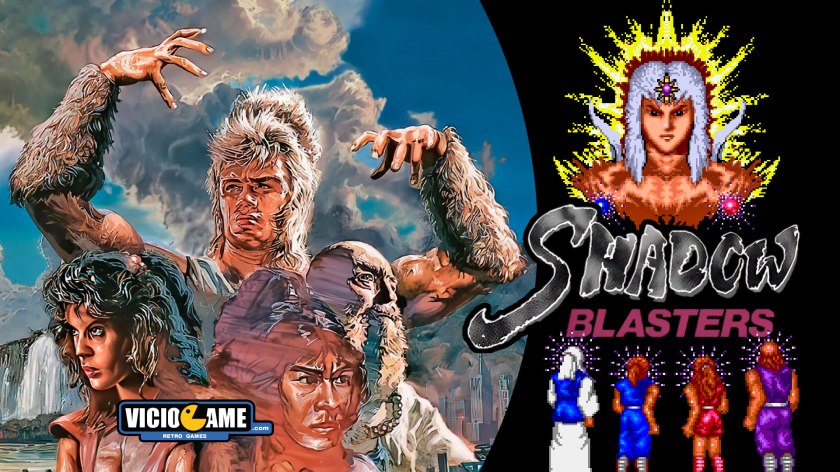
Shadow Blasters is a 2D platformer released in 1990 for the Sega Genesis. What sets it apart is the ability to switch between four heroes at any time, as each one has their own unique abilities. After Earth falls under the control of an evil force, the gods gather to choose the four greatest humans, who are tasked with bringing peace back to the planet.
Developer: Sigma Pro-Tech / Cyclone System
Publisher: Sigma Enterprises
Release date: 1990
Platform: Sega Genesis / Mega Drive
Shadow Blasters: The Ultimate Guide
Released for the Sega Genesis in 1990, Shadow Blasters (四天明王, Shiten-Myooh in Japan) makes its presence in the video game scene quite modestly. The North American version hits shelves on August 9, 1990, followed by the Japanese version on August 10, 1990. This period, the beginning of the 16-bit era, is crucial for Sega’s console, which seeks to establish its identity and compete with already established consoles. Titles released at this early stage frequently demonstrate the capabilities of the new hardware and explore new design directions.
Development was carried out by Sigma Pro-Tech with support from Cyclone System. Publishing was carried out by Sigma Enterprises in Japan and Sage’s Creation in North America. The game is primarily classified as a side-scrolling platform style, but incorporates hand-to-hand combat elements. The game also offers support for 1 or 2 simultaneous players, a valued feature that increases replayability and social interaction in homes. Shadow Blasters‘ release date positions it as one of the first games to shape the perception of the Sega Genesis. This initial phase of the console is characterized by a visual aesthetic that, for many, presents a dark atmosphere or a darker tone compared to the more vibrant graphics of competitors like Nintendo. The apprehensive music and dark environment align with this aesthetic, contributing to the visual and sound identity that the Mega Drive begins to build.
It’s possible to control one character at a time, choosing from a group of four warriors. One of the game’s most distinctive aspects is the non-linear structure of the first six stages (mountain, street, glen, harbor, forest, and future), which can be played in any order. This freedom of stage choice is compared to the mechanic popularized by the Mega Man series, giving the game a strategic layer uncommon for the time. Once a stage is completed, the player can no longer access it. As the player progresses, characters become more powerful by collecting power-ups that enhance their speed, jump, and attack power attributes.
In the Japanese version of the game, some stage names are different:
| Western | Japanese |
|---|---|
| Mountain | Rock |
| Street | Street |
| Glen | Meadow |
| Harbor | Harbor |
| Forest | Forest |
| Future | Future |
| Wicked World | Hell |
| Heavenly Sky | Heaven |
| Space | Outer Space |
The ability to switch characters at any time, accessing a selection screen through the Start button, is a central mechanic. Each warrior has their own life bar and collects power-ups independently. The death of a character makes them unusable until all others are defeated or a “continue” is activated, which effectively grants the player four distinct “lives” to manage. This strategic management of characters is fundamental to success, especially in the more advanced stages and against bosses.
Despite not being a widely acclaimed title, Shadow Blasters is known for its bizarre production values and a certain charm. For some, it’s considered underrated.
The plot is based on a cosmic conflict: an evil force from heaven descends upon Earth with the objective of subjugating all human beings with its diabolical forces. Only those with a sound mind and strong body can withstand this evil force and banish it from the face of the Earth. Meanwhile, in another dimension, a celestial paradise is enjoyed only by the gods. These benevolent gods are humanity’s protectors, but over time, human morality corrodes and evil takes hold. Shocked and disconcerted, the gods close and lock the two doors of their sanctuary. Ashura, the King of the Evil World, sees this as his golden opportunity. He sends his minions of malice, who find no resistance in dominating the already depraved human race. Earth is now under Ashura’s spell.
Saddened by this tragic event, the good gods gather and debate what to do. Said one good god: “Ashura is trying to rule not only the Evil World, but the humble human world as well. Shouldn’t we help these humans?” Said another not-so-good god: “Let them suffer!” After much debate, they decide to try to save the humans. Among the good gods, Hyprion was the greatest. He orders the assembly: “Choose four worthy humans upon whom I will bestow my power. Through them we can save Earth.” Suddenly, the clouds part and, with a flash of lightning, Hyprion’s supreme power and message are injected into the bodies of these four humans.
The story is described by critics as vague, balancedly epic and unbalanced. The premise of gods interfering in humanity’s depraved ways indicates an attempt to create a grandiose backdrop, but the narrative execution is superficial. The plot is minimalist, presented through an optional introduction and a few lines of dialogue at the game’s end. The text, which scrolls slowly, even contains some spelling errors, and all cutscenes can be skipped. Despite the thematic ambition of a divine battle of epic proportions, the way the narrative is presented in the game is quite limited. This indicates that the development priority is on gameplay and action, rather than a complex and detailed plot. This approach is common in many action titles of that era, where the premise serves more as a trigger for gameplay than as a central element of the experience.
The four warriors chosen by Hyprion to face Ashura are distinct figures, whose names and descriptions vary between the Japanese and Western versions of the game. In the Japanese version, the heroes are Kotarou and Ayame (ninjas), Kidenbou (Buddhist fighting monk), and Senshirou (swordsman).
In the English localization, their names are changed to:
Horatio: The male ninja. He is described as agile but weak, and possesses the power of fire. Horatio states: “Since childhood, I train in the art of Ninjutsu. I have already surpassed the skill of my mentor, Hakunsai, a master ninja. My special weapon is the Fire Dragon.”
Tiffany: The female ninja. Like Horatio, she is fast but weak, and manifests the power of wind. Tiffany declares: “I was born in a ninja village and have studied the art of Ninjutsu since I can remember. Now, I am highly skilled in all Ninjutsu techniques – even the village warriors fear me.”
Marco: The Buddhist monk. He is characterized as corpulent and better at brute force than religious theories. Marco states: “I am a Buddhist monk, but I am better at combating the forces of evil than reciting Buddha’s sutras. I will never yield in pursuing and destroying the evils that exist in the world.”
Leo: The swordsman. He is curiously called the best Japanese swordsman of all time, despite using boomerangs as weapons. His versatility is one of his strong points. Leo declares: “I am considered the best in Japanese swordsmanship and have never been defeated in my life. I will continue to study the art of Japanese swordsmanship until I achieve perfection or until I am killed by another man’s sword.”
The alteration of names, especially to Horatio and Tiffany, is considered generic and contributes to the general bizarreness of the game’s production. This localization practice, common in the era of 8 and 16-bit consoles, frequently results in a loss of original cultural authenticity, prioritizing supposed familiarity for Western audiences. The incongruity of a Japanese swordsman using boomerangs is a clear example of how these localization choices can introduce elements strange to the narrative, becoming part of the game’s peculiar and sometimes confusing charm.
The controls are straightforward and reflect the simplicity of 16-bit era platform games. Basic actions include walking, jumping, crouching, and firing a projectile weapon specific to each character. The directional pad is used for character movement, allowing walking left and right. Pressing down makes the warrior kneel. Pressing up allows aiming upward. Button A is dedicated to attack, and if the player holds it down, it increases the explosive power of the attack. Button B is for jumping. Button C activates a special attack that can only be used once per stage and destroys all enemies on screen. The player can fire projectiles while jumping or kneeling, or fire directly upward with Up + A.
Movement is slow, even when the character’s speed attributes are at maximum. Jumps are also very difficult. The lack of control responsiveness is a common complaint, with characters that seem to run underwater. A significant limitation is the inability to shoot diagonally or downward, which can be particularly frustrating when facing enemies that attack from lower positions or when trying to hit targets on different platforms. Contact with enemies, while not instantly fatal, causes the character to recoil. In stages that feature chasms or traps, this recoil can be dangerous, pushing the player to their death. The control lacks fluidity and precision, resulting in sporadic damage and requiring a more cautious than dynamic approach.
The character switching system is one of the most important and strategic mechanics. At any time, the player can pause the game and access a screen to select one of the four available warriors. This flexibility allows adapting strategy in real time, choosing the most suitable character for the current situation. Each of the four characters has their own life bar and collects power-ups independently. This means that damage suffered by one character doesn’t affect the others’ health. However, if a character dies, they become unusable and the text “DEATH” appears in their status. They can only be used again if all other three characters also die, leading to a “Game Over.” When using a “continue,” all characters are resurrected, but lose all power-ups they had collected before death.
The true differentiation between the four warriors lies in their unique projectile weapons and attack progression. Each character has a distinct projectile, and these attacks can be charged by holding the A button, increasing their power up to 9 phases. The graphic representation of the attack also changes at phases 3, 6, and 9, indicating the power increase.
| Hero | Power Levels | Pros | Cons |
|---|---|---|---|
| Horatio (Kotarou) | Shuriken<br>Small Fireball<br>Large Fireball<br>Fire Dragon | Strong attack, especially the Fire Dragon. Good balance between speed and attack power. | Limited range, requiring more maneuvering to align with enemies. |
| Tiffany (Ayame) | Bomb<br>Single Tornado<br>Double Tornado<br>Large Tornado | Arcing bomb attack, good frontal coverage. Double tornado (Level 6-8) offers excellent area coverage. | Level 1-2 attack doesn’t cover entire screen. Single tornado (Level 3-5) at angle makes frontal hits difficult. Maximum power attack (Level 9) loses coverage and is slower. |
| Leo (Senshirou) | Knife<br>Single Boomerang<br>Double Boomerangs<br>Large Boomerang | Highly versatile, especially with boomerangs from Level 3 onward, allowing attacks in two directions almost simultaneously. | Attack strength is not high. |
| Marco (Kidenbou) | Ball<br>Energy<br>Thunder<br>Triple Thunder | Very strong attack, even at low power levels. Can explode the opposition when enhanced. | Attack doesn’t spread much until Level 9, requiring precise alignment with enemies. |
The variation in projectile types and their power progressions is a crucial element in the game’s strategy. The player identifies which character is most effective for each type of enemy or boss, exploring the advantages of range, power, or attack pattern. For example, a boss that might be difficult for Leo’s boomerangs is quickly defeated by Horatio’s powerful charged Dragon attacks. This subtle but significant differentiation encourages experimentation and utilization of the entire cast of characters.
The power-up system is implemented through flame-shaped emblems that are dropped by defeated enemies. These emblems serve as a simplified progression system, allowing players to enhance their characters’ attributes throughout the game. There are five types of emblems, each with a distinct effect:
| Emblem Type (Color) | Effect in Game | Gameplay Impact |
|---|---|---|
| Red | Increases speed by one unit (maximum 3 times). | Greater mobility, allowing dodging attacks and traversing stages more quickly. |
| Blue | Increases jump by one unit (maximum 4). | Allows reaching higher platforms and avoiding ground obstacles more easily. |
| White | Increases attack power meter by one unit permanently. If the meter is filled (9 units), maximum power attack is automatic, without need to charge. | Reduces charging time for powerful attacks, eventually allowing maximum power attacks with a single touch, significantly increasing damage per second. |
| Crimson (Orange) | Restores one unit of life bar. | Essential for character survival, allowing them to absorb more damage before being defeated. |
| Explosive (Dark Gray) | Completely restores life bar. | A high-value life recovery item, crucial in crisis moments or before boss confrontations. |
It’s important to note that power-ups are specific to the character that collects them and don’t transfer to other characters if the current one is already at maximum for a particular attribute. This means the player considers which character is in play when collecting emblems to optimize their team’s strengthening. The emblem system functions as a micro-RPG element, rewarding enemy elimination with tangible attribute enhancements. The ability to achieve maximum power attacks with a single touch, thanks to white emblems, transforms combat dynamics, encouraging players to seek and collect these items to maximize their offensive potential.
The scoring system in Shadow Blasters is simple: it’s displayed in the upper right corner of the main screen and increases as enemies are defeated. However, the game doesn’t save high score tables, which diminishes the incentive for score-focused replayability.
The game offers two difficulty options: Normal and Hard. On Hard difficulty, enemies move faster, attack more frequently, and require more hits to be defeated. This difference is more noticeable in boss confrontations.
One of the most impactful aspects of difficulty is the presence of unlimited continues. Although a character’s death is permanent until a “Game Over” occurs, the possibility of continuing indefinitely with all characters resurrected makes the game manageable even for a novice. This characteristic creates a paradox in difficulty: individual character management is tactically challenging, but the game’s general progression is quite forgiving. Limiting the use of continues could provide a more challenging and rewarding experience. The absence of a save system or password demonstrates that the game was designed for shorter sessions focused on immediate completion.
After completing the six initial stages, the game transitions to a second part, which follows a linear and predetermined progression. This part consists of two sequential stages: Round 7 – Wicked World and Round 8 – Heavenly Sky.
The climax of Shadow Blasters is the final confrontation against the antagonist Ashura, which occurs in Stage 9 – Space. This final battle is different from previous stages in terms of control and gameplay style, seeking to offer a unique experience for the adventure’s conclusion. You have two types of attack: multiple shots with wide amplitude but short range, and single long-range shots.
However, despite the expectation of a grandiose challenge for the final confrontation, boss Ashura is easily defeated. He has a simple pattern that allows players to avoid damage and attack effectively. A tip is to spin in circles and attack him whenever there’s a chance (as shown in our gameplay at the top of this article). This ease of the final boss, after the accumulation of character power throughout the game, can be seen as an anticlimax.
Enemy design presents a duality. Common enemies, which appear in waves or sometimes are absent in entire sections of stages, are like samurai with terrible artificial intelligence or small gargoyle bats that simply move forward aimlessly or fly in a loop pattern. They are easy to defeat and die quickly.
In contrast, stage bosses, while having predictable patterns, have great diversity. The variety of bosses is a positive point, with figures ranging from a giant golem to a brain in a glass container, or a bandit who throws knives. To defeat them effectively, it’s necessary to employ characters with strong attacks and fast movements. An example is the boss The Tarman, which proves difficult for Leo’s boomerangs, but is quickly overcome by Horatio’s charged Dragon attacks. The stages themselves are poorly designed, demonstrating even ill will from the designers. Below are some details about the stages and their bosses:
Mountain: The player must be careful when crossing dangerous rock formations, as some may suddenly sink into the water. When a rock begins to sink underfoot, the player must jump. The boss of this stage is Skeltar, a huge ghostly skeleton that slides back and forth while throwing fireballs in three directions. He’s not very fast, so the player has a chance to attack.
Street: Looks like a typical street at first glance, but is hidden with holes and traps. The player must go slowly and be careful. The boss is Kallus, a giant sculpture. The only way to defeat him is to besiege his flying head. The player shouldn’t stand still for too long to avoid the stones thrown from his body.
Harbor: The player makes a dangerous journey through dilapidated warehouses to reach the harbor. One must watch out for the deadly attack of bats and spiders. The bosses are Brutus and Tarman. Brutus is a cunning and difficult boss. If the player is at a distance, he bombards them with knives, but if the player approaches, he jumps. The player must shoot when he lands. Tarman is a harmless slime blob that crawls, but when it rises, it fires flaming pitch balls. The only hope is to shoot at his weak point – his waist.
Forest: The player must not get lost in the depths of this dark and dangerous forest. Deep holes and fallen branches can knock the player to their death – if the enemy doesn’t catch them first. The boss is Vallevo. There’s no point shooting while he spins. But when he stops, this hairy mutant creature shocks with its true appearance.
Future: It’s a space base in the future. The player must clear all lethal defense systems before being able to reach the boss, Gyrrina. There’s no point attacking when Gyrrina is surrounded by barriers, but the chance arises during the seconds when the barriers are open. The player must not miss this chance.
Round 7 – Wicked World: The boss is Hawkus. This world looks like a desolate underground. The minions here are not weak, the player needs to shoot several times to defeat them. It’s important not to lose the items that increase the life bar.
Round 8 – Heavenly Sky: The boss is Wortan. Finally, a fight happens in the celestial sky. Ashura, the final enemy, is very close. The player must be careful!
Round 9 – Space: This is the final stage. It’s time to face the most dangerous enemy, Ashura. Here, instead of your 4 warriors, Hyprion himself fights against Ashura. The printed manual asks: “Can he defeat Ashura and save Earth’s future?”
Regardless of which character is used, the game doesn’t offer multiple endings. The game’s narrative culminates in a single final confrontation against Ashura in space, followed by a singular and predetermined outcome.
The graphics follow the visual style of the console’s early years. They don’t present anything special with grainy backgrounds and characters outlined in black. Some consider this a charm of old design technique. For a title released so early in the Sega Genesis‘ life, the visual presentation fulfills its role.
The game makes use of visual techniques that are important for the hardware. It features beautiful parallax scrolling, which creates the illusion of depth by moving different background layers at varying speeds. Stylish sprites and the presence of sufficient dithering to please pixel art purists are characteristics. Dithering, a stippling technique, is frequently employed to simulate a broader color palette than the device’s native capabilities. Magazines of the time criticized some stages, claiming they could have used more colors and that the graphics in general are not very colorful.
The characters, in turn, are generic and remind one of the Gauntlet cast or the Sinbad character. However, the game benefits from a dark atmosphere common in pre-Sonic Mega Drive titles, with many night skies, lonely landscapes, and ruined buildings. This aesthetic aligns with the visual identity that Sega sought for the console in its early years, before the explosion of colors and speed of Sonic the Hedgehog.
The soundtrack, composed by Kim Songdong, is highlighted for its quality. The music is very pleasant, capable of exciting at specific moments. Some tracks have a style reminiscent of the techno of the time.
Contrary to the music, the sound effects are sharp and irritating. The sounds of the characters’ projectiles are like whispers, which can diminish the impact of combat. Additionally, the sound is muffled by the music, with an imbalance in audio mixing. Furthermore, the music can stop abruptly when encountering enemies, which affects the game’s energy and rhythm. It’s a real challenge to work with the Sega Genesis‘ YM2612 sound chip, which, while distinct and capable of rich sounds via FM synthesis, also has technical limitations.
The development of Shadow Blasters happened through the collaboration of two companies. Sigma Pro-Tech was the main developer, while Cyclone System served as additional support. Sigma Pro-Tech has a relatively small game catalog, releasing only three titles between 1988 and 1991: Shadow Blasters, Aerostar, and Zoom!. However, it was already an arcade developer since the 70s. Cyclone System, in turn, released five games between 1988 and 1992, including Shadow Blasters, Saint Sword, Cadash, Wurm: Journey to the Center of the Earth, and Zoom!. Both companies were smaller studios, practically independent, which implied restricted resources and tight deadlines.
The responsibility for publishing was divided between two entities as well: Sigma Enterprises in Japan and Sage’s Creation in North America. Sage’s Creation was an American publisher specialized in bringing Japanese games to Sega platforms. The company had a relatively short existence, disappearing from the market in 1992. After its closure, some titles that were planned to be released by Sage’s Creation were transferred to other publishers, such as Sega itself or Flying Edge. This illustrates a common dynamic in the video game market of the early 90s: the existence of smaller publishers that dedicated themselves to localizing and distributing Japanese titles that didn’t have the appeal of major releases for larger publishers.
Despite its unique characteristics and appreciation from a niche of fans, it didn’t exert a broad or lasting influence on the general video game scene. It didn’t even inspire other franchises or establish design trends. Its main legacy lies in its status as an obscure title or historical footnote. The fact that its developers produced only a few games, and its North American publisher disappeared quickly, significantly limits any potential for direct influence through sequels or a legacy of continuous development by the original teams.
However, even without massive impact, it contributes to the rich diversity of video game history. It represents a specific moment in development for Sega’s console, reflecting the challenges and design philosophies of the time. For retro game enthusiasts, the game offers a peculiar and fun experience, a glimpse of the creativity that flourished at the beginning of the 16-bit era.
The game stands out for its innovative mechanics, such as the character switching system and the non-linear selection of the six initial stages. The ability to alternate between four warriors, each with their own life bar and power-up progression, transforms the team into a strategic resource to be managed, adding a tactical layer. The non-linearity of stages, while not offering an obvious strategic advantage like in Mega Man, provides freedom to the player and increases replayability.
For retro game enthusiasts, it offers a peculiar and fun experience, a glimpse of the creativity that flourished at the beginning of the 16-bit era. In the right measure for those looking for a short-duration game with tactical satisfaction of managing multiple characters simultaneously. Shadow Blasters is a reminder that not every game needs to be perfect to have a place in history, contributing to the rich and d
Shadow Blasters: O Guia Definitivo
Lançado para o Sega Genesis em 1990, Shadow Blasters (四天明王, Shiten-Myooh no Japão) marca sua presença no cenário dos videogames de forma bem tímida. A versão norte-americana chega às prateleiras em 9 de agosto de 1990, seguida pela japonesa em 10 de agosto de 1990. Este período, o início da era de 16 bits, é crucial para o console da Sega, que busca estabelecer sua identidade e competir com consoles já consolidados. Títulos lançados nesse estágio inicial frequentemente demonstram as capacidades do novo hardware e exploram novas direções de design.
O desenvolvimento ficou a cargo da Sigma Pro-Tech com apoio da Cyclone System. A publicação é realizada pela Sigma Enterprises no Japão e pela Sage’s Creation na América do Norte. O jogo é classificado primariamente como um estilo plataforma de rolagem lateral, mas incorpora elementos de combate corpo-a-corpo. O jogo também oferece suporte para 1 ou 2 jogadores simultâneos, um recurso valorizado que aumenta a rejogabilidade e a interação social nos lares. A data de lançamento de Shadow Blasters o posiciona como um dos primeiros jogos a moldar a percepção do Sega Genesis. Essa fase inicial do console é caracterizada por uma estética visual que, para muitos, apresenta uma atmosfera sombria ou um tom mais sombrio em comparação com os gráficos mais vibrantes de concorrentes como a Nintendo. A música apreensiva e o ambiente escuro se alinham a essa estética, contribuindo para a identidade visual e sonora que o Mega Drive começa a construir.
É possível controlar um personagem por vez, escolhendo entre um grupo de quatro guerreiros. Um dos aspectos mais distintivos do jogo é a estrutura não linear das seis primeiras fases (montanha, rua, vale, porto, floresta e futurista), que podem ser jogadas em qualquer ordem. Essa liberdade de escolha de fases é comparada à mecânica popularizada pela série Mega Man, conferindo ao jogo uma camada estratégica incomum para a época. Uma vez que uma fase é concluída, o jogador não pode mais acessá-la. À medida que o jogador avança, os personagens se tornam mais poderosos ao coletar power-ups que aprimoram seus atributos de velocidade, salto e poder de ataque.
Na versão japonesa do jogo, os nomes de algumas fases são diferentes:
| Ocidental | Japonês |
| Mountain | Rock |
| Street | Street |
| Glen | Meadow |
| Harbor | Harbor |
| Forest | Forest |
| Future | Future |
| Wicked World | Hell |
| Heavenly Sky | Heaven |
| Space | Outer Space |
A capacidade de trocar de personagem a qualquer momento, acessando uma tela de seleção através do botão Start, é uma mecânica central. Cada guerreiro possui sua própria barra de vida e coleta power-ups de forma independente. A morte de um personagem o torna inutilizável até que todos os outros sejam derrotados ou um “continue” seja acionado, o que efetivamente concede ao jogador quatro “vidas” distintas para gerenciar. Essa gestão estratégica dos personagens é fundamental para o sucesso, especialmente nas fases mais avançadas e contra os chefes.
Apesar de não ser um título amplamente aclamado, Shadow Blasters é conhecido por seus valores de produção bizarros e um certo charme. Para alguns, é considerado subestimado.
A trama é fundamentada em um conflito cósmico: uma força maligna do céu desce sobre a Terra com o objetivo de subjugar todos os seres humanos com suas forças diabólicas. Somente aqueles com uma mente sã e um corpo forte podem suportar essa força maligna e bani-la da face da Terra. Enquanto isso, em outra dimensão, um paraíso celestial é desfrutado apenas pelos deuses. Esses deuses benevolentes são os protetores da humanidade, mas com o tempo, a moral humana se corrói e a maldade se instala. Chocados e desconcertados, os deuses fecham e trancam as duas portas de seu santuário. Ashura, o Rei do Mundo do Mal, vê isso como sua oportunidade de ouro. Ele envia seus lacaios da malícia, que não encontram resistência ao dominar a raça humana já depravada. A Terra agora está sob o feitiço de Ashura.
Entristecidos por esse evento trágico, os bons deuses se reúnem e debatem sobre o que fazer. Disse um deus bondoso: “Ashura está tentando governar não apenas o Mundo do Mal, mas o humilde mundo humano também. Não deveríamos ajudar esses humanos?” Disse outro deus não tão bondoso: “Deixe-os sofrer!” Após muito debate, eles decidem tentar salvar os humanos. Entre os bons deuses Hyprion era o maior. Ele ordena a reunião: “Escolham quatro humanos dignos sobre os quais eu concederei meu poder. Através deles podemos salvar a Terra“. De repente, as nuvens se separam e, com um clarão de relâmpago, o poder supremo e a mensagem de Hyprion são injetados nos corpos desses quatro humanos.
A história é descrita por críticos como vaga, equilibradamente épica e desequilibrada. A premissa de deuses interferindo nos modos depravados da humanidade indica uma tentativa de criar um pano de fundo grandioso, mas a execução narrativa é superficial. O enredo é minimalista, apresentado através de uma introdução opcional e algumas poucas linhas de diálogo no final do jogo. O texto, que rola lentamente, contém inclusive alguns erros de ortografia, e todas as cutscenes podem ser puladas. Apesar da ambição temática de uma batalha divina de proporções épicas, a forma como a narrativa é apresentada no jogo é bastante limitada. Isso indica que a prioridade no desenvolvimento está na jogabilidade e na ação, em vez de um enredo complexo e detalhado. Essa abordagem é comum em muitos títulos de ação daquela época, onde a premissa serve mais como um gatilho para a jogabilidade do que como um elemento central da experiência.
Os quatro guerreiros escolhidos por Hyprion para enfrentar Ashura são figuras distintas, cujos nomes e descrições variam entre as versões japonesa e ocidental do jogo. Na versão japonesa, os heróis são Kotarou e Ayame (ninjas), Kidenbou (monge budista lutador), e Senshirou (esgrimista).
Na localização para o inglês, seus nomes são alterados para:
Horatio: O ninja masculino. Ele é descrito como ágil, mas fraco, e possui o poder de fogo. Horatio afirma: “Desde a infância, treino na arte do Ninjutsu. Já superei a habilidade do meu mentor, Hakunsai, um mestre ninja. Minha arma especial é o Fire Dragon“.
Tiffany: A ninja feminina. Assim como Horatio, ela é rápida, mas fraca, e manifesta o poder do vento. Tiffany declara: “Nasci em uma vila ninja e estudo a arte do Ninjutsu desde que me lembro. Agora, sou altamente habilidosa em todas as técnicas de Ninjutsu – até os guerreiros da vila me temem“.
Marco: O monge budista. É caracterizado como corpulento e melhor na força bruta, do que nas teorias religiosas. Marco afirma: “Sou um monge budista, mas sou melhor em combater as forças do mal do que em recitar os sutras de Buda. Nunca cederei em perseguir e destruir os males que existem no mundo“.
Leo: O esgrimista. É curiosamente chamado de o melhor esgrimista japonês de todos os tempos, apesar de utilizar bumerangues como armas. Sua versatilidade é um de seus pontos fortes. Leo declara: “Sou considerado o melhor na esgrima japonesa e nunca fui derrotado em minha vida. Continuarei a estudar a arte da esgrima japonesa até alcançar a perfeição ou até ser morto pela espada de outro homem“.
A alteração dos nomes, especialmente para Horatio e Tiffany, é considerada genérica e contribui para a bizarrice geral da produção do jogo. Essa prática de localização, comum na época dos consoles de 8 e 16 bits, frequentemente resulta em uma perda da autenticidade cultural original, priorizando uma suposta familiaridade para o público ocidental. A incongruência de um esgrimista japonês usando bumerangues é um exemplo claro de como essas escolhas de localização podem introduzir elementos estranhos à narrativa, tornando-se parte do charme peculiar e, por vezes, confuso do jogo.
Os controles são diretos e refletem a simplicidade dos jogos de plataforma da era 16 bits. As ações básicas incluem andar, pular, agachar e disparar uma arma de projétil específica para cada personagem. O direcional é utilizado para a movimentação do personagem, permitindo andar para a esquerda e direita. Pressionar para baixo faz o guerreiro ajoelhar. Pressionar para cima permite mirar para cima. O botão A é dedicado ao ataque, e se o jogador o mantém pressionado, aumenta o poder explosivo do ataque. O botão B é para o salto. O botão C ativa um ataque especial que pode ser usado apenas uma vez por fase e destrói todos os inimigos na tela. O jogador pode disparar projéteis enquanto pula ou ajoelha, ou disparar diretamente para cima com Cima + A.
A movimentação é lenta, mesmo quando os atributos de velocidade do personagem estão no máximo. Os saltos também são muito difíceis. A falta de responsividade dos controles é uma queixa comum, com personagens que parecem correr debaixo d’água. Uma limitação significativa é a incapacidade de atirar na diagonal ou para baixo, o que pode ser particularmente frustrante ao enfrentar inimigos que atacam de posições inferiores ou ao tentar atingir alvos em plataformas diferentes. O contato com inimigos, embora não seja fatal instantaneamente, causa um recuo no personagem. Em fases que apresentam abismos ou armadilhas, esse recuo pode ser perigoso, empurrando o jogador para a morte. O controle carece de fluidez e precisão, resultando em danos esporádicos e exigindo uma abordagem mais cautelosa do que dinâmica.
O sistema de troca de personagens é uma das mecânicas mais importantes e estratégicas. A qualquer momento, o jogador pode pausar o jogo e acessar uma tela para selecionar um dos quatro guerreiros disponíveis. Essa flexibilidade permite adaptar a estratégia em tempo real, escolhendo o personagem mais adequado para a situação atual. Cada um dos quatro personagens possui sua própria barra de vida e coleta power-ups de forma independente. Isso significa que o dano sofrido por um personagem não afeta a vida dos outros. No entanto, se um personagem morre, ele se torna inutilizável e o texto “DEATH” aparece em seu status. Ele só pode ser usado novamente se todos os outros três personagens também morrem, levando a um “Game Over”. Ao usar um “continue”, todos os personagens são ressuscitados, mas perdem todos os power-ups que haviam coletado antes da morte.
A verdadeira diferenciação entre os quatro guerreiros está em suas armas de projéteis únicas e na progressão de seus ataques. Cada personagem possui um projétil distinto, e esses ataques podem ser carregados segurando o botão A, aumentando seu poder em até 9 fases. A representação gráfica do ataque também muda nas fases 3, 6 e 9, indicando o aumento de poder.
| Herói | Níveis de poder | Prós | Contras |
|---|---|---|---|
| Horatio (Kotarou) | Shuriken Bola de Fogo Pequena Bola de Fogo Grande Dragão de Fogo | Ataque forte, especialmente o Dragão de Fogo. Bom equilíbrio entre velocidade e poder de ataque. | Alcance limitado, exigindo mais manobras para alinhar com inimigos. |
| Tiffany (Ayame) | Bomba Tornado Único Tornado Duplo Tornado Grande | Ataque de bomba em arco, boa cobertura frontal. Tornado duplo (Nível 6-8) oferece excelente cobertura de área. | Ataque Nível 1-2 não cobre a tela inteira. Tornado único (Nível 3-5) em ângulo dificulta acertos frontais. Ataque de poder máximo (Nível 9) perde a cobertura e é mais lento. |
| Leo (Senshirou) | Faca Bumerangue Único Bumerangues Duplos Bumerangue Grande | Altamente versátil, especialmente com bumerangues a partir do Nível 3, permitindo atacar em duas direções quase simultaneamente. | Força de ataque não é alta. |
| Marco (Kidenbou) | Bola Energia Trovão Trovão Triplo | Ataque muito forte, mesmo em níveis de poder baixos. Pode explodir a oposição quando aprimorado. | Ataque não se espalha muito até o Nível 9, exigindo alinhamento preciso com os inimigos. |
A variação nos tipos de projéteis e suas progressões de poder é um elemento crucial na estratégia do jogo. O jogador identifica qual personagem é mais eficaz para cada tipo de inimigo ou chefe, explorando as vantagens de alcance, poder ou padrão de ataque. Por exemplo, um chefe que pode ser difícil para os bumerangues de Leo é rapidamente derrotado pelos poderosos ataques carregados de Dragão de Horatio. Essa diferenciação sutil, mas significativa, incentiva a experimentação e a utilização de todo o elenco de personagens.
O sistema de power-ups é implementado através de emblemas em forma de chama que são deixados por inimigos derrotados. Esses emblemas servem como um sistema de progressão simplificado, permitindo que os jogadores aprimorem os atributos de seus personagens ao longo do jogo. Existem cinco tipos de emblemas, cada um com um efeito distinto:
| Tipo de Emblema (Cor) | Efeito no Jogo | Impacto na jogabilidade |
| Vermelho | Aumenta a velocidade em uma unidade (máximo de 3 vezes). | Maior mobilidade, permitindo desviar de ataques e atravessar fases mais rapidamente. |
| Azul | Aumenta o salto em uma unidade (máximo de 4). | Permite alcançar plataformas mais altas e evitar obstáculos no solo com mais facilidade. |
| Branco | Aumenta o medidor de poder de ataque em uma unidade permanentemente. Se o medidor for preenchido (9 unidades), o ataque de poder máximo é automático, sem necessidade de carregar. | Reduz o tempo de carregamento para ataques poderosos, eventualmente permitindo ataques de poder máximo com um único toque, aumentando significativamente o dano por segundo. |
| Carmesim (Laranja) | Restaura uma unidade da barra de vida. | Essencial para a sobrevivência do personagem, permitindo que ele absorva mais dano antes de ser derrotado. |
| Explosivo (Cinza-escuro) | Restaura completamente a barra de vida. | Um item de recuperação de vida de alto valor, crucial em momentos de crise ou antes de confrontos com chefes. |
É importante notar que os power-ups são específicos para o personagem que os coleta e não se transferem para outros personagens se o atual já está no máximo de um determinado atributo. Isso significa que o jogador considera qual personagem está em jogo ao coletar emblemas para otimizar o fortalecimento de sua equipe. O sistema de emblemas funciona como um elemento de micro-RPG, recompensando a eliminação de inimigos com aprimoramentos tangíveis de atributos. A capacidade de alcançar ataques de poder máximo com um único toque, graças aos emblemas brancos, transforma a dinâmica do combate, incentivando os jogadores a buscar e coletar esses itens para maximizar seu potencial ofensivo.
O sistema de pontuação em Shadow Blasters é simples: ela é é exibida no canto superior direito da tela principal e aumenta à medida que os inimigos são derrotados. No entanto, o jogo não salva a tabela de recordes, o que diminui o incentivo para a rejogabilidade focada em pontuação.
O jogo oferece duas opções de dificuldade: Normal e Hard. Na dificuldade Hard, os inimigos se movem mais rapidamente, atacam com mais frequência e exigem mais golpes para serem derrotados. Essa diferença é mais perceptível nos confrontos com chefes.
Um dos aspectos mais impactantes da dificuldade é a presença de continues ilimitados. Embora a morte de um personagem seja permanente até que um “Game Over” ocorra, a possibilidade de continuar indefinidamente com todos os personagens ressuscitados torna o jogo gerenciável mesmo para um novato. Essa característica cria um paradoxo na dificuldade: o gerenciamento individual dos personagens é taticamente desafiador, mas a progressão geral do jogo é bastante perdoável. Limitar o uso de continues poderia proporcionar uma experiência mais desafiadora e gratificante. A ausência de um sistema de salvamento ou de password demonstra que o jogo foi projetado para sessões mais curtas e focadas na conclusão imediata.
Após a conclusão das seis fases iniciais, o jogo transita para uma segunda parte, que segue uma progressão linear e predeterminada. Esta parte consiste em duas fases sequenciais: Round 7 – Wicked World e Round 8 – Heavenly Sky.
O clímax de Shadow Blasters é o confronto final contra o antagonista Ashura, que ocorre na Fase 9 – Space. Esta batalha final é diferente das fases anteriores em termos de controle e estilo de jogo, buscando oferecer uma experiência única para o desfecho da aventura. Você tem dois tipos de ataque: tiros múltiplis com grande amplitude, porém com curto alcance, e tiro único de longo alcance.
No entanto, apesar da expectativa de um desafio grandioso para o confronto final, o chefe Ashura é facilmente derrotado. Ele possui um padrão simples que permite aos jogadores evitar danos e atacar de forma eficaz. Uma dica é girar em círculos e atacá-lo sempre que há uma chance (como mostrado em nossa gameplay que está no topo deste artigo). Essa facilidade do chefe final, após o acúmulo de poder dos personagens ao longo do jogo, pode ser vista como um anticlimax.
O design de inimigos apresenta uma dualidade. Os inimigos comuns, que aparecem em ondas ou, por vezes, estão ausentes em seções inteiras das fases, são como samurais com péssima inteligência artificial ou pequenos morcegos gárgulas que simplesmente param para frente sem rumo ou voam em um padrão de loop. Eles são fáceis de derrotar e morrem rapidamente.
Em contraste, os chefes de fase, embora possuam padrões previsíveis, tem grande diversidade. A variedade de chefes é um ponto positivo, com figuras que vão desde um golem gigante a um cérebro em um recipiente de vidro, ou um bandido que atira facas. Para derrotá-los de forma eficaz, é necessário empregar personagens com ataques fortes e movimentos rápidos. Um exemplo é o chefe The Tarman, que se mostra difícil para os bumerangues de Leo, mas é rapidamente superado pelos ataques carregados de Dragão de Horatio. As fases em si são mal projetadas, demonstrando até má vontade dos designers. Abaixo estão alguns detalhes sobre as fases e seus chefes:
Mountain: O jogador deve ter cuidado ao atravessar formações rochosas perigosas, pois algumas podem afundar repentinamente na água. Quando uma rocha começa a afundar sob os pés, o jogador deve pular. O chefe desta fase é Skeltar, um esqueleto fantasmagórico enorme que desliza para frente e para trás enquanto arremessa bolas de fogo em três direções. Ele não é muito rápido, então o jogador tem chance de atacar.
Street: Parece uma rua típica à primeira vista, mas está escondida com buracos e armadilhas. O jogador deve ir com calma e ter cuidado. O chefe é Kallus, um gigante esculpido. A única maneira de derrotá-lo é sitiar sua cabeça voadora. O jogador não deve ficar parado por muito tempo para evitar as pedras arremessadas de seu corpo.
Harbor: O jogador faz uma jornada perigosa por armazéns dilapidados para chegar ao porto. Deve-se ficar atento ao ataque mortal de morcegos e aranhas. Os chefes são Brutus e Tarman. Brutus é um chefe astuto e difícil. Se o jogador está à distância, ele o bombardeia com facas, mas se o jogador se aproxima, ele salta. O jogador deve atirar quando ele aterrissa. Tarman é uma mancha de lodo inofensiva que se arrasta, mas quando se levanta, dispara bolas de piche flamejantes. A única esperança é atirar em seu ponto fraco-sua cintura.
Forest: O jogador não deve se perder na profundidade desta floresta escura e perigosa. Buracos profundos e galhos caídos podem derrubar o jogador para a morte-se o inimigo não o pegar primeiro. O chefe é Vallevo. Não adianta atirar enquanto ele gira. Mas quando ele para, essa criatura mutante peluda choca com sua verdadeira aparência.
Future: É uma base espacial no futuro. O jogador deve limpar todos os sistemas de defesa letais antes de conseguir alcançar o chefe, Gyrrina. Não adianta atacar quando Gyrrina está cercada por barreiras, mas a chance surge durante os segundos em que as barreiras estão abertas. O jogador não deve perder essa chance.
Round 7 – Wicked World: O chefe é Hawkus. Este mundo parece um subterrâneo desolado. Os lacaios aqui não são fracos, o jogador precisa atirar várias vezes para derrotá-los. É importante não perder os itens que aumentam a barra de vida.
Round 8 – Heavenly Sky: O chefe é Wortan. Finalmente, uma luta acontece no céu celestial. Ashura, o inimigo final, está muito perto. O jogador deve ter cuidado!
Round 9 – Space: Esta é a fase final. É hora de enfrentar o inimigo mais perigoso, Ashura. Aqui, em vez dos seus 4 guerreiros, o próprio Hyprion luta contra Ashura. O manual impresso questiona: “Ele pode derrotar Ashura e salvar o futuro da Terra?“.
Seja qual for o personagem utilizado, o jogo não oferece múltiplos finais. A narrativa do jogo culmina em um único confronto final contra Ashura no espaço, seguido por um desfecho singular e predeterminado.
Os gráficos seguem o estilo visual dos primeiros anos do console. Não apresentam nada de especial com cenários granulados e personagens delineados em preto. Há quem considere isso um charme da velha técnica de design. Para um título lançado tão cedo na vida do Sega Genesis, a apresentação visual cumpre seu papel.
O jogo faz uso de técnicas visuais que são importantes para o hardware. Apresenta um belo parallax scrolling, que cria a ilusão de profundidade ao mover diferentes camadas de fundo em velocidades variadas. Os sprites estilosos e a presença de dithering suficiente para agradar os puristas de pixel art são características. O dithering, uma técnica de pontilhamento, é frequentemente empregado para simular uma paleta de cores mais ampla do que as capacidades nativas do aparelho. Revistas da época criticaram algumas fases, alegando que poderiam ter usado mais cores e que os gráficos em geral não são muito coloridos.
Os personagens, por sua vez, são genéricos e lembram o elenco de Gauntlet ou o personagem Sinbad. No entanto, o jogo se beneficia de uma atmosfera sombria comum em títulos pré-Sonic do Mega Drive, com muitos céus noturnos, paisagens solitárias e edifícios em ruínas. Essa estética alinha-se com a identidade visual que a Sega buscava para o console em seus primeiros anos, antes da explosão de cores e velocidade de Sonic the Hedgehog.
A trilha sonora, composta por Kim Songdong, é destacada por sua qualidade. A música é muito agradável, capaz de empolgar em momentos específicos. Algumas faixas têm um estilo que remete ao tecno da época.
Contrariamente à música, os efeitos sonoros são agudos e irritantes. Os sons dos projéteis dos personagens são como sussurros, o que pode diminuir o impacto do combate. Além disso, o som é abafado pela música, com um desequilíbrio na mixagem de áudio. Além disso, a música pode parar abruptamente ao encontrar inimigos, o que afeta a energia e o ritmo do jogo. É um verdadeiro desafio trabalhar com o chip de som YM2612 do Sega Genesis, que, embora distinto e capaz de sons ricos via síntese FM, também possui limitações técnicas.
O desenvolvimento de Shadow Blasters aconteceu por meio da colaboração de duas empresas. A Sigma Pro-Tech foi a desenvolvedora principal, enquanto a Cyclone System serviu de apoio adicional. A Sigma Pro-Tech possui um catálogo de jogos relativamente pequeno, lançando apenas três títulos entre 1988 e 1991: Shadow Blasters, Aerostar e Zoom!. No entanto, já era uma desenvolvedora de arcade desde os anos 70. A Cyclone System, por sua vez, lançou cinco jogos entre 1988 e 1992, incluindo Shadow Blasters, Saint Sword, Cadash, Wurm: Journey to the Center of the Earth e Zoom!. Ambas companhias eram estúdios de menor porte, praticamente independentes, o que implicou em recursos restritos e prazos apertados.
A responsabilidade pela publicação foi dividida entre duas entidades também: a Sigma Enterprises no Japão e a Sage’s Creation na América do Norte. A Sage’s Creation era uma editora americana especializada em trazer jogos japoneses para as plataformas da Sega. A empresa teve uma existência relativamente curta, desaparecendo do mercado em 1992. Após seu fechamento, alguns títulos que estavam planejados para serem lançados pela Sage’s Creation foram transferidos para outras editoras, como a própria Sega ou a Flying Edge. Isso ilustra uma dinâmica comum no mercado de videogames do início dos anos 90: a existência de editoras menores que se dedicavam a localizar e distribuir títulos japoneses que não tinham o apelo de grandes lançamentos para as editoras maiores.
Apesar de suas características únicas e do apreço de um nicho de fãs, não exerceu uma influência ampla ou duradoura no cenário geral dos videogames. Nem sequer inspirou outras franquias ou estabeleceu tendências de design. Seu legado principal está em seu status como um título obscuro ou nota de rodapé histórica. O fato de seus desenvolvedores terem produzido apenas alguns jogos, e sua publicadora norte-americana ter desaparecido rapidamente, limita significativamente qualquer potencial de influência direta através de sequências ou de um legado de desenvolvimento contínuo pelas equipes originais.
No entanto, mesmo sem um impacto massivo, contribui para a rica diversidade da história dos jogos eletrônicos. Ele representa um momento específico no desenvolvimento para o console da Sega, refletindo os desafios e as filosofias de design da época. Para os entusiastas de jogos retrô, o jogo oferece uma experiência peculiar e divertida, um vislumbre da criatividade que floresce no início da era de 16 bits.
O jogo se destaca por suas mecânicas inovadoras, como o sistema de troca de personagens e a seleção não linear das seis fases iniciais. A capacidade de alternar entre quatro guerreiros, cada um com sua própria barra de vida e progressão de power-ups, transforma a equipe em um recurso estratégico a ser gerenciado, adicionando uma camada tática. A não-linearidade das fases, embora não ofereça uma vantagem estratégica óbvia como em Mega Man, proporciona liberdade ao jogador e aumenta a rejogabilidade.
Para os entusiastas de jogos retrô, ele oferece uma experiência peculiar e divertida, um vislumbre da criatividade que floresce no início da era de 16 bits. Na medida certa para quem procura um jogo de curta duração e com satisfação tática de gerenciar vários personagens simultaneamente. Shadow Blasters é um lembrete de que nem todo jogo precisa ser um perfeito para ter um lugar na história, contribuindo para a rica e diversa história do universo dos videogames.
🤑💲Earn money without doing anything! Just leave these apps open:
   ✓ https://r.honeygain.me/CONTA9DB02

   ✓ https://packetstream.io/?psr=1uPb
🤑💲1-Click button earns Bitcoin every 1 hour: https://freebitco.in/?r=53528449
⬛ 𝗧𝗶𝗸𝗧𝗼𝗸: https://www.tiktok.com/@viciogame
🟧 𝗜𝗻𝘀𝘁𝗮𝗴𝗿𝗮𝗺: http://www.instagram.com/viciogame
🟥 𝗬𝗼𝘂𝘁𝘂𝗯𝗲: http://www.youtube.com/viciogame
🟦 𝗙𝗮𝗰𝗲𝗯𝗼𝗼𝗸: http://www.facebook.com/viciogame
🔳 𝗧𝗵𝗿𝗲𝗮𝗱𝘀: https://www.threads.net/@viciogame
🟪 𝗧𝘄𝗶𝘁𝗰𝗵: https://www.twitch.tv/ViciogameRetroGames
🟨 𝗕𝗹𝗼𝗴: http://www.viciogameblog.com/
🟦𝗧𝘄𝗶𝘁𝘁𝗲𝗿: http://www.twitter.com/viciogame
#Viciogame #Gameplay #LetsPlay #Gamer #Playthrough #Games #News #Videogames #Review #Game #Detonado #Walkthrough #Ending #Reviews #Facts #Retro #Record #Roms #Emulator #Longplay #Speedrun #ShadowBlasters #SegaGenesis #MegaDrive #Sega #Genesis #Sigma #四天明王 #ShitenMyooh #MegaMan #TecToy #Ashura #メガドライブ #セガ
 VICIOGAME