
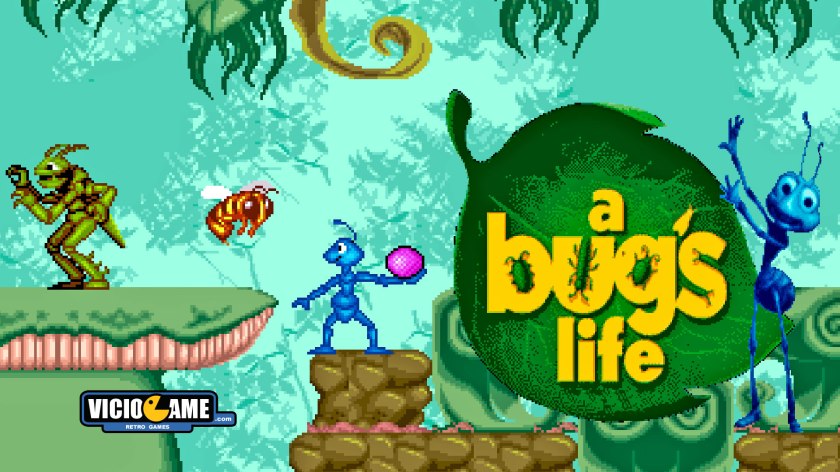
A Bug’s Life is a 2D platformer game unofficially released for Super Nintendo in 1998. It’s a port of the official Game Boy Color version with several visual improvements, but with several levels cut out. Flink begins his journey to save his ant colony from the oppression of Hopper, a cruel grasshopper, and his gang of bullies.
Developer/Publisher: DVS Electronic
Release date: 1998
Platform: Super Nintendo Entertainment System
A Bug’s Life: The Ultimate Guide
The year 1998 marked the debut of A Bug’s Life, the second production from the acclaimed partnership between Disney and Pixar, which quickly won over audiences with its engaging narrative and charismatic characters. As was common for major film releases of the era, the movie generated a series of video game adaptations across various platforms including PlayStation, Nintendo 64, PC, and Game Boy Color. The console and PC versions presented themselves as 3D platform games, developed by studios like Traveller’s Tales and published by industry giants such as Disney Interactive, SCEA, and Activision. The Game Boy Color version, in turn, offered a more traditional 2D experience, developed by Tiertex and published by THQ.
However, amid these official adaptations, a peculiar and often forgotten entry emerged in video game history: an unofficial version of A Bug’s Life for the Super Nintendo (SNES). This type of pirate game release was a common phenomenon in the 16-bit era, especially in markets with less stringent copyright regulation.
This is a direct port of the Game Boy Color (GBC) version of the game, which was itself ported to the Sega Genesis in North America by Unite Lucky Technology in the year 2000. From this Mega Drive version, the SNES port was subsequently created in the same year.
DVS Electronic Co. is a Ukrainian company founded in April 2000, with a primary focus on developing gaming and multimedia products. While not a renowned developer in the official scene, it is known in unlicensed gaming circles for other pirate titles for Nintendo’s 16-bit console, such as “Aladdin 2000.”
The cascading portability process, from handheld to Genesis, and then to SNES, brought with it a series of technical challenges and compromises that shaped the final gaming experience. The original Game Boy Color version had eight stages, but both ports retained only four of them. The reduction in stage count and content cuts occurred due to time constraints, resource limitations, and technical difficulties inherent to the unauthorized porting process.
Additionally, the way graphic and audio elements were handled reveals the improvised nature of these developments. The Genesis port demonstrated an improvement in graphic and audio quality compared to the original, even incorporating assets from PlayStation, Nintendo 64, and PC versions, such as the “Game Over” screen and the leaf-shaped health meter.
The SNES version suffered degradation in musical quality, with its soundtrack being taken from the game Bonkers. The unofficial release resulted in a diminished user experience. The game has poor physics and is difficult to control, representing a critical failure for a platform game.
The narrative of A Bug’s Life for the Super Nintendo follows the plot of the original Disney/Pixar film. The central storyline revolves around the adventures of Flik, an inventive and clumsy ant, on his mission to save his colony from the oppression of Hopper and his band of grasshoppers. The story is presented in a simplified and truncated manner, through static screens with explanatory text, rather than cinematic cutscenes.
The main character, Flik, is the playable protagonist, and other important characters from the film, such as Hopper (the main antagonist), Dim (the rhinoceros beetle), and Princess Dot, make appearances in the game. Basic movement mechanics include walking left/right, jumping, and crouching. Flik’s primary attack method is throwing berries.
The graphics are updates made from the Mega Drive version. However, the franchise in general, even in its official versions, was criticized for poorly rendered and lifeless character models compared to the film, including in later generation versions.
The simple existence of a game like A Bug’s Life for SNES represents a direct challenge to Disney/Pixar and Nintendo’s intellectual property rights. Both companies have a well-documented history of aggressive legal action against unauthorized use of their intellectual property. The fact that it was released and circulated represents the limitations of intellectual property enforcement in the pre-internet era and across international borders. The proliferation of pirate games like this represents a silent war between rights holders and underground developers.
The first stage is Ant Island, and introduces the basic mechanics of the game, with Flik navigating through the ant colony environment. The main objective is to traverse platforms and overcome obstacles. Flik must jump over ledges and throw berries at enemies. The main adversaries are grasshoppers and worms that emerge from the ground. It’s crucial to manage berry usage, as they are the primary offensive tool.
The second stage is Find The Hero, considered the slowest and most frustrating in the game, and requires patience and precision. It’s characterized by slow event sequences and game mechanics that drag progression. Initially, Flik must ride a beetle to knock down pillars and be launched through waterfalls. Next, it’s necessary to shoot with a cannon to hit the grasshopper three times. It’s not possible to hit it immediately like in the first two times. Flik also needs to manipulate a caterpillar so it doesn’t sleep next to golden leaves. Finally, it’s necessary to wait for a spider to weave webs to allow traversal of certain areas. Patience is fundamental. Each of these sequences is extremely slow, and precision in commands is necessary to avoid repetitions.
The third stage focuses more on evasion and strategic use of Flik’s movement. The main task is to avoid enemies along the path. Focus on efficient movements and minimizing direct confrontation with enemies.
The fourth stage is the last, an auto-scrolling stage where the main objective is survival. The screen advances automatically, requiring Flik to move and react quickly to obstacles and enemies. Here we encounter Hopper flying in specific patterns. The priority is evasion and quick reaction. It’s essential to anticipate the movements of the scenery and enemies to avoid collisions. The ending merely mirrors the film’s conclusion, summarizing itself to two sequential scenes to tell the plot’s end.
The experience of playing A Bug’s Life on the Super Nintendo is that of a technically compromised and severely truncated platform game. It offers a challenge that is more often frustrating than rewarding, imposed by imprecise controls, poor physics, and stage design that drags painfully. Far from being a masterpiece, it’s a product that reflects the limitations and questionable practices of unlicensed game development.
Despite its flaws, it is an integral component of video game history. It illustrates the technological limitations of the era, the demands of a market eager for content from popular franchises, and the gray areas of intellectual property.
Although widely criticized, it has paradoxically become a known curiosity, much like Sonic 4 on SNES. Therefore, it serves not only as a practical resource for those seeking to unravel the peculiarities of this game, but also as a historical record, ensuring that even the most obscure corners of the gaming universe are explored and understood.
A Bug’s Life: O Guia Definitivo
O ano de 1998 marcou a estreia de A Bug’s Life, a segunda produção da aclamada parceria entre Disney e Pixar, que rapidamente conquistou o público com sua narrativa envolvente e personagens carismáticos. Como era comum para grandes lançamentos cinematográficos da época, o filme gerou uma série de adaptações para videogames, abrangendo diversas plataformas como PlayStation, Nintendo 64, PC e Game Boy Color. As versões para consoles e PC se apresentavam como jogos de plataforma 3D, desenvolvidas por estúdios como Traveller’s Tales e publicadas por gigantes da indústria como Disney Interactive, SCEA e Activision. A versão para Game Boy Color, por sua vez, oferecia uma experiência 2D mais tradicional, desenvolvida pela Tiertex e publicada pela THQ.
No entanto, em meio a essas adaptações oficiais, surgiu uma entrada peculiar e muitas vezes esquecida na história dos videogames: uma versão não oficial de A Bug’s Life para o Super Nintendo (SNES). Este tipo de lançamento de jogo pirata era um fenômeno comum na era dos 16 bits, especialmente em mercados com regulamentação de direitos autorais menos rigorosa.
Este é um port direto da versão de Game Boy Color (GBC) do jogo, que por sua vez foi portada para o Sega Genesis na América do Norte pela Unite Lucky Technology no ano 2000. A partir desta versão do Mega Drive, o port para o SNES foi subsequentemente criado no mesmo ano.
A DVS Electronic Co. é uma empresa ucraniana fundada em abril de 2000, com foco principal no desenvolvimento de produtos de jogos e multimídia. Embora não seja uma desenvolvedora de renome no cenário oficial, ela é conhecida no meio dos jogos não licenciados por outros títulos piratas para o console 16 bits da Nintendo, como “Aladdin 2000“.
O processo de portabilidade em cascata, do portátil para Genesis, e depois para SNES, trouxe consigo uma série de desafios técnicos e compromissos que moldaram a experiência final do jogo. A versão original do Game Boy Color possuía oito fases, mas tanto os port retiveram apenas quatro delas. A diminuição do número de fases e cortes de conteúdo, aconteceram por conta de restrições de tempo, recursos e dificuldades técnicas inerentes ao processo de portabilidade não autorizado.
Além disso, a forma como os elementos gráficos e sonoros foram tratados revela a natureza improvisada desses desenvolvimentos. O port para Genesis demonstrou uma melhoria na qualidade gráfica e sonora em relação ao original, chegando a incorporar ativos de versões de PlayStation, Nintendo 64 e PC, como a tela de “Game Over” e o medidor de saúde em forma de folha.
A versão SNES sofreu uma degradação na qualidade musical, com sua trilha sonora sendo retirada do jogo Bonkers. O lançamento não oficial resultou em uma experiência de usuário diminuída. O jogo tem uma física ruim e é difícil de controlar, o que representa uma falha crítica para um jogo de plataforma.
A narrativa de A Bug’s Life para o Super Nintendo segue a trama do filme original da Disney/Pixar. O enredo central gira em torno das aventuras de Flik, uma formiga inventora e desajeitada, em sua missão para salvar sua colônia da opressão de Hopper e seu bando de gafanhotos. A história é apresentada de forma simplificada e truncada, através de telas estáticas com texto explicativo, em vez de cutscenes cinematográficas.
O personagem principal, Flik, é o protagonista jogável, e outros personagens importantes do filme, como Hopper (o antagonista principal), Dim (o besouro rinoceronte) e a Princesa Dot, fazem aparições no jogo. As mecânicas básicas de movimentação incluem andar para a esquerda/direita, pular e agachar. O principal método de ataque de Flik é o arremesso de bagas.
Os gráficos são atualizações feitas a partir da versão para Mega Drive. No entanto, a franquia em geral, mesmo em suas versões oficiais, foi criticada por modelos de personagens mal renderizados e sem vida em comparação com o filme, inclusive nas versões de gerações posteriores.
A simples existência de um jogo como A Bug’s Life para SNES representa um desafio direto aos direitos de propriedade intelectual da Disney/Pixar e da Nintendo. Ambas as empresas possuem um histórico bem documentado de ações legais agressivas contra o uso não autorizado de sua propriedade intelectual. O fato de ter sido lançado e circulado, representa as limitações da aplicação da propriedade intelectual na era pré-internet e através de fronteiras internacionais. A proliferação de jogos piratas como este representa uma guerra silenciosa entre os detentores dos direitos e os desenvolvedores underground.
A primeira fase é Ant Island, e introduz as mecânicas básicas do jogo, com Flik navegando pelo ambiente da colônia de formigas. O objetivo principal é atravessar plataformas e superar obstáculos. Flik deve pular sobre saliências e arremessar bagas nos inimigos. Os principais adversários são gafanhotos e vermes que emergem do solo. É crucial gerenciar o uso de bagas, pois são a principal ferramenta ofensiva.
A segunda fase é Find The Hero, considerada a mais lenta e frustrante do jogo, e exige paciência e precisão. É caracterizada por sequências de eventos lentos e mecânicas de jogo que arrastam a progressão. Inicialmente, Flik deve montar um besouro para derrubar pilares e ser lançado através de quedas d’água. Em seguida, é necessário atirar com um canhão para acertar o gafanhoto três vezes. Não é possível atingi-lo imediatamente como nas duas primeiras vezes. Flik também precisa manipular uma lagarta para que ela não durma ao lado de folhas douradas. Por fim, é necessário aguardar uma aranha tecer teias para permitir a travessia de certas áreas. A paciência é fundamental. Cada uma dessas sequências é extremamente lenta, e a precisão nos comandos é necessária para evitar repetições.
A terceira fase foca mais na evasão e no uso estratégico do movimento de Flik. A principal tarefa é evitar inimigos ao longo do percurso. Concentre-se em movimentos eficientes e em minimizar o confronto direto com inimigos.
A quarta fase é a última, de rolagem automática, onde o principal objetivo é a sobrevivência. A tela avança automaticamente, exigindo que Flik se mova e reaja rapidamente aos obstáculos e inimigos. Aqui encontramos Hopper voando em padrões específicos. A prioridade é a evasão e a reação rápida. É essencial antecipar os movimentos do cenário e dos inimigos para evitar colisões. O final apenas espelha a conclusão do filme, resumindo-se a duas cenas em sequência para contar o fim da trama.
A experiência de jogar A Bug’s Life no Super Nintendo é a de um jogo de plataforma tecnicamente comprometido e severamente truncado. Ele oferece um desafio que é mais frequentemente frustrante do que recompensador, imposto por controles imprecisos, física deficiente e um design de fases que se arrasta dolorosamente. Longe de ser uma obra-prima, é um produto que reflete as limitações e as práticas questionáveis do desenvolvimento de jogos não licenciados.
Apesar de suas falhas, é um componente integral da história dos videogames. Ilustra as limitações tecnológicas da época, as demandas de um mercado ávido por conteúdo de franquias populares e as áreas cinzentas da propriedade intelectual.
Embora amplamente criticado, paradoxalmente se tornou uma curiosidade conhecida, assim como Sonic 4 no SNES. Portanto, serve não apenas como um recurso prático para aqueles que buscam desvendar as peculiaridades deste jogo, mas também como um registro histórico, garantindo que mesmo os cantos mais obscuros do universo dos jogos sejam explorados e compreendidos.
🤑💲Earn money without doing anything! Just leave these apps open:
   ✓ https://r.honeygain.me/CONTA9DB02

   ✓ https://packetstream.io/?psr=1uPb
🤑💲1-Click button earns Bitcoin every 1 hour: https://freebitco.in/?r=53528449
⬛ 𝗧𝗶𝗸𝗧𝗼𝗸: https://www.tiktok.com/@viciogame
🟧 𝗜𝗻𝘀𝘁𝗮𝗴𝗿𝗮𝗺: http://www.instagram.com/viciogame
🟥 𝗬𝗼𝘂𝘁𝘂𝗯𝗲: http://www.youtube.com/viciogame
🟦 𝗙𝗮𝗰𝗲𝗯𝗼𝗼𝗸: http://www.facebook.com/viciogame
🔳 𝗧𝗵𝗿𝗲𝗮𝗱𝘀: https://www.threads.net/@viciogame
🟪 𝗧𝘄𝗶𝘁𝗰𝗵: https://www.twitch.tv/ViciogameRetroGames
🟨 𝗕𝗹𝗼𝗴: http://www.viciogameblog.com/
🟦𝗧𝘄𝗶𝘁𝘁𝗲𝗿: http://www.twitter.com/viciogame
#Viciogame #Gameplay #LetsPlay #Gamer #Playthrough #Games #News #Videogames #Review #Game #Detonado #Walkthrough #Ending #Reviews #Facts #Retro #Record #Roms #Emulator #Longplay #Speedrun #aBugsLife #SNES #Disney #Flink #SuperNintendo #ants #Nintendo #formigas #SuperFamicom #antz #VidaDeInseto #bootleg #DVS #pirata #indie #homebrew #スーパーファミコン #任天堂
 VICIOGAME