
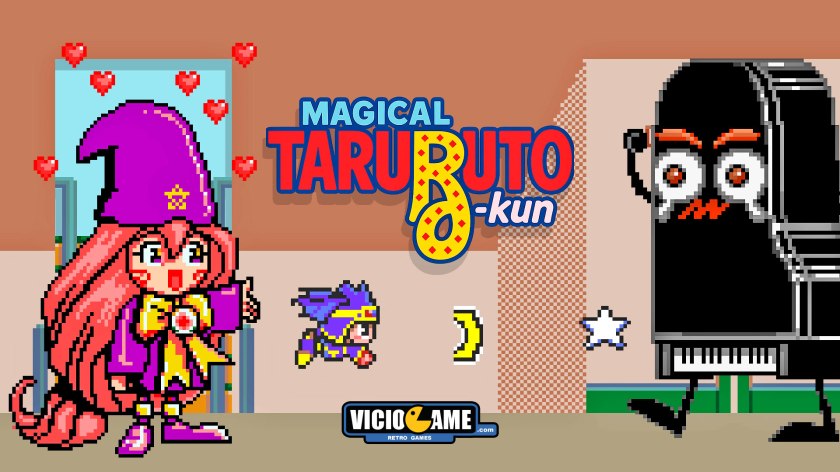
Magical Taruruto-kun is a shoot-‘em-up style game released in 1991 for the Sega Game Gear. This title is based on the manga and anime series of the same name, created by Tatsuya Egawa. The young wizard Taruruto-kun embarks on a mission to rescue his friends Honmaru Edojo and Iyona Kawai, who have been kidnapped by the villain Raivar, a magical troll.
Developer/Publisher: Tsukuda Ideal
Release date: 1991
Platform: Sega Game Gear
Magical Taruruto-kun: The Ultimate Guide
If you’re a retro gaming fan or someone curious about hidden gems from the past, Magical Taruruto-kun for the Game Gear is an adventure that deserves your attention. Released in 1991 in Japan by Tsukuda Ideal, this game is an adaptation of the manga and anime of the same name created by Tatsuya Egawa, a work that won over Japanese audiences between the late 1980s and early 1990s. Unlike the Mega Drive version, which is a 2D platformer, the portable Sega title is a horizontal scrolling shoot-‘em-up, offering a unique experience that combines the vibrant aesthetics of the series with the fast-paced gameplay typical of the genre.
The story revolves around Honmaru Edojo, an 11-year-old boy who faces typical pre-adolescent challenges like bullying and social insecurities, until he meets Taruruto, an eccentric wizard who emerges from a magic book. In the game, you control Taruruto-kun, who embarks on a mission to rescue Honmaru and his classmate Iyona Kawai from the clutches of the villainous troll Raivar. The narrative is simple, as was common in games of that era, but serves as a backdrop for frantic action. The plot doesn’t delve too deep, as the focus is on gameplay, but the presence of well-known characters from the series, like the sorceress Mimora, adds nostalgic charm for fans of the original material. For those unfamiliar with the manga or anime, the game is still accessible, as the premise is straightforward: fly, shoot, and defeat enemies in a magical and colorful world.
The gameplay is the heart of the experience. As a horizontal scrolling shoot-‘em-up, the game puts you in command of Taruruto, who flies through scenarios using his magical wings. Control is handled with the directional pad, allowing movement in any direction, while button 1 fires magical projectiles and button 2 activates special spells. A notable characteristic is the absence of automatic fire, which requires the player to repeatedly press the button to attack, something that can be tiring but adds a touch of challenge in the style of classic games. Throughout the stages, Taruruto collects items that offer upgrades, such as more powerful weapons, single-use spells, speed increases, or health recovery. Taruruto’s life is represented by hearts at the bottom of the screen, and collisions with enemies or projectiles decrease this bar, leading to a life loss if it’s depleted. The difficulty is moderate, with enemies and obstacles that require quick reflexes, but without reaching the punishing level of some more hardcore titles of the era.
One of the game’s most distinctive elements is the presence of Mimora, who appears in all stages. When colliding with her, the player is taken to a shop where they can choose an item, such as a new weapon, a spell, or a health upgrade. This mechanic adds a strategic layer, as the choice of item can significantly change the approach to a stage. The products she can offer you in the shop are as follows:
- Weapons: small and fast shot, large and slow shot, double shot, wide spread shot, homing shot, and sonic wave shot.
- Magic: shot that pierces multiple targets simultaneously, grenade that sticks to the enemy, shot that puts the enemy to sleep until it falls off the screen, and the ability to stop time.
- Upgrades: speed 1, 2, and 3. This is not a definitive choice, so if you opted for maximum speed and didn’t like it, you can buy a lower speed at the next shop.
- Items: extra life and extra life.
Each item can only be used once through button 2. It’s possible to buy multiple products, which are represented by icons in a queue at the bottom right of the screen. It’s important to manage this inventory correctly, as magic and items are consumed in the order they were purchased. If the inventory seems full, don’t worry, new purchases will be there, but “off-screen,” and will appear as you use the previous ones.
The stages themselves are varied, with scenarios ranging from enchanted forests to mystical castles, all filled with enemies like magical creatures, robots, and monsters that seem to come straight from the anime universe. Each stage ends with a boss, which varies from giant creatures to more charismatic figures. These confrontations are a highlight, requiring the player to learn attack patterns and manage collected resources well.
The graphics are one of the high points for a Game Gear game. Despite the portable’s limitations, such as the small screen and reduced color palette, the game impresses with large and well-animated sprites. Taruruto and the enemies have a faithful design to the anime, with vibrant colors that capture the childish and eccentric tone of the series. The scenarios are detailed, with parallax layers that give a sense of depth, something incredible for a portable console from 1991. However, the console’s small screen can make it difficult to see smaller projectiles, which sometimes makes the action chaotic, especially in more intense moments. Still, the visuals are one of the most praised aspects, frequently compared to 16-bit games in terms of quality.
The soundtrack, composed by Matsuda, is another highlight. The music is lively and cheerful, perfectly aligned with the childish and magical aesthetic of the game. Catchy melodies accompany the stages, creating an atmosphere that makes the player feel like they’re inside an anime episode. However, the repetitiveness of the tracks can become tiresome in longer sessions, especially because the game is relatively short, with six stages that can be completed in less than an hour by experienced players. The sound effects are simple but effective, with shooting and explosion sounds that serve their purpose well. An interesting detail is the inclusion of voice samples from Tarako (Taruruto) and Kumiko Nishihara (Mimora), taken directly from the anime, which adds authenticity and a special touch for fans of the series.
The difficulty level is an aspect that divides opinions. For casual players, the game is accessible, with simple controls and a learning curve that allows progress without much frustration. However, the absence of automatic fire and the need to dodge dense attack patterns on a small screen can be challenging, especially in the final stages. Continues are limited, which adds an element of tension, but the possibility of collecting upgrades at Mimora’s shop helps balance the experience. Compared to other Game Gear shoot-‘em-ups, like Aerial Assault or Fantasy Zone, this one is less punishing, but still requires practice to be mastered.
The game’s historical context is fascinating. Developed by Tsukuda Ideal, a lesser-known company in the video game scene, Magical Taruruto-kun was one of many titles based on the popularity of the manga and anime, which were at their peak in Japan at the time. Unlike the Mega Drive version, created by Game Freak (famous for Pokémon), the Game Gear version opted for a completely different genre, showing the franchise’s versatility in adapting to different game styles. The choice for a shoot-‘em-up was influenced by the success of games like R-Type and Gradius in the early 1990s, but the light and humorous tone distinguishes it from its more serious contemporaries. Unfortunately, the game was never released outside Japan, which limited its reach, but its inclusion in retro collections and emulators has maintained its relevance among collectors and enthusiasts.
Its legacy is modest but significant. For fans of the manga and anime, the game is a time capsule that captures the essence of the series, with its charismatic characters and peculiar humor. For shoot-‘em-up players, it’s a solid addition to the Game Gear catalog, though it doesn’t reach classic status like Sonic or Shinobi on the same console. The rarity of the cartridge in the collectibles market is moderate; it’s not as hard to find as some Mega Drive titles, but it’s also not common, especially in good condition with box and manual.
Magical Taruruto-kun is an underrated gem that combines the nostalgia of a classic anime with the excitement of a well-executed shoot-‘em-up. Its colorful graphics, lively soundtrack, and accessible yet challenging gameplay make it a memorable experience, especially for retro gaming fans or fans of Tatsuya Egawa’s series. Although it doesn’t have the same recognition as other Game Gear titles, its uniqueness and faithfulness to the original material make it worthy of exploration. Whether you’re a nostalgic person seeking memories from the 1990s or a player curious about obscure Japanese titles, this game has something to offer. Grab your Game Gear (or emulator) and embark on this magical adventure with Taruruto-kun!
Magical Taruruto-kun: O Guia Definitivo
Se você é um fã de jogos retrô ou um curioso em busca de pérolas escondidas do passado, Magical Taruruto-kun para o Game Gear é uma aventura que merece sua atenção. Lançado em 1991 no Japão pela Tsukuda Ideal, este jogo é uma adaptação do mangá e anime homônimo criado por Tatsuya Egawa, uma obra que conquistou o público japonês entre o final dos anos 1980 e início dos 1990. Diferente da versão de Mega Drive, que é um plataforma 2D, o título para o portátil da Sega é um shoot-‘em-up de rolagem horizontal, oferecendo uma experiência única que combina a estética vibrante da série com a jogabilidade ágil típica do gênero.
A história gira em torno de Honmaru Edojo, um garoto de 11 anos que enfrenta os desafios típicos de um pré-adolescente, como bullying e inseguranças sociais, até encontrar Taruruto, um mago excêntrico que surge de um livro mágico. No jogo, você controla Taruruto-kun, que embarca em uma missão para resgatar Honmaru e sua colega Iyona Kawai das garras do troll vilanesco Raivar. A narrativa é simples, como era comum em jogos da época, mas serve como pano de fundo para a ação frenética. O enredo não se aprofunda muito, já que o foco está na jogabilidade, mas a presença de personagens conhecidos da série, como a feiticeira Mimora, adiciona um charme nostálgico para os fãs do material original. Para quem não está familiarizado com o mangá ou anime, o jogo ainda é acessível, pois a premissa é direta: voe, atire e derrote inimigos em um mundo mágico e colorido.
A jogabilidade é o coração da experiência. Como um shoot-‘em-up de rolagem horizontal, o jogo coloca você no comando de Taruruto, que voa pelos cenários usando suas asas mágicas. O controle é feito com o direcional, permitindo movimentação em qualquer direção, enquanto o botão 1 dispara projéteis mágicos e o botão 2 ativa feitiços especiais. Uma característica marcante é a ausência de disparo automático, o que exige que o jogador pressione repetidamente o botão para atacar, algo que pode ser cansativo, mas adiciona um toque de desafio à la jogos clássicos. Ao longo das fases, Taruruto coleta itens que oferecem upgrades, como armas mais poderosas, feitiços de uso único, aumentos de velocidade ou recuperação de vida. A vida de Taruruto é representada por corações na parte inferior da tela, e colisões com inimigos ou projéteis diminuem essa barra, levando a uma perda de vida caso ela se esgote. A dificuldade é moderada, com inimigos e obstáculos que exigem reflexos rápidos, mas sem atingir o nível punitivo de alguns títulos mais hardcore da época.
Um dos elementos mais distintos do jogo é a presença de Mimora, que aparece em todas as fases. Ao colidir com ela, o jogador é levado a uma loja onde pode escolher um item, como uma nova arma, um feitiço ou um upgrade de saúde. Essa mecânica adiciona uma camada estratégica, pois a escolha do item pode mudar significativamente a abordagem em uma fase. Os produtos que ela pode lhe oferecer na loja são os seguintes:
- Armas: tiro pequeno e rápido, tiro grande e lento, tiro duplo, tiro amplo espalhado, tiro teleguiado, e tiro com onda sônica.
- Magias: tiro que atravessa vários alvos simultaneamente, granada que gruda no inimigo, tiro que adormece o inimigo até que ele caia para fora da tela, e habilidade de parar o tempo.
- Upgrades: velocidade 1, 2 e 3. Esta não é uma escolha definitiva, então se você optou pela velocidade máxima e não gostou, poderá comprar uma velocidade menor na próxima loja.
- Itens: life extra e vida extra.
Cada item pode ser utilizado apenas uma vez através do botão 2. É possível comprar vários produtos, que são representados por ícones em fila no canto inferior direito da tela. É importante gerenciar da forma correta este inventário, pois as magias e itens são consumidos na ordem em que foram comprados. Caso o inventário pareça cheio, não se preocupe, as novas compras estarão ali, mas “fora da tela”, e aparecerão conforme você usa as anteriores.
As fases em si são variadas, com cenários que vão desde florestas encantadas a castelos místicos, todos repletos de inimigos como criaturas mágicas, robôs e monstros que parecem saídos diretamente do universo do anime. Cada estágio termina com um chefe, que varia de criaturas gigantes a figuras mais carismáticas. Esses confrontos são um destaque, exigindo que o jogador aprenda padrões de ataque e gerencie bem os recursos coletados.
Os gráficos são um dos pontos altos para um jogo de Game Gear. Apesar das limitações do portátil, como a tela pequena e a paleta de cores reduzida, o jogo impressiona com sprites grandes e bem animados. Taruruto e os inimigos têm um design fiel ao anime, com cores vibrantes que capturam o tom infantil e excêntrico da série. Os cenários são detalhados, com camadas de parallax que dão uma sensação de profundidade, algo incrível para um console portátil de 1991. No entanto, a pequena tela do console pode dificultar a visualização de projéteis menores, o que às vezes torna a ação caótica, especialmente em momentos mais intensos. Ainda assim, o visual é um dos aspectos mais elogiados, frequentemente comparado a jogos de 16 bits em termos de qualidade.
A trilha sonora, composta por Matsuda, é outro destaque. As músicas são animadas e alegres, perfeitamente alinhadas com a estética infantil e mágica do jogo. Melodias cativantes acompanham as fases, criando uma atmosfera que faz o jogador se sentir dentro de um episódio do anime. Porém, a repetitividade das faixas pode cansar em sessões mais longas, especialmente porque o jogo é relativamente curto, com seis fases que podem ser completadas em menos de uma hora por jogadores experientes. Os efeitos sonoros são simples, mas eficazes, com sons de disparos e explosões que cumprem bem o papel. Um detalhe interessante é a inclusão de amostras de voz de Tarako (Taruruto) e Kumiko Nishihara (Mimora), tiradas diretamente do anime, o que adiciona autenticidade e um toque especial para os fãs da série.
O nível de dificuldade é um aspecto que divide opiniões. Para jogadores casuais, o jogo é acessível, com controles simples e uma curva de aprendizado que permite progredir sem muita frustração. No entanto, a ausência de disparo automático e a necessidade de desviar de padrões de ataque densos em uma tela pequena podem ser desafiadoras, especialmente nas fases finais. Os continues são limitados, o que adiciona um elemento de tensão, mas a possibilidade de coletar upgrades na loja de Mimora ajuda a equilibrar a experiência. Comparado a outros shoot-‘em-ups do Game Gear, como Aerial Assault ou Fantasy Zone, este é menos punitivo, mas ainda exige prática para ser dominado.
O contexto histórico do jogo é fascinante. Desenvolvido pela Tsukuda Ideal, uma empresa menos conhecida no cenário de jogos eletrônicos, Magical Taruruto-kun foi um dos muitos títulos baseados na popularidade do mangá e anime, que na época estavam no auge no Japão. Diferente da versão de Mega Drive, criada pela Game Freak (famosa por Pokémon), a versão de Game Gear optou por um gênero completamente diferente, mostrando a versatilidade da franquia em se adaptar a diferentes estilos de jogo. A escolha por um shoot-‘em-up foi influenciada pelo sucesso de jogos como R-Type e Gradius no início dos anos 1990, mas o tom leve e humorístico distingue de seus contemporâneos mais sérios. Infelizmente, o jogo nunca foi lançado fora do Japão, o que limitou seu alcance, mas sua inclusão em coleções retrô e emuladores tem mantido sua relevância entre colecionadores e entusiastas.
Seu legado é modesto, mas significativo. Para os fãs do mangá e anime, o jogo é uma cápsula do tempo que captura a essência da série, com seus personagens carismáticos e humor peculiar. Para jogadores de shoot-‘em-up, é uma adição sólida ao catálogo do Game Gear, embora não alcance o status de clássico como Sonic ou Shinobi no mesmo console. A raridade do cartucho no mercado de colecionáveis é moderada; ele não é tão difícil de encontrar quanto alguns títulos de Mega Drive, mas também não é comum, especialmente em boas condições com caixa e manual.
Magical Taruruto-kun é uma joia subestimada que combina a nostalgia de um anime clássico com a emoção de um shoot-‘em-up bem executado. Seus gráficos coloridos, trilha sonora animada e jogabilidade acessível, mas desafiadora, fazem dele uma experiência memorável, especialmente para fãs de jogos retrô ou da série de Tatsuya Egawa. Embora não tenha o mesmo reconhecimento que outros títulos do Game Gear, sua singularidade e fidelidade ao material original o tornam digno de ser explorado. Seja você um saudosista em busca de memórias dos anos 1990 ou um jogador curioso por títulos japoneses obscuros, este jogo tem algo a oferecer. Pegue seu Game Gear (ou emulador) e embarque nessa aventura mágica com Taruruto-kun!
🤑💲Earn money without doing anything! Just leave these apps open:
   ✓ https://r.honeygain.me/CONTA9DB02

   ✓ https://packetstream.io/?psr=1uPb
🤑💲1-Click button earns Bitcoin every 1 hour: https://freebitco.in/?r=53528449
⬛ 𝗧𝗶𝗸𝗧𝗼𝗸: https://www.tiktok.com/@viciogame
🟧 𝗜𝗻𝘀𝘁𝗮𝗴𝗿𝗮𝗺: http://www.instagram.com/viciogame
🟥 𝗬𝗼𝘂𝘁𝘂𝗯𝗲: http://www.youtube.com/viciogame
🟦 𝗙𝗮𝗰𝗲𝗯𝗼𝗼𝗸: http://www.facebook.com/viciogame
🔳 𝗧𝗵𝗿𝗲𝗮𝗱𝘀: https://www.threads.net/@viciogame
🟪 𝗧𝘄𝗶𝘁𝗰𝗵: https://www.twitch.tv/ViciogameRetroGames
🟨 𝗕𝗹𝗼𝗴: http://www.viciogameblog.com/
🟦𝗧𝘄𝗶𝘁𝘁𝗲𝗿: http://www.twitter.com/viciogame
Viciogame #Gameplay #LetsPlay #Gamer #Playthrough #Games #News #Videogames #Review #Game #Detonado #Walkthrough #Ending #Reviews #Facts #Retro #Record #Roms #Emulator #Longplay #Speedrun #MagicalTarurutokun #GameGear #MagicalTaruruutokun #Sega #shootemup #TsukudaIdeal #shooter #anime #shmup #manga #まじかるタルるートくん #cartoon #TatsuyaEgawa #desenho #Shueisha #JogoDeNavinha #Kawai #ToeiAnimation #株式会社集英社 #東映アニメーション #SegaGenesis #MegaDrive #Genesis #HonmaruEdojo #IyonaKawai #セガ
 VICIOGAME