
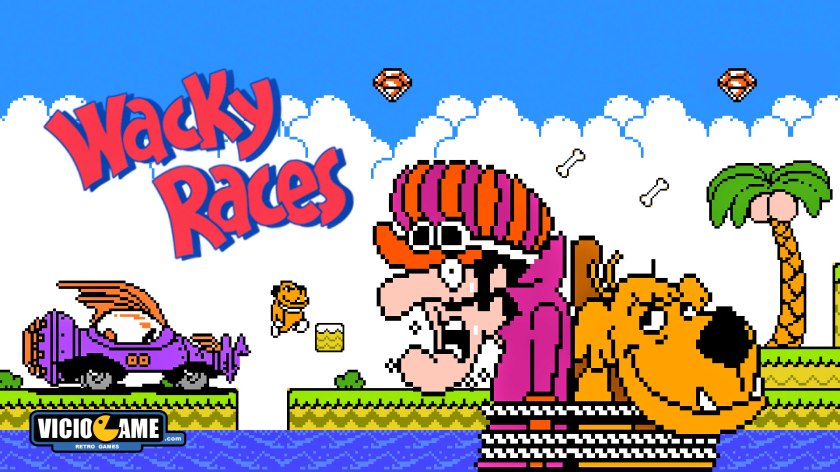
Wacky Races is a 2D platformer game released in 1991 for Nintendo. Although it’s based on the classic cartoon series, oddly enough there are no actual racing stages. Muttley gets tired of being put in perilous situations during races with Dick Dastardly, so he decides to take charge this time to help his bumbling but loyal companion finally become the winner of the race.
Developer/Publisher: Atlus
Release date: 1991
Platform: Nintendo Entertainment System / Famicom
Wacky Races: The Ultimate Guide
Wacky Races, released for the Nintendo Entertainment System (NES) in 1991, is a platform game developed by Atlus based on the popular animated series of the same name by Hanna-Barbera. In the game, the player takes control of Muttley, Dick Dastardly’s canine companion, on a mission to rescue his master, who, as usual, has gotten himself into trouble by trying to cheat to win the race.
The game is also known as “Chiki Chiki Machine Mou Race” (チキチキマシン猛レース) in Japan, as “Los Autos Locos” in Spanish-speaking countries, and as “Corrida Maluca” in Brazil.
The narrative unfolds with Dick Dastardly and Muttley once again preparing to participate in the world-famous Wacky Race. In the recent past, the heroic duo challenged this racetrack and lost painfully. It was pure pandemonium. Dick Dastardly and his bold actions usually put Muttley in more trouble than a dog can dig his way out of. So, he decided to take command. Yes, this man’s best friend who fears fleas will do whatever it takes to get his clumsy companion through the entire race – and as a winner! But does this brave example of canine cunning know exactly what he’s getting into?
The Wacky Race has three courses and, in each course, there are several stages. Muttley must manage to rescue Dastardly at the end of each stage, with only his bite, his brain, and some secret weapons to help. And that’s not to mention the many powerful and evil bosses that await our hero in each stage! Sit down, folks, and hold onto your hats!
The game features three distinct courses, named A, B, and C. Course A is recommended for beginners, serving as a warm-up for Muttley to practice his jumps, dodges, and aim, as well as learn to locate and rescue Dick Dastardly. Course B, in turn, is where Muttley will have the chance to test his speed and agility, making it crucial to collect as many diamonds and bones as possible. Course C is the most challenging, requiring all the experience gained by the player. Each course is composed of several themed stages, which include environments such as desert, forest, castle, island, cake land, ocean, ice village, downtown, western town, and mountain.
In the desert, Muttley must constantly jump to avoid falling into quicksand, where Sergeant Blast and his Army Surplus Special await him. In the forest, gorillas and monkeys represent a constant danger, and even if the hero survives the jungle, he’ll still have to face Rufus Ruffcut in his Buzz Wagon. In the castle, the objective is to cross the grounds to challenge Big Gruesome in his Creepy Coupe. On the island, Muttley needs to be alert to native shooters and collapsed bridges. In cake land, it’s essential that Muttley uses his wings to overcome long jumps. In the ocean, Muttley demonstrates his swimming ability, using the directional pad to advance. In the ice village, the slippery terrain requires caution to avoid enemies and falls. Downtown, Muttley will face big jumps, both day and night, plus a Muttley clone chasing him. In the western town, Muttley must be alert to Lazy Luke and his friends. Finally, on the mountain, rolling stones and bouncing rocks require agility to dodge.
To navigate this wacky racing world, Muttley will need quick reflexes and precise movements. The directional pad is fundamental for moving Muttley left or right, and for making him crouch or dodge when necessary. The A button allows Muttley to jump, and he can jump quite high when the situation demands. The Select button is used to access the item menu, where Muttley can choose among his secret weapons. Pressing the Start button begins the game or pauses the action, allowing Muttley to rest during the race. The B button puts Muttley in attack mode; if no weapon is selected, he bites ferociously, but if a weapon is chosen, the B button activates it.
An interesting aspect of the game is how power-ups are implemented. Initially, Muttley only has a bite attack with limited range and three life points. To improve his abilities, he must collect bones. Just one bone is enough to move the item cursor on the status bar. Items include a bomb with limited range that takes time to launch, a bark that travels almost across the entire screen, and a floating ability similar to Raccoon Mario, where repeatedly pressing the jump button allows for a slow descent. The last item is an extra life. Both weapons and lives are considerably powerful. Bones are scattered throughout all stages, and it’s possible to fully load Muttley with the bark, six life points, and the floating ability right in the first half of the first stage.
Theoretically, the weapons would work better if they had limited use, perhaps for 20 or 30 seconds. However, once activated, they remain active until Muttley loses a life. The way hearts work also contributes to the game’s ease: it’s possible to add three hearts to the total for every four bones collected. After that, each time the heart is activated, Muttley’s life is completely restored. This means that in boss chambers, where there’s usually a bone, it’s possible to leave the meter on the third slot, take the bone and then move the meter to the life recharge, effectively giving Muttley eleven hits to defeat the bosses. If the heart recharged one point at a time, Wacky Races would be one of the most balanced platform games on Nintendo. Instead, it becomes a beginner’s platform game, without much tension or challenges.
The game screen provides crucial information for the player. The “Diamond” indicates the amount of diamonds collected by Muttley. The “Time” is a clock that shows the remaining time for Muttley. The “Muttley” image represents the hero of the day. The “Hearts” are a meter that shows how many hits Muttley can take before losing a life. The “Item Window” displays the items that Muttley picked up or that have already been selected for use. Finally, the “Item” is what Muttley must pick up along the way.
The “Rev-Up” items are essential for Muttley’s success in the race, granting him special abilities. Diamonds are crucial, as for every 100 collected, Muttley gains an extra life. When collecting diamonds, Muttley briefly transforms, performing a graceful upward jump. Bones, in turn, can reveal various disguised items, such as a cannonball, a sonic bark, extra energy, or even wings. When Muttley picks up a bone, he does so delicately, with a quick advance and a powerful jump, followed by a decisive bite.
Among the weapons and abilities, the bomb is a powerful tool, allowing Muttley to fire cannonballs at enemies. The sonic bark transforms Muttley into a formidable adversary, capable of advancing slowly and chewing anyone in his path. The wings allow Muttley to stay in the air longer after a jump; to activate them, just press the A button twice and hold it the second time, allowing the hero to fly. Hearts are vital for Muttley’s energy; by selecting a heart when a red arrow appears above it, Muttley gains extra energy. Just wait for the red arrow to appear above Muttley’s hearts and then select them in the item window.
The game is divided into three circuits, but the stages aren’t necessarily connected thematically. Each of the ten stages ends with a boss battle. Despite being a platform game, Wacky Races for the NES doesn’t feature racing, which may be surprising given the title. Instead, the game is a traditional 2D platformer, where the player controls Muttley through ten stages, collecting bones and gems. There are no major twists to the formula, and the only stage that isn’t a platformer is a swimming level, which, like the rest of the game, is quite easy. Wacky Races can be considered one of the easiest games of its genre on the console. It’s an ideal title for young children, between 6 and 8 years old, due to its responsive controls, fun character designs, and low difficulty.
The game’s bosses are the other characters from the animated series, each with their characteristic vehicle. However, they don’t have unique personalities and tend to be generic, following predictable attack patterns and launching similar projectiles. Although some are in appropriate scenarios, there’s no deep connection to the animated series in terms of attitude or behavior. For example, a character’s car that transforms in the cartoon doesn’t transform in the game. There’s no haunted house for the Gruesome Twosome, nor are the military characters in a military-themed stage. In essence, the bosses could be from any other game, without a strong connection to the original series, except for the sprite design. Despite being quite resistant (and one of them being faced in quicksand, which can be irritating), the battles are somewhat fun.
Visually, it presents colorful graphics and character designs that are faithful to the aesthetic of the original animated series. The sprites of Muttley and the other characters are well drawn and recognizable, which contributes to the immersion of series fans. The stage scenarios, although sometimes simple, are varied and attempt to capture the essence of different environments, such as deserts, forests, and ice villages. Character animation is fluid enough for the era, allowing jumping, biting, and item usage movements to be clearly perceived. However, despite the visual fidelity to the characters, the lack of racing elements and the generic nature of some scenarios and enemies can make the game not feel as connected to the franchise universe as it could be.
In terms of audio, the game offers a soundtrack that, while not particularly incredible, fulfills its role in accompanying the gameplay. Sound effects are functional, with sounds for jumps, bites, item collection, and enemy attacks. There’s nothing that stands out negatively or positively in a significant way, being an aspect that fits the standard of many platform games from the NES era. The background music and sound effects contribute to the game’s overall atmosphere, but they’re not elements that by themselves elevate the experience to a higher level. The audio simplicity reflects the game’s straightforward approach, focused on platform gameplay without major sound innovations.
To assist players on their journey, the Wacky Races manual offers some useful tips. In the Ice Village, Muttley needs to slow down and plan his movements in advance, as the terrain is very slippery and it’s easy to slide off a cliff or fall into an enemy. When judging distances for jumps, the game emphasizes that the race is full of long and complicated jumps. Muttley should look before jumping and use his wings to have more control over his movements.
For players seeking an advantage or simply wanting to explore the game in different ways, Wacky Races offers some cheats and codes. On the title screen, it’s possible to access a boss stage selector by pressing the following sequence: A, B, Right, Left, Right, Left, Down, Down, Up, and Start. If done correctly, the game will allow the player to start directly at the boss stages.
Additionally, for those using the Game Genie accessory, there are various codes that alter the gaming experience:
- AAKVEIZA: Start with 1 life.
- GAKVEIZA: Start with 5 lives.
- TAKVEIZA: Start with 7 lives.
- AAKVEIZE: Start with 9 lives.
- TASTOILA: Start with 6 hearts.
- AASTOILE: Start with 8 hearts.
- SASSZEVK + SEKIYEVK: Infinite lives.
- GXSGSVVK + GZNKVVVK: Infinite lives (alternative code).
These codes can be useful for players who want to practice specific stages, experiment with different difficulty levels, or simply have fun without worrying about losing lives.
The game’s ending is simple and straightforward. After completing the last stage, regardless of the chosen course, the credits roll. A final scene shows Dick Dastardly and Muttley, with the revelation that, despite all efforts, they lost the race once again. This comedic ending, faithful to the spirit of the animated series, is a nice touch that concludes the adventure in a light and fun way. There are no multiple endings or secret scenes, which reinforces the game’s direct and uncomplicated nature.
Its legacy is that of a solid platform game, but one that doesn’t innovate. It’s remembered as a title that, despite being based on a racing franchise, opted for a different genre, which may have disappointed some fans at the time. However, its accessible gameplay and precise controls make it a good entry point to the platform genre, especially for younger players. The game didn’t have a major cultural impact like other NES titles, but remains as an interesting curiosity in the console’s catalog, especially for fans of the animated series.
Wacky Races for the NES is a platform experience that, while not reinventing the genre, offers fun and accessible gameplay, especially for fans of the classic animation. The visual fidelity to the characters and the humor inherent in the game’s premise are its strong points, compensating for the simplicity of its mechanics and low difficulty. For those seeking a nostalgic journey or a light introduction to 8-bit era platform games, this Atlus title remains as an interesting piece of video game history, inviting players to relive Muttley’s misadventures in his eternal quest for Dick Dastardly.
Wacky Races: O Guia Definitivo
Wacky Races, lançado para o Nintendo Entertainment System (NES) em 1991, é um jogo de plataforma desenvolvido pela Atlus que se baseia no popular desenho animado de mesmo nome da Hanna-Barbera (conhecido no Brasil como Corrida Maluca). No jogo, o jogador assume o controle de Muttley (Rabugento), o companheiro canino de Dick Dastardly (Dick Vigarista), em uma missão para resgatar seu mestre, que, como de costume, se meteu em encrencas ao tentar trapacear para vencer a corrida.
O jogo também é conhecido como “Chiki Chiki Machine Mou Race” (チキチキマシン猛レース) no Japão, e como “Los Autos Locos” em países de língua espanhola.
A narrativa se desenrola com Dick Dastardly e Muttley mais uma vez se preparando para participar da mundialmente famosa Corrida Maluca. No passado recente, a dupla de heróis desafiou esta pista de corrida e perdeu dolorosamente. Foi um pandemônio puro. Dick Dastardly e suas ações audaciosas geralmente colocam Muttley em mais problemas do que um cachorro consegue cavar para sair. Então, ele decidiu assumir o comando. Sim, este amigo do homem que teme as pulgas fará o que for preciso para levar seu companheiro desajeitado pela corrida inteiro – e como vencedor! Mas será que este bravo exemplo de astúcia canina sabe exatamente no que está se metendo?
A Corrida Maluca tem três percursos e, em cada percurso, existem várias fases. Muttley deve conseguir resgatar Dastardly no final de cada fase, com apenas sua mordida, seu cérebro e algumas armas secretas para ajudar. E isso sem mencionar os muitos chefes poderosos e malvados que aguardam nosso herói em cada fase! Sente-se, pessoal, e segurem seus chapéus!
O jogo apresenta três percursos distintos, nomeados A, B e C. O Percurso A é recomendado para iniciantes, servindo como um aquecimento para Muttley praticar seus saltos, esquivas e mira, além de aprender a localizar e resgatar Dick Dastardly. O Percurso B, por sua vez, é onde Muttley terá a chance de testar sua velocidade e agilidade, sendo crucial coletar o máximo de diamantes e ossos possível. Já o Percurso C é o mais desafiador, exigindo toda a experiência adquirida pelo jogador. Cada percurso é composto por várias fases temáticas, que incluem ambientes como deserto, floresta, castelo, ilha, terra do bolo, oceano, vila de gelo, centro da cidade, cidade ocidental e montanha.
No deserto, Muttley deve pular constantemente para evitar cair na areia movediça, onde o Sargento Blast e seu Army Surplus Special o aguardam. Na floresta, gorilas e macacos representam um perigo constante, e mesmo que o herói sobreviva à selva, ele ainda terá que enfrentar Rufus Ruffcut em seu Buzz Wagon. No castelo, o objetivo é atravessar os terrenos para desafiar Big Grusome em seu Creepy Coupe. Na ilha, Muttley precisa estar atento a nativos atiradores e pontes desabadas. Na terra do bolo, é essencial que Muttley utilize suas asas para superar longos saltos. No oceano, Muttley demonstra sua habilidade de nado, utilizando o direcional para avançar. Na vila de gelo, o terreno escorregadio exige cautela para evitar inimigos e quedas. No centro da cidade, Muttley enfrentará grandes saltos, tanto de dia quanto de noite, além de um clone de Muttley o perseguindo. Na cidade ocidental, Muttley deve estar atento a Lazy Luke e seus amigos. Por fim, na montanha, pedras rolantes e rochas saltitantes exigem agilidade para desviar.
Para navegar por este mundo de corrida maluca, Muttley precisará de reflexos rápidos e movimentos precisos. O direcional é fundamental para mover Muttley para a esquerda ou direita, e para fazê-lo se abaixar ou desviar quando necessário. O botão A permite que Muttley salte, e ele pode pular bem alto quando a situação exige. O botão Select é usado para acessar o menu de itens, onde Muttley pode escolher entre suas armas secretas. Pressionar o botão Start inicia o jogo ou pausa a ação, permitindo que Muttley descanse durante a corrida. O botão B coloca Muttley em modo de ataque; se nenhuma arma for selecionada, ele morde ferozmente, mas se uma arma for escolhida, o botão B a ativa.
Um aspecto interessante do jogo é a forma como os power-ups são implementados. Inicialmente, Muttley possui apenas um ataque de mordida de alcance limitado e três pontos de vida. Para melhorar suas habilidades, ele deve coletar ossos. Apenas um osso é suficiente para mover o cursor de item na barra de status. Os itens incluem uma bomba de alcance limitado e que demora para ser lançada, um latido que percorre quase toda a tela, e uma habilidade de flutuar semelhante à do Mario Guaxinim, onde pressionar o botão de salto repetidamente permite uma descida lenta. O último item é uma vida extra. Tanto as armas quanto as vidas são consideravelmente poderosas. Os ossos estão espalhados por todas as fases, e é possível carregar Muttley completamente com o latido, seis pontos de vida e a habilidade de flutuar logo na primeira metade da primeira fase.
Teoricamente, as armas funcionariam melhor se tivessem uso limitado, talvez por 20 ou 30 segundos. No entanto, uma vez ativadas, elas permanecem ativas até que Muttley perca uma vida. A forma como os corações funcionam também contribui para a facilidade do jogo: é possível adicionar três corações ao total a cada quatro ossos coletados. Depois disso, cada vez que o coração é ativado, a vida de Muttley é completamente restaurada. Isso significa que, em câmaras de chefes, onde geralmente há um osso, é possível deixar o medidor no terceiro slot, pegar o osso e então mover o medidor para a recarga de vida, efetivamente dando a Muttley onze acertos para derrotar os chefes. Se o coração recarregasse um ponto por vez, Wacky Races seria um dos jogos de plataforma mais equilibrados do Nintendo. Em vez disso, ele se torna um jogo de plataforma para iniciantes, sem muita tensão ou desafios.
A tela do jogo fornece informações cruciais para o jogador. O “Diamante” indica a quantidade de diamantes coletados por Muttley. O “Tempo” é um relógio que mostra o tempo restante para Muttley. A imagem de “Muttley” representa o herói do dia. Os “Corações” são um medidor que mostra quantos acertos Muttley pode suportar antes de perder uma vida. A “Janela de Itens” exibe os itens que Muttley pegou ou que já foram selecionados para uso. Por fim, o “Item” é o que Muttley deve pegar ao longo do caminho.
Os itens de “Rev-Up” são essenciais para o sucesso de Muttley na corrida, concedendo-lhe habilidades especiais. Os diamantes são cruciais, pois a cada 100 coletados, Muttley ganha uma vida extra. Ao coletar diamantes, Muttley se transforma brevemente, realizando um salto gracioso para cima. Os ossos, por sua vez, podem revelar diversos itens disfarçados, como uma bola de canhão, um latido sônico, energia extra ou até mesmo asas. Quando Muttley pega um osso, ele o faz de forma delicada, com um rápido avanço e um salto poderoso, seguido de uma mordida decisiva.
Entre as armas e habilidades, a bomba é uma ferramenta poderosa, permitindo que Muttley dispare bolas de canhão contra os inimigos. O latido sônico transforma Muttley em um adversário formidável, capaz de avançar lentamente e mastigar qualquer um que esteja em seu caminho. As asas permitem que Muttley permaneça no ar por mais tempo após um salto; para ativá-las, basta pressionar o botão A duas vezes e mantê-lo pressionado na segunda vez, permitindo que o herói voe. Os corações são vitais para a energia de Muttley; ao selecionar um coração quando uma seta vermelha aparece acima dele, Muttley ganha energia extra. Basta esperar a seta vermelha aparecer acima dos corações de Muttley e, em seguida, selecioná-los na janela de itens.
O jogo é dividido em três circuitos, mas as fases não são necessariamente conectadas tematicamente. Cada uma das dez fases termina com uma batalha contra um chefe. Apesar de ser um jogo de plataforma, Wacky Races para o NES não apresenta corridas, o que pode ser surpreendente dado o título. Em vez disso, o jogo é um plataformer 2D tradicional, onde o jogador controla Muttley através de dez fases, coletando ossos e joias. Não há grandes reviravoltas na fórmula, e a única fase que não é de plataforma é um nível de natação, que, assim como o restante do jogo, é bastante fácil. Wacky Races pode ser considerado um dos jogos mais fáceis de seu gênero no console. É um título ideal para crianças pequenas, entre 6 e 8 anos, devido aos seus controles responsivos, designs de personagens divertidos e baixa dificuldade.
Os chefes do jogo são os outros personagens do desenho animado, cada um com seu veículo característico. No entanto, eles não possuem personalidades únicas e tendem a ser genéricos, seguindo padrões de ataque previsíveis e lançando projéteis semelhantes. Embora alguns estejam em cenários apropriados, não há uma conexão profunda com o desenho animado em termos de atitude ou comportamento. Por exemplo, o carro de um personagem que se transforma no desenho não se transforma no jogo. Não há uma casa assombrada para os Gruesome Twosome, nem os personagens militares estão em uma fase com tema militar. Em essência, os chefes poderiam ser de qualquer outro jogo, sem uma ligação forte com a série original, exceto pelo design dos sprites. Apesar de serem bastante resistentes (e um deles ser enfrentado em areia movediça, o que pode ser irritante), as batalhas são, de certa forma, divertidas.
Visualmente, apresenta gráficos coloridos e designs de personagens que são fiéis à estética do desenho animado original. Os sprites de Muttley e dos outros personagens são bem desenhados e reconhecíveis, o que contribui para a imersão dos fãs da série. Os cenários das fases, embora por vezes simples, são variados e tentam capturar a essência dos diferentes ambientes, como desertos, florestas e vilas de gelo. A animação dos personagens é fluida o suficiente para a época, permitindo que os movimentos de salto, mordida e uso de itens sejam claramente percebidos. No entanto, apesar da fidelidade visual aos personagens, a falta de elementos de corrida e a natureza genérica de alguns cenários e inimigos podem fazer com que o jogo não se sinta tão conectado ao universo da franquia quanto poderia.
Em termos de áudio, o jogo oferece uma trilha sonora que, embora não seja particularmente incrível, cumpre seu papel ao acompanhar a jogabilidade. Os efeitos sonoros são funcionais, com sons para saltos, mordidas, coleta de itens e ataques dos inimigos. Não há nada que se destaque negativamente ou positivamente de forma significativa, sendo um aspecto que se encaixa no padrão de muitos jogos de plataforma da era NES. A música de fundo e os efeitos sonoros contribuem para a atmosfera geral do jogo, mas não são elementos que por si só elevem a experiência a um patamar superior. A simplicidade do áudio reflete a abordagem direta do jogo, focada na jogabilidade de plataforma sem grandes inovações sonoras.
Para auxiliar os jogadores em sua jornada, o manual de Wacky Races oferece algumas dicas úteis. Na Vila de Gelo, Muttley precisa diminuir a velocidade e planejar seus movimentos com antecedência, pois o terreno é muito escorregadio e é fácil deslizar de um penhasco ou cair em um inimigo. Ao julgar distâncias para saltos, o jogo enfatiza que a corrida é cheia de pulos longos e complicados. Muttley deve olhar antes de pular e usar suas asas para ter mais controle sobre seus movimentos.
Para os jogadores que buscam uma vantagem ou simplesmente querem explorar o jogo de maneiras diferentes, Wacky Races oferece algumas trapaças e códigos. Na tela de título, é possível acessar um seletor de fases de chefe pressionando a seguinte sequência: A, B, Direita, Esquerda, Direita, Esquerda, Baixo, Baixo, Cima e Start. Se feito corretamente, o jogo permitirá que o jogador comece diretamente nas fases de chefe.
Além disso, para aqueles que utilizam o acessório Game Genie, existem diversos códigos que alteram a experiência de jogo:
- AAKVEIZA: Começa com 1 vida.
- GAKVEIZA: Começa com 5 vidas.
- TAKVEIZA: Começa com 7 vidas.
- AAKVEIZE: Começa com 9 vidas.
- TASTOILA: Começa com 6 corações.
- AASTOILE: Começa com 8 corações.
- SASSZEVK + SEKIYEVK: Vidas infinitas.
- GXSGSVVK + GZNKVVVK: Vidas infinitas (código alternativo).
Esses códigos podem ser úteis para jogadores que desejam praticar fases específicas, experimentar diferentes níveis de dificuldade ou simplesmente se divertir sem a preocupação de perder vidas.
O final do jogo é simples e direto. Após completar a última fase, independentemente do percurso escolhido, os créditos rolam. Uma cena final mostra Dick Dastardly e Muttley, com a revelação de que, apesar de todos os esforços, eles perderam a corrida mais uma vez. Este final cômico e fiel ao espírito do desenho animado é um toque agradável que encerra a aventura de forma leve e divertida. Não há múltiplos finais ou cenas secretas, o que reforça a natureza direta e descomplicada do jogo.
Seu legado é o de um jogo de plataforma sólido, mas que não inova. É lembrado como um título que, apesar de baseado em uma franquia de corrida, optou por um gênero diferente, o que pode ter decepcionado alguns fãs na época. No entanto, sua jogabilidade acessível e controles precisos o tornam uma boa porta de entrada para o gênero de plataforma, especialmente para jogadores mais jovens. O jogo não teve um grande impacto cultural como outros títulos do NES, mas permanece como uma curiosidade interessante no catálogo do console, especialmente para os fãs do desenho animado.
Wacky Races para o NES é uma experiência de plataforma que, embora não reinvente o gênero, oferece uma jogabilidade divertida e acessível, especialmente para os fãs da clássica animação. A fidelidade visual aos personagens e o humor inerente à premissa do jogo são seus pontos fortes, compensando a simplicidade de sua mecânica e a baixa dificuldade. Para aqueles que buscam uma jornada nostálgica ou uma introdução leve aos jogos de plataforma da era 8-bit, este título da Atlus permanece como uma peça interessante da história dos videogames, convidando os jogadores a reviver as desventuras de Muttley em sua eterna busca por Dick Dastardly.
🤑💲Earn money without doing anything! Just leave these apps open:
   ✓ https://r.honeygain.me/CONTA9DB02

   ✓ https://packetstream.io/?psr=1uPb
🤑💲1-Click button earns Bitcoin every 1 hour: https://freebitco.in/?r=53528449
⬛ 𝗧𝗶𝗸𝗧𝗼𝗸: https://www.tiktok.com/@viciogame
🟧 𝗜𝗻𝘀𝘁𝗮𝗴𝗿𝗮𝗺: http://www.instagram.com/viciogame
🟥 𝗬𝗼𝘂𝘁𝘂𝗯𝗲: http://www.youtube.com/viciogame
🟦 𝗙𝗮𝗰𝗲𝗯𝗼𝗼𝗸: http://www.facebook.com/viciogame
🔳 𝗧𝗵𝗿𝗲𝗮𝗱𝘀: https://www.threads.net/@viciogame
🟪 𝗧𝘄𝗶𝘁𝗰𝗵: https://www.twitch.tv/ViciogameRetroGames
🟨 𝗕𝗹𝗼𝗴: http://www.viciogameblog.com/
🟦𝗧𝘄𝗶𝘁𝘁𝗲𝗿: http://www.twitter.com/viciogame
#Viciogame #Gameplay #LetsPlay #Gamer #Playthrough #Games #News #Videogames #Review #Game #Detonado #Walkthrough #Ending #Reviews #Facts #Retro #Record #Roms #Emulator #Longplay #Speedrun #WackyRaces #NES #HannaBarbera #Atlus #Nintendo #Muttley #Famicom #DickDastardly #ChikiChikiMachineMouRace #LosAutosLocos #CorridaMaluca #Rabugento #DickVigarista #Desenhos #Desenhoanimado #Cartoons #チキチキマシン猛レース #race #racer #racing #nintendinho #ファミリーコンピュータ #任天堂
 VICIOGAME