
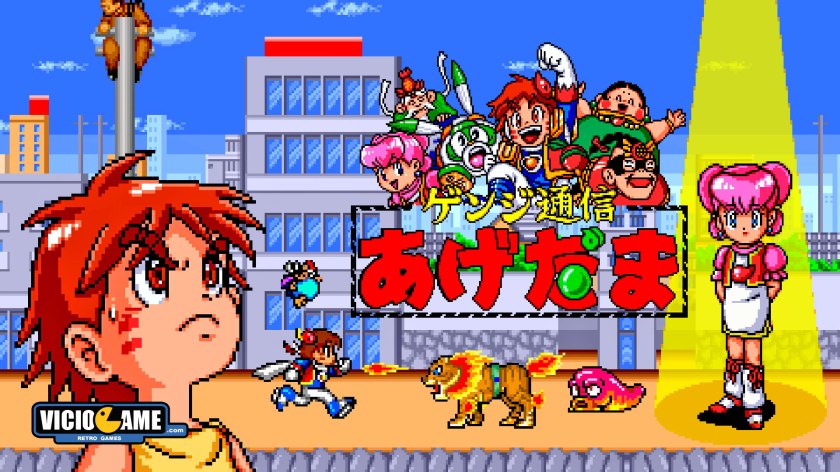
Genji Tsuushin Agedama (ゲンジ通信あげだま) is an auto-scrolling platform game based on the anime of the same name, released in 1991 for the PC Engine. Its main feature is the variety of weapons and their incredible upgrades. Aliens are taking over various countries, and to prevent this from happening to Japan, you must eliminate the evil and save the planet.
Developer/Publisher: NEC Home Electronics
Release date: 1991
Platform: PC Engine / TurboGrafx-16
Genji Tsuushin Agedama: The Ultimate Guide
Genji Tsuushin Agedama is an action-platformer game released in 1991 for the PC Engine (known as TurboGrafx-16 in North America) that stands out for its dynamic gameplay and for being based on an anime of the same name, which aired between 1991 and 1992. Although the anime was not widely translated into English, the game managed to capture the essence of the series, presenting a vibrant and energetic experience. The auto-scrolling nature of the first four and a half stages, combined with Agedama’s ability to shoot, leads some people to compare it to a shmup, or scrolling shooter game. However, it maintains distinct platforming elements that set it apart. The game was developed by NEC Home Electronics, licensed by NAS, TV Tokyo and Studio Gallop, ensuring a direct connection with the original anime production.
The gameplay is centered on agility and strategic use of Agedama’s abilities. The controls are straightforward: button 1 is used to jump, button 2 to attack, the combination of directional up and button 1 allows a high jump, and directional down makes Agedama roll. Rolling is a crucial mechanic, as the protagonist becomes invulnerable to projectiles and enemies while rolling, and can even damage opponents. The RUN button pauses the game, allowing the player a brief respite to plan their actions.
The weapon charging system is the most distinctive aspect of the gameplay. At the top of the screen, a series of dots fills from left to right as the attack button is held down. The attack released depends on the rightmost highlighted dot. Main attacks are represented by larger circles with Japanese characters, while smaller dots release weaker attacks, but based on the next large circle. The main attacks are:
- か (Ka): A series of explosions that project a short distance in front of Agedama.
- た (Ta): Five small tornadoes that spread out and cover most of the screen in front of Agedama.
- は (Ha): A series of green crescent shapes that fire in a straight line.
- ま (Ma): Three genies appear behind Agedama, pause briefly, then fly forward. This attack hits most of the screen and, while the genies are stationary, they repeatedly hit any enemy that overlaps them, making them very effective against bosses that remain at the edge of the screen.
- ら (Ra): Lightning that travels across the screen, usually hitting everything.
Additionally, if all five options are available and the player continues holding the attack button, Agedama will start flashing. If the button is released at this moment, the action pauses, the screen shakes, a mushroom-shaped cloud with a skull appears on screen, and lightning moves like in the ‘ra’ attack. This is the most powerful attack in most situations, functioning as a special attack or super-attack.
The game consists of six stages and can be completed in approximately 35 minutes by experienced players. Most stages feature auto-scrolling, which requires quick reflexes and constant adaptation to the scenery from the player. The game’s difficulty is fair, offering an adequate challenge without being excessively punishing. Progression through the stages is linear, with each presenting new challenges and enemies, keeping the player engaged. The absence of a password or save system means the game must be completed in a single session, which contributes to its arcade nature and the need to master its mechanics.
In terms of power-ups, besides the attack charging system, the game offers items that can be collected to assist Agedama on his journey. These include orbs that restore health, and others that can temporarily increase movement speed or firing rate. Strategic collection of these items is fundamental for survival, especially in later stages, where the density of enemies and projectiles increases significantly. Interaction with the environment is also an important factor, with platforms and obstacles that require precision in jumping and using the roll. The diversity of enemies, each with distinct attack patterns, requires the player to learn and adapt to overcome them. Stage bosses are a highlight, presenting unique challenges that test the player’s mastery of the character’s abilities, especially the use of charged attacks and rolling to avoid damage and maximize damage dealt.
The narrative follows the anime’s premise, where Agedama, a young hero, finds himself involved in a battle to save Earth from an alien invasion. Although the story is not the main focus of the game, it serves as a backdrop for the intense action sequences. Story progression is subtle, often told through small vignettes or changes in scenery between stages, keeping the player focused on gameplay.
Visually, Genji Tsuushin Agedama is an example of the PC Engine’s graphical capabilities. The graphics are colorful and vibrant, with well-drawn sprites that faithfully represent the characters and enemies from the anime. The scenarios are detailed and varied, ranging from urban landscapes to more fantastical environments, contributing to immersion. The fluid animation of Agedama and enemies is a strong point, making movements and attacks clear and responsive. The visual effects of charged attacks, such as explosions and lightning, are impressive and add significant impact to the gaming experience.
The sound design and soundtrack complement the on-screen action. The music is captivating and energetic, with melodies that fit perfectly with the game’s fast-paced rhythm. Sound effects are sharp and effective, providing clear feedback for attacks, impacts, and item collection. The combination of graphics and sound creates a cohesive and engaging atmosphere that keeps the player immersed in Agedama’s adventure.
Mastery in Genji Tsuushin Agedama is achieved through repetition and improvement of combat and movement techniques. Each failure serves as a learning opportunity, allowing the player to memorize enemy patterns, optimize the use of charged attacks, and perfect rolling timing. This ensures that completing the game is a true proof of proficiency, without shortcuts or conveniences.
Although the game doesn’t feature multiple endings, the gaming experience is enriched by pursuing maximum score and completion in record time. The simplicity of its structure, with six well-defined stages, allows players to focus on optimizing each run, exploring the nuances of gameplay. The control function is intuitive, with the directional pad responding precisely to movement commands, and action buttons allowing fluid execution of jumps and attacks. The learning curve is well balanced, with the first stages serving as a gradual introduction to the mechanics, while later stages require complete mastery of all of Agedama’s abilities.
There is a hidden cheat menu in the game, where you can change some options. On the title screen, simply hold buttons 1 and 2, and press SELECT. In the new screen that appears, you can configure the difficulty level, number of continues, test sounds, and select a starting stage.
Genji Tsuushin Agedama is a title that, despite its origin in an anime little known in the West, managed to establish itself as a solid and fun action-platformer game. Unique characteristics make it an example of what the console was capable of delivering. For retro gaming enthusiasts and those seeking an action-platformer experience with a distinct touch, this game remains a significant milestone in the PC Engine library, inviting players to master its mechanics and enjoy its contagious energy.
The production credits of Genji Tsuushin Agedama reveal the team behind the development of this PC Engine title. The original work (げんさく) is by Akira Sakuma (さくま あきら), while the concept (せってい) and game design (ゲームコンセプト) are by Ohji Hiroi (ひろい おうじ). Character design (キャラクターデザイン) was handled by Kennosuke Mizutani (みずたに けんのすけ). Game design (ゲームデザイン) was done by Yukihiko Hojo (ほうじょう “YUKINBO” ゆきひこ). Coordination (コーディネート) was by Keiichi Chiba (ちば けいいち). The main programmers (メイン プログラマー) were Tsuyoshi Koyama (こやま つよし) and Eiki Aizawa (あいざわ えいき) as sub-programmer. The main designers (メインデザイナー) were Masako Yukumoto (ゆくもと まさこ), with Minako Ueda (うえだ みなこ) and Misa Yanagisawa (やなぎさわ みさ) as sub-designers. The soundtrack (サウンド) was produced by T’s Music. The supervisors (スーパーバイザー) were Nobuyuki Kondo (こんどう のぶゆき) and Nobuhiro Takagaki (たかがき のぶひろ). The executive producer (エグゼクティブプロデューサー) was Masakane Toshioka (としおか まさかね). The production had collaboration (せいさく きょうりょく) from Asatsu and Kodansha Comic BomBom. The team also thanked Masaki Kobayashi (こばやし まさき), Yasuhiro Fujii (ふじい やすひろ) and Kubo (ぼく くぼ) in the special thanks.
Genji Tsuushin Agedama: O Guia Definitino
Genji Tsuushin Agedama é um jogo de ação e plataforma lançado em 1991 para o PC Engine (conhecido como TurboGrafx-16 na América do Norte) que se destaca por sua jogabilidade dinâmica e por ser baseado em um anime de mesmo nome, que foi ao ar entre 1991 e 1992. Embora o anime não tenha sido amplamente traduzido para o inglês, o jogo conseguiu capturar a essência da série, apresentando uma experiência vibrante e cheia de energia. A natureza de rolagem automática das primeiras quatro fases e meia, combinada com a capacidade de Agedama de atirar, leva algumas pessoas a compará-lo a um shmup, ou jogo de tiro com rolagem. No entanto, ele mantém elementos distintos de plataforma que o diferenciam. O jogo foi desenvolvido pela NEC Home Electronics, com licença da NAS, TV Tokyo e Studio Gallop, garantindo uma conexão direta com a produção original do anime.
A jogabilidade é centrada na agilidade e no uso estratégico das habilidades de Agedama. Os controles são diretos: o botão 1 é usado para pular, o botão 2 para atacar, a combinação de direcional para cima e botão 1 permite um salto alto, e o direcional para baixo faz com que Agedama role. A rolagem é uma mecânica crucial, pois o protegonista se torna invulnerável a projéteis e inimigos enquanto rola, podendo até mesmo causar dano aos adversários. O botão RUN pausa o jogo, permitindo ao jogador um breve respiro para planejar suas ações.
O sistema de carregamento de armas é o aspecto mais distintivo da jogabilidade. Na parte superior da tela, uma série de pontos se preenche da esquerda para a direita conforme o botão de ataque é mantido pressionado. O ataque liberado depende do ponto mais à direita que estiver destacado. Os ataques principais são representados por círculos maiores com caracteres japoneses, enquanto os pontos menores liberam ataques mais fracos, mas baseados no próximo círculo grande. Os ataques principais são:
- か (Ka): Uma série de explosões que se projetam a uma curta distância à frente de Agedama.
- た (Ta): Cinco pequenos tornados que se espalham e cobrem a maior parte da tela à frente de Agedama.
- は (Ha): Uma série de formas crescentes verdes que disparam em linha reta.
- ま (Ma): Três gênios aparecem atrás de Agedama, pausam brevemente e depois voam para a frente. Este ataque atinge a maior parte da tela e, enquanto os gênios estão parados, eles atingem repetidamente qualquer inimigo que se sobreponha a eles, tornando-os muito eficazes contra chefes que permanecem na borda da tela.
- ら (Ra): Raios que viajam pela tela, geralmente atingindo tudo.
Além disso, se todas as cinco opções estiverem disponíveis e o jogador continuar segurando o botão de ataque, Agedama começará a piscar. Se o botão for solto nesse momento, a ação pausa, a tela treme, uma nuvem em forma de cogumelo com uma caveira aparece na tela, e raios se movem como no ataque ‘ra’. Este é o ataque mais poderoso na maioria das situações, funcionando como um ataque especial ou super-ataque.
O jogo é composto por seis fases, e pode ser concluído em aproximadamente 35 minutos por jogadores experientes. A maioria das fases apresenta rolagem automática, o que exige do jogador reflexos rápidos e adaptação constante ao cenário. A dificuldade do jogo é justa, oferecendo um desafio adequado sem ser excessivamente punitivo. A progressão pelas fases é linear, com cada uma apresentando novos desafios e inimigos, mantendo o jogador engajado. A ausência de um sistema de passwords ou saves significa que o jogo deve ser completado em uma única sessão, o que contribui para a sua natureza arcade e a necessidade de dominar suas mecânicas.
Em termos de power-ups, além do sistema de carregamento de ataques, o jogo oferece itens que podem ser coletados para auxiliar Agedama em sua jornada. Estes incluem orbes que restauram a saúde, e outros que podem aumentar temporariamente a velocidade de movimento ou a cadência de tiro. A coleta estratégica desses itens é fundamental para a sobrevivência, especialmente nas fases mais avançadas, onde a densidade de inimigos e projéteis aumenta significativamente. A interação com o ambiente também é um fator importante, com plataformas e obstáculos que exigem precisão nos saltos e no uso da rolagem. A diversidade de inimigos, cada um com padrões de ataque distintos, exige que o jogador aprenda e se adapte para superá-los. Os chefes de fase são um destaque, apresentando desafios únicos que testam a maestria do jogador sobre as habilidades do personagem, especialmente o uso dos ataques carregados e da rolagem para evitar danos e maximizar o dano causado.
A narrativa segue a premissa do anime, onde Agedama, um jovem herói, se vê envolvido em uma batalha para salvar a Terra de uma invasão alienígena. Embora a história não seja o foco principal do jogo, ela serve como pano de fundo para as intensas sequências de ação. A progressão da história é sutil, muitas vezes contada através de pequenas vinhetas ou mudanças no cenário entre as fases, mantendo o jogador focado na jogabilidade.
Visualmente, Genji Tsuushin Agedama é um exemplo da capacidade gráfica do PC Engine. Os gráficos são coloridos e vibrantes, com sprites bem desenhados que representam fielmente os personagens e inimigos do anime. Os cenários são detalhados e variados, indo desde paisagens urbanas até ambientes mais fantásticos, contribuindo para a imersão. A fluidez da animação de Agedama e dos inimigos é um ponto forte, tornando os movimentos e ataques claros e responsivos. Os efeitos visuais dos ataques carregados, como as explosões e os raios, são impressionantes e adicionam um impacto significativo à experiência de jogo.
O design de som e a trilha sonora complementam a ação na tela. As músicas são cativantes e energéticas, com melodias que se encaixam perfeitamente no ritmo acelerado do jogo. Os efeitos sonoros são nítidos e eficazes, fornecendo feedback claro para os ataques, impactos e coleta de itens. A combinação de gráficos e som cria uma atmosfera coesa e envolvente, que mantém o jogador imerso na aventura de Agedama.
A maestria em Genji Tsuushin Agedama é alcançada através da repetição e do aprimoramento das técnicas de combate e movimentação. Cada falha serve como uma oportunidade de aprendizado, permitindo ao jogador memorizar padrões de inimigos, otimizar o uso dos ataques carregados e aperfeiçoar o timing da rolagem. Isso garante que a conclusão do jogo seja uma verdadeira prova de proficiência, sem atalhos ou facilidades.
Embora o jogo não apresente múltiplos finais, a experiência de jogo é enriquecida pela busca da pontuação máxima e pela conclusão em tempo recorde. A simplicidade de sua estrutura, com seis fases bem definidas, permite que os jogadores se concentrem em otimizar cada corrida, explorando as nuances da jogabilidade. A função dos controles é intuitiva, com o direcional respondendo de forma precisa aos comandos de movimento, e os botões de ação permitindo uma execução fluida dos saltos e ataques. A curva de aprendizado é bem equilibrada, com as primeiras fases servindo como uma introdução gradual às mecânicas, enquanto as fases posteriores exigem um domínio completo de todas as habilidades de Agedama.
Há um menu de trapaças escondido no jogo, onde você pode alterar algumas opções. Na tela de título, basta segurar os botões 1 e 2, e pressionar SELECT. Na nova tela que vai aparecer, você pode configurar o nível de dificuldade, a quantidade de continues, testar os sons, e selecionar uma fase de início.
Genji Tsuushin Agedama é um título que, apesar de sua origem em um anime pouco conhecido no ocidente, conseguiu se estabelecer como um jogo de ação e plataforma sólido e divertido. Características únicas o tornam um exemplo do que o console era capaz de entregar. Para os entusiastas de jogos retrô e para aqueles que buscam uma experiência de ação e plataforma com um toque distinto, este jogo permanece como um marco significativo na biblioteca do PC Engine, convidando os jogadores a dominarem suas mecânicas e a desfrutarem de sua energia contagiante.
Os créditos de produção de Genji Tsuushin Agedama revelam a equipe por trás do desenvolvimento deste título para o PC Engine. A obra original (げんさく) é de Akira Sakuma (さくま あきら), enquanto o conceito (せってい) e o design do jogo (ゲームコンセプト) são de Ohji Hiroi (ひろい おうじ). O design dos personagens (キャラクターデザイン) ficou a cargo de Kennosuke Mizutani (みずたに けんのすけ). O design do jogo (ゲームデザイン) foi feito por Yukihiko Hojo (ほうじょう “YUKINBO” ゆきひこ). A coordenação (コーディネート) foi de Keiichi Chiba (ちば けいいち). Os programadores principais (メイン プログラマー) foram Tsuyoshi Koyama (こやま つよし) e Eiki Aizawa (あいざわ えいき) como subprogramador. Os designers principais (メインデザイナー) foram Masako Yukumoto (ゆくもと まさこ), com Minako Ueda (うえだ みなこ) e Misa Yanagisawa (やなぎさわ みさ) como subdesigners. A trilha sonora (サウンド) foi produzida pela T’s Music. Os supervisores (スーパーバイザー) foram Nobuyuki Kondo (こんどう のぶゆき) e Nobuhiro Takagaki (たかがき のぶひろ). O produtor executivo (エグゼクティブプロデューサー) foi Masakane Toshioka (としおか まさかね). A produção contou com a colaboração (せいさく きょうりょく) da Asatsu e da Kodansha Comic BomBom. A equipe também agradeceu a Masaki Kobayashi (こばやし まさき), Yasuhiro Fujii (ふじい やすひろ) e Kubo (ぼく くぼ) nos agradecimentos especiais.
🤑💲Earn money without doing anything! Just leave these apps open:
   ✓ https://r.honeygain.me/CONTA9DB02

   ✓ https://packetstream.io/?psr=1uPb
🤑💲1-Click button earns Bitcoin every 1 hour: https://freebitco.in/?r=53528449
⬛ 𝗧𝗶𝗸𝗧𝗼𝗸: https://www.tiktok.com/@viciogame
🟧 𝗜𝗻𝘀𝘁𝗮𝗴𝗿𝗮𝗺: http://www.instagram.com/viciogame
🟥 𝗬𝗼𝘂𝘁𝘂𝗯𝗲: http://www.youtube.com/viciogame
🟦 𝗙𝗮𝗰𝗲𝗯𝗼𝗼𝗸: http://www.facebook.com/viciogame
🔳 𝗧𝗵𝗿𝗲𝗮𝗱𝘀: https://www.threads.net/@viciogame
🟪 𝗧𝘄𝗶𝘁𝗰𝗵: https://www.twitch.tv/ViciogameRetroGames
🟨 𝗕𝗹𝗼𝗴: http://www.viciogameblog.com/
🟦𝗧𝘄𝗶𝘁𝘁𝗲𝗿: http://www.twitter.com/viciogame
#Viciogame #Gameplay #LetsPlay #Gamer #Playthrough #Games #News #Videogames #Review #Game #Detonado #Walkthrough #Ending #Reviews #Facts #Retro #Record #Roms #Emulator #Longplay #Speedrun #GenjiTsuushinAgedama #PcEngine #TurboGrafx16 #NEC #ゲンジ通信あげだま #StudioGallop #TvTokyo #PCエンジン #Agedama #エヌイーシー #日本電気
 VICIOGAME