
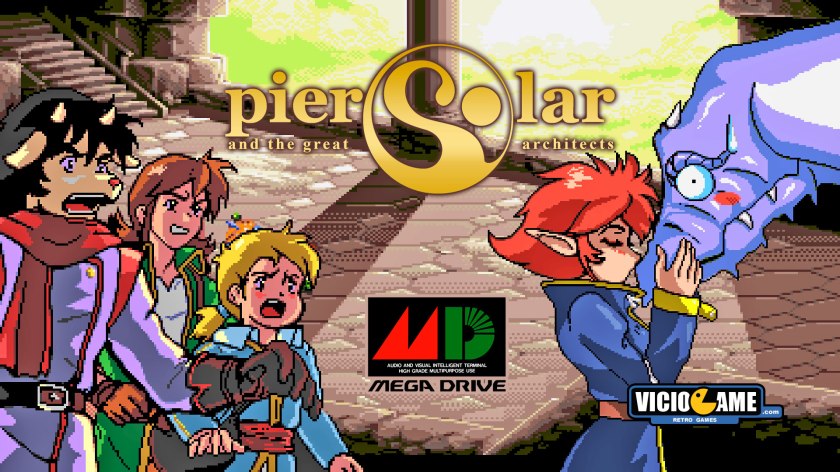
Pier Solar and the Great Architects is an RPG released in 2010 for the Sega Genesis. Three protagonists in a fantasy world wield the elements of water, fire, earth, and wind while seeking to unravel their pasts and motivations. A true tribute to the classic 16-bit era RPGs.
Developer/Publisher: Watermelon Development
Release date: 2010
Platform: Sega Genesis / Mega Drive / Sega-CD / Mega-CD
Pier Solar: The Ultimate Guide
The development of Pier Solar and the Great Architects (ピエアソーラーと偉大なる建築家) began in 2004, stemming from discussions on an online forum called “The Tavern” at the Eidolon’s Inn website. Gaming enthusiasts and Mega Drive emulator developers came together with the ambition to create a new RPG for Sega’s 16-bit console. Originally known as “Tavern RPG”, the project evolved into Pier Solar, with a complete story rewrite to reach a broader audience. The development team, WaterMelon, was composed of members from various nationalities, including Fonzie (France) as game engine programmer and graphic artist, Tulio Adriano Cardoso Gonçalves (Brazil) as support tools developer, story writer and composer, Daniel Horváth (Germany), Mendicant (Bangladesh) and Alianger (Sweden) as graphic artists. Indirect members such as Phyu Win (Myanmar) in story writing and Wanderson Rodriguez (Brazil) and Gustavo do Carmo (Brazil) in musical composition also contributed significantly.
Initially, the game was conceived for the Sega Mega-CD, but technical difficulties working with the hardware led the team to opt for a cartridge release for the Sega Genesis. However, WaterMelon innovated by allowing the Sega CD to be used as an accessory to enhance the game’s soundtrack through the “MEGA Soundtrack Booster CD”. This disc not only provided an alternative music source during gameplay but also included extra PC content such as “making of” slides and wallpapers. The worldwide release of Pier Solar and the Great Architects occurred in December 2010, and at 8 megabytes (64 megabits) in size, it became the second largest game ever released for the console. It was the first game commercially released internationally for the Mega Drive since 2002, marking an achievement for the homebrew scene.
The development process was long and filled with challenges. The team faced the limitations of the Genesis hardware, such as the 64 simultaneous color palette, and had to develop custom tools and drivers for graphics and audio. Map design, for example, required a less conventional approach due to system constraints. Creating music and sound drivers was particularly complex, requiring the construction of digital instruments and tools to assemble the compositions. Despite the difficulties, the team learned valuable lessons about software and game design that would be applied to future projects.
The narrative of Pier Solar begins in an apparently clichéd manner, with three young protagonists in a fantasy world. Hoston, son of a florist, seeks herbs to cure his sick father; Alina, a brave and educated girl, seeks recognition from her adoptive father, the archaeologist Murto; and Edessot, a young inventor, joins the group with his navigation robot Lossa. The story unfolds from exploring a forbidden cave near their village, dragging them into events of much greater proportions than their everyday life. The game is openly inspired by classic RPGs on Sega’s platform, such as Phantasy Star, Lunar, Shining Force II and Albert Odyssey, as well as SNES titles like Chrono Trigger. Although intentionally filled with clichés as homage to these games, Pier Solar seeks its own identity through a Western approach to writing and dialogue.
To start the game, the Pier Solar package includes a sturdy box, an instruction manual, a set of stickers, a poster, and the 64-megabit cartridge. The game was designed to be played on any original and licensed Sega Mega Drive or Genesis system. There is a legend that any attempt to play Pier Solar on unlicensed or modified hardware may damage both the cartridge and the console. The game is compatible with all other hardware revisions and extensions manufactured by Sega, including the Sega Mega Drive II/Genesis Mark II and other models. On first use of the cartridge, due to the advanced technology employed, the game will request the selection of a default language and prepare the cartridge, a process that takes approximately 15 seconds. In case of error, the manual suggests consulting the Troubleshooting and Warranty Notes section.
When starting Pier Solar for the first time, the player is presented with a menu with options to start a new game or continue a saved game. The game is compatible with 3 and 6-button controllers. On the title screen, you can press START or wait until the game credits appear. Upon pressing START, a scrolling menu with five options is displayed, selectable with the directional pad left/right and confirmed with the C button. The “New Game” option allows you to start a new game or overwrite an existing save. You must enter a name for the save slot using the directional pad. Each save slot displays the current team composition, location, and total play time. The “Options” section allows you to manage save slots (copy/delete), switch language options, and activate the “Enhanced Soundtrack Disc” (sold separately) if a Mega-CD/Sega CD unit is connected. The “Goodies” section lists all content the player has unlocked by progressing in the game, based on the most recent save. Finally, the “Credits” option allows you to watch the game credits.
The basic game controls are intuitive: the directional pad is used to move the character or cursor; the START button pauses the game; the A button is used to select or interact, such as talking to characters; the B button cancels actions or makes the character run; the C button opens the menu; and the X, Y, and Z buttons function as shortcuts for specific functions. During the game, except on the world map, the C button activates the internal menu, which offers seven main options. “Inventory” displays team statistics and items. “Spell” lists spells that can be used outside of battles, such as healing or special abilities. The “Notebook” offers hints about the team’s next objective. The “Load” option allows you to reload the game from the last save point, which records progress based on location but not the player’s exact position, allowing you to revisit more challenging areas as many times as desired. In “Options”, you can adjust various game settings, including the “Auto-Run” function and “Path-Finder”, which allows the team leader to automatically avoid obstacles. This section also contains more conventional settings such as background music volume, PCM drums, track list preferences, language, and interface color theme. The “Exit” option returns to the game’s title screen.
The core gameplay of Pier Solar is straightforward: the player guides a team of one or more characters through the game world, manipulating elements (Water, Fire, Earth, and Wind) and interacting with characters to unravel their pasts and motivations. The directional pad allows walking in any direction, encouraging exploration of the world. If the path is blocked, destiny may have other plans. Communication with NPCs is done by pressing the A button, and anyone, of any race or civilization, can offer help in times of difficulty. To progress, it is essential to increase character abilities and levels through training and defeating enemies. Books and conversations with people can also provide valuable knowledge. Strategic use of items and spells to solve puzzles can reward the player with new items, spells, or access to new stages. Some chests in the game require a key to be opened, and it is possible to push certain objects to discover secret passages. Talking to shopkeepers opens the item panel for purchases and sales.
The inventory menu, accessible at any time during the game via the C button, is divided into two main subsections. The first is the Character Statistics panel, where the player can view the status of the current hero or other team members, navigating with the directional pad left/right. Pressing the C button expands to the next subsection, the Item Inventory panel. The game uses various abbreviations for statistics: HP (Health Points), which when reaching zero means character death, and if all team members die, the game ends; MP (Magic Points), where a higher level allows the use of more spells. The LEV (Level) statistic indicates the character’s overall ability, and a higher level increases HP and MP meters, as well as providing more effective attacks. EXP (Experience Points) are gained with each defeated enemy, and accumulating EXP leads to level increases.
Efficiency statistics directly influence battle performance: PP (Power Points) improve attack strength; DP (Defense Points) measure resistance to enemy attacks; AP (Agility Points) determine character speed and the probability of dodging an attack; LP (Luck Points) can assist in hopeless attacks; MA (Magic Attack) affects spell strength; and MD (Magic Defense) measures defense against magical attacks. Efficiency statistics are calculated based on character equipment. Each character can equip three items: a weapon, armor, and an accessory. Many items are for exclusive use or can only be equipped by certain characters. The directional pad is used to select an item and check its effect on the team. Item examples include: “Herb” (heals some HP), “Antidote” (cures poison), “Berries” (heals some MP), “Caffeine Pills” (wakes from sleep), “Potion+” (heals a lot of HP), “Gold coins” (10 GP), “Gold bar” (100 GP), “Metal coins” (1 GP), and “Gold block” (500 GP).
Battles in Pier Solar are generated by random encounters. When combat occurs, the player is transported to a side view of the battlefield, with enemies positioned on the left side of the screen and the player’s team on the right. A basic status panel is displayed at the bottom of the screen. Although controls are purely turn-based, the order of actions is not fixed; the fastest character or enemy, determined by AP (Agility Points), attacks first. In case of ambush, enemies have priority in the first turn. On the other hand, if the player’s team performs a preemptive attack, they will have priority, which is called “Advantage”. The battle ends in victory when all enemies are defeated or when the team manages to flee. The battle is aborted if all player characters flee. Finally, the battle ends in defeat when all player characters are eliminated. At the end of a victorious battle, each character receives experience points (EXP) in proportion to the number of successful attacks, the number of enemies eliminated, and their strength.
Pier Solar’s battle system has a unique feature that allows characters to accumulate energy between turns, known as “Gather”. “Gather” fills a character’s Gather bar and exponentially increases the power of subsequent attacks and spells. Certain attacks and spells only become accessible when a sufficient Gather level is reached. The accumulated energy can be shared among group members to significantly increase a character’s power. However, any damage suffered by the character can affect their Gather bar. Gather levels work as follows: Level 1 (1.5x damage), Level 2 (2x damage), Level 3 (2.5x damage), Level 4 (3x damage), and Level 5 (4x damage). Level 5 is not achievable without cooperation and only lasts one turn before returning to Level 4. The battle menu offers the following main options: “Manual”, “AI” (Artificial Intelligence), “Run Away”, and “Options”. When selecting “Manual”, the player has access to “Inventory” to use items, “Spell” to cast spells (with the option to “Ask Gather” to use accumulated energy), “Attack” to perform physical attacks (also with the option to “Ask Gather”), “Defend” to protect the character or an ally (with the option to “Go Back / Go Front” to adjust position in formation), and “Gather” to accumulate energy or pass it to another group member.
The game presents various statuses that affect characters during battles: poisoning drastically reduces attributes, prevents concentration, and causes HP loss per turn; hibernation leaves the character immobile until cured; and death, which removes the character from battle. All statuses are removed after combat, but resurrected allies return with only 1 HP. Game difficulty is a point to consider; although the combat system is praised for its strategic depth, common encounters can become dragging, and many regular enemies can seem like mini-bosses. Stages are often large and labyrinthine, with invisible passages, elevator puzzles, and one-way slides. Exploration is encouraged by the presence of optional treasures, but losing a crucial item can have lasting consequences, and the linear mission structure with points of no return may not align well with deep exploration.
Despite allowing the game to be saved at any time outside of battles, there are specific situations where saving is disabled. Hotels in cities offer rest to recover HP and MP, but there are stretches of the game where the player will face long sequences of battles without access to rest points or with limited resources. In addition to the main journey, Pier Solar offers various side quests that, although not mandatory, can significantly facilitate progression. The inventory is vast, with a large quantity of items, including books that teach new battle techniques. Item descriptions in the menu help understand their functions, but the game is also known for including some “tricky” items that can surprise the player.
In 2012, WaterMelon launched a Kickstarter campaign to fund an HD version of the game. The campaign was a success, raising $231,370 from 3,519 backers, exceeding the goal of $139,000. This led to the development of Pier Solar HD, which was released for various modern platforms. On September 30, 2014, the game arrived on Windows, Linux, and OS X (via Steam), PlayStation 3 and PlayStation 4. In October 2014, a version for Ouya was released, followed by Nintendo Wii U and Xbox One in November 2014. A DVD version for Windows, Linux, and OS X was made available in November 2015.
Pier Solar HD is not a remake, but rather a port of the original Mega Drive game with additions and improvements. The main changes include HD graphics, which combine original pixelated elements with high-definition graphics to create a unique aesthetic. The story was also updated to reintroduce elements that had been cut from the Mega Drive version due to cartridge limitations, tying up loose ends pointed out by players. The HD version brought new stages, new bosses, new sidequests, and new minigames. WaterMelon developed a flexible game engine that allowed cross-platform development, with the biggest challenge being the certification process for each console. Reception of the HD version was mixed, with some critics praising the game and others pointing out flaws, often confusing the port with a remake. The WaterMelon team clarified that the goal was to make the game available to players without a Mega Drive, maintaining the essence of the original and adding new features as bonuses.
The Pier Solar manual includes important warnings for health and cartridge care. There is an epilepsy warning, informing that exposure to certain patterns or backgrounds on a television screen during gameplay may induce an epileptic seizure in some individuals, in addition to other symptoms such as dizziness, altered vision, eye or muscle spasms, loss of consciousness, disorientation, involuntary movements, and convulsions. Additionally, the manual warns against absurd things like not submerging the cartridge in water, not setting it on fire, not subjecting it to shocks, and even not ingesting it.
A “Special Thanks” section lists a vast community of individuals and groups who contributed to the project, including Abyss, AdmiralJonB, André Meister, AyaT, BastienM, Ben, Boris Descargues, Cdoty, Christian Schiller, Doug, Dragon Warrior, Eduardo, GustavoC, Hardy Scheunemann, Heiko Poppen, Humaro, Janice, Jennifer, JPL, Julien G, KanedaFR, Kbank, Kekun, Ken, KlaytonV, Madroms, Manu, MaskOfDestiny, Mendicant, Melf, Metalix, MiguelM, Misako, Mysticales, Pablo, PascalB, Patrick C, PaulLee, Ptitcerf, PK, Raoul Wagner, RedAngel, RGC Team, Sea, Shiru, StefD, Steve Snake, Sundog2K, Tami&AmiL, TiDragon, Tomy, WandersonR, and many others, reinforcing the collaborative and community character of the development.
The legacy of Pier Solar and the Great Architects lies in its uniqueness as an original and ambitious RPG for the Sega Genesis released long after the end of its commercial life. It represents a milestone for the independent community and demonstrates the creative and technical potential that still existed for the console. The transition to modern platforms with the HD version allowed a new generation of players to experience this unique title, which, despite its peculiarities and challenges, is a sincere tribute to classic 16-bit RPGs. Its development story, from an online forum to a cross-platform release, is an example of the passion and dedication of its creators in reviving the magic of retro games.
Pier Solar: O Guia Definitivo
O desenvolvimento de Pier Solar and the Great Architects (ピエアソーラーと偉大なる建築家) teve início em 2004, a partir de discussões em um fórum online chamado “The Tavern”, no site Eidolon’s Inn. Entusiastas de jogos e desenvolvedores de emuladores de Mega Drive se uniram com a ambição de criar um novo RPG para o console de 16 bits da Sega. Originalmente conhecido como “Tavern RPG”, o projeto evoluiu para Pier Solar, com uma reescrita completa da história para alcançar um público mais amplo. A equipe de desenvolvimento, a WaterMelon, era composta por membros de diversas nacionalidades, incluindo Fonzie (França) como programador do motor do jogo e artista gráfico, Tulio Adriano Cardoso Gonçalves (Brasil) como desenvolvedor de ferramentas de suporte, escritor do enredo e compositor, Daniel Horváth (Alemanha), Mendicant (Bangladesh) e Alianger (Suécia) como artistas gráficos. Membros indiretos como Phyu Win (Myanmar) na escrita do enredo e Wanderson Rodriguez (Brasil) e Gustavo do Carmo (Brasil) na composição musical também contribuíram significativamente.
Inicialmente, o jogo foi concebido para o Sega Mega-CD, mas as dificuldades técnicas de trabalhar com o hardware levaram a equipe a optar pelo lançamento em cartucho para o Sega Genesis. No entanto, a WaterMelon inovou ao permitir que o Sega CD fosse utilizado como um acessório para aprimorar a trilha sonora do jogo, através do “MEGA Soundtrack Booster CD”. Este disco não apenas fornecia uma fonte alternativa de música durante o gameplay, mas também incluía conteúdo extra para PC, como slides de “making of” e papéis de parede. O lançamento mundial de Pier Solar and the Great Architects ocorreu em dezembro de 2010, e com 8 megabytes (64 megabits) de tamanho, ele se tornou o segundo maior jogo já lançado para o console. Foi o primeiro jogo comercialmente lançado internacionalmente para o Mega Drive desde 2002, marcando um feito para a cena homebrew.
O processo de desenvolvimento foi longo e repleto de desafios. A equipe enfrentou as limitações do hardware do Genesis, como a paleta de 64 cores simultâneas, e teve que desenvolver ferramentas e drivers personalizados para gráficos e áudio. O design de mapas, por exemplo, exigiu uma abordagem menos convencional devido às restrições do sistema. A criação de drivers de música e som foi particularmente complexa, demandando a construção de instrumentos digitais e ferramentas para montar as composições. Apesar das dificuldades, a equipe aprendeu valiosas lições sobre design de software e jogos, que seriam aplicadas em projetos futuros.
A narrativa de Pier Solar começa de forma aparentemente clichê, com três jovens protagonistas em um mundo de fantasia. Hoston, filho de um florista, busca ervas para curar seu pai doente; Alina, uma garota corajosa e educada, busca o reconhecimento de seu pai adotivo, o arqueólogo Murto; e Edessot, um jovem inventor, se junta ao grupo com seu robô de navegação Lossa. A história se desenrola a partir da exploração de uma caverna proibida perto de sua vila, arrastando-os para eventos de proporções muito maiores do que sua vida cotidiana. O jogo é abertamente inspirado em RPGs clássicos na plataforma da Sega, como Phantasy Star, Lunar, Shining Force II e Albert Odyssey, bem como em títulos do SNES como Chrono Trigger. Embora intencionalmente repleto de clichês em homenagem a esses jogos, Pier Solar busca sua própria identidade através de uma abordagem ocidental na escrita e nos diálogos.
Para iniciar o jogo, o pacote de Pier Solar inclui uma caixa resistente, um manual de instruções, um conjunto de adesivos, um pôster e o cartucho de 64 megabits. O jogo foi projetado para ser jogado em qualquer sistema Sega Mega Drive ou Genesis original e licenciado. Há uma lenda de que qualquer tentativa de jogar Pier Solar em hardware não licenciado ou modificado pode danificar tanto o cartucho quanto o console. O jogo é compatível com todas as outras revisões de hardware e extensões fabricadas pela Sega, incluindo o Sega Mega Drive II/Genesis Mark II e outros modelos. No primeiro uso do cartucho, devido à tecnologia avançada empregada, o jogo solicitará a escolha de um idioma padrão e preparará o cartucho, processo que leva aproximadamente 15 segundos. Em caso de erro, o manual sugere consultar a seção de Solução de Problemas e Notas de Garantia.
Ao iniciar Pier Solar pela primeira vez, o jogador é apresentado a um menu com opções para começar um novo jogo ou continuar um jogo salvo. O jogo é compatível com controles de 3 e 6 botões. Na tela de título, pode-se pressionar START ou aguardar até que os créditos do jogo apareçam. Ao pressionar START, um menu de rolagem com cinco opções é exibido, selecionáveis com o direcional para a esquerda/direita e confirmadas com o botão C. A opção “New Game” permite iniciar um novo jogo ou sobrescrever um save existente. É necessário inserir um nome para o slot de save usando o direcional. Cada slot de save exibe a composição atual da equipe, a localização e o tempo total de jogo. A seção “Options” permite gerenciar os slots de save (copiar/apagar), trocar as opções de idioma e ativar o “Enhanced Soundtrack Disc” (vendido separadamente) se uma unidade Mega-CD/Sega CD estiver conectada. A seção “Goodies” lista todo o conteúdo que o jogador desbloqueou ao progredir no jogo, com base no save mais recente. Finalmente, a opção “Credits” permite assistir aos créditos do jogo.
Os controles básicos do jogo são intuitivos: o direcional é utilizado para mover o personagem ou o cursor; o botão START pausa o jogo; o botão A serve para selecionar ou interagir, como falar com personagens; o botão B cancela ações ou faz o personagem correr; o botão C abre o menu; e os botões X, Y e Z funcionam como atalhos para funções específicas. Durante o jogo, exceto no mapa-múndi, o botão C aciona o menu interno, que oferece sete opções principais. O “Inventory” exibe as estatísticas da equipe e os itens. “Spell” lista as magias que podem ser usadas fora das batalhas, como cura ou habilidades especiais. O “Notebook” oferece dicas sobre o próximo objetivo da equipe. A opção “Load” permite recarregar o jogo a partir do último ponto de save, que registra o progresso com base na localização, mas não a posição exata do jogador, permitindo revisitar áreas mais desafiadoras quantas vezes desejar. Em “Options”, é possível ajustar diversas configurações do jogo, incluindo a função “Auto-Run” e “Path-Finder”, que permite ao líder da equipe desviar automaticamente de obstáculos. Esta seção também contém configurações mais convencionais, como volume da música de fundo, bateria PCM, preferências de lista de faixas, idioma e tema de cor da interface. A opção “Exit” retorna à tela de título do jogo.
A jogabilidade central de Pier Solar é direta: o jogador guia uma equipe de um ou mais personagens através do mundo do jogo, manipulando os elementos (Água, Fogo, Terra e Vento) e interagindo com os personagens para desvendar seus passados e motivações. O direcional permite caminhar em qualquer direção, incentivando a exploração do mundo. Se o caminho estiver bloqueado, o destino pode ter outros planos. A comunicação com NPCs é feita pressionando o botão A, e qualquer pessoa, de qualquer raça ou civilização, pode oferecer ajuda em momentos de dificuldade. Para progredir, é essencial aumentar as habilidades e o nível dos personagens através do treinamento e da derrota de inimigos. Livros e conversas com pessoas também podem fornecer conhecimento valioso. O uso estratégico de itens e magias para resolver quebra-cabeças pode recompensar o jogador com novos itens, feitiços ou acesso a novas fases. Alguns baús no jogo exigem uma chave para serem abertos, e é possível empurrar certos objetos para descobrir passagens secretas. Conversar com lojistas abre o painel de itens para compras e vendas.
O menu de inventário, acessível a qualquer momento durante o jogo através do botão C, é dividido em duas subseções principais. A primeira é o painel de Estatísticas do Personagem, onde o jogador pode visualizar o status do herói atual ou de outros membros da equipe, navegando com o direcional para a esquerda/direita. Pressionar o botão C expande para a próxima subseção, o painel de Inventário de Itens. O jogo utiliza diversas abreviações para as estatísticas: HP (Health Points), que ao atingir zero significa a morte do personagem, e se todos os membros da equipe morrerem, o jogo termina; MP (Magic Points), onde um nível mais alto permite o uso de mais magias. A estatística de LEV (Level) indica a habilidade geral do personagem, e um nível mais alto aumenta os medidores de HP e MP, além de proporcionar ataques mais eficazes. EXP (Experience Points) são ganhos a cada inimigo derrotado, e o acúmulo de EXP leva ao aumento de nível.
As estatísticas de eficiência influenciam diretamente o desempenho em batalha: PP (Power Points) melhoram a força de ataque; DP (Defense Points) medem a resistência a ataques inimigos; AP (Agility Points) determinam a velocidade do personagem e a probabilidade de desviar de um ataque; LP (Luck Points) podem auxiliar em ataques sem esperança; MA (Magic Attack) afeta a força das magias; e MD (Magic Defense) mede a defesa contra ataques mágicos. As estatísticas de eficiência são calculadas com base nos equipamentos dos personagens. Cada personagem pode equipar três itens: uma arma, uma armadura e um acessório. Muitos itens são de uso exclusivo ou podem ser equipados por apenas alguns personagens. O direcional é usado para selecionar um item e verificar seu efeito na equipe. Exemplos de itens incluem: “Herb” (cura um pouco de HP), “Antidote” (cura veneno), “Berries” (cura um pouco de MP), “Caffeine Pills” (acorda do sono), “Potion+” (cura muito HP), “Gold coins” (10 GP), “Gold bar” (100 GP), “Metal coins” (1 GP) e “Gold block” (500 GP).
As batalhas em Pier Solar são geradas por encontros aleatórios. Quando um combate ocorre, o jogador é transportado para uma visão lateral do campo de batalha, com os inimigos posicionados à esquerda da tela e a equipe do jogador à direita. Um painel de status básico é exibido na parte inferior da tela. Embora os controles sejam puramente baseados em turnos, a ordem das ações não é fixa; o personagem ou inimigo mais rápido, determinado pelos AP (Agility Points), ataca primeiro. Em caso de emboscada, os inimigos têm prioridade no primeiro turno. Por outro lado, se a equipe do jogador realizar um ataque preventivo, ela terá prioridade, o que é chamado de “Advantage”. A batalha termina com a vitória quando todos os inimigos são derrotados ou quando a equipe consegue fugir. A batalha é abortada se todos os personagens do jogador fugirem. Finalmente, a batalha termina em derrota quando todos os personagens do jogador são eliminados. Ao final de uma batalha vitoriosa, cada personagem recebe pontos de experiência (EXP) em proporção ao número de ataques bem-sucedidos, ao número de inimigos eliminados e à sua força.
O sistema de batalha de Pier Solar possui uma característica única que permite aos personagens acumular energia entre os turnos, conhecida como “Gather”. O “Gather” preenche a barra de Gather de um personagem e aumenta exponencialmente o poder de ataques e magias subsequentes. Certos ataques e magias só se tornam acessíveis quando um nível de Gather suficiente é alcançado. A energia acumulada pode ser compartilhada entre os membros do grupo para aumentar significativamente o poder de um personagem. No entanto, qualquer dano sofrido pelo personagem pode afetar sua barra de Gather. Os níveis de Gather funcionam da seguinte forma: Nível 1 (1.5x dano), Nível 2 (2x dano), Nível 3 (2.5x dano), Nível 4 (3x dano) e Nível 5 (4x dano). O Nível 5 não é alcançável sem cooperação e só dura um turno antes de retornar ao Nível 4. O menu de batalha oferece as seguintes opções principais: “Manual”, “AI” (Inteligência Artificial), “Run Away” (Fugir) e “Options”. Ao selecionar “Manual”, o jogador tem acesso a “Inventory” para usar itens, “Spell” para lançar feitiços (com a opção de “Ask Gather” para usar energia acumulada), “Attack” para realizar ataques físicos (também com a opção de “Ask Gather”), “Defend” para proteger o personagem ou um aliado (com a opção de “Go Back / Go Front” para ajustar a posição na formação) e “Gather” para acumular energia ou passá-la para outro membro do grupo.
O jogo apresenta diversos status que afetam os personagens durante as batalhas: envenenamento reduz drasticamente os atributos, impede a concentração e causa perda de HP por turno; hibernação deixa o personagem imóvel até ser curado; e morte, que remove o personagem da batalha. Todos os status são removidos após o combate, mas aliados ressuscitados retornam com apenas 1 HP. A dificuldade do jogo é um ponto a ser considerado; embora o sistema de combate seja elogiado por sua profundidade estratégica, encontros comuns podem se tornar arrastados, e muitos inimigos regulares podem parecer mini-chefes. As fases são frequentemente grandes e labirínticas, com passagens invisíveis, quebra-cabeças de elevador e escorregadores de sentido único. A exploração é incentivada pela presença de tesouros opcionais, mas a perda de um item crucial pode ter consequências duradouras, e a estrutura linear da missão, com pontos de não retorno, pode não se alinhar bem com a exploração profunda.
Apesar de permitir salvar o jogo a qualquer momento fora das batalhas, existem situações específicas onde o salvamento é desabilitado. Hotéis nas cidades oferecem descanso para recuperar HP e MP, mas há trechos do jogo onde o jogador enfrentará longas sequências de batalhas sem acesso a pontos de descanso ou com recursos limitados. Além da jornada principal, Pier Solar oferece diversas missões secundárias que, embora não obrigatórias, podem facilitar significativamente a progressão. O inventário é vasto, com uma grande quantidade de itens, incluindo livros que ensinam novas técnicas de batalha. As descrições dos itens no menu ajudam a entender suas funções, mas o jogo também é conhecido por incluir alguns itens “sacanas” que podem surpreender o jogador.
Em 2012, a WaterMelon lançou uma campanha de Kickstarter para financiar uma versão HD do jogo. A campanha foi um sucesso, arrecadando US$231.370 de 3.519 apoiadores, superando a meta de US$139.000. Isso levou ao desenvolvimento de Pier Solar HD, que foi lançado para diversas plataformas modernas. Em 30 de setembro de 2014, o jogo chegou ao Windows, Linux e OS X (via Steam), PlayStation 3 e PlayStation 4. Em outubro de 2014, foi lançada uma versão para Ouya, seguida por Nintendo Wii U e Xbox One em novembro de 2014. Uma versão em DVD para Windows, Linux e OS X foi disponibilizada em novembro de 2015.
Pier Solar HD não é um remake, mas sim um port do jogo original do Mega Drive com adições e melhorias. As principais mudanças incluem gráficos HD, que combinam elementos pixelados originais com gráficos de alta definição para criar uma estética única. A história também foi atualizada para reintroduzir elementos que haviam sido cortados da versão do Mega Drive devido a limitações de cartucho, fechando pontas soltas apontadas pelos jogadores. A versão HD trouxe novas fases, novos chefes, novas sidequests e novos minijogos. A WaterMelon desenvolveu um motor de jogo flexível que permitiu o desenvolvimento multiplataforma, com o maior desafio sendo o processo de certificação para cada console. A recepção da versão HD foi variada, com alguns críticos elogiando o jogo e outros apontando falhas, muitas vezes confundindo o port com um remake. A equipe da WaterMelon esclareceu que o objetivo era disponibilizar o jogo para jogadores sem um Mega Drive, mantendo a essência do original e adicionando novos recursos como bônus.
O manual de Pier Solar inclui avisos importantes para a saúde e o cuidado com o cartucho. Há um alerta de epilepsia, informando que a exposição a certos padrões ou fundos em uma tela de televisão durante o jogo pode induzir uma crise epiléptica em alguns indivíduos, além de outros sintomas como tontura, visão alterada, espasmos oculares ou musculares, perda de consciência, desorientação, movimentos involuntários e convulsões. Além disso, o manual adverte sobre coisas absurdas como não submergir o cartucho em água, não colocá-lo no fogo, não submetê-lo a choques, e até não ingeri-lo.
Uma seção de “Agradecimentos Especiais” lista uma vasta comunidade de indivíduos e grupos que contribuíram para o projeto, incluindo Abyss, AdmiralJonB, André Meister, AyaT, BastienM, Ben, Boris Descargues, Cdoty, Christian Schiller, Doug, Dragon Warrior, Eduardo, GustavoC, Hardy Scheunemann, Heiko Poppen, Humaro, Janice, Jennifer, JPL, Julien G, KanedaFR, Kbank, Kekun, Ken, KlaytonV, Madroms, Manu, MaskOfDestiny, Mendicant, Melf, Metalix, MiguelM, Misako, Mysticales, Pablo, PascalB, Patrick C, PaulLee, Ptitcerf, PK, Raoul Wagner, RedAngel, RGC Team, Sea, Shiru, StefD, Steve Snake, Sundog2K, Tami&AmiL, TiDragon, Tomy, WandersonR e muitos outros, reforçando o caráter colaborativo e comunitário do desenvolvimento.
O legado de Pier Solar and the Great Architects está em sua singularidade como um RPG original e ambicioso para o Sega Genesis lançado muito tempo após o fim de sua vida comercial. Ele representa um marco para a comunidade independente e demonstra o potencial criativo e técnico que ainda existia para o console. A transição para plataformas modernas com a versão HD permitiu que uma nova geração de jogadores experimentasse este título único, que, apesar de suas peculiaridades e desafios, é um tributo sincero aos RPGs clássicos de 16 bits. Sua história de desenvolvimento, desde um fórum online até um lançamento multiplataforma, é um exemplo da paixão e dedicação de seus criadores em reviver a magia dos jogos retrô.
🤑💲Earn money without doing anything! Just leave these apps open:
   ✓ https://r.honeygain.me/CONTA9DB02

   ✓ https://packetstream.io/?psr=1uPb
🤑💲1-Click button earns Bitcoin every 1 hour: https://freebitco.in/?r=53528449
⬛ 𝗧𝗶𝗸𝗧𝗼𝗸: https://www.tiktok.com/@viciogame
🟧 𝗜𝗻𝘀𝘁𝗮𝗴𝗿𝗮𝗺: http://www.instagram.com/viciogame
🟥 𝗬𝗼𝘂𝘁𝘂𝗯𝗲: http://www.youtube.com/viciogame
🟦 𝗙𝗮𝗰𝗲𝗯𝗼𝗼𝗸: http://www.facebook.com/viciogame
🔳 𝗧𝗵𝗿𝗲𝗮𝗱𝘀: https://www.threads.net/@viciogame
🟪 𝗧𝘄𝗶𝘁𝗰𝗵: https://www.twitch.tv/ViciogameRetroGames
🟨 𝗕𝗹𝗼𝗴: http://www.viciogameblog.com/
🟦𝗧𝘄𝗶𝘁𝘁𝗲𝗿: http://www.twitter.com/viciogame
#Viciogame #Gameplay #LetsPlay #Gamer #Playthrough #Games #News #Videogames #Review #Game #Detonado #Walkthrough #Ending #Reviews #Facts #Retro #Record #Roms #Emulator #Longplay #Speedrun #PierSolar #SegaGenesis #MegaDrive #Sega #Genesis #MegaCD #SegaCD #RPG #ピエアソー #FinalFantasy #Zelda #Watermelon #TheTavern #Fonzie #homebrew #indie #PhantasyStar #ShiningForce #ChronoTrigger #メガドライブ #セガ
 VICIOGAME