
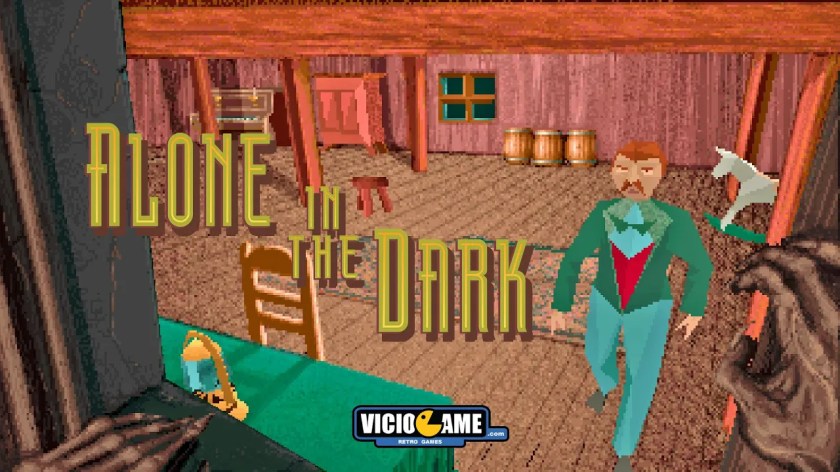
Alone in the Dark is a 3D survival horror game released in 1992 for PC. The owner of a mansion is found dead under mysterious circumstances, apparently by suicide. There are rumors of a haunting by an evil force. Your mission is to uncover the truth and make it out alive.
Developer/Publisher: Infogrames
Release date: 1992
Platform: PC / MS-DOS
Alone in the Dark: The Ultimate Guide
The emergence of Alone in the Dark in 1992, developed and published by Infogrames for MS-DOS, represented a fundamental milestone in video game history, establishing the foundation for the 3D survival horror genre. The game’s conception originated from an idea by Bruno Bonnell, founder of Infogrames, who envisioned a game set in predominantly dark environments, where navigation would depend on sounds and limited light sources. However, the project took shape as an independent initiative, led by programmer Frédérick Raynal, who, inspired by his passion for horror films and his experience with 3D programming in the game Continuum, decided to create a new gaming experience. Raynal envisioned an action-adventure game with zombies and monsters, focused on the player’s solitude in an old mansion from the early 20th century, a period that would avoid the complexity of modern technologies. The primary objective, summarized in one sentence, was clear: “Get out alive!”
The game’s technical development faced considerable challenges. Didier Chanfray, the lead animator, created a demonstration of a 3D sphere moving in an attic. The initial idea of digitizing photos of real locations for 2D backgrounds and then reverse engineering them for collision detection proved unfeasible. Thus, Yaël Barroz was tasked with creating hand-drawn 2D backgrounds, while Philippe Vachey was responsible for the audio department. After presenting a prototype, Bonnell officially approved the project, initially known by titles such as “In the Dark” and “Screams in the Dark,” before consolidating as Alone in the Dark, a name chosen to emphasize the narrative’s tragic nature. The development team, which started with three people, expanded to seven. Hubert Chardot, a screenwriter from 20th Century Fox, was responsible for structuring the plot and most of the dialogue in just three afternoons, weaving a story that would become one of the game’s pillars.
The narrative of Alone in the Dark is deeply influenced by H. P. Lovecraft’s Cthulhu Mythos, although Frédérick Raynal admitted that directors like Dario Argento and George A. Romero had a more direct influence on the terror atmosphere. Lovecraft was used to provide “atmosphere” and introduce “some creatures” to the game’s bestiary. This approach, however, led Chaosium to revoke the “Call of Cthulhu” license, claiming the game strayed from the spirit of the original work or was too simplistic to do justice to the tabletop RPG. Raynal, aware of the graphical limitations of the era, chose to integrate texts and documents into the game to deepen the story, as he believed that “few polygons” would not be enough to create a truly frightening atmosphere. The game’s design was intentionally crafted to generate anxiety, with seemingly simple tasks, such as walking down a corridor or opening a door, potentially resulting in sudden death, forcing the player to maintain constant vigilance.
The main plot unfolds in 1924, in Louisiana, where Jeremy Hartwood, a renowned artist and owner of the Derceto mansion, is found dead under mysterious circumstances, apparently by suicide. The mansion has long been the subject of rumors of being haunted by an evil force. The player assumes the role of Edward Carnby, a private detective searching for a piano in the attic for an antiques dealer, or Emily Hartwood, Jeremy’s niece, who believes the piano holds a secret note about her uncle’s death. Regardless of the character choice, the journey begins with entry into the mansion, where doors mysteriously close and the character is attacked by monsters in the attic. The game’s progression involves unraveling the truth behind Hartwood’s death and escaping the mansion, confronting or evading supernatural creatures and dangers.
Throughout the exploration of the mansion, the player discovers documents revealing the history of Derceto, built by Ezechiel Pregzt, an occultist pirate who performed dark rituals in underground caves to accumulate fortune and unnaturally prolong his life. Pregzt was killed and the mansion burned during the American Civil War, but his spirit persisted, inhabiting an ancient tree in the caves. Jeremy Hartwood committed suicide to prevent his body from being possessed by Pregzt, who now seeks the player as a new host. One of the game’s endings occurs if the player is incapacitated: their body is dragged to a sacrifice area and possessed by Pregzt, resulting in the release of supernatural horrors into the world. In another ending, the character finds a passage to the caves in Hartwood’s office, confronts Pregzt in the tree and sets it on fire with a lit lantern, fleeing as the cave collapses. The mansion is purified, and the player can exit through the front door. However, the game ends with a disturbing twist: upon returning to the car, the driver is revealed to be a zombie, taking the character back to civilization, suggesting that the threat has not been completely eradicated or that the malevolent influence has spread.
The gameplay of Alone in the Dark offers an experience that combines exploration, puzzle-solving, and combat. The player chooses between Edward Carnby or Emily Hartwood, whose backstories are distinct, but the main game progression is the same. Initially, the character is restricted to the attic and third floor of Derceto mansion, which must be traversed linearly. After solving a specific puzzle on the third floor, access to the first and second floors is unlocked, allowing for more non-linear exploration. Completing another puzzle grants access to the caves beneath the mansion, which, in turn, are completely linear.
Combat in the game is a strategic part of the experience. Enemies such as zombies, rats, and ghosts are dangerous and require caution. In melee combat, the player can execute different attacks – headbutt, quick punch, strong punch, or high kick – by holding the Space key and pressing the directions. Each move has distinct characteristics of reach, speed, and power, and the main objective is to stun enemies to avoid being immobilized. Firearms, such as a pistol and shotgun, and a bow can be found, but ammunition is extremely limited (six shells, twelve bullets, and three arrows), which reinforces the need for strategy. Many enemies must be overcome with intelligence, and direct confrontation is often discouraged. For example, in the first room, a werewolf and a zombie can be contained by moving furniture to block their path, demonstrating the importance of using the environment to the player’s advantage.
Exploration and puzzle-solving are central elements of the gameplay. The player must search the mansion for clues about past events, opening and closing doors, pushing objects, and collecting key items. The puzzles are logical and their solutions are suggested by references found in books and documents scattered throughout the house. However, the game features instant death traps and the possibility of making mistakes that render the game unwinnable, which, although frustrating, was a design choice to encourage learning through trial and error. The game’s inventory is limited by weight, not by the number of items, requiring the player to prioritize what to carry. Discarded items remain in place and can be retrieved, and how items are used or positioned is crucial to solving many puzzles.
The controls of Alone in the Dark are an aspect that generated discussion. The game uses what became known as “tank controls,” where the directional pad controls the character’s rotation relative to the camera, not the absolute direction of movement. Running, which is essential to escape certain situations, requires a double tap on the up arrow key, a command that can be inconsistent and difficult to master, especially considering the character’s default walking speed, which is quite slow. The version for the 3DO console brought a significant improvement in this aspect, introducing a separate button for running, which made movement more tolerable for players.
Technically, Alone in the Dark was a pioneer. The combination of polygonal 3D characters and objects with pre-rendered 2D backgrounds was an innovation for the time, allowing a level of visual detail in the settings that would be impossible with full 3D graphics. The character models, composed of approximately 250 polygons, moved over these static backgrounds. The game’s default resolution was 320×200 pixels, a common characteristic in MS-DOS games of that period. The limitation of real-time 3D rendering led to the adoption of the fixed camera system, which, although initially a constraint, was intelligently exploited by the developers to create an atmosphere of suspense and limit the player’s field of view, generating a constant sense of apprehension. The Macintosh version stood out for presenting “improved” graphics, with double resolution and a visual filter applied to the 2D backgrounds, offering a slightly superior visual experience.
The sound design and soundtrack of Alone in the Dark were crucial to building the terror atmosphere. Philippe Vachey, Infogrames’ in-house composer, created a haunting and organic soundtrack using Ad Lib, Inc. sound cards. His composition incorporated classic elements of horror soundtracks, such as piano strikes and plucked strings. Vachey developed specific musical themes for each monster, and, at Frédérick Raynal’s suggestion, these songs occasionally played even in the absence of enemies, with the purpose of inducing the player to feel in imminent danger. Sound effects, such as the realistic creaking of wooden floors and jingles that signaled nearby events, were carefully implemented using Sound Blaster audio samples, contributing significantly to immersion. The CD-ROM version, released in 1993, enhanced the experience with voice acting for character descriptions and documents. The original French dubbing was particularly praised for its theatrical quality, contrasting with the English version, which did not reach the same level of excellence.
The legacy of Alone in the Dark is undeniable. It is widely considered the “grandfather” of the 3D survival horror genre, directly influencing later titles such as Capcom’s Resident Evil, which adopted many of its concepts, including fixed camera angles and limited resource management. The game was both a critical and commercial success, receiving praise for its unsettling atmosphere, effective soundtrack, and technical innovations. It won several industry awards and regularly appears on lists of the greatest games of all time. The main development team, including Frédérick Raynal, later founded Adeline Software International, where they created games like Little Big Adventure and Time Commando, using a similar graphics engine. The Alone in the Dark franchise spawned several sequels and two film adaptations, and in 2024, a reimagined version of the original game was released by THQ Nordic, reaffirming its enduring cultural relevance.
An interesting complement to the Alone in the Dark experience was Jack in the Dark, a small promotional game released in 1993. This title functioned as a demonstration for Alone in the Dark 2 and was distributed in special packages and with CD-ROM versions. Rather than being an excerpt from the main game, Jack in the Dark presented a Christmas story where Grace Saunders, a child, becomes trapped in a toy store with Santa Claus, both held hostage by an evil toy. Grace, unable to fight, must solve puzzles to restore the spirit of Christmas. The game, which lasts about fifteen minutes, ends with Grace being captured, serving as a direct prelude to the events of Alone in the Dark 2. Despite its short duration, Jack in the Dark is remembered as a pleasant and nostalgic experience.
Alone in the Dark transcended the technical limitations of its time to create an experience that redefined the horror genre in video games. Its fusion of innovative graphics, a dense atmosphere, and an engaging narrative, inspired by masters of horror, ensured its place as a timeless classic. Despite some imperfections in gameplay and controls, its cultural impact and influence on subsequent titles are undeniable, solidifying its status as a fundamental pillar in the evolution of the survival horror genre. The game continues to be studied and appreciated for its boldness and for having paved the way for many of the conventions we consider standard today.
Alone in the Dark: O Guia Definitivo
O surgimento de Alone in the Dark em 1992, desenvolvido e publicado pela Infogrames para MS-DOS, representou um marco fundamental na história dos videogames, estabelecendo as bases para o gênero survival horror 3D. A concepção do jogo partiu de uma ideia de Bruno Bonnell, fundador da Infogrames, que vislumbrava um jogo ambientado em cenários predominantemente escuros, onde a navegação dependeria de sons e fontes de luz limitadas. Contudo, o projeto tomou forma como uma iniciativa independente, liderada pelo programador Frédérick Raynal, que, inspirado por sua paixão por filmes de terror e sua experiência com programação 3D no jogo Continuum, decidiu criar uma nova experiência de jogo. Raynal idealizou um jogo de ação e aventura com zumbis e monstros, focado na solidão do jogador em uma mansão antiga do início do século XX, um período que evitaria a complexidade de tecnologias modernas. O objetivo primordial, resumido em uma frase, era claro: “Saia vivo!”.
O desenvolvimento técnico do jogo enfrentou desafios consideráveis. Didier Chanfray, o animador principal, criou uma demonstração de uma esfera 3D movimentando-se em um sótão. A ideia inicial de digitalizar fotos de locais reais para os fundos 2D e, em seguida, aplicar engenharia reversa para colisões, mostrou-se inviável. Assim, Yaël Barroz foi encarregada de criar os fundos 2D desenhados à mão, enquanto Philippe Vachey foi responsável pelo departamento de áudio. Após a apresentação de um protótipo, Bonnell aprovou oficialmente o projeto, inicialmente conhecido por títulos como “In the Dark” e “Screams in the Dark”, antes de se consolidar como Alone in the Dark, um nome escolhido para enfatizar a natureza trágica da narrativa. A equipe de desenvolvimento, que começou com três pessoas, expandiu-se para sete. Hubert Chardot, um roteirista da 20th Century Fox, foi o responsável por estruturar o enredo e a maioria dos diálogos em apenas três tardes, tecendo uma trama que se tornaria um dos pilares do jogo.
A narrativa de Alone in the Dark é profundamente influenciada pelo Cthulhu Mythos de H. P. Lovecraft, embora Frédérick Raynal tenha admitido que diretores como Dario Argento e George A. Romero tiveram uma influência mais direta na atmosfera de terror. Lovecraft foi utilizado para conferir “ambiente” e introduzir “algumas criaturas” ao bestiário do jogo. Essa abordagem, no entanto, levou a Chaosium a revogar a licença de “Call of Cthulhu”, alegando que o jogo se distanciava do espírito da obra original ou era simplista demais para fazer jus ao RPG de mesa. Raynal, ciente das limitações gráficas da época, optou por integrar textos e documentos no jogo para aprofundar a história, pois acreditava que “poucos polígonos” não seriam suficientes para criar uma atmosfera verdadeiramente assustadora. O design do jogo foi intencionalmente elaborado para gerar ansiedade, com tarefas aparentemente simples, como caminhar por um corredor ou abrir uma porta, podendo resultar em morte súbita, forçando o jogador a uma constante vigilância.
O enredo principal se desenrola em 1924, na Louisiana, onde Jeremy Hartwood, um renomado artista e proprietário da mansão Derceto, é encontrado morto em circunstâncias misteriosas, aparentemente por suicídio. A mansão, há muito tempo, é alvo de rumores de assombração por uma força maligna. O jogador assume o papel de Edward Carnby, um detetive particular em busca de um piano no sótão para um negociante de antiguidades, ou Emily Hartwood, sobrinha de Jeremy, que acredita que o piano guarda uma nota secreta sobre a morte de seu tio. Independentemente da escolha do personagem, a jornada começa com a entrada na mansão, onde as portas se fecham misteriosamente e o personagem é atacado por monstros no sótão. A progressão do jogo envolve desvendar a verdade por trás da morte de Hartwood e escapar da mansão, enfrentando ou evadindo criaturas sobrenaturais e perigos.
Ao longo da exploração da mansão, o jogador descobre documentos que revelam a história de Derceto, construída por Ezechiel Pregzt, um pirata ocultista que realizava rituais sombrios nas cavernas subterrâneas para acumular fortuna e prolongar sua vida de forma antinatural. Pregzt foi morto e a mansão incendiada durante a Guerra Civil Americana, mas seu espírito persistiu, habitando uma antiga árvore nas cavernas. Jeremy Hartwood cometeu suicídio para evitar que seu corpo fosse possuído por Pregzt, que agora busca o jogador como novo hospedeiro. Um dos finais do jogo ocorre se o jogador for incapacitado: seu corpo é arrastado para uma área de sacrifício e possuído por Pregzt, resultando na libertação de horrores sobrenaturais para o mundo. Em outro final, o personagem encontra uma passagem para as cavernas no escritório de Hartwood, confronta Pregzt na árvore e a incendeia com uma lanterna acesa, fugindo enquanto a caverna desaba. A mansão é purificada, e o jogador pode sair pela porta da frente. No entanto, o jogo termina com uma reviravolta perturbadora: ao retornar ao carro, o motorista é revelado como um zumbi, levando o personagem de volta à civilização, sugerindo que a ameaça ainda não foi completamente erradicada ou que a influência maligna se espalhou.
A jogabilidade de Alone in the Dark oferece uma experiência que combina exploração, resolução de quebra-cabeças e combate. O jogador escolhe entre Edward Carnby ou Emily Hartwood, cujas histórias de fundo são distintas, mas a progressão principal do jogo é a mesma. Inicialmente, o personagem está restrito ao sótão e ao terceiro andar da mansão Derceto, que devem ser percorridos de forma linear. Após resolver um quebra-cabeça específico no terceiro andar, o acesso aos primeiro e segundo andares é liberado, permitindo uma exploração mais não linear. A conclusão de outro quebra-cabeça concede acesso às cavernas sob a mansão, que, por sua vez, são completamente lineares.
O combate no jogo é uma parte estratégica da experiência. Inimigos como zumbis, ratos e fantasmas são perigosos e exigem cautela. No combate corpo a corpo, o jogador pode executar diferentes ataques – cabeçada, soco rápido, soco forte ou chute alto – segurando a tecla Espaço e pressionando as direções. Cada movimento possui características distintas de alcance, velocidade e poder, e o objetivo principal é atordoar os inimigos para evitar ser imobilizado. Armas de fogo, como pistola e espingarda, e um arco podem ser encontrados, mas a munição é extremamente limitada (seis cartuchos, doze balas e três flechas), o que reforça a necessidade de estratégia. Muitos inimigos devem ser superados com inteligência, e o confronto direto é frequentemente desaconselhado. Por exemplo, no primeiro cômodo, um lobisomem e um zumbi podem ser contidos movendo móveis para bloquear seu caminho, demonstrando a importância de usar o ambiente a favor do jogador.
A exploração e a resolução de quebra-cabeças são elementos centrais da jogabilidade. O jogador deve vasculhar a mansão em busca de pistas sobre os eventos passados, abrindo e fechando portas, empurrando objetos e coletando itens-chave. Os quebra-cabeças são lógicos e suas soluções são sugeridas por referências encontradas em livros e documentos espalhados pela casa. No entanto, o jogo apresenta armadilhas de morte instantânea e a possibilidade de cometer erros que tornam o jogo invencível, o que, embora frustrante, foi uma escolha de design para incentivar o aprendizado por tentativa e erro. O inventário do jogo é limitado por peso, não por quantidade de itens, exigindo que o jogador priorize o que carregar. Itens descartados permanecem no local e podem ser recuperados, e a forma como os itens são usados ou posicionados é crucial para a resolução de muitos quebra-cabeças.
Os controles de Alone in the Dark são um aspecto que gerou discussões. O jogo utiliza o que ficou conhecido como “tank-controls”, onde o direcional controla a rotação do personagem em relação à câmera, e não a direção absoluta do movimento. Correr, que é essencial para escapar de certas situações, exige um duplo toque na tecla de seta para cima, um comando que pode ser inconsistente e difícil de dominar, especialmente considerando a velocidade de caminhada padrão do personagem, que é bastante lenta. A versão para o console 3DO trouxe uma melhoria significativa nesse aspecto, introduzindo um botão separado para correr, o que tornou a movimentação mais tolerável para os jogadores.
Tecnicamente, Alone in the Dark foi um pioneiro. A combinação de personagens e objetos 3D poligonais com fundos 2D pré-renderizados foi uma inovação para a época, permitindo um nível de detalhe visual nos cenários que seria impossível com gráficos 3D completos. Os modelos dos personagens, compostos por aproximadamente 250 polígonos, moviam-se sobre esses fundos estáticos. A resolução padrão do jogo era de 320×200 pixels, uma característica comum em jogos de MS-DOS daquele período. A limitação da renderização 3D em tempo real levou à adoção do sistema de câmera fixa, que, embora inicialmente uma restrição, foi inteligentemente explorado pelos desenvolvedores para criar uma atmosfera de suspense e limitar o campo de visão do jogador, gerando uma constante sensação de apreensão. A versão para Macintosh se destacou por apresentar gráficos “melhorados”, com resolução dupla e um filtro visual aplicado aos fundos 2D, oferecendo uma experiência visual ligeiramente superior.
O design de som e a trilha sonora de Alone in the Dark foram cruciais para a construção da atmosfera de terror. Philippe Vachey, o compositor interno da Infogrames, criou uma trilha sonora assombrosa e orgânica utilizando placas de som Ad Lib, Inc. Sua composição incorporou elementos clássicos de trilhas de terror, como batidas de piano e cordas dedilhadas. Vachey desenvolveu temas musicais específicos para cada monstro, e, por sugestão de Frédérick Raynal, essas músicas ocasionalmente tocavam mesmo na ausência de inimigos, com o propósito de induzir o jogador a sentir-se em perigo iminente. Os efeitos sonoros, como os rangidos realistas do piso de madeira e os jingles que sinalizavam eventos próximos, foram cuidadosamente implementados usando amostras de áudio Sound Blaster, contribuindo significativamente para a imersão. A versão em CD-ROM, lançada em 1993, aprimorou a experiência com dublagem para as descrições de personagens e documentos. A dublagem francesa original foi particularmente elogiada por sua qualidade teatral, contrastando com a versão em inglês, que não atingiu o mesmo nível de excelência.
O legado de Alone in the Dark é inegável. Ele é amplamente considerado o “avô” do gênero survival horror em 3D, influenciando diretamente títulos posteriores como Resident Evil da Capcom, que adotou muitos de seus conceitos, incluindo os ângulos de câmera fixos e a gestão de recursos limitados. O jogo foi um sucesso tanto de crítica quanto comercial, recebendo elogios por sua atmosfera inquietante, trilha sonora eficaz e inovações técnicas. Conquistou diversos prêmios da indústria e figura regularmente em listas dos melhores jogos de todos os tempos. A equipe principal de desenvolvimento, incluindo Frédérick Raynal, posteriormente fundou a Adeline Software International, onde criaram jogos como Little Big Adventure e Time Commando, utilizando um motor gráfico similar. A franquia Alone in the Dark gerou várias sequências e duas adaptações cinematográficas, e em 2024, uma versão reimaginada do jogo original foi lançado pela THQ Nordic, reafirmando sua duradoura relevância cultural.
Um complemento interessante à experiência de Alone in the Dark foi Jack in the Dark, um pequeno jogo promocional lançado em 1993. Este título funcionava como uma demonstração para Alone in the Dark 2 e era distribuído em embalagens especiais e com as versões em CD-ROM. Em vez de ser um trecho do jogo principal, Jack in the Dark apresentava uma história natalina onde Grace Saunders, uma criança, fica presa em uma loja de brinquedos com o Papai Noel, ambos mantidos reféns por um brinquedo maligno. Grace, incapaz de lutar, deve resolver quebra-cabeças para restaurar o espírito do Natal. O jogo, que dura cerca de quinze minutos, termina com Grace sendo capturada, servindo como um prelúdio direto para os eventos de Alone in the Dark 2. Apesar de sua curta duração, Jack in the Dark é lembrado como uma experiência agradável e nostálgica.
Alone in the Dark transcendeu as limitações técnicas de sua época para criar uma experiência que redefiniu o gênero de terror nos videogames. Sua fusão de gráficos inovadores, uma atmosfera densa e uma narrativa envolvente, inspirada em mestres do horror, garantiu seu lugar como um clássico atemporal. Apesar de algumas imperfeições na jogabilidade e nos controles, seu impacto cultural e sua influência sobre títulos subsequentes são inegáveis, solidificando seu status como um pilar fundamental na evolução do gênero survival horror. O jogo continua a ser estudado e apreciado por sua audácia e por ter pavimentado o caminho para muitas das convenções que hoje consideramos um padrão.
🤑💲Earn money without doing anything! Just leave these apps open:
   ✓ https://r.honeygain.me/CONTA9DB02

   ✓ https://packetstream.io/?psr=1uPb
🤑💲1-Click button earns Bitcoin every 1 hour: https://freebitco.in/?r=53528449
⬛ 𝗧𝗶𝗸𝗧𝗼𝗸: https://www.tiktok.com/@viciogame
🟧 𝗜𝗻𝘀𝘁𝗮𝗴𝗿𝗮𝗺: http://www.instagram.com/viciogame
🟥 𝗬𝗼𝘂𝘁𝘂𝗯𝗲: http://www.youtube.com/viciogame
🟦 𝗙𝗮𝗰𝗲𝗯𝗼𝗼𝗸: http://www.facebook.com/viciogame
🔳 𝗧𝗵𝗿𝗲𝗮𝗱𝘀: https://www.threads.net/@viciogame
🟪 𝗧𝘄𝗶𝘁𝗰𝗵: https://www.twitch.tv/ViciogameRetroGames
🟨 𝗕𝗹𝗼𝗴: http://www.viciogameblog.com/
🟦𝗧𝘄𝗶𝘁𝘁𝗲𝗿: http://www.twitter.com/viciogame
#Viciogame #Gameplay #LetsPlay #Gamer #Playthrough #Games #News #Videogames #Review #Game #Detonado #Walkthrough #Ending #Reviews #Facts #Retro #Record #Roms #Emulator #Longplay #Speedrun #AloneInTheDark #PC #MsDOS #SurvivalHorror #Infogrames #ResidentEvil #SilentHill #RPG #Adventure #Sierra #Lucasarts
 VICIOGAME