
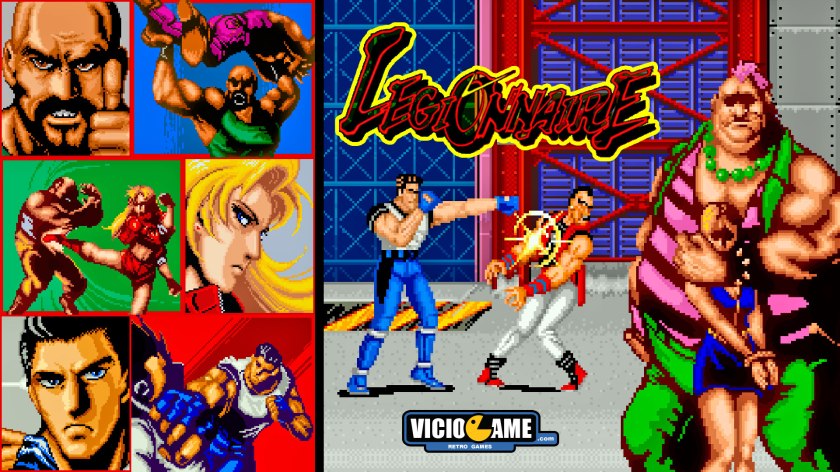
Legionnaire is a beat ‘em up arcade game released in 1992. The city has been taken over by a dangerous gang led by the powerful Mr. G. Amidst this chaos, a group of vigilantes decides to take on the criminals to free the city and rescue Judy, a team member who has been kidnapped.
Developer: TAD Corporation
Publisher: Fabtek
Release date: 1992
Platform: Arcade
Legionnaire: The Ultimate Guide
Released in 1992 by TAD Corporation, Legionnaire is an arcade beat ‘em up that, despite not achieving the same notoriety as other titles from that era like Final Fight or Streets of Rage, built its own legacy among retro gaming enthusiasts. With the original Japanese title Saishuu Kakutou Kizoku Legionnaire, the game fits into the context of a golden age of arcades, offering a cooperative action experience. Developed by a team formed by former Data East employees, TAD Corporation was already known for games like Cabal and Toki. Legionnaire was one of their last projects before closing their operations. For a long period, the game was considered “lost” due to a copy protection system that made emulation difficult, which contributed to its obscurity. Only after the MAME emulator team managed to crack this protection did the game become accessible to a wider audience, allowing its history and peculiarities to be properly preserved and analyzed.
The narrative of Legionnaire unfolds in the fictional Blood City, a city that, as the name suggests, has been dominated by crime and corruption under the control of the Crimson gang. Amid this chaotic scenario, a group of four vigilantes calling themselves Legionnaire rises as the only force willing to confront the criminals. The plot is triggered when the gang, in an attempt to break the group’s spirit of resistance, kidnaps one of its members, Judy. The mission of the three remaining members is to traverse the city, defeating hordes of enemies to rescue their companion. The story’s progression is presented through cutscenes between stages, which display a map of the five-stage journey, along with the portrait of each stage’s boss and a brief description about them, similar to what was seen in Final Fight.
Players can choose from three characters to begin their journey: Alfred, Chris, and Frank. Each has their own characteristics, although the basic moveset is surprisingly similar among them. Alfred is the balanced character, Chris is more agile, and Frank is the strongest, but these differences are subtle in practice. Judy, the kidnapped member, is not playable, but her presence is the catalyst for the plot. The game allows up to three players to participate simultaneously, which intensifies the action and cooperative strategy. The character choice, however, does not drastically alter the gameplay experience, since special abilities and attacks are largely standardized.
Legionnaire‘s gameplay follows the classic beat ‘em up formula of the era, with controls that, while familiar, are quite simplified. The moveset is relatively small, and the game does not offer collectible weapons, with the exception of some explosive barrels that can be used. Items found in crates and other destructible objects are generally limited to health or point bonuses. The special attack, which consumes a portion of the player’s health bar, is identical for all characters: a jump into the air followed by throwing a grenade on the ground.
The most distinctive feature of the combat system is the ability to run, executed by tapping the jump button twice. By combining the dash with the attack button, the player can perform a quick and powerful attack or, if close enough to an enemy, grab and throw them. It’s important to note that this is the only way to throw enemies, as it’s not possible to grab them when they’re stunned, as in other games of the genre. The timing to execute the dash can be a bit tricky, as a poorly timed tap can result in an unwanted jump. Additionally, by holding the directional up or down at the end of a combo sequence, enemies are thrown away, providing additional crowd control, except for Frank, who already has this move as default. Despite the simplicity, the controls are responsive and precise, aligning well with the genre’s premise.
Despite its conventional gameplay structure, Legionnaire stands out for the peculiar details of its enemy roster. Besides generic thugs, the game features adversaries like clawed dwarves and, occasionally, bomb-men who jump from the sky. A particularly bizarre enemy, with a big nose and glasses, flees in panic after a single hit, dropping bonus items. One of the bosses, a corpulent woman who spits fire, looks at the screen and makes an obscene gesture at the player, adding an unexpected touch of humor. There are also enemies that emit a comical scream before charging at the player. Most enemies fit the standard gang member pattern of beat ‘em ups, but the fourth stage boss stands out for having extendable limbs and drawing a sword from his own arm, breaking the monotony. Curiously, the penultimate villain is a bearded and elegant man in a red suit, which contrasts with the bizarreness of other enemies. After defeating him once, the player faces him again in a space station, where he appears with electric claws, a final touch to the confrontation.
The journey in Legionnaire is divided into five distinct stages, each culminating in a confrontation with a boss. The stages take players through different scenarios of Blood City, from gang-infested streets to more unusual locations, such as the space station where the final confrontation with the main antagonist occurs. The progression is linear, and the objective in each stage is simple: eliminate the enemies that appear on screen and advance to the boss. At the end of the game, after defeating the villain, the game presents an ending that, for the time, was quite atypical. Instead of a generic conclusion, Legionnaire shows the fate of the characters after the story’s events. Alfred and Judy, for example, settle down and start a family, while Frank fulfills his dream of opening a hot dog stand. These individual outcomes for each character add a personal touch and a sense of closure to the narrative, something that not all arcade-era beat ‘em ups offered.
The game includes several debug functions that, although disabled in the final version, can be accessed through code modifications. Among them, the Income Report accessible on the TAD Corp screen stands out, providing detailed statistics about the machine’s runtime, high, low, and average scores, the bosses where players lose the most, and general revenue information for each of the three characters. A second revenue report screen shows the exact point in each stage where players had a “Game Over,” as well as indicating whether the game was completed. The game’s dynamic difficulty system can also be viewed and even disabled, revealing how the game adjusts its challenge based on player performance. There’s also an Enemy Debug that allows the creation of specific enemies for testing, showing the enemy’s current action below player 1’s health bar, with a complete list of actions.
The game contains unused graphics that offer a glimpse of what could have been. There’s an incomplete speech bubble for an enemy taunt that was overwritten. Sprites of Judy speaking on the “Continue” screen were also found, showing that the character would have had more incentive for the player to continue the game. Additionally, six sprites of panicking animals were discovered – a rat, a chick, a rooster, a crow, a piglet, and a pig – that were not implemented in the final game. The presence of the hidden text “Start Up Program V1.02 (C)1986 Seibu Kaihatsu Inc.” proves the technology collaboration of Seibu Kaihatsu.
The preservation of titles like Legionnaire, regardless of their initial popularity or critical reception, is a valuable effort, as it allows video game history to be maintained and explored by new generations of players and researchers. Overcoming the technical challenges of emulation ensures that games with unique peculiarities are not forgotten.
This is more than just a simple beat ‘em up from the golden age of arcades; it’s an example of the creativity and peculiarities that could be found in lesser-known games. Although its gameplay may seem simplistic compared to the giants of the genre, its positive points give it a unique charm. For arcade enthusiasts and those seeking to explore the less-explored corners of video game history, Legionnaire offers an experience that, while not revolutionary, is rich in detail and worthy of being revisited and appreciated.
Legionnaire: O Guia Definitivo
Lançado em 1992 pela TAD Corporation, Legionnaire é um jogo de arcade do gênero beat ‘em up que, apesar de não ter alcançado a mesma notoriedade de outros títulos da época, como Final Fight ou Streets of Rage, construiu um legado próprio entre os entusiastas de jogos retrô. Com o título original japonês Saishuu Kakutou Kizoku Legionnaire, o jogo se insere no contexto de uma era de ouro dos arcades, oferecendo uma experiência de ação cooperativa. Desenvolvido por uma equipe formada por ex-funcionários da Data East, a TAD Corporation já era conhecida por jogos como Cabal e Toki. Legionnaire foi um de seus últimos projetos antes do encerramento de suas atividades. Por um longo período, o jogo foi considerado “perdido” devido a um sistema de proteção anticópia que dificultava sua emulação, o que contribuiu para sua obscuridade. Apenas após a equipe do emulador MAME conseguir decifrar essa proteção é que o jogo se tornou acessível a um público mais amplo, permitindo que sua história e suas particularidades fossem devidamente preservadas e analisadas.
A narrativa de Legionnaire se desenrola na fictícia Blood City, uma cidade que, como o nome sugere, foi dominada pelo crime e pela corrupção sob o controle da gangue Crimson. Em meio a esse cenário caótico, um grupo de quatro vigilantes autointitulado Legionnaire se ergue como a única força disposta a enfrentar os criminosos. A trama tem seu estopim quando a gangue, em uma tentativa de quebrar o espírito de resistência do grupo, sequestra uma de suas integrantes, Judy. A missão dos três membros restantes é, então, atravessar a cidade, derrotando hordas de inimigos para resgatar sua companheira. A progressão da história é apresentada por meio de cenas entre as fases, que exibem um mapa da jornada de cinco fases, juntamente com o retrato do chefe de cada fase e uma breve descrição sobre ele, de forma semelhante ao que era visto em Final Fight.
Os jogadores podem escolher entre três personagens para iniciar sua jornada: Alfred, Chris e Frank. Cada um possui suas próprias características, embora o conjunto de movimentos básicos seja surpreendentemente similar entre eles. Alfred é o personagem equilibrado, Chris é mais ágil e Frank é o mais forte, mas essas diferenças são sutis na prática. Judy, a integrante sequestrada, não é jogável, mas sua presença é o catalisador da trama. O jogo permite que até três jogadores participem simultaneamente, o que intensifica a ação e a estratégia cooperativa. A escolha do personagem, no entanto, não altera drasticamente a experiência de jogo, já que as habilidades especiais e os ataques são, em grande parte, padronizados.
A jogabilidade de Legionnaire segue a fórmula clássica dos beat ‘em ups da época, com controles que, embora familiares, são bastante simplificados. O conjunto de movimentos é relativamente pequeno, e o jogo não oferece armas coletáveis, com exceção de alguns barris explosivos que podem ser utilizados. Os itens encontrados em caixas e outros objetos destrutíveis geralmente se limitam a bônus de saúde ou pontos. O ataque especial, que consome uma porção da barra de vida do jogador, é idêntico para todos os personagens: um salto no ar seguido do lançamento de uma granada no chão.
A característica mais distintiva do sistema de combate é a capacidade de correr, executada ao tocar duas vezes no botão de pulo. Ao combinar o dash com o botão de ataque, o jogador pode realizar um ataque rápido e poderoso ou, se estiver próximo o suficiente de um inimigo, agarrá-lo e arremessá-lo. É importante notar que esta é a única maneira de arremessar inimigos, pois não é possível agarrá-los quando atordoados, como em outros jogos do gênero. O tempo para executar o dash pode ser um pouco complicado, pois um toque mal cronometrado pode resultar em um pulo indesejado. Além disso, ao segurar o direcional para cima ou para baixo no final de uma sequência de golpes, os inimigos são arremessados para longe, proporcionando um controle adicional sobre a multidão, exceto para Frank, que já possui esse movimento como padrão. Apesar da simplicidade, os controles são responsivos e precisos, alinhando-se bem com a proposta do gênero.
Apesar de sua estrutura de jogabilidade convencional, Legionnaire se destaca pelos detalhes peculiares de seu elenco de inimigos. Além dos arruaceiros genéricos, o jogo apresenta adversários como anões com garras e, ocasionalmente, homens-bomba que saltam do céu. Um inimigo particularmente bizarro, com um nariz grande e óculos, foge em pânico após um único golpe, deixando cair itens bônus. Um dos chefes, uma mulher corpulenta que cospe fogo, olha para a tela e faz um gesto obsceno para o jogador, adicionando um toque de humor inesperado. Há também inimigos que emitem um grito cômico antes de avançar contra o jogador. A maioria dos inimigos se encaixa no padrão de membros de gangue de beat ‘em ups, mas o chefe da quarta fase se diferencia por possuir membros extensíveis e sacar uma espada do próprio braço, quebrando a monotonia. Curiosamente, o penúltimo vilão é um homem barbudo e elegante em um terno vermelho, o que contrasta com a bizarrice de outros inimigos. Após derrotá-lo uma vez, o jogador o enfrenta novamente em uma estação espacial, onde ele aparece com garras elétricas, um toque final para o confronto.
A jornada em Legionnaire é dividida em cinco fases distintas, cada uma culminando em um confronto com um chefe. As fases levam os jogadores por diferentes cenários de Blood City, desde as ruas infestadas de gangues até locais mais inusitados, como a estação espacial onde ocorre o confronto final com o antagonista principal. A progressão é linear, e o objetivo em cada fase é simples: eliminar os inimigos que surgem na tela e avançar até o chefe. Ao final do jogo, após a derrota do vilão, o jogo apresenta um final que, para a época, era bastante atípico. Em vez de uma conclusão genérica, Legionnaire mostra o destino dos personagens após os eventos da história. Alfred e Judy, por exemplo, se estabelecem e formam uma família, enquanto Frank realiza seu sonho de abrir uma barraca de cachorro-quente. Esses desfechos individuais para cada personagem adicionam um toque pessoal e um senso de conclusão à narrativa, algo que nem todos os beat ‘em ups da era arcade ofereciam.
O jogo inclui diversas funções de depuração que, embora desativadas na versão final, podem ser acessadas por meio de modificações no código. Entre elas, destaca-se o Income Report acessível na tela da TAD Corp, que fornece estatísticas detalhadas sobre o tempo de funcionamento da máquina, pontuações altas, baixas e médias, os chefes em que os jogadores mais perdem e informações gerais de receita para cada um dos três personagens. Uma segunda tela do relatório de receita mostra o ponto exato em cada fase onde os jogadores tiveram um “Game Over”, além de indicar se o jogo foi finalizado. O sistema de dificuldade dinâmica do jogo também pode ser visualizado e até desativado, revelando como o jogo ajusta seu desafio com base na performance do jogador. Existe ainda um Enemy Debug que permite a criação de inimigos específicos para testes, mostrando a ação atual do inimigo abaixo da barra de vida do jogador 1, com uma lista completa de ações.
O jogo contém gráficos não utilizados que oferecem um vislumbre do que poderia ter sido. Há um balão de fala incompleto, para uma provocação de um inimigo, que foi sobrescrito. Sprites de Judy falando na tela de “Continue” também foram encontrados, mostrando que a personagem teria mais incentivo para o jogador continuar o jogo. Além disso, foram descobertos seis sprites de animais em pânico – um rato, um pintinho, um galo, um corvo, um leitão e um porco – que não foram implementados no jogo final. A presença do texto escondido “Start Up Program V1.02 (C)1986 Seibu Kaihatsu Inc.” comprova a colaboração de tecnologia da Seibu Kaihatsu.
A preservação de títulos como Legionnaire, independentemente de sua popularidade ou recepção crítica inicial, é um esforço valioso, pois permite que a história dos videogames seja mantida e explorada por novas gerações de jogadores e pesquisadores. A superação dos desafios técnicos de emulação garante que jogos com particularidades únicas não sejam esquecidos.
Este é mais do que um simples beat ‘em up da era de ouro dos arcades; é um exemplo da criatividade e das peculiaridades que podiam ser encontradas em jogos menos conhecidos. Embora sua jogabilidade possa parecer simplista em comparação com os gigantes do gênero, seus pontos positivos conferem-lhe um charme único. Para os aficionados por fliperamas e para aqueles que buscam conhecer os cantos menos explorados da história dos jogos eletrônicos, Legionnaire oferece uma experiência que, embora não revolucionária, é rica em detalhes e digna de ser revisitada e apreciada.
🤑💲Earn money without doing anything! Just leave these apps open:
   ✓ https://r.honeygain.me/CONTA9DB02

   ✓ https://packetstream.io/?psr=1uPb
🤑💲1-Click button earns Bitcoin every 1 hour: https://freebitco.in/?r=53528449
⬛ 𝗧𝗶𝗸𝗧𝗼𝗸: https://www.tiktok.com/@viciogame
🟧 𝗜𝗻𝘀𝘁𝗮𝗴𝗿𝗮𝗺: http://www.instagram.com/viciogame
🟥 𝗬𝗼𝘂𝘁𝘂𝗯𝗲: http://www.youtube.com/viciogame
🟦 𝗙𝗮𝗰𝗲𝗯𝗼𝗼𝗸: http://www.facebook.com/viciogame
🔳 𝗧𝗵𝗿𝗲𝗮𝗱𝘀: https://www.threads.net/@viciogame
🟪 𝗧𝘄𝗶𝘁𝗰𝗵: https://www.twitch.tv/ViciogameRetroGames
🟨 𝗕𝗹𝗼𝗴: http://www.viciogameblog.com/
🟦𝗧𝘄𝗶𝘁𝘁𝗲𝗿: http://www.twitter.com/viciogame
#Viciogame #Gameplay #LetsPlay #Gamer #Playthrough #Games #News #Videogames #Review #Game #Detonado #Walkthrough #Ending #Reviews #Facts #Retro #Record #Roms #Emulator #Longplay #Speedrun #Legionnaire #arcade #TadCorporation #Fabtek #BeatEmUp #FinalFight #streetsOfRage #GoldenAxe #mame #fliperama #アーケードゲーム
 VICIOGAME