
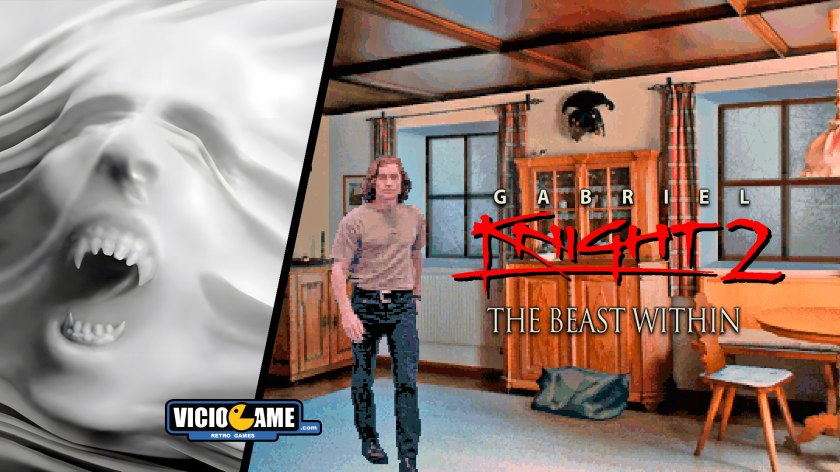
Gabriel Knight 2: The Beast Within is a point-and-click adventure game released in 1995 for MS-DOS. One year after the events of the first game, Gabriel, now in Germany, must investigate a series of brutal attacks involving wolves, werewolves, a hunting club, King Ludwig II, and a lost opera.
Developer/Publisher: Sierra On-Line
Release date: 1995
Platform: PC / MS-DOS
Gabriel Knight 2: The Beast Within – The Ultimate Guide
The rise of The Beast Within: A Gabriel Knight Mystery in the adventure game scene for MS-DOS in 1995 represented a technological and narrative milestone, solidifying the series created by Jane Jensen. Moving away from the traditional animation of its predecessor, Gabriel Knight: Sins of the Fathers, this title embraced Full Motion Video (FMV) technology, using real actors and locations photographed in Germany to create an experience that approached the “interactive movie.” This change, though ambitious, required the game to be distributed across six CD-ROMs, a considerable volume for the time, reflecting the vast amount of video needed to bring the narrative to life.
The story unfolds one year after the events of the first game. Gabriel Knight, now a recognized Schattenjäger (shadow hunter), resides in the ancestral Schloss Ritter in Bavaria, Germany. He attempts to write a novel but is interrupted by terrified villagers seeking the shadow hunter’s help to investigate a series of brutal attacks on children, initially attributed to wolves that escaped from a local zoo. The narrative quickly plunges into a deeper mystery, involving werewolves, a secret hunting club in Munich, and the legend of the “Fairy Tale King,” Ludwig II of Bavaria, and his connection to composer Richard Wagner. The game is divided into six chapters, with control alternating between Gabriel and his assistant, Grace Nakimura, who joins the investigation remotely from New Orleans and later in Germany.
The gameplay is based on the point-and-click system, but with a simplified interface compared to its predecessor. The cursor, which transforms into a dagger when hovering over interactive objects or areas, indicates the possibility of interaction. The control panel, accessible through a werewolf face icon (matching the CD cover), allows you to save and load the game (with up to 20 saves per directory), adjust the volume, and crucially, toggle the video window size between full screen and half screen. An important feature is the “Movie Projector,” which allows the player to rewatch any significant FMV scene already viewed, aiding in understanding the plot.
The information-gathering system is central to progression. Gabriel uses a tape recorder, recording all conversations. A unique and challenging tool is the recorder’s “Splice” function, introduced early in the first chapter. To advance, the player needs to splice together recorded phrases from different characters to create a new message, such as the one Gabriel uses to impersonate Dr. Klingmann and gain access to the zoo’s wolves. Precision in word choice is vital, making this one of the most notorious and frustrating puzzles in the game (or in that entire generation). Grace, on the other hand, records her findings in a notebook, organizing notes by subject, reflecting her more methodical, research-oriented approach.
Character alternation and the chapter structure are fundamental to the mystery’s chronology:
| Chapter | Character | Main Location | Investigation Focus |
|---|---|---|---|
| 1 | Gabriel Knight | Huber Farm, Munich Zoo, Marienplatz | Initial investigation of attacks, gathering evidence (wolf hair, paw cast), and infiltrating the hunting club. |
| 2 | Grace Nakimura | Schloss Ritter, Rittersberg | Historical research on werewolves, the 1750 case, and the legend of the “Black Wolf” and Ludwig II. |
| 3 | Gabriel Knight | Munich, Hunting Club, Perlach | Deeper infiltration of the club, using the recorder to obtain information, and investigating Baron von Glower. |
| 4 | Grace Nakimura | Munich (Museums, Archives), Neuschwanstein Castle | Research on Ludwig II, Wagner, and the lost opera, requiring extensive exploration of historical locations. |
| 5 | Gabriel Knight | Neuschwanstein Castle, Forest | Search for Grace, confrontation with von Glower, and the forest chase. |
| 6 | Gabriel & Grace | Neuschwanstein, Cave, Furnace | Story climax, with characters working together for the final confrontation. |
Chapter 4, controlling Grace, is an example of the game’s “pixel hunting” style, where the player must meticulously examine every detail in museums and archives to find the triggers that unlock new research topics or locations. The difficulty lies in not missing a single interaction point, which can stall progress. A tip to know if you’ve missed something is to return to the city map and click the “Hint” button. If the location flashes a red outline, there’s still a pending action there.
The game’s difficulty level is high, mainly due to the nature of the sometimes illogical puzzles and the need for exhaustive exploration. Sierra On-Line, aware of this, included a hints section in the manual, phone help with specialized attendants, and official printed guides.
Although there are no power-ups or alternate endings in the traditional sense, the game presents a dramatic climax in Chapter 6. The final confrontation involves a real-time action sequence where Gabriel transforms into a werewolf and the player assumes a first-person perspective, with altered visuals, to hunt their opponent in an enclosed environment. This is one of the few sequences that deviates from the point-and-click format and requires quick reflexes, though the solution is more a puzzle of strategy and timing than pure combat. In short, you need to block specific doors to force the wolf to follow a single path that leads directly to the furnace.
The soundtrack, composed by Robert Holmes, who also worked on the first game, received praise for its orchestral quality, which adapts to the dark, operatic tone of the story. The absolute highlight is the inclusion of a “lost” Wagnerian opera, composed specifically for the game. Though only one act, the piece is impressive and adds a layer of authenticity and cultural depth to the plot revolving around Wagner and Ludwig II. However, most of the game is marked by long periods of silence, punctuated only by sound effects and voice acting, which, for some, contributed to a sense of sluggish pacing.
The transition to FMV brought technical and design challenges. The need to film each interaction limited the amount of dialogue and interactive objects compared to the previous game, resulting in scenarios that, while visually stunning (such as the castles and landscapes of Bavaria), felt “empty” to some players. The acting, though above average for games of the era, was criticized for making Gabriel (played by Dean Erickson) less rough and charismatic, and Grace (Joanne Takahashi) initially colder and more hostile. However, the production quality and Jane Jensen’s narrative ambition overcame the technology’s limitations, securing The Beast Within a prominent place in adventure game history.
In an interview, Jane Jensen admitted to being proud of the historical content and mature themes explored, but the technology available in 1995 wasn’t entirely ready to fully realize her creative vision. If she did it again, she would consider a hybrid approach combining filmed actors with rendered or painted backgrounds instead of full video from start to finish.
The legacy of The Beast Within: A Gabriel Knight Mystery lies in its ability to blend historical facts, mythology, and fiction in an engaging way. The depth of Jane Jensen’s research on Bavarian culture, werewolf myths, and the life of Ludwig II transformed the game into a rich and educational experience. Despite pacing issues and sometimes tedious nature, it’s remembered as one of the best examples of the FMV genre and a high point in the Gabriel Knight series, which would continue to explore occult and historical themes in Gabriel Knight 3: Blood of the Sacred, Blood of the Damned.
The game remains a definitive example for point-and-click fans, even during a time of technological transition. For those who love a horror plot, Gabriel Knight 2 brings exploration of werewolf legend and a dark, adult adventure that challenged the limits of interactive narrative in its time.
Gabriel Knight 2: The Beast Within – O Guia Definitivo
A ascensão de The Beast Within: A Gabriel Knight Mystery no cenário dos jogos de aventura para MS-DOS em 1995 representou um marco tecnológico e narrativo, consolidando a série criada por Jane Jensen. Distanciando-se da animação tradicional do seu antecessor, Gabriel Knight: Sins of the Fathers, este título abraçou a tecnologia Full Motion Video (FMV), utilizando atores reais e cenários fotografados na Alemanha para criar uma experiência que se aproximava do “filme interativo”. Essa mudança, embora ambiciosa, exigiu que o jogo fosse distribuído em seis CDs-ROM, um volume considerável para a época, refletindo a vasta quantidade de vídeo necessária para dar vida à narrativa.
A história se desenrola um ano após os eventos do primeiro jogo. Gabriel Knight, agora um Schattenjäger (caçador de sombras) reconhecido, reside no ancestral Schloss Ritter, na Baviera, Alemanha. Ele tenta escrever um romance, mas é interrompido por aldeões aterrorizados que buscam a ajuda do caçador de sombras para investigar uma série de ataques brutais a crianças, inicialmente atribuídos a lobos que escaparam de um zoológico local. A narrativa rapidamente mergulha em um mistério mais profundo, envolvendo lobisomens, um clube de caça secreto em Munique e a lenda do “Rei de Contos de Fadas”, Ludwig II da Baviera, e sua ligação com o compositor Richard Wagner. O jogo é dividido em seis fases (capítulos), com o controle alternando entre Gabriel e sua assistente, Grace Nakimura, que se junta à investigação remotamente de Nova Orleans e, posteriormente, na Alemanha.
A jogabilidade é baseada no sistema point-and-click, mas com uma interface simplificada em relação ao seu predecessor. O cursor, que se transforma em uma adaga ao passar sobre objetos ou áreas interativas, indica a possibilidade de interação. O painel de controle, acessível através de um ícone de rosto de lobisomem (igual a capa do CD), permite salvar e carregar o jogo (com até 20 saves por diretório), ajustar o volume e, crucialmente, alternar o tamanho da janela de vídeo entre tela cheia e meia tela. Uma característica importante é o “Movie Projector”, que permite ao jogador rever qualquer cena FMV significativa já assistida, auxiliando na compreensão da trama.
O sistema de coleta de informações é central para a progressão. Gabriel utiliza um gravador de fitas, registrando todas as conversas. Uma ferramenta única e desafiadora é a função “Splice” do gravador, introduzida logo na primeira fase. Para avançar, o jogador precisa emendar frases gravadas de diferentes personagens para criar uma nova mensagem, como a que Gabriel usa para se passar pelo Dr. Klingmann e obter acesso aos lobos do zoológico. A precisão na escolha das palavras é vital, tornando este um dos quebra-cabeças mais notórios e frustrantes do jogo (ou de toda aquela geração). Já Grace registra suas descobertas em um caderno, organizando as anotações por assunto, o que reflete sua abordagem mais metódica e de pesquisa.
A alternância de personagens e a estrutura de fases são fundamentais para a cronologia do mistério:
| Fase | Personagem | Localização Principal | Foco da Investigação |
|---|---|---|---|
| 1 | Gabriel Knight | Fazenda Huber, Zoológico de Munique, Marienplatz | Investigação inicial dos ataques, coleta de evidências (pelo de lobo, molde de pata), e infiltração no clube de caça. |
| 2 | Grace Nakimura | Schloss Ritter, Rittersberg | Pesquisa histórica sobre lobisomens, o caso de 1750, e a lenda do “Lobo Negro” e Ludwig II. |
| 3 | Gabriel Knight | Munique, Clube de Caça, Perlach | Infiltração mais profunda no clube, uso do gravador para obter informações, e investigação do Barão von Glower. |
| 4 | Grace Nakimura | Munique (Museus, Arquivos), Castelo de Neuschwanstein | Pesquisa sobre Ludwig II, Wagner, e a ópera perdida, exigindo extensa exploração de locais históricos. |
| 5 | Gabriel Knight | Castelo de Neuschwanstein, Floresta | Busca por Grace, confronto com von Glower, e a perseguição na floresta. |
| 6 | Gabriel & Grace | Neuschwanstein, Caverna, Fornalha | Clímax da história, com os personagens trabalhando juntos para o confronto final. |
A fase 4, controlando Grace, é um exemplo do estilo “caça ao clique” do jogo, onde o jogador deve examinar meticulosamente cada detalhe em museus e arquivos para encontrar os gatilhos que liberam novos tópicos de pesquisa ou locais. A dificuldade está em não perder um único ponto de interação, o que pode travar o progresso. Uma dica para saber se faltou alguma coisa, é voltar para o mapa da cidade e clicar no botão “Hint”. Se o local piscar um contorno vermelho, é porque ainda tem ação pendente por lá.
O nível de dificuldade do jogo é alto, principalmente devido à natureza dos quebra-cabeças sem muita lógica e à necessidade de uma exploração exaustiva. A Sierra On-Line, ciente disso, incluiu uma seção de dicas no manual, ajuda via telefone com atendentes especializados, e guias oficiais impressos.
Embora não existam power ups ou finais alternativos no sentido tradicional, o jogo apresenta um clímax dramático na Fase 6. O confronto final envolve uma sequência de ação em tempo real, onde Gabriel se transforma em lobisomem e o jogador assume uma perspectiva em primeira pessoa, com visuais alterados, para caçar seu oponente em um ambiente fechado. Esta é uma das poucas sequências que se desvia do formato point-and-click e exige reflexos rápidos, embora a solução seja mais um quebra-cabeça de estratégia e tempo do que de combate puro. Resumindo, você precisa bloquear portas específicas para forçar o lobo a seguir um único caminho, que leva diretamente para a fornalha.
A trilha sonora, composta por Robert Holmes, que também trabalhou no primeiro jogo, recebeu elogios por sua qualidade orquestral, que se adapta ao tom sombrio e operístico da história. O destaque absoluto é a inclusão de uma ópera wagneriana “perdida”, composta especificamente para o jogo. Embora seja apenas um ato, a peça é impressionante e adiciona uma camada de autenticidade e profundidade cultural à trama que gira em torno de Wagner e Ludwig II. No entanto, a maior parte do jogo é marcada por longos períodos de silêncio, pontuados apenas por efeitos sonoros e a dublagem, o que, para alguns, contribuiu para uma sensação de lentidão no ritmo.
A transição para o FMV trouxe desafios técnicos e de design. A necessidade de filmar cada interação limitou a quantidade de diálogos e objetos interativos em comparação com o jogo anterior, resultando em cenários que, embora visualmente deslumbrantes (como os castelos e paisagens da Baviera), pareciam “vazios” para alguns jogadores. A atuação, embora superior à média dos jogos da época, foi criticada por tornar Gabriel (interpretado por Dean Erickson) menos rude e carismático, e Grace (Joanne Takahashi) inicialmente mais fria e hostil. No entanto, a qualidade da produção e a ambição narrativa de Jane Jensen superaram as limitações da tecnologia, garantindo a The Beast Within um lugar de destaque na história dos jogos de aventura.
Em uma entrevista, Jane Jensen assumiu estar orgulhosa do conteúdo histórico e dos temas maduros explorados, mas a tecnologia disponível em 1995 não estava inteiramente pronta para realizar sua visão criativa completamente. Se fizesse novamente, ela consideraria abordagem híbrida combinando atores filmados com backgrounds renderizados ou pintados ao invés de vídeo completo do início ao fim.
O legado de The Beast Within: A Gabriel Knight Mystery está em sua capacidade de misturar fatos históricos, mitologia e ficção de forma envolvente. A profundidade da pesquisa de Jane Jensen sobre a cultura bávara, os mitos de lobisomens e a vida de Ludwig II transformou o jogo em uma experiência rica e educativa. Apesar dos problemas de ritmo e da natureza por vezes tediosa, é lembrado como um dos melhores exemplos do gênero FMV e um ponto alto na série Gabriel Knight, que continuaria a explorar temas ocultos e históricos em Gabriel Knight 3: Blood of the Sacred, Blood of the Damned.
O jogo permanece um exemplo definitivo aos fãs de point and click, mesmo em um momento de transição tecnológica. Para você que adora uma trama de terror, Gabriel Knight 2 traz exploração da lenda do lobisomem e uma aventura sombria e adulta que desafiou os limites da narrativa interativa em sua época.
🤑💲Earn money without doing anything! Just leave these apps open:
   ✓ https://r.honeygain.me/CONTA9DB02

   ✓ https://packetstream.io/?psr=1uPb
🤑💲1-Click button earns Bitcoin every 1 hour: https://freebitco.in/?r=53528449
⬛ 𝗧𝗶𝗸𝗧𝗼𝗸: https://www.tiktok.com/@viciogame
🟧 𝗜𝗻𝘀𝘁𝗮𝗴𝗿𝗮𝗺: http://www.instagram.com/viciogame
🟥 𝗬𝗼𝘂𝘁𝘂𝗯𝗲: http://www.youtube.com/viciogame
🟦 𝗙𝗮𝗰𝗲𝗯𝗼𝗼𝗸: http://www.facebook.com/viciogame
🔳 𝗧𝗵𝗿𝗲𝗮𝗱𝘀: https://www.threads.net/@viciogame
🟪 𝗧𝘄𝗶𝘁𝗰𝗵: https://www.twitch.tv/ViciogameRetroGames
🟨 𝗕𝗹𝗼𝗴: http://www.viciogameblog.com/
🟦𝗧𝘄𝗶𝘁𝘁𝗲𝗿: http://www.twitter.com/viciogame
#Viciogame #Gameplay #LetsPlay #Gamer #Playthrough #Games #News #Videogames #Review #Game #Detonado #Walkthrough #Ending #Reviews #Facts #Retro #Record #Roms #Emulator #Longplay #Speedrun #GabrielKnight2 #TheBeastWithin #PC #MsDOS #aGabrielKnightMystery #Sierra #Lucasarts #PointAndClick #Adventure #FMV #brokensword #GabrielKnight #IndianaJones #PoliceQuest #Windows #JaneJensen #warewolf #wolf #lobo #Lobisomem #terror #horror #FullMotionVideo
 VICIOGAME