
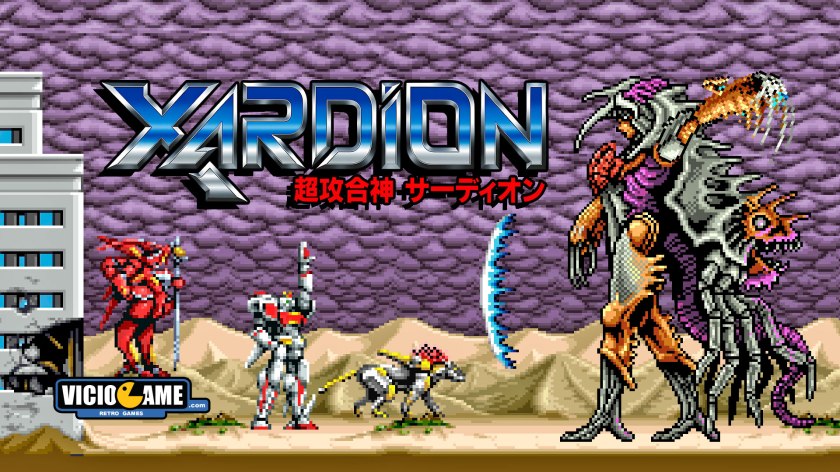
Xardion is a platformer with RPG elements, released in 1992 for the Super Nintendo. Three planets join forces and send their most powerful robots to destroy rogue guardians. At the same time, they must locate the robot Xardion and its ultimate weapon in order to put an end to the evil once and for all.
Developer: Jorudan
Publisher: Asmik
Release date: 1992
Platform: Super Nintendo / Super Famicom
Xardion – The Ultimate Guide
Xardion, originally released in Japan on March 20, 1992 under the title Chōkō Gasshin Xardion (超攻合神サーディオン which translates as “Super Attack God Xardion”), is a platform game with light RPG elements developed by Jorudan and published by Asmik Corporation for the Super Nintendo Entertainment System. The North American version hit the market in April 1992, bringing with it a script translation by Robert Woodhead, co-creator of the famous Wizardry series.
The project featured participation from high-caliber mecha designers. Hajime Katoki, known for his extensive work on the Gundam franchise and games like Policenauts and Virtua On, was responsible for the main mechanical designs. Yasuhiro Moriki, who worked on Hades Project Zeorymer, Nadesico, and Gravion, also contributed mecha designs. The animation studio Gainax, legendary for productions like Neon Genesis Evangelion and Gunbuster, provided creative consultation to the project. The soundtrack was handled by Kohei Tanaka, and music programming was executed by Tenpei Sato, who also worked on other Jorudan projects like Gdleen and Musya. Despite this impressive team, the game did not achieve the expected commercial success and remained a relatively obscure work in the console’s catalog.
The story of Xardion takes place in the Alpha 1 solar system, located in a distant galaxy. Seven decades before the game’s events, in the year 208C (or 2108 A.D. for Earth dwellers), a race of highly intelligent beings built the ultimate apocalyptic device to protect their planet. This device was given the name Xardion, a being endowed with artificial intelligence created on the planet Fiera, the fire planet of the Alpha 1 solar system. On Fiera, science had long ago evolved to a state of supreme theory. The planetary scientific community discovered that ozone layer depletion would cause a drastic change to the planet in the future, making it uninhabitable in approximately 285 years.
Meanwhile, at the other end of the galaxy, Professor Dr. Sim U. Late was working on his theory about life and environments. His goal was to rejuvenate a single planet and build an artificial ecosystem. Once his theory and planet were complete, he left a human on the planet to test his project called “New Frontier.” His goal was to control the ecosystem and allow the people of Fiera to relocate to a safe planet when the time came. Unfortunately, the doctor fell ill and, anticipating his death, programmed the supercomputers of NGC-1611 to control all ecological functions, including its defense. The supercomputers malfunctioned 12 years later, and the planet’s sole inhabitant was left in a survival lifestyle. The guardian devices tried to protect the test human and the ecosystem, but the computers misinterpreted their instructions as “search and destroy” orders. Without computer control over the guardians, they soon became wild beasts of rage and fury, transforming many times beyond their original design.
During this period, the distant Alpha 1 Solar System was locked in a seven-month war. In an act of desperation, the leaders of the three planets quickly resolved their differences to fight the invaders from NGC-1611, utilizing their three most significant robotic eliminators. Immediately “Triton, King of the Sea” was commissioned by the oceansphere, Aquata. The Hollowsphere, Zikar, sent Panthera, the cyber Leopard, and Fiera sent Alcedes, the telekinetic Beastybot. Each of these robots must arm themselves with weapons located on the planets’ surfaces. The robots are function progression mechanisms, or learning ones. The more experience they have, the better their ability to perform the desired task. Your duty, as given by the planetary federation, is to lead the pilots of Alcedes and Triton and the cybercerebral mind of Panthera to the distant star NGC-1611. Locate Xardion, if possible, but at any cost you must terminate the power source of the invaders and save the Alpha 1 Solar System.
Xardion is structured as a “metroidvania” style platform and action game with non-linear elements inspired by titles like Metroid and Mega Man. The player controls three distinct robots at the start of the journey, able to switch between them at any time through the pause menu, accessed with the Select button. Each robot has unique characteristics, individual statistics, and a set of special abilities that are discovered throughout exploration. The game’s structure allows the player to visit different planets through a stage selection screen, accessible by pressing the Start and Select buttons simultaneously. This screen functions as a galactic map where it’s possible to revisit previous stages to collect missed items, accumulate additional experience, or replenish resources like health and ammunition.
The first available robot is Triton, known as “King of the Sea,” created by the inhabitants of the oceanic planet Aquata. Despite his aquatic origins, Triton does not possess special water-related abilities and does not move differently when submerged. Triton is the most versatile character of the trio, functioning as a balanced robot in terms of attack and defense. His most important characteristic is being the only one of the three initial characters capable of aiming upward with his standard attack, which makes him essential for dealing with flying enemies and bosses that stay in elevated positions. Triton acquires four special abilities throughout the adventure: Act-Plasma, found in Oceansphere’s first chapter, which fires a plasma beam directly in front that remains in place for a second causing damage over several ticks; Grenade, located in Hollowsphere’s first chapter, which fires a slow-moving grenade that causes massive damage and penetrates enemies; Shield, found in Fiera’s first chapter, which creates a shield in front capable of blocking projectiles; and Reflex-L, acquired in NGC-1611’s first chapter, which fires a laser beam that penetrates all enemies in its path.
The second robot is Alcedes, referred to as a telekinetic beast, originating from Fiera, a technologically advanced desert planet. Alcedes resembles a scarab beetle, with six limbs and two antennae. These antennae are Alcedes’ primary weapon and attack by whipping forward and backward, allowing Alcedes to hit enemies approaching from behind without needing to turn direction. This attack pattern, while unique, has a problematic hitbox that can make it difficult to hit certain enemies. Alcedes’ special weapons focus on crowd control and defense. BL-Force, found in Oceansphere’s first chapter, freezes the screen and causes massive damage to all visible enemies; SI-Force, located in Hollowsphere’s second chapter, fires a fireball that passes through walls and any target in its path; Black Hole, discovered in Fiera’s second chapter, produces a black hole behind the character that sucks in projectiles, though projectiles that hit Alcedes while entering the black hole still cause damage; and N-Barrier, found in NGC-1611’s first chapter, grants invulnerability for a brief period of time.
The third robot is Panthera, a quadrupedal robot from the jungle planet Zikar. Panthera’s most useful asset is his unique hitbox, which is twice as wide but only half the height of the other characters. This allows him to function as the team’s equivalent to Metroid‘s Morph Ball, exploring narrow passages and ignoring many enemy projectiles that simply pass over him. Panthera acquires four special abilities: Torch, found in Oceansphere’s second chapter, which fires a fireball in front but can cause as much damage as the standard attack; Scorch, located in Fiera’s first chapter, which transforms Panthera into a fireball while jumping slightly higher and farther than normal; Inv-Shield, found in Space Ship’s first chapter, which grants invulnerability for a brief period; and Burst, discovered in NGC-1611’s first chapter, which charges a fireball that penetrates enemies and causes slightly more damage than a standard shot.
The fourth and final robot, Xardion, joins the team in the penultimate stage of the game. However, in the name of artificially extending the game’s length, Xardion starts at level 1 and his mandatory special weapon must be assembled from three components found by returning to previous stages. After about twenty minutes of backtracking and experience accumulation, Xardion essentially becomes a stronger version of Triton and is the only robot capable of damaging the final boss. Xardion has four special abilities already unlocked from the start: Hyperbeam, a laser that passes through walls and enemies causing massive damage; Lightning, which launches a lightning storm destroying all enemies on screen, though it doesn’t instantly kill bosses; Sphereon, which fires three homing orbs that target any enemy on screen; and L-Arrow, the game’s most powerful weapon, which must be collected in three parts located in Oceansphere’s second chapter, Hollowsphere’s first chapter, and Fiera’s first chapter. The L-Arrow fires a light arrow that passes through everything in its path and is essential for destroying a barrier before the final boss.
The RPG-style progression system in Xardion is one of its most prominent aspects. During gameplay, numbers appear in the upper right portion of the screen. These numbers are part of an exclusive system included in the game. At the start, the three robots begin with zero experience points. As the player eliminates guardians and small creatures, experience points are accumulated. The points earned appear next to the number needed to be promoted to the next level of attack and defense. Significant changes in the robots’ abilities are noticeable as experience progresses. Each robot accumulates experience and levels up individually, which increases both maximum health points and special weapon ammunition. This system forces the player to use all three robots to survive, since each character needs to gain experience separately. Once Xardion is obtained, he becomes versatile enough that the other three fall into disuse, even while at the initial level.
Death in the game does not result in loss of experience or inventory items. When a character loses all their health, the player is sent back to the stage selection screen, keeping all experience points and items collected during the failed attempt. This forgiving mechanic allows the player to naturally overcome difficult areas simply by getting stronger with each attempt. This progression by inertia, while facilitating the game’s completion, also reveals one of the fundamental design problems: without the need for mandatory grinding for experience and items necessary to make characters competitive, Xardion could be completed in approximately one hour.
The directional pad controls the robot’s direction. The Select button takes the player to the menu area, while holding Start along with Select accesses the map screen. The A and R buttons fire special weapons when pre-selected in the menu area. The B button makes the robot jump. The X button uses the special item. The Y button fires the standard weapon. The L button has no assigned function. The controls in Xardion are heavily criticized for their lack of responsiveness. All characters move as if they were constantly in waist-deep water, dragging themselves heavily forward. Jumping feels similar, with characters slowly rising upward at a consistent speed before suddenly falling back to the ground. The controls resemble those of the game Musya, another title developed by the same Jorudan team.
The menu and submenu system is accessed by pressing the Select button during gameplay. To access a menu, press the A button and then press up or down on the directional pad to select the desired item. The selected item will be highlighted in white. To go to another menu, press the A button. To return to a previous menu, press the B button. To close the menu area, press the Select button again. When you enter the menu area, you’re automatically in menu number 1, the robot selection menu. Menu number 2 is “Individual Weapons,” where each robot has its own unique special weapons. When you start the game, you’ll notice that one menu is empty. To fill the empty menu, you must locate items within various levels scattered throughout the game. Menu number 3 shows the current robot’s status, including health, armor, experience, and other data. Menu number 4 is “Shared Weapons and Items,” which can be used by any robot.
The shared items in menu 4 include various essential tools. T-Bomb are time bombs that can be used to blow up walls in some areas. By placing a T-Bomb directly in front of the character, it explodes after a few seconds, causing damage to enemies and being able to destroy certain blocks. Ammo is self-explanatory, simply filling the ammunition meter on the gameplay screen. Save allows you to store your game progress and your exact position in a stage. It’s important to note that regular game progress will be saved automatically. To erase a saved game, simply hold the Select button pressed while turning on the Super NES. Missiles fires three homing missiles that fly toward the enemy. Subtank automatically replenishes your health power. The items in menu 4 are shared by all robots and will show, for example, “AMMO 4,” meaning you can use ammunition four times. Collect the items you need and remember where they are for future reference.
Xardion‘s non-linear structure reveals itself through stage progression. Although the map screen suggests a completely linear journey, most players will find themselves jumping between stages as the game progresses, with several stages containing branching paths and completely optional areas. Each robot can acquire four unique upgrades that, in Metroid style, are only found through exploration, making it necessary to revisit stages if any are missed. Collectible items also reappear when revisiting a stage, allowing the player to stock up on health and ammunition replenishments before boss fights. Backtracking becomes mandatory once Xardion is recovered, with his strongest weapon – necessary to destroy a barrier before the final boss – only available after revisiting previous stages on a mission to recover its components.
The first available stage is Oceansphere Chapter 1, where the trio enters the base to hunt the enemy called ARMS (the original monster that captured Panthera at the beginning of the game). Oceansphere Chapter 2 takes place in an aquatic environment filled with cyborg mermaids that swim in unpredictable patterns and fire three projectiles at a time. The boss is a large aquatic creature that floats slowly from left to right at the top of the screen, firing homing bubbles and summoning water sprites that jump toward the player.
Hollowsphere Chapter 1 is a short stage that takes place in an underground tropical jungle. The stage is extremely straightforward, simply going from left to right along branches with trolls and moths until reaching the end. Hollowsphere Chapter 2 features a large tower that the player must climb. This stage’s boss is a large face with crab legs that swing down toward the middle of the screen. After victory, gravity inverts and the player simply jumps from the tower to the left, falling into the water to complete the stage.
Fiera Chapter 1 takes place on a desert planet under attack. Panthera’s Scorch ability is immediately available at the start of the stage. The player can choose to go underground or remain on the surface. This stage’s boss is an aircraft that floats around the entire screen in a predictable pattern. Fiera Chapter 2 occurs inside a tower that the player must climb using silver moving platforms. This stage’s pseudo-boss is Hell Gunner, an invincible mech that falls from the top of the screen and fires bursts on the ground in front of him, causing the ground to collapse. Hell Gunner then falls off the screen. The characters express irritation at never having been able to properly fight him, and then move on to the next stage. This moment is one of the game’s highlights, showing a self-aware sense of humor rarely seen in games of the era.
Space Ship Chapter 1 takes place on a spaceship with Panthera’s Inv-Shield ability available right at the start. This stage’s boss floats along the top of the screen and moves left and right in the player’s direction.
NGC-1611 Chapter 1 is a very straightforward but difficult stage. The player starts on the surface of planet NGC-1611. Trees in the background of the screen jump to the foreground and follow the player jumping. This stage’s boss is literally a wall of faces. In the first phase, the wall doesn’t move. Once all the faces explode, a small head appears randomly and fires a single shot that heads toward the player and then circles.
From here on, the player must backtrack to revisit previous stages and collect the three parts of the L-Arrow. The first part can be found in Oceansphere Chapter 2, in the same room where there was an optional underwater boss during the first visit. The boss is incredibly easy, doesn’t move, and only fires single shots. You must shoot his brain at the top of the body. The second part is in Hollowsphere Chapter 1, in the same location as the first visit, but now on a large rose at the end of the stage. The third and final part is in Fiera Chapter 1, inside an opening to the right after falling into the massive hole in the ground.
NGC-1611 Chapter 2 is the game’s final stage, where you face the final boss, which has five distinct phases. In Phase 1, the boss constantly walks toward the player, forcing jumps over him before he walks over the character. In Phase 2, the boss gets scared and constantly runs to the right launching a series of homing orbs. In Phase 3, the boss grows and is too heavy to move his own body weight. His feet move in animation, but he remains in the same location on the right side of the screen, and it’s only possible to cause damage by jumping and shooting at his head. In Phase 4, the boss will have four attack patterns. The safest place to stay is right in front of the boss, but stay alert to get away, as he will grow to evolve. Phase 5 is the final phase of this boss. Any items that were saved up to this point can all be used here.
Xardion‘s audiovisual presentation is a mixed aspect. Visually, the four planets in Alpha 1 look genuinely distinct from each other, and their respective robots feel like natural extensions of their environments. The Gundam-style Triton is at home in the sleek, gray warship that forms the centerpiece of Aquata, and Alcedes’ scarab beetle design and sun-tipped staff match the flaming deserts of Fiera. Most impressive, though, is Zikar, a “Hollowsphere” with a frozen surface and a tropical jungle occupying the interior. Upon defeating the boss, the characters climb a pillar to the other side of the sphere, causing the screen to invert and leading to a brief upside-down platforming section.
The soundtrack was composed by Kohei Tanaka, with music programming by Tenpei Sato. There are some good tracks here and there, but overall, the sound effects are uninspiring and sometimes boring. There are many better soundtracks for the Super Nintendo. The music isn’t bad on its own, but it doesn’t stand out on a console known for its exceptional audio capabilities. The sound effects are curiously chosen, with some sounds for collecting power-ups and firing weapons being particularly low and discreet.
Xardion received mixed to negative reviews both at the time of its release and in retrospective analyses. The Japanese magazine Famitsu gave the game a score of 21 out of 40, indicating a lukewarm reception in the Japanese market. North American critics were equally unenthusiastic. On GameFAQs, the game has a “reasonable average” rating and the difficulty is classified as “just right.” On MobyGames, the game received a score of 5.5 out of 10, ranking 665th among Super Nintendo games. If Xardion had controls similar to Contra or ActRaiser with mechs, it could have been a much superior title.
The game has positive aspects that are recognized even by more skeptical players. The dialogue writing is competent and doesn’t slow down the game, though it’s never clear which character is speaking, making some exchanges difficult to interpret. The revelations about what’s really happening in NGC-1611 are surprisingly morbid for a 1992 Super Nintendo game. The ending, which jumps hundreds of years ahead, ruminates on the meaning of history and then reveals that Xardion transformed into a tree, seems like something from the next console generation.
There is a cheat code that allows the player to obtain all items and abilities at once. During gameplay, press Select to enter the item menu. Then, hold Left + L on controller two and press Start three times on controller one. If done correctly, a sound will be heard. Upon re-entering the items screen, the player will have all items and abilities available. This cheat can be useful for exploring the game without the need for extensive repetition or for testing all abilities of each character.
The game’s official manual included information about two promotional initiatives. The Asmik Klue Klub invited players to send in the return card included in the packaging completely filled out. Upon receiving the card, Asmik would send a membership certificate with a toll-free phone number to receive game tips. Asmik’s counselors were available to provide all the big secrets. The “XARDION Metal Maniac Contest” began on April 1, 1992 and lasted until July 30, 1992. To participate, players had to look for contest details in “Electronic Gaming Monthly” magazine or “Game Players Guide to Nintendo Games.”
Xardion‘s legacy is that of a forgotten curiosity in the Super Nintendo library. Despite the impressive pedigree of its creative team and the ambitious concept mixing platforming, action, and RPG elements in a sci-fi setting with mechs, the game never found a significant audience. Jorudan never made a sequel, which is revealing considering the amount of work that was invested in pre-production. Additionally, there’s an abundance of cartridges in Japanese secondhand markets, proving a high production that exceeded demand. The game has not received re-releases in compilations or virtual game services, remaining accessible only through the original cartridge or emulation.
The uniformly lukewarm or negative critical reception ensured that the game did not achieve the classic status its concept suggested was possible. While contemporary games like Metal Warriors (also for the SNES) managed to find appreciation, Xardion remains largely unknown. The inevitable comparison with releases from the same era made it even more difficult to find defenders. When several games with similar structures are released simultaneously, it’s natural that some get overshadowed. However, Xardion has gained a small dedicated fanbase that appreciates its ambitions, even when poorly executed. It remains a fascinating example of unrealized potential, which had all the ingredients present to create a great game.
Xardion – O Guia Definitivo
Xardion, lançado originalmente no Japão em 20 de março de 1992 sob o título Chōkō Gasshin Xardion (超攻合神サーディオン que se traduz como “Super Attack God Xardion”), é um jogo de plataforma com poucos elementos de RPG desenvolvido pela Jorudan e publicado pela Asmik Corporation para o Super Nintendo Entertainment System. A versão norte-americana chegou ao mercado em abril de 1992, trazendo consigo uma tradução do roteiro realizada por Robert Woodhead, co-criador da famosa série Wizardry.
O projeto contou com a participação de designers de mecha de alto calibre. Hajime Katoki, conhecido por seu trabalho extensivo na franquia Gundam e em jogos como Policenauts e Virtua On, foi responsável pelos designs mecânicos principais. Yasuhiro Moriki, que trabalhou em Hades Project Zeorymer, Nadesico e Gravion, também contribuiu com designs de mecha. O estúdio de animação Gainax, lendário por produções como Neon Genesis Evangelion e Gunbuster, forneceu consultoria criativa ao projeto. A trilha sonora ficou a cargo de Kohei Tanaka, e a programação de música foi executada por Tenpei Sato, que também trabalhou em outros projetos da Jorudan como Gdleen e Musya. Apesar dessa equipe impressionante, o jogo não alcançou o sucesso comercial esperado e permaneceu como uma obra relativamente obscura no catálogo do console.
A história de Xardion se passa no sistema solar Alpha 1, localizado em uma galáxia distante. Sete décadas antes dos eventos do jogo, no ano 208C (ou 2108 d.C. para terráqueos), uma raça de seres altamente inteligentes construiu o dispositivo apocalíptico definitivo para proteger seu planeta. Este dispositivo recebeu o nome de Xardion, um ser dotado de inteligência artificial criado no planeta Fiera, o planeta de fogo do sistema solar Alpha 1. Em Fiera, a ciência havia evoluído há muito tempo para um estado de teoria suprema. A comunidade científica planetária descobriu que uma depleção da camada de ozônio causaria uma mudança drástica no planeta no futuro, tornando-o inabitável em aproximadamente 285 anos.
Enquanto isso, na outra extremidade da galáxia, o professor Dr. Sim U. Late trabalhava em sua teoria sobre vida e ambientes. Seu objetivo era rejuvenescer um único planeta e construir um ecossistema artificial. Uma vez que sua teoria e planeta estivessem completos, ele deixou um humano no planeta para testar seu projeto chamado “New Frontier”. Seu objetivo era controlar o ecossistema e permitir que o povo de Fiera se realocasse em um planeta seguro quando chegasse a hora. Infelizmente, o doutor ficou doente e, antecipando sua morte, programou os supercomputadores de NGC-1611 para controlar todas as funções da ecologia, incluindo sua defesa. Os supercomputadores apresentaram falhas 12 anos depois, e o único habitante do planeta foi deixado em um estilo de vida de sobrevivência. Os dispositivos guardiões tentaram proteger o humano de teste e o ecossistema, mas os computadores interpretaram mal suas instruções como ordens de “buscar e destruir”. Sem o controle dos computadores sobre os guardiões, eles logo se tornaram bestas selvagens de raiva e fúria, transformando-se muitas vezes além de seu design original.
Durante este período, o distante Sistema Solar Alpha 1 estava travado em uma guerra de sete meses. Em um ato de desespero, os líderes dos três planetas rapidamente resolveram suas diferenças para lutar contra os invasores de NGC-1611, utilizando seus três eliminadores robóticos mais significativos. Imediatamente “Triton, Rei do Mar” foi comissionado pela oceanosfera, Aquata. A Hollowsphere, Zikar, enviou Panthera, o Leopardo cibernético, e Fiera enviou Alcedes, o Beastybot telecinético. Cada um desses robôs deve se armar com armas localizadas na superfície dos planetas. Os robôs são mecanismos de progressão de função, ou aprendizagem. Quanto mais experiência eles têm, melhor sua capacidade de realizar a tarefa desejada. Seu dever, conforme dado pela federação planetária, é liderar os pilotos de Alcedes e Triton e a mente cibercerebral de Panthera até a estrela distante NGC-1611. Localize Xardion, se possível, mas a qualquer custo você deve terminar a fonte de energia dos invasores e salvar o Sistema Solar Alpha 1.
Xardion se estrutura como um jogo do estilo “metroidvania” de plataforma e ação com elementos não-lineares inspirados em títulos como Metroid e Mega Man. O jogador controla três robôs distintos no início da jornada, podendo alternar entre eles a qualquer momento através do menu de pausa, acessado com o botão Select. Cada robô possui características únicas, estatísticas individuais e um conjunto de habilidades especiais que são descobertas ao longo da exploração. A estrutura do jogo permite que o jogador visite diferentes planetas através de uma tela de seleção de fases, acessível pressionando os botões Start e Select simultaneamente. Esta tela funciona como um mapa galáctico onde é possível revisitar fases anteriores para coletar itens perdidos, acumular experiência adicional ou repor recursos como vida e munição.
O primeiro robô disponível é Triton, conhecido como “Rei do Mar”, criado pelos habitantes do planeta oceânico Aquata. Apesar de suas origens aquáticas, Triton não possui habilidades especiais relacionadas à água e não se move de forma diferente quando submerso. Triton é o personagem mais versátil do trio, funcionando como um robô equilibrado em termos de ataque e defesa. Sua característica mais importante é ser o único dos três personagens iniciais capaz de mirar para cima com seu ataque padrão, o que o torna essencial para lidar com inimigos voadores e chefes que ficam em posições elevadas. Triton adquire quatro habilidades especiais ao longo da aventura: Act-Plasma, encontrado no primeiro capítulo de Oceansphere, que dispara um feixe de plasma diretamente na frente que permanece no lugar por um segundo causando dano ao longo de vários tiques; Grenade, localizado no primeiro capítulo de Hollowsphere, que dispara uma granada de movimento lento que causa dano massivo e penetra inimigos; Shield, encontrado no primeiro capítulo de Fiera, que cria um escudo na frente capaz de bloquear projéteis; e Reflex-L, adquirido no primeiro capítulo de NGC-1611, que dispara um feixe laser que penetra todos os inimigos em seu caminho.
O segundo robô é Alcedes, referido como uma besta telecinética, originário de Fiera, um planeta desértico tecnologicamente avançado. Alcedes se assemelha a um besouro escaravelho, com seis membros e duas antenas. Estas antenas são a arma primária de Alcedes e atacam chicoteando para frente e para trás, permitindo que Alcedes atinja inimigos que se aproximam por trás sem precisar virar de direção. Este padrão de ataque, embora único, possui uma caixa de colisão problemática que pode tornar difícil acertar certos inimigos. As armas especiais de Alcedes focam em controle de multidões e defesa. BL-Force, encontrado no primeiro capítulo de Oceansphere, congela a tela e causa dano massivo a todos os inimigos visíveis; SI-Force, localizado no segundo capítulo de Hollowsphere, dispara uma bola de fogo que atravessa paredes e qualquer alvo em seu caminho; Black Hole, descoberto no segundo capítulo de Fiera, produz um buraco negro atrás do personagem que suga projéteis, embora projéteis que atingem Alcedes ao entrar no buraco negro ainda causem dano; e N-Barrier, encontrado no primeiro capítulo de NGC-1611, concede invulnerabilidade por um breve período de tempo.
O terceiro robô é Panthera, um robô quadrúpede do planeta selva Zikar. O ativo mais útil de Panthera é sua caixa de colisão única, que é duas vezes mais larga mas apenas metade da altura dos outros personagens. Isso permite que ele funcione como o equivalente da equipe à Morph Ball de Metroid, explorando passagens estreitas e ignorando muitos projéteis inimigos que simplesmente passam por cima dele. Panthera adquire quatro habilidades especiais: Torch, encontrado no segundo capítulo de Oceansphere, que dispara uma bola de fogo na frente mas pode causar tanto dano quanto o ataque padrão; Scorch, localizado no primeiro capítulo de Fiera, que transforma Panthera em uma bola de fogo enquanto pula ligeiramente mais alto e mais longe do que o normal; Inv-Shield, encontrado no primeiro capítulo de Space Ship, que concede invulnerabilidade por um breve período; e Burst, descoberto no primeiro capítulo de NGC-1611, que carrega uma bola de fogo que penetra inimigos e causa um pouco mais de dano do que um tiro padrão.
O quarto e último robô, Xardion, se junta à equipe no penúltimo estágio do jogo. No entanto, em nome do prolongamento artificial da duração, Xardion começa no nível 1 e sua arma especial obrigatória deve ser montada a partir de três componentes encontrados ao retornar a fases anteriores. Após cerca de vinte minutos de retrocesso e acumulação de experiência, Xardion se torna essencialmente uma versão mais forte de Triton e é o único robô capaz de causar dano ao chefe final. Xardion possui quatro habilidades especiais já desbloqueadas desde o início: Hyperbeam, um laser que atravessa paredes e inimigos causando dano massivo; Lightning, que lança uma tempestade de raios destruindo todos os inimigos na tela, embora não mate chefes instantaneamente; Sphereon, que dispara três orbes teleguiados que miram qualquer inimigo na tela; e L-Arrow, a arma mais poderosa do jogo, que deve ser coletada em três partes localizadas no segundo capítulo de Oceansphere, primeiro capítulo de Hollowsphere e primeiro capítulo de Fiera. O L-Arrow dispara uma flecha de luz que atravessa tudo em seu caminho e é essencial para destruir uma barreira antes do chefe final.
O sistema de progressão estilo RPG em Xardion é um de seus aspectos mais proeminentes. Durante a jogatina, números aparecem na porção superior direita da tela. Estes números fazem parte de um sistema exclusivo incluído no jogo. No início, os três robôs começam com zero pontos de experiência. Conforme o jogador elimina guardiões e pequenas criaturas, pontos de experiência são acumulados. Os pontos ganhos aparecem ao lado do número necessário para ser promovido ao próximo nível de ataque e defesa. Mudanças significativas nas habilidades dos robôs são perceptíveis conforme se progride em experiência. Cada robô acumula experiência e sobe de nível individualmente, o que aumenta tanto os pontos de vida máximos quanto a munição das armas especiais. Este sistema força o jogador a utilizar todos os três robôs para sobreviver, já que cada personagem precisa ganhar experiência separadamente. Uma vez que Xardion é obtido, ele se torna versátil o suficiente para que os outros três caiam em desuso, mesmo estando no nível incial.
A morte no jogo não resulta em perda de experiência ou itens de inventário. Quando um personagem perde toda a sua vida, o jogador é enviado de volta à tela de seleção de fases, mantendo todos os pontos de experiência e itens coletados durante a tentativa falhada. Essa mecânica perdoadora permite que o jogador naturalmente supere áreas difíceis simplesmente ficando mais forte a cada tentativa. Esta progressão por inércia, embora facilite a conclusão do jogo, também revela um dos problemas fundamentais de design: sem a necessidade de moagem obrigatória por experiência e itens necessários para tornar os personagens competitivos, Xardion poderia ser completado em aproximadamente uma hora.
O direcional permite controlar a direção do robô. O botão Select leva o jogador à área de menu, enquanto segurar Start junto com Select acessa a tela de mapa. Os botões A e R disparam as armas especiais quando pré-selecionadas na área de menu. O botão B faz o robô pular. O botão X usa o item especial. O botão Y dispara a arma padrão. O botão L não possui função atribuída. Os controles em Xardion são bastante criticados por sua falta de responsividade. Todos os personagens se movem como se estivessem constantemente em água na altura da cintura, arrastando-se pesadamente para frente. Pular se sente similar, com os personagens subindo lentamente para cima a uma velocidade consistente antes de subitamente cair de volta ao chão. Os controles se assemelham ao do jogo Musya, outro título desenvolvido pela mesma equipe da Jorudan.
O sistema de menu e submenus é acessado pressionando o botão Select durante a jogatina. Para acessar um menu, pressione o botão A e então pressione para cima ou para baixo no direcional para selecionar o item desejado. O item selecionado será destacado em branco. Para ir a outro menu, pressione o botão A. Para voltar a um menu anterior, pressione o botão B. Para fechar a área de menu, pressione o botão Select novamente. Quando você entra na área de menu, automaticamente está no menu número 1, o menu de seleção de robô. O menu número 2 é “Armas Individuais”, onde cada robô possui suas próprias armas especiais únicas. Quando você começa o jogo, notará que um menu está vazio. Para preencher o menu vazio, deve localizar os itens dentro de vários níveis espalhados pelo jogo. O menu número 3 mostra o status do robô atual, incluindo vida, armadura, experiência e outros dados. O menu número 4 é “Armas e Itens Compartilhados”, que podem ser usados por qualquer robô.
Os itens compartilhados no menu 4 incluem várias ferramentas essenciais. T-Bomb são bombas de tempo que podem ser usadas para explodir paredes em algumas áreas. Ao colocar uma T-Bomb diretamente na frente do personagem, ela explode após alguns segundos, causando dano a inimigos e podendo destruir certos blocos. Ammo é autoexplicativo, simplesmente preenchendo o medidor de munição na tela de jogo. Save permite armazenar seu progresso do jogo e sua posição exata em uma fase. É importante notar que o progresso regular do jogo será salvo automaticamente. Para apagar um jogo salvo, simplesmente segure o botão Select pressionado enquanto liga o Super NES. Missiles dispara três mísseis teleguiados que voam em direção ao inimigo. Subtank reabastece automaticamente seu poder de vida. Os itens no menu 4 são compartilhados por todos os robôs e mostrarão, por exemplo, “AMMO 4”, significando que você pode usar munição quatro vezes. Colete os itens que você precisa e lembre-se de onde eles estão para referência futura.
A estrutura não-linear de Xardion se revela através da progressão das fases. Embora a tela de mapa sugira uma jornada completamente linear, a maioria dos jogadores se encontrará pulando entre fases conforme o jogo progride, com várias fases contendo caminhos ramificados e áreas completamente opcionais. Cada robô pode adquirir quatro atualizações únicas que, ao estilo Metroid, só são encontradas através de exploração, tornando necessário revisitar fases caso alguma seja perdida. Itens colecionáveis também reaparecem ao revisitar uma fase, permitindo ao jogador estocar reabastecimentos de vida e munição antes de lutas contra chefes. O retrocesso se torna obrigatório uma vez que Xardion é recuperado, com sua arma mais forte – necessária para destruir uma barreira antes do chefe final – disponível apenas após revisitar fases anteriores em uma missão para recuperar seus componentes.
A primeira fase disponível é Oceansphere Chapter 1, onde o trio entra na base para caçar o inimigo chamado ARMS (o monstro original que capturou Panthera no início do jogo). Oceansphere Chapter 2 se passa em um ambiente aquático repleto de sereias ciborgues que nadam em padrões imprevisíveis e disparam três projéteis de cada vez. O chefe é uma criatura aquática grande que flutua lentamente da esquerda para a direita no topo da tela, disparando bolhas teleguiadas e invocando sprites de água que pulam em direção ao jogador.
Hollowsphere Chapter 1 é uma fase curta que se passa em uma selva tropical subterrânea. A fase é extremamente direta, simplesmente indo da esquerda para a direita ao longo de galhos com trolls e mariposas até chegar ao final. Hollowsphere Chapter 2 apresenta uma grande torre que o jogador deve escalar. O chefe desta fase é um rosto grande com pernas de caranguejo que oscilam para baixo em direção ao meio da tela. Após a vitória, a gravidade inverte e o jogador simplesmente pula da torre para a esquerda, caindo na água para completar a fase.
Fiera Chapter 1 se passa em um planeta desértico sob ataque. A habilidade Scorch de Panthera está imediatamente disponível no início da fase. O jogador pode optar por ir pelo subsolo ou permanecer na superfície. O chefe desta fase é uma aeronave que flutua ao redor de toda a tela em um padrão previsível. Fiera Chapter 2 ocorre dentro de uma torre que o jogador deve escalar usando plataformas móveis prateadas. O pseudo-chefe desta fase é Hell Gunner, um mech invencível que cai do topo da tela e dispara rajadas no chão na frente dele, fazendo o chão colapsar. Hell Gunner então cai da tela. Os personagens expressam irritação por nunca terem conseguido lutar adequadamente contra ele, e então seguem para a próxima fase. Este momento é um dos pontos altos do jogo, mostrando um senso de humor autoconsciente raramente visto em jogos da época.
Space Ship Chapter 1 se passa em uma nave espacial com a habilidade Inv-Shield de Panthera disponível logo no início. O chefe desta fase flutua ao longo do topo da tela e se move para a esquerda e direita na direção do jogador.
NGC-1611 Chapter 1 é uma fase muito direta, mas difícil. O jogador começa na superfície do planeta NGC-1611. Árvores no fundo da tela saltam para o primeiro plano e seguem o jogador pulando. O chefe desta fase é literalmente uma parede de rostos. Na primeira fase, a parede não se move. Uma vez que todos os rostos explodem, uma pequena cabeça aparece aleatoriamente e dispara um único tiro que se dirige ao jogador e então circula.
Daqui em diante, o jogador deve retroceder para revisitar fases anteriores e coletar as três partes do L-Arrow. A primeira parte pode ser encontrada em Oceansphere Chapter 2, na mesma sala onde havia um chefe subaquático opcional durante a primeira visita. O chefe é incrivelmente fácil, não se move e apenas dispara tiros únicos. Deve-se atirar em seu cérebro no topo do corpo. A segunda parte está em Hollowsphere Chapter 1, no mesmo local da primeira visita, mas agora sobre uma rosa grande no final da fase. A terceira e última parte está em Fiera Chapter 1, dentro de uma abertura à direita após cair no buraco massivo no chão.
NGC-1611 Chapter 2 é a fase final do jogo, onde você enfrenta o último chefe, que possui cinco fases distintas. Na Fase 1, o chefe caminha constantemente em direção ao jogador, forçando pulos sobre ele antes que ele caminhe sobre o personagem. Na Fase 2, o chefe fica assustado e corre constantemente para a direita lançando uma série de orbes teleguiados. Na Fase 3, o chefe cresce e está muito pesado para mover seu próprio peso corporal. Seus pés se movem em animação, mas ele permanece no mesmo local no lado direito da tela, e só é possível causar dano pulando e atirando na cabeça dele. Na Fase 4, o chefe terá quatro padrões de ataque. O lugar mais seguro para ficar é bem na frente do chefe, mas fique atento para sair de perto, pois ele crescerá para evoluir. A Fase 5 é a fase final deste chefe. Quaisquer itens que foram guardados até este ponto podem ser todos usados aqui.
A apresentação audiovisual de Xardion é um aspecto misto. Visualmente, os quatro planetas em Alpha 1 parecem genuinamente distintos uns dos outros, e seus respectivos robôs se sentem como extensões naturais de seus ambientes. O Triton estilo Gundam está em casa na nave de guerra elegante e cinza que forma a peça central de Aquata, e o design de besouro escaravelho de Alcedes e o cajado com ponta de sol combinam com os desertos flamejantes de Fiera. O mais impressionante, porém, é Zikar, uma “Hollowsphere” com uma superfície congelada e uma selva tropical ocupando o interior. Ao derrotar o chefe, os personagens sobem um pilar para o outro lado da esfera, fazendo a tela inverter e levando a uma breve seção de plataforma de cabeça para baixo.
A trilha sonora foi composta por Kohei Tanaka, com programação musical de Tenpei Sato. Há algumas músicas boas aqui e ali, mas no geral, os efeitos sonoros são pouco inspiradores e às vezes entediantes. Existem muitas trilhas sonoras melhores para o Super Nintendo. A música não é ruim por si só, mas não se destaca em um console conhecido por suas capacidades de áudio excepcionais. Os efeitos sonoros são escolhidos de forma curiosa, com alguns sons para coletar power-ups e disparar armas sendo particularmente baixos e discretos.
Xardion recebeu críticas mistas a negativas tanto na época de seu lançamento quanto em análises retrospectivas. A revista japonesa Famitsu deu ao jogo uma pontuação de 21 de 40, indicando uma recepção morna no mercado japonês. Críticos norte-americanos foram igualmente pouco entusiasmados. No GameFAQs, o jogo possui uma classificação “média”razoável” e a dificuldade é classificada como “na medida certa”. No MobyGames, o jogo recebeu uma pontuação de 5.5 de 10, ocupando o posto 665 entre jogos de Super Nintendo. Se Xardion tivesse controles semelhantes aos de Contra ou ActRaiser com mechs, poderia ter sido um título muito superior.
O jogo possui aspectos positivos que são reconhecidos mesmo por jogadores mais céticos. A escrita de diálogo é competente e não desacelera o jogo, embora nunca fique claro qual personagem está falando, tornando algumas trocas difíceis de interpretar. As revelações sobre o que realmente está acontecendo em NGC-1611 são surpreendentemente mórbidas para um jogo de Super Nintendo de 1992. O final, que pula centenas de anos à frente, rumina sobre o significado da história e então revela que Xardion se transformou em uma árvore, parece algo da próxima geração de consoles.
Existe um código de trapaça que permite ao jogador obter todos os itens e habilidades de uma só vez. Durante a jogatina, pressione Select para entrar no menu de itens. Em seguida, segure Esquerda + L no controle dois e pressione Start três vezes no controle um. Se feito corretamente, um som será ouvido. Ao entrar novamente na tela de itens, o jogador terá todos os itens e habilidades disponíveis. Esta trapaça pode ser útil para explorar o jogo sem necessidade de repetição extensiva ou para testar todas as habilidades de cada personagem.
O manual oficial do jogo incluía informações sobre duas iniciativas promocionais. O Asmik Klue Klub convidava jogadores a enviar o cartão de retorno incluído na embalagem completamente preenchido. Ao receber o cartão, a Asmik enviaria um certificado de membro com um número telefônico gratuito para recever dicas de jogo. Os conselheiros da Asmik estavam disponíveis para fornecer todos os grandes segredos. O concurso “XARDION Metal Maniac Contest” começou em 1º de abril de 1992 e durou até 30 de julho de 1992. Para participar, os jogadores deviam procurar detalhes do concurso na revista “Electronic Gaming Monthly” ou “Game Players Guide to Nintendo Games”.
O legado de Xardion é de uma curiosidade esquecida na biblioteca do Super Nintendo. Apesar do pedigree impressionante de sua equipe criativa e do conceito ambicioso misturando plataforma, ação e elementos de RPG em um cenário de ficção científica com mechs, o jogo nunca encontrou uma audiência significativa. A Jorudan nunca fez uma sequência, o que é revelador considerando a quantidade de trabalho que foi investida na pré-produção. Além disso, há uma abundância de cartuchos em mercados de segunda mão japoneses, comprovando uma produção alta que excedeu a demanda. O jogo não recebeu relançamentos em compilações ou serviços de jogos virtuais, permanecendo acessível apenas através do cartucho original ou emulação.
A recepção crítica uniformemente morna ou negativa garantiu que o jogo não alcançasse o status de clássico que seu conceito sugeria ser possível. Enquanto jogos contemporâneos como Metal Warriors (também do SNES) conseguiram encontrar apreciação, Xardion permanece amplamente desconhecido. A comparação inevitável com lançamentos da mesma época, tornou ainda mais difícil para encontrar defensores. Quando vários jogos com estruturas similares são lançados simultaneamente, é natural que algum seja ofuscado. No entanto, Xardion ganhou uma pequena base de fãs dedicados que apreciam suas ambições, mesmo quando mal executadas. Este permanece como um exemplo fascinante de potencial não realizado, que tinha todos os ingredientes presentes para criar um ótimo jogo.
🤑💲Earn money without doing anything! Just leave these apps open:
   ✓ https://r.honeygain.me/CONTA9DB02

   ✓ https://packetstream.io/?psr=1uPb
🤑💲1-Click button earns Bitcoin every 1 hour: https://freebitco.in/?r=53528449
⬛ 𝗧𝗶𝗸𝗧𝗼𝗸: https://www.tiktok.com/@viciogame
🟧 𝗜𝗻𝘀𝘁𝗮𝗴𝗿𝗮𝗺: http://www.instagram.com/viciogame
🟥 𝗬𝗼𝘂𝘁𝘂𝗯𝗲: http://www.youtube.com/viciogame
🟦 𝗙𝗮𝗰𝗲𝗯𝗼𝗼𝗸: http://www.facebook.com/viciogame
🔳 𝗧𝗵𝗿𝗲𝗮𝗱𝘀: https://www.threads.net/@viciogame
🟪 𝗧𝘄𝗶𝘁𝗰𝗵: https://www.twitch.tv/ViciogameRetroGames
🟨 𝗕𝗹𝗼𝗴: http://www.viciogameblog.com/
🟦𝗧𝘄𝗶𝘁𝘁𝗲𝗿: http://www.twitter.com/viciogame
Viciogame #Gameplay #LetsPlay #Gamer #Playthrough #Games #News #Videogames #Review #Game #Detonado #Walkthrough #Ending #Reviews #Facts #Retro #Record #Roms #Emulator #Longplay #Speedrun #Xardion #SNES #超攻合神サーディオン #SuperFamicom #Nintendo #SuperNintendo #SuperNes #Robot #Mecha #Evangelion #MetalWarriors #Metroidvania #MegaMan #Castlevania #Metroid #Jorudan #Asmik #ChōkōGasshinXardion #スーパーファミコン #任天堂 #Gundam
 VICIOGAME