
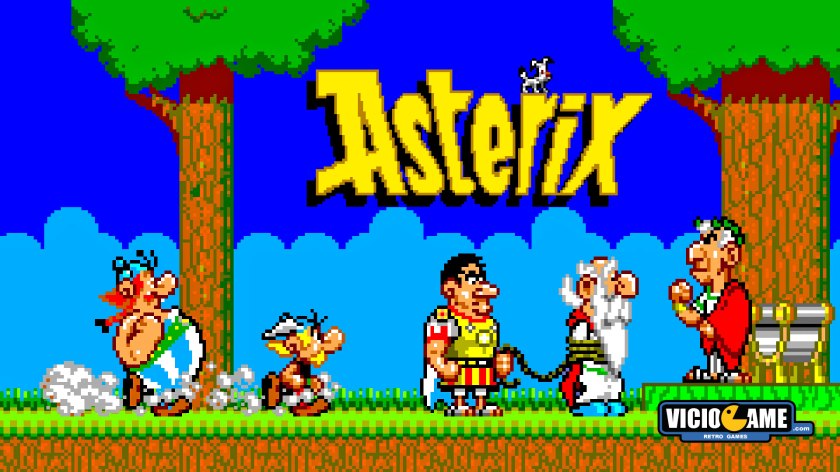
Asterix is a 2D platformer released in 1991 for the Sega Master System. Only one village remains unconquered by the Romans, thanks to the powers of Getafix. However, knowing this, the empire has kidnapped the druid, who now can only count on Asterix and Obelix to rescue him.
Developer/Publisher: Sega
Release date: 1991
Platform: Sega Master System
Asterix – The Ultimate Guide
Asterix was released for the Sega Master System in December 1991, exclusively in European and South American markets, regions where the French comic franchise created by René Goscinny and Albert Uderzo enjoyed enormous popularity. Developed internally by Sega of Japan under the direction of Tomozou Endo, the same person responsible for Castle of Illusion Starring Mickey Mouse and Michael Jackson’s Moonwalker for the system, the game represented the first appearance of the Gaulish duo on a home console and established itself as one of the best platformers in the Master System catalog.
The game emerged in a particular industry context. While the Master System had lost ground to the Nintendo Entertainment System in North America, the console maintained a strong presence in Europe and especially in Brazil, where Tec Toy officially distributed Sega products. The choice to release Asterix only in these regions demonstrated Sega’s understanding of its market, focusing on a license that resonated culturally with European audiences, unlike the Japanese or American properties that dominated the global catalog.
The development team included Tomozou Endo as lead planner, Taku.S in the roles of sub-planner and lead programmer, Kyuzou as sub-planner and artist, plus Com.Blue, Siva, and Wariyuri as additional programmers. The art department also included Cyouko and Kudor.Yo, while Takayuki Nakamura composed the entire soundtrack. Nakamura would later become a prolific composer, working on titles like Virtua Fighter, Ehrgeiz, and Lumines. This same team had previously worked on Castle of Illusion and Land of Illusion, forming a sort of unofficial trilogy of exceptionally high-quality platform games for the system.
The narrative is set in 50 BC, when all of Gaul is occupied by the Romans. All of it? No. One small village of indomitable Gauls still resists the invader thanks to the magic potion of the druid Getafix, which grants superhuman strength to the villagers. Aware of the potion’s power, Julius Caesar orders the kidnapping of Getafix, taking him to Rome. With the potion supply running out, chief Vitalstatistix orders Asterix and Obelix to rescue the druid at any cost. This simple premise serves as justification for a journey that crosses diverse environments throughout Europe and beyond.
The game is structured into seven main stages, called “rounds,” totaling twenty-one individual stages when considering that each phase can have from one to three distinct areas. The first stage, Gaul, is divided into two mandatory areas where the player must use first Asterix and then Obelix. From the second stage onward, the player freely chooses which character to control before each stage, a decision that significantly affects the gameplay experience. The second stage takes the heroes to underground caves, the third to frozen Nordic environments, the fourth to Egypt and its pyramids, the fifth to the Mediterranean Sea and its aquatic dangers, the sixth presents varied challenges approaching Rome, and the seventh culminates in the Roman arenas, with a chariot race as the final stage.
The game’s core mechanics are distinguished by offering substantially different experiences depending on the chosen character. Asterix is agile and fast, capable of accessing narrow and secret areas that Obelix cannot reach due to his large size. However, Asterix cannot destroy blocks with regular punches, depending on the Explosive Potion for that task. Obelix, on the other hand, moves slowly and doesn’t fit in tight passages, but can destroy blocks simply by punching them or jumping on them, in addition to possessing greater natural offensive power. This difference goes beyond simple difficulty adjustments: the stages literally change layout depending on the character, with completely distinct paths, different positioning of enemies and items, and even alternative bosses in some cases.
The controls use the directional pad and two buttons. The directional pad moves the character left and right, pressing it upward allows climbing ropes and vines, while pressing it downward makes the character descend ropes or enter pipes and large barrels. Button 1 executes punches, while Button 2 performs jumps, with holding the button resulting in higher jumps. When submerged, repeatedly pressing Button 2 makes the character rise toward the surface. Special combinations include directional up plus Button 1 to throw carried items, directional down plus Button 1 to drop items at the character’s feet, directional up during a jump to grab ropes and vines, and Button 1 during a jump to execute a descending punch with Asterix or a hip attack with Obelix.
The health system is represented by red blocks in the interface, starting with three blocks at the beginning of the game. Each contact with enemies or traps empties one block. When all blocks are emptied, the player loses a life. The meter can expand to six blocks by collecting specific items during the game. Players start with three lives, and when all are exhausted, the game ends. The continue option allows resuming from the beginning of the stage where the game over occurred, but all points, extra lives, and collected bones return to zero.
The game implements a complex item system divided into two categories. Non-actionable items include jars that hide real prizes inside, individual bones worth one unit for the collection, groups of three bones, keys necessary to open locked doors at the end of stages, and extra character figures that grant an additional life. Actionable items, in turn, are essential tools for progression. The Solid Potion creates temporary bridges over water, lava, or even over enemies when the flask breaks upon touching the ground. The Fire Potion illuminates dark areas and melts ice that cannot be destroyed by other means. The Explosive Potion, exclusive to Asterix, destroys blocks and can create walkable water columns when thrown into larger bodies of water. Rocks, exclusive to Obelix, function similarly to Explosive Potions, creating aquatic platforms and eliminating enemies.
Bonus and recovery items are scattered throughout the stages. Gold bags grant 500 points, coins are worth 200 points, hearts expand the life meter by one block and completely fill the bar (or grant 100 points if the bar is already full), jars restore half of the current capacity of the life meter (or 100 points if already full), and meat pieces fill one block of the meter (or 100 points with a full bar).
Throughout the stages, the player encounters pipes and large barrels that function as portals to secret areas. To enter, it’s necessary to position oneself over the object and press the directional pad down. If the character starts spinning, the entrance is valid. Some barrels can be moved by punching them, altering the portal’s destination. The keys necessary to open the locked doors at the end of most stages are hidden in blue jars, which may be near the door or in secret areas accessible only through these portals.
The scoring system rewards the elimination of certain enemies and the collection of specific items. Additionally, any time remaining at the end of a stage converts to points at a rate of 10 points per time unit. The system rounds down the units column, so a timer showing 247 at the end results in 2,400 points. If time runs out during a stage, the player automatically loses a life.
The game offers single-player and two-player modes. In single-player mode, after the first mandatory stage with both characters, the player freely chooses between Asterix and Obelix before each area. In two-player mode, player one controls Asterix and player two controls Obelix, alternating turns with each completed area. If one character loses all their lives, both bone counters return to zero. The same occurs with points: if any character exhausts their lives, both score markers reset. In two-player mode, if one character loses all lives, the other can continue until also exhausting their lives. Only then does the option to continue the game appear.
Upon collecting fifty bones and completing the current stage, the difficulty selection screen for the Dogmatix bonus stage appears. Three difficulty levels appear: Easy, Normal, and Hard. A frame moves quickly between the options, and the player must press Button 1 or 2 when the frame is over the desired level. Dogmatix, the little dog of the group, must then pop as many bubbles as possible before time runs out or until he can no longer advance to the right. Three types of bubbles exist: green, yellow, and red. The player positions Dogmatix over the bubble and makes him jump repeatedly. Green bubbles require three jumps to pop, transforming into yellow after the first jump and red after the second, worth 1,000 points when popped. Yellow bubbles need two jumps, worth 300 points. Red bubbles pop with a single jump, worth 100 points. Thorns along the way must be avoided, as Dogmatix has low pain tolerance. Popping absolutely all bubbles that appear in the stage grants an additional bonus of 3,000 points.
The game’s visual presentation stands out as one of the best on the Master System. The team adopted a chibi style for the characters, diverging slightly from Uderzo’s art present in the original comics, but creating an aesthetic that works perfectly in the 8-bit context. The animations have multiple frames even for basic actions like punches, surpassing the standard two-frame animations common to games of the era. The enemy variety is impressive, with each stage presenting unique adversaries: Romans hidden in tree stumps in the Gaulish forest, swordfish in ice stages, murderous pots in Egyptian pyramids, among many others. Some enemies appear exclusively in a single stage. The scenarios use colorful and vibrant palettes, clearly differentiating from each other to avoid visual monotony during prolonged gaming sessions.
The fluid animation has its price: in some later stages, particularly when multiple elements are on screen simultaneously, the system presents noticeable slowdown, with the action temporarily becoming slower. This technical problem, though notable, does not significantly compromise gameplay.
Takayuki Nakamura’s soundtrack consists of pleasant melodies that accompany the action well, although none of the compositions reach particularly memorable peaks. The music lacks the strength and impact found in the Asterix arcade game released by Konami in 1992, but maintains its own charm and suits the tone of the adventures presented. Each stage has a distinct musical theme, contributing to the sense of progression through varied environments.
The stage design demonstrates clear influences from other genre classics, particularly Super Mario Bros. and Castlevania. The pipes that lead to underground areas filled with coins and treasures directly reference Mario games. The use of throwable potions that create damage fields upon impacting the ground resembles Castlevania’s holy water, as does the structure of the stage selection map and some enemy patterns. Despite these obvious references, the game establishes its own identity through the dual character mechanic with different routes and the focus on exploration and secret discovery.
The stages are relatively short individually, but densely populated with secret passages and hidden items. Practically every wall can hide a secret area, encouraging meticulous exploration. Destructible blocks hide treasures and essential items, requiring players to experiment with destroying seemingly decorative structures. This emphasis on secrets and exploration significantly increases the game’s longevity, as discovering all alternative paths and collectibles demands multiple sessions.
The difficulty progression proves balanced, although some players report steep difficulty spikes in specific stages. The seventh stage, situated in the dungeons of Rome, is frequently cited as particularly challenging, with complex traps, platforms that collapse at the slightest touch, and sections requiring precise use of actionable items. Moving platforms that collapse into bottomless pits become recurring in the second half of the game, requiring the player to throw potions to create temporary platforms while advancing quickly. The lack of a generous area of effect in potion explosions can frustrate in situations where timing needs to be perfect.
Some stages implement autoscrolling, where the screen moves automatically, forcing the player to maintain pace or fall to their death. When combined with the need to use potions on moving platforms, these segments become especially demanding. The final stage, paradoxically, presents itself as an anticlimax. Designated as Stage 8-1 with no subsequent stages, it consists of a chariot race where the player simply jumps obstacles. After the trials of the seventh stage, this trivial challenge disappoints many players who expected an epic confrontation against Julius Caesar or a more elaborate final challenge.
The bosses at the end of stages vary in complexity but generally follow predictable patterns, jumping or moving in specific sequences that can be memorized. One of the most creative encounters involves a trio of dwarves that emerges from holes in the ground, transforming the combat into a violent version of whack-a-mole. Other bosses are shared between Asterix and Obelix, while some change depending on the chosen character. Most bosses don’t represent a major obstacle, being defeatable quickly once the player identifies the pattern.
The game makes limited use of established characters in Asterix mythology. Most enemies consist of generic Romans, various hostile animals and Vikings, with only a few visual references to the comics, such as the Romans disguised in tree stumps. This generic approach contrasts with Konami’s arcade game, which better captured the humorous tone and comic violence characteristic of the original series. In Asterix for the Master System, when the player punches an enemy hidden in a stump, the Roman’s parts fly in cartoon-style layers, but these moments of physical humor are rare throughout the experience.
A recurring criticism relates to the use of magic potions. In the comics, the Gauls drink the potion to gain superhuman strength. In the game, the potions are thrown as projectiles that explode, essentially functioning as bombs. This alteration, though necessary from a game design standpoint, deviates from the original source unnecessarily. Additionally, generally only one type of potion appears per stage, limiting the strategic variety that the item system could provide.
Some stages include aquatic sections where characters swim. The underwater physics is satisfactory, although characters cannot drown, making these sections less tense than they could be. However, swimming downward and disappearing from the screen in incorrect locations results in instant death, requiring the player to memorize which areas are safe for vertical exploration.
The game never received an official re-release in compilations or digital services, remaining exclusive to the original Master System cartridge. This exclusivity, combined with the limited release only in European and South American markets, makes the game relatively rare for collectors, though it doesn’t reach prohibitive values in the used market. The Brazilian version distributed by Tec Toy is identical to the European one, maintaining the English and French language options in the selection menu.
Critical reviews at the time were mostly positive. The British magazine Mean Machines especially praised the visual fidelity to the comics, although the chibi style diverged from the original art. Modern reviews on MobyGames attributed an 86% average to the game, highlighting it as one of the best platform games on the system. The HonestGamers site awarded a score of 10 for visual presentation and animation, classifying Asterix as one of the games that established a quality standard for what games could and should be. Hardcore Gaming 101 described it as one of the best platform games on the Master System, emphasizing the quality of execution even if it didn’t revolutionize the genre.
More recent criticisms point out problems that became more evident over time. The reviewer Indie Gamer Chick, while acknowledging the technical quality and the development team’s pedigree, considered that the game “has sloppy spots,” particularly criticizing the sections that depend on throwing potions on moving platforms, describing them as tedious work due to the lack of a larger area of effect in the explosions. She also noted that the game, which seemed solid in 1991, hasn’t aged as well as other classics of the era.
Comparisons with other licensed platform games are inevitable. Asterix stands out positively in this context, avoiding the mediocrity that afflicted many license-based games in the 8-bit era. Internal development by Sega, instead of outsourcing to smaller studios, guaranteed a level of polish and attention to detail rarely seen in licensed products. The decision to allow a Japanese team to interpret European intellectual property resulted in a product that, while not perfectly capturing the specific humor of the French comics, presented solid technical quality and gameplay.
The success of Asterix on the Master System led Sega to produce two sequels for the system. Asterix and the Secret Mission released in 1993, again developed by Sega of Japan with Tomozou Endo returning as consultant. This sequel expanded the differences between Asterix and Obelix, with some stages being completely distinct depending on the character, instead of just alternative layouts. The game received positive reviews but was considered shorter and easier than the original. Asterix and the Great Rescue, also from 1993 but released later in 1994 for Master System, was developed by British company Core Design instead of Sega of Japan. This third entry received mixed reviews, with many considering it inferior to the first two games, citing less responsive controls and loss of the charm that characterized the previous titles.
The Brazilian version had an interesting history. Tec Toy, Sega’s official distributor in Brazil, initially released Asterix maintaining the original license and name. Years later, in 1996, the company re-released Asterix and the Secret Mission under the title “As Aventuras da TV Colosso,” replacing the Gaulish characters with characters from a popular Brazilian children’s program. This practice of “re-skinning” licensed games was common at the time, especially in smaller markets like Brazil.
The legacy of Asterix for the Master System remains solid among console enthusiasts. The game frequently appears on “essential” lists for the system, recommended both for franchise fans and platform game enthusiasts in general. The mechanic of offering genuinely different experiences depending on the chosen character anticipated concepts that would be explored more deeply in later generations. The density of secrets and alternative paths rewards exploration in a way that few contemporaries could.
For modern players interested in experiencing the game, some considerations are important. The difficulty can frustrate, particularly in the final stages where minimal errors result in death and return to distant checkpoints. The absence of a password or save system means the game must be completed in a single session or through the continue option, which resets score and collectibles. Players accustomed to modern conventions may find strange the need for constant experimentation to discover false walls and secret areas without any visual indication.
Technically, the cartridge uses 4 megabits of memory, a generous size for the Master System at the time, allowing the inclusion of twenty-one distinct stages, dozens of different enemy types, significant variety of visual environments, and a complete soundtrack for each stage. The game only supports the standard Master System controller, not making use of additional peripherals like the Light Phaser or paddle controller.
The original instruction manual in English and French provides narrative context through panels reminiscent of the comics, detailed explanations about each item and their functions, and vague tips about how to look for hidden passages. The manual explicitly warns that some enemies are indestructible and that there are traps from which there is no escape, preparing the player for inevitable moments of frustration.
During development, a prototype of the game was shown in some specialized magazines under the title “Asterix in Egypt,” with screenshots showing significant differences in graphics and stage design. This preliminary version was never released to the public, and only low-quality images in magazines document its existence. This version represented a parallel project that was canceled and incorporated into the product that was released.
The reception among collectors and retrogaming enthusiasts remains positive decades after release. Forums dedicated to the Master System frequently cite Asterix as an example of how the system was capable of competing visually with the NES when developers invested adequate effort. The decision to release only in markets where the franchise was popular, instead of forcing global distribution, is seen as a demonstration of Sega’s cultural sensitivity at the time.
Asterix for the Master System remains as proof of Sega’s ability to produce high-quality platform games during the heyday of 8-bit systems. Although it never achieved the global recognition of series like Sonic or Mario, the game earned a special place in the memory of European and Brazilian players who grew up with the system. It was established as an essential title for any serious collection. For those willing to accept the challenges and peculiarities typical of early 1990s platform games, Asterix offers a substantial adventure that remains playable and, above all, fun more than three decades after its original release.
Asterix – O Guia Definitivo
Asterix foi lançado para o Sega Master System em dezembro de 1991, exclusivamente nos mercados europeu e sul-americano, regiões onde a franquia francesa de quadrinhos criada por René Goscinny e Albert Uderzo desfrutava de enorme popularidade. Desenvolvido internamente pela Sega of Japan sob direção de Tomozou Endo, o mesmo responsável por Castle of Illusion Starring Mickey Mouse e Michael Jackson’s Moonwalker para o sistema, o jogo representou a primeira aparição da dupla de gauleses em um console doméstico e estabeleceu-se como um dos melhores jogos de plataforma do catálogo do Master System.
O jogo surge em um contexto particular da indústria. Enquanto o Master System havia perdido terreno para o Nintendo Entertainment System na América do Norte, o console mantinha forte presença na Europa e especialmente no Brasil, onde a Tec Toy distribuía oficialmente os produtos Sega. A escolha de lançar Asterix apenas nessas regiões demonstrava compreensão da Sega sobre seu mercado, focando em uma licença que ressoava culturalmente com o público europeu, ao contrário das propriedades japonesas ou americanas que dominavam o catálogo global.
A equipe de desenvolvimento incluía Tomozou Endo como planejador principal, Taku.S nos papéis de sub-planejador e programador principal, Kyuzou como sub-planejador e artista, além de Com.Blue, Siva e Wariyuri como programadores adicionais. O departamento artístico contava ainda com Cyouko e Kudor.Yo, enquanto Takayuki Nakamura compôs toda a trilha sonora. Nakamura posteriormente se tornaria um compositor prolífico, trabalhando em títulos como Virtua Fighter, Ehrgeiz e Lumines. Esta mesma equipe havia trabalhado previamente em Castle of Illusion e Land of Illusion, formando uma espécie de trilogia não oficial de jogos de plataforma com qualidade excepcional para o sistema.
A narrativa situa-se no ano 50 a.C., quando toda a Gália está ocupada pelos romanos. Toda? Não. Uma pequena aldeia de irredutíveis gauleses ainda resiste ao invasor graças à poção mágica do druida Panoramix, que concede força sobre-humana aos aldeões. Ciente do poder da poção, Júlio César ordena o sequestro de Panoramix, levando-o para Roma. Com o suprimento de poção se esgotando, o chefe Abracurcix ordena que Asterix e Obelix resgatem o druida a qualquer custo. Esta premissa simples serve como justificativa para uma jornada que atravessa diversos ambientes pela Europa e além.
O jogo estrutura-se em sete fases principais, chamadas de “rounds”, totalizando vinte e um estágios individuais quando se considera que cada fase pode ter de uma a três áreas distintas. A primeira fase, Gália, divide-se em duas áreas obrigatórias onde o jogador deve utilizar primeiro Asterix e depois Obelix. A partir da segunda fase, o jogador escolhe livremente qual personagem controlar antes de cada estágio, decisão que afeta significativamente a experiência de jogo. A segunda fase leva os heróis a cavernas subterrâneas, a terceira aos gelados ambientes nórdicos, a quarta ao Egito e suas pirâmides, a quinta ao mar Mediterrâneo e seus perigos aquáticos, a sexta apresenta desafios variados em aproximação a Roma, e a sétima culmina nas arenas romanas, com uma corrida de bigas como estágio final.
A mecânica central do jogo diferencia-se por oferecer experiências substancialmente diferentes conforme o personagem escolhido. Asterix é ágil e rápido, capaz de acessar áreas estreitas e secretas que Obelix não consegue alcançar devido ao seu tamanho avantajado. No entanto, Asterix não pode destruir blocos com socos comuns, dependendo da Poção Explosiva para essa tarefa. Obelix, por outro lado, move-se lentamente e não cabe em passagens apertadas, mas pode destruir blocos simplesmente socando-os ou pulando sobre eles, além de possuir maior poder ofensivo natural. Esta diferença vai além de simples alterações de dificuldade: os estágios literalmente mudam de layout dependendo do personagem, com caminhos completamente distintos, posicionamento diferente de inimigos e itens, e até mesmo chefes alternativos em alguns casos.
Os controles utilizam o direcional e dois botões. O direcional movimenta o personagem para esquerda e direita, pressioná-lo para cima permite subir em cordas e trepadeiras, enquanto pressioná-lo para baixo faz o personagem descer por cordas ou entrar em canos e grandes barris. O Botão 1 executa socos, enquanto o Botão 2 realiza saltos, sendo que manter o botão pressionado resulta em saltos mais altos. Quando submerso, pressionar repetidamente o Botão 2 faz o personagem subir em direção à superfície. Combinações especiais incluem direcional para cima mais Botão 1 para arremessar itens carregados, direcional para baixo mais Botão 1 para soltar itens aos pés do personagem, direcional para cima durante um salto para agarrar cordas e trepadeiras, e Botão 1 durante um salto para executar um soco descendente com Asterix ou um ataque de quadril com Obelix.
O sistema de saúde representa-se por blocos vermelhos na interface, começando com três blocos no início do jogo. Cada contato com inimigos ou armadilhas esvazia um bloco. Quando todos os blocos se esvaziam, o jogador perde uma vida. O medidor pode expandir até seis blocos ao coletar itens específicos durante o jogo. Os jogadores começam com três vidas, e quando todas se esgotam, o jogo termina. A opção de continuar permite retomar do início da fase onde ocorreu o fim de jogo, mas todos os pontos, vidas extras e ossos coletados retornam a zero.
O jogo implementa um sistema de itens complexo dividido em duas categorias. Os itens não-acionáveis incluem jarros que escondem prêmios verdadeiros em seu interior, ossos individuais que valem uma unidade para a coleção, grupos de três ossos, chaves necessárias para abrir portas trancadas no final das fases e figuras de personagem extra que concedem uma vida adicional. Os itens acionáveis, por sua vez, são ferramentas essenciais para progressão. A Poção Sólida cria pontes temporárias sobre água, lava ou até sobre inimigos quando o frasco quebra ao tocar o chão. A Poção de Fogo ilumina áreas escuras e derrete gelo que não pode ser destruído por outros meios. A Poção Explosiva, exclusiva para Asterix, destrói blocos e pode criar colunas de água caminháveis quando arremessada em corpos d’água maiores. As Rochas, exclusivas para Obelix, funcionam de maneira similar às Poções Explosivas, criando plataformas aquáticas e eliminando inimigos.
Itens de bônus e recuperação espalham-se pelos estágios. Sacos de ouro concedem 500 pontos, moedas valem 200 pontos, corações expandem o medidor de vida em um bloco e preenchem completamente a barra (ou concedem 100 pontos se a barra já estiver cheia), jarros restauram metade da capacidade atual do medidor de vida (ou 100 pontos se já estiver cheio), e pedaços de carne preenchem um bloco do medidor (ou 100 pontos com a barra cheia).
Ao longo das fases, o jogador encontra canos e grandes barris que funcionam como portais para áreas secretas. Para entrar, é necessário posicionar-se sobre o objeto e pressionar o direcional para baixo. Se o personagem começar a girar, a entrada é válida. Alguns barris podem ser movidos socando-os, alterando o destino do portal. As chaves necessárias para abrir as portas trancadas no final da maioria das fases escondem-se em jarros azuis, que podem estar próximos à porta ou em áreas secretas acessíveis apenas através desses portais.
O sistema de pontuação recompensa a eliminação de certos inimigos e a coleta de itens específicos. Adicionalmente, qualquer tempo restante ao final de uma fase converte-se em pontos à taxa de 10 pontos por unidade de tempo. O sistema arredonda para baixo a coluna das unidades, então um timer mostrando 247 ao final resulta em 2.400 pontos. Se o tempo se esgotar durante uma fase, o jogador perde uma vida automaticamente.
O jogo oferece modos para um e dois jogadores. No modo de um jogador, após a primeira fase obrigatória com ambos os personagens, o jogador escolhe livremente entre Asterix e Obelix antes de cada área. No modo de dois jogadores, o jogador um controla Asterix e o jogador dois controla Obelix, alternando turnos a cada área completada. Se um dos personagens perde todas as suas vidas, ambos os contadores de ossos retornam a zero. O mesmo ocorre com os pontos: se qualquer personagem esgota suas vidas, ambos os marcadores de pontuação resetam. No modo de dois jogadores, se um personagem perde todas as vidas, o outro pode continuar até também esgotar suas vidas. Apenas então surge a opção de continuar o jogo.
Ao coletar cinquenta ossos e completar a fase em andamento, surge a tela de seleção de dificuldade do estágio bônus de Dogmatix. Três níveis de dificuldade aparecem: Fácil, Normal e Difícil. Uma moldura move-se rapidamente entre as opções, e o jogador deve pressionar Botão 1 ou 2 quando a moldura estiver sobre o nível desejado. Dogmatix, o cãozinho da turma, deve então estourar o máximo de bolhas possível antes que o tempo acabe ou até não poder mais avançar para a direita. Três tipos de bolhas existem: verdes, amarelas e vermelhas. O jogador posiciona Dogmatix sobre a bolha e o faz pular repetidamente. Bolhas verdes requerem três pulos para estourar, transformando-se em amarelas após o primeiro pulo e em vermelhas após o segundo, valendo 1.000 pontos ao estourar. Bolhas amarelas necessitam dois pulos, valendo 300 pontos. Bolhas vermelhas estouram com um único pulo, valendo 100 pontos. Espinhos pelo caminho devem ser evitados, pois Dogmatix possui baixa tolerância à dor. Estourar absolutamente todas as bolhas que aparecem no estágio concede um bônus adicional de 3.000 pontos.
A apresentação visual do jogo destaca-se como uma das melhores do Master System. A equipe adotou um estilo chibi para os personagens, divergindo ligeiramente da arte de Uderzo presente nos quadrinhos originais, mas criando uma estética que funciona perfeitamente no contexto de 8 bits. As animações possuem múltiplos quadros mesmo para ações básicas como socos, superando o padrão de animações de dois quadros comum aos jogos da era. A variedade de inimigos impressiona, com cada fase apresentando adversários únicos: romanos escondidos em tocos de árvores na floresta gaulesa, peixes-espada nos estágios de gelo, potes assassinos nas pirâmides egípcias, entre muitos outros. Alguns inimigos aparecem exclusivamente em um único estágio. Os cenários utilizam paletas coloridas e vibrantes, diferenciando-se claramente entre si para evitar monotonia visual durante sessões prolongadas de jogo.
A animação fluída tem seu preço: em algumas fases posteriores, particularmente quando múltiplos elementos estão em tela simultaneamente, o sistema apresenta slowdown perceptível, com a ação tornando-se temporariamente mais lenta. Este problema técnico, embora notável, não compromete significativamente a jogabilidade.
A trilha sonora de Takayuki Nakamura consiste em melodias agradáveis que acompanham bem a ação, embora nenhuma das composições atinja picos particularmente memoráveis. As músicas carecem da força e impacto encontrados no jogo de arcade de Asterix lançado pela Konami em 1992, mas mantêm charme próprio e adequam-se ao tom das aventuras apresentadas. Cada fase possui tema musical distinto, contribuindo para a sensação de progressão através de ambientes variados.
O design de fases demonstra influências claras de outros clássicos do gênero, particularmente Super Mario Bros. e Castlevania. Os canos que levam a áreas subterrâneas repletas de moedas e tesouros remetem diretamente aos jogos de Mario. O uso de poções arremessáveis que criam campos de dano ao impactar o solo assemelha-se à água benta de Castlevania, assim como a estrutura do mapa de seleção de fases e alguns padrões de inimigos. Apesar dessas referências óbvias, o jogo estabelece identidade própria através da mecânica de personagens duais com rotas diferentes e do foco em exploração e descoberta de segredos.
As fases são relativamente curtas individualmente, mas densamente povoadas com passagens secretas e itens escondidos. Praticamente toda parede pode esconder uma área secreta, incentivando exploração meticulosa. Blocos destruíveis escondem tesouros e itens essenciais, exigindo que os jogadores experimentem destruir estruturas aparentemente decorativas. Esta ênfase em segredos e exploração aumenta significativamente a longevidade do jogo, pois descobrir todos os caminhos alternativos e colecionáveis demanda múltiplas sessões.
A progressão de dificuldade mostra-se equilibrada, embora alguns jogadores relatem picos de dificuldade acentuados em fases específicas. A sétima fase, situada nas masmorras de Roma, é frequentemente citada como particularmente desafiadora, com armadilhas complexas, plataformas que desabam ao menor toque e seções que exigem uso preciso dos itens acionáveis. Plataformas móveis que colapsam em fossos sem fundo tornam-se recorrentes na segunda metade do jogo, exigindo que o jogador arremesse poções para criar plataformas temporárias enquanto avança rapidamente. A falta de área de efeito generosa nas explosões das poções pode frustrar em situações onde o timing precisa ser perfeito.
Alguns estágios implementam autoscrolling, onde a tela move-se automaticamente, forçando o jogador a manter o ritmo ou cair para a morte. Quando combinado com a necessidade de usar poções em plataformas móveis, esses segmentos tornam-se especialmente exigentes. A fase final, paradoxalmente, apresenta-se como anticlímax. Designada como Fase 8-1 sem fases subsequentes, consiste em uma corrida de bigas onde o jogador simplesmente salta obstáculos. Após as provações da sétima fase, este desafio trivial decepciona muitos jogadores que esperavam confronto épico contra Júlio César ou desafio final mais elaborado.
Os chefes ao final das fases variam em complexidade, mas geralmente seguem padrões previsíveis, saltando ou movendo-se em sequências específicas que podem ser memorizadas. Um dos encontros mais criativos envolve um trio de anões que emerge de buracos no chão, transformando o combate em uma versão violenta do jogo “acerte a toupeira”. Outros chefes são compartilhados entre Asterix e Obelix, enquanto alguns mudam dependendo do personagem escolhido. A maioria dos chefes não representa grande obstáculo, podendo ser derrotada rapidamente uma vez que o jogador identifica o padrão.
O jogo faz uso limitado de personagens estabelecidos na mitologia de Asterix. A maior parte dos inimigos consiste em romanos genéricos, diversos animais hostis e vikings, com apenas algumas referências visuais aos quadrinhos, como os romanos disfarçados em tocos de árvore. Esta abordagem genérica contrasta com o arcade da Konami, que capturava melhor o tom humorístico e a violência cômica característica da série original. Em Asterix do Master System, quando o jogador soca um inimigo escondido em um toco, as partes do romano voam em camadas estilo desenho animado, mas estes momentos de humor físico são raros ao longo da experiência.
Uma crítica recorrente relaciona-se ao uso das poções mágicas. Nos quadrinhos, os gauleses bebem a poção para ganhar força sobre-humana. No jogo, as poções são arremessadas como projéteis que explodem, funcionando essencialmente como bombas. Esta alteração, embora necessária do ponto de vista de game design, afasta-se da fonte original de maneira desnecessária. Adicionalmente, geralmente apenas um tipo de poção aparece por fase, limitando a variedade estratégica que o sistema de itens poderia proporcionar.
Alguns estágios incluem seções aquáticas onde os personagens nadam. A física subaquática é satisfatória, embora os personagens não possam se afogar, tornando estas seções menos tensas que poderiam ser. No entanto, nadar para baixo e desaparecer da tela em locais incorretos resulta em morte instantânea, exigindo que o jogador memorize quais áreas são seguras para exploração vertical.
O jogo nunca recebeu relançamento oficial em compilações ou serviços digitais, permanecendo exclusivo ao cartucho original do Master System. Esta exclusividade, combinada com o lançamento limitado apenas nos mercados europeu e sul-americano, torna o jogo relativamente raro para colecionadores, embora não alcance valores proibitivos no mercado de usados. A versão brasileira distribuída pela Tec Toy é idêntica à europeia, mantendo as opções de idioma inglês e francês no menu de seleção.
As avaliações críticas da época foram majoritariamente positivas. A revista britânica Mean Machines elogiou especialmente a fidelidade visual aos quadrinhos, embora o estilo chibi divergisse da arte original. Revisões modernas no MobyGames atribuíram ao jogo média de 86%, destacando-o como um dos melhores jogos de plataforma do sistema. O site HonestGamers concedeu nota 10 para a apresentação visual e animação, classificando Asterix como um dos jogos que estabeleceu padrão de qualidade para o que jogos poderiam e deveriam ser. O Hardcore Gaming 101 descreveu-o como um dos melhores jogos de plataforma do Master System, enfatizando a qualidade da execução mesmo que não revolucionasse o gênero.
Críticas mais recentes apontam problemas que se tornaram mais evidentes com o tempo. A revisora Indie Gamer Chick, embora reconhecendo a qualidade técnica e o pedigree da equipe de desenvolvimento, considerou que o jogo “tem pontos desleixados“, criticando particularmente as seções que dependem de arremessar poções em plataformas móveis, descrevendo-as como trabalho entediante devido à falta de área de efeito maior nas explosões. Ela também notou que o jogo, que parecia sólido em 1991, não envelheceu tão bem quanto outros clássicos da época.
Comparações com outros jogos de plataforma licenciados são inevitáveis. Asterix destaca-se positivamente neste contexto, evitando a mediocridade que afligia muitos jogos baseados em licenças na era dos 8 bits. O desenvolvimento interno pela Sega, ao invés de terceirização para estúdios menores, garantiu nível de polimento e atenção ao detalhe raramente visto em produtos licenciados. A decisão de permitir que uma equipe japonesa interpretasse propriedade intelectual europeia resultou em produto que, embora não capturasse perfeitamente o humor específico dos quadrinhos franceses, apresentava qualidade técnica e gameplay sólidos.
O sucesso de Asterix no Master System levou a Sega a produzir duas sequências para o sistema. Asterix and the Secret Mission lançado em 1993, novamente desenvolvido pela Sega of Japan com Tomozou Endo retornando como consultor. Esta sequência expandiu as diferenças entre Asterix e Obelix, com algumas fases sendo completamente distintas dependendo do personagem, em vez de apenas layouts alternativos. O jogo recebeu avaliações positivas mas foi considerado mais curto e fácil que o original. Asterix and the Great Rescue, também de 1993 mas lançado posteriormente em 1994 para Master System, foi desenvolvido pela britânica Core Design ao invés da Sega of Japan. Esta terceira entrada recebeu críticas mistas, com muitos considerando-a inferior aos dois primeiros jogos, citando controles menos responsivos e perda do charme que caracterizava os títulos anteriores.
A versão brasileira teve história interessante. A Tec Toy, distribuidora oficial da Sega no Brasil, lançou inicialmente Asterix mantendo a licença e nome originais. Anos depois, em 1996, a empresa relançou Asterix and the Secret Mission sob o título “As Aventuras da TV Colosso”, substituindo os personagens gauleses pelos personagens de um popular programa infantil brasileiro. Esta prática de “re-skinning” de jogos licenciados era comum na época, especialmente em mercados menores como o Brasil.
O legado de Asterix para o Master System permanece sólido entre entusiastas do console. O jogo frequentemente aparece em listas de “essenciais” do sistema, recomendado tanto para fãs da franquia quanto para apreciadores de jogos de plataforma em geral. A mecânica de oferecer experiências genuinamente diferentes conforme o personagem escolhido antecipou conceitos que seriam explorados mais profundamente em gerações posteriores. A densidade de segredos e caminhos alternativos premia exploração de maneira que poucos contemporâneos conseguiam.
Para jogadores modernos interessados em experimentar o jogo, algumas considerações são importantes. A dificuldade pode frustrar, particularmente nas fases finais onde erros mínimos resultam em morte e retorno a checkpoints distantes. A ausência de sistema de passwords ou saves significa que o jogo deve ser completado em uma única sessão ou através da opção de continuar, que reseta pontuação e colecionáveis. Jogadores acostumados com convenções modernas podem estranhar a necessidade de experimentação constante para descobrir paredes falsas e áreas secretas sem qualquer indicação visual.
Tecnicamente, o cartucho utiliza 4 megabits de memória, tamanho generoso para o Master System na época, permitindo a inclusão de vinte e um estágios distintos, dezenas de tipos de inimigos diferentes, variedade significativa de ambientes visuais e trilha sonora completa para cada fase. O jogo suporta apenas o controle padrão do Master System, não fazendo uso de periféricos adicionais como o Light Phaser ou o controle paddle.
O manual de instruções original em inglês e francês fornece contexto narrativo através de painéis que remetem aos quadrinhos, explicações detalhadas sobre cada item e suas funções, e dicas vagas sobre como procurar passagens escondidas. O manual adverte explicitamente que alguns inimigos são indestrutíveis e que existem armadilhas das quais não há escapatória, preparando o jogador para momentos de frustração inevitáveis.
Durante o desenvolvimento, um protótipo do jogo foi mostrada em algumas revistas especializadas sob o título “Asterix in Egypt”, com screenshots mostrando diferenças significativas em gráficos e design de fases. Esta versão preliminar nunca foi lançada ao público, e apenas imagens de baixa qualidade em revistas documentam sua existência. Esta versão representava um projeto paralelo que foi cancelado e incorporado ao produto que foi lançado.
A recepção entre colecionadores e entusiastas de retrogaming permanece positiva décadas após o lançamento. Fóruns dedicados ao Master System frequentemente citam Asterix como exemplo de como o sistema era capaz de competir visualmente com o NES quando desenvolvedores investiam esforço adequado. A decisão de lançar apenas em mercados onde a franquia era popular, ao invés de forçar distribuição global, é vista como demonstração de sensibilidade cultural da Sega da época.
Asterix para o Master System permanece como uma prova da capacidade da Sega de produzir jogos de plataforma de alta qualidade durante o apogeu dos sistemas de 8 bits. Embora nunca tenha alcançado o reconhecimento global de séries como Sonic ou Mario, o jogo conquistou lugar especial na memória de jogadores europeus e brasileiros que cresceram com o sistema. Este foi estabelecido como um título essencial para qualquer coleção séria. Para aqueles dispostos a aceitar os desafios e peculiaridades típicas dos jogos de plataforma do início dos anos 1990, Asterix oferece aventura substancial que permanece jogável e, sobretudo, divertida mais de três décadas após seu lançamento original.
🤑💲Earn money without doing anything! Just leave these apps open:
   ✓ https://r.honeygain.me/CONTA9DB02

   ✓ https://packetstream.io/?psr=1uPb
🤑💲1-Click button earns Bitcoin every 1 hour: https://freebitco.in/?r=53528449
⬛ 𝗧𝗶𝗸𝗧𝗼𝗸: https://www.tiktok.com/@viciogame
🟧 𝗜𝗻𝘀𝘁𝗮𝗴𝗿𝗮𝗺: http://www.instagram.com/viciogame
🟥 𝗬𝗼𝘂𝘁𝘂𝗯𝗲: http://www.youtube.com/viciogame
🟦 𝗙𝗮𝗰𝗲𝗯𝗼𝗼𝗸: http://www.facebook.com/viciogame
🔳 𝗧𝗵𝗿𝗲𝗮𝗱𝘀: https://www.threads.net/@viciogame
🟪 𝗧𝘄𝗶𝘁𝗰𝗵: https://www.twitch.tv/ViciogameRetroGames
🟨 𝗕𝗹𝗼𝗴: http://www.viciogameblog.com/
🟦𝗧𝘄𝗶𝘁𝘁𝗲𝗿: http://www.twitter.com/viciogame
#Viciogame #Gameplay #LetsPlay #Gamer #Playthrough #Games #News #Videogames #Review #Game #Detonado #Walkthrough #Ending #Reviews #Facts #Retro #Record #Roms #Emulator #Longplay #Speedrun #Asterix #MasterSystem #Sega #Obelix #ReneGoscinny #AlbertUderzo #Cartoon #TvColosso #tectoy #マスターシステム #セガ
 VICIOGAME