
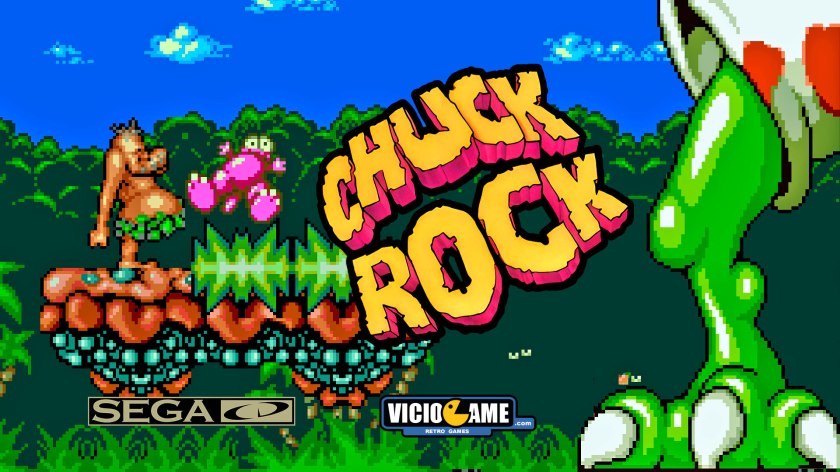
Chuck Rock is a 2D platformer released in 1992 for the Sega CD. While watching TV and drinking his beer, Chuck hears his wife’s cries for help—she’s been kidnapped in a moment of distraction. To rescue her, he must leave behind his peaceful caveman lifestyle and embark on a journey through various hostile locations.
Developer: Core Design
Publisher: Sony Imagesoft
Release date: 1992
Platform: Sega CD / Mega CD / Sega Genesis / Mega Drive
Chuck Rock – The Ultimate Guide
Chuck Rock was developed by Core Design and originally released in 1991 for Amiga and Atari ST computers, marking one of the British developer’s first forays into the prehistoric-themed platformer market. The Sega CD version, published by Sony Imagesoft, arrived in the North American market in October 1992, bringing significant improvements over the original versions and the Mega Drive / Sega Genesis port. The game was developed at a time when Core Design was still seeking to establish its identity in the video game market, years before achieving worldwide fame with the creation of Lara Croft and the Tomb Raider franchise in 1996. The character Chuck Rock became one of the company’s first mascots, even appearing in comic strip stories published in the British children’s magazine Look-in during the 1990s.
The story of Chuck Rock takes place in a fictional version of the Stone Age, where Neanderthal humans coexist anachronistically with dinosaurs, woolly mammoths, saber-toothed tigers, and other prehistoric creatures in a setting reminiscent of productions like the film “One Million Years B.C.” and animated series like “The Flintstones” and “Dinosaurs.” The game’s narrative begins when Chuck is at home watching television and consuming beer, at which point his wife Ophelia is kidnapped by the jealous bully Gary Gritter (a name that makes a direct and intentional reference to glam rock singer Gary Glitter). Leaving behind only enormous footprints in the ground, Gary takes Ophelia to his hideout in a dinosaur graveyard. Chuck, initially more concerned with the fact that the laundry hasn’t been done than with the kidnapping itself, finally decides to rescue his wife and sets off on a journey through five distinct worlds.
The protagonist is a chubby and lazy caveman, characterized by his prominent belly, bald head, square jaw, and extremely limited vocabulary consisting basically of the phrase “Unga Bunga.” Chuck is the guitarist and vocalist of a rock band composed of other cavemen, his attractive wife Ophelia Rock, and a hairy dinosaur that plays bass. During performances, Chuck uses a long wig to hide his baldness.
The Sega CD version of Chuck Rock presents substantial improvements over the Genesis cartridge. The most significant is the addition of an animated introduction that narrates the events leading to Ophelia’s kidnapping. This sequence uses questionable production values, with choppy scenes and a narrator who seems to be reading from a script, but still adds context to the adventure that was absent in the cartridge version. The Genesis did not include this animated introduction, leaving players without knowing exactly why Chuck was traveling through prehistoric environments and facing dinosaurs, unless they read the back of the game box. The audio also received special treatment in the CD version, with the title screen featuring clear rock music instead of the harsher electronic sounds of the original version. Although the soundtrack is still not full CD quality, remaining as chip-tune, the composers at Martin’s Music Workshop created high-quality tracks superior to previous versions. Additionally, the stages in the CD version are slightly longer.
Chuck Rock is a side-scrolling platform game that differs from other titles in the genre primarily through its unique combat system. Unlike most platform games of the era where the character jumps on enemies to defeat them, Chuck uses his prominent belly as his primary weapon. The B button executes the belly attack, where Chuck pushes his adversaries with his generous abdomen, destroying them in the process. This attack method has short range and peculiar timing, requiring players to allow enemies to get quite close before connecting the hit. The C button makes Chuck jump, and when combined with the B button during the jump, he executes an aerial kick that is particularly useful against flying creatures. Both attacks have limited range and can feel awkward at first, especially considering that enemies often hide behind foreground scenery elements to hit the player with cheap shots or throw projectiles from off-screen. Pressing down on the directional pad makes Chuck crouch, an essential move to avoid flying insects and other aerial enemies. When in water, which appears mainly in stage three, Chuck can swim by pressing the directional pad in any direction, including up, although underwater control is difficult and imprecise.
One of Chuck Rock’s most distinctive mechanics involves manipulating stones and rocks scattered throughout the environments. Chuck can pick up stones by pressing down on the directional pad to crouch and then pressing the B button. Once holding a stone, pressing B again makes Chuck throw it in the direction he’s facing, crushing dinosaurs and other enemies in the way. Stones function as long-range weapons that compensate for the short range of Chuck’s melee attacks, becoming essential tools for progressing in the game. Beyond offensive use, stones can be stacked to create improvised platforms, allowing Chuck to reach areas that would otherwise be inaccessible. This mechanic adds an exploratory puzzle element to the game, although Chuck can only carry one stone at a time and his jumping ability is significantly reduced when carrying a large stone. In certain situations, such as during volcanic eruptions in the second stage, Chuck can hold a stone over his head to protect himself from debris falling from the sky. The game also allows Chuck to use alligators as catapults by walking on one end and bouncing a stone on the other, launching him to elevated areas.
The health system in Chuck Rock is represented by a heart icon located in the lower right corner of the screen. This heart gradually shrinks as Chuck takes damage from enemies or environmental obstacles, and swells when he gains health or starts a new life. When Chuck suffers a hit that costs health, his eyes pop out and he sticks his thick tongue directly at the player in a humorous animation that clearly indicates the damage received. Health can be recovered by collecting hearts generously scattered throughout the scenery. Chuck starts each game with four lives, indicated in the lower right corner of the screen by an image of Chuck’s goofy face followed by an “X” and a number from 1 to 3 showing how many lives remain. The player receives an extra life for every 100,000 points accumulated, encouraging the collection of bonus items scattered throughout the environments. The current score is also displayed on screen.
The game offers a password system that allows players to continue their adventure from specific stages without having to restart from the beginning. This functionality was an exclusive addition to the Sega CD version that was not present in the original Genesis version. The password system can be accessed through the options screen, which also allows players to listen to samples of the game’s various music tracks and experiment with different sound effects. Control settings can also be modified on this screen, allowing players to adjust button assignments according to their preference. Additionally, there is a continue mode that allows the player to return to the game up to two times after losing all lives, with five seconds to press the Start button and continue from where they left off.
The structure of Chuck Rock consists of five main stages, each with multiple levels and its own final boss. The first stage, called “The Law of the Jungle,” has eight levels and features Chuck navigating through a primordial jungle full of dinosaurs, carnivorous plants, and other prehistoric dangers. The boss of this stage is a large triceratops with a bandage on its rear, whose attack pattern is easily exploitable once understood.
The second stage, titled “If You Can’t Take the Heat, Get Out of the Volcano,” has six levels and takes Chuck into the interior of a volcanic mountain where he must navigate dangerous caves full of lava and moving platforms. The boss of this stage is a saber-toothed tiger that is permanently irritated, offering a more challenging battle than the previous boss.
The third stage, called “In the (Primordial) Soup,” contains four levels and represents perhaps the game’s greatest challenge due to the difficulty of controlling Chuck underwater. Chuck can swim in all directions by pressing the respective directional buttons, floating to the surface when the player releases the controls. Curiously, when he loses a life in this stage, Chuck sinks to the bottom instead of floating.
The fourth stage, “Chuck Chills Out in the Ice Age,” consists of six levels set in snow and ice-covered landscapes. The ice is rendered in bright blue tones, creating some of the game’s most impressive visuals, standing out as an aesthetic high point. The slippery ice terrain adds an extra element of difficulty to Chuck’s already challenging controls.
The fifth and final stage, “Watch Out for ‘Dem Bones,” has four final levels that take Chuck through a macabre dinosaur graveyard where he will finally confront Gary Gritter and rescue Ophelia. The stage requires players to use all the skills learned throughout the game, combining precise combat, strategic use of stones, and improvised platforms.
Throughout his journey to save Ophelia, Chuck can collect various caveman snacks that increase his score. Each stage has its own thematic set of collectible items with specific point values. All hearts that restore health are also available in each stage.
The visual presentation of Chuck Rock in the Sega CD version was widely praised by critics of the time. The sprites are colorful and full of personality, with careful animations and attention to detail that make the game stand out visually. Lee Pullen, the artist responsible for the visuals, was specifically credited by critics like Stuart Campbell for creating sprites that “jump out at you” with wonderful colors and full of attitude. Chuck’s humorous animations, including his idle pose and exaggerated reactions to taking damage, add charm to the game. The enemies were described as “beautifully drawn” with varied animations and detailed facial expressions. The environments, while sometimes featuring less colorful backgrounds than the original Amiga version, still maintain an attractive look reminiscent of Saturday morning cartoons. The graphics were considered by some critics as the primary motivation for playing, with Game Pro magazine stating that “the game is worth the money for the graphics alone.”
The soundtrack of Chuck Rock on Sega CD received considerable praise, being described as a masterpiece for the console by some critics. Although technically still chip-tune and not full CD quality audio, the composers at Martin’s Music Workshop created high-quality tracks that significantly elevate the experience over the Genesis version. The main menu screen features a band jam session, immediately establishing the game’s musical tone in a manner similar to Rock n’ Roll Racing. During gameplay, each stage has its own thematic music track, although the music repeats throughout all levels within the same stage, which can become repetitive after long periods of play. The jungle stage maintains the same music through all eight levels, for example. Despite this limitation, the compositions are generally pleasant and appropriate for each environment. The Ice Age stage four received special mention for perfectly complementing the impressive snow-covered visuals.
The sound effects in Chuck Rock significantly contribute to the game’s humorous atmosphere. Many sounds were digitized for the Sega CD version, including animal grunts, alligator burps during the aquatic stage, and Chuck’s frequent “Unga Bunga” exclamations which, though limited, perfectly capture the character’s simple personality. Critics highlighted the Stone Age-themed sound effects reminiscent of “The Flintstones” as particularly effective. The sounds of Chuck’s belly attacks, the impacts of stones hitting enemies, and the various noises of different types of dinosaurs and creatures create a rich soundscape that complements the cartoonish visuals. The narrator of the animated introduction, though considered cheesy and not particularly well-acted, adds a peculiar charm that many players appreciate for its comedic value.
Chuck Rock can be completed in approximately one hour by experienced players, making it one of the shortest titles in the Sega CD library. This reduced duration was often cited as one of the game’s biggest weaknesses, especially considering there is no option to adjust difficulty, limiting replayability. The overall difficulty is moderate, with the early stages being relatively easy and the challenge increasing significantly during the aquatic, ice, and bone graveyard stages. The boss attack patterns are easily exploitable once understood, reducing the challenge of these encounters. Repetitiveness also becomes an issue, particularly in the middle stages where many players reported feeling bored to the point of wanting to turn off the game, although the final stages recover interest. The password system partially alleviates this problem, allowing players to pause and return to later stages without having to replay everything from the beginning.
Chuck Rock’s gameplay presents both innovative elements and persistent frustrations. Chuck’s unique belly attack method, while original, requires a significant adjustment period due to its extremely short range and peculiar timing. Enemies need to be practically touching Chuck for the attack to connect, which frequently results in mutual damage where both Chuck and the enemy suffer. The stone-throwing mechanic partially compensates for this limitation, but the fact that Chuck can only carry one stone at a time and has his mobility reduced while carrying a large stone limits the usefulness of this strategy. The aerial kick executed by jumping with C and attacking with B offers an alternative with slightly greater range, but also demands precise timing. Exploration of the environments is normally linear, with few dead ends or dead-end paths, minimizing the exploratory element despite the multiple routes available through some stages. The ability to stack stones to reach elevated areas adds an inventive puzzle element that many players appreciated.
Compared to other versions of Chuck Rock, the Sega CD port stands out for its medium-specific improvements. The original Mega Drive version, while well-received for its smooth graphical transition and faster performance compared to the Amiga, lacked the animated introduction and password system, making the CD version a superior choice for many players. The Super Nintendo version, published by Sony Imagesoft in 1992, suffered censorship in compliance with Nintendo’s content policies, including alterations to the ending text that removed sexual innuendos, changing a suggestive line about Ophelia’s phrase. The Game Boy version, developed by Spidersoft and released in 1993, was criticized for problematic collision detection, slow character movement, and monotonous environments. Versions for computers like Commodore 64, Acorn Archimedes, and Amiga CD32 also existed, expanding the game’s reach across multiple platforms during the early 1990s.
Although Sega is considered more liberal than Nintendo regarding content and age rating, the Sega CD version was also subject to censorship: in addition to the alteration to the final phrase with sexual connotation (as in the Super Nintendo), there was also a cut of an animation in the opening cutscene, where Ophelia bends down to pick up clothing from the floor, making her buttocks more evident (which narratively further instigates Gary’s criminal action).
The critical reception of Chuck Rock was positive, albeit with reservations. The Video Game Critic gave the game a favorable review, highlighting that the CD version incorporated a map screen similar to Ghouls ‘N Ghosts, as well as longer stages and some new enemies compared to the Genesis cartridge. Electronic Gaming Monthly praised the successful combination of humorous elements, with one critic arguing that Kato and Ken was the only other game he had played with that quality. The graphics were acclaimed as excellent, exceptional, and magnificent by various publications. Julian Rignall of Mean Machines declared that Chuck Rock was the best platform game seen up to that point in 1991, emphatically recommending that Mega Drive players acquire the title. Richard Leadbetter was equally enthusiastic, stating he preferred this over the Amiga original due to its superior audio/visual and addictive gameplay. Sega-16 magazine summarized the game as providing nostalgic fun in a bright and carefree world, although the strange attack method and short play time hurt the experience.
Not all criticism was positive. Some reviewers pointed out that Chuck Rock was simple and not original, following a basic platform formula without innovating significantly beyond its peculiar protagonist and belly attack mechanic. The short duration was consistently cited as a significant deficiency, especially for a CD game that could have taken advantage of the greater storage capacity to include more content. The lack of character development for Chuck was mentioned, with critics noting that he doesn’t possess enough qualities to make players fall in love with him the same way as Mario or Sonic.
The legacy of Chuck Rock is complex and multifaceted. The comic strips centered on the daily life of Chuck, Ophelia, and their son Junior, with a meta-referential joke where Junior owned a “SteggaDrive” console, a reference to the European name Mega Drive. The magazine ceased operations one year after the comic strip began, with the final story showing Chuck being swept from his boat, presumed dead but eventually emerging on a tribal island where he is revered as a god. Inexplicably and comically, Chuck’s “funeral” included then British Prime Minister John Major as one of the mourners.
As a curiosity, there is what many consider a continuity error in the representation of the character Gary Gritter. In the opening cutscene, he is clearly shown as a caveman, while in the final cutscene, he is displayed as a dinosaur wearing boxing gloves and underwear. In fact, this was intentional, and is a comedic liberty adopted by the developers to represent Gary at his strongest and most enraged during the final battle. Portraying the villain as a huge humanized green Tyrannosaurus Rex was much more cartoonish, epic, and representative than a simple human fighting another.
The predicted success of Chuck Rock led to the immediate development of a direct sequel, Chuck Rock II: Son of Chuck, released in 1993 by Core Design. In fact, this was explicitly announced in the ending credits of the first game. This sequel changed the protagonist to Chuck’s baby son, Chuck Junior, who embarks on a mission to rescue his father kidnapped by the villain Brick Jagger, a rival manufacturer jealous of Chuck’s skills in carving stone automobiles. Unlike the original’s focus on melee combat via belly attacks and kicks, the sequel introduced ranged shooting mechanics using a slingshot or gun, as well as sustained attacks with a club and puzzle elements involving moving stones. The sequel featured a longer campaign with six worlds, each culminating in boss battles. The Sega CD version of Chuck Rock II included enhanced audio with CD-quality tracks and a complete animated introduction in the style of “The Flintstones” with a narrator, worth several laughs.
A franchise spin-off came in the form of BC Racers, released in 1993, the same year as Chuck Rock II: Son of Chuck. BC Racers changed the platform format to racing, being released for Mega-CD, Sega 32X, and 3DO. The game was designed by Toby Gard, who later created Lara Croft, and maintained the characters from Chuck Rock as well as his son Chuck Junior. Other prehistoric racers included Millstone Rockafella, Brick Jagger, and Jimi Handtrix, all with parody names of famous musicians. The game was well-received among fans of the consoles in question, and BC Racers was named Best Racing Game for Sega CD of the Year at GameFan’s 1994 “Megawards.” It was released as freeware two years later for PC. Core Design promised an updated version of Chuck Rock for next-generation consoles, but this project never materialized.
Although Chuck Rock did not revolutionize the platform genre or achieve the iconic status of other famous mascots, the game offers a fun and unique experience that stands out for the protagonist’s personality and well-executed prehistoric theme. The Sega CD version represents the best way to experience the adventure. For fans of 16-bit era platformers and game collectors, Chuck Rock remains a title worth exploring, offering a nostalgic trip to a time when eccentric characters and unusual gameplay mechanics could still find space in the saturated platform game market.
Chuck Rock – O Guia Definitivo
Chuck Rock foi desenvolvido pela Core Design e originalmente lançado em 1991 para computadores Amiga e Atari ST, marcando uma das primeiras investidas da desenvolvedora britânica no mercado de jogos de plataforma com temática pré-histórica. A versão para Sega CD, publicada pela Sony Imagesoft, chegou ao mercado norte-americano em outubro de 1992, trazendo aprimoramentos significativos em relação às versões originais e ao port para Mega Drive / Sega Genesis. O jogo foi desenvolvido em uma época em que a Core Design ainda buscava estabelecer sua identidade no mercado de videogames, anos antes de alcançar fama mundial com a criação de Lara Croft e a franquia Tomb Raider em 1996. O personagem Chuck Rock chegou a ser um dos primeiros mascotes da empresa, aparecendo inclusive em histórias em quadrinhos publicadas na revista infantil britânica Look-in durante os anos 1990.
A história de Chuck Rock se passa em uma versão ficcional da Idade da Pedra, onde humanos neandertais convivem anacrônicamente com dinossauros, mamutes lanosos, tigres dentes-de-sabre e outras criaturas pré-históricas em um cenário que remete a produções como o filme “One Million Years B.C.” e séries animadas como “Os Flintstones” e “Dinosaurs”. A narrativa do jogo começa quando Chuck está em casa assistindo televisão e consumindo cerveja, momento em que sua esposa Ophelia é sequestrada pelo valentão ciumento Gary Gritter (nome que faz uma referência direta e intencional ao cantor de glam rock Gary Glitter). Deixando para trás apenas pegadas enormes na terra firme, Gary leva Ophelia para seu esconderijo em um cemitério de dinossauros. Chuck, inicialmente mais preocupado com o fato de que as roupas não foram lavadas do que com o sequestro em si, finalmente decide resgatar sua esposa e parte em uma jornada através de cinco mundos distintos.
O protagonista é um homem das cavernas rechonchudo e preguiçoso, caracterizado por sua barriga proeminente, crânio careca, mandíbula quadrada e vocabulário extremamente limitado que consiste basicamente na frase “Unga Bunga”. Chuck é guitarrista e vocalista de uma banda de rock composta por outros homens das cavernas, sua atraente esposa Ophelia Rock e um dinossauro cabeludo que toca baixo. Durante as apresentações, Chuck usa uma peruca longa para esconder sua calvície.
A versão para Sega CD de Chuck Rock apresenta melhorias substanciais em relação ao cartucho do Genesis. A mais significativa é a adição de uma introdução animada que narra os eventos que levam ao sequestro de Ophelia. Esta sequência utiliza valores de produção questionáveis, com cenas pouco fluidas e um narrador que parece estar lendo um roteiro, mas ainda assim adiciona contexto à aventura que estava ausente na versão cartucho. O Genesis não incluía esta introdução animada, deixando os jogadores sem saber exatamente por que Chuck estava viajando por ambientes pré-históricos e enfrentando dinossauros, a menos que lessem a parte de trás da caixa do jogo. O áudio também recebeu tratamento especial na versão CD, com a tela de título apresentando música rock clara em vez dos sons eletrônicos mais ásperos da versão original. Embora a trilha sonora ainda não seja de qualidade CD completa, permanecendo como chip-tune, os compositores do Martin’s Music Workshop criaram faixas de alta qualidade superiores às versões anteriores. Além disso, as fases na versão CD são um pouco mais longas.
Chuck Rock é um jogo de plataforma de rolagem lateral que se diferencia de outros títulos do gênero principalmente por seu sistema de combate único. Ao contrário da maioria dos jogos de plataforma da época onde o personagem pula sobre os inimigos para derrotá-los, Chuck utiliza sua barriga proeminente como arma primária. O botão B executa o ataque de barrigada, onde Chuck empurra seus adversários com seu abdômen avantajado, destruindo-os no processo. Este método de ataque tem alcance curto e timing peculiar, exigindo que os jogadores permitam que os inimigos se aproximem bastante antes de conectar o golpe. O botão C faz Chuck pular, e quando combinado com o botão B durante o salto, ele executa um chute aéreo que é particularmente útil contra criaturas voadoras. Ambos os ataques possuem alcance limitado e podem parecer desajeitados no início, especialmente considerando que os inimigos frequentemente se escondem atrás de elementos do cenário em primeiro plano para acertar o jogador com golpes baratos ou arremessam projéteis de fora da tela. Pressionar o direcional para baixo faz Chuck se agachar, movimento essencial para evitar insetos voadores e outros inimigos aéreos. Quando está na água, que aparece principalmente na fase três, Chuck pode nadar pressionando o direcional em qualquer direção, incluindo para cima, embora o controle subaquático seja difícil e impreciso.
Uma das mecânicas mais distintivas de Chuck Rock envolve a manipulação de pedras e rochas espalhadas pelos ambientes. Chuck pode apanhar pedras pressionando o direcional para baixo para agachar e então pressionando o botão B. Uma vez segurando uma pedra, pressionar B novamente faz Chuck arremessá-la na direção que está voltado, esmagando dinossauros e outros inimigos no caminho. As pedras funcionam como armas de longo alcance que compensam o alcance curto dos ataques corpo a corpo de Chuck, tornando-se ferramentas essenciais para progredir no jogo. Além do uso ofensivo, as pedras podem ser empilhadas para criar plataformas improvisadas, permitindo que Chuck alcance áreas que seriam inacessíveis de outra forma. Esta mecânica adiciona um elemento de quebra-cabeça exploratório ao jogo, embora Chuck só possa carregar uma pedra de cada vez e sua capacidade de pular fica significativamente reduzida quando está carregando uma pedra grande. Em certas situações, como durante erupções vulcânicas na segunda fase, Chuck pode segurar uma pedra sobre a cabeça para se proteger de detritos caindo do céu. O jogo também permite que Chuck use jacarés como catapultas caminhando em uma extremidade e fazendo uma pedra ricochetear na outra, lançando-o para áreas elevadas.
O sistema de energia em Chuck Rock é representado por um ícone de coração localizado no canto inferior direito da tela. Este coração encolhe gradualmente conforme Chuck recebe dano de inimigos ou obstáculos ambientais, e incha quando ele ganha energia ou inicia uma nova vida. Quando Chuck sofre um golpe que custa energia, seus olhos saltam para fora e ele projeta sua língua grossa diretamente para o jogador em uma animação humorística que indica claramente o dano recebido. A energia pode ser recuperada coletando corações espalhados generosamente pelos cenários. Chuck começa cada partida com quatro vidas, indicadas no canto inferior direito da tela por uma imagem do rosto bobo de Chuck seguida por um “X” e um número de 1 a 3 mostrando quantas vidas restam. O jogador recebe uma vida extra a cada 100.000 pontos acumulados, incentivando a coleta de itens de bônus espalhados pelos ambientes. A pontuação atual também é exibida na tela.
O jogo oferece um sistema de password que permite aos jogadores continuar sua aventura a partir de fases específicas sem precisar recomeçar desde o início. Esta funcionalidade foi uma adição exclusiva da versão Sega CD que não estava presente na versão Genesis original. O sistema de password pode ser acessado através da tela de opções, que também permite aos jogadores ouvirem amostras das várias faixas musicais do jogo e experimentarem diferentes efeitos sonoros. As configurações de controle também podem ser modificadas nesta tela, permitindo que os jogadores ajustem as atribuições dos botões conforme sua preferência. Adicionalmente, há um modo de continuar que permite ao jogador retornar ao jogo até duas vezes após perder todas as vidas, com cinco segundos para pressionar o botão Start e continuar de onde parou.
A estrutura de Chuck Rock consiste em cinco fases principais, cada uma com múltiplos estágios e seu próprio chefão final. A primeira fase, chamada “The Law of the Jungle”, possui oito estágios e apresenta Chuck navegando por uma selva primordial cheia de dinossauros, plantas carnívoras e outros perigos pré-históricos. O chefão desta fase é um triceratops grande com um curativo em seu traseiro, cujo padrão de ataque é facilmente explorável uma vez compreendido.
A segunda fase, intitulada “If You Can’t Take the Heat, Get Out of the Volcano”, possui seis estágios e leva Chuck para o interior de uma montanha vulcânica onde ele deve navegar por cavernas perigosas cheias de lava e plataformas móveis. O chefão desta fase é um tigre dentes-de-sabre que está permanentemente irritado, oferecendo uma batalha mais desafiadora que o chefão anterior.
A terceira fase, denominada “In the (Primordial) Soup”, contém quatro estágios e representa talvez o maior desafio do jogo devido à dificuldade de controlar Chuck debaixo d’água. Chuck pode nadar em todas as direções pressionando os respectivos botões do direcional, flutuando para a superfície quando o jogador solta os controles. Curiosamente, quando perde uma vida nesta fase, Chuck afunda até o fundo em vez de flutuar.
A quarta fase, “Chuck Chills Out in the Ice Age”, consiste em seis estágios ambientados em paisagens cobertas de neve e gelo. O gelo é renderizado em tons de azul brilhante, criando um dos visuais mais impressionantes do jogo, se destacando como um ponto alto estético. O terreno escorregadio do gelo adiciona um elemento extra de dificuldade ao controle já desafiador de Chuck.
A quinta e última fase, “Watch Out for ‘Dem Bones”, possui quatro estágios finais que levam Chuck através de um cemitério de dinossauros macabro onde ele finalmente confrontará Gary Gritter e resgatará Ophelia. A fase exige que os jogadores utilizem todas as habilidades aprendidas ao longo do jogo, combinando combate preciso, uso estratégico de pedras e plataformas improvisadas.
Ao longo de sua jornada para salvar Ophelia, Chuck pode coletar diversos lanches das cavernas que aumentam sua pontuação. Cada fase possui seu próprio conjunto temático de itens colecionáveis com valores de pontos específicos. Todos os corações que restauram energia também estão disponíveis em cada fase.
A apresentação visual de Chuck Rock na versão Sega CD foi amplamente elogiada pelos críticos da época. Os sprites são coloridos e cheios de personalidade, com animações cuidadosas e atenção aos detalhes que fazem o jogo se destacar visualmente. Lee Pullen, o artista responsável pelos visuais, foi especificamente creditado por críticos como Stuart Campbell por criar sprites que “saltam aos olhos” com cores maravilhosas e cheios de atitude. As animações humorísticas de Chuck, incluindo sua pose parada e suas reações exageradas ao tomar dano, adicionam charme ao jogo. Os inimigos foram descritos como “lindamente desenhados” com animações variadas e expressões faciais detalhadas. Os ambientes, embora às vezes apresentando fundos menos coloridos do que a versão Amiga original, ainda mantêm um visual atraente que lembra desenhos animados de sábado de manhã. Os gráficos foram considerados por alguns críticos como motivação primária para jogar, com a revista Game Pro afirmando que “o jogo já vale o dinheiro apenas pelos gráficos“.
A trilha sonora de Chuck Rock no Sega CD recebeu elogios consideráveis, sendo descrita como uma obra-prima do console por alguns críticos. Embora tecnicamente ainda seja chip-tune e não áudio de qualidade CD completa, os compositores do Martin’s Music Workshop criaram faixas de alta qualidade que elevam significativamente a experiência em relação à versão Genesis. A tela principal do menu apresenta uma jam session de uma banda, estabelecendo imediatamente o tom musical do jogo de forma similar a Rock n’ Roll Racing. Durante o gameplay, cada fase possui sua própria faixa musical temática, embora a música se repita ao longo de todos os estágios dentro da mesma fase, o que pode tornar-se repetitivo após longos períodos de jogo. A fase da selva mantém a mesma música através de todos os oito estágios, por exemplo. Apesar desta limitação, as composições são geralmente agradáveis e apropriadas para cada ambiente. A fase quatro da Idade do Gelo recebeu destaque especial por complementar perfeitamente os visuais impressionantes cobertos de neve.
Os efeitos sonoros em Chuck Rock contribuem significativamente para o clima humorístico do jogo. Muitos sons foram digitalizados para a versão Sega CD, incluindo os grunhidos de animais, os arrotos de jacarés durante a fase aquática, e as exclamações frequentes de “Unga Bunga” de Chuck que, embora limitadas, capturam perfeitamente a personalidade simples do personagem. Os críticos destacaram os efeitos sonoros temáticos da Idade da Pedra reminiscentes de “Os Flintstones” como particularmente eficazes. Os sons dos ataques de barriga de Chuck, os impactos das pedras atingindo inimigos, e os diversos ruídos dos diferentes tipos de dinossauros e criaturas criam uma paisagem sonora rica que complementa os visuais cartunescas. O narrador da introdução animada, embora considerado cafona e não particularmente bem atuado, adiciona um charme peculiar que muitos jogadores apreciam pelo valor cômico.
Chuck Rock pode ser completado em aproximadamente uma hora por jogadores experientes, tornando-o um dos títulos mais curtos da biblioteca do Sega CD. Esta duração reduzida foi frequentemente citada como uma das maiores fraquezas do jogo, especialmente considerando que não há opção para ajustar a dificuldade, limitando a rejogabilidade. A dificuldade geral é moderada, com os primeiros estágios sendo relativamente fáceis e o desafio aumentando significativamente durante as fases aquática, gelada e do cemitério de ossos. Os padrões de ataque dos chefões são facilmente exploráveis uma vez compreendidos, reduzindo o desafio destes encontros. A repetitividade também se torna um problema, particularmente nos estágios intermediários onde muitos jogadores relataram sentir tédio ao ponto de querer desligar o jogo, embora os estágios finais recuperem o interesse. O sistema de password ameniza parcialmente este problema, permitindo que os jogadores pausem e retornem às fases posteriores sem precisar rejogar tudo desde o início.
A jogabilidade de Chuck Rock apresenta tanto elementos inovadores quanto frustrações persistentes. O método único de ataque usando a barriga de Chuck, embora original, requer um período de adaptação significativo devido ao alcance extremamente curto e timing peculiar. Os inimigos precisam estar praticamente tocando Chuck para que o ataque conecte, o que frequentemente resulta em dano mútuo onde tanto Chuck quanto o inimigo sofrem. A mecânica de arremesso de pedras compensa parcialmente esta limitação, mas o fato de Chuck só poder carregar uma pedra por vez e ter sua mobilidade reduzida enquanto carrega uma pedra grande limita a utilidade desta estratégia. O chute aéreo executado pulando com C e atacando com B oferece uma alternativa de alcance ligeiramente maior, mas também exige timing preciso. A exploração dos ambientes normalmente é linear, com poucas rotas mortas ou caminhos sem saída, minimizando o elemento exploratório apesar das múltiplas rotas disponíveis através de alguns estágios. A capacidade de empilhar pedras para alcançar áreas elevadas adiciona um elemento de quebra-cabeça inventivo que muitos jogadores apreciaram.
Comparado com outras versões de Chuck Rock, o port para Sega CD se destaca por suas melhorias específicas ao meio. A versão Mega Drive original, embora bem recebida por sua transição gráfica suave e desempenho mais rápido em relação ao Amiga, carecia da introdução animada e do sistema de password, fazendo da versão CD uma escolha superior para muitos jogadores. A versão Super Nintendo, publicada pela Sony Imagesoft em 1992, sofreu censura em conformidade com as políticas de conteúdo da Nintendo, incluindo alterações no texto do final que removeram insinuações sexuais, mudando uma linha sugestiva sobre a frase de Ophelia. A versão Game Boy, desenvolvida pela Spidersoft e lançada em 1993, foi criticada por detecção de colisão problemática, movimento lento do personagem e ambientes monótonos. Versões para computadores como Commodore 64, Acorn Archimedes e Amiga CD32 também existiram, expandindo o alcance do jogo através de múltiplas plataformas durante o início dos anos 1990.
Embora a Sega seja considerada mais liberal que a Nintendo no que diz respeito ao conteúdo e faixa etária, a versão de Sega CD também foi alvo de censura: além da alteração na frase final com conotação sexual (como no Super Nintendo), também houve corte de uma animação na cutscene inicial, onde Ophelia se curva para pegar uma roupa no chão, deixando seus glúteos mais evidentes (o que narrativamente instiga ainda mais a ação criminosa de Gary).
A recepção crítica de Chuck Rock foi positiva, embora com ressalvas. O Video Game Critic deu ao jogo uma avaliação favorável, destacando que a versão CD incorporou uma tela de mapa similar a Ghouls ‘N Ghosts, além de estágios mais longos e alguns inimigos novos comparados ao cartucho Genesis. A Electronic Gaming Monthly elogiou a combinação bem-sucedida de elementos humorísticos, com um crítico argumentando que Kato and Ken era o único outro jogo que ele havia jogado com essa qualidade. Os gráficos foram aclamados como excelentes, excepcionais e magníficos por várias publicações. Julian Rignall da Mean Machines declarou que Chuck Rock era o melhor jogo de plataforma visto até aquele ponto em 1991, recomendando enfaticamente que os jogadores do Mega Drive adquirissem o título. Richard Leadbetter foi igualmente entusiasta, afirmando preferir este em vez do original de Amiga devido ao seu áudio/visual superior e gameplay viciante. A revista Sega-16 resumiu o jogo como proporcionando diversão nostálgica em um mundo brilhante e despreocupado, embora o método estranho de ataque e o curto tempo de jogo prejudicassem a experiência.
Nem toda crítica foi positiva. Alguns revisores apontaram que Chuck Rock era simples e não original, seguindo uma fórmula básica de plataforma sem inovar significativamente além de seu protagonista peculiar e mecânica de barrigada. A curta duração foi consistentemente citada como uma deficiência significativa, especialmente para um jogo em CD que poderia ter aproveitado a maior capacidade de armazenamento para incluir mais conteúdo. A falta de desenvolvimento de personagem para Chuck foi mencionada, com críticos notando que ele não possui qualidades suficientes para fazer os jogadores se apaixonarem por ele da mesma forma que Mario ou Sonic.
O legado de Chuck Rock é complexo e multifacetado. As histórias em quadrinhos centravam-se na vida cotidiana de Chuck, Ophelia e seu filho Junior, com uma piada meta-referencial onde Junior possuía um console “SteggaDrive”, referência ao nome europeu Mega Drive. A revista encerrou suas atividades um ano após o início da tira cômica, com a história final mostrando Chuck sendo varrido de seu barco, presumido morto mas eventualmente surgindo em uma ilha tribal onde é reverenciado como um deus. De forma inexplicável e cômica, o “funeral” de Chuck incluiu o então Primeiro-Ministro britânico John Major como um dos enlutados.
A título de curiosidade, há o que muitos consideram um erro de continuidade na representação do personagem Gary Gritter. Na cutscene inicial, ele é claramente demonstrado como um homem das cavernas, enquanto na cutscene final, ele é exibido como um dinossauro usando luvas de boxe e cuecas. Na verdade, isso foi intencional, e trata-se de uma liberdade cômica adotada pelos desenvolvedores para representar Gary em seu momento mais forte e raivoso durante a batalha final. Colocar o vilão como um enorme Tiranossauro Rex verde humanizado ficou muito mais caricato, épico e representativo, do que um simples humano lutando contra outro.
O sucesso previsto de Chuck Rock levou ao desenvolvimento imediato de uma sequência direta, Chuck Rock II: Son of Chuck, lançada em 1993 pela Core Design. Inclusive, isto era explicitamente avisado nos créditos finais do primeiro jogo. Esta sequência mudou o protagonista para o filho bebê de Chuck, Chuck Junior, que embarca em uma missão para resgatar seu pai sequestrado pelo vilão Brick Jagger, um fabricante rival com ciúmes das habilidades de Chuck em esculpir automóveis de pedra. Ao contrário do foco do original em combate corpo a corpo via barrigadas e chutes, a sequência introduziu mecânicas de tiro à distância usando um estilingue ou arma, além de ataques mantidos com um taco e elementos de quebra-cabeça envolvendo mover pedras. A sequência apresentou uma campanha mais longa com seis mundos, cada um culminando em batalhas contra chefões. A versão Sega CD de Chuck Rock II incluiu áudio aprimorado com faixas de qualidade CD e uma introdução animada completa em estilo Os Flintstones com narrador, valendo várias risadas.
Um spin-off da franquia veio na forma de BC Racers, lançado em 1993, o mesmo ano que Chuck Rock II: Son of Chuck. BC Racers mudou o formato de plataforma para corrida, sendo lançado para Mega-CD, Sega 32X e 3DO. O jogo foi projetado por Toby Gard, que mais tarde criou Lara Croft, e manteve os personagens de Chuck Rock bem como seu filho Chuck Junior. Outros corredores pré-históricos incluíam Millstone Rockafella, Brick Jagger e Jimi Handtrix, todos com nomes paródicos de músicos famosos. O jogo foi bem recebido entre os fãs dos consoles em questão, e BC Racers foi nomeado o Melhor Jogo de Corrida para Sega CD do Ano nos “Megawards” de 1994 da GameFan. Foi lançado como freeware dois anos depois para PC. A Core Design prometeu uma versão atualizada de Chuck Rock para consoles de próxima geração, mas este projeto nunca se materializou.
Embora Chuck Rock não tenha revolucionado o gênero de plataforma ou alcançado o status icônico de outros mascotes famosos, o jogo oferece uma experiência divertida e única que se destaca pela personalidade do protagonista e pela temática pré-histórica bem executada. A versão Sega CD representa a melhor maneira de experimentar a aventura. Para fãs de plataformas da era de 16 bits e colecionadores de jogos, Chuck Rock permanece um título que vale a pena ser explorado, oferecendo uma viagem nostálgica a uma época em que personagens excêntricos e mecânicas de gameplay inusitadas ainda podiam encontrar espaço no mercado saturado de jogos de plataforma.
🤑💲Earn money without doing anything! Just leave these apps open:
   ✓ https://r.honeygain.me/CONTA9DB02

   ✓ https://packetstream.io/?psr=1uPb
🤑💲1-Click button earns Bitcoin every 1 hour: https://freebitco.in/?r=53528449
⬛ 𝗧𝗶𝗸𝗧𝗼𝗸: https://www.tiktok.com/@viciogame
🟧 𝗜𝗻𝘀𝘁𝗮𝗴𝗿𝗮𝗺: http://www.instagram.com/viciogame
🟥 𝗬𝗼𝘂𝘁𝘂𝗯𝗲: http://www.youtube.com/viciogame
🟦 𝗙𝗮𝗰𝗲𝗯𝗼𝗼𝗸: http://www.facebook.com/viciogame
🔳 𝗧𝗵𝗿𝗲𝗮𝗱𝘀: https://www.threads.net/@viciogame
🟪 𝗧𝘄𝗶𝘁𝗰𝗵: https://www.twitch.tv/ViciogameRetroGames
🟨 𝗕𝗹𝗼𝗴: http://www.viciogameblog.com/
🟦𝗧𝘄𝗶𝘁𝘁𝗲𝗿: http://www.twitter.com/viciogame
#Viciogame #Gameplay #LetsPlay #Gamer #Playthrough #Games #News #Videogames #Review #Game #Detonado #Walkthrough #Ending #Reviews #Facts #Retro #Record #Roms #Emulator #Longplay #Speedrun #ChuckRock #SegaCD #MegaCD #SegaGenesis #MegaDrive #Sega #Genesis #CoreDesign #prehistoric #iceage #trex #dinosaur #caveman #Amiga #BcRacers #SonOfChuck #メガドライブ #セガ
 VICIOGAME