
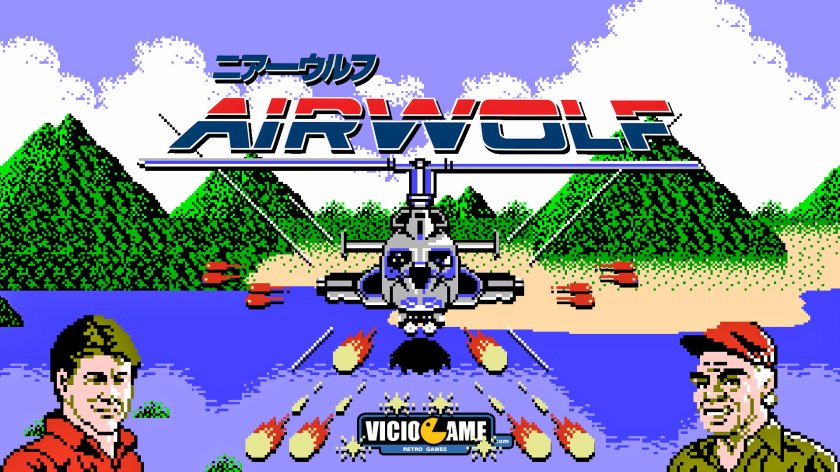
Airwolf is a horizontal scrolling shoot ‘em up game released in 1988 for the Nintendo Entertainment System. The villain Pig Bad has kidnapped the brother of experienced pilot S. Hawk and is now blackmailing the military with the threat of detonating nuclear missiles. Your mission is to board the supersonic helicopter to prevent the catastrophe and rescue the hostage.
Developer/Publisher: Kyugo Boueki
Release date: 1988
Platform: Famicom / Nintendo
Airwolf – The Ultimate Guide
Airwolf for Nintendo is a horizontal shoot ‘em up game developed by Kyugo Boueki and released exclusively in Japan on December 24, 1988. Based on the homonymous television series from the 1980s created by Donald P. Bellisario, this title represents a conversion of the arcade game that the same developer had produced in September 1987. It is essential to distinguish this Japanese version from the Airwolf released by Acclaim in the United States for NES also in 1988, as they are completely different games, with the American title having been developed by Beam Software and featuring distinct gameplay mechanics.
The original arcade version of the game had achieved certain commercial success in the Japanese market, being listed by Game Machine magazine as the fourteenth most successful tabletop arcade machine of the month. For this reason, in principle, it justified the developer’s effort in releasing a port for the home console.
The game’s narrative places the player in the role of S. Hawk, pilot of the supersonic helicopter called Airwolf. The story begins with a threatening letter from a villain named “Pig Bad” who has kidnapped Hawk’s brother. The antagonist demands that an explosion stop command be entered within 24 hours, otherwise he will detonate nuclear missiles that will destroy both the protagonist’s brother and the United States. It falls to the player to face six phases of intense combat to rescue the hostage and prevent nuclear catastrophe. This premise, though simple, establishes an urgency that permeates the entire game experience and justifies the progression through varied environments.
The game’s control system uses the standard Famicom gamepad in a direct and functional manner. The eight-directional pad moves the aircraft through the battlefield and is also used for numerical selection on data entry screens. The A button fires simultaneously at aerial and ground targets, allowing the player to maintain constant offense on multiple fronts. The B button activates or cancels turbo mode, a temporary invincibility state where the screen scrolling speed increases and the helicopter can destroy enemies through direct collision. The Start button initiates the game and functions as pause during matches. This control system reflects a simplified approach typical of 8-bit era shoot ‘em up games, prioritizing accessibility without sacrificing tactical depth.
Turbo mode deserves special attention for its interesting implementation. When pressing the B button for the first time, turbo is activated and continues functioning until the fuel gauge at the top of the screen is completely depleted. A second press of the B button cancels turbo, allowing the player to conserve fuel for more critical moments. During turbo activation, the Airwolf becomes temporarily invulnerable and can eliminate enemies successively through collision, although this invincibility does not apply to contact with rocks in the cave scene of Stage 3, where collision still results in self-destruction. Fuel automatically replenishes between stages, encouraging the player to use it strategically without fear of hindering subsequent stages. This mechanic adds a layer of resource management that elevates the game beyond a simple reflex-based shoot ‘em up.
Before each stage, the player is presented with the weapon selection screen. This screen is divided into two windows: the left window marked as “AIR” allows the selection of weapons against aerial enemies through the B button, while the right window marked as “GROUND” offers weapon options against ground targets selectable with the A button. This separation of armaments demonstrates the dual nature of the challenges the player will face, requiring strategic preparation before each mission.
The weapons available against aerial enemies include three distinct options. The “CHAIN GUNS” fires two projectiles simultaneously: one straight forward and another diagonally upward at 45 degrees, offering coverage in two directions but with a slow fire rate of approximately one shot every two seconds. The “CANON” fires straight-forward projectiles with greater height that increases the probability of hitting, allowing up to four shots in rapid succession and being widely considered the best aerial weapon due to its fast fire rate and ability to create a continuous burst effect when positioned correctly before enemy formations. The “FALCON” launches long missiles that fly only in a straight line, characterized by high firing speed and the ability to shoot again immediately after a missile is destroyed by eliminating an enemy, allowing a rapid-fire effect when used tactically.
For ground targets, the arsenal offers three complementary alternatives. The “HELLFIRE” fires projectiles diagonally downward at 45 degrees forward, mirroring the pattern of the Chain Guns’ upper projectile but suffering from the same slow fire rate limitations. The “REDEYE” drops projectiles vertically downward from the helicopter’s position at a decent speed, offering direct precision but requiring careful positioning. The “COPPERHEAD” launches missiles that descend diagonally at 30 degrees below the horizontal axis, moving at considerable speed and being generally recommended by experienced players. The most effective combination according to the player community is Canon for aerial attacks and Copperhead for ground bombardment, a duo that offers sufficient firing speed and versatility to face most combat situations.
The game’s progression system presents unique characteristics that distinguish it from other shoot ‘em ups of the era. Each stage culminates in a boss area that completely abandons the side-scrolling horizontal perspective in favor of a first-person view. In these sequences, the player controls a cursor on the screen using the directional pad and can fire with the A or B buttons, aiming at static or semi-static targets that periodically release missiles. The complete destruction of all enemies within the area results in stage completion. A particularly interesting aspect is that the missiles fired by bosses can be easily neutralized through a simple technique: scroll the screen left or right until the missiles are no longer visible, at which point they permanently disappear when returning the camera to the original position. This mechanic, though technically a programming flaw, makes boss battles surprisingly manageable.
Upon completing Stages 1 through 5, the player is presented with a password screen where a five-digit numerical code appears, granting 60 seconds for notation. These codes are randomly generated for each game session, making it impossible to create universal password lists. The function of these codes is not to allow the player to continue from where they left off, but rather to unlock the game’s true ending. On the password entry screen, accessible after completing the first five stages, the player must enter all five codes within a time limit. The directional pad selects numbers, the A button confirms selection, and the B button moves the cursor one space back with the CLR function allowing clearing of already entered numbers. The “C” mark also offers the clearing function. After entering a code, the player selects the return mark and presses the A button, with an alarm sound indicating errors. Only by correctly entering all five codes can the player reach the narrative’s true conclusion.
Stage 1 introduces the player to the game’s basic mechanics through a gradual difficulty progression. In the first few minutes, enemies appear predictably, but quickly the game begins sending adversaries from the back of the screen, requiring the player to maintain some distance from the left edge. Missiles and capsule-shaped bombs fall from the top of the screen at moderate speed, remaining in the field of view long enough to become significant obstacles if not destroyed quickly. An invincible helicopter periodically crosses the upper part of the screen dropping bombs that must be avoided or destroyed. The special enemy of this stage is a golden airplane of above-average size that requires multiple shots to be eliminated. This airplane, after exiting through the left edge of the screen, reappears from the side closest to the Airwolf, whether from the left, upper left, or lower left, creating pressure situations where the player can be cornered between regular enemy formations and this persistent opponent. The boss battle of Stage 1 presents a ship with multiple missile-launching sections that must be destroyed one by one, some positioned obscurely requiring side scrolling for location, all within a time limit indicated by bars at the bottom of the screen.
Stage 2 transports the player to an urban environment where white posts with red tops and satellite-shaped weapons appear on buildings, camouflaging themselves skillfully against the scenery and firing projectiles. To destroy the posts, the player must specifically hit the red marking. Large red missiles begin emerging from the left side of the screen, requiring constant attention. Shortly after crossing the first visible bridge in the background scenery, a green helicopter appears that functions as the special enemy of this stage, following the same pattern as the golden airplane from the previous stage but with the aggravation of dropping projectiles with parachutes while crossing the upper third of the screen. The parachutes increase the surface area of the projectiles, facilitating their downing, and the helicopter consistently remains in the upper part allowing the player to seek refuge in the lower part when necessary. This stage also introduces greater variety of bonus items, including the star that destroys all visible enemies on the screen, one of the most valuable power-ups in the game. The boss battle presents an airplane with ten targets divided equally between the front wings: three larger propellers and two smaller ones near the cockpit on each wing, with no targets on the rear wings or the cockpit itself.
Stage 3 represents a drastic change in scenery and mechanics by transporting the player to a cave. The upper third of the scenery consists of a rocky ceiling that instantly destroys the Airwolf upon contact, with additional rocky platforms scattered throughout the battlefield also being lethal. The path of least resistance generally involves positioning oneself between the upper platforms and the cave ceiling, maintaining maximum safe altitude. Silver surfaces on the ground allow the helicopter to descend and position itself over them without damage, offering temporary refuge areas. This is the only stage where the recommended Canon and Copperhead combination may be questionable, with some players preferring Chain Guns combined with Red-Eye or Hellfire to obtain greater vertical range, essential in the cave’s tight passages. After the initial cave section, the scenery transitions to an area with water at the bottom, at which point the player must gain altitude immediately as missiles begin launching directly from below the helicopter’s position rising vertically, requiring maneuvering space. Curiously, Stage 3 does not present a persistent special enemy, focusing entirely on environmental challenges. The boss battle consists of destroying seven cannons embedded in the cave wall.
Stage 4 significantly intensifies difficulty through multiple simultaneous threat types. Right at the start, purple bunkers open in the scenery firing missiles that split into four projectiles traveling in cardinal directions, later evolving into diagonal splits. These bunkers do not follow an apparent pattern in their locations but maintain fixed positions in each playthrough, allowing players using emulators to develop memorization strategies. Upon reaching open waters, submarines emerge from the surface and, if not destroyed within approximately three seconds, fire five projectiles vertically. Black airplanes cross the screen dropping multiple loads of projectiles downward, can be destroyed with a single shot but represent significant threat if ignored due to the volume of fire they generate. Near the end of the stage, missiles appear that launch from the bottom of the screen at a 45-degree angle to the northwest at high speed, although their frequency remains relatively low in this stage. The boss battle requires the player to sink six submarines specifically aiming at each one’s command towers, with noticeably faster missiles than in previous battles requiring frequent screen scrolling for neutralization.
Stage 5 elevates the chaos through random acceleration of enemy airplanes, which do not maintain constant speed and frequently surprise the player with sudden rhythm changes. Immediately the stage introduces the fast missiles seen at the end of Stage 4 in greater quantity, now including variants that descend from the top of the screen toward the southeast in addition to those rising from below to the northwest. After the first wave of capsule-shaped missiles, the stage’s special enemy appears: an airplane resembling a space shuttle that fires a single projectile in the player’s direction upon entering the scene and then simply circles the screen without additional attacks. The true challenge of this stage is not the special enemy itself, but the massive volume of regular adversaries that frequently cause slowdown on the NES hardware, creating situations where control response becomes imprecise and requiring the player to prioritize eliminating common enemies before focusing on the special target to avoid being cornered during moments of deceleration. The boss battle presents ten tanks divided into two groups: five in the rear that should be the initial priority as they are destroyed more quickly and, once eliminated, cease missile launching, followed by the five front-line tanks that offer greater resistance.
Stage 6 completely breaks the pattern established by previous stages by eliminating the use of turbo mode, with the “FUEL” meter being replaced by a countdown time display. The first segment presents four statues that must have their eyes destroyed, being possible to eliminate only one eye at a time. Until all eight eyes are destroyed, the stage will cyclically repeat the same four statues, creating an interesting opportunity for players seeking maximum scores: it is possible to deliberately prolong this loop by destroying squadrons of enemy airplanes repeatedly until little time remains on the clock before finally eliminating all eyes. Completing this section within the time limit allows access to the boss area. The final confrontation abandons the first-person battle format used in all previous stages, returning to the horizontal scrolling perspective with a high-resistance enemy helicopter that must be continuously bombarded. The helicopter moves forward toward the left side of the screen, at which point the player must pass it, and when the boss returns the player must retreat to the left side continuing the constant attack, all while avoiding the helicopter’s projectile barrage and occasional turrets. After the final boss’s destruction, the game presents the password entry screen where the player must correctly enter the five codes obtained in Stages 1 through 5 to unlock the adventure’s true ending.
The game’s item system offers four types of bonuses that appear occasionally. The “Power” item increases the number of projectiles fired or increments their speed. The “1-Up” item adds an extra aircraft to the player’s total lives, a precious resource given that losing all lives results in the continue screen. The “Emblem” offers points for the score count. The most powerful is the “Skull Mark” which instantly eliminates all enemies present on the entire screen, adding the score that would be obtained by their normal destructions to the total score, functioning as a lifesaver in situations of extreme pressure. These items do not drop from individual enemies but rather are left by specific formations, rewarding players who can eliminate complete squadrons quickly.
The game implements various cheat codes that can be activated through specific button sequences. For invincibility, the player must start the game and when the helicopter’s starting point appears, hold down the A button on controller 2 while pressing Up, Left, Down, Right, Down, Left, Up, and Right on controller 1, with the helicopter blinking if the code is entered correctly. For stage selection, on the title screen the player must press Up, Down, Left, Right, A, B, A, and B on controller 2 and then press A plus Start on controller 1.
The game’s critical and historical reception remains relatively obscure due to its exclusive release in the Japanese market and frequent confusion with the homonymous American version developed by Beam Software. The Japanese version by Kyugo is often compared to Silk Worm due to similar control, although the helicopter in Airwolf is considerably smaller, affecting the hitbox and overall game feel. The distinction between the two regional versions is fundamental, as they represent completely different experiences despite sharing name and license.
From a technical standpoint, Airwolf demonstrates both the capabilities and limitations of the Famicom hardware. The game frequently experiences slowdown during Stage 5 when multiple enemies and projectiles occupy the screen simultaneously, a common problem in 8-bit era shoot ‘em ups that attempted to push hardware limits. The alternation between horizontal scrolling perspective and first-person view for boss battles represents a creative solution to offer visual variety within memory constraints, although the simplicity of these boss sequences were implemented more out of technical necessity than pure design choice. The random password generation uses a seed based on the system’s internal timestamp, demonstrating uncommon programming sophistication for the era.
Airwolf remains an interesting example of television property adaptation to videogame in the 8-bit era, offering a competent horizontal shoot ‘em up experience with unique mechanical peculiarities. Its exclusive release in Japan and the shadow cast by the different American version contributed to its status as a historical curiosity more than a widely recognized classic. For Nintendo enthusiasts and collectors of licensed games, it represents an important piece of Kyugo Boueki’s catalog and a demonstration of the multiple approaches that Japanese developers took when working with licensed Western properties during the late 1980s.
Airwolf – O Guia Definitivo
Airwolf para Nintendo é um jogo de tiro horizontal desenvolvido pela Kyugo Boueki e lançado exclusivamente no Japão em 24 de dezembro de 1988. Baseado na série de televisão homônima dos anos 80 criada por Donald P. Bellisario, este título representa uma conversão do jogo arcade que a mesma desenvolvedora havia produzido em setembro de 1987. É fundamental distinguir esta versão japonesa do Airwolf lançado pela Acclaim nos Estados Unidos para NES também em 1988, pois são jogos completamente diferentes, com o título americano tendo sido desenvolvido pela Beam Software e apresentando mecânicas de jogabilidade distintas.
A versão arcade original do jogo havia alcançado certo sucesso comercial no mercado japonês, sendo listada pela revista Game Machine como a décima quarta máquina arcade de mesa mais bem-sucedida do mês. Por este motivo, a princípio, justificava o esforço da desenvolvedora em lançar um port para o console doméstico.
A narrativa do jogo coloca o jogador no papel de S. Hawk, piloto do helicóptero supersônico chamado Airwolf. A história começa com uma carta ameaçadora de um vilão chamado “Pig Bad” que sequestrou o irmão de Hawk. O antagonista exige que um comando de parada de explosão seja inserido dentro de 24 horas, caso contrário ele detonará mísseis nucleares que destruirão tanto o irmão do protagonista quanto os Estados Unidos. Cabe ao jogador enfrentar seis fases de combate intenso para resgatar o refém e impedir a catástrofe nuclear. Esta premissa, embora simples, estabelece uma urgência que permeia toda a experiência de jogo e justifica a progressão através de ambientes variados.
O sistema de controle do jogo utiliza o gamepad padrão do Famicom de forma direta e funcional. O direcional de oito direções move a aeronave pelo campo de batalha e também é utilizado para seleção numérica nas telas de entrada de dados. O botão A dispara simultaneamente contra alvos aéreos e terrestres, permitindo que o jogador mantenha uma ofensiva constante em múltiplas frentes. O botão B ativa ou cancela o modo turbo, um estado de invencibilidade temporária onde a velocidade de rolagem da tela aumenta e o helicóptero pode destruir inimigos através de colisão direta. O botão Start inicia o jogo e funciona como pausa durante as partidas. Este sistema de controles reflete uma abordagem simplificada típica dos jogos de tiro da era 8 bits, priorizando a acessibilidade sem sacrificar a profundidade tática.
O modo turbo merece atenção especial por sua implementação interessante. Ao pressionar o botão B pela primeira vez, o turbo é ativado e continua funcionando até que o medidor de combustível na parte superior da tela seja completamente esgotado. Uma segunda pressão no botão B cancela o turbo, permitindo que o jogador conserve combustível para momentos mais críticos. Durante a ativação do turbo, o Airwolf torna-se temporariamente invulnerável e pode eliminar inimigos sucessivamente através de colisão, embora esta invencibilidade não se aplique ao contato com rochas na cena da caverna da Fase 3, onde a colisão ainda resulta em autodestruição. O combustível se repõe automaticamente entre as fases, incentivando o jogador a utilizá-lo estrategicamente sem receio de prejudicar fases subsequentes. Esta mecânica adiciona uma camada de gerenciamento de recursos que eleva o jogo além de um simples shoot’em up de reflexos.
Antes de cada fase, o jogador é apresentado à tela de seleção de armas. Esta tela divide-se em duas janelas: a janela esquerda marcada como “AIR” permite a seleção de armas contra inimigos aéreos através do botão B, enquanto a janela direita marcada como “GROUND” oferece opções de armas contra alvos terrestres selecionáveis com o botão A. Esta separação de armamentos demonstra a natureza dual dos desafios que o jogador enfrentará, exigindo preparação estratégica antes de cada missão.
As armas disponíveis contra inimigos aéreos incluem três opções distintas. A “CHAIN GUNS” dispara dois projéteis simultaneamente: um direto para frente e outro em diagonal para cima a 45 graus, oferecendo cobertura em duas direções mas com taxa de disparo lenta de aproximadamente um tiro a cada dois segundos. O “CANON” dispara projéteis retos para frente com altura maior que aumenta a probabilidade de acerto, permitindo até quatro disparos em rápida sucessão e sendo amplamente considerado a melhor arma aérea devido à sua taxa de tiro rápida e capacidade de criar um efeito de rajada contínua quando posicionado corretamente diante de formações inimigas. O “FALCON” lança mísseis longos que voam apenas em linha reta, caracterizando-se pela alta velocidade de disparo e pela capacidade de atirar novamente imediatamente após um míssil ser destruído ao eliminar um inimigo, permitindo um efeito de tiro rápido quando utilizado taticamente.
Para alvos terrestres, o arsenal oferece três alternativas complementares. O “HELLFIRE” dispara projéteis em diagonal descendente a 45 graus para frente, espelhando o padrão do projétil superior da Chain Guns mas sofrendo das mesmas limitações de taxa de tiro lenta. O “REDEYE” solta projéteis verticalmente para baixo a partir da posição do helicóptero a uma velocidade decente, oferecendo precisão direta mas exigindo posicionamento cuidadoso. O “COPPERHEAD” lança mísseis que descem em diagonal a 30 graus abaixo do eixo horizontal, movendo-se em velocidade considerável e sendo geralmente recomendado por jogadores experientes. A combinação mais eficaz segundo a comunidade de jogadores é Canon para ataques aéreos e Copperhead para bombardeios terrestres, uma dupla que oferece velocidade de disparo e versatilidade suficientes para enfrentar a maioria das situações de combate.
O sistema de progressão do jogo apresenta características únicas que o distinguem de outros shoot’em ups da época. Cada fase culmina em uma área de chefe que abandona completamente a perspectiva de rolagem horizontal lateral em favor de uma visão em primeira pessoa. Nestas sequências, o jogador controla um cursor na tela usando o direcional e pode disparar com os botões A ou B, mirando em alvos estáticos ou semi-estáticos que liberam mísseis periodicamente. A destruição completa de todos os inimigos dentro da área resulta na conclusão da fase. Um aspecto particularmente interessante é que os mísseis disparados pelos chefes podem ser facilmente neutralizados através de uma técnica simples: rolar a tela para a esquerda ou direita até que os mísseis não sejam mais visíveis, momento em que eles desaparecem permanentemente ao retornar a câmera à posição original. Esta mecânica, embora tecnicamente uma falha de programação, torna as batalhas de chefe surpreendentemente administráveis.
Ao completar as Fases 1 até 5, o jogador é presenteado com uma tela de password onde um código numérico de cinco dígitos aparece, concedendo 60 segundos para anotação. Estes códigos são gerados aleatoriamente para cada sessão de jogo, tornando impossível a criação de listas universais de passwords. A função destes códigos não é permitir que o jogador continue de onde parou, mas sim desbloquear o verdadeiro final do jogo. Na tela de entrada de passwords, acessível após completar as cinco primeiras fases, o jogador deve inserir todos os cinco códigos dentro de um limite de tempo. O direcional seleciona números, o botão A confirma a seleção, e o botão B move o cursor um espaço para trás com a função CLR permitindo limpar números já inseridos. A marca “C” também oferece a função de limpeza. Após inserir um código, o jogador seleciona a marca de retorno e pressiona o botão A, com um som de alarme indicando erros. Apenas inserindo corretamente todos os cinco códigos o jogador pode alcançar o verdadeiro encerramento da narrativa.
A Fase 1 introduz o jogador às mecânicas básicas do jogo através de uma progressão gradual de dificuldade. Nos primeiros minutos, inimigos aparecem de forma previsível, mas rapidamente o jogo passa a enviar adversários pela parte traseira da tela, exigindo que o jogador mantenha alguma distância da borda esquerda. Mísseis e bombas em formato de cápsula caem do topo da tela em velocidade moderada, permanecendo tempo suficiente no campo de visão para se tornarem obstáculos significativos se não forem destruídos rapidamente. Um helicóptero invencível atravessa periodicamente a parte superior da tela soltando bombas que devem ser evitadas ou destruídas. O inimigo especial desta fase é um avião dourado de tamanho acima da média que requer múltiplos disparos para ser eliminado. Este avião, após sair pela borda esquerda da tela, reaparece pelo lado mais próximo ao Airwolf, seja pela esquerda, superior esquerda ou inferior esquerda, criando situações de pressão onde o jogador pode ser encurralado entre formações de inimigos regulares e este oponente persistente. A batalha de chefe da Fase 1 apresenta um navio com múltiplas seções lançadoras de mísseis que devem ser destruídas uma por uma, algumas posicionadas de forma obscura exigindo rolagem lateral para localização, tudo dentro de um limite de tempo indicado por barras na parte inferior da tela.
A Fase 2 transporta o jogador para um ambiente urbano onde postes brancos com topos vermelhos e armas em formato de satélite aparecem sobre edifícios, camuflando-se habilmente contra o cenário e disparando projéteis. Para destruir os postes, o jogador deve acertar especificamente a marcação vermelha. Grandes mísseis vermelhos começam a emergir pelo lado esquerdo da tela, exigindo atenção constante. Logo após cruzar a primeira ponte visível no cenário de fundo, surge um helicóptero verde que funciona como o inimigo especial desta fase, seguindo o mesmo padrão do avião dourado da fase anterior mas com o agravante de soltar projéteis com paraquedas enquanto atravessa o terço superior da tela. Os paraquedas aumentam a área de superfície dos projéteis, facilitando seu abate, e o helicóptero mantém-se consistentemente na parte superior permitindo ao jogador buscar refúgio na parte inferior quando necessário. Esta fase também introduz maior variedade de itens bônus, incluindo a estrela que destrói todos os inimigos visíveis na tela, um dos power-ups mais valiosos do jogo. A batalha de chefe apresenta um avião com dez alvos divididos igualmente entre as asas dianteiras: três hélices maiores e duas menores próximas à cabine em cada asa, sem alvos nas asas traseiras ou na própria cabine.
A Fase 3 representa uma mudança drástica de cenário e mecânica ao transportar o jogador para uma caverna. O terço superior do cenário consiste em um teto rochoso que destrói instantaneamente o Airwolf em caso de contato, com plataformas rochosas adicionais espalhadas pelo campo de batalha também sendo letais. O caminho de menor resistência geralmente envolve posicionar-se entre as plataformas superiores e o teto da caverna, mantendo altitude máxima segura. Superfícies prateadas no chão permitem que o helicóptero desça e se posicione sobre elas sem dano, oferecendo áreas de refúgio temporário. Esta é a única fase onde a combinação recomendada de Canon e Copperhead pode ser questionável, com alguns jogadores preferindo Chain Guns combinada com Red-Eye ou Hellfire para obter maior alcance vertical, essencial nas passagens apertadas da caverna. Após a seção inicial de caverna, o cenário transita para uma área com água no fundo, momento em que o jogador deve ganhar altitude imediatamente pois mísseis começam a ser lançados diretamente de baixo da posição do helicóptero subindo verticalmente, exigindo espaço de manobra. Curiosamente, a Fase 3 não apresenta inimigo especial persistente, focando inteiramente nos desafios ambientais. A batalha de chefe consiste em destruir sete canhões embutidos na parede da caverna.
A Fase 4 intensifica significativamente a dificuldade através de múltiplos tipos de ameaças simultâneas. Logo no início, bunkers roxos se abrem no cenário disparando mísseis que se dividem em quatro projéteis viajando nas direções cardeais, posteriormente evoluindo para divisões diagonais. Estes bunkers não seguem padrão aparente em suas localizações mas mantêm posições fixas em cada partida, permitindo que jogadores que utilizam emuladores desenvolvam estratégias de memorização. Ao alcançar águas abertas, submarinos emergem da superfície e, se não forem destruídos dentro de aproximadamente três segundos, disparam cinco projéteis verticalmente. Aviões negros atravessam a tela soltando múltiplas cargas de projéteis para baixo, podendo ser destruídos com um único disparo mas representando ameaça significativa se ignorados devido ao volume de fogo que geram. Próximo ao final da fase, surgem mísseis que lançam do fundo da tela em ângulo de 45 graus para noroeste em alta velocidade, embora sua frequência permaneça relativamente baixa nesta fase. A batalha de chefe exige que o jogador afunde seis submarinos mirando especificamente nas torres de comando de cada um, com mísseis notadamente mais rápidos que em batalhas anteriores exigindo rolagem frequente da tela para neutralização.
A Fase 5 eleva o caos através da aceleração aleatória dos aviões inimigos, que não mantêm velocidade constante e frequentemente surpreendem o jogador com mudanças súbitas de ritmo. Imediatamente a fase introduz os mísseis rápidos vistos no final da Fase 4 em maior quantidade, agora incluindo variantes que descem do topo da tela em direção sudeste além dos que sobem de baixo para noroeste. Após a primeira onda de mísseis em formato de cápsula, aparece o inimigo especial da fase: um avião semelhante a um ônibus espacial que dispara um único projétil na direção do jogador ao entrar em cena e então simplesmente circula pela tela sem ataques adicionais. O verdadeiro desafio desta fase não é o inimigo especial em si, mas o volume massivo de adversários regulares que frequentemente causam slowdown no hardware do NES, criando situações onde a resposta dos controles torna-se imprecisa e exigindo que o jogador priorize a eliminação de inimigos comuns antes de focar no alvo especial para evitar ser encurralado durante momentos de desaceleração. A batalha de chefe apresenta dez tanques divididos em dois grupos: cinco na retaguarda que devem ser a prioridade inicial pois são destruídos mais rapidamente e, uma vez eliminados, cessam o lançamento de mísseis, seguidos pelos cinco tanques da linha de frente que oferecem maior resistência.
A Fase 6 quebra completamente o padrão estabelecido pelas fases anteriores ao eliminar o uso do modo turbo, com o medidor “FUEL” sendo substituído por um display de contagem regressiva de tempo. O primeiro segmento apresenta quatro estátuas que devem ter seus olhos destruídos, sendo possível eliminar apenas um olho por vez. Até que todos os oito olhos sejam destruídos, o estágio repetirá ciclicamente as mesmas quatro estátuas, criando uma oportunidade interessante para jogadores que buscam pontuações máximas: é possível deliberadamente prolongar este loop destruindo esquadrões de aviões inimigos repetidamente até que reste pouco tempo no relógio antes de finalmente eliminar todos os olhos. Completar esta seção dentro do limite de tempo permite acesso à área de chefe. O confronto final abandona o formato de batalha em primeira pessoa utilizado em todas as fases anteriores, retornando à perspectiva de rolagem horizontal com um helicóptero inimigo de alta resistência que deve ser bombardeado continuamente. O helicóptero move-se para frente em direção ao lado esquerdo da tela, momento em que o jogador deve ultrapassá-lo, e quando o chefe retorna o jogador deve recuar para o lado esquerdo continuando o ataque constante, tudo enquanto evita a barragem de projéteis do helicóptero e torretas ocasionais. Após a destruição do chefe final, o jogo apresenta a tela de entrada de passwords onde o jogador deve inserir corretamente os cinco códigos obtidos nas Fases 1 a 5 para desbloquear o verdadeiro encerramento da aventura.
O sistema de itens do jogo oferece quatro tipos de bônus que aparecem ocasionalmente. O item “Power” aumenta o número de projéteis disparados ou incrementa a velocidade dos mesmos. O item “1-Up” adiciona uma aeronave extra ao total de vidas do jogador, recurso precioso dado que perder todas as vidas resulta na tela de continue. O “Emblem” oferece pontos para a contagem de score. O mais poderoso é o “Skull Mark” que elimina instantaneamente todos os inimigos presentes na tela inteira, adicionando a pontuação que seria obtida por suas destruições normais ao score total, funcionando como salva-vidas em situações de extrema pressão. Estes itens não caem de inimigos individuais mas sim são deixados por formações específicas, recompensando jogadores que conseguem eliminar esquadrões completos rapidamente.
O jogo implementa diversos códigos de trapaça que podem ser ativados através de sequências específicas de botões. Para invencibilidade, o jogador deve iniciar o jogo e quando o ponto de largada do helicóptero aparecer, manter pressionado o botão A no controle 2 enquanto pressiona Cima, Esquerda, Baixo, Direita, Baixo, Esquerda, Cima e Direita no controle 1, com o helicóptero piscando caso o código seja inserido corretamente. Para seleção de fase, na tela de título o jogador deve pressionar Cima, Baixo, Esquerda, Direita, A, B, A e B no controle 2 e então pressionar A mais Start no controle 1.
A recepção crítica e histórica do jogo permanece relativamente obscura devido ao seu lançamento exclusivo no mercado japonês e à confusão frequente com a versão americana homônima desenvolvida pela Beam Software. A versão japonesa da Kyugo é frequentemente comparada a Silk Worm devido ao controle similar, embora o helicóptero em Airwolf seja consideravelmente menor, afetando a hitbox e a sensação geral de jogo. A distinção entre as duas versões regionais é fundamental, pois representam experiências completamente diferentes apesar de compartilharem nome e licença.
Do ponto de vista técnico, Airwolf demonstra tanto as capacidades quanto as limitações do hardware do Famicom. O jogo frequentemente experimenta slowdown durante a Fase 5 quando múltiplos inimigos e projéteis ocupam a tela simultaneamente, um problema comum em shoot’em ups da era 8-bit que tentavam empurrar os limites do hardware. A alternância entre perspectiva de rolagem horizontal e visão em primeira pessoa para batalhas de chefe representa uma solução criativa para oferecer variedade visual dentro das restrições de memória, embora a simplicidade destas sequências de chefe tenham sido implementadas mais por necessidade técnica que por escolha de design puro. A geração de passwords aleatórios usa semente baseada em timestamp interno do sistema, demonstrando sofisticação programática incomum para a época.
Airwolf permanece como exemplo interessante de adaptação de propriedade televisiva para videogame na era 8-bit, oferecendo experiência de shoot’em up horizontal competente com peculiaridades mecânicas únicas. Seu lançamento exclusivo no Japão e a sombra lançada pela versão americana diferente contribuíram para seu status de curiosidade histórica mais que clássico amplamente reconhecido. Para entusiastas do Nintendo e colecionadores de jogos baseados em licenças, representa peça importante do catálogo da Kyugo Boueki e demonstração das múltiplas abordagens que desenvolvedores japoneses tomavam ao trabalhar com propriedades ocidentais licenciadas durante o final dos anos 80.
🤑💲Earn money without doing anything! Just leave these apps open:
   ✓ https://r.honeygain.me/CONTA9DB02

   ✓ https://packetstream.io/?psr=1uPb
🤑💲1-Click button earns Bitcoin every 1 hour: https://freebitco.in/?r=53528449
⬛ 𝗧𝗶𝗸𝗧𝗼𝗸: https://www.tiktok.com/@viciogame
🟧 𝗜𝗻𝘀𝘁𝗮𝗴𝗿𝗮𝗺: http://www.instagram.com/viciogame
🟥 𝗬𝗼𝘂𝘁𝘂𝗯𝗲: http://www.youtube.com/viciogame
🟦 𝗙𝗮𝗰𝗲𝗯𝗼𝗼𝗸: http://www.facebook.com/viciogame
🔳 𝗧𝗵𝗿𝗲𝗮𝗱𝘀: https://www.threads.net/@viciogame
🟪 𝗧𝘄𝗶𝘁𝗰𝗵: https://www.twitch.tv/ViciogameRetroGames
🟨 𝗕𝗹𝗼𝗴: http://www.viciogameblog.com/
🟦𝗧𝘄𝗶𝘁𝘁𝗲𝗿: http://www.twitter.com/viciogame
#Viciogame #Gameplay #LetsPlay #Gamer #Playthrough #Games #News #Videogames #Review #Game #Detonado #Walkthrough #Ending #Reviews #Facts #Retro #Record #Roms #Emulator #Longplay #Speedrun #Airwolf #Nintendo #Famicom #NES #ShootEmUp #Kyugo #CrossFire #arcade #shmup #Acclaim #BeamSoftware #helicopter #エアーウルフ #ファミリーコンピュータ #任天堂 #comanche, #JogoDeNavinha #TrovaoAzul #AguiaDeFogo
 VICIOGAME