
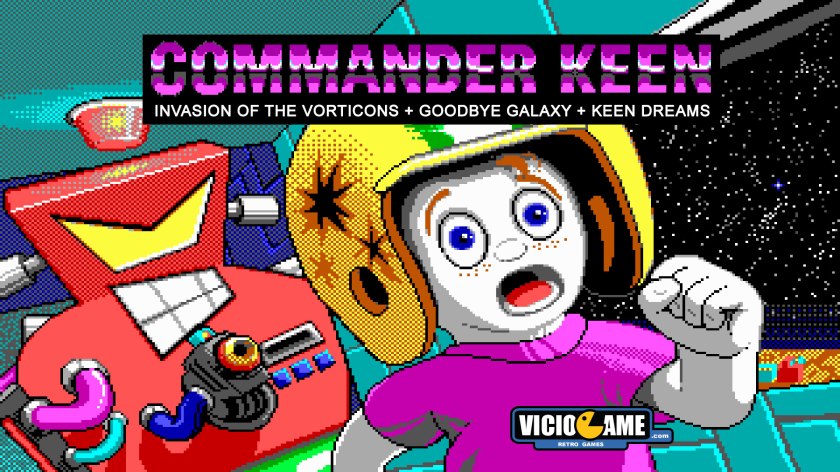
Commander Keen is a series of seven 2D platformer games released for MS-DOS PCs in the early 1990s. You control a young, dreamy boy who tries to save various parts of the universe from evil aliens. A title that set the standard and changed the history of video games on computers.
Developer: id Software
Publisher: Apogee Software / Softdisk / FormGen
Release date: 1990/1991
Platform: PC / MS-DOS
Commander Keen – The Ultimate Guide
Commander Keen represents a fundamental milestone in the history of PC platform games, establishing technical and creative standards that influenced an entire generation of developers. Created by id Software and published by Apogee Software, the series follows the adventures of Billy Blaze, an eight-year-old child prodigy who, using his brother’s football helmet, transforms himself into the galaxy’s defender Commander Keen. Between 1990 and 1991, the franchise received seven episodes for MS-DOS, divided into two main trilogies and an intermediate episode, each expanding the creative universe and technical capabilities of the game engine.
Commander Keen’s trajectory began with a technological revolution. On September 19, 1990, John Carmack finally succeeded in implementing smooth horizontal scrolling in EGA mode, something considered impossible for PCs of that era. Tom Hall, wanting to play a prank on John Romero, used the new engine to recreate the first level of Super Mario Bros. 3, pixel by pixel, but using the character Dangerous Dave instead of Mario. The result, titled “Dangerous Dave in Copyright Infringement,” left Romero speechless for three hours when he ran the disk the next morning. The smooth scrolling capability represented the future of PC gaming, a territory until then dominated by Nintendo consoles. At that moment, on September 20, 1990, id Software was unofficially born, when Romero, Carmack, Hall, and Jay Wilbur decided to form their own company, since Softdisk, where they worked, didn’t allow games without CGA support.
The team initially tried to sell the idea of a Super Mario Bros. 3 port to Nintendo, and the demo reached the highest levels of the company, impressing executives. However, Nintendo rejected the proposal, maintaining the philosophy of exclusivity for Mario games on their consoles. After this rejection, Tom Hall created the Commander Keen concept in just fifteen minutes, presenting it with a voice imitating 1940s radio announcer Walter Winchell. Carmack applauded, and the project was officially started. Meanwhile, John Romero discovered that several fan letters he had received all came from the same address, revealing Scott Miller from Apogee Software trying to establish contact. Romero sent the famous “psycho letter” in response, initiating the partnership that would define the company’s future.
Scott Miller, upon seeing the Super Mario Bros. 3 demo, immediately recognized the commercial potential of the game engine. Despite having only five thousand dollars in his bank account, he agreed to pay two thousand dollars to finance the team’s first project, in addition to sending weekly checks of one hundred dollars for pizza. The deal was sealed on September 28, 1990, and over the next three months, working at Softdisk during the day and developing Commander Keen in their free time, the team created the first episode of the trilogy.
Commander Keen 1: Marooned on Mars was released on December 14, 1990, inaugurating the Invasion of the Vorticons trilogy. The game features Billy Blaze exploring the mountains of Mars when aliens from planet Vorticon VI, discovering the eight-year-old genius, plan his destruction. The Vorticans steal four vital pieces from his Bean-with-Bacon Megarocket spacecraft and hide them in distant Martian cities. The pieces include the Joystick (for manual flight control), the Car Battery (for electrical systems), the Vacuum Cleaner (reconfigured as an ion propulsion unit), and the Everclear (alcohol for fuel). Keen must explore the red planet, face Martians, robots, and tanks, locate members of the Vorticon outpost, and recover the pieces from their evil clutches.
The control system uses the directional pad for movement, with the space bar to jump and Control to fire the Neural Stunner, Keen’s main weapon that temporarily stuns enemies. Alt allows use of the pogo stick, an iconic item that enables higher jumps and access to secret areas. The game implements a scoring system based on collectible items, with different values for each type of object found in levels.
The levels of Marooned on Mars feature labyrinthine structures with hidden secrets, encouraging complete exploration. The main map allows choosing the order of some levels, offering freedom to the player. Among enemies, the Yorps stand out, green jumping creatures that became unofficial mascots of the series, and the Gargs, flying creatures that represent constant challenges. The final level of each city contains one of the stolen ship pieces.
The conclusion of Marooned on Mars reveals that, after gathering all the pieces and returning to Earth, Keen discovers the Vortican mothership hovering over the planet, ready to destroy all Earth’s cities and wonders. Racing to arrive before his parents, Keen also brings a pet Yorp named Spot home, convincing his mother to discuss keeping him in the morning. When his parents fall asleep, Keen returns to his ship and flies toward the mothership, preparing for the next adventure.
Commander Keen 2: The Earth Explodes, the second episode of the trilogy, was completed in just four days after the first, being released on December 18, 1990. Keen infiltrates the Vortican mothership, which orbits Earth ready to destroy it. The setting changes drastically, with metallic corridors, control rooms, and alien technology replacing Martian landscapes. With incredible luck, Keen finds a Vorticon HyperPistol almost out of ammunition, a weapon of the Vortican elite that offers greater firepower than the Neural Stunner.
The structure of The Earth Explodes revolves around eight X-14 Tantalus rays installed on the mothership, each pointed at a specific city on Earth. Keen must locate and disable each ray before they fire. The level map is a printed blueprint of the mothership that Keen “borrowed” from a Vorticon on Mars, notably printed by ACME. The ship is protected by Vorticon Guards, Vorticon Grunts, and the dangerous Vorticon Elite, all controlled by the mysterious Grand Intellect on Vorticon VI.
The levels present greater technical complexity than the previous episode, with moving platforms, teleport systems, and areas requiring precise timing for navigation. The Bottom Galley, where Keen docks his ship at the weakest area of the mothership, serves as the entry point. The claustrophobic atmosphere of the metallic corridors contrasts strongly with Mars’ open environments, creating constant tension.
After disabling all Tantalus rays, the Vorticans return defeated to Vorticon VI, reporting their defeat to the Grand Intellect. The next morning, Keen discovers it has snowed, canceling school. He uses the free time to travel to Vorticon VI, eliminate the Vortican threat definitively, and discover the identity of the mysterious Grand Intellect, establishing the events of the third episode.
Commander Keen 3: Keen Must Die!, completed along with the second episode on December 18, 1990, concludes the Invasion of the Vorticons trilogy. Keen travels to the Vortican homeworld to confront the Grand Intellect directly. In response to Keen’s acts in disabling the mothership, the Grand Intellect issued a simple order to all of Vorticon VI: “Commander Keen must die.” Landing on the small island of Vortiville, distant from the Grand Intellect’s Castle, Keen crosses Vortican cities and settlements, many displaying mysterious flags and portraits with the Grand Intellect’s name.
The third episode presents environmental variety superior to the previous ones, including urban areas, military bases, and industrial facilities. Keen faces various enemies, including the lethal VortiNinjas, trained in Vortican military bases. These alien ninjas, drawn by Adrian Carmack during the final stages of development, represent some of the trilogy’s most challenging opponents. Progression through the planet gradually reveals the extent of the Grand Intellect’s control over Vortican society.
The revolutionary conclusion reveals that the Grand Intellect is Mortimer McMire, Keen’s longtime arch-enemy. McMire, sitting inside the deadly Mangling Machine, prepares to destroy Keen personally. Keen emerges victorious, exploding the Mangling Machine and freeing Vorticon VI from mind control. The Vorticans, finally free, grant Keen the Big V, Vorticon VI’s highest honor, presented by the Vortican King. However, a final twist reveals that the destroyed Mortimer was just a fake dummy, and the real Mortimer remains alive, planning to destroy the entire universe.
Development of the final levels of Keen 2 and Keen 3 occurred under extreme time pressure. John Romero and Tom Hall designed approximately sixteen levels in just two days, resulting in several bugs in level design, with one Keen 3 level being impossible to complete in the original version. Later patches corrected these problems, but due to the absence of efficient update methods at the time, these corrections only reached players who bought new copies of the games.
The Invasion of the Vorticons trilogy received its first royalty check in January 1991, totaling approximately ten thousand dollars. This financial success allowed John Romero, Tom Hall, Jay Wilbur, John Carmack, and Adrian Carmack to officially leave Softdisk, forming id Software on February 1, 1991. Exclusive versions were produced for different publishers, including a promotional version for Advanced Gravis Computer Technology and customized versions distributed by Precision Software Applications in the United Kingdom.
An announcement distributed by Apogee Software after the first trilogy’s release mentioned a planned port for the Nintendo console, which would be published by a major American company licensed by Nintendo. No additional information was disclosed, and the project never materialized. Similarly, an August 1991 letter promised to re-release the original trilogy in CGA, EGA, and 256-color VGA formats with support for multiple sound cards after the release of Goodbye, Galaxy!, but this remake was never developed, abandoned after the cancellation of the VGA version of Goodbye, Galaxy! and the start of more ambitious projects like Wolfenstein 3D.
Elements removed during development include a mysterious access card present in the tilesets of Keen 1 and Keen 2 but never used, whose planned function remains unknown. A story cutscene showed a Vorticon Guard stealing the Bean-with-Bacon Megarocket pieces, but was removed for being repetitive after multiple viewings.
Commander Keen in Keen Dreams, frequently referenced as “Keen 3.5,” was created after Keen 3 and before Keen 4, positioning itself chronologically between the two main series. Initially released with limited distribution, the episode didn’t have wide publicity until some time after the Goodbye, Galaxy! series, earning the moniker “lost episode.” In June 2013, Super Fighter Team released an Android port available on Google Play, followed by a Nintendo Switch port developed by Lone Wolf Technology on February 7, 2019, including new music and options for different sound effects. In September 2014, a community-funded effort acquired the rights to Keen Dreams and released the source code under the GPL, making it available on GitHub. Due to complications regarding distribution rights, the game is no longer available for purchase except through used copies in secondhand sales.
Keen Dreams differs significantly from other episodes in the series. The game has no pogo stick, Neural Stunner, or raygun, equipping Keen with Flower Power, an ability that temporarily incapacitates enemies by transforming them into flowers. The absence of the Standard Galactic alphabet (SGA) means the adventure doesn’t occur in space, focusing on a general theme of vegetables and food. This thematic choice connects directly to the narrative.
The story begins with Billy arguing with his mother about eating vegetables. After declaring he saved Earth and therefore doesn’t need to eat vegetables, especially mashed potatoes, his mother compares him unfavorably to Neil Armstrong. Billy mutters that Armstrong never traveled to Vorticon VI and defeated the Grand Intellect. After a doubtful comment about the quality of the mashed potatoes, Billy is sent to his room, where he quickly falls asleep grumbling about stupid vegetables.
Billy suddenly awakens atop a hill, his bed surrounded by giant potatoes wearing metal helmets and carrying bayonets. The Tater Troopers inform him he was brought by the Dream Machine under orders of Boobus Tuber, their king and boss, now Keen’s master. Billy grabs his football helmet, correcting them that it’s “COMMANDER Keen,” not “Captain Keen.” He retrieves his Vorticon HyperPistol from under the pillow, adjusting it from “Stun” to “Fry to Delicate Brown,” but after two shots the weapon is empty. A chained child appears, begging Keen to save them from the Dream Machine. Billy gets out of bed and begins his quest to defeat King Boobus Tuber and destroy the Dream Machine.
Keen Dreams’ design presents surreal environments populated by hostile anthropomorphic vegetables. French fries, asparagus, pumpkins, and carrots serve as enemies, each with unique movement patterns. Boobus Tuber, the potato king, commands this bizarre vegetable kingdom where children are kept in forced slavery dealing with vegetables. The dreamlike atmosphere permeates each level, creating an experience distinctly different from the series’ typical space adventures.
After defeating Boobus Tuber, whose remains fall from the sky like shredded french fries, Keen approaches the Dream Machine. Analyzing the complex controls and readings, he simply pulls a large red lever marked “On/Off Switch,” silencing the machine and freeing all children from vegetable slavery. Everything around Keen shakes uncomfortably, his eyelids grow heavy, and he falls asleep again.
Billy awakens in his room with morning sunlight shining on his face. No vegetables in sight. Had it all been just a dream? His mother enters, informing him about news on TV he would find interesting. The President declared “National I Hate Broccoli Day,” allowing children to choose one vegetable they don’t have to eat. Billy responds he’s not afraid of stupid vegetables, but if it’s no problem, he’d prefer not to eat french fries for a while, ambiguously suggesting whether the adventure was real or imaginary.
Keen Dreams maintains the series’ core gameplay but adapts to the vegetarian theme. Flower Power replaces conventional weapons, creating a unique system where defeated enemies temporarily become flowers, which can be used as platforms. This mechanic adds puzzle elements to levels, requiring strategic planning about when and where to incapacitate specific enemies. The absence of the pogo stick significantly alters vertical exploration, requiring different approaches to reach elevated areas.
Development of the true sequel began exactly when Keen Dreams was finalized, in June 1991, with the working title Commander Keen II: Goodbye, Galaxy!. Original ambitions included producing three separate versions: VGA, EGA, and CGA. Another planned graphical improvement was a slightly tilted perspective instead of directly lateral. Sound improvements would include richer effects, addition of music, and support for multiple sound cards, including Sound Blaster. Release was planned for September 20, 1991 as another trilogy of episodes. An August 1991 letter promised to make the previous trilogy look like Pong, going beyond to create the best possible game with innovations in graphics and animation.
It quickly became apparent that id Software was overly optimistic about the timeline. The tilted graphics demanded significantly more time to create than the original trilogy’s graphics, and the new project required considerably more graphical assets than Keen Dreams. The VGA version was abandoned early in development for not being seen as worth the effort. Support for Sound Blaster-specific soundtrack was also eliminated in favor of only Adlib soundtrack. The tentative release date was postponed from September 20, 1991 to December 15, 1991.
Id Software initiated negotiations with FormGen Corporation, which convinced the team to split the third episode into a separate title sold exclusively at retail. Thus, the direct sequel consisted of only two episodes, with the third receiving independent release. Tom Hall, having grown up in Wisconsin, suggested the team relocate to Madison. After a trip in late summer, everyone agreed it would be a much better neighborhood than Shreveport. In September, the entire team (except Jay Wilbur, who remained because Softdisk needed him) moved to Madison. Hall forgot to mention how cold it could get during winter, something the other southern-born members weren’t prepared for. Despite the frigid climate, they remained there for the rest of development.
Commander Keen 4: Secret of the Oracle, first episode of Goodbye, Galaxy!, begins months after Keen freed the Vorticans from Mortimer McMire. While testing his latest invention, the Photachyon Transceiver (faster-than-light instant radio capable of picking up signals from anywhere in the galaxy as if present locally), Keen captures a strange and distorted message spoken in Omnispeak, a language the Vorticans taught him. Through the fragmented transmission, Keen discovers that an unknown race called the Shikadi plans to destroy the Milky Way in the name of a mysterious Gannalech.
After picking up many bad alien sitcoms, the message arrives: “Moment of great triumph. The Milky Way will only be destroyed for good now, and no one can stop us. We will recreate the galaxy in the name of the Gannalech. Power to our race! Power to the Shikadi!” Billy concludes it sounds like a job for Commander Keen, donning his brother’s football helmet again and contemplating three questions: who are the Shikadi, where are they, and how do they plan to destroy the galaxy?
Climbing into the Bean-with-Bacon Megarocket’s cockpit, Billy sets the launch sequence for Gnosticus IV, home of the Gnosticenes, guardians of the oracle who owe him a favor from some adventure never mentioned in greater detail. The launch sequence begins when his mother announces dinner. With no time to interrupt the sequence and cover the ship, Billy thinks fast, drawing his Neural Stunner and pointing it at the door. One “Zzzzap!” later and his mother is frozen in the doorway. His father appears questioning what’s wrong, resulting in another “Zzzzap!”
Arriving on Gnosticus IV, a council member runs to him. After Keen corrects that it’s “Commander Keen” and not “Captain Keen,” he explains that the Shikadi were there, kidnapped the high council members, and took them to the distant Shadowlands to the west. When Keen asks why they didn’t kill them, the page clarifies they’re immortal, so the Shikadi simply ensured they weren’t available to activate the oracle. He warns they left horrible creatures and traps guarding the prisoners, to which Keen then responds he’ll fetch them carefully. Before leaving, Keen warns that if he calls him Captain Keen again, he’ll take him along.
The Shadowlands feature dangerous creatures lurking in jungles, deserts, caves, and even underwater, some native and others left by the Shikadi to guard the Gnosticenes. Secret of the Oracle significantly expands the series’ visual and playable complexity. The tilted perspective gives depth to environments, while the variety of settings surpasses any previous episode. Poison slugs, mushrooms, creatures that lick platforms, rocks that mimic the environment, and small magical beings populate the Shadowlands, each requiring specific strategies for safe navigation.
Tom Hall commented on the artistic development: “Most of the art from the original Keen trilogy was done by me. Now, with Adrian working on this new Keen set, with his skills improved over many games, the art is getting incredible. Deciding on the tilted perspective made things much cooler, but the levels took much longer to make. I think the overall art design turned out much nicer, though I hold a special place in my heart for the original Keen’s development.”
A preliminary demo version of five levels was released on October 9, 1991 as part of a promotional package from FormGen Corporation publicizing their upcoming games, specifically used to promote Aliens Ate My Baby Sitter!. The episode wasn’t yet complete, but clearly demonstrated significant progress. The final version of Secret of the Oracle was released on November 22, 1991.
After locating and freeing all eight council members, Keen returns with them to the oracle. The council activates the oracle (labeled “ACME ORACLE” in Standard Galactic), which reveals that the Shikadi come from the distant side of the galaxy, living in the Korath system, and are building an Armageddon Machine to destroy the galaxy. Interestingly, this contradicts the story at the end of Keen 5, when the Shikadi “flee back to their own galaxy.” The oracle also shows Keen’s reaction to seeing the Shikadi’s appearance. Keen then departs for Korath III to find and stop the Shikadi. Meanwhile, on Earth, Keen’s parents remain stunned outside while a storm appears to be forming over them.
The official ending promises: “Don’t miss ‘Armageddon Machine,’ the shocking conclusion of ‘Goodbye, Galaxy!’, where you’ll see: what the Shikadi look like, the interior of the ‘Omegamatic,’ many bizarre robots and aliens, incredible scenes of the galaxy exploding, plus one or two big surprises!”
Elements removed from Secret of the Oracle include a planned desert city that doesn’t appear in the final version because the episode already contained eighteen levels, more than enough. The Dort, a cow-like creature that could be ridden like the Bounder, eventually gave way to the Poison Slug, because its function was too similar to the Bounder and therefore unnecessary. The music “A Good Old Kick in the Pants in Hillville” references a level called Hillville, and Bobby Prince explained that the first version of this level had small characters running and kicking everything in their path, inspiring the composition. These characters were removed before the final release.
Design notes by Tom Hall mention trident power being necessary to swim, showing that originally the Wetsuit wasn’t the item for underwater swimming in Secret of the Oracle. Such power was considered excessively mythological and replaced. The world map icon of Hillville shows several houses, but the final level contains none. Level data indicates there were houses at some point in development, removed in favor of hills. Lifewater Oasis contains inaccessible items at the bottom of the level, the result of a redesign during development that went unnoticed by developers before release.
Commander Keen 5: The Armageddon Machine begins immediately after Keen 4. Having freed the council members from their exile in the Shadowlands and activated the oracle, Keen learned that the Shikadi are in the Korath system planning to destroy the Milky Way with their Armageddon Machine, the Omegamatic. Keen quickly heads to Korath III, where the Omegamatic is being built in orbit around the planet. Arriving there, he infiltrates through the lower decks, docking at a ventilation duct near the main exhaust.
Aboard, Keen faces all types of robots, defenses, and creatures, including the Shikadi themselves. His initial objective is to pass through the lower decks to the main deck, then destroy each of the four machines protecting the main elevator shaft, each guarded by a defense tunnel. This ensures access to the second elevator, allowing travel to the upper deck where he can attack the Omegamatic’s core, the Quantum Explosion Dynamo.
The scrolling story describes: “After discovering the location of the Shikadi secret base, Keen entered the trusty Bean-with-Bacon Megarocket and shot through interstellar space. Seventy-five furious games of Paddle War later, Keen exited light speed near the Korath system.” This humorous detail about playing Paddle War during interstellar travel adds personality to the narrative.
Development of The Armageddon Machine began in mid-November 1991 and was completed in just a single month, despite this becoming many people’s favorite episode, including Tom Hall, who declared: “We made Keen 4, then Keen 6 (Aliens Ate My Baby Sitter) and then Keen 5. We produced Keen 5 in a month. It was an incredible amount of work, but it’s probably my favorite Keen, even though it doesn’t have a Dopefish!” The episode was released in mid-December 1991 under the title Commander Keen: Goodbye, Galaxy!.
The Armageddon Machine presents advanced industrial and technological setting, with complex metallic corridors, dangerous electrical systems, synchronized moving platforms, and sophisticated robotic enemies. Shikadi Guards, Shockshunds (electric dogs), Spirogrips (ceiling-clinging robots), Spindreds (mechanical spiders), and Spherefuls (bouncing spheres) populate the station, each presenting unique attack patterns requiring precise timing and strategic planning. The Shikadi themselves, shadow beings finally revealed to the player, float through corridors representing significant threats.
After successfully destroying the Omegamatic, Keen examines its executive offices, finding only a single letter on the apparent chairperson’s desk. Written in the Standard Galactic Alphabet, he takes the note with him to decipher when he gets home, not noticing Mortimer McMire’s helmet under the desk. Meanwhile, the Shikadi do one of two different things: if the fuse was broken at their secret Korath III base, they’re stuck there and receive a double illegal parking fine; if not, they escape back to their home galaxy.
Back home after saving the galaxy, Billy feeds his rain-soaked parents ice cream and gently shakes them back to consciousness, hoping this won’t affect his allowance. The ending promises: “See you at Christmas ’92, when Commander Keen returns to battle for the universe! It will be the greatest Keen of all! You won’t believe your eyes!” This promise refers to The Universe Is Toast, announced at the end of this episode but never realized, as id Software moved on to bigger projects like Wolfenstein 3D, Doom, and Quake.
An unused music track exists in The Armageddon Machine’s files, not implemented simply because the amount of available levels in the episode is relatively small compared to Secret of the Oracle. In the Energy Flow Systems level, a hidden secret reveals a swastika in the pipe layout, a reference to id Software’s next title, Wolfenstein 3D. John Romero confirmed: “Obviously, it was a reference to Wolfenstein…? Of course, Keen 5 was created before Wolfy, but we knew that would be our next project.” This later caused discomfort among players, resulting in censorship in the version released by GT Interactive at retail.
CGA versions of both Goodbye, Galaxy! episodes were released simultaneously with the EGA versions. In the case of Goodbye, Galaxy!, the CGA version was sold separately at a price five dollars cheaper than the EGA version. For Aliens Ate My Baby Sitter!, both EGA and CGA versions were included in the retail package. Ironically, the reason id Software left Softdisk initially was the unavailability of their games for CGA platforms. The smooth horizontal scrolling problem wasn’t overcome in the sequel, but due to the significantly more detailed graphics, the irregularity of horizontal scrolling wasn’t as noticeable.
Despite initially appearing to have market demand for these versions, the specific CGA version of Goodbye, Galaxy! sold very few copies, being the reason no future Apogee Software game was released with CGA support. Scott Miller stated: “Apogee Software will no longer support CGA. The CGA version of Goodbye Galaxy showed us this is a dead market.”
Updates were produced for the sequels, similarly to the original trilogy, obtainable only through purchasing new copies of the games since no good patch process had been invented yet. The Armageddon Machine had a fairly problematic bug in its original release where the secret level always crashed if played on easy difficulty.
Publisher-specific versions also existed, with at least FormGen Corporation and GT Interactive Software receiving their own versions of Goodbye, Galaxy!. The version published by GT Interactive was a slightly newer version of the game. The engine used in the three episodes was reused in another Apogee Software game, Bio Menace.
Despite having less content per dollar with Goodbye, Galaxy! consisting of only two episodes, initial sales of the sequel were as good as the original trilogy’s. Tom Hall expressed regret for the decision to split the third episode into a separate title, thinking that receiving two episodes per payment instead of just one could have greatly increased sales: “We were convinced to make the third game a commercial game, which I think hurt sales of the first two quite a bit. Getting a trilogy seems great. Receiving only the second half doesn’t seem as nice. Even so, they still sold decently.”
Commander Keen 6: Aliens Ate My Baby Sitter! occurs some time after Keen 5. The events are a diversion from the main plot of the rest of the series, in the quite literal sense, as Molly McMire’s kidnapping by the Bloogs would buy time for Mortimer McMire to advance his evil scheme to destroy the universe.
McMire’s plan was simple: create a situation to which Commander Keen would have to respond, but which, if Keen succeeded, would provide no setback for himself. And he had the perfect means. The Bloogs, a species of rather dumb aliens driven by hunger from Fribbulus Xax, were very easy to convince. All McMire needed to do was give them the location of the Stupendous Sandwich of Chungella IV, and they would do what he asked. It was then that the Bloogs departed to kidnap Keen’s babysitter, Molly, Mortimer’s sister. (Whether everyone planned to share both the sandwich and Molly for dinner isn’t clear; more likely the Bloogs didn’t think it through well.)
The timing and mechanics of the kidnapping were executed perfectly. Molly was taken by the Bloogs while babysitting Keen. When Keen ran outside to see what had happened, he found a note informing where Molly had been taken, elaborating that she would be eaten by the Bloogs. Keen, as McMire expected, went to his babysitter’s aid.
Billy is working on his new project when Molly calls him for dinner, but he continues working. Hearing a strange noise in the yard, he decides to investigate. On a piece of scorched grass he finds a note: “Keen, thanks for dinner. The Bloogs of Fribbulus Xax. P.S. Next time, get one with more meat, please.” He reflects on this for a moment, then realizes the babysitter stopped calling. Suddenly, he realizes aliens are having her for dinner. If he doesn’t save her, his parents will be furious. They’ll never believe this.
Aliens Ate My Baby Sitter! entered development alongside Secret of the Oracle and both were finalized at approximately the same time. Secret of the Oracle received complete release on November 22, 1991, while Aliens Ate My Baby Sitter! entered retail stores during late November 1991. A demo version with three complete levels available for exploration was also released.
Rescuing Molly proved to be a great challenge. Fribbulus Xax was well populated by all types of dangerous creatures, including, of course, the Bloogs themselves. Still, Mortimer, never making things easy, ensured the planet was extra-prepared for Keen’s arrival. With luck, this little diversion would kill Keen.
The planet presents considerable environmental diversity, including alien forests, industrial areas, underground facilities, and aquatic zones. Bloogs, Blooglets (young Bloogs), Fleex (jumping creatures), Bipships (bipedal ships), Flects (reflector aliens), Nospikes (spiked creatures), and Orbatrix (floating orbs) populate Fribbulus Xax, each representing unique obstacles. The Bloogs themselves are large, green creatures extremely hungry, constantly looking for their next meal.
Fortunately, Keen succeeded in rescuing Molly. After doing so, Keen discovered that Mortimer is still alive and well when he had been presumed dead after the Mangling Machine incident. Molly revealed to Keen that he intended to blow up the entire universe! (Keen could have discovered this after thwarting the Omegamatic scheme, but never got around to translating Mortimer’s planted note.)
The ending promises: “Until next time, when Commander Keen and Mortimer McMire battle for the universe!” This promise, like The Armageddon Machine’s, references The Universe Is Toast, a planned sequel that was never realized.
The Commander Keen series revolutionized PC platform games through multiple technical innovations. The smooth scrolling engine developed by John Carmack allowed gameplay experiences previously exclusive to consoles. Before this innovation, PC games were largely limited to static perspectives or jerky scrolling, placing them at significant disadvantage against Nintendo and Sega. Carmack’s method, using clever tricks with EGA, demonstrated that PCs could rival consoles in fluid and responsive action.
The implementation of the Standard Galactic Alphabet (SGA) throughout the space games created a consistent alien language that players could decipher, adding layers of immersion and rewarding careful exploration. SGA texts appear on signs, control panels, documents, and environmental elements, creating a sense of coherent universe where alien technology operates under its own linguistic conventions. Fans created complete translation guides, and the community developed tools to decode messages, transforming the alphabet into an integral component of the experience.
The shareware distribution model adopted by Apogee Software proved revolutionary. Distributing the first episode for free allowed players to experience the product’s complete quality before buying the remaining episodes. This model, combined with the games’ exceptional quality, generated significant sales and established standards that would influence the industry for years. Scott Miller and Apogee Software refined this approach through Commander Keen, demonstrating that shareware could be profitable when implemented with high-quality software.
The music composed by Bobby Prince for the series established standards for PC soundtracks using Adlib synthesizers. Incredible compositions like “Fanatics,” “On the Ship,” and “The Gear” created distinct atmospheres for each environment, using limited hardware to produce catchy melodies that remained in players’ memories. Prince developed techniques that maximized the capabilities of the era’s sound hardware, creating surprising rhythmic and harmonic complexity given the available resources.
Level design throughout the series demonstrates continuous evolution in complexity and creativity. The first trilogy presents relatively straightforward structures with hidden secrets encouraging exploration. Keen Dreams experiments with unique mechanics based on enemy transformation. Goodbye, Galaxy! dramatically expands scale and environmental variety, introducing levels with multiple paths, complex environmental puzzles, and sequences requiring precise timing and strategic planning.
Difficulty progression through the episodes maintains balance between accessibility and challenge. Initial levels introduce mechanics gradually, allowing players to master controls and understand enemy patterns. Later levels combine elements learned previously in increasingly complex configurations, requiring mastery over all of Keen’s abilities. Secret levels offer extreme challenges for experienced players, rewarding thorough exploration with extra lives and massive scores.
The scoring system encourages complete level exploration. Collectible items like lollipops, popsicles, candies, and other sweets provide points, while special items like access cards and crystals grant access to secret areas. Accumulating enough points guarantees extra lives, important for progressing through the most difficult sections. This reward loop encourages players to explore every corner of levels instead of simply rushing to objectives.
The Bean-with-Bacon Megarocket, built by Billy from old soup cans, rubber cement, and plastic tubing, serves as a constant narrative element throughout the series. The ship represents Billy’s ingenuity and creativity, transforming mundane materials into technology capable of interstellar travel. This juxtaposition between ordinary elements and extraordinary achievements perfectly captures the series’ spirit: an eight-year-old boy repeatedly saving the galaxy using intelligence, determination, and a borrowed football helmet.
Humor permeates the entire experience. References to ACME Corporation, visual jokes hidden in levels, self-aware dialogue, and absurd situations create a light tone even during moments of danger. Keen’s insistence on being called “Commander” and not “Captain” provides recurring humor, as do the domestic situations that always complicate his galactic adventures.
Enemies throughout the series demonstrate consistent creative design. Each creature possesses distinct behaviors that players must learn and exploit. Some enemies can be defeated, others must be avoided, and some serve as moving platforms when stunned. This variety forces players to constantly adapt strategies, preventing gameplay from becoming repetitive. Bosses, when present, require specific approaches, typically involving patterns that must be learned through trial and error.
Special items add strategic variety. The pogo stick allows higher jumps and access to elevated areas, but requires practice to use effectively on narrow platforms. Access cards open locked doors, requiring careful exploration to locate. The wetsuit in Secret of the Oracle allows underwater exploration, opening entire sections of levels previously inaccessible. These items transform exploration into puzzle-solving, where players must determine not just where to go, but what equipment they need to reach specific areas.
The Neural Stunner serves as the primary weapon through most episodes, temporarily stunning enemies instead of destroying them permanently. This design choice creates interesting dynamics where players must carefully manage timing, knowing that stunned enemies will eventually return. The Vorticon HyperPistol in Keen 2 offers superior firepower but limited ammunition, creating strategic decisions about when to conserve ammunition versus when to use maximum force.
The fan community keeps the series alive decades after the last official release. Modders created tools to edit levels, sprites, music, and enemy behavior, resulting in hundreds of fan-created episodes. Some ambitious projects recreated complete episodes with improved graphics, new game mechanics, and original stories expanding the Commander Keen universe. This longevity testifies to the solid design of the original games and the lasting impact they had on players.
Commander Keen’s influence on id Software cannot be understated. The financial success allowed the company to pursue more ambitious projects. The techniques developed for the Commander Keen engines directly informed the development of Wolfenstein 3D, which established id Software as a pioneer in first-person games. Doom and Quake built on that foundation, transforming the company into the most influential developer of the 1990s. Without Commander Keen’s initial success, id Software’s trajectory—and the gaming industry in general—could have been dramatically different.
Tom Hall, John Romero, John Carmack, Adrian Carmack, and Jay Wilbur formed a team whose individual contributions synergized perfectly. Hall provided creative and narrative vision, Carmack solved impossible technical challenges, Romero contributed level design and gameplay, Adrian created distinctive visual art, and Wilbur managed commercial aspects. This collaboration produced games that technically surpassed their contemporaries while maintaining charm and personality that resonated deeply with players.
The decision to split Goodbye, Galaxy! into two shareware episodes and a separate retail episode represents an interesting moment in the series’ history. Although Tom Hall expressed regret about this choice, it demonstrates the commercial pressures developers faced when navigating between shareware and retail models. Aliens Ate My Baby Sitter!, sold exclusively at retail, achieved commercial success but possibly at the expense of Goodbye, Galaxy! sales. This tension between different distribution models prefigured debates that would continue as the industry evolved.
The cancellation of The Universe Is Toast left fans without a definitive conclusion to the Keen versus Mortimer McMire saga. The promise of “the greatest game in the series” remains unrealized, creating a sense of incomplete narrative. However, this openness allowed players’ imaginations to fill the gaps, and fan-created projects attempted to provide their own closures. Id Software moved on to different territories with Wolfenstein 3D and beyond, fundamentally changing the company’s direction and the industry’s.
Commander Keen remains accessible through various modern platforms. GOG.com and Steam offer the original games running through DOSBox emulation, allowing players on modern operating systems to experience the titles essentially as they were at original release. These releases preserve the games for future generations while introducing the series to audiences who didn’t own compatible PCs during the original release.
The series demonstrates that technical limitations often inspire extraordinary creativity. Working within the constraints of EGA hardware, limited memory, and modest processing capabilities, the id Software team created experiences that rivaled and often surpassed technically superior console games. This lesson—that constraints can drive innovation—influenced independent developers decades later, demonstrating that large budgets and cutting-edge technology aren’t prerequisites for creating exceptional games.
Commander Keen’s legacy extends beyond the individual games. The series established id Software as a premier developer, demonstrated shareware’s viability as a distribution model, proved that PCs could compete with consoles in action games, and created a rich universe that captured the imaginations of countless players. Billy Blaze, the eight-year-old child prodigy repeatedly saving the galaxy, remains an icon of the golden age of PC gaming, representing the unlimited creativity, determination, and sense of adventure that define the best games of the period.
The Commander Keen series represents a singular achievement in video game history, combining technical innovation, exceptional game design, charming narrative, and adorable characters in a cohesive package that continues to entertain and inspire players decades after its original release. Billy Blaze’s adventures established standards for platform games that resonate to this day, ensuring that Commander Keen will remain an important figure for many generations to come.
Commander Keen – O Guia Definitivo
Commander Keen representa um marco fundamental na história dos jogos de plataforma para PC, estabelecendo padrões técnicos e criativos que influenciaram toda uma geração de desenvolvedores. Criada pela id Software e publicada pela Apogee Software, a série acompanha as aventuras de Billy Blaze, um garoto prodígio de oito anos que, utilizando o capacete de futebol americano de seu irmão, transforma-se no defensor da galáxia Commander Keen. Entre 1990 e 1991, a franquia recebeu sete episódios para MS-DOS, divididos em duas trilogias principais e um episódio intermediário, cada um expandindo o universo criativo e as capacidades técnicas do motor de jogo.
A trajetória de Commander Keen começou com uma revolução tecnológica. Em 19 de setembro de 1990, John Carmack finalmente conseguiu implementar rolagem horizontal suave em modo EGA, algo considerado impossível para PCs da época. Tom Hall, querendo fazer uma brincadeira com John Romero, utilizou o novo motor para recriar a primeira fase de Super Mario Bros. 3, pixel por pixel, mas usando o personagem Dangerous Dave no lugar de Mario. O resultado, intitulado “Dangerous Dave in Copyright Infringement”, deixou Romero sem palavras por três horas quando ele executou o disco na manhã seguinte. A capacidade de rolagem suave representava o futuro dos jogos de PC, um território até então dominado pelos consoles Nintendo. Naquele momento, em 20 de setembro de 1990, nasceu não oficialmente a id Software, quando Romero, Carmack, Hall e Jay Wilbur decidiram formar sua própria empresa, pois a Softdisk, onde trabalhavam, não permitia jogos sem suporte para CGA.
A equipe inicialmente tentou vender a ideia de um port de Super Mario Bros. 3 para a Nintendo, e o demo chegou aos mais altos níveis da empresa, impressionando os executivos. Contudo, a Nintendo recusou a proposta, mantendo a filosofia de exclusividade dos jogos Mario para seus consoles. Após essa recusa, Tom Hall criou o conceito de Commander Keen em apenas quinze minutos, apresentando-o com uma voz imitando o locutor de rádio Walter Winchell dos anos 1940. Carmack aplaudiu, e o projeto estava oficialmente iniciado. Paralelamente, John Romero descobriu que várias cartas de fãs que havia recebido vinham todas do mesmo endereço, revelando Scott Miller da Apogee Software tentando estabelecer contato. Romero enviou a famosa “psycho letter” em resposta, iniciando a parceria que definiria o futuro da empresa.
Scott Miller, ao ver o demo de Super Mario Bros. 3, reconheceu imediatamente o potencial comercial do motor de jogo. Apesar de ter apenas cinco mil dólares em sua conta bancária, ele concordou em pagar dois mil dólares para financiar o primeiro projeto da equipe, além de enviar cheques semanais de cem dólares para pizza. O acordo foi fechado em 28 de setembro de 1990, e nos três meses seguintes, trabalhando na Softdisk durante o dia e desenvolvendo Commander Keen em seu tempo livre, a equipe criou o primeiro episódio da trilogia.
Commander Keen 1: Marooned on Mars foi lançado em 14 de dezembro de 1990, inaugurando a trilogia Invasion of the Vorticons. O jogo apresenta Billy Blaze explorando as montanhas de Marte quando alienígenas do planeta Vorticon VI, descobrindo sobre o gênio de oito anos, planejam sua destruição. Os Vorticanos roubam quatro peças vitais de sua espaçonave Bean-with-Bacon Megarocket e as escondem em cidades marcianas distantes. As peças incluem o Joystick (para controle manual de voo), a Car Battery (bateria de carro para sistemas elétricos), o Vacuum Cleaner (aspirador de pó reconfigurado como unidade de propulsão iônica) e o Everclear (álcool para combustível). Keen deve explorar o planeta vermelho, enfrentar marcianos, robôs e tanques, localizar os membros do posto avançado Vorticano e recuperar as peças de suas garras malignas.
O sistema de controle utiliza o direcional para movimentação, com a barra de espaço para pular e Control para disparar o Neural Stunner, a arma principal de Keen que atordoa temporariamente os inimigos. Alt permite usar o pogo stick, item icônico que possibilita pulos mais altos e acesso a áreas secretas. O jogo implementa um sistema de pontuação baseado em itens coletáveis, com diferentes valores para cada tipo de objeto encontrado nas fases.
As fases de Marooned on Mars apresentam estruturas labirínticas com segredos escondidos, incentivando a exploração completa. O mapa principal permite escolher a ordem de algumas fases, oferecendo liberdade ao jogador. Entre os inimigos, destacam-se os Yorps, criaturas verdes saltitantes que se tornaram mascotes não oficiais da série, e os Gargs, criaturas voadoras que representam desafios constantes. A fase final de cada cidade contém uma das peças roubadas da nave.
A conclusão de Marooned on Mars revela que, após reunir todas as peças e retornar à Terra, Keen descobre a nave mãe Vorticana pairando sobre o planeta, pronta para destruir todas as cidades e maravilhas terrestres. Correndo para chegar antes de seus pais, Keen também traz um Yorp de estimação chamado Spot para casa, convencendo sua mãe a discutir sobre mantê-lo pela manhã. Quando seus pais adormecem, Keen retorna à sua nave e voa em direção à nave mãe, preparando-se para a próxima aventura.
Commander Keen 2: The Earth Explodes, segundo episódio da trilogia, foi completado em apenas quatro dias após o primeiro, sendo lançado em 18 de dezembro de 1990. Keen infiltra-se na nave mãe Vorticana, que orbita a Terra pronta para destruí-la. O cenário muda drasticamente, com corredores metálicos, salas de controle e tecnologia alienígena substituindo as paisagens marcianas. Com incrível sorte, Keen encontra uma Vorticon HyperPistol quase sem munição, arma da elite Vorticana que oferece maior poder de fogo que o Neural Stunner.
A estrutura de The Earth Explodes gira em torno dos oito raios X-14 Tantalus instalados na nave-mãe, cada um apontado para uma cidade específica na Terra. Keen deve localizar e desativar cada raio antes que disparem. O mapa da fase é um projeto impresso da nave mãe que Keen “pegou emprestado” de um Vorticano em Marte, notavelmente impresso pela ACME. A nave é protegida por Vorticon Guards, Vorticon Grunts e o perigoso Vorticon Elite, todos controlados pelo misterioso Grand Intellect em Vorticon VI.
As fases apresentam maior complexidade técnica que o episódio anterior, com plataformas móveis, sistemas de teleporte e áreas que requerem timing preciso para navegação. O Bottom Galley, onde Keen atraca sua nave na área mais fraca da nave mãe, serve como ponto de entrada. A atmosfera claustrofóbica dos corredores metálicos contrasta fortemente com os ambientes abertos de Marte, criando tensão constante.
Após desativar todos os raios Tantalus, os Vorticanos retornam derrotados para Vorticon VI, relatando sua derrota para o Grand Intellect. Na manhã seguinte, Keen descobre que nevou, cancelando a escola. Ele usa o tempo livre para viajar até Vorticon VI, eliminar a ameaça Vorticana definitivamente e descobrir a identidade do misterioso Grand Intellect, estabelecendo os eventos do terceiro episódio.
Commander Keen 3: Keen Must Die!, completado junto com o segundo episódio em 18 de dezembro de 1990, conclui a trilogia Invasion of the Vorticons. Keen viaja até o planeta natal dos Vorticanos para confrontar o Grand Intellect diretamente. Em resposta aos atos de Keen ao desabilitar a nave mãe, o Grand Intellect emitiu uma ordem simples para todo Vorticon VI: “Commander Keen precisa morrer”. Pousando na pequena ilha de Vortiville, distante do Castelo do Grand Intellect, Keen atravessa cidades e assentamentos Vorticanos, muitos exibindo bandeiras e retratos misteriosos com o nome do Grand Intellect.
O terceiro episódio apresenta variedade ambiental superior aos anteriores, incluindo áreas urbanas, bases militares e instalações industriais. Keen enfrenta diversos inimigos, incluindo os letais VortiNinjas, treinados nas bases militares Vorticanas. Esses ninjas alienígenas, desenhados por Adrian Carmack durante os estágios finais do desenvolvimento, representam alguns dos oponentes mais desafiadores da trilogia. A progressão através do planeta revela gradualmente a extensão do controle do Grand Intellect sobre a sociedade Vorticana.
A conclusão revolucionária revela que o Grand Intellect é Mortimer McMire, arqui-inimigo de longa data de Keen. McMire, sentado dentro da mortal Mangling Machine, prepara-se para destruir Keen pessoalmente. Keen emerge vitorioso, explodindo a Mangling Machine e libertando Vorticon VI do controle mental. Os Vorticanos, finalmente livres, concedem a Keen o Big V, a mais alta honra de Vorticon VI, apresentada pelo Rei Vorticano. Contudo, um twist final revela que o Mortimer destruído era apenas um manequim falso, e o verdadeiro Mortimer permanece vivo, planejando destruir o universo inteiro.
O desenvolvimento das fases finais de Keen 2 e Keen 3 ocorreu sob pressão extrema de tempo. John Romero e Tom Hall projetaram aproximadamente dezesseis fases em apenas dois dias, resultando em diversos bugs no design das fases, com uma fase de Keen 3 sendo impossível de completar na versão original. Patches posteriores corrigiram esses problemas, mas devido à ausência de métodos eficientes de atualização na época, essas correções apenas chegavam aos jogadores que compravam novas cópias dos jogos.
A trilogia Invasion of the Vorticons recebeu o primeiro cheque de royalties em janeiro de 1991, totalizando aproximadamente dez mil dólares. Esse sucesso financeiro permitiu que John Romero, Tom Hall, Jay Wilbur, John Carmack e Adrian Carmack deixassem oficialmente a Softdisk, formando a id Software em 1º de fevereiro de 1991. Versões exclusivas foram produzidas para diferentes publishers, incluindo uma versão promocional para a Advanced Gravis Computer Technology e versões customizadas distribuídas pela Precision Software Applications no Reino Unido.
Um anúncio distribuído pela Apogee Software após o lançamento da primeira trilogia mencionava um port planejado para o console Nintendo, que seria publicado por uma grande empresa americana licenciada pela Nintendo. Nenhuma informação adicional foi divulgada, e o projeto nunca se concretizou. Similarmente, uma carta de agosto de 1991 prometia relançar a trilogia original em formatos CGA, EGA e VGA de 256 cores com suporte a múltiplas placas de som após o lançamento de Goodbye, Galaxy!, mas esse remake nunca foi desenvolvido, abandonado após o cancelamento da versão VGA de Goodbye, Galaxy! e o início de projetos mais ambiciosos como Wolfenstein 3D.
Elementos removidos durante o desenvolvimento incluem um misterioso cartão de acesso presente nos tilesets de Keen 1 e Keen 2 mas nunca utilizada, cuja função planejada permanece desconhecida. Uma cutscene de história mostrava um Vorticon Guard roubando as peças da Bean-with-Bacon Megarocket, mas foi removida por ser repetitiva após visualizações múltiplas.
Commander Keen in Keen Dreams, frequentemente referenciado como “Keen 3.5”, foi criado após Keen 3 e antes de Keen 4, posicionando-se cronologicamente entre as duas séries principais. Lançado inicialmente com distribuição limitada, o episódio não teve ampla divulgação até algum tempo após a série Goodbye, Galaxy!, ganhando a alcunha de “episódio perdido”. Em junho de 2013, a Super Fighter Team lançou um port para Android disponível no Google Play, seguido por um port para Nintendo Switch desenvolvido pela Lone Wolf Technology em 7 de fevereiro de 2019, incluindo música nova e opções para diferentes efeitos sonoros. Em setembro de 2014, um esforço financiado pela comunidade adquiriu os direitos de Keen Dreams e liberou o código-fonte sob a GPL, disponibilizando-o no GitHub. Devido a complicações sobre direitos de distribuição, o jogo não está mais disponível para compra exceto através de cópias usadas em vendas de segunda mão.
Keen Dreams se diferencia significativamente dos outros episódios da série. O jogo não possui pogo stick, Neural Stunner ou raygun, equipando Keen com Flower Power, habilidade que incapacita temporariamente inimigos transformando-os em flores. A ausência do alfabeto Standard Galactic (SGA) significa que a aventura não ocorre no espaço, focando em um tema geral de vegetais e comida. Essa escolha temática conecta-se diretamente à narrativa.
A história começa com Billy discutindo com sua mãe sobre comer vegetais. Após declarar que salvou a Terra e portanto não precisa comer legumes, especialmente purê de batatas, sua mãe compara-o desfavoravelmente a Neil Armstrong. Billy murmura que Armstrong nunca viajou a Vorticon VI e derrotou o Grand Intellect. Após um comentário duvidoso sobre a qualidade do purê, Billy é enviado para o quarto, onde rapidamente adormece resmungando sobre vegetais estúpidos.
Billy desperta subitamente no topo de uma colina, sua cama cercada por batatas gigantes usando capacetes metálicos e carregando baionetas. Os Tater Troopers informam que ele foi trazido pela Dream Machine sob ordens de Boobus Tuber, seu rei e chefe, agora mestre de Keen. Billy pega seu capacete de futebol americano, corrigindo-os que é “COMMANDER Keen”, não “Captain Keen”. Ele recupera sua Vorticon HyperPistol debaixo do travesseiro, ajustando-a de “Stun” para “Fry to Delicate Brown”, mas após dois disparos a arma fica vazia. Uma criança acorrentada aparece, implorando para Keen salvá-los da Dream Machine. Billy sai da cama e inicia sua busca para derrotar King Boobus Tuber e destruir a Dream Machine.
O design de Keen Dreams apresenta ambientes surreais povoados por vegetais antropomórficos hostis. Batatas fritas, asparagos, abóboras e cenouras servem como inimigos, cada um com padrões de movimento únicos. Boobus Tuber, o rei batata, comanda esse reino vegetal bizarro onde crianças são mantidas em escravidão forçada a lidar com vegetais. A atmosfera onírica permeia cada fase, criando uma experiência distintamente diferente das aventuras espaciais típicas da série.
Após derrotar Boobus Tuber, cujos restos caem do céu como batatas fritas desfiadas, Keen aproxima-se da Dream Machine. Analisando os controles e leituras complexas, ele simplesmente puxa uma grande alavanca vermelha marcada “On/Off Switch”, silenciando a máquina e libertando todas as crianças da escravidão vegetal. Tudo ao redor de Keen balança desconfortavelmente, suas pálpebras pesam, e ele adormece novamente.
Billy desperta em seu quarto com o sol matinal brilhando em seu rosto. Sem vegetais à vista. Teria sido tudo apenas um sonho? Sua mãe entra, informando sobre notícias na TV que ele acharia interessantes. O Presidente declarou o dia Nacional “Dia Nacional Eu Odeio Brócolis”)”, permitindo que crianças escolham um vegetal que não precisam comer. Billy responde que não tem medo de vegetais estúpidos, mas se não houver problema, prefere não comer batatas fritas por um tempo, sugerindo ambiguamente se a aventura foi real ou imaginária.
Keen Dreams mantém a jogabilidade central da série mas adapta-se ao tema vegetariano. Flower Power substitui as armas convencionais, criando um sistema único onde inimigos derrotados tornam-se flores temporariamente, podendo ser usadas como plataformas. Essa mecânica adiciona elementos de quebra-cabeça às fases, requerendo planejamento estratégico sobre quando e onde incapacitar inimigos específicos. A ausência do pogo stick altera significativamente a exploração vertical, exigindo abordagens diferentes para alcançar áreas elevadas.
O desenvolvimento da verdadeira sequência começou exatamente quando Keen Dreams foi finalizado, em junho de 1991, com o título provisório Commander Keen II: Goodbye, Galaxy!. As ambições originais incluíam produzir três versões separadas: VGA, EGA e CGA. Outra melhoria gráfica planejada era uma perspectiva ligeiramente inclinada em vez de diretamente lateral. Melhorias sonoras incluiriam efeitos mais ricos, adição de música e suporte para múltiplas placas de som, incluindo Sound Blaster. O lançamento estava planejado para 20 de setembro de 1991 como outra trilogia de episódios. Uma carta de agosto de 1991 prometia fazer aprimeira trilogia anterior parecer Pong, indo além para criar o melhor jogo possível com inovações em gráficos e animação.
Rapidamente ficou aparente que a id Software foi excessivamente otimista sobre o cronograma. Os gráficos inclinados demandaram significativamente mais tempo para criar que os gráficos da trilogia original, e o novo projeto requeria consideravelmente mais assets gráficos que Keen Dreams. A versão VGA foi abandonada cedo no desenvolvimento por não ser vista como valendo o esforço. Suporte para trilha sonora específica de Sound Blaster também foi eliminado em favor de apenas trilha Adlib. A data tentativa de lançamento foi postergada de 20 de setembro de 1991 para 15 de dezembro de 1991.
A id Software iniciou negociações com a FormGen Corporation, que convenceu a equipe a dividir o terceiro episódio em um título separado vendido exclusivamente no varejo. Assim, a sequência direta consistiu de apenas dois episódios, com o terceiro recebendo lançamento independente. Tom Hall, tendo crescido em Wisconsin, sugeriu que a equipe se relocalizasse para Madison. Após uma viagem no final do verão, todos concordaram que seria uma vizinhança muito melhor que Shreveport. Em setembro, a equipe inteira (exceto Jay Wilbur, que permaneceu porque a Softdisk precisava dele) mudou-se para Madison. Hall esqueceu de mencionar quão frio poderia ficar durante o inverno, algo para o qual os outros membros nascidos mais ao sul não estavam preparados. Apesar do clima gelado, permaneceram lá pelo restante do desenvolvimento.
Commander Keen 4: Secret of the Oracle, primeiro episódio de Goodbye, Galaxy!, começa meses após Keen libertar os Vorticanos de Mortimer McMire. Enquanto testa sua mais recente invenção, o Photachyon Transceiver (rádio instantâneo mais rápido que a luz capaz de captar sinais de qualquer lugar da galáxia como se estivesse presente localmente), Keen captura uma mensagem estranha e distorcida falada em Omnispeak, idioma que os Vorticanos lhe ensinaram. Através da transmissão fragmentada, Keen descobre que uma raça desconhecida chamada Shikadi planeja destruir a Via Láctea em nome de um misterioso Gannalech.
Após captar muitos sitcoms alienígenas ruins, a mensagem chega: “Momento de grande triunfo. A Via Láctea só será destruída de vez agora, e ninguém poderá nos deter. Recriaremos a galáxia em nome dos Gannalech. Poder à nossa raça! Poder aos Shikadi!“. Billy conclui que soa como trabalho para Commander Keen, vestindo novamente o capacete de futebol americano de seu irmão e contemplando três questões: quem são os Shikadi, onde estão, e como planejam destruir a galáxia.
Subindo na cabine da Bean-with-Bacon Megarocket, Billy configura a sequência de lançamento para Gnosticus IV, lar dos Gnosticenes, guardiões do oráculo que lhe devem um favor de alguma aventura nunca mencionada em maior detalhe. A sequência de lançamento começa quando sua mãe anuncia o jantar. Sem tempo para interromper a sequência e cobrir a nave, Billy pensa rápido, sacando seu Neural Stunner e apontando para a porta. Um “Zzzzap!” depois e sua mãe está congelada na entrada. Seu pai aparece questionando o que há de errado, resultando em outro “Zzzzap!”.
Chegando em Gnosticus IV, um membro do conselho corre até ele. Após Keen corrigir que é “Commander Keen” e não “Captain Keen”, ele explica que os Shikadi estiveram lá, sequestraram os membros do alto conselho e os levaram para as Shadowlands distantes a oeste. Quando Keen pergunta por que não os mataram, o page esclarece que são imortais, então os Shikadi simplesmente garantiram que não estivessem disponíveis para ativar o oráculo. Ele avisa que deixaram criaturas horríveis e armadilhas guardando os prisioneiros, ao que Keen então responde que irá buscá-los cuidadosamente. Antes de sair, Keen adverte que se chamá-lo de Captain Keen novamente, o levará junto.
As Shadowlands apresentam criaturas perigosas espreitando em selvas, desertos, cavernas e até debaixo d’água, algumas nativas e outras deixadas pelos Shikadi para guardar os Gnosticenes. Secret of the Oracle expande significativamente a complexidade visual e jogável da série. A perspectiva inclinada confere profundidade aos ambientes, enquanto a variedade de cenários supera qualquer episódio anterior. Lesmas venenosas, cogumelos, criaturas que lambem plataformas, pedras que imitam o ambiente, e pequenos seres mágicos, povoam as Shadowlands, cada um requerendo estratégias específicas para navegação segura.
Tom Hall comentou sobre o desenvolvimento artístico: “A maior parte da arte da trilogia original de Keen foi feita por mim. Agora, com o Adrian trabalhando neste novo conjunto de Keen, com suas habilidades aprimoradas ao longo de muitos jogos, a arte está ficando incrível. Decidir pela perspectiva inclinada deixou as coisas muito mais legais, mas os níveis levaram bem mais tempo para serem feitos. Acho que o design de arte geral ficou muito mais bacana, embora eu guarde um lugar especial no coração pelo desenvolvimento do Keen original“.
Uma versão demo preliminar de cinco fases foi lançada em 9 de outubro de 1991 como parte de um pacote promocional da FormGen Corporation divulgando seus próximos jogos, usado especificamente para promover Aliens Ate My Baby Sitter!. O episódio ainda não estava completo, mas demonstrava claramente o progresso significativo. A versão final de Secret of the Oracle foi lançada em 22 de novembro de 1991.
Após localizar e libertar todos os oito membros do conselho, Keen retorna com eles ao oráculo. O conselho ativa o oráculo (etiquetado “ACME ORACLE” em Standard Galactic), que revela que os Shikadi vêm do lado distante da galáxia, vivendo no sistema Korath, e estão construindo uma Armageddon Machine para destruir a galáxia. Interessantemente, isso contradiz a história no final de Keen 5, quando os Shikadi “fogem de volta para sua própria galáxia”. O oráculo também mostra a reação de Keen ao ver a aparência dos Shikadi. Keen então parte para Korath III para encontrar e parar os Shikadi. Enquanto isso, na Terra, os pais de Keen permanecem atordoados do lado de fora enquanto uma tempestade parece estar se formando sobre eles.
O final oficial promete: “Não perca ‘Armageddon Machine’, a chocante conclusão de ‘Goodbye, Galaxy!’, onde você vai ver: a aparência dos Shikadi, o interior do ‘Omegamático’, muitos robôs e alienígenas bizarros, cenas incríveis da galáxia explodindo, além de uma ou duas grandes surpresas!“.
Elementos removidos de Secret of the Oracle incluem uma cidade no deserto planejada que não aparece na versão final porque o episódio já continha dezoito fases, mais que suficiente. O Dort, criatura similar a vaca que poderia ser montada como o Bounder, eventualmente deu lugar ao Poison Slug, porque sua função era muito similar ao Bounder e portanto desnecessária. A música “A Good Old Kick in the Pants in Hillville” referencia uma fase chamada Hillville, e Bobby Prince explicou que a primeira versão dessa fase tinha pequenos personagens correndo e chutando tudo em seu caminho, inspirando a composição. Esses personagens foram removidos antes do lançamento final.
Notas de design por Tom Hall mencionam trident power sendo necessário para nadar, mostrando que originalmente o Wetsuit não era o item para natação subaquática em Secret of the Oracle. Tal poder foi considerado excessivamente mitológico e substituído. O ícone do mapa mundial de Hillville mostra várias casas, mas a fase final não contém nenhuma. Dados de fase indicam que houve casas em algum momento do desenvolvimento, removidas em favor de colinas. Lifewater Oasis contém itens inacessíveis na parte inferior da fase, resultado de um redesign durante desenvolvimento que passou despercebido pelos desenvolvedores antes do lançamento.
Commander Keen 5: The Armageddon Machine inicia imediatamente após Keen 4. Tendo libertado os membros do conselho de seu exílio nas Shadowlands e ativado o oráculo, Keen aprendeu que os Shikadi estão no sistema Korath planejando destruir a Via Láctea com sua Armageddon Machine, o Omegamatic. Keen rapidamente se dirige a Korath III, onde o Omegamatic está sendo construído em órbita ao redor do planeta. Chegando lá, ele infiltra-se pelos andares inferiores, acoplando-se a um duto de ventilação próximo ao escape principal.
A bordo, Keen enfrenta todos os tipos de robôs, defesas e criaturas, incluindo os próprios Shikadi. Seu objetivo inicial é passar pelos andares inferiores até o deck principal, depois destruir cada uma das quatro máquinas protegendo o shaft do elevador principal, cada uma guardada por um túnel de defesa. Isso garante acesso ao segundo elevador, permitindo viajar ao deck superior onde pode atacar o núcleo do Omegamatic, o Quantum Explosion Dynamo.
A história rolante descreve: “Após descobrir a localização da base secreta dos Shikadi, Keen entrou na confiável Bean-with-Bacon Megarocket e disparou através do espaço interestelar. Setenta e cinco partidas furiosas de Paddle War depois, Keen saiu da velocidade da luz perto do sistema Korath“. Esse detalhe humorístico sobre jogar Paddle War durante viagem interestelar adiciona personalidade à narrativa.
O desenvolvimento de The Armageddon Machine começou em meados de novembro de 1991 e foi completado em apenas um único mês, apesar disso tornando-se o episódio favorito de muitos, incluindo Tom Hall, que declarou: “Fizemos o Keen 4, depois o Keen 6 (Aliens Ate My Baby Sitter) e, em seguida, o Keen 5. Produzimos o Keen 5 em um mês. Foi uma quantidade de trabalho incrível, mas é provavelmente o meu Keen favorito, mesmo que não tenha um Dopefish!” O episódio foi lançado em meados de dezembro de 1991 sob o título Commander Keen: Goodbye, Galaxy!.
The Armageddon Machine apresenta ambientação industrial e tecnológica avançada, com corredores metálicos complexos, sistemas elétricos perigosos, plataformas móveis sincronizadas e inimigos robóticos sofisticados. Shikadi Guards, Shockshunds (cães elétricos), Spirogrips (robôs que se agarram ao teto), Spindreds (aranhas mecânicas) e Spherefuls (esferas saltitantes) povoam a estação, cada um apresentando padrões de ataque únicos que exigem timing preciso e planejamento estratégico. Os próprios Shikadi, seres de sombra revelados finalmente ao jogador, flutuam pelos corredores representando ameaças significativas.
Após destruir com sucesso o Omegamatic, Keen examina seus escritórios executivos, encontrando apenas uma única carta na aparente mesa do chairperson. Escrita no Standard Galactic Alphabet, ele leva a nota consigo para decifrar quando chegar em casa, não percebendo o capacete de Mortimer McMire sob a mesa. Enquanto isso, os Shikadi fazem uma de duas coisas diferentes: se o fusível foi quebrado em sua base secreta de Korath III, ficam presos lá e recebem multa por estacionamento ilegal duplo; se não, escapam de volta para sua galáxia natal.
De volta em casa após salvar a galáxia, Billy alimenta seus pais encharcados de chuva com sorvete e gentilmente os sacode de volta à consciência, esperando que isso não afete sua mesada. O final promete: “Nos vemos no Natal de 92, quando Commander Keen retorna para batalhar pelo universo! Será o maior Keen de todos! Você não vai acreditar nos seus olhos!” Essa promessa refere-se a The Universe Is Toast, anunciado no final deste episódio mas nunca realizado, pois a id Software seguiu para projetos maiores como Wolfenstein 3D, Doom e Quake.
Uma música não utilizada existe nos arquivos de The Armageddon Machine, não implementada simplesmente porque a quantidade de fases disponíveis no episódio é relativamente pequena comparada a Secret of the Oracle. Na fase Energy Flow Systems, um segredo escondido revela uma suástica no layout da tubulação, referência ao próximo título da id Software, Wolfenstein 3D. John Romero confirmou: “Obviamente, era uma referência a Wolfenstein…? Claro, o Keen 5 foi criado antes do Wolfy, mas sabíamos que esse seria nosso próximo projeto“. Isso posteriormente causou desconforto entre jogadores, resultando em censura na versão lançada pela GT Interactive no varejo.
Versões em CGA de ambos episódios de Goodbye, Galaxy! foram lançadas simultaneamente com as versões EGA. No caso de Goodbye, Galaxy!, a versão CGA foi vendida separadamente a preço cinco dólares mais barato que a versão EGA. Para Aliens Ate My Baby Sitter!, ambas as versões EGA e CGA foram incluídas no pacote de varejo. Ironicamente, a razão pela qual a id Software deixou a Softdisk inicialmente foi a indisponibilidade de seus jogos para plataformas CGA. O problema com rolagem horizontal suave não foi superado na sequência, mas devido aos gráficos significativamente mais detalhados, a irregularidade da rolagem horizontal não era tão perceptível.
Apesar de inicialmente parecer haver demanda de mercado para essas versões, a versão específica de CGA de Goodbye, Galaxy! vendeu muito poucas cópias, sendo a razão para nenhum jogo futuro da Apogee Software ser lançado com suporte CGA. Scott Miller declarou: “A Apogee Software não dará mais suporte a CGA. A versão CGA de Goodbye Galaxy nos mostrou que esse é um mercado morto“.
Atualizações foram produzidas para as sequências, similarmente à trilogia original, obtíveis apenas através da compra de novas cópias dos jogos pois nenhum bom processo de patch havia sido inventado ainda. The Armageddon Machine tinha um bug bastante problemático em seu lançamento original onde a fase secreta sempre travava se jogada no nível de dificuldade fácil.
Versões específicas de publishers também existiram, com pelo menos a FormGen Corporation e a GT Interactive Software recebendo suas próprias versões de Goodbye, Galaxy!. A versão publicada pela GT Interactive era uma versão ligeiramente mais nova do jogo. O motor usado nos três episódios foi reutilizado em outro jogo da Apogee Software, Bio Menace.
Apesar de ter menos conteúdo por dólar com Goodbye, Galaxy! consistindo de apenas dois episódios, as vendas iniciais da sequência foram tão boas quanto as da trilogia original. Tom Hall expressou arrependimento pela decisão de dividir o terceiro episódio em título separado, pensando que receber dois episódios por pagamento em vez de apenas um poderia ter aumentado grandemente as vendas: “Ficamos convencidos a fazer o terceiro jogo um jogo comercial, o que acho que prejudicou bastante as vendas dos dois primeiros. Conseguir uma trilogia parece ótimo. Receber apenas a segunda metade não parece tão legal. Mesmo assim, eles ainda venderam decentemente“.
Commander Keen 6: Aliens Ate My Baby Sitter! ocorre algum tempo após Keen 5. Os eventos são uma diversão do enredo principal do resto da série, no sentido bem literal, pois o sequestro de Molly McMire pelos Bloogs compraria tempo para Mortimer McMire avançar seu esquema malévolo de destruir o universo.
O plano de McMire era simples: criar uma situação à qual Commander Keen teria que responder, mas que, caso Keen tivesse sucesso, não forneceria nenhum revés para si mesmo. E ele tinha os meios perfeitos. Os Bloogs, uma espécie de alienígenas bastante burros e movidos pela fome de Fribbulus Xax, eram muito fáceis de convencer. Tudo que McMire precisou fazer foi dar-lhes a localização do Stupendous Sandwich of Chungella IV, e eles fariam o que ele pedisse. Foi então que os Bloogs partiram para sequestrar a babá de Keen, Molly, irmã de Mortimer. (Se todos planejavam compartilhar tanto o sanduíche quanto Molly para jantar não está claro; mais provável é que os Bloogs não pensaram bem nisso.)
O timing e a mecânica do sequestro foram executados perfeitamente. Molly foi levada pelos Bloogs enquanto cuidava de Keen. Quando Keen correu para fora para ver o que havia acontecido, encontrou uma nota informando onde Molly havia sido levada, elaborando ainda que ela seria comida pelos Bloogs. Keen, como McMire esperava, foi em auxílio de sua babá.
Billy está trabalhando em seu novo projeto quando Molly o chama para o jantar, mas ele continua trabalhando. Ouvindo um barulho estranho no quintal, decide investigar. Em um pedaço de grama chamuscada encontra uma nota: “Keen, obrigado pelo jantar. Os Bloogs de Fribbulus Xax. P.S. Na próxima, pegue um com mais carne, por favor“. Ele reflete sobre isso por um momento, então percebe que a babá parou de chamar. Subitamente, ele percebe que alienígenas estão tendo-a para o jantar. Se ele não salvá-la, seus pais ficarão furiosos. Eles nunca acreditarão nisso.
Aliens Ate My Baby Sitter! entrou em desenvolvimento juntamente com Secret of the Oracle e ambos foram finalizados aproximadamente ao mesmo tempo. Secret of the Oracle recebeu lançamento completo em 22 de novembro de 1991, enquanto Aliens Ate My Baby Sitter! entrou em lojas de varejo durante o final de novembro de 1991. Uma versão demo com três fases completas disponíveis para exploração também foi lançada.
Resgatar Molly provou ser um grande desafio. Fribbulus Xax estava bem povoado por todos os tipos de criaturas perigosas, incluindo, é claro, os próprios Bloogs. Ainda assim, Mortimer, nunca facilitando as coisas, garantiu que o planeta estivesse extra-preparado para a chegada de Keen. Com sorte, essa pequena diversão mataria Keen.
O planeta apresenta diversidade ambiental considerável, incluindo florestas alienígenas, áreas industriais, instalações subterrâneas e zonas aquáticas. Bloogs, Blooglets (Bloogs jovens), Fleex (criaturas saltitantes), Bipships (naves bípedes), Flects (alienígenas refletores), Nospikes (criaturas com espinhos) e Orbatrix (orbes flutuantes) povoam Fribbulus Xax, cada um representando obstáculos únicos. Os próprios Bloogs são criaturas grandes e verdes extremamente famintas, constantemente procurando sua próxima refeição.
Felizmente, Keen teve sucesso em resgatar Molly. Após fazê-lo, Keen descobriu que Mortimer ainda está vivo e bem quando havia sido presumido morto após o incidente da Mangling Machine. Molly revelou a Keen que ele pretendia explodir o universo inteiro! (Keen poderia ter descoberto isso após frustrar o esquema do Omegamatic, mas nunca chegou a traduzir a nota plantada de Mortimer).
O final promete: “Até a próxima, quando Commander Keen e Mortimer McMire batalharem pelo universo!“. Essa promessa, assim como a de The Armageddon Machine, referencia The Universe Is Toast, sequência planejada que nunca foi realizada.
A série Commander Keen revolucionou os jogos de plataforma para PC através de múltiplas inovações técnicas. O motor de rolagem suave desenvolvido por John Carmack permitiu experiências de jogabilidade anteriormente exclusivas de consoles. Antes dessa inovação, jogos de PC eram largamente limitados a perspectivas estáticas ou rolagem irregular, colocando-os em desvantagem significativa contra Nintendo e Sega. O método de Carmack, utilizando trucagens inteligentes com EGA, demonstrou que PCs podiam rivalizar com consoles em ação fluida e responsiva.
A implementação do Standard Galactic Alphabet (SGA) através dos jogos espaciais criou uma linguagem alienígena consistente que jogadores podiam decifrar, adicionando camadas de imersão e recompensando exploração cuidadosa. Textos em SGA aparecem em placas, painéis de controle, documentos e elementos ambientais, criando sensação de universo coerente onde tecnologia alienígena opera sob convenções linguísticas próprias. Fãs criaram guias de tradução completos, e a comunidade desenvolveu ferramentas para decodificar mensagens, transformando o alfabeto em componente integral da experiência.
O modelo de distribuição shareware adotado pela Apogee Software provou-se revolucionário. Distribuir o primeiro episódio gratuitamente permitia que jogadores experimentassem a qualidade completa do produto antes de comprar os episódios restantes. Esse modelo, combinado com a qualidade excepcional dos jogos, gerou vendas significativas e estabeleceu padrões que influenciariam a indústria por anos. Scott Miller e a Apogee Software refinaram essa abordagem através de Commander Keen, demonstrando que shareware poderia ser lucrativo quando implementado com software de alta qualidade.
A música composta por Bobby Prince para a série estabeleceu padrões para trilhas sonoras de PC usando sintetizadores Adlib. Composições incríveis como “Fanatics,” “On the Ship,” e “The Gear” criaram atmosferas distintas para cada ambiente, utilizando hardware limitado para produzir melodias cativantes que permaneciam na memória dos jogadores. Prince desenvolveu técnicas que maximizavam as capacidades do hardware de som da época, criando complexidade rítmica e harmônica surpreendente dado os recursos disponíveis.
O design de fases através da série demonstra evolução contínua em complexidade e criatividade. A primeira trilogia apresenta estruturas relativamente diretas com segredos escondidos incentivando exploração. Keen Dreams experimenta com mecânicas únicas baseadas em transformação de inimigos. Goodbye, Galaxy! expande dramaticamente a escala e variedade ambiental, introduzindo fases com múltiplos caminhos, puzzles ambientais complexos e sequências que exigem timing preciso e planejamento estratégico.
A progressão de dificuldade através dos episódios mantém equilíbrio entre acessibilidade e desafio. Fases iniciais introduzem mecânicas gradualmente, permitindo que jogadores dominem controles e entendam padrões de inimigos. Fases posteriores combinam elementos aprendidos anteriormente em configurações cada vez mais complexas, requerendo maestria sobre todas as habilidades de Keen. Fases secretas oferecem desafios extremos para jogadores experientes, recompensando exploração minuciosa com vidas extras e pontuações massivas.
O sistema de pontuação incentiva exploração completa das fases. Itens colecionáveis como pirulitos, picolés, doces e outras guloseimas fornecem pontos, enquanto itens especiais como cartões de acesso e cristais concedem acesso a áreas secretas. Acumular pontos suficientes garante vidas extras, importantes para progredir através das seções mais difíceis. Esse loop de recompensa incentiva jogadores a explorar cada canto das fases em vez de simplesmente correr para os objetivos.
A Bean-with-Bacon Megarocket, construída por Billy de latas de sopa velhas, cimento de borracha e tubulação plástica, serve como elemento narrativo constante através da série. A nave representa a engenhosidade e criatividade de Billy, transformando materiais mundanos em tecnologia capaz de viagem interestelar. Essa justaposição entre elementos ordinários e conquistas extraordinárias captura perfeitamente o espírito da série: um garoto de oito anos salvando repetidamente a galáxia usando inteligência, determinação e um capacete de futebol americano emprestado.
O humor permeia toda a experiência. Referências a ACME Corporation, piadas visuais escondidas em fases, diálogos auto-conscientes e situações absurdas criam tom leve mesmo durante momentos de perigo. A insistência de Keen em ser chamado “Commander” e não “Captain” fornece humor recorrente, assim como as situações domésticas que sempre complicam suas aventuras galácticas.
Os inimigos através da série demonstram design criativo consistente. Cada criatura possui comportamentos distintos que jogadores devem aprender e explorar. Alguns inimigos podem ser derrotados, outros devem ser evitados, e alguns servem como plataformas móveis quando atordoados. Essa variedade força jogadores a adaptarem estratégias constantemente, prevenindo que jogabilidade se torne repetitiva. Chefes, quando presentes, requerem abordagens específicas, tipicamente envolvendo padrões que devem ser aprendidos através de tentativa e erro.
Itens especiais adicionam variedade estratégica. O pogo stick permite pulos mais altos e acesso a áreas elevadas, mas requer prática para usar efetivamente em plataformas estreitas. Cartões de acesso abrem portas trancadas, requerendo exploração cuidadosa para localizar. A roupa de mergulho em Secret of the Oracle permite exploração subaquática, abrindo seções inteiras de fases previamente inacessíveis. Esses itens transformam exploração em resolução de quebra-cabeças, onde jogadores devem determinar não apenas onde ir, mas qual equipamento necessitam para alcançar áreas específicas.
O Neural Stunner serve como arma primária através da maioria dos episódios, atordoando temporariamente inimigos em vez de destruí-los permanentemente. Essa escolha de design cria dinâmica interessante onde jogadores devem gerenciar timing cuidadosamente, sabendo que inimigos atordoados eventualmente retornarão. A Vorticon HyperPistol em Keen 2 oferece poder de fogo superior mas munição limitada, criando decisões estratégicas sobre quando conservar munição versus quando usar força máxima.
A comunidade de fãs mantém a série viva décadas após o último lançamento oficial. Modders criaram ferramentas para editar fases, sprites, música e comportamento de inimigos, resultando em centenas de episódios criados por fãs. Alguns projetos ambiciosos recriaram episódios completos com gráficos aprimorados, novas mecânicas de jogo, e histórias originais expandindo o universo de Commander Keen. Essa longevidade testemunha o design sólido dos jogos originais e o impacto duradouro que tiveram sobre jogadores.
A influência de Commander Keen na id Software não pode ser subestimada. O sucesso financeiro permitiu que a empresa perseguisse projetos mais ambiciosos. As técnicas desenvolvidas para os motores de Commander Keen informaram diretamente o desenvolvimento de Wolfenstein 3D, que estabeleceu id Software como pioneira em jogos de primeira pessoa. Doom e Quake construíram sobre essa fundação, transformando a empresa em desenvolvedora mais influente da década de 1990. Sem o sucesso inicial de Commander Keen, a trajetória da id Software – e da indústria de jogos em geral – poderia ter sido dramaticamente diferente.
Tom Hall, John Romero, John Carmack, Adrian Carmack e Jay Wilbur formaram equipe cujas contribuições individuais sinergizaram perfeitamente. Hall forneceu visão criativa e narrativa, Carmack resolveu desafios técnicos impossíveis, Romero contribuiu com design de fases e gameplay, Adrian criou arte visual distintiva, e Wilbur gerenciou aspectos comerciais. Essa colaboração produziu jogos que superaram tecnicamente seus contemporâneos enquanto mantinham charme e personalidade que ressoaram profundamente com jogadores.
A decisão de dividir Goodbye, Galaxy! em dois episódios shareware e um episódio retail separado representa momento interessante na história da série. Embora Tom Hall tenha expressado arrependimento sobre essa escolha, ela demonstra as pressões comerciais que desenvolvedores enfrentavam ao navegar entre modelos shareware e retail. Aliens Ate My Baby Sitter!, vendido exclusivamente no varejo, alcançou sucesso comercial mas possivelmente às custas das vendas de Goodbye, Galaxy!. Essa tensão entre diferentes modelos de distribuição prefigurava debates que continuariam conforme a indústria evoluía.
O cancelamento de The Universe Is Toast deixou fãs sem conclusão definitiva para a saga de Keen versus Mortimer McMire. A promessa de “o maior jogo de todos da série” permanece não realizada, criando sensação de narrativa incompleta. Contudo, essa abertura permitiu que imaginação dos jogadores preenchesse lacunas, e projetos criados por fãs tentaram fornecer encerramentos próprios. A id Software seguiu para territórios diferentes com Wolfenstein 3D e além, mudando fundamentalmente a direção da empresa e da indústria.
Commander Keen permanece acessível através de várias plataformas modernas. GOG.com e Steam oferecem os jogos originais funcionando através de emulação DOSBox, permitindo que jogadores em sistemas operacionais modernos experimentem os títulos essencialmente como eram em lançamento original. Essas releases preservam os jogos para gerações futuras enquanto introduzem a série a públicos que não possuíam PCs compatíveis durante o lançamento original.
A série demonstra que limitações técnicas frequentemente inspiram criatividade extraordinária. Trabalhando dentro das restrições de hardware EGA, memória limitada e capacidades de processamento modestas, a equipe da id Software criou experiências que rivalizavam e frequentemente superavam jogos de console tecnicamente superiores. Essa lição – que restrições podem impulsionar inovação – influenciou desenvolvedores independentes décadas depois, demonstrando que orçamentos grandes e tecnologia de ponta não são pré-requisitos para criar jogos excepcionais.
O legado de Commander Keen estende-se além dos jogos individuais. A série estabeleceu a id Software como desenvolvedora premier, demonstrou viabilidade do shareware como modelo de distribuição, provou que PCs podiam competir com consoles em jogos de ação, e criou universo rico que capturou imaginações de incontáveis jogadores. Billy Blaze, o garoto prodígio de oito anos salvando repetidamente a galáxia, permanece ícone da era de ouro dos jogos de PC, representando a criatividade ilimitada, determinação e senso de aventura que definem os melhores jogos do período.
A série Commander Keen representa conquista singular na história dos jogos eletrônicos, combinando inovação técnica, design de jogo excepcional, narrativa charmosa e personagens adoráveis em um pacote coeso que continua entretendo e inspirando jogadores décadas após seu lançamento original. As aventuras de Billy Blaze estabeleceram padrões para jogos de plataforma que ressoam até hoje, assegurando que Commander Keen ainda permanecerá como figura importante por muitas gerações.
 VICIOGAME
Iconic games!!
CurtirCurtir