
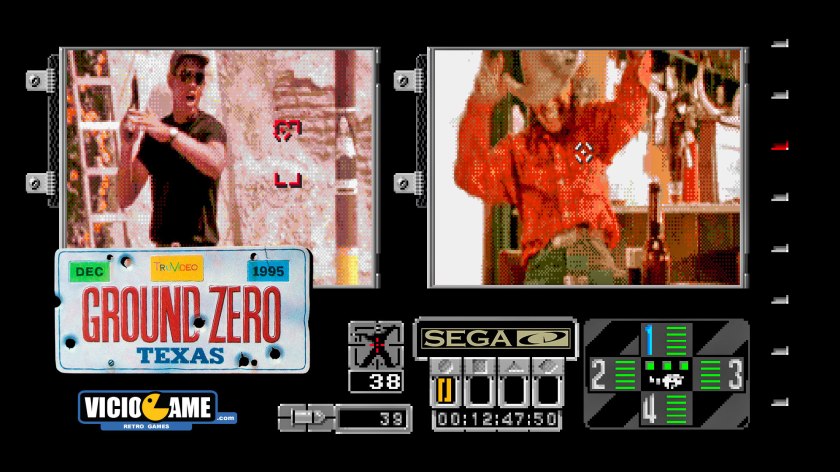
Ground Zero Texas is an FMV interactive movie game released in 1993 for Sega CD. The town has been invaded by aliens who can disguise themselves as humans. Your objective is to control surveillance cameras, identify the real enemies, and fire laser cannons to eliminate all the invaders.
Developer: Digital Pictures
Publisher: Sony Imagesoft
Release date: 1993
Platform: Sega CD / Mega CD / Sega Genesis / Mega Drive
Ground Zero Texas – The Ultimate Guide
Ground Zero Texas was released in 1993 for the Sega CD by Sony Imagesoft, representing one of Digital Pictures’ most ambitious projects, a company that specialized in full-motion video (FMV) games during the brief era when this technology seemed to be the future of video games. Developed under the direction of Dwight H. Little, a filmmaker known for movies like “Halloween 4”, “Rapid Fire”, and “Marked For Death”, the game attempted to elevate the FMV genre to a new level of cinematic production, with an impressive budget of two million dollars and a team that included names like Edward Neumeier, screenwriter of “Robocop” and “Starship Troopers”. The title was distributed on two discs and featured a mixture of sequences filmed with real actors and gameplay moments based on shooting gallery mechanics, creating an experience that positioned itself between interactive cinema and traditional video games.
The narrative premise of Ground Zero Texas draws direct inspiration from 1950s and 1960s science fiction films, particularly “Invasion of the Body Snatchers”, proposing a discreet alien invasion rather than a frontal attack. The game takes place in the fictional city of El Cadron, a border community between the United States and Mexico that serves as the stage for an extraterrestrial infiltration. The Reticulans, the antagonistic alien race, possess the ability to kidnap humans and assume their forms through a cellular regeneration process, making them indistinguishable from the town’s original inhabitants. The plot begins with the mysterious disappearance of several residents, an event that catches the attention of government authorities who decide to intervene covertly. The President of the United States, in communication with Brigadier General Morris Jordan of SAT COM HQ, decides to implement “One Man Show” instead of a large-scale military operation, sending a single tactical specialist to the region. The story incorporates elements of Cold War-characteristic paranoia, mentioning previous incidents at Yucca Flats and Bikini Atoll, suggesting this isn’t the first time humanity has faced extraterrestrial threats.
The player assumes the role of an unnamed tactical specialist who works in conjunction with Lieutenant Harlan T. Reece, a war veteran responsible for coordinating the field operation. The narrative is presented through military documents, including a satellite transmission where Field Agent Harrington JG describes the situation in El Cadron before being apparently killed by the aliens. Harrington reports that the Reticulans have infiltrated the entire town, keeping kidnapped humans in cold storage chambers, and that besides the camouflaged aliens there are robotic troops with superior weaponry and armor. This report serves as an introduction to the scenario the player will face, establishing both the danger and the urgency of the mission. The military tone and documentary presentation of the introductory materials give the game a layer of seriousness that contrasts with the exaggerated execution of the filmed scenes.
Ground Zero Texas‘s game system revolves around remote control of four battle cameras, called BattleCams, positioned at strategic locations in El Cadron. Each camera is equipped with a laser cannon capable of stunning the aliens, since conventional weapons cannot eliminate them permanently. The player observes the action through an interface that simulates a military control panel, with the camera image occupying most of the screen and tactical information displayed at the bottom. Camera 1 monitors the Cantina, described as the town’s main meeting point, where all inhabitants eventually pass through, making it a critical location for identifying infiltrators. Camera 2 watches Main Street, a commercial area that houses a discount store, an arcade, and a pawn shop, places where the suspicious store manager moves products of dubious origin. Camera 3 covers Plaza Square, a region generally quiet during the day but which becomes busy during the Day of the Dead Festival that occurs simultaneously with the game’s events. Camera 4 is positioned at the hotel window where the player has established their headquarters, observing the town’s tourist area.
The core gameplay consists of rapidly alternating between these four locations whenever a camera flashes red, indicating hostile activity. The control pad is used to move the crosshair on the screen and the C button fires a shot. To change cameras, the player must hold a direction on the pad and press the A button. The aerial map of El Cadron appears briefly during the transition, showing which camera the player is leaving and which they’re going to. The correspondence is direct: up leads to the Cantina (BattleCam 1), left goes to Main Street (BattleCam 2), right accesses Plaza Square (BattleCam 3), and down returns to the Hotel Window (BattleCam 4). The B button activates and deactivates a defensive shield for the current camera, a crucial resource when multiple locations are under simultaneous attack. The START button pauses the game and displays a help screen, with a second press leading to the options menu.
Each camera has its own energy bar represented by five markers that change from green to yellow and finally red as the camera takes damage. When all markers turn red, the camera loses power and becomes temporarily inoperative. The interface shows the camera number in blue when the player is at that location, in flashing red when there’s hostile activity, and in black when the camera is out of power. A clock at the bottom indicates elapsed time, while an ammo counter shows available shots. There’s also a count of eliminated Reticulans, allowing the player to track their progress. Camera 4 is extremely important, since its position directly outside the hotel window means its destruction results in an immediate invasion of the player’s headquarters, instantly ending the mission. This mechanic forces the player to prioritize the defense of this specific location, creating a point of constant tension.
The field agents positioned at each location play crucial roles in both narrative and game mechanics. Breen is the agent infiltrated in the Cantina (BattleCam 1), characterized as attractive and flirtatious, but inexperienced in field operations. Matthews works on Main Street (BattleCam 3), being careful and dedicated to his work. Pike is positioned at Plaza Square (BattleCam 5), presented as a cynical veteran who has seen it all and maintains a sarcastic attitude. DiSalvo serves as second in command of the entire operation and also as the agent at the Hotel Window (BattleCam 4), being characterized as extremely demanding and tough. Reece acts as the general coordinator, appearing in various scenes to provide instructions and tactical information. Each agent not only contributes to the development of the story through their scenes, but also has a specific mechanical function: when a camera runs out of power, the corresponding agent is responsible for repairing it. If an agent is kidnapped by the aliens during the game, the camera at that location cannot be repaired in the first phase, creating a critical situation for the player.
The shield system adds a strategic layer to defending locations. Each camera has a shield that can be activated through the B button, allowing the camera to withstand some shots while the player is absent dealing with threats in other areas. The shield status is displayed on the right side of the screen through a series of light markers that cycle more quickly as the shield takes damage. After a determined number of impacts, the shield disintegrates and becomes disabled for the rest of that phase. They remain active even when the player changes location, which means a camera can continue suffering attacks even when not being monitored.
The weapon available on the BattleCams is described in the manual as “a remote auto-stabilizing photo-enhanced particle beam disruptor with stun capability, contained in a reinforced titanium casing to resist maximum fire, with internal refraction through diamond filaments that allow motion sensitivity”. Despite the impressive technical nomenclature, the reality is that this weapon can only stun the Reticulans for a few minutes, not being capable of permanently eliminating them. The aliens recover and return to action quickly even after being hit directly. This technological limitation serves as motivation for the mission to find the alien arsenal, where supposedly more powerful weapons capable of effectively defeating the invaders are stored. The inability to definitively kill enemies contributes to the game’s repetitive nature, since the same aliens appear multiple times in each location throughout combat sequences.
The game imposes strict rules about when the player can and cannot fire, creating one of the most controversial elements of the experience. The fundamental rule is not to shoot innocent humans, something Reece explicitly emphasizes. During combat sequences, disguised aliens draw weapons and attack, at which point they become legitimate targets. However, distinguishing between a real human and a disguised alien before they reveal their hostile intentions is impossible. The game over system related to this is ruthless: if the player shoots three or more innocent humans at any point in the game, whether during a combat scene or even in a passive narrative sequence, the mission ends immediately. The game over scene shows Reece invading the control room and punching the player in the face while shouting “I don’t want people like you protecting me! The helicopter is waiting! It’s over!”, a moment that combines involuntary humor with genuine frustration. This limitation becomes even more severe when the player eventually gains access to the alien arsenal with weapons capable of killing definitively, as at this point a single accidental shot at a human results in instant game over.
The combat sequences follow a static pattern that quickly becomes repetitive. The player observes a fixed scenario while enemies appear in predetermined positions, one at a time in most situations, draw their weapons and fire if not neutralized quickly. The absence of camera movement or dynamic angles during combat contrasts strongly with the narrative scenes, which use multiple cinematic angles. This inconsistency breaks the illusion that the player is actually observing through security cameras installed on the cannons. If the player misses an enemy once, they will certainly attack again, though possibly from a different position. The aiming mechanic through the cursor controlled by the directional pad is clumsy and imprecise, especially considering that many targets appear briefly and require quick reflexes. The absence of support for the Menacer, Genesis’s light gun, is a frustrating omission, since the peripheral would have been ideal for this type of gameplay.
The difficulty increases significantly when multiple locations are attacked simultaneously, a situation that occurs with increasing frequency as you progress. The player needs to alternate rapidly between cameras, activating shields and eliminating threats before any camera loses all its power. The loss of three cameras cumulatively in any phase results in mission end. The energy counter for each camera provides visual feedback about which location is in greatest danger, but the speed necessary to manage four simultaneous battle fronts exceeds the control system’s capabilities. During high-pressure moments, camera switching can feel slow and the aiming cursor responds inconsistently. A good tip for dealing with situations where multiple locations are being attacked is to switch to each one and close the shields before entering combat, gaining precious time to deal with each threat individually.
The narrative structure incorporates several subplots involving El Cadron’s inhabitants, some of which intertwine with the main story while others serve primarily as distraction or filler. One of the parallel plots follows a group of FBI agents investigating drug smuggling and illicit money in the town, criminal activity that continues unfolding independently of the alien crisis. Interactions between cowboys, waitresses, and local gunslingers provide moments of secondary character development, though the dialogues resort to western genre clichés and stereotypical expressions about frontier life. These narrative scenes appear interspersed with combat sequences, creating an irregular rhythm that oscillates between frantic action and mundane conversation. The targets vary from game to game, with randomness in events, though the general structure of the scenes remains consistent between playthroughs.
When the player manages to stun enough aliens to keep the attacks controlled, Reece obtains the opportunity to use the RoverCam, a miniaturized portable reconnaissance device. The device has identified three possible locations for the alien arsenal, and it falls to the player, as tactical specialist, to make the decision about which location to investigate. The three options are: the basement, an abandoned mine, and a storage shed next to a gas station. This sequence represents a break in the repetitive shooting gallery formula, introducing an element of exploration and decision-making. If the player selects the incorrect location, the aliens gain additional time to organize their defenses, making subsequent encounters more difficult. The correct choice will advance the narrative appropriately.
The vault with the arsenal represents one of the few genuine puzzles in the game, appearing when the player successfully locates the alien hideout. This extraterrestrial technology is extremely dangerous, emitting a zero force chamber reading that indicates the device is programmed to explode the entire town of El Cadron if manipulated incorrectly. The player has only one chance to open the vault correctly, making this moment critical for the mission’s success. The mechanic involves entering a four-digit code. Obtaining the correct code depends on saving the field agents during the first phase: each time the player successfully protects an agent from being kidnapped, they receive one digit of the code. Allowing agents to be captured not only compromises the ability to repair cameras, but also makes it impossible to open the arsenal, forcing multiple simultaneous objectives on the player.
The successful invasion of the alien arsenal triggers the second half of the game, where difficulty increases dramatically with the introduction of Robot Stormtroopers. These robotic units, mentioned in Harrington’s initial report but not yet deployed by the aliens, enter action as a direct response to human aggression against their facilities. SAT COM predicted this escalation and implements the “RED FLAG” procedure, downloading periodic situation reports to keep the player informed about approaching enemy activities. During the download of these satellite transmissions, SAT COM temporarily assumes control of the BattleCam station, preventing the player from acting until all material is reviewed. For impatient players or those who already know the messages’ content, there’s a shortcut: pressing START and the A button simultaneously skips the transmissions and immediately restores control. The Stormtroopers prove to be more dangerous adversaries than the disguised Reticulans, with armor that absorbs more damage and superior weaponry that causes faster destruction to the cameras.
With access to the alien arsenal, the player finally obtains weapons capable of permanently eliminating the invaders instead of just stunning them. This improvement fundamentally alters combat dynamics, allowing threats to be definitively neutralized at the cost of drastically increasing the consequences of wrong shots. Agent DiSalvo provides a complete briefing on the Laser Cannon, an advanced weapon available in this later phase of the game. Phase 4 is particularly brutal, with the manual advising that “if a camera is almost destroyed, the player should close the shield and shoot like crazy in hopes of getting lucky”. There are no humans to accidentally hit in Phase 4, removing that specific restriction and allowing more liberal use of lethal force, though the advice is to preserve shield strength to keep this option available.
The progression system allows players to access previously completed phases through the options menu, which appears when pressing START twice. As each phase is completed, it appears listed in the menu, allowing the player to start from that point instead of beginning from the start. The “continue” option allows resuming exactly where the player left off, while the other options allow practicing specific phases or experimenting with different choices. To restart the game completely, the player can press A, B, C and START simultaneously, and pressing the combination a second time returns to the Mega CD control panel.
Ground Zero Texas‘s production quality is substantially superior to most FMV titles of the era in terms of scope, but suffers from the same technical limitations inherent to the format. The cast is extensive compared to Night Trap or Double Switch, with multiple main actors and numerous extras playing El Cadron’s inhabitants. Steve Eastin plays Reece, Leslie Harter plays DiSalvo, Scott Lawrence is Pike, Christopher Bradley appears as Breen, and Ricky Aiello plays the role of Matthews. Dwight H. Little’s direction is competent within the genre’s confines, though it cannot completely overcome the medium’s restrictions. The acting is exaggerated, with moments that function as B-movie action drama and others that fall into unintentional trash territory. Edward Neumeier and Joshua Stallings’s script attempts to inject some sophistication into the premise, but resorts to clichéd dialogue and superficial character development.
The technical presentation reveals the Sega CD‘s severe limitations when handling interactive videos. Ken Melville, Digital Pictures’ co-founder, provided a revealing quote about the process: “All our videos had to be made worse to support the Sega CD’s reduced color palette. I shudder to think about it.” This statement is interesting considering the company had already released several games on the platform and was fully aware of how terrible their games would end up looking visually. The questioning about why two million dollars was invested in something that would not only be a frustrating game but also inevitably look bad reflects the irrational exuberance of the early 1990s multimedia era. The video quality in Ground Zero Texas suffers from severe compression, faded colors, low frame rate, and reduced resolution that makes details difficult to discern. During action sequences where aiming precision is crucial, the degraded visual quality significantly hinders target identification. Due to the CD format’s storage limitations, even with the aggressive compression applied to the videos, the game needed to be released on two discs.
The sound design in Ground Zero Texas consists mainly of dialogue recorded during filming and generic sound effects during combat. The soundtrack incorporates repetitive military drums that play incessantly during shooting gallery sequences, creating a tense but eventually monotonous atmosphere due to lack of variation. Laser weapon effects sound appropriately futuristic, while impact sounds when cameras are hit provide audio feedback of damage. The audio mix prioritizes dialogue during narrative scenes, ensuring that Reece’s instructions and conversations between characters remain intelligible despite compression. The overall sound presentation is functional but not exceptional, serving the game’s needs without creating a particularly distinct or engaging sonic identity.
The critical reception of Ground Zero Texas was predominantly negative, with reviewers citing excessive repetitiveness, frustrating controls, and production quality that didn’t justify the invested budget. The Sega-16 blog gave the game an extremely low score of 2 out of 10, calling it “truly one of the worst FMV games ever seen” and specifically criticizing “the horrible story, the most nauseating acting, horrible control, no variety in gameplay, and a difficulty level that will seriously irritate you to the point of violence”. It emphasized that even dedicated Sega CD fans willing to give FMV games chances should avoid this title. The Hardcore Gaming 101 blog was slightly more generous in its evaluation, acknowledging that the game keeps players more alert than Night Trap and that some narrative scenes are genuinely fun, but concluding that “if it weren’t for the extremely repetitive gameplay, Ground Zero Texas would make a fun short-duration experience, like most decent FMV games do. Instead, the boredom involved will probably lead someone to give up the first time an accidental mistake or overwhelming odds lead to the game over screen”.
Recurring criticisms focus on the central mechanic of moving a cursor across the screen using the directional pad instead of a light gun. The absence of Menacer support is universally seen as a missed opportunity that would have significantly improved gameplay. The small and difficult-to-hit target region during narrative sequences where the player has only a few seconds to react contributes to a frustrating experience. The repetitiveness of shooting gallery sequences, where the same four or five enemy poses appear repeatedly at each location, quickly drains any initial novelty. The multiple paths to game over create a punitive atmosphere where progress seems to depend as much on luck as on skill. The need to multitask between four locations under simultaneous attack exceeds the control system’s capabilities, resulting in deaths that feel unfair.
Ground Zero Texas‘s legacy is tied to the broader commercial and critical failure of FMV games as a genre. The title serves as an example of the unfulfilled promises of the early 1990s “multimedia revolution”, when companies and developers believed that converging video games with film technology would be the next big innovation in the industry. Reality proved that technical limitations, poor game design, and the superficial novelty of filming with real actors could not overcome the lack of substantive gameplay. Ground Zero Texas‘s two million dollar budget represents significant investment in a technology that was destined to become a footnote in video game history. Subsequent developers would learn that successful integration of live-action video in games requires more than simply filming actors and adding minimal game mechanics, demanding careful design that leverages the strengths of both media.
Digital Pictures continued producing FMV games after Ground Zero Texas, including Double Switch, Prize Fighter, and Maximum Surge, but none achieved significant commercial success and the company eventually ceased operations as the market moved away from the format. The Sega CD as a platform suffered in part due to the proliferation of FMV games of questionable quality, with consumers quickly tiring of the novelty and perceiving the lack of game depth. The association between the Sega CD and FMV games damaged the hardware’s perception, overshadowing genuinely good titles in the system’s library like Sonic CD, Snatcher, Lunar: The Silver Star, and Shining Force CD. Ground Zero Texas contributed to this negative reputation, serving as an example of how not to develop for the platform and demonstrating that high budget and Hollywood talent don’t guarantee game quality.
One of the most intriguing Easter eggs in Ground Zero Texas is embedded directly in the game’s disc itself. It features a secret audio track with a hidden message: the track begins with a phone call answered at the Digital Pictures office, followed by the phrase “Number 9” repeated backwards—a clear reference to the Beatles’ “Revolution 9”. You can check this out in our gameplay video at the top of this article.
In the years since its release, Ground Zero Texas has developed a reputation as a historical curiosity rather than a legitimately good game, occasionally appearing on worst Sega CD games lists or discussions about the FMV era. Game preservationists and historians maintain interest in the title as a specific experimental era in video game development, where companies were trying to figure out what was possible with new CD technology before the limitations became fully apparent. Modern players exploring the Sega CD library approach Ground Zero Texas with morbid curiosity, wanting to experience firsthand what critics describe as one of the platform’s most frustrating experiences. Some appreciate the exaggerated aspect of the acting and narrative, treating the game as “so bad it’s good”, while others find the gameplay too punitive to extract any fun even from ironic appreciation.
Ground Zero Texas remains as a record of a time when the video game industry was aggressively experimenting with different technological and creative directions, not all of which proved to be sustainable or desirable. The game represents significant ambition from its creators, who genuinely believed they were building something that would elevate FMV games to a new level of legitimacy and mainstream appeal. The title continues to be a reminder that even with substantial resources and talents involved, creating a compelling game experience requires fundamental focus on responsive mechanics and engaging design that transcends the novelty of any specific technology.
Ground Zero Texas – O Guia Definitivo
Ground Zero Texas foi lançado em 1993 para o Sega CD pela Sony Imagesoft, representando um dos projetos mais ambiciosos da Digital Pictures, empresa que se especializou em jogos com vídeo de movimento completo (FMV) durante a breve era em que essa tecnologia parecia ser o futuro dos videogames. Desenvolvido sob a direção de Dwight H. Little, um cineasta conhecido por filmes como “Halloween 4”, “Rapid Fire” e “Marked For Death”, o jogo tentou elevar o gênero FMV a um novo patamar de produção cinematográfica, contando com um orçamento expressivo de dois milhões de dólares e uma equipe que incluía nomes como Edward Neumeier, roteirista de “Robocop” e “Starship Troopers”. O título foi distribuído em dois discos e apresentava uma mistura de sequências filmadas com atores reais e momentos de jogabilidade baseados em galeria de tiros, criando uma experiência que se posicionava entre o cinema interativo e o videogame tradicional.
A premissa narrativa de Ground Zero Texas se inspira diretamente em filmes de ficção científica dos anos 1950 e 1960, particularmente em “Invasion of the Body Snatchers”, propondo uma invasão alienígena discreta em vez de um ataque frontal. O jogo se passa na cidade fictícia de El Cadron, uma comunidade fronteiriça entre Estados Unidos e México que serve como palco para uma infiltração extraterrestre. Os Reticulanos, raça alienígena antagonista, possuem a capacidade de sequestrar humanos e assumir suas formas através de um processo de regeneração celular, tornando-se indistinguíveis dos habitantes originais da cidade. A trama começa com o desaparecimento misterioso de vários moradores, evento que chama a atenção das autoridades governamentais que decidem intervir de maneira encoberta. O presidente dos Estados Unidos, em comunicação com o Brigadeiro General Morris Jordan do SAT COM HQ, decide implementar a “One Man Show” em vez de uma operação militar em larga escala, enviando um único especialista tático para a região. A história incorpora elementos de paranoia característica da Guerra Fria, mencionando incidentes anteriores em Yucca Flats e no Atol de Bikini, sugerindo que esta não é a primeira vez que a humanidade enfrenta ameaças extraterrestres.
O jogador assume o papel de um especialista tático não nomeado que trabalha em conjunto com o Tenente Harlan T. Reece, veterano de guerra responsável por coordenar a operação em campo. A narrativa é apresentada através de documentos militares, incluindo uma transmissão via satélite onde o Agente de Campo Harrington JG descreve a situação em El Cadron antes de ser aparentemente morto pelos alienígenas. Harrington relata que os Reticulanos infiltraram toda a cidade, mantendo humanos sequestrados em câmaras frigoríficas, e que além dos alienígenas camuflados existem tropas robóticas com armamento e armadura superiores. Este relatório serve como introdução ao cenário que o jogador enfrentará, estabelecendo tanto o perigo quanto a urgência da missão. O tom militar e a apresentação documental dos materiais introdutórios conferem ao jogo uma camada de seriedade que contrasta com a execução exagerada das cenas filmadas.
O sistema de jogo de Ground Zero Texas gira em torno do controle remoto de quatro câmeras de batalha, chamadas BattleCams, posicionadas em locais estratégicos de El Cadron. Cada câmera está equipada com um canhão laser capaz de atordoar os alienígenas, já que as armas convencionais não conseguem eliminá-los permanentemente. O jogador observa a ação através de uma interface que simula um painel de controle militar, com a imagem da câmera ocupando a maior parte da tela e informações táticas exibidas na parte inferior. A Câmera 1 monitora a Cantina, descrita como o principal ponto de encontro da cidade, onde todos os habitantes eventualmente passam, tornando-a um local crítico para identificar infiltrados. A Câmera 2 vigia a Main Street, área comercial que abriga uma loja de descontos, um salão de jogos e um penhorista, lugares onde o gerente suspeito da loja movimenta produtos de procedência duvidosa. A Câmera 3 cobre a Plaza Square, região geralmente tranquila durante o dia mas que se torna agitada durante o Festival do Dia dos Mortos que ocorre simultaneamente aos eventos do jogo. A Câmera 4 está posicionada na janela do hotel onde o jogador estabeleceu seu quartel-general, observando a área turística da cidade.
A jogabilidade central consiste em alternar rapidamente entre essas quatro localidades sempre que uma câmera pisca em vermelho, indicando atividade hostil. O direcional do controle é utilizado para mover a mira na tela e o botão C dispara um tiro. Para mudar de câmera, o jogador deve segurar uma posição no direcional e pressionar o botão A. O mapa aéreo de El Cadron aparece brevemente durante a transição, mostrando de qual câmera o jogador está saindo e para qual está indo. A correspondência é direta: para cima leva à Cantina (BattleCam 1), esquerda vai para Main Street (BattleCam 2), direita acessa Plaza Square (BattleCam 3), e para baixo retorna à Janela do Hotel (BattleCam 4). O botão B ativa e desativa um escudo defensivo para a câmera atual, recurso crucial quando múltiplas locações estão sob ataque simultâneo. O botão START pausa o jogo e exibe uma tela de ajuda, sendo que um segundo pressionar leva ao menu de opções.
Cada câmera possui sua própria barra de energia representada por cinco marcadores que mudam de verde para amarelo e finalmente vermelho conforme a câmera sofre danos. Quando todos os marcadores ficam vermelhos, a câmera perde energia e fica temporariamente inoperante. A interface mostra o número da câmera em azul quando o jogador está naquela localidade, em vermelho piscante quando há atividade hostil, e em preto quando a câmera está sem energia. Um relógio na parte inferior indica o tempo decorrido, enquanto um contador de munição mostra os disparos disponíveis. Existe também uma contagem de Reticulanos eliminados, permitindo ao jogador acompanhar seu progresso. A Câmera 4 possui extrema importância, já que sua posição diretamente fora da janela do hotel significa que sua destruição resulta em uma invasão imediata ao quartel-general do jogador, terminando a missão instantaneamente. Esta mecânica força o jogador a priorizar a defesa desta localidade específica, criando um ponto de tensão constante.
Os agentes de campo posicionados em cada localidade desempenham papéis cruciais tanto na narrativa quanto na mecânica de jogo. Breen é o agente infiltrado na Cantina (BattleCam 1), caracterizado como atraente e flertador, mas inexperiente em operações de campo. Matthews trabalha em Main Street (BattleCam 3), sendo cuidadoso e dedicado ao trabalho. Pike está posicionado na Plaza Square (BattleCam 5), apresentado como um veterano cínico que já viu de tudo e mantém uma atitude sarcástica. DiSalvo serve como segunda em comando da operação inteira e também como agente na Janela do Hotel (BattleCam 4), sendo caracterizada como extremamente exigente e dura. Reece atua como o coordenador geral, aparecendo em diversas cenas para fornecer instruções e informações táticas. Cada agente não só contribui para o desenvolvimento da história através de suas cenas, mas também tem uma função mecânica específica: quando uma câmera fica sem energia, o agente correspondente é responsável por repará-la. Se um agente for sequestrado pelos alienígenas durante o jogo, a câmera daquela localidade não poderá ser reparada na primeira fase, criando uma situação crítica para o jogador.
O sistema de escudo adiciona uma camada estratégica à defesa das localidades. Cada câmera possui um escudo que pode ser ativado através do botão B, permitindo que a câmera resista a alguns disparos enquanto o jogador está ausente lidando com ameaças em outras áreas. O status do escudo é exibido no lado direito da tela através de uma série de marcadores luminosos que cicla mais rapidamente conforme o escudo sofre danos. Após um número determinado de impactos, o escudo se desintegra e fica desabilitado pelo resto daquela fase. Eles permanecem ativos mesmo quando o jogador muda de localidade, o que significa que uma câmera pode continuar sofrendo ataques mesmo quando não está sendo monitorada.
A arma disponível nas BattleCams é descrita no manual como “um disruptor de feixe de partículas fotomelhorado auto-estabilizador remoto com capacidade de atordoamento, contido em uma carcaça de titânio reforçado para resistir a disparos máximos, com refração interna através de filamentos de diamante que permitem sensibilidade ao movimento“. Apesar da nomenclatura técnica impressionante, a realidade é que esta arma só consegue atordoar os Reticulanos por alguns minutos, não sendo capaz de eliminá-los permanentemente. Os alienígenas se recuperam e voltam à ação rapidamente mesmo após serem atingidos diretamente. Esta limitação tecnológica serve como motivação para a missão de encontrar o arsenal alienígena, onde supostamente estão armazenadas armas mais poderosas capazes de efetivamente derrotar os invasores. A incapacidade de matar os inimigos definitivamente contribui para a natureza repetitiva do jogo, já que os mesmos alienígenas aparecem múltiplas vezes em cada localidade ao longo das sequências de combate.
O jogo impõe regras estritas sobre quando o jogador pode e não pode disparar, criando um dos elementos mais controversos da experiência. A regra fundamental é não atirar em humanos inocentes, algo que Reece enfatiza explicitamente. Durante as sequências de combate, alienígenas disfarçados sacam armas e atacam, momento em que se tornam alvos legítimos. No entanto, distinguir entre um humano real e um alienígena disfarçado antes que ele revele suas intenções hostis é impossível. O sistema de game over relacionado a isso é impiedoso: se o jogador atirar em três ou mais humanos inocentes a qualquer momento do jogo, seja durante uma cena de combate ou mesmo em uma sequência narrativa passiva, a missão termina imediatamente. A cena de game over mostra Reece invadindo a sala de controle e socando o jogador no rosto enquanto grita “Não quero gente como você me protegendo! O helicóptero está esperando! Acabou!“, um momento que combina humor involuntário com frustração genuína. Esta limitação se torna ainda mais severa quando o jogador eventualmente obtém acesso ao arsenal alienígena com armas capazes de matar definitivamente, pois neste ponto um único disparo acidental em um humano resulta em game over instantâneo.
As sequências de combate seguem um padrão estático que rapidamente se torna repetitivo. O jogador observa um cenário fixo enquanto inimigos surgem em posições predeterminadas, um de cada vez na maioria das situações, sacam suas armas e disparam se não forem neutralizados rapidamente. A ausência de movimento de câmera ou ângulos dinâmicos durante o combate contrasta fortemente com as cenas narrativas, que utilizam múltiplos ângulos cinematográficos. Esta inconsistência quebra a ilusão de que o jogador está realmente observando através das câmeras de segurança instaladas nos canhões. Se o jogador errar um inimigo uma vez, ele certamente atacará novamente, embora possivelmente de uma posição diferente. A mecânica de mira através do cursor controlado pelo direcional é desajeitada e imprecisa, especialmente considerando que muitos alvos aparecem brevemente e exigem reflexos rápidos. A ausência de suporte para o Menacer, pistola de luz do Genesis, é uma omissão frustrante, já que o periférico teria sido ideal para este tipo de jogabilidade.
A dificuldade aumenta significativamente quando múltiplas localidades são atacadas simultaneamente, situação que ocorre com frequência crescente conforme você progride. O jogador precisa alternar rapidamente entre câmeras, ativando escudos e eliminando ameaças antes que qualquer câmera perca toda sua energia. A perda de três câmeras cumulativamente em qualquer fase resulta em fim da missão. O contador de energia de cada câmera proporciona feedback visual sobre qual localidade está em maior perigo, mas a velocidade necessária para gerenciar quatro frentes de batalha simultâneas ultrapassa as capacidades do sistema de controle. Durante momentos de alta pressão, a troca de câmeras pode parecer lenta e o cursor de mira responde de forma inconsistente. Uma boa dica para lidar com situações onde múltiplas localidades estão sendo atacadas, é trocar para cada uma e fechar os escudos antes de entrar em combate, ganhando tempo precioso para lidar com cada ameaça individualmente.
A estrutura narrativa incorpora várias sub-tramas envolvendo os habitantes de El Cadron, algumas das quais se entrelaçam com a história principal enquanto outras servem principalmente como distração ou preenchimento. Uma das tramas paralelas segue um grupo de agentes do FBI investigando contrabando de drogas e dinheiro ilícito na cidade, atividade criminal que continua desenrolando-se independentemente da crise alienígena. As interações entre cowboys, garçonetes e pistoleiros locais fornecem momentos de desenvolvimento de personagens secundários, embora os diálogos recorram a clichês do gênero western e expressões estereotipadas sobre a vida na fronteira. Estas cenas narrativas aparecem intercaladas com as sequências de combate, criando um ritmo irregular que oscila entre ação frenética e conversação mundana. Os alvos variam de jogo para jogo, com aleatoriedade nos eventos, embora a estrutura geral das cenas permaneça consistente entre jogadas.
Quando o jogador consegue atordoar alienígenas suficientes para manter os ataques controlados, Reece obtém a oportunidade de utilizar a RoverCam, um dispositivo de reconhecimento portátil miniaturizado. O dispositivo identificou três possíveis localizações para o arsenal alienígena, e cabe ao jogador, como especialista tático, tomar a decisão sobre qual local investigar. As três opções são: o porão, uma mina abandonado, e um galpão de armazenamento ao lado de um posto de gasolina. Esta sequência representa uma quebra na fórmula repetitiva de galeria de tiros, introduzindo um elemento de exploração e tomada de decisão. Se o jogador selecionar a localização incorreta, os alienígenas ganham tempo adicional para organizar suas defesas, tornando os encontros subsequentes mais difíceis. A escolha correta avançará a narrativa apropriadamente.
O cofre com o arsenal representa um dos poucos puzzles genuínos no jogo, aparecendo quando o jogador localiza com sucesso o esconderijo alienígena. Esta tecnologia extraterrestre é extremamente perigosa, emitindo uma leitura de câmara de força zero que indica que o dispositivo está programado para explodir toda a cidade de El Cadron se manipulado incorretamente. O jogador tem apenas uma chance de abrir o cofre corretamente, tornando este momento crítico para o sucesso da missão. A mecânica envolve inserir um código de quatro dígitos. A obtenção do código correto depende de salvar os agentes de campo durante a primeira fase: cada vez que o jogador protege com sucesso um agente de ser sequestrado, ele recebe um dígito do código. Permitir que agentes sejam capturados não apenas compromete a capacidade de reparar câmeras, mas também torna impossível abrir o arsenal, forçando múltiplos objetivos simultâneos sobre o jogador.
A invasão bem-sucedida do arsenal alienígena desencadeia a segunda metade do jogo, onde a dificuldade aumenta dramaticamente com a introdução dos Robot Stormtroopers. Estas unidades robóticas, mencionadas no relatório inicial de Harrington mas ainda não implementadas pelos alienígenas, entram em ação como resposta direta à agressão humana contra suas instalações. O SAT COM previu esta escalada e implementa o procedimento “RED FLAG”, baixando relatórios periódicos de situação para manter o jogador informado sobre as atividades dos inimigos que se aproximam. Durante o download destas transmissões via satélite, o SAT COM temporariamente assume controle da estação BattleCam, impedindo o jogador de agir até que todo o material seja revisado. Para jogadores impacientes ou que já conhecem o conteúdo das mensagens, existe um atalho: pressionar START e o botão A simultaneamente pula as transmissões e restaura o controle imediatamente. Os Stormtroopers provam ser adversários mais perigosos que os Reticulanos disfarçados, com armadura que absorve mais danos e armamento superior que causa destruição mais rápida às câmeras.
Com o acesso ao arsenal alienígena, o jogador finalmente obtém armas capazes de eliminar permanentemente os invasores em vez de apenas atordoá-los. Esta melhoria altera fundamentalmente a dinâmica do combate, permitindo que ameaças sejam neutralizadas definitivamente ao custo de aumentar drasticamente as consequências de disparos errados. A Agente DiSalvo fornece um briefing completo sobre o Laser Cannon, arma avançada disponível nesta fase posterior do jogo. A Fase 4 é particularmente brutal, com o manual aconselhando que “se uma câmera estiver quase destruída, o jogador deve fechar o escudo e atirar como louco na esperança de ter sorte“. Não há humanos para acidentalmente atingir na Fase 4, removendo aquela restrição específica e permitindo uso mais liberal da força letal, embora o conselho seja preservar força do escudo para manter esta opção disponível.
O sistema de progressão permite que jogadores acessem fases previamente completadas através do menu de opções, que aparece ao pressionar START duas vezes. Conforme cada fase é concluída, ela aparece listada no menu, permitindo ao jogador iniciar daquele ponto em vez de começar desde o início. A opção “continue” permite retomar exatamente de onde o jogador parou, enquanto as outras opções permitem praticar fases específicas ou experimentar escolhas diferentes. Para reiniciar o jogo completamente, o jogador pode pressionar A, B, C e START simultaneamente, e apertar a combinação uma segunda vez retorna ao painel de controle do Mega CD.
A qualidade da produção de Ground Zero Texas é substancialmente superior à maioria dos títulos FMV da época em termos de escopo, mas sofre das mesmas limitações técnicas inerentes ao formato. O elenco é extenso comparado a Night Trap ou Double Switch, com múltiplos atores principais e numerosos figurantes interpretando os habitantes de El Cadron. Steve Eastin interpreta Reece, Leslie Harter vive DiSalvo, Scott Lawrence é Pike, Christopher Bradley aparece como Breen, e Ricky Aiello desempenha o papel de Matthews. A direção de Dwight H. Little é competente dentro dos confins do gênero, embora não possa superar completamente as restrições do meio. A atuação é exagerada, com momentos que funcionam como drama de filme B de ação e outros que caem em território trash não intencional. O roteiro de Edward Neumeier e Joshua Stallings tenta injetar alguma sofisticação na premissa, mas recorre a diálogos clichês e desenvolvimento de personagens superficial.
A apresentação técnica revela as severas limitações do Sega CD ao lidar com vídeos interativos. Ken Melville, cofundador da Digital Pictures, forneceu uma citação reveladora sobre o processo: “Todos os nossos vídeos tinham que ser piorados para suportar a paleta de cores reduzida do Sega CD. Eu estremeço ao pensar nisso.“. Esta declaração é interessante considerando que a empresa já havia lançado vários jogos na plataforma e estava plenamente ciente de como terríveis seus jogos acabariam parecendo visualmente. O questionamento sobre por que dois milhões de dólares foram investidos em algo que não apenas seria um jogo frustrante mas também inevitavelmente pareceria ruim reflete a exuberância irracional da era multimídia do início dos anos 1990. A qualidade do vídeo em Ground Zero Texas sofre de compressão severa, cores desbotadas, taxa de quadros baixa e resolução reduzida que torna detalhes difíceis de discernir. Durante sequências de ação onde precisão de mira é crucial, a qualidade visual degradada dificulta significativamente a identificação de alvos. Devido às limitações de armazenamento do formato CD, mesmo com a compressão agressiva aplicada aos vídeos, o jogo precisou ser lançado em dois discos.
O design de som em Ground Zero Texas consiste principalmente de diálogo gravado durante as filmagens e efeitos sonoros genéricos durante o combate. A trilha sonora incorpora tambores militares repetitivos que tocam incessantemente durante as sequências de galeria de tiros, criando uma atmosfera tensa mas eventualmente monótona devido à falta de variação. Efeitos de armas laser soam adequadamente futurísticos, enquanto os sons de impacto quando as câmeras são atingidas fornecem feedback áudio de dano. A mixagem de áudio prioriza o diálogo durante as cenas narrativas, garantindo que as instruções de Reece e as conversas entre personagens permaneçam inteligíveis apesar da compressão. A apresentação geral sonora é funcional mas não excepcional, servindo às necessidades do jogo sem criar uma identidade sonora particularmente distinta ou envolvente.
A recepção crítica de Ground Zero Texas foi predominantemente negativa, com revisores citando repetitividade excessiva, controles frustrantes, e qualidade de produção que não justificava o orçamento investido. O blog Sega-16 deu ao jogo uma pontuação extremamente baixa de 2 de 10, chamando-o de “verdadeiramente um dos piores jogos FMV já vistos” e criticando especificamente “a história horrível, a atuação mais nauseante, controle horrível, nenhuma variedade na jogabilidade, e um nível de dificuldade que seriamente irritará você ao ponto da violência“. Enfatizou que mesmo dedicados fãs do Sega CD dispostos a dar chances aos jogos FMV deveriam evitar este título. Já o blog Hardcore Gaming 101 foi ligeiramente mais generoso em sua avaliação, reconhecendo que o jogo mantém os jogadores mais alertas que Night Trap e que algumas cenas narrativas são genuinamente divertidas, mas concluindo que “se não fosse pela jogabilidade extremamente repetitiva, Ground Zero Texas faria uma experiência divertida de curta duração, como a maioria dos jogos FMV decentes fazem. Em vez disso, o tédio envolvido provavelmente levará alguém a desistir na primeira vez que um erro acidental ou probabilidades esmagadoras levam à tela de game over“.
Críticas recorrentes focam na mecânica central de mover um cursor pela tela usando o direcional em vez de uma pistola de luz. A ausência de suporte ao Menacer é universalmente vista como uma oportunidade perdida que teria melhorado significativamente a jogabilidade. A região de alvo pequena e difícil de acertar durante sequências narrativas onde o jogador tem apenas alguns segundos para reagir contribui para uma experiência frustrante. A repetitividade das sequências de galeria de tiros, onde as mesmas quatro ou cinco poses de inimigos aparecem repetidamente em cada localização, drena rapidamente qualquer novidade inicial. Os múltiplos caminhos para game over criam uma atmosfera punitiva onde progresso parece depender tanto de sorte quanto de habilidade. A necessidade de multitarefa entre quatro localidades sob ataque simultâneo ultrapassa as capacidades do sistema de controle, resultando em mortes que parecem injustas.
O legado de Ground Zero Texas está ligado ao fracasso comercial e crítico mais amplo dos jogos FMV como gênero. O título serve como exemplo das promessas não cumpridas da “revolução multimídia” do início dos anos 1990, quando empresas e desenvolvedores acreditavam que convergir videogames com tecnologia de filme seria a próxima grande inovação na indústria. A realidade provou que limitações técnicas, design de jogo pobre, e a novidade superficial das filmagens com atores reais não conseguiram superar a falta de jogabilidade substantiva. O orçamento de dois milhões de dólares de Ground Zero Texas representa investimento significativo em uma tecnologia que estava destinada a se tornar uma nota de rodapé na história dos videogames. Desenvolvedores subsequentes aprenderiam que integração bem-sucedida de vídeo live-action em jogos requer mais do que simplesmente filmar atores e adicionar mecânicas de jogo mínimas, exigindo design cuidadoso que aproveita os pontos fortes de ambos os meios.
A Digital Pictures continuou produzindo jogos FMV após Ground Zero Texas, incluindo Double Switch, Prize Fighter, e Maximum Surge, mas nenhum alcançou sucesso comercial significativo e a empresa eventualmente cessou operações conforme o mercado se afastou do formato. O Sega CD como plataforma sofreu em parte devido à proliferação de jogos FMV de qualidade questionável, com consumidores se cansando rapidamente da novidade e percebendo a falta de profundidade de jogo. A associação entre o Sega CD e jogos FMV prejudicou a percepção do hardware, ofuscando títulos genuinamente bons na biblioteca do sistema como Sonic CD, Snatcher, Lunar: The Silver Star, e Shining Force CD. Ground Zero Texas contribuiu para esta reputação negativa, servindo como exemplo de como não desenvolver para a plataforma e demonstrando que orçamento alto e talento de Hollywood não garantem qualidade de jogo.
Um dos Easter eggs mais intrigantes de Ground Zero Texas está embutido no próprio disco do jogo. Há uma faixa de áudio secreta com uma mensagem escondida: inicia-se com uma ligação atendida no escritório da Digital Pictures, prosseguindo com a repetição da frase “Number 9” ao contrário — uma referência à faixa “Revolution 9” dos Beatles. Você pode conferir em nosso vídeo do jogo no topo neste artigo.
Nos anos desde seu lançamento, Ground Zero Texas desenvolveu uma reputação como curiosidade histórica em vez de jogo legitimamente bom, ocasionalmente aparecendo em listas de piores jogos do Sega CD ou discussões sobre a era FMV. Preservacionistas de jogos e historiadores mantêm interesse no título como uma era experimental específica no desenvolvimento de videogames, onde empresas tentavam descobrir o que era possível com nova tecnologia CD antes que as limitações se tornassem totalmente aparentes. Jogadores modernos que exploram a biblioteca do Sega CD abordam Ground Zero Texas com curiosidade mórbida, querendo experimentar em primeira mão o que as críticas descrevem como uma das experiências mais frustrantes da plataforma. Alguns apreciam o aspecto exagerado da atuação e narrativa, tratando o jogo como “tão ruim que é bom”, enquanto outros acham a jogabilidade muito punitiva para extrair qualquer diversão mesmo de apreciação irônica.
Ground Zero Texas permanece como registro de uma época em que a indústria de videogames estava experimentando agressivamente com diferentes direções tecnológicas e criativas, nem todas as quais provaram ser sustentáveis ou desejáveis. O jogo representa ambição significativa de seus criadores, que genuinamente acreditavam estar construindo algo que elevaria jogos FMV a um novo nível de legitimidade e apelo mainstream. O título continua sendo um lembrete de que mesmo com recursos substanciais e talentos envolvidos, criar uma experiência de jogo convincente requer foco fundamental em mecânicas responsivas e design engajante que transcende a novidade de qualquer tecnologia específica.
🤑💲Earn money without doing anything! Just leave these apps open:
   ✓ https://r.honeygain.me/CONTA9DB02

   ✓ https://packetstream.io/?psr=1uPb
🤑💲1-Click button earns Bitcoin every 1 hour: https://freebitco.in/?r=53528449
⬛ 𝗧𝗶𝗸𝗧𝗼𝗸: https://www.tiktok.com/@viciogame
🟧 𝗜𝗻𝘀𝘁𝗮𝗴𝗿𝗮𝗺: http://www.instagram.com/viciogame
🟥 𝗬𝗼𝘂𝘁𝘂𝗯𝗲: http://www.youtube.com/viciogame
🟦 𝗙𝗮𝗰𝗲𝗯𝗼𝗼𝗸: http://www.facebook.com/viciogame
🔳 𝗧𝗵𝗿𝗲𝗮𝗱𝘀: https://www.threads.net/@viciogame
🟪 𝗧𝘄𝗶𝘁𝗰𝗵: https://www.twitch.tv/ViciogameRetroGames
🟨 𝗕𝗹𝗼𝗴: http://www.viciogameblog.com/
🟦𝗧𝘄𝗶𝘁𝘁𝗲𝗿: http://www.twitter.com/viciogame
Viciogame #Gameplay #LetsPlay #Gamer #Playthrough #Games #News #Videogames #Review #Game #Detonado #Walkthrough #Ending #Reviews #Facts #Retro #Record #Roms #Emulator #Longplay #Speedrun #NoCommentary #GroundZeroTexas #SegaCD #MegaDrive #Sega #Genesis #MegaCD #SegaGenesis #FMV #NightTrap #DoubleSwitch #DigitalPictures #RobinWilliams #メガCD #セガ #メガドライブ
 VICIOGAME