
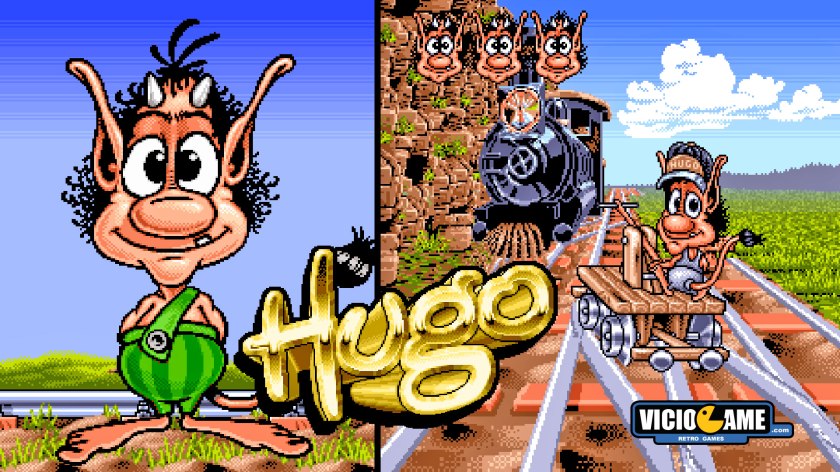
Hugo is an adventure game series released in 1992 for the Amiga. It’s the home version of the game that appeared on the TV show that became a hit in several countries. The evil witch has kidnapped the troll’s family to use as ingredients for her rejuvenation spell. Your mission is to find her and defeat her.
Developer/Publisher: Silverrock Productions / ITE Media
Release date: 1991
Platform: Commodore Amiga
Hugo – The Ultimate Guide
In the early 1990s, a small Danish troll named Hugo conquered millions of hearts across Europe through a technological innovation that seemed like science fiction at the time. The Hugo franchise represented a perfect fusion of live television and video games, creating an interactive experience that was decades ahead of its time. At the center of this revolution was the Commodore Amiga, a computer that made the impossible possible.
Hugo’s story begins in 1987, when Ivan Sølvason, founder of the small company SilverRock Productions and former editor-in-chief of Oberoende Computer magazine, joined forces with animator Niels Krogh Mortensen to conceive something completely new. The idea was revolutionary: create a television program where the audience at home could control a character on screen using only their telephone. This vision would become reality in September 1990, when the program debuted on Danish TV2 during the Eleva2ren show. To transform this vision into reality, ITE developed a custom system called the ITE 3000, an engineering masterpiece that cost approximately $100,000 to build. The heart of this system consisted of two Amiga 3000 computers working in tandem, accompanied by specialized hardware that included an audio control system, a MIDI sampler, a DTMF (Dual-Tone Multi-Frequency) system for decoding telephone signals, and various custom extra components.
The genius of the ITE 3000 lay in its ability to instantly convert signals from any touch-tone telephone into control commands for the game characters. When a viewer pressed the keys on their phone, usually keys 1, 2, and 3 or 2, 4, and 6 depending on regional configuration, these signals were captured, processed, and translated into Hugo’s movements on screen, all in real-time during a live broadcast. This system was notoriously complex and difficult to operate, requiring highly specialized technicians. The telephone infrastructure varied from country to country, which meant specific adaptations were necessary for each market. Spain, for example, needed a customized version of the system due to the peculiarities of its telephone network.
The choice of the Amiga 3000 was no accident. This computer represented the state of the art in terms of multimedia capabilities in the early 1990s. The Amiga 3000 was equipped with the OCS (Original Chip Set) and later with improved versions, offering graphics and sound capabilities that were revolutionary for the time. The Amiga’s capabilities that made the Hugo show possible included hardware-accelerated graphics processing through custom chips like Paula (audio), Denise (graphics), and Agnus (coordination). The system could display up to 4,096 colors from a total palette, with special modes like HAM (Hold And Modify) allowing all these colors to be displayed simultaneously on screen. For audio, the Paula chip offered four channels of 8-bit PCM sound with sampling rates up to 28 kHz, allowing voice samples and sound effects of impressive quality for the time.
With the success of the program, ITE continued innovating. The ITE 3000 system was replaced by the PC-based ITE 4000, which introduced the revolutionary Animation Mask System (AMS). This real-time motion capture system, invented by Bjarne Sølvason (Ivan Sølvason’s father), represented a significant technological leap. The AMS allowed an actor wearing a helmet equipped with sensors to have their facial movements, expressions, and eye movements captured and instantly transferred to the Hugo character on screen. While all body movements were pre-rendered, facial expressions were controlled in real-time, adding an extra layer of life and personality to the character during live broadcasts. In 1996, ITE took another step forward by creating a 3D graphics system using Silicon Graphics Onyx Reality Engine workstations, extremely expensive machines used in professional film production. In 2005, a new real-time 3D animation technology was developed, though primarily targeted at Asian markets.
The first game for Amiga, Hugo – På Nye Eventyr, was released in 1991, with an improved version arriving in 1992 by Silverrock Productions. This title brings the TV show experience directly to homes, allowing players to control Hugo without the pressure of being live on television. The game includes two main stages that became iconic in the franchise. The first is the “Handcar” or “Train” stage, where Hugo pilots a handcar along the rails. The player needs to help the troll change tracks, dodge steam locomotives coming from the opposite direction, and collect gold bags along the way. The gameplay is frenetic and requires quick reflexes, with difficulty progressively increasing as more obstacles appear simultaneously. The second stage is “Mountaineering” or “Mountain,” where Hugo climbs a steep mountain on a narrow cliff path. The objective is to reach the top of the mountain where the witch’s lair is located, avoiding huge rocks rolling down the mountain, jumping over dangerous chasms, and collecting gold bags. This stage has a time limit, adding an extra layer of tension to the experience.
The sequel, Hugo – På Nye Eventyr Del 2, was released in 1992 and brought two completely different new scenarios, expanding Hugo’s universe and offering new challenges. ITE also invested significantly in audio, adding much more digitized speech and sound effects to enrich the experience. The first new stage is “Forest,” where Hugo wanders through the forest searching for Scylla’s hideout. The witch, upon discovering he’s on his way, sends a storm cloud over the forest, transforming the entire environment into a dark and evil place. The player needs to avoid elaborate traps while navigating through the dense vegetation, with the game’s atmosphere changing dramatically when darkness takes over the screen. The second stage is “Plane,” where Hugo pilots a biplane through a fierce storm conjured by Scylla. The player needs to navigate the turbulent skies, dodging lightning-laden clouds and balloons carrying bombs, all while collecting gold. The plane’s physics demands skill from the player while maneuvering between obstacles, creating a tense and exciting gaming experience.
Both games share the same exciting final sequence that is identical to what’s seen on the TV show. After completing all stages, Hugo finally arrives at Scylla’s lair. The witch, who keeps Hugo’s family prisoner in a cage, presents the player with a crucial challenge: choose the correct rope among three or four options (depending on the version). If the player chooses correctly, Scylla is defeated in one of two ways: in the first, she transforms into an eagle and flies away, doubling the player’s total score. In the best possible conclusion, the witch ends up magically tied with a rope and is ejected headfirst out a window by a spring launcher, tripling the player’s score. Some versions of the game give fixed points of up to 2,026 additional points instead of multiplying the score. However, if the player chooses incorrectly, it’s Hugo who ends up tied and launched in the same humiliating manner, with the score remaining unchanged, representing a critical failure in the rescue mission.
The Hugo games make extensive use of the Amiga’s graphics capabilities, utilizing the OCS chipset available in the Amiga 500, 600, and 3000 models. The graphics are characterized by massive and colorful sprites that immediately grab attention. Hugo himself is made with a large, well-animated sprite, with fluid movements that take advantage of the system’s hardware-accelerated animation capabilities.
The visual design adopts a vibrant cartoon style, with color palettes carefully selected to maximize visual impact within technical limitations. The scenarios feature parallax scrolling, a technique where different background layers move at different speeds to create an illusion of three-dimensional depth. The typical resolution used is 320×256 pixels in standard PAL mode, with up to 32 colors on screen simultaneously through the use of 5 bitplanes. Developers Henrik Christensen (responsible for the Mountain stage) and Esben Krag Hansen (responsible for the Train stage) demonstrated considerable skill in extracting the maximum from the Amiga hardware’s capabilities.
Audio is one of the strong points of the Hugo games. Using the four audio channels of the Paula chip, the games feature a complex mix of sound effects and digitized voice. Hugo’s voice, speaking in Danish (or Swedish/Norwegian in localized versions), is sampled and played during the game, adding personality and charm to the character. Although many international players don’t understand the language, Hugo’s enthusiastic exclamations like “Yahoooo!” became iconic and contribute to the game’s overall atmosphere. The sound effects are varied and well-produced, from the creaking of the rails in the train level to the thunder in the airplane sequence. The audio quality is incredible considering the memory limitations of the era. Voice samples had to be carefully compressed and optimized to fit on Amiga diskettes, along with all the graphics, game code, and other data. The loading system was optimized to minimize wait times, but players still need to swap diskettes frequently during gameplay sessions.
The Hugo TV program became a truly impressive global phenomenon. Since its debut in Denmark in 1990, the show was licensed to more than 40 countries (43 in 2007), each with its own adapted version. The genius of the format lay in complete localization: Hugo spoke the local language in each country, making millions of viewers believe the program was native to their own nations.
In Spain, the program achieved surprising numbers when 25% of the population tuned in to watch Hugo, presented by Carmen Sevilla on Telecinco. This record audience from 1994 was never surpassed in the country. Spanish success was so great that it generated a spin-off program called Hugolandia, presented by Beatriz Rico, Luis Alberto Vazquez, Roma, and Eva Morales. In Sweden, the version aired by TV4 became the highest-rated children’s program of all time in 1996. In Turkey, Hugo achieved the position of highest-rated children’s program, capturing 12% of the total market share in 1993, a remarkable feat in a country that was just beginning to have private channels. Millions of Turkish children watched the show, with thousands competing to play.
In Argentina, “A Jugar Con Hugo,” presented by Gabriela “Gaby” Royfe, was a spectacular success that lasted seven seasons and 343 episodes. The program won the Martín Fierro award for “Best Children’s Show” in 2003. Hugo was dubbed by César Ledesma, and there was even a paper magazine published dedicated to the show. In Brazil, the program debuted in 1995 through a partnership between the channels Rede CNT and TV Gazeta, and was adapted by Herbert Richers, being broadcast exclusively on these channels until its end in 1998. It achieved tremendous success, especially in the launch year, recording up to 1.8 million calls in a single day—which overloaded telephone centers, causing fires—and audience peaks 500% above expectations. It had several hosts, including Matheus Petinatti, Vanessa Vholker, Andrea Pujol, and Rodrigo Brassolotto.
Not everything was smooth in Hugo’s global expansion. The character faced unexpected problems related to his physical characteristics. Hugo’s horns, a defining feature of the Scandinavian troll, caused problems in some markets. In South Africa, the program never aired because the local TV station demanded that ITE remove the horns from all animations, as superstitious viewers believed Hugo would look like a demon from local beliefs. The horns also caused problems in the Middle East. In Brazil, Hugo was presented as a “goblin” and was operated by a robotic puppet on CNT Gazeta, a unique adaptation that showed how different cultures interpreted and adapted the concept for their local audiences.
The program’s dynamics were fascinating and challenging for both participants and production. Viewers called a phone number for the show. If selected, they were instructed by a live human host on how to control Hugo by pressing specific numeric keys on the phone. The telecommunications delay of the era, combined with the complexity of the ITE 3000 system, meant there was a perceptible lag between the player’s key press and the response on screen. This made the game considerably more difficult than playing directly on the Amiga at home. Many viewers, especially in France where the program was called “Hugo Délire” and presented by Karen Cheryl, suspected the show might be rigged due to these technical limitations. Participants typically had three lives to complete the challenges. Scoring was calculated based on the amount of gold collected along the way, with lost lives negatively impacting the final score. After finishing the game, winning or losing, prizes were determined by the score achieved.
In the original season that lasted one year on Danish television, the focus was exclusively on the titular character. Hugo was presented as a small, friendly 220-year-old troll (still considered young for a troll), navigating a dangerous mine in search of hidden treasures. The character communicated with the player, commenting on the game’s progress, adding a layer of interactivity and personality. For the second season, ITE massively expanded Hugo’s universe. His wife Hugoline, 180 years old, and his three children were introduced: Rit (TrolleRit), Rat (TrolleRat), and Rut (TrolleRut), ranging in age from 20 to 50 years. The main antagonist also made her debut: Scylla, an evil witch who became Hugo’s nemesis. The original Danish name was Afskylia, but she received different names in each international market. In the German version she was Hexana, in Spanish Maldicia, in Portuguese and Brazilian Maldiva, in Croatian Mordana, in Finnish Skylla, in Turkish Sila, and in Vietnamese Simla.
Scylla’s characterization is particularly interesting. She is extremely old and hideous in her true form, but uses magic to appear young and beautiful when she’s near Hugoline and her captive children. In the Turkish version, Scylla kidnaps Hugo’s family because she wants to drink troll sweat to become young and beautiful forever. Most games and later adaptations abandoned this motive, making Scylla permanently young by default and focusing on her quest for revenge against Hugo or her desire to conquer the world, or even trying to extinguish the trolls.
In January 1999, a new program format called “Hugo: Jungle Island” (Hugo Vulkanøen) debuted in Denmark, replacing the content of all Hugo programs from that point forward. The setting changed from the familiar magical forests of northern Europe to a remote and exotic island off the coast of Peru. In this new configuration, Scylla had moved after once again kidnapping Hugo’s family, building a new home for herself atop a volcano located in the center of the island. The various paths leading there were not only full of traps but also populated by pirates loyal to the witch and infested with stupid and evil monkeys she sent after Hugo. This version featured completely different main scenarios and renewed final scenes, with diamonds replacing gold as scoring items. New main characters were introduced, including Don Croco, Scylla’s devoted chief henchman, and Fernando, a local ally of Hugo.
Hugo was truly a pioneer in the field of interactive television entertainment, paving the way for numerous similar formats that would emerge later. The worldwide success inspired several other shows during the 1990s, including “Games World” (UK/Germany, 1993-1998), “Pizza Rollo” (France, 1994-1995), “Joe Razz” (Sweden, 1994), “Game Over” (Finland, 1994-1997), “Galilei the Dog” (Finland, 1996-1997), and “Maxihra” (Slovakia, 1997-2000). ITE itself created another show called “Throut and Neck” (Denmark/Brazil, 1997-1999).
In Denmark, the franchise’s home country, merchandise licensed by ITE included food products such as ice cream and candy, as well as various other items like two board games (based on the first and second seasons of the show), figurines, puzzles, watches, and backpacks. The Hugo brand was extremely popular in the country. One example was the sale of more than 35,000 bath towels in just a few weeks. Swedish candy factory Cloetta managed to increase its market share in Denmark from 4% to 35% during the 18 months of its Hugo licensing campaign. There was even a Hugo-themed casino slot machine based on the gold mine setting. In other countries, merchandise included music cassette tapes and sticker albums in Chile, the Hugo board game in Sweden, and in Germany a complete product line including clothing (t-shirts, sweatshirts, hoodies, and socks), plush dolls (of Hugo and his family), PVC figures (of Hugo, his family, Fernando, and Scylla), and posters.
The Hugo games achieved massive commercial success, particularly in Europe. The first PC game remained the best-selling diskette game in Germany for a long period in 1995, leading the charts in March, June, July, October, and November. Hugo was also the best-selling game for Amiga 500 in September 1996, while Hugo 3 came in second place right after its release in 1996. Hugo had already been one of the best-selling computer games in Spain in 1992. In August 1998, Hugo 2 for Game Boy received the “Gold” sales award from Verband der Unterhaltungssoftware Deutschland (VUD), indicating sales of at least 100,000 units in Germany, Austria, and Switzerland.
Critical reviews of the games were mixed and often negative, especially outside the target children’s audience. Francisco Delgada, from Spanish magazine pcmanía, commented that while Hugo wasn’t a bad game, it was somewhat bland and repetitive, especially because the home version differed from the television version only in difficulty. Arkadiusz Matczyński, from Polish magazine Świat Gier Komputerowych, recommended the game as fantastic for younger Amiga users, but noted that more mature audiences might get bored quickly.
The Hugo franchise continued evolving far beyond the original Amiga games. Later releases for Windows included Hugo 4 (1996, originally “Hugo: Äventyret Går Vidare”), Hugo 5 (1997), and Hugo 6: Wild River (1998), as well as updated compilations like Hugo Gold (1998), Hugo Platin (1999), and Hugo XL (1999).
In 2002, Ivan Sølvason sold ITE to venture capital firm Olicom A/S, which invested $22 million in the company, reduced ITE’s staff by a third to 60 employees, and attempted to expand further into US, UK, and Asian markets. Olicom, in turn, sold ITE in 2006, when it had only 35 employees, to NDS Group, where it became NDS Denmark. Hugo’s copyrights were acquired by Danish game publisher Krea Medie A/S, part of the Kraemedie media company. The new owner Henrik Kølle revealed in October 2012 that several new projects for the Hugo franchise were being planned, including a film project. Later, in November, Krea Medie was acquired by the Egmont Group, but Hugo Games and Hugo’s rights were not part of the sale agreement with Egmont. Since 2011, Krea Media (Hugo Games / 5th Planet Games) has developed a series of mobile game remakes of some of the classic minigames transformed into endless runners. A series of inspired online slots has also been released since 2016, keeping the franchise relevant for new generations.
Hugo – På Nye Eventyr and its sequel Del 2 represent much more than simple Amiga games. They are cultural works that captured a unique moment in the history of technology and entertainment, when the boundaries between television, video games, and telecommunications were united in an innovative way. The Hugo TV program demonstrated the potential of interactive media long before the internet became ubiquitous. In an era where streaming and online participation are common, it’s easy to forget how revolutionary it was to call a TV show and control a character in real-time through the phone.
These Amiga games allowed this experience to be captured and preserved, bringing the show’s magic to homes without the need to participate live. They showcased the Amiga’s impressive multimedia capabilities, with its colorful graphics, fluid animations, digitized voice, and accessible gameplay. Although the games may seem simple by modern standards, and reviews were mixed, Hugo’s cultural impact is undeniable. The franchise sold millions of copies, reached dozens of countries, and created lasting memories for an entire generation of children. The small Danish troll became an icon, proving that technological innovation combined with charismatic character design can transcend linguistic and cultural barriers.
Hugo remains as proof of the platform’s capabilities and a brilliant example of how talented developers could extract every drop of performance from the hardware. It represents a crucial step in the evolution of interactive reality shows and transmedia experiences that dominate contemporary entertainment. Hugo’s story is a story of vision, technical innovation, and the ability to dream big. Ivan Sølvason and Niels Krogh Mortensen imagined something that didn’t exist and, through ingenuity and persistence, brought to life a phenomenon that touched millions of people around the world. Hugo’s legacy lives on, not only in the memories of those who grew up with it, but also in the principles of interactivity and audience engagement that continue to shape modern media.
Hugo – O Guia Definitivo
No início dos anos 1990, um pequeno troll dinamarquês chamado Hugo conquistou milhões de corações em toda a Europa através de uma inovação tecnológica que parecia ficção científica na época. A franquia Hugo representou uma fusão perfeita entre televisão ao vivo e videogames, criando uma experiência interativa que estava décadas à frente de seu tempo. No centro dessa revolução estava o Commodore Amiga, um computador que tornou possível o impossível.
A história de Hugo começa em 1987, quando Ivan Sølvason, fundador da pequena empresa SilverRock Productions e ex-editor-chefe da revista Oberoende Computer, juntou-se ao animador Niels Krogh Mortensen para conceber algo completamente novo. A ideia era revolucionária: criar um programa de televisão onde o público em casa pudesse controlar um personagem na tela usando apenas o telefone. Esta visão se tornaria realidade em setembro de 1990, quando o programa estreou na TV2 dinamarquesa durante o show Eleva2ren. Para transformar essa visão em realidade, a ITE desenvolveu um sistema customizado chamado ITE 3000, uma obra-prima de engenharia que custou aproximadamente 100 mil dólares para ser construída. O coração deste sistema era composto por dois computadores Amiga 3000 trabalhando em conjunto, acompanhados por hardware especializado que incluía um sistema de controle de áudio, um sampler MIDI, um sistema DTMF (Dual-Tone Multi-Frequency) para decodificação de sinais telefônicos e diversos componentes extras customizados.
A genialidade do ITE 3000 estava em sua capacidade de converter instantaneamente os sinais de qualquer telefone de tons em comandos de controle para os personagens do jogo. Quando um telespectador pressionava as teclas de seu telefone, geralmente as teclas 1, 2 e 3 ou 2, 4 e 6, dependendo da configuração regional, esses sinais eram capturados, processados e traduzidos em movimentos do Hugo na tela, tudo em tempo real durante uma transmissão ao vivo. Este sistema era notoriamente complexo e difícil de operar, exigindo técnicos altamente especializados. A infraestrutura telefônica variava de país para país, o que significava que adaptações específicas eram necessárias para cada mercado. A Espanha, por exemplo, precisou de uma versão customizada do sistema devido às particularidades de sua rede telefônica.
A escolha do Amiga 3000 não foi acidental. Este computador representava o estado da arte em termos de capacidades multimídia no início dos anos 1990. O Amiga 3000 era equipado com o chipset OCS (Original Chip Set) e posteriormente com versões aprimoradas, oferecendo capacidades gráficas e sonoras que eram revolucionárias para a época. As capacidades do Amiga que tornaram o show Hugo possível incluíam o processamento gráfico acelerado por hardware através de chips customizados como Paula (áudio), Denise (gráficos) e Agnus (coordenação). O sistema podia exibir até 4096 cores de uma paleta total, com modos especiais como o HAM (Hold And Modify) permitindo exibir todas essas cores simultaneamente na tela. Para o áudio, o chip Paula oferecia quatro canais de som PCM de 8 bits com taxa de amostragem de até 28 kHz, permitindo samples de voz e efeitos sonoros de qualidade impressionante para a época.
Com o sucesso do programa, a ITE continuou inovando. O sistema ITE 3000 foi substituído pelo ITE 4000 baseado em PC, que introduziu o revolucionário Animation Mask System (AMS). Este sistema de captura de movimento em tempo real, inventado por Bjarne Sølvason (pai de Ivan Sølvason), representava um salto tecnológico significativo. O AMS permitia que um ator vestindo um capacete equipado com sensores tivesse seus movimentos faciais, expressões e movimentos de olhos capturados e transferidos instantaneamente para o personagem Hugo na tela. Embora todos os movimentos corporais fossem pré-renderizados, as expressões faciais eram controladas em tempo real, adicionando uma camada extra de vida e personalidade ao personagem durante as transmissões ao vivo. Em 1996, a ITE deu outro passo adiante ao criar um sistema de gráficos 3D usando as estações de trabalho Silicon Graphics Onyx Reality Engine, máquinas extremamente caras usadas na produção cinematográfica profissional. Em 2005, uma nova tecnologia de animação 3D em tempo real foi desenvolvida, embora direcionada principalmente para mercados asiáticos.
O primeiro jogo para Amiga, Hugo – På Nye Eventyr, foi lançado em 1991, com uma versão aprimorada chegando em 1992 pela Silverrock Productions. Este título traz a experiência do programa de TV diretamente para os lares, permitindo que os jogadores controlem Hugo sem a pressão de estar ao vivo na televisão. O jogo inclui duas fases principais que se tornaram icônicas na franquia. A primeira é a fase “Handcar” ou “Train”, onde Hugo pilota um carrinho pelos trilhos. O jogador precisa ajudar o troll a mudar de trilho, desviar de locomotivas a vapor que vem em direção contrária e coletar sacos de ouro ao longo do caminho. A jogabilidade é frenética e exige reflexos rápidos, com a dificuldade aumentando progressivamente à medida que mais obstáculos aparecem simultaneamente. A segunda fase é “Mountaineering” ou “Mountain”, onde Hugo escala uma montanha íngreme em um caminho de penhasco estreito. O objetivo é alcançar o topo da montanha onde fica o covil da bruxa, evitando pedras enormes que rolam montanha abaixo, saltar sobre abismos perigosos e coletar sacos de ouro. Esta fase tem um limite de tempo, adicionando uma camada extra de tensão à experiência.
A sequência, Hugo – På Nye Eventyr Del 2, foi lançada em 1992 e trouxe dois novos cenários completamente diferentes, expandindo o universo de Hugo e oferecendo novos desafios. A ITE também investiu significativamente em áudio, adicionando muito mais falas digitalizadas e efeitos sonoros para enriquecer a experiência. A primeira nova fase é “Forest”, onde Hugo vaga pela floresta em busca do esconderijo de Scylla. A bruxa, ao descobrir que ele está a caminho, envia uma nuvem de tempestade sobre a floresta, transformando todo o ambiente em um lugar sombrio e maligno. O jogador precisa evitar armadilhas elaboradas enquanto navega através da vegetação densa, com a atmosfera do jogo mudando drasticamente quando a escuridão toma conta da tela. A segunda fase é “Plane”, onde Hugo pilota um biplano através de uma tempestade feroz invocada por Scylla. O jogador precisa navegar pelos céus turbulentos, desviando de nuvens carregadas de raios e balões que carregam bombas, tudo enquanto coleta ouro. A física do avião exige habilidade do jogador enquanto manobra entre os obstáculos, criando uma experiência de jogo tensa e emocionante.
Ambos os jogos compartilham a mesma sequência final emocionante que é idêntica à vista no programa de TV. Após completar todas as fases, Hugo finalmente chega ao covil de Scylla. A bruxa, que mantém a família de Hugo prisioneira em uma gaiola, apresenta ao jogador um desafio crucial: escolher a corda correta entre três ou quatro opções (dependendo da versão). Se o jogador escolher corretamente, Scylla é derrotada de uma das duas maneiras: na primeira, ela se transforma em uma águia e foge voando, dobrando a pontuação total do jogador. Na melhor conclusão possível, a bruxa acaba magicamente amarrada com uma corda e é ejetada de cabeça para fora de uma janela por um lançador de mola, triplicando a pontuação do jogador. Algumas versões do jogo dão pontos fixos de até 2026 pontos adicionais ao invés de multiplicar a pontuação. Contudo, se o jogador escolher incorretamente, é Hugo quem acaba amarrado e lançado da mesma maneira humilhante, com a pontuação permanecendo inalterada, representando uma falha crítica na missão de resgate.
Os jogos Hugo fazem uso extensivo das capacidades gráficas do Amiga, utilizando o chipset OCS disponível nos modelos Amiga 500, 600 e 3000. Os gráficos são caracterizados por sprites massivos e coloridos que chamam atenção imediatamente. Hugo em si é feito em sprite grande e bem animado, com movimentos fluidos que aproveitam as capacidades de animação acelerada por hardware do sistema.
O design visual adota um estilo cartunesco vibrante, com paletas de cores cuidadosamente selecionadas para maximizar o impacto visual dentro das limitações técnicas. Os cenários apresentam paralaxe scrolling, uma técnica onde diferentes camadas do fundo se movem em velocidades diferentes para criar uma ilusão de profundidade tridimensional. A resolução típica utilizada é de 320×256 pixels no modo PAL padrão, com até 32 cores na tela simultaneamente através do uso de 5 bitplanes. Os desenvolvedores Henrik Christensen (responsável pela fase Mountain) e Esben Krag Hansen (responsável pela fase Train) demonstraram habilidade considerável em extrair o máximo das capacidades do hardware Amiga.
O áudio é um dos pontos fortes dos jogos Hugo. Utilizando os quatro canais de áudio do chip Paula, os jogos apresentam uma mixagem complexa de efeitos sonoros e voz digitalizada. A voz de Hugo, falando em dinamarquês (ou sueco/norueguês em versões localizadas), é sampleada e reproduzida durante o jogo, adicionando personalidade e charme ao personagem. Embora muitos jogadores internacionais não compreendam o idioma, as exclamações entusiasmadas de Hugo como “Yahoooo!” se tornaram icônicas e contribuem para a atmosfera geral do jogo. Os efeitos sonoros são variados e bem produzidos, desde o rangido dos trilhos no nível do trem até os trovões na sequência do avião. A qualidade do áudio é incrível considerando as limitações de memória da época. Os samples de voz tinham que ser cuidadosamente comprimidos e otimizados para caber nos disquetes do Amiga, junto com todos os gráficos, código do jogo e outros dados. O sistema de carregamento foi otimizado para minimizar os tempos de espera, mas ainda assim os jogadores precisam trocar disquetes frequentemente durante as sessões de jogo.
O programa de TV Hugo se tornou um fenômeno global verdadeiramente impressionante. Desde sua estreia na Dinamarca em 1990, o show foi licenciado para mais de 40 países (43 em 2007), cada um com sua própria versão adaptada. A genialidade do formato estava na localização completa: Hugo falava o idioma local em cada país, fazendo com que milhões de espectadores acreditassem que o programa era nativo de suas próprias nações.
Na Espanha, o programa alcançou números surpreendentes quando 25% da população sintonizava para assistir Hugo, apresentado por Carmen Sevilla na Telecinco. Esta audiência recorde de 1994 nunca foi superada no país. O sucesso espanhol foi tão grande que gerou um programa derivado chamado Hugolandia, apresentado por Beatriz Rico, Luis Alberto Vazquez, Roma e Eva Morales. Na Suécia, a versão exibida pela TV4 se tornou o programa infantil com maior audiência de todos os tempos em 1996. Na Turquia, Hugo alcançou a posição de programa infantil mais bem classificado, conquistando 12% do share total do mercado em 1993, um feito notável em um país que estava apenas começando a ter canais privados. Milhões de crianças turcas assistiam ao show, com milhares competindo para jogar.
Na Argentina, “A Jugar Con Hugo”, apresentado por Gabriela “Gaby” Royfe, foi um sucesso espetacular que durou sete temporadas e 343 episódios. O programa ganhou o prêmio Martín Fierro de “Melhor Show Infantil” em 2003. Hugo era dublado por César Ledesma, e havia até uma revista em papel publicada dedicada ao show. No Brasil o programa estreou em 1995 através da parceria entre os canais Rede CNT e TV Gazeta, e foi adaptado pela Herbert Richers, sendo exibido exclusivamente nesses canais até o seu fim, em 1998. Obteve sucesso estrondoso, especialmente no ano de lançamento, registrando até 1,8 milhão de ligações em um único dia — o que sobrecarregou centros telefônicos, causando incêndios —, e picos de audiência 500% acima do esperado. Teve vários apresentadores, como Matheus Petinatti, Vanessa Vholker, Andrea Pujol e Rodrigo Brassolotto.
Nem tudo foi tranquilo na expansão global de Hugo. O personagem enfrentou problemas inesperados relacionados às suas características físicas. Os chifres de Hugo, uma característica definidora do troll escandinavo, causaram problemas em alguns mercados. Na África do Sul, o programa nunca foi ao ar porque a estação de TV local exigiu que a ITE removesse os chifres de todas as animações, já que espectadores supersticiosos acreditavam que Hugo pareceria um demônio de crenças locais. Os chifres também causaram problemas no Oriente Médio. No Brasil, Hugo foi apresentado como um “duende” e era operado por um boneco robótico no CNT Gazeta, uma adaptação única que mostrava como diferentes culturas interpretavam e adaptavam o conceito para suas audiências locais.
A dinâmica do programa era fascinante e desafiadora tanto para os participantes quanto para a produção. Os telespectadores ligavam para um número telefônico do show. Se fossem selecionados, eram instruídos por um apresentador humano ao vivo sobre como controlar Hugo pressionando as teclas numéricas específicas do telefone. O atraso nas telecomunicações da época, combinado com a complexidade do sistema ITE 3000, significava que havia um delay perceptível entre o pressionamento da tecla pelo jogador e a resposta na tela. Isso tornava o jogo consideravelmente mais difícil do que jogar diretamente no Amiga em casa. Muitos espectadores, especialmente na França onde o programa era chamado “Hugo Délire” e apresentado por Karen Cheryl, suspeitavam que o show poderia ser manipulado devido a essas limitações técnicas. Os participantes tinham tipicamente três vidas para completar os desafios. A pontuação era calculada com base na quantidade de ouro coletada ao longo do caminho, com vidas perdidas impactando negativamente a pontuação final. Após terminar o jogo, ganhando ou perdendo, os prêmios eram determinados pela pontuação alcançada.
Na temporada original que durou um ano na televisão dinamarquesa, o foco estava exclusivamente no personagem titular. Hugo era apresentado como um troll pequeno e amigável de 220 anos de idade (ainda considerado jovem para um troll), navegando por uma mina perigosa em busca de tesouros escondidos. O personagem se comunicava com o jogador, comentando sobre o progresso do jogo, adicionando uma camada de interatividade e personalidade. Para a segunda temporada, a ITE expandiu massivamente o universo de Hugo. Foram introduzidos sua esposa Hugolina (também conhecida como Hugoline), de 180 anos de idade, e seus três filhos: Rit (TrolleRit), Rat (TrolleRat) e Rut (TrolleRut), com idades entre 20 e 50 anos. A antagonista principal também fez sua estreia: Scylla, uma bruxa malvada que se tornou a nemesis de Hugo. O nome original dinamarquês era Afskylia, mas ela recebeu nomes diferentes em cada mercado internacional. Na versão alemã era Hexana, na espanhola Maldicia, na portuguesa e brasileira Maldiva, na croata Mordana, na finlandesa Skylla, na turca Sila e na vietnamita Simla.
A caracterização de Scylla é particularmente interessante. Ela é extremamente velha e horrorosa em sua forma verdadeira, mas usa magia para parecer jovem e bela quando está próxima de Hugolina e seus filhos mantidos em cativeiro. Na versão turca, Scylla sequestra a família de Hugo porque quer beber suor de troll para se tornar jovem e bonita para sempre. A maioria dos jogos e adaptações posteriores abandonaram este motivo, tornando Scylla permanentemente jovem por padrão e focando em sua busca por vingança contra Hugo ou seu desejo de conquistar o mundo, ou até mesmo tentando extinguir os trolls.
Em janeiro de 1999, um novo formato de programa chamado “Hugo: Jungle Island” (Hugo Vulkanøen) estreou na Dinamarca, substituindo o conteúdo de todos os programas Hugo daquele ponto em diante. O cenário mudou das familiares florestas mágicas do norte da Europa para uma ilha remota e exótica na costa do Peru. Nesta nova configuração, Scylla havia se mudado após mais uma vez sequestrar a família de Hugo, construindo uma nova casa para si no topo de um vulcão localizado no centro da ilha. Os vários caminhos que levavam até lá não eram apenas cheios de armadilhas, mas também povoados por piratas leais à bruxa e infestados de macacos estúpidos e malvados que ela enviava atrás de Hugo. Esta versão apresentava cenários principais completamente diferentes e cenas finais renovadas, com diamantes substituindo o ouro como itens de pontuação. Novos personagens principais foram introduzidos, incluindo Don Croco, o devotado capanga-chefe de Scylla, e Fernando, um aliado local de Hugo.
Hugo foi verdadeiramente pioneiro no campo do entretenimento televisivo interativo, abrindo caminho para inúmeros formatos similares que surgiriam posteriormente. O sucesso mundial inspirou vários outros shows durante a década de 1990, incluindo “Games World” (Reino Unido/Alemanha, 1993-1998), “Pizza Rollo” (França, 1994-1995), “Joe Razz” (Suécia, 1994), “Game Over” (Finlândia, 1994-1997), “Galilei the Dog” (Finlândia, 1996-1997) e “Maxihra” (Eslováquia, 1997-2000). A própria ITE criou outro show chamado “Throut and Neck” (Dinamarca/Brasil, 1997-1999).
Na Dinamarca, país natal da franquia, o merchandising licenciado pela ITE incluía produtos alimentícios como sorvetes e doces, além de diversos outros itens como dois jogos de tabuleiro (baseados na primeira e segunda temporadas do show), estatuetas, quebra-cabeças, relógios e mochilas. A marca Hugo era extremamente popular no país. Um exemplo foi a venda de mais de 35.000 toalhas de banho em apenas algumas semanas. A fábrica sueca de doces Cloetta conseguiu aumentar sua participação no mercado dinamarquês de 4% para 35% durante os 18 meses de sua campanha de licenciamento Hugo. Havia até uma máquina caça-níqueis de cassino temática de Hugo baseada no cenário da mina de ouro. Em outros países, o merchandising incluía fitas cassete de música e álbuns de figurinhas no Chile, o jogo de tabuleiro Hugo na Suécia, e na Alemanha uma linha completa de produtos incluindo roupas (camisetas, moletons, hoodies e meias), bonecos de pelúcia (de Hugo e sua família), figuras de PVC (de Hugo, sua família, Fernando e Scylla), e pôsteres.
Os jogos Hugo alcançaram sucesso comercial massivo, particularmente na Europa. O primeiro jogo para PC permaneceu como o jogo de disquete mais vendido na Alemanha por um longo período em 1995, liderando as paradas em março, junho, julho, outubro e novembro. Hugo também foi o jogo mais vendido para Amiga 500 em setembro de 1996, enquanto Hugo 3 ficou em segundo lugar logo após seu lançamento em 1996. Hugo já havia sido um dos jogos de computador mais vendidos na Espanha em 1992. Em agosto de 1998, Hugo 2 para Game Boy recebeu o prêmio de vendas “Ouro” da Verband der Unterhaltungssoftware Deutschland (VUD), indicando vendas de pelo menos 100.000 unidades na Alemanha, Áustria e Suíça.
As avaliações críticas dos jogos foram mistas e frequentemente negativas, especialmente fora do público infantil alvo. Francisco Delgada, da revista espanhola pcmanía, comentou que embora Hugo não fosse um jogo ruim, era um pouco insosso e repetitivo, especialmente porque a versão de caseira diferia da versão televisiva apenas na dificuldade. Arkadiusz Matczyński, da revista polonesa Świat Gier Komputerowych, recomendou o jogo como fantástico para usuários mais jovens do Amiga, mas observou que o público mais maduro poderia se entediar rapidamente.
A franquia Hugo continuou evoluindo muito além dos jogos originais do Amiga. Lançamentos posteriores para Windows incluíram Hugo 4 (1996, originalmente “Hugo: Äventyret Går Vidare”), Hugo 5 (1997) e Hugo 6: Wild River (1998), além de compilações atualizadas como Hugo Gold (1998), Hugo Platin (1999) e Hugo XL (1999).
Em 2002, Ivan Sølvason vendeu a ITE para a empresa de capital de risco Olicom A/S, que investiu 22 milhões de dólares na empresa, reduziu a equipe da ITE em um terço para 60 funcionários e tentou expandir mais para os mercados dos EUA, Reino Unido e Ásia. A Olicom, por sua vez, vendeu a ITE em 2006, quando tinha apenas 35 funcionários, para o NDS Group, onde se tornou NDS Denmark. Os direitos autorais de Hugo foram adquiridos pela editora dinamarquesa de jogos Krea Medie A/S, parte da empresa de mídia Kraemedie. O novo proprietário Henrik Kølle revelou em outubro de 2012 que vários novos projetos para a franquia Hugo estavam sendo planejados, incluindo um projeto de filme. Mais tarde, em novembro, a Krea Medie foi adquirida pelo Grupo Egmont, mas Hugo Games e os direitos de Hugo não fizeram parte do acordo de venda com a Egmont. Desde 2011, a Krea Media (Hugo Games / 5th Planet Games) desenvolveu uma série de remakes de jogos móveis de alguns dos minigames clássicos transformados em endless runners. Uma série de caça-níqueis online inspirados também foi lançada desde 2016, mantendo a franquia relevante para novas gerações.
Hugo – På Nye Eventyr e sua sequência Del 2 representam muito mais do que simples jogos para Amiga. Eles são obras culturais que capturaram um momento único na história da tecnologia e do entretenimento, quando as fronteiras entre televisão, videogames e telecomunicações foram unidas de maneira inovadora. O programa de TV Hugo demonstrou o potencial da mídia interativa muito antes da internet se tornar onipresente. Em uma época onde streaming e participação online são comuns, é fácil esquecer quão revolucionário era ligar para um programa de TV e controlar um personagem em tempo real através do telefone.
Estes jogos para Amiga permitiram que essa experiência fosse capturada e preservada, trazendo a magia do show para os lares sem a necessidade de participar ao vivo. Eles mostraram as capacidades multimídia impressionantes do Amiga, com seus gráficos coloridos, animações fluidas, voz digitalizada e jogabilidade acessível. Embora os jogos possam parecer simples pelos padrões modernos, e as críticas tenham sido mistas, o impacto cultural de Hugo é inegável. A franquia vendeu milhões de cópias, alcançou dezenas de países e criou memórias duradouras para uma geração inteira de crianças. O pequeno troll dinamarquês se tornou um ícone, provando que inovação tecnológica combinada com design de personagens carismático pode transcender barreiras linguísticas e culturais.
Hugo permanece como prova das capacidades da plataforma e exemplo brilhante de como desenvolvedores talentosos podiam extrair cada gota de performance do hardware. Representa um degrau crucial na evolução de reality shows interativos e experiências transmídia que dominam o entretenimento contemporâneo. A história de Hugo é uma história de visão, inovação técnica e a capacidade de sonhar grande. Ivan Sølvason e Niels Krogh Mortensen imaginaram algo que não existia e, através de engenhosidade e persistência, trouxeram à vida um fenômeno que tocou milhões de pessoas ao redor do mundo. O legado de Hugo continua vivo, não apenas nas memórias daqueles que cresceram com ele, mas também nos princípios de interatividade e engajamento do público que continuam a moldar a mídia moderna.
🤑💲Earn money without doing anything! Just leave these apps open:
   ✓ https://r.honeygain.me/CONTA9DB02

   ✓ https://packetstream.io/?psr=1uPb
🤑💲1-Click button earns Bitcoin every 1 hour: https://freebitco.in/?r=53528449
⬛ 𝗧𝗶𝗸𝗧𝗼𝗸: https://www.tiktok.com/@viciogame
🟧 𝗜𝗻𝘀𝘁𝗮𝗴𝗿𝗮𝗺: http://www.instagram.com/viciogame
🟥 𝗬𝗼𝘂𝘁𝘂𝗯𝗲: http://www.youtube.com/viciogame
🟦 𝗙𝗮𝗰𝗲𝗯𝗼𝗼𝗸: http://www.facebook.com/viciogame
🔳 𝗧𝗵𝗿𝗲𝗮𝗱𝘀: https://www.threads.net/@viciogame
🟪 𝗧𝘄𝗶𝘁𝗰𝗵: https://www.twitch.tv/ViciogameRetroGames
🟨 𝗕𝗹𝗼𝗴: http://www.viciogameblog.com/
🟦𝗧𝘄𝗶𝘁𝘁𝗲𝗿: http://www.twitter.com/viciogame
#Viciogame #Gameplay #LetsPlay #Gamer #Playthrough #Games #News #Videogames #Review #Game #Detonado #Walkthrough #Ending #Reviews #Facts #Retro #Record #Roms #Emulator #Longplay #Speedrun #NoCommentary #Hugo #Amiga #Commodore #PaNyeEventyr #Silverrock #IteMedia #TvShow #CommodoreAmiga #IvanSolvason #NielsKroghMortensen #Eleva2ren #ITE3000 #Amiga3000 #Amiga500 #Amiga1200 #Amiga2000 #CNT #Gazeta #PaNyeEventyrDel2 #PcGaming
 VICIOGAME