
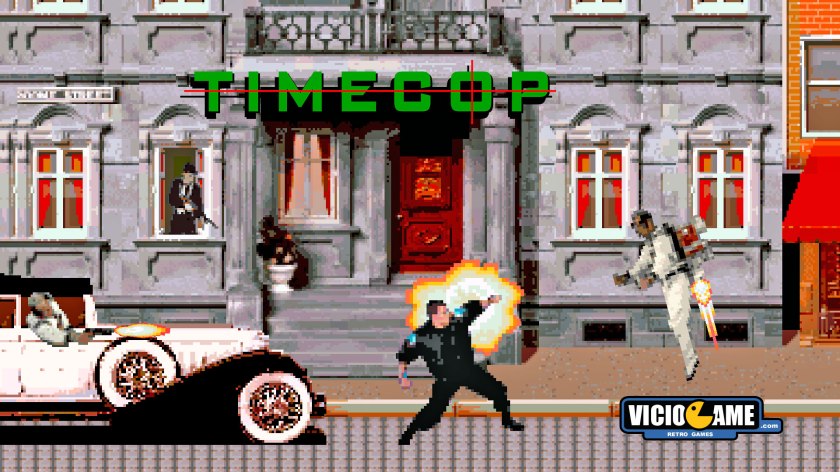
Timecop is a 2D action-platformer game released in 1995 for the Super Nintendo. The story serves as a continuation of the events depicted in the film of the same name, starring Jean-Claude Van Damme. You assume the role of the last human possessing the ability to travel through time, with the mission to prevent the world from falling under the domination of an evil scientist.
Developer: Cryo Interactive
Publisher: JVC Musical Industries
Release date: 1995
Platform: Super Nintendo / Super Famicom
Timecop – The Ultimate Guide
Timecop for Super Nintendo represents one of the most controversial examples of film-to-video game adaptation during the 16-bit era. Developed by French studio Cryo Interactive and published by JVC Musical Industries in April 1995, the game arrived in the North American market months after the release of the eponymous film starring Jean-Claude Van Damme in September 1994. Unlike most adaptations of the era that attempted to recreate the events of the original film, Timecop opted for a sequential narrative approach, positioning itself as a direct continuation of the events presented on cinema screens.
The Japanese version of the game was released on February 17, 1995 by Victor Entertainment, preceding the American release by several months. The title also received distribution in Europe through JVC, consolidating its presence in the major SNES markets. It’s important to note that, despite being fully developed, a Sega CD version never received an official release. JVC decided to cancel publication of this version even after its completion, although a functional single-level demo was distributed with Sega Pro CD magazine in 1995. In 2007, the lead programmer of the cancelled version, Jean-Charles Meyrignac, made the complete Mega CD version of the game available on the internet, revealing that it included FMV sequences and a CD-quality audio soundtrack, substantially differentiating it from the cartridge version.
The game’s story unfolds after the events of the original film. Thanks to the efforts of Max Walker and the Time Enforcement Commission, known by the acronym TEC, the time travel system created by Professor Kleindast did not fall into the hands of corrupt Senator Aaron McComb. With the implementation of a new security system called Timescan, developed to immediately intercept anyone attempting to alter the course of history, Max Walker’s interventions have apparently become unnecessary. After completing one last routine mission, Walker prepares to leave TEC headquarters when he notices that a new corporate logo has appeared on the company’s electronic devices: HKE, which stands for Hans Kleindast Electronics Inc.
The shocking revelation is that the inventor of time travel, Professor Kleindast, did not die during the first experiment as believed. Walker is suddenly teleported to a new building, where he is captured by armed guards who take him to Kleindast. The scientist proclaims Walker as the last human capable of traveling through time. Kleindast explains that he has become the master of contemporary technology, the only one capable of conceiving Timescan and, since its activation, the only one capable of time traveling with impunity. However, his status as Master of Time bores him deeply, as he needs a worthy opponent to play against him on the temporal board. Kleindast then hands Walker a temporal control bracelet and declares: “Let the duel begin.” As soon as Walker places the bracelet on his wrist, the guards place him in a time capsule. The engine starts immediately, sending Walker through the infinite corridors of time on his most dangerous mission.
The game utilizes a technical feature that was relatively uncommon for console games at the time: digitized characters. Actors were filmed in front of a blue screen, and static photographs were captured from the video to create all characters and their animations. This digitization process, while impressive by Super Nintendo standards, resulted in enemies that exhibit extremely robotic movements and don’t respond adequately when hit by punches or kicks. It’s worth noting that, despite the use of digitized actors, Jean-Claude Van Damme was not used to represent protagonist Max Walker in the game, which represents a significant savings in licensing costs but also limits the authenticity of the experience for fans of the film.
The left or right directional button allows horizontal character movement, while pressing down makes Walker crouch. The L and R triggers execute an uppercut. The A button performs kicks, while the B button is responsible for jumps. The X button executes punches, and the Y button fires the weapon when ammunition is available. The Select button activates special T.E.C. Ripple Bombs when available in inventory. The Start button pauses the game at any time. While this command distribution is theoretically intuitive, practical execution suffers from serious responsiveness problems. The movement and jump controls are incredibly slippery, and the turning animation when running at high speed has missing frames, creating a visually uncomfortable transition and leaving the player vulnerable to attacks during this period.
Walker starts the game equipped with a standard pistol and, in some stages, with a submachine gun. However, ammunition is extremely limited, and after firing just three shots, the player immediately runs out of ammunition, forcing them to resort to kicking enemies patrolling the areas. The powerful T.E.C. Ripple Bombs are screen-clearing bombs and are recommended only in extreme circumstances due to their rarity. This resource management system adds a strategic layer to the game, although many players simply choose to jump over enemies instead of confronting them, since adversaries continue to respawn indefinitely regardless of how many times they are eliminated.
The game extends through 15 stages distributed across five distinct temporal locations. The first area is Washington D.C., at TEC headquarters in 2005. Players need to return to the present, now transformed into the grim alternate reality created by Kleindast. After passing the security guard, access is gained to the classified area of TEC headquarters. Keeping the remaining henchmen subdued, it’s possible to discover Kleindast’s secret plan for world domination. This introductory stage establishes the tone for the rest of the game, with corridors full of armed guards and basic platforming challenges.
The second location is Sandreas Break, under the ocean in 1945. Kleindast plans to harvest a fortune in the ocean, as rare underwater metals are needed to perfect revolutionary electronic components. To combat Kleindast’s army and giant octopuses, the player must use the pistol. It’s crucial to spend shots wisely, as sinking or swimming is at stake. If bitten twice, the underwater adventure ends prematurely. This stage stands out for implementing underwater movement mechanics, where Walker uses a diving suit and can only shoot at enemies. The absence of the crouching ability in this stage is frustrating, forcing players to execute hilariously exaggerated “moon jumps” to avoid projectiles from other divers. The stage also includes a section where the player controls a submarine disproportionate to the screen size, which fires its weapon inconsistently.
The third area transports players to New York, Wall Street in 1929. Kleindast has the Mafia in his pocket, they’re everywhere and want to get Walker. Moving car shootouts are nothing new in this version of 1929, a reality in which Kleindast tries to control the stock market. Unwilling to give up, Kleindast sends his robotic double after Walker, chasing him to a warehouse. This stage is challenging, with gangsters in period clothing constantly attacking. The player travels to Wall Street and shoots gangsters before destroying a robot in a bank, a sequence that lacks narrative context even after watching the explanatory cinematics that precede each set of stages.
The fourth location is Lake Dortmund, Germany in 1944. Kleindast has a master plan to accumulate treasures of gems and art from the Germans until benefiting from their maximum value in 2005. The player’s mission is to recover the two trucks loaded with treasure and deliver them to the arriving Allied troops. In this stage, Max travels to Nazi Germany and, surprisingly, destroys a tank with his handgun, a scene that exemplifies the disconnect between the presented narrative and actual gameplay.
The last area is Los Angeles, Brainblast factory in 2117. Walker is sent to the only place where he can stop Kleindast: his Brainblast production line just before going to market. There’s a wave of robots to combat before finding the way to Kleindast’s inner sanctum. It’s crucial to save energy for the final battle: a jetpack duel between Walker and Kleindast high above the Los Angeles skyline. This final confrontation occurs with both characters flying with jetpacks and shooting at each other, a surreal conclusion to an equally bizarre temporal journey.
The game’s combat mechanics prove to be deeply problematic. When the player tries to punch an enemy but misses the attack timing and the adversary walks directly into them, a significant amount of energy is lost. The game’s design is extremely complicated, with players needing to repeat the same stage multiple times, trying to beat it because they constantly lose energy. Human enemies are equipped with firearms and fists to knock out the protagonist. Robots are simply annoying objects that try to touch the player, moving at very slow speed. Touching any enemy results in energy loss, a terrible example of planning.
Character range and collision detection are imprecise, leading the player to stay distant in their attacks while the adversary can time a response during the animation cycle. The best attack to use is the crouching kick, as it has the longest range and enemies rarely attack from below. However, it takes too long to eliminate someone this way. The next best strategy is to alternate between a crouching kick and a punch while the enemy freezes and blinks, which dispatches an adversary in about half the time, but there are still many opponents in the way.
Some stages completely eliminate the platforming mechanic, requiring the player to go from one end of the scenario to the other. These levels require much more action, with additional ammunition provided for the weapon, something that is otherwise never used. However, the character is positioned too far to the right of the screen when moving, providing little time to avoid henchmen shooting from windows. The positive point is that the game is very generous in providing energy, and lives accumulate with a sufficiently high score. Starting out, the game seems like one of those impossibly bad ones, but in reality it’s just bad and can be completed in less than an hour without continuing and with little practice.
The game’s graphical aspect presents an interesting quality. The texture and digitized graphics stimulate “real” textures in the game as close as possible to the SNES processing capability. Objects, scenarios, and characters are extremely realistic, at least within the hardware limitations. However, animations are stiff and robotic, with many enemies lacking death animations, simply blinking for a few seconds before disappearing.
The player character, Max Walker, has some notable visual quirks. He can punch approximately three times per second, for example. His uppercut attack is incredibly slow. Enemies are shamelessly reused repeatedly, and all are the same due to the limited number of actors available for motion capture. Additionally, the artists didn’t know how to make smooth loops, so there’s a noticeable break for most animation loops, simply without any intermediate frames to make everything look fluid.
The stage design is bland and labyrinthine, with environments that fail to capture the feel of different historical periods. Even when the player travels to the 1940s and 1920s, beyond some enemies in gangster clothing, you never get a real sense of place. The same applies when traveling even further into the future, where everything just looks deteriorated and enemies change to the 90s version of futuristic criminals, which of course are rejected punk rockers with mohawks. The lack of temporal visual identity represents a significant missed opportunity, especially considering that the game’s core concept revolves around time travel.
Boss fights are pathetic, presenting no challenges or differentiated mechanics. Bosses simply appear as slightly more resistant versions of regular enemies, without unique attack patterns or specific strategies needed to defeat them. This lack of variation makes boss battles tedious instead of exciting. This even applies to the final boss.
The game’s soundtrack was composed by David De Gruttola, better known by the pseudonym David Cage, who would later become the founder of Quantic Dream studio and director of acclaimed games like Heavy Rain, Beyond: Two Souls, and Detroit: Become Human. Before his career as a game director, Cage worked as a professional musician and founded the company Totem Interactive in 1993, which was dedicated to musical and sound productions. His contribution to Timecop represents one of his early works in the video game industry. The game includes nine tracks in total.
The compositions are inoffensive and without personality of their own. All were created with the standard and excessively loud SNES sound font, without grace and without style in the music. Players can ignore them, which is nice, but it would have been even better if they weren’t ignorable and had been genuinely good. The game also featured some rare use of digital voice, primarily in the background theme that repeats phrases during the first stages. However, the overall audio quality remains mediocre, contributing to the overall disappointing experience.
Sound effects are generic, using low-quality samples that don’t convey weight or impact to blows and shots. When Walker fires his weapon, the sound is weak and without force. The impacts of punches and kicks lack adequate tactile feedback, making combat feel even more unsatisfying than it already is due to the problematic mechanics.
The game’s difficulty level is inconsistent. It presents considerable challenges, however, the greatest complication comes more from frustrating mechanics and imprecise controls. The time limit in many stages represents as great a threat as the enemies, forcing players to rush through levels even when clumsy combat would make a more careful pace preferable.
There is a debug code accessible by pressing A, B, X, Y twice and then Start on the title screen, players are sent to a screen with stage selection and sound test. In the Japanese version, the audio function is called “Musics and Sounds,” while in international versions it’s “Music and Sounds,” a small difference but one that exemplifies inattention to detail. Additionally, for those using Pro Action Replay devices, there are codes for infinite health (7E06F340), infinite ammunition (7E06F563), infinite time (7E063863), and infinite bombs (7E06F763).
The critical reception of Timecop was overwhelmingly negative. Japanese magazine Famitsu gave the game a score of 20 out of 40 possible points, reflecting a mediocre evaluation. GamePro harshly criticized the title, citing exaggerated animation, lack of digitized voice, and nearly unplayable design. Allgame gave a score of 2.5 out of 5 stars. On GameFAQs, the game received an overall “Poor” rating based on user reviews, consolidating its reputation as one of the worst titles ever released for the Super Nintendo.
Critics described the game as an “uninspired mess of concepts, none of which land with any grace or style” and as “exactly the kind of bad game that would come to mind.” Frequent comparison with other problematic licensed games like Batman Forever and Mortal Kombat Mythologies: Sub-Zero illustrates how the application of digitization techniques to 2D side-scrolling games consistently produced poor results. While this technology worked for Mortal Kombat, where only individual fights needed to be managed, the transition to action platformers proved disastrous.
Several critics noted that the game seems to have an amateur and incomplete feel, although some acknowledge that it has a strange hypnotic appeal precisely due to its incompetence. One magazine described Timecop as “so strangely bad that it’s almost hypnotizing to the point of recommendation,” suggesting that there is some entertainment to be derived from observing how spectacularly the game fails in almost every aspect of game design.
Timecop‘s legacy in video game history is primarily as a cautionary example of poorly executed film adaptations. The game joins the ranks of licensed titles like The Last Action Hero, Blues Brothers 2000, and Little Nicky, terrible games based on less-than-beloved films that were created simply to capitalize on a name that, in the end, wasn’t worth the effort of capitalizing on. Unlike the film, which at least knew it was a cheesy slice of the 90s and didn’t try to be anything more than that, making it fun and enjoyable, the game tries to take itself seriously while delivering a fundamentally broken experience.
It’s ironic that the game was inspired by the film Timecop, considering that Mortal Kombat, the game that served as inspiration for Timecop‘s digitization approach, was initially conceived as a game about Timecop‘s protagonist, Jean-Claude Van Damme. This circular connection adds another layer of irony to the game’s history.
The Sega CD version that was completed but never officially released remains a curiosity in the game’s history. The fact that JVC chose to cancel publication even after development had been completed demonstrates that the company recognized that investing additional marketing resources in a product of such low quality would be counterproductive.
This game represents a product of its time, an era when publishers frequently rushed out film adaptations to take advantage of brand recognition, with little consideration for the quality of the resulting experience. While some licensed games managed to transcend their origins and create genuinely enjoyable experiences, Timecop exemplifies the opposite side of the spectrum, a game that fails on practically every level: controls, graphics in motion, stage design, combat, utilization of the core concept, and overall presentation. It serves as a useful catalog of mistakes to avoid, demonstrating how impressive technology (the digitized graphics) cannot compensate for fundamentally flawed mechanics and rushed execution.
For those seeking a fun action and platforming experience from the 16-bit era, there are literally hundreds of superior options in the console’s catalog. Timecop remains firmly in its place as a footnote in the history of both film adaptations and SNES games, remembered primarily for its incompetence instead of any genuine achievement. It’s a title that doesn’t deserve to be celebrated or recommended.
Timecop – O Guia Definitivo
Timecop para Super Nintendo representa um dos exemplos mais controversos de adaptação cinematográfica para videogames durante a era de 16 bits. Desenvolvido pela francesa Cryo Interactive e publicado pela JVC Musical Industries em abril de 1995, o jogo chegou ao mercado norte-americano meses após o lançamento do filme homônimo estrelado por Jean-Claude Van Damme em setembro de 1994. Diferentemente da maioria das adaptações da época que tentavam recriar os eventos do filme original, Timecop optou por uma abordagem narrativa sequencial, posicionando-se como uma continuação direta dos acontecimentos apresentados nas telas de cinema.
A versão japonesa do jogo foi lançada em 17 de fevereiro de 1995 pela Victor Entertainment, precedendo o lançamento americano em alguns meses. O título também recebeu distribuição na Europa através da JVC, consolidando sua presença nos principais mercados do SNES. É importante destacar que, apesar de ter sido completamente desenvolvida, uma versão para Sega CD nunca chegou a ser oficialmente lançada. A JVC decidiu cancelar a publicação dessa versão mesmo após sua conclusão, embora uma demo funcional de um único nível tenha sido distribuída junto à revista Sega Pro CD em 1995. Em 2007, o programador principal da versão cancelada, Jean-Charles Meyrignac, disponibilizou a versão completa do jogo para Mega CD na internet, revelando que incluía sequências em FMV e trilha sonora em qualidade de CD de áudio, diferenciando-se substancialmente da versão cartucho.
A história do jogo se desenrola após os eventos do filme original. Graças aos esforços de Max Walker e da Time Enforcement Commission, conhecida pela sigla TEC, o sistema de viagem no tempo criado pelo Professor Kleindast não caiu nas mãos do corrupto Senador Aaron McComb. Com a implementação de um novo sistema de segurança denominado Timescan, desenvolvido para interceptar imediatamente qualquer pessoa que tente alterar o curso da história, as intervenções de Max Walker aparentemente tornaram-se desnecessárias. Após concluir uma última missão de rotina, Walker se prepara para deixar os escritórios da TEC quando percebe que um novo logotipo corporativo apareceu nos dispositivos eletrônicos da empresa: HKE, que significa Hans Kleindast Electronics Inc.
A revelação chocante é que o inventor da viagem no tempo, Professor Kleindast, não morreu durante o primeiro experimento como se acreditava. Walker é subitamente teletransportado para um novo edifício, onde é capturado por guardas armados que o levam até Kleindast. O cientista proclama Walker como o último humano capaz de viajar através do tempo. Kleindast explica que se tornou o mestre da tecnologia contemporânea, o único capaz de conceber o Timescan e, desde sua ativação, o único capaz de viajar no tempo com impunidade. Entretanto, seu status de Mestre do Tempo o entedia profundamente, pois necessita de um oponente valioso para jogar contra ele no tabuleiro temporal. Kleindast então entrega a Walker um bracelete de controle temporal e declara: “Que o duelo comece“. Assim que Walker coloca o bracelete em seu pulso, os guardas o colocam em uma cápsula temporal. O motor inicia imediatamente, enviando Walker pelos corredores infinitos do tempo para sua missão mais perigosa.
O jogo utiliza uma característica técnica que era relativamente incomum para jogos de console na época: personagens digitalizados. Atores foram filmados em frente a uma tela azul, e fotografias estáticas foram capturadas do vídeo para criar todos os personagens e suas animações. Esse processo de digitalização, embora impressionante para os padrões do Super Nintendo, resultou em inimigos que apresentam movimentos extremamente robóticos e não respondem adequadamente quando são atingidos por socos ou chutes. Vale ressaltar que, apesar do uso de atores digitalizados, Jean-Claude Van Damme não foi utilizado para representar o protagonista Max Walker no jogo, o que representa uma economia significativa de custos de licenciamento, mas também limita a autenticidade da experiência para fãs do filme.
O direcional esquerdo ou direito permite mover o personagem horizontalmente, enquanto pressionar para baixo faz Walker agachar. Os gatilhos L e R executam um uppercut. O botão A realiza chutes, enquanto o botão B é responsável pelos pulos. O botão X executa socos, e o botão Y dispara a arma quando há munição disponível. O botão Select aciona as bombas especiais T.E.C. Ripple Bomb quando disponíveis no inventário. O botão Start pausa o jogo a qualquer momento. Embora essa distribuição de comandos seja teoricamente intuitiva, a execução prática sofre com problemas graves de responsividade. Os controles de movimento e pulo são incrivelmente escorregadios, e a animação de virar de direção quando correndo em alta velocidade apresenta frames faltando, criando uma transição visualmente incômoda e deixando o jogador vulnerável a ataques durante esse período.
Walker inicia o jogo equipado com uma pistola padrão e, em algumas fases, com uma submetralhadora. Entretanto, a munição é extremamente limitada, e após disparar apenas três tiros, o jogador imediatamente fica sem munição, forçando-o a recorrer a chutes nos inimigos que patrulham as áreas. As poderosas T.E.C. Ripple Bombs são bombas que limpam a tela de inimigos e são recomendadas apenas em circunstâncias extremas devido à sua raridade. Esse sistema de gerenciamento de recursos adiciona uma camada estratégica ao jogo, embora muitos jogadores optem simplesmente por pular sobre os inimigos ao invés de enfrentá-los, já que os adversários continuam ressurgindo indefinidamente independentemente de quantas vezes sejam eliminados.
O jogo se estende por 15 fases distribuídas através de cinco locações temporais distintas. A primeira área é Washington D.C., no quartel-general da T.E.C. em 2005. Os jogadores precisam retornar ao presente, agora transformado na sombria realidade alternativa criada por Kleindast. Após passar pelo guarda de segurança, ganha-se acesso à área classificada do quartel-general da T.E.C. Mantendo os capangas restantes subjugados, é possível descobrir o plano secreto de Kleindast para dominação mundial. Esta fase introdutória estabelece o tom para o restante do jogo, com corredores repletos de guardas armados e desafios de plataforma básicos.
A segunda locação é Sandreas Break, sob o oceano em 1945. Kleindast planeja colher uma fortuna no oceano, já que metais raros subaquáticos são necessários para aperfeiçoar componentes eletrônicos revolucionários. Para combater o exército de Kleindast e polvos gigantes, o jogador deve usar a pistola. É crucial gastar os tiros com sabedoria, pois afundar ou nadar está em jogo. Se for mordido duas vezes, a aventura subaquática termina prematuramente. Esta fase se destaca por implementar mecânicas de movimento subaquático, onde Walker usa um traje de mergulho e só pode atirar nos inimigos. A ausência da habilidade de agachar nesta fase é frustrante, forçando os jogadores a executar “pulos lunares” hilariantemente exagerados para evitar projéteis de outros mergulhadores. A fase também inclui uma seção onde o jogador controla um submarino desproporcional ao tamanho da tela, que dispara sua arma de forma inconsistente.
A terceira área transporta os jogadores para Nova York, Wall Street em 1929. Kleindast tem a Máfia no bolso, eles estão por toda parte e querem pegar Walker. Tiroteios de carros em movimento não são novidade nesta versão de 1929, uma realidade na qual Kleindast tenta controlar o mercado de ações. Não disposto a desistir, Kleindast envia seu duplo robótico atrás de Walker, perseguindo-o até um armazém. Esta fase é desafiadora, com gangsters em roupas de época atacando constantemente. O jogador viaja para Wall Street e atira em gangsters antes de destruir um robô em um banco, uma sequência que carece de contexto narrativo mesmo após assistir às cinemáticas explicativas que precedem cada conjunto de fases.
A quarta locação é Lake Dortmund, Alemanha em 1944. Kleindast tem um plano mestre para acumular tesouros de gemas e arte dos alemães até se beneficiar de seu valor máximo em 2005. A missão do jogador é recuperar os dois caminhões carregados com o tesouro e entregá-los às tropas aliadas que estão chegando. Nesta fase, Max viaja para a Alemanha nazista e, surpreendentemente, destrói um tanque com sua pistola de mão, uma cena que exemplifica a desconexão entre a narrativa apresentada e a jogabilidade real.
A última área é Los Angeles, fábrica Brainblast em 2117. Walker é enviado para o único lugar onde pode parar Kleindast: sua linha de produção Brainblast pouco antes de ir ao mercado. Há uma onda de robôs para combater antes de encontrar o caminho para o santuário interno de Kleindast. É crucial guardar energia para a batalha final: um duelo de jetpack entre Walker e Kleindast no alto do horizonte de Los Angeles. Este confronto final ocorre com ambos os personagens voando com jetpacks e atirando um no outro, uma conclusão surreal para uma jornada temporal igualmente bizarra.
A mecânica de combate do jogo revela-se profundamente problemática. Quando o jogador tenta socar um inimigo mas erra o tempo de ataque e o adversário caminha diretamente para ele, uma quantidade significativa de energia é perdida. O design do jogo é extremamente complicado, com jogadores precisando repetir a mesma fase várias vezes, tentando vencê-la porque perdem energia constantemente. Os inimigos humanos estão equipados com armas de fogo e punhos para nocautear o protagonista. Os robôs são simplesmente objetos irritantes que tentam tocar o jogador, movendo-se em velocidade muito lenta. Tocar qualquer inimigo resulta em perda de energia, um exemplo terrível de planejamento.
O alcance dos personagens e a detecção de colisão são imprecisos, levando o jogador a ficar distante em seus ataques enquanto o adversário pode cronometrar uma resposta durante o ciclo de animação. O melhor ataque para usar é o chute agachado, pois possui o maior alcance e os inimigos raramente atacam por baixo. Entretanto, leva tempo demais para eliminar alguém desta forma. A próxima melhor estratégia é alternar entre um chute agachado e um soco enquanto o inimigo congela e pisca, o que despacha um adversário em cerca de metade do tempo, mas ainda há muitos oponentes no caminho.
Algumas fases eliminam completamente a mecânica de plataforma, exigindo que o jogador vá de uma ponta do cenário à outra. Esses níveis requerem muito mais ação, com munição adicional fornecida para a arma, algo que de outra forma nunca é usado. Entretanto, o personagem está posicionado muito à direita da tela quando se move, proporcionando pouco tempo para evitar capangas atirando de janelas. O ponto positivo é que o jogo é muito generoso ao fornecer energia, e as vidas se acumulam com uma pontuação suficientemente alta. Iniciando, o jogo parece um daqueles impossivelmente ruins, mas na realidade é apenas ruim e pode ser concluído em menos de uma hora sem continuar e com pouca prática.
O aspecto gráfico do jogo apresenta uma qualidade interessante. A textura e os gráficos digitalizados estimulam texturas “reais” no jogo tão próximas quanto possível da capacidade de processamento do SNES. Objetos, cenários e personagens são extremamente realistas, pelo menos dentro das limitações do hardware. Entretanto, as animações são rígidas e robóticas, com muitos inimigos não possuindo animações de morte, simplesmente piscando por alguns segundos antes de desaparecer.
O personagem do jogador, Max Walker, possui algumas peculiaridades visuais notáveis. Ele pode socar aproximadamente três vezes em um segundo, por exemplo. Seu ataque de uppercut é incrivelmente lento. Os inimigos são reutilizados descaradamente repetidamente, e todos são iguais devido ao número limitado de atores disponíveis para captura de movimento. Além disso, os artistas não sabiam como fazer repetições suaves, então há uma quebra perceptível para a maioria dos loops de animação, simplesmente sem quaisquer frames intermediários para fazer tudo parecer fluido.
O design das fases é sem graça e labiríntico, com ambientes que não conseguem capturar a sensação de diferentes períodos históricos. Mesmo quando o jogador viaja para as décadas de 1940 e 1920, além de alguns inimigos em roupas de gangster, nunca se obtém uma sensação real de lugar. O mesmo se aplica quando se viaja ainda mais para o futuro, onde tudo simplesmente parece deteriorado e os inimigos mudam para a versão dos anos 90 de criminosos futuristas, que é claro, são rejeitados punk rock com moicanos. A falta de identidade visual temporal representa uma oportunidade perdida significativa, especialmente considerando que o conceito central do jogo gira em torno de viagens no tempo.
As lutas contra chefes são patéticas, sem apresentar desafios ou mecânicas diferenciadas. Os chefes simplesmente aparecem como versões ligeiramente mais resistentes dos inimigos regulares, sem padrões de ataque únicos ou estratégias específicas necessárias para derrotá-los. Essa falta de variação torna as batalhas contra chefes tediosas ao invés de emocionantes. Isso vale, inclusive, para o chefão final.
A trilha sonora do jogo foi composta por David De Gruttola, mais conhecido pelo pseudônimo David Cage, que posteriormente se tornaria o fundador do estúdio Quantic Dream e diretor de jogos aclamados como Heavy Rain, Beyond: Two Souls e Detroit: Become Human. Antes de sua carreira como diretor de jogos, Cage trabalhou como músico profissional e fundou a empresa Totem Interactive em 1993, que se dedicava a produções musicais e sonoras. Sua contribuição para Timecop representa um dos seus trabalhos iniciais na indústria de videogames. O jogo inclui nove faixas no total.
As composições são inofensivas e sem personalidade própria. Todas foram criadas com a fonte sonora padrão e excessivamente volumosa do SNES, sem graça e sem estilo nas músicas. Os jogadores podem ignorá-las, o que é agradável, mas teria sido ainda melhor se não fossem ignoráveis e tivessem sido genuinamente boas. O jogo também apresentou algum uso raro de voz digital, principalmente no tema de fundo que repete frases durante as primeiras fases. Entretanto, a qualidade geral do áudio permanece medíocre, contribuindo para a experiência geral decepcionante.
Os efeitos sonoros são genéricos, utilizando samples de baixa qualidade que não conferem peso ou impacto aos golpes e tiros. Quando Walker dispara sua arma, o som é fraco e sem força. Os impactos dos socos e chutes carecem de feedback tátil adequado, fazendo com que o combate pareça ainda mais insatisfatório do que já é devido às mecânicas problemáticas.
O nível de dificuldade do jogo é inconsistente. Apresenta desafios consideráveis, entretanto, a maior complicação vem mais de mecânicas frustrantes e controles imprecisos. O limite de tempo em muitas fases representa uma ameaça tão grande quanto os inimigos, forçando os jogadores a apressar-se através dos níveis mesmo quando o combate desajeitado tornaria um ritmo mais cuidadoso preferível.
Existe um código de depuração acessível pressionando A, B, X, Y duas vezes e então Start na tela de título, os jogadores são enviados para uma tela com seleção de fases e teste de som. Na versão japonesa, a função de áudio é denominada “Musics and Sounds”, enquanto nas versões internacionais é “Music and Sounds”, uma diferença pequena mas que exemplifica desatenção aos detalhes. Adicionalmente, para aqueles que utilizam dispositivos Pro Action Replay, existem códigos para saúde infinita (7E06F340), munição infinita (7E06F563), tempo infinito (7E063863) e bombas infinitas (7E06F763).
A recepção crítica de Timecop foi esmagadoramente negativa. A revista japonesa Famitsu concedeu ao jogo uma pontuação de 20 de 40 pontos possíveis, refletindo uma avaliação medíocre. A GamePro criticou duramente o título, citando animação exagerada, falta de voz digitalizada e design quase injogável. A Allgame concedeu uma pontuação de 2.5 de 5 estrelas. No GameFAQs, o jogo recebeu uma classificação geral de “Pobre” baseada em avaliações de usuários, consolidando sua reputação como um dos piores títulos já lançados para o Super Nintendo.
Críticos descreveram o jogo como uma “bagunça sem inspiração de conceitos, nenhum dos quais aterrissa com qualquer graça ou estilo” e como “exatamente o tipo de jogo ruim que viria à mente“. A comparação frequente com outros jogos licenciados problemáticos como Batman Forever e Mortal Kombat Mythologies: Sub-Zero ilustra como a aplicação de técnicas de digitalização a jogos de rolagem lateral 2D consistentemente produziu resultados ruins. Enquanto essa tecnologia funcionou para Mortal Kombat, onde apenas lutas individuais precisavam ser gerenciadas, a transição para plataformas de ação revelou-se desastrosa.
Diversos críticos observaram que o jogo parece ter uma sensação amadora e incompleta, embora alguns reconheçam que possui um apelo hipnótico estranho precisamente devido à sua incompetência. Uma revista descreveu Timecop como “tão estranhamente ruim que é quase hipnotizante a ponto de recomendação“, sugerindo que há algum entretenimento a ser derivado de observar quão espetacularmente o jogo falha em quase todos os aspectos do design de jogos.
O legado de Timecop na história dos videogames é primariamente como exemplo de advertência sobre adaptações cinematográficas mal executadas. O jogo se junta às fileiras de títulos licenciados como The Last Action Hero, Blues Brothers 2000 e Little Nicky, jogos terríveis baseados em filmes menos que amados que foram criados simplesmente para capitalizar um nome que, no final, não valia o esforço de capitalização. Ao contrário do filme, que pelo menos sabia que era uma fatia tímida dos anos 90 e não tentava ser nada além disso, tornando-o divertido e agradável, o jogo tenta se levar a sério enquanto entrega uma experiência fundamentalmente quebrada.
É irônico que o jogo tenha sido inspirado pelo filme Timecop, considerando que Mortal Kombat, o jogo que serviu de inspiração para a abordagem de digitalização de Timecop, foi inicialmente concebido como um jogo sobre o protagonista de Timecop, Jean-Claude Van Damme. Essa conexão circular adiciona outra camada de ironia à história do jogo.
A versão para Sega CD que foi completada mas nunca lançada oficialmente permanece como uma curiosidade na história do jogo. O fato de que JVC optou por cancelar a publicação mesmo após o desenvolvimento ter sido concluído demonstra que a empresa reconheceu que investir recursos de marketing adicionais em um produto de qualidade tão baixa seria contraproducente.
Este jogo representa um produto do seu tempo, uma era em que editoras frequentemente lançavam apressadamente adaptações de filmes para aproveitar o reconhecimento de marca, com pouca consideração pela qualidade da experiência resultante. Enquanto alguns jogos licenciados conseguiram transcender suas origens e criar experiências genuinamente agradáveis, Timecop exemplifica o lado oposto do espectro, um jogo que falha em praticamente todos os níveis: controles, gráficos em movimento, design de fases, combate, utilização do conceito central e apresentação geral. Serve como um catálogo útil de erros a evitar, demonstrando como tecnologia impressionante (os gráficos digitalizados) não pode compensar mecânicas fundamentalmente falhas e execução apressada.
Para aqueles que desejam uma experiência divertida de ação e plataforma da era de 16 bits, existem literalmente centenas de opções superiores no catálogo do console. Timecop permanece firmemente em seu lugar como uma nota de rodapé na história tanto das adaptações de filmes quanto dos jogos do SNES, lembrado principalmente por sua incompetência ao invés de qualquer conquista genuína. É um título que não merece ser celebrado ou recomendado.
🤑💲Earn money without doing anything! Just leave these apps open:
✓ https://r.honeygain.me/CONTA9DB02
✓ https://packetstream.io/?psr=1uPb
🤑💲1-Click button earns Bitcoin every 1 hour: https://freebitco.in/?r=53528449
⬛ 𝗧𝗶𝗸𝗧𝗼𝗸: https://www.tiktok.com/@viciogame
🟧 𝗜𝗻𝘀𝘁𝗮𝗴𝗿𝗮𝗺: http://www.instagram.com/viciogame
🟥 𝗬𝗼𝘂𝘁𝘂𝗯𝗲: http://www.youtube.com/viciogame
🟦 𝗙𝗮𝗰𝗲𝗯𝗼𝗼𝗸: http://www.facebook.com/viciogame
🔳 𝗧𝗵𝗿𝗲𝗮𝗱𝘀: https://www.threads.net/@viciogame
🟪 𝗧𝘄𝗶𝘁𝗰𝗵: https://www.twitch.tv/ViciogameRetroGames
🟨 𝗕𝗹𝗼𝗴: http://www.viciogameblog.com/
🟦𝗧𝘄𝗶𝘁𝘁𝗲𝗿: http://www.twitter.com/viciogame
#Viciogame #Gameplay #LetsPlay #Playthrough #Games #Gaming #Videogames #Review #Game #Detonado #Walkthrough #Ending #Reviews #Facts #Retro #RetroGaming #Roms #Emulator #Longplay #Speedrun #NoCommentary #Timecop #SNES #SuperNes #SuperNintendo #SuperFamicom #Nintendo #Cryo #JVC #VanDamme #JeanClaudeVanDamme #Movie #スーパーファミコン #任天堂
 VICIOGAME