
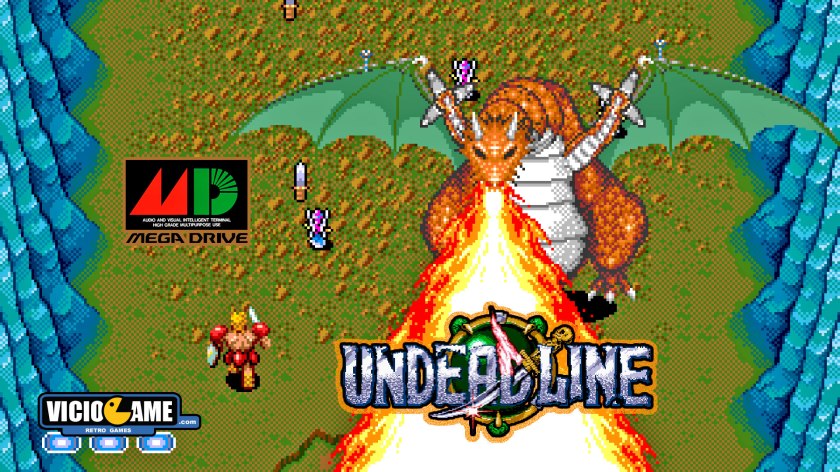
Undead Line is a vertical scrolling shoot ‘em up game released in 1991 for the Mega Drive. An evil being has revived an ancient raging beast. The warrior Leon must find the only divine power capable of stopping this creature and saving the kingdom.
Developer: T&E Soft
Publisher: Palsoft
Release date: 1991
Platform: Sega Mega Drive / Sega Genesis
Undead Line – The Ultimate Guide
Undead Line represents one of the most challenging and unique chapters in the Sega Mega Drive game library, a title that remained exclusively in the Japanese market for decades and earned a legendary reputation both for its extreme difficulty and its dark and unusual theme for the shoot ‘em up genre. Developed by T&E Soft and published by Palsoft on December 20, 1991, the game presents an ambitious fusion between vertical shooter elements and RPG mechanics, creating an experience that challenges genre conventions and tests the limits of even the most experienced players.
The game’s history begins with its origins on the MSX2 computer, where it was originally released on July 22, 1989 by T&E Soft. The success of this initial release led to a conversion for the X68000 on September 14, 1990, which featured significant improvements in graphics and audio, as well as the addition of two extra stages. The Mega Drive version, which arrived about two years after the original release, is a very different adaptation, with changes to the narrative, gameplay, and even the selection of available characters. Unlike the computer versions, which allowed players to choose between three distinct characters, the warrior Leon, the mage Dino, and the ninja Ruika, the Mega Drive version focuses exclusively on Leon as the playable protagonist.
The narrative of the Mega Drive version was reformulated to accommodate this structural change. The kingdom of Zidane, previously protected by barriers that separated it from the demonic world, sees these protections broken, allowing hordes of monsters to invade the territory. Count Brahzen, leader of the demonic forces, invades the kingdom in search of an ancient relic known as the Soul of Roshufa, an artifact that would allow him to revive a supreme weapon capable of guaranteeing his absolute victory. King Fahrenheit II and his forces manage to temporarily repel the invasion, but the threat remains imminent. It is in this context that the monarch entrusts the warrior Leon with the crucial mission of finding the Soul of Roshufa before Brahzen can locate it, a task that will take the protagonist through seven brutal stages filled with supernatural dangers.
The game’s development was led by Tokihiro Naito, designer and director who had already left his mark on the industry through his work on the Hydlide series, including Hydlide and Hydlide 3. The main programming was handled by Tetsuya “Futaro” Yamamoto, while Katsushi Morizane and Shigeru Tomita contributed essential subroutines for the game’s operation. The art direction involved a considerable team of talents, including Etsuko Suzuki, Hideaki Shinmura, Kayoko Miura, Kenji Nakashima, Takahiro Hachiya, Takako Hayase, and Yuuji Hattori, all responsible for creating the characteristic visuals that define the game’s dark atmosphere. The soundtrack was the responsibility of Kazunori Hasegawa, a composer who worked at T&E Soft and managed to create a unique sound identity for the game, moving away from the typical energetic themes of the shoot ‘em up genre to embrace a darker and more atmospheric approach.
A particularly interesting aspect of the development process concerns T&E Soft’s testing philosophy. According to Tetsuya Yamamoto, the company had the peculiar habit of challenging its testers in extreme ways, even going so far as to cut a hole in paper and use it to cover the screen, forcing players to see only a small portion of the playing field at a time. As the testers’ skills naturally improved through repeated practice, the designers responded by progressively increasing the game’s difficulty to keep them under constant pressure. This development methodology resulted in a notoriously challenging title, with enemy movement patterns and spawns meticulously calibrated to offer a severe test of reflexes and skill. This philosophy largely explains why Undead Line developed a reputation as one of the most difficult shoot ‘em ups available on the Sega Genesis.
From a gameplay perspective, Undead Line presents a structure that stands out significantly from conventional shoot ‘em ups. The game adopts a top-down vertical perspective, with the character constantly moving upward through continuously unfolding scenarios. Unlike traditional space games of the genre, where the player controls a ship, here the protagonist is a human character who walks through the battlefield, armed with various weapons and defensive abilities. This design choice brings the game closer to titles like Elemental Master, but with a completely unique visual and thematic identity, focused on gothic horror and dark fantasy instead of the more conventional elements of the genre.
The game’s progression structure has one of its most distinctive features. After starting a game, the player is presented with a stage selection screen where they can choose in which order to face the first six available stages. This freedom of choice is not merely cosmetic, as the difficulty of each stage adjusts dynamically based on the order in which they are played. Stages left for later become more challenging, with more resistant enemies and more complex attack patterns. This mechanic encourages players to experiment with different sequences to discover which stage order best suits their play style and character progression strategy. Completed stages appear in sepia tone on the selection screen and cannot be revisited during the same playthrough, forcing strategic decisions about when to face each challenge.
After completing the six initial stages in any order, the player finally accesses the seventh and final stage, a mysterious castle that leads to the final confrontation against Count Brahzen’s forces. This stage cannot be freely selected and serves as the adventure’s climax, presenting the most intense challenges and the most powerful bosses in the entire game. Progression through this final stage tests everything the player learned in the previous stages, culminating in the confrontation against the Ancient Demon Lord.
The combat system offers the player seven different types of weapons, each with unique characteristics and specific applications. The player always starts equipped with the sword, the most basic weapon in the arsenal. This weapon offers limited attack power but serves as a reliable option when other weapons are unavailable. The throwing knives and axes are weapons that use the ST (strength) attribute as the base for their attack power, being considered the most powerful options when properly developed through the character progression system. These weapons cause significant damage against individual enemies and are particularly effective against bosses.
Magic weapons include the spirit and thunder shot, which use the MP (magic) attribute as their power source. These weapons cannot be fired in rapid-fire mode, but compensate for this limitation through their ability to destroy not only enemies but also their projectiles in a wide area. This defensive characteristic makes them extremely valuable in situations where the battlefield becomes saturated with enemy fire. The boomerang and flamethrower use the DX (dexterity) attribute and offer a unique advantage when fully upgraded, as they gain automatic tracking capability, actively pursuing enemies. This property makes them exceptionally useful for dealing with enemies that move in erratic patterns.
All weapons, with the exception of the basic sword, can be upgraded to three power levels through collecting specific items found in treasure chests scattered throughout the stages. In the Mega Drive version, an additional mechanic allows the player to cycle between different weapons and power-ups by shooting them before collecting them, offering greater control over which equipment to receive. This tactical flexibility is crucial given that the character’s death results in the complete loss of the equipped weapon, forcing the player to restart with the basic sword. This severe penalty dramatically increases the game’s difficulty, as facing the harder stages without a powerful weapon is practically impossible.
The defense system offers three different types of shield-type protection devices. The Iron Ball, which can be used up to three times per playthrough, orbits the character and blocks most enemy attacks and projectiles. However, it disappears after absorbing a certain amount of damage, making it necessary to use this ability strategically. The Barrier functions as temporary protection that blocks one enemy melee attack and up to three enemy projectiles before dissipating. The Blue Potion grants temporary invincibility for a determined period, creating a window of opportunity to traverse particularly hazard-dense sections without taking damage.
In addition to combat items, the game offers various power-ups that affect different aspects of gameplay. Boots increase movement speed for a determined time, facilitating evasion of complex attack patterns. Scoring items come in different forms, including regular points and jewels that contribute to the total score. The 1-UP adds an extra life, an extremely valuable resource given the high difficulty level. Curiously, the game also includes a Red Potion that, contrary to what one would expect, causes damage to the player instead of healing them. This item functions as a trap that punishes careless players who collect all power-ups indiscriminately. The Sword Icon is another counterproductive item, as it returns all equipped weapons to the sword at the lowest level, effectively resetting weapon development progress.
The RPG-based character progression system differentiates Undead Line from other Mega Drive shoot ‘em ups. After defeating each stage’s boss, the player is taken to a parameter allocation screen where they can distribute experience points (EXP) among four main attributes. The ST (strength) attribute increases the attack power of throwing knives and axes. MP (magic) enhances spirits and thunder shots. DX (dexterity) strengthens boomerangs and flamethrowers. Finally, AG (agility) increases the character’s movement speed, allowing more effective evasions and better tactical positioning during battles. The character’s level is determined by the total number of fairies found during the stages, serving as a general indicator of accumulated strength.
Count Brahzen appears multiple times throughout the game, including an intermediate battle in the Cave stage and a final confrontation in the Castle stage. His recurring presence establishes him as the narrative’s central antagonist, with each encounter increasing in intensity and complexity. Curiously, Count Brahzen’s strength in the Cave stage increases based on the character’s level, becoming more difficult if the player chose to complete other stages before facing him. This detail demonstrates the dynamic balancing system that adjusts boss difficulty based on player progression. The Ancient Demon Lord, who awaits at the end of the Castle stage, is the game’s culminating confrontation.
The graphics adopt a gothic aesthetic that stands out from most of the space and military shoot ‘em ups that dominated the Mega Drive. Environments include haunted houses in strange dimensions, sewer systems, rainy cemeteries, and frozen caves, all rendered with a darker and more somber color palette. Enemies fully embrace the theme, including bats, Jason Voorhees-like characters, gargoyles, ghosts, zombies, and Death itself as recurring antagonists. While the theme is a welcome change and the bosses are visually impressive and well-designed, the overall graphics quality remains somewhat lackluster, lacking in detail and color variety.
The soundtrack composed by Kazunori Hasegawa takes a different direction from what is typical in the genre. Instead of energetic and fast-paced tracks that normally accompany shooting games, Hasegawa opted for mid-tempo compositions, minor scales, and melodies that sound sad and melancholic. This choice perfectly suits the game’s horror theme, with certain tracks adapting very well.
The sound effects contribute to the experience, especially during intense moments. The sound of thunder adds atmospheric tension, while the deadly lasers and eye beams from final bosses intensify the pressure during these crucial confrontations. The sound of impacts against enemies offers satisfying feedback that effectively communicates the damage caused. However, the soundtrack, despite being thematically appropriate, lacks that driving energy that many players expect from shoot ‘em ups, which can diminish excitement during prolonged gaming sessions.
The extreme difficulty has become Undead Line‘s main characteristic. This is considered one of the most difficult games on the Mega Drive, a reputation that persists to this day. Even on the easiest difficulty setting, the game presents substantial challenges that can turn away casual players. Games-X magazine specifically mentioned that the difficulty level is a negative aspect. Damian Butt from Sega Pro shared similar sentiments, noting that the high difficulty can prove frustrating for players and criticizing problems with collision detection that exacerbate this frustration.
The problematic collision detection is one of the most consistent technical complaints about the game. Players report situations where the character appears to be hit by projectiles or enemies that visually should not have made contact, or inversely, situations where attacks that appear to have hit enemies do not register damage. This problem makes an already extremely difficult game even more challenging, as it adds an element of unpredictability that cannot be overcome through skill or pattern memorization.
The rarity of Undead Line has become a defining aspect of its legacy. The game never received a release outside Japan during its original era, limiting its distribution and recognition. Original copies of the MSX2 version are rare and command extremely high prices in the secondary collectors’ market, reaching values of hundreds or even thousands of dollars depending on condition. The Mega Drive version, while also rare, is somewhat more accessible, but still a coveted item for dedicated collectors of the console’s Japanese library.
In 2025, Retro-Bit Publishing announced that it was producing an official Collector’s Edition of Undead Line for the Sega Genesis and Mega Drive, marking the first time the game would receive an official release outside Japan. This special edition, which had pre-orders open from July 8 to August 10, 2025, includes an official English translation by Nathan Deren with translations by Jonathan Antonioli. The collector’s edition comes complete with a physical “Midnight Soul” cartridge for American and Japanese consoles, color instruction manual, individually numbered commemorative slipcover, reversible cartridge sleeve featuring exclusive art by Zander Martinez from Zander6comix, and a celebratory art card set also by Martinez.
Comparatively, the game shares conceptual DNA with Twinkle Tale, a vertical shoot ‘em up with RPG elements for the Sega Genesis, but embraces a colorful and charming magical fantasy, being more balanced and less punishing, though still challenging. Both games are rare and collectible, both offer non-linear stage selection, and combine shooting action with character progression. Undead Line was considered at the time as its “evil twin.”
Undead Line remains a game that provokes strong reactions both positive and negative. For players seeking a brutal challenge that tests not only reflexes but also strategic planning and resource management, the game offers an experience that few other console titles can match. Its fusion of shoot ‘em up and RPG mechanics creates a satisfying progression where each completed stage genuinely makes the character stronger, offering a tangible sense of growth that many conventional shoot ‘em ups do not provide. For casual players or those with limited tolerance for frustration, however, the title will likely prove to be a more negative than positive experience. Decades after its original release, Undead Line maintains its status as one of the most challenging games in the Mega Drive library.
Undead Line – O Guia Definitivo
Undead Line representa um dos capítulos mais desafiadores e únicos da biblioteca de jogos do Sega Mega Drive, um título que permaneceu exclusivamente no mercado japonês durante décadas e que conquistou uma reputação lendária tanto por sua dificuldade extrema quanto por sua temática sombria e incomum para o gênero de shoot ‘em up. Desenvolvido pela T&E Soft e publicado pela Palsoft em 20 de dezembro de 1991, o jogo apresenta uma fusão ambiciosa entre elementos de jogos de tiro verticais com mecânicas de RPG, criando uma experiência que desafia as convenções do gênero e testa os limites até mesmo dos jogadores mais experientes.
A história do jogo tem início em suas origens para o computador MSX2, onde foi lançado originalmente em 22 de julho de 1989 pela T&E Soft. O sucesso deste lançamento inicial levou a uma conversão para o X68000 em 14 de setembro de 1990, que apresentava melhorias significativas nos gráficos e no áudio, além da adição de duas fases extras. A versão do Mega Drive, que chegou cerca de dois anos após o lançamento original, sendo uma adaptação bem diferente, com mudanças na narrativa, na jogabilidade e até mesmo na seleção de personagens disponíveis. Diferentemente das versões para computadores, que permitiam aos jogadores escolherem entre três personagens distintos, o guerreiro Leon, o mago Dino e a ninja Ruika, a versão do Mega Drive concentra-se exclusivamente em Leon como protagonista jogável.
A narrativa da versão do Mega Drive foi reformulada para se adequar a essa mudança estrutural. O reino de Zidane, anteriormente protegido por barreiras que o separavam do mundo demoníaco, vê essas proteções serem rompidas, permitindo que hordas de monstros invadam o território. O Conde Brahzen, líder das forças demoníacas, invade o reino em busca de uma relíquia antiga conhecida como a Alma de Roshufa, um artefato que lhe permitiria reviver uma arma suprema capaz de garantir sua vitória absoluta. O Rei Fahrenheit II e suas forças conseguem repelir temporariamente a invasão, mas a ameaça permanece iminente. É neste contexto que o monarca confia ao guerreiro Leon a missão crucial de encontrar a Alma de Roshufa antes que Brahzen possa localizá-la, tarefa que levará o protagonista através de sete fases brutais repletas de perigos sobrenaturais.
O desenvolvimento do jogo foi conduzido por Tokihiro Naito, designer e diretor que já havia deixado sua marca na indústria através de seu trabalho na série Hydlide, incluindo Hydlide e Hydlide 3. A programação principal ficou a cargo de Tetsuya “Futaro” Yamamoto, enquanto Katsushi Morizane e Shigeru Tomita contribuíram com sub-rotinas essenciais para o funcionamento do jogo. A direção artística envolveu um time considerável de talentos, incluindo Etsuko Suzuki, Hideaki Shinmura, Kayoko Miura, Kenji Nakashima, Takahiro Hachiya, Takako Hayase e Yuuji Hattori, todos responsáveis por criar os visuais característicos que definem a atmosfera sombria do título. A trilha sonora ficou sob a responsabilidade de Kazunori Hasegawa, compositor que trabalhou na T&E Soft e que conseguiu criar uma identidade sonora única para o jogo, afastando-se dos típicos temas energéticos do gênero shoot ‘em up para abraçar uma abordagem mais sombria e atmosférica.
Um aspecto particularmente interessante do processo de desenvolvimento diz respeito à filosofia de testes da T&E Soft. Segundo Tetsuya Yamamoto, a empresa tinha o hábito peculiar de desafiar seus testadores de maneira extrema, chegando até mesmo a cortar um buraco em papel e usá-lo para cobrir a tela, forçando os jogadores a enxergarem apenas uma pequena porção do campo de jogo por vez. Conforme as habilidades dos testadores naturalmente melhoravam através da prática repetida, os designers respondiam aumentando progressivamente a dificuldade do jogo para mantê-los sob pressão constante. Esta metodologia de desenvolvimento resultou em um título notoriamente desafiador, com padrões de movimento de inimigos e spawn meticulosamente calibrados para oferecer um teste severo de reflexos e habilidade. Esta filosofia explica em grande parte porque Undead Line desenvolveu uma reputação como um dos shoot ‘em ups mais difíceis disponíveis no Sega Genesis.
Do ponto de vista da jogabilidade, Undead Line apresenta uma estrutura que se destaca significativamente dos shoot ‘em ups convencionais. O jogo adota uma perspectiva vertical de cima para baixo, com o personagem movendo-se constantemente para cima através de cenários que se desenrolam continuamente. Diferentemente de jogos espaciais tradicionais do gênero, onde o jogador controla uma nave, aqui o protagonista é um personagem humano que caminha pelo campo de batalha, armado com diversas armas e habilidades defensivas. Esta escolha de design aproxima o jogo de títulos como Elemental Master, mas com uma identidade visual e temática completamente própria, focada em terror gótico e fantasia sombria ao invés dos elementos mais convencionais do gênero.
A estrutura de progressão do jogo possui uma das suas características mais distintas. Após iniciar uma partida, o jogador é apresentado a uma tela de seleção de fases onde pode escolher em qual ordem deseja enfrentar as primeiras seis fases disponíveis. Esta liberdade de escolha não é meramente cosmética, pois a dificuldade de cada fase se ajusta dinamicamente com base na ordem em que são jogadas. Fases deixadas para o final tornam-se mais desafiadoras, com inimigos mais resistentes e padrões de ataque mais complexos. Esta mecânica encoraja os jogadores a experimentarem diferentes sequências para descobrir qual ordem de fases melhor se adapta ao seu estilo de jogo e estratégia de progressão de personagem. As fases completadas aparecem em tom sépia na tela de seleção e não podem ser revisitadas durante a mesma partida, forçando decisões estratégicas sobre quando enfrentar cada desafio.
Após completar as seis fases iniciais em qualquer ordem, o jogador finalmente acessa a sétima e última fase, um castelo misterioso que direciona para o confronto final contra as forças do Conde Brahzen. Esta fase não pode ser selecionada livremente e serve como o clímax da aventura, apresentando os desafios mais intensos e os chefes mais poderosos do jogo inteiro. A progressão através desta fase final testa tudo que o jogador aprendeu nas fases anteriores, culminando no confronto contra o Ancient Demon Lord.
O sistema de combate oferece ao jogador sete tipos diferentes de armas, cada uma com características únicas e aplicações específicas. O jogador sempre começa equipado com a espada, a arma mais básica do arsenal. Esta arma oferece poder de ataque limitado mas serve como uma opção confiável quando outras armas não estão disponíveis. As facas de arremesso e os machados são armas que utilizam o atributo ST (força) como base para seu poder de ataque, sendo consideradas as opções mais poderosas quando adequadamente desenvolvidas através do sistema de progressão de personagem. Estas armas causam dano significativo contra inimigos individuais e são particularmente eficazes contra chefes.
As armas mágicas incluem o espírito e o disparo de trovão, que utilizam o atributo MP (magia) como fonte de poder. Estas armas não podem ser disparadas em modo de tiro rápido, mas compensam esta limitação através de sua capacidade de destruir não apenas inimigos mas também seus projéteis em uma área ampla. Esta característica defensiva as torna extremamente valiosas em situações onde o campo de batalho fica saturado com disparos inimigos. O bumerangue e o lança-chamas utilizam o atributo DX (destreza) e oferecem uma vantagem única quando completamente aprimorados, pois ganham capacidade de rastreamento automático, perseguindo inimigos ativamente. Esta propriedade os torna excepcionalmente úteis para lidar com inimigos que se movem em padrões erráticos.
Todas as armas, com exceção da espada básica, podem ser aprimoradas até três níveis de poder através da coleta de itens específicos encontrados em baús de tesouro espalhados pelas fases. Na versão do Mega Drive, uma mecânica adicional permite ao jogador ciclar entre diferentes armas e power-ups atirando neles antes de coletá-los, oferecendo maior controle sobre qual equipamento receber. Esta flexibilidade tática é crucial dado que a morte do personagem resulta na perda completa da arma equipada, forçando o jogador a recomeçar com a espada básica. Esta penalidade severa aumenta drasticamente a dificuldade do jogo, pois enfrentar as fases mais difíceis sem uma arma poderosa é praticamente impossível.
O sistema de defesa oferece três tipos diferentes de dispositivos de proteção do tipo escudo. O Iron Ball, que pode ser usado até três vezes por partida, orbita o personagem e bloqueia a maioria dos ataques inimigos e projéteis. No entanto, ele desaparece após absorver uma certa quantidade de dano, tornando necessário usar esta habilidade de forma estratégica. O Barrier funciona como uma proteção temporária que bloqueia um ataque corpo a corpo de inimigo e até três projéteis inimigos antes de se dissipar. A Blue Potion concede invencibilidade temporária por um período determinado, criando uma janela de oportunidade para atravessar seções particularmente densas em perigos sem sofrer dano.
Além dos itens de combate, o jogo oferece diversos power-ups que afetam diferentes aspectos da jogabilidade. As Boots aumentam a velocidade de movimento por um tempo determinado, facilitando a evasão de padrões de ataque complexos. Os itens de pontuação vêm em diferentes formas, incluindo pontos regulares e joias que contribuem para a pontuação total. O 1-UP adiciona uma vida extra, recurso extremamente valioso dado o alto nível de dificuldade. Curiosamente, o jogo também inclui uma Red Potion que, ao contrário do que se esperaria, causa dano ao jogador ao invés de curá-lo. Este item funciona como uma armadilha que pune jogadores descuidados que coletam todos os power-ups indiscriminadamente. O Sword Icon é outro item contraproducente, pois retorna todas as armas equipadas para a espada no nível mais baixo, efetivamente resetando o progresso de desenvolvimento de armamento.
O sistema de progressão de personagem baseado em RPG diferencia Undead Line de outros shoot ‘em ups do Mega Drive. Após derrotar o chefe de cada fase, o jogador é levado a uma tela de alocação de parâmetros onde pode distribuir pontos de experiência (EXP) entre quatro atributos principais. O atributo ST (força) aumenta o poder de ataque das facas de arremesso e machados. O MP (magia) potencializa os espíritos e disparos de trovão. O DX (destreza) fortalece os bumerangues e lança-chamas. Finalmente, o AG (agilidade) aumenta a velocidade de movimento do personagem, permitindo evasões mais eficazes e melhor posicionamento tático durante as batalhas. O nível do personagem é determinado pelo número total de fadas encontradas durante as fases, servindo como indicador geral da força acumulada.
O Conde Brahzen aparece múltiplas vezes ao longo do jogo, incluindo uma batalha intermediária na fase Cave e um confronto final na fase Castle. Sua presença recorrente estabelece-o como o antagonista central da narrativa, com cada encontro aumentando em intensidade e complexidade. Curiosamente, a força do Conde Brahzen na fase Cave aumenta com base no nível do personagem, tornando-se mais difícil se o jogador escolheu completar outras fases antes de enfrentá-lo. Este detalhe demonstra o sistema de balanceamento dinâmico que ajusta a dificuldade dos chefes baseado na progressão do jogador. O Ancient Demon Lord, que aguarda no final da fase Castle, é o confronto culminante do jogo.
Os gráficos adotam uma estética gótica que se destaca da maioria dos shoot ‘em ups espaciais e militares que dominavam o Mega Drive. Os ambientes incluem casas mal-assombradas em dimensões estranhas, sistemas de esgoto, cemitérios chuvosos e cavernas geladas, todos renderizados com uma paleta de cores mais escura e sombria. Os inimigos abraçam completamente a temática, incluindo morcegos, personagens semelhantes a Jason Voorhees, gárgulas, fantasmas, zumbis e a própria Morte como antagonistas recorrentes. Embora a temática seja uma mudança bem-vinda e os chefes sejam visualmente impressionantes e bem projetados, a qualidade geral dos gráficos permanece algo sem brilho, carente de detalhes e variedade de cores.
A trilha sonora composta por Kazunori Hasegawa toma uma direção diferente do que é típico no gênero. Ao invés de faixas energéticas e aceleradas que normalmente acompanham jogos de tiro, Hasegawa optou por composições em tempo médio, escalas menores e melodias que soam tristes e melancólicas. Esta escolha adequa-se perfeitamente à temática de terror do jogo, com certas faixas adaptando-se muito bem.
Os efeitos sonoros contribuem para a experiência, principalmente durante momentos intensos. O som dos trovões adiciona tensão atmosférica, enquanto os lasers mortais e raios oculares dos chefes finais intensificam a pressão durante esses confrontos cruciais. O som dos impactos contra inimigos oferece feedback satisfatório que comunica efetivamente o dano causado. No entanto, a trilha sonora, apesar de apropriada tematicamente, carece daquela energia propulsora que muitos jogadores esperam de shoot ‘em ups, o que pode diminuir a excitação durante sessões prolongadas de jogo.
A dificuldade extrema tornou-se a principal característica de Undead Line. Este é considerado um dos jogos mais difíceis do Mega Drive, uma reputação que persiste até hoje. Mesmo na configuração de dificuldade mais fácil, o jogo apresenta desafios substanciais que podem afastar jogadores casuais. A revista Games-X especificamente mencionou que o nível de dificuldade é um aspecto negativo. Damian Butt da Sega Pro compartilhou sentimentos similares, observando que a alta dificuldade pode se mostrar frustrante para os jogadores e criticando problemas com a detecção de colisão que exacerbam essa frustração.
A detecção de colisão problemática é uma das queixas técnicas mais consistentes sobre o jogo. Jogadores reportam situações onde o personagem parece ser atingido por projéteis ou inimigos que visualmente não deveriam ter feito contato, ou inversamente, situações onde ataques que parecem ter acertado os inimigos não registram dano. Este problema torna um jogo já extremamente difícil ainda mais desafiador, pois adiciona um elemento de imprevisibilidade que não pode ser superado através de habilidade ou memorização de padrões.
A raridade de Undead Line tornou-se um aspecto definidor de seu legado. O jogo nunca recebeu lançamento fora do Japão durante sua época original, limitando sua distribuição e reconhecimento. Cópias originais da versão MSX2 são raras e comandam preços extremamente altos no mercado secundário de colecionadores, atingindo valores de centenas ou até milhares de dólares dependendo da condição. A versão do Mega Drive, embora também rara, é um pouco mais acessível, mas ainda um item cobiçado para colecionadores dedicados da biblioteca japonesa do console.
Em 2025 a Retro-Bit Publishing anunciou que estava produzindo uma Collector’s Edition oficial de Undead Line para o Sega Genesis e Mega Drive, marcando a primeira vez que o jogo receberia um lançamento oficial fora do Japão. Esta edição especial, que teve pré-vendas abertas de 8 de julho a 10 de agosto de 2025, inclui uma tradução oficial para inglês realizada por Nathan Deren com traduções de Jonathan Antonioli. A edição de colecionador vem completa com um cartucho físico “Midnight Soul” para consoles americanos e japoneses, manual de instruções em cores, slipcover comemorativa numerada individualmente, sleeve reversível para o cartucho apresentando arte exclusiva de Zander Martinez da Zander6comix, e um set de art cards celebratório também de Martinez.
Comparativamente, o jogo compartilha DNA conceitual com Twinkle Tale, um shoot ‘em up vertical com elementos de RPG para o Sega Genesis, mas abraça uma fantasia mágica colorida e encantadora, sendo mais equilibrado e menos punitivo, embora ainda desafiador. Ambos os jogos são raros e colecionáveis, ambos oferecem seleção não-linear de fases, e combinam ação de tiro com progressão de personagem. Undead Line foi considerado na época como seu “gêmeo do mal”.
Undead Line permanece um jogo que provoca reações fortes tanto positivas quanto negativas. Para jogadores que procuram um desafio brutal que testa não apenas reflexos mas também planejamento estratégico e gerenciamento de recursos, o jogo oferece uma experiência que poucos outros títulos do console podem igualar. Sua fusão de mecânicas de shoot ‘em up e RPG cria uma progressão satisfatória onde cada fase completada genuinamente torna o personagem mais forte, oferecendo uma sensação tangível de crescimento que muitos shoot ‘em ups convencionais não proporcionam. Para jogadores casuais ou aqueles com tolerância limitada para frustração, no entanto, o título provavelmente provará ser uma experiência mais negativa do que positiva. Décadas após seu lançamento original, Undead Line mantém seu status como um dos jogos mais desafiadores da biblioteca do Mega Drive.
🤑💲Earn money without doing anything! Just leave these apps open:
✓ https://r.honeygain.me/CONTA9DB02
✓ https://packetstream.io/?psr=1uPb
🤑💲1-Click button earns Bitcoin every 1 hour: https://freebitco.in/?r=53528449
⬛ 𝗧𝗶𝗸𝗧𝗼𝗸: https://www.tiktok.com/@viciogame
🟧 𝗜𝗻𝘀𝘁𝗮𝗴𝗿𝗮𝗺: http://www.instagram.com/viciogame
🟥 𝗬𝗼𝘂𝘁𝘂𝗯𝗲: http://www.youtube.com/viciogame
🟦 𝗙𝗮𝗰𝗲𝗯𝗼𝗼𝗸: http://www.facebook.com/viciogame
🔳 𝗧𝗵𝗿𝗲𝗮𝗱𝘀: https://www.threads.net/@viciogame
🟪 𝗧𝘄𝗶𝘁𝗰𝗵: https://www.twitch.tv/ViciogameRetroGames
🟨 𝗕𝗹𝗼𝗴: http://www.viciogameblog.com/
🟦𝗧𝘄𝗶𝘁𝘁𝗲𝗿: http://www.twitter.com/viciogame
#Viciogame #Gameplay #LetsPlay #Playthrough #Games #Gaming #Videogames #Review #Game #Detonado #Walkthrough #Ending #Reviews #Facts #Retro #RetroGaming #Roms #Emulator #Longplay #Speedrun #NoCommentary #UndeadLine #MegaDrive #SegaGenesis #ShootEmUp #Sega #Genesis #MSX #Hydlide #TwinkleTale #メガドライブ #セガ #アンデッドライン
 VICIOGAME