
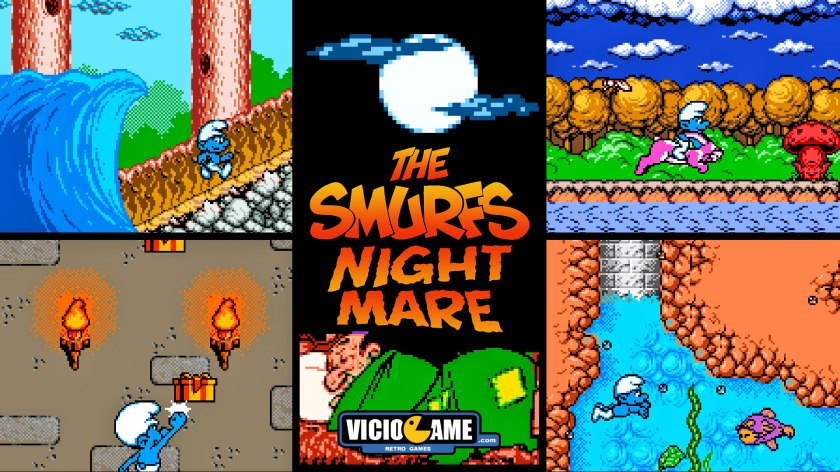
The Smurfs’ Nightmare is a 2D platform game released in 1999 for the Game Boy Color. Gargamel created a spell that trapped the Smurfs in their dreams, turning them into each one’s personal nightmare. Hefty Smurf is the only one who was awake, and able to undo the spell to free his friends.
Developer: Velez & Dubail
Publisher: Infogrames
Release date: 1999
Platform: Nintendo Game Boy Color
The Smurfs’ Nightmare – The Ultimate Guide
The Smurfs’ Nightmare represents the third chapter in the Smurfs game trilogy developed by Velez & Dubail and published by Infogrames for Nintendo handheld systems. Originally released on December 18, 1997 for the Game Boy in Europe, the game later received an exclusive Game Boy Color version on February 28, 1999 in the United States and February 11, 1999 in Europe, marking its entry into the North American market. This title brings a unique premise to the series, with a darker theme.
The narrative of The Smurfs’ Nightmare establishes a different atmosphere from previous games in the series. The story begins when Gargamel, the eternal antagonist of the Smurfs, finally manages to execute a devastating plan. During a particularly sinister night, under the influence of a full moon, the wizard casts a spell that traps all the Smurfs in their own homes, plunging them into distorted dream worlds that represent their deepest fears. Having insomnia, Hefty Smurf remains immune to the spell. This immunity places him as the only one capable of traversing the nightmare portals and rescuing each of his companions. The premise establishes a slightly darker tone than previous titles, exploring themes of fears and anxieties, while maintaining the colorful and accessible presentation characteristic of the franchise.
The game’s structure is organized in a semi-non-linear fashion through Smurf Village, which functions as the central hub. From the beginning, the player can walk through the village and see all six mushroom-shaped houses that need to be explored, as well as three of the four characters or objects that grant access to special bonus sequences. However, progression is controlled by a key system: each house requires a specific key to be unlocked, and these keys are obtained sequentially by completing previous houses. The first available key only unlocks the first house on the left, forcing a specific exploration order. This structure creates an illusion of freedom while keeping the player on a predetermined path.
Each of the six houses contains two main platforming levels, representing different aspects of the nightmare of the Smurf who lives there. The environments are thematically distinct and progressively more challenging. The first house presents “The Kitchen of Danger,” where common household utensils become threatening obstacles in an environment that distorts the scale and functionality of everyday objects. This initial stage establishes the recurring objective of finding a specific item, in this case a carrot, which must be located to complete the level. The sequence of stages includes “The Library of Fear,” where Brainy Smurf finds himself trapped in a labyrinth of distorted knowledge, “Mysterious Planet,” which transports the player to an alien space setting, “Haunted Manor,” featuring gothic and supernatural elements, “Workbench Gone Mad,” where tools and construction materials come to life, and finally “Laboratory of Hell,” culminating the experience with scientific experiments gone out of control.
Hefty Smurf moves through a side-scrolling perspective, navigating platforms, avoiding obstacles and eliminating enemies. The controls use the directional pad for movement and crouching, the A button for jumps, and the B button for contextual interactions like opening dialogues or operating levers. There is also a double jump mechanism: by touching the jump button twice quickly, Hefty executes a higher jump.
Sarsaparilla leaves function as the game’s central collectibles, serving multiple purposes. First, collecting all the leaves in a level guarantees access to a bonus minigame at the end of the stage. Additionally, these leaves permanently increase Hefty’s double jump capacity, allowing him to reach higher areas. This system creates an incentive for complete exploration and replayability, as some areas may be inaccessible on a first playthrough without enough leaves, forcing the player to revisit previous locations.
Combat is restricted to a single mechanic: jumping on enemies’ heads to eliminate them, following the tradition established by classics like Super Mario Bros. The game offers no direct attacks or permanent weapons, keeping the gameplay simple and accessible. Enemies vary in appearance depending on the environment, from anthropomorphized kitchen objects in the first stage to alien creatures on the mysterious planet. Some enemies follow predictable movement patterns, while others react to Hefty’s presence. The absence of elaborate bosses at the end of each stage is a limitation, with levels ending after the player reaches a specific point or collects a designated item.
The power-up system temporarily enriches Hefty’s abilities through colored potions distributed throughout the stages. Red potions restore energy hearts, essential for recovering from damage taken. Blue potions grant temporary invulnerability, allowing Hefty to cross dangerous sections without taking damage. Green potions freeze all enemies on screen for a limited period, facilitating navigation in densely populated areas. There is also a special potion that adds an extra heart to Hefty’s maximum energy bar, increasing his survival capacity. These power-ups are not abundant, requiring the player to manage resources and carefully plan when to use them.
The Smurfs’ Nightmare implements expanded mobility elements through temporary and permanent items. Soap bubbles appear in certain sections, allowing Hefty to float up to elevated platforms that would otherwise be inaccessible. At specific moments, the player can acquire wings that grant temporary flight capability, offering greater control over aerial movement. A rocket is also available in certain stages, propelling Hefty vertically. These mobility mechanics break the monotony of constant horizontal progression, introducing segments of vertical navigation and three-dimensional exploration within the 2D space.
The stages of The Smurfs’ Nightmare incorporate puzzle elements through environmental manipulation. Levers must be activated to open passages or change platform configurations. Objects can be pushed to create improvised stairs or block dangerous mechanisms. Packages scattered throughout the scenarios can be opened to reveal useful items or collectibles. Moving platforms, including rotating plates and spiral elevators, require precise timing for safe navigation. These mechanics, while not extremely complex, add variety to the gameplay and prevent the game from becoming a simple left-to-right race.
Between main stages, The Smurfs’ Nightmare offers four bonus minigames that can be accessed through the village. “The Bottomless Well” places Hefty in a swimming sequence, where the player must descend through an aquatic well, avoiding obstacles and collecting items. “The Flood Wave” presents a race against a giant wave, with Hefty using springs to jump and stay ahead of the destructive water. “The Mole’s Burrow” allows the player to ride a mole and navigate through underground tunnels at high speed. “The Rabbit Ride” places Hefty on a bouncing rabbit in a forced-scrolling race, where quick reflexes are essential to avoid obstacles. Completing these minigames grants bonus points to the player’s total score, although they are not essential for main progression.
A special bonus minigame appears at the end of certain stages when the player has collected all available leaves. This simplistic minigame requires the player to move Hefty laterally while pressing the punch button to capture objects falling from the top of the screen. While extremely simple and unrewarding, this bonus offers an additional opportunity to increase the score.
Graphically, The Smurfs’ Nightmare was specifically designed to take advantage of the Game Boy Color’s capabilities. Although it was first released on the monochromatic console, from its original conception, it was specially designed to have colors. The sprites are impressively large by the system’s standards, with Hefty occupying generous proportions of the screen and presenting fluid animations for running, jumping, and idle states. Enemies display varied and often bizarre designs, appropriate to the nightmare theme, with animations that convey personality despite technical limitations. The background scenery stands out as one of the game’s visual strengths: in addition to being rich in vibrant colors and details, they implement parallax scrolling in multiple layers, creating an impression of depth rarely seen in handheld titles. Some scenarios extend horizontally for considerable distances, demonstrating technical ambition in utilizing the hardware.
The visual differences between the Game Boy and Game Boy Color versions go beyond simply adding colors. The original monochromatic version implements fade in and fade out effects on most screen transitions, while the color version eliminated these effects, opting for instant transitions. This change aims to improve gameplay flow, reducing unnecessary interruptions. Another visual change occurred specifically in Smurf Village: the dam at the end of the area is wider in the original version, causing unwanted overlap with Hefty’s sprite. A bush is also positioned in the foreground, overlapping the character during jumps. In the Game Boy Color version, the dam was shortened and the extended bush was repositioned in the background, correcting these visual collision issues.
The audio for The Smurfs’ Nightmare was composed by Alberto J. González (also known as McAlby), who had previously worked on another Smurfs game for Game Boy. The complete soundtrack demonstrates an understanding of the portable hardware’s technical limitations, composing melodies that remain distinct despite audio channel restrictions. González revealed in notes about the soundtrack that the main menu theme was the same one he had composed for another franchise title, indicating reuse of musical assets. Sound effects adequately accompany the game’s actions, with distinct sounds for jumps, item collection, damage taken, and enemy elimination. The overall audio is functional, without being impressive or innovative.
A special level select code is available on the title screen. Simply press the sequence: Left, Up, Down, Down, Right, Up, Left. A confirmation sound indicates correct code entry. After starting the game with the code activated, pressing the Select button during gameplay allows you to advance to the next stage immediately.
The legacy of The Smurfs’ Nightmare includes a particularly bizarre historical curiosity. The game became one of the first Game Boy Color titles to be hacked and sold as piracy disguised as a Pokémon game, specifically under the title “Monster Go! Go! Go!”. In this pirated version, Gargamel was replaced by Meowth (who speaks a bizarre language including lyrics from the Titanic song “My Heart Will Go On”), and the playable Smurf character was swapped for Pikachu. Other Pokémon, like Bellsprout, make appearances as enemies.
The Smurfs’ Nightmare’s position as the third game in Infogrames’ Smurfs trilogy for Game Boy is contextually important. The first title, simply called The Smurfs, established the franchise on Nintendo’s handheld. The second game in the trilogy, curiously, was not released outside of Europe, creating a gap in the series for North American audiences. Consequently, when The Smurfs’ Nightmare arrived in the United States as a Game Boy Color exclusive, the startup screen was modified to remove the multilingual numbering that identified it as the third game, referring to it simply as “The Smurfs’ Nightmare” in English. This editorial decision aimed to avoid confusion among North American consumers who had never had access to the second title.
The Smurfs’ Nightmare occupies a particular space in the history of licensed games. It doesn’t achieve the greatness that could have made it a lasting classic, but it also avoids being a technical or conceptual disaster. It exists comfortably in the middle ground, offering a competent yet uninspired experience that adequately served its purpose and audience at the time of release. It represents a window into a different era of game development, when popular licenses could generate modest titles that met basic expectations without necessarily redefining genres or creating unforgettable experiences.
The Smurfs’ Nightmare – O Guia Definitivo
The Smurfs’ Nightmare representa o terceiro capítulo da trilogia de jogos dos Smurfs desenvolvida pela Velez & Dubail e publicada pela Infogrames para os portáteis da Nintendo. Lançado originalmente em 18 de dezembro de 1997 para o Game Boy na Europa, o jogo posteriormente recebeu uma versão exclusiva para Game Boy Color em 28 de fevereiro de 1999 nos Estados Unidos e em 11 de fevereiro de 1999 na Europa, marcando sua entrada no mercado norte-americano. Este título traz uma premissa única na série, com temática mais sombria.
A narrativa de The Smurfs’ Nightmare estabelece uma atmosfera diferente dos jogos anteriores da série. A história começa quando Gargamel, o eterno antagonista dos Smurfs, consegue finalmente executar um plano devastador. Durante uma noite particularmente sinistra, sob a influência de uma lua cheia, o mago lança um encantamento que aprisiona todos os Smurfs em suas próprias casas, mergulhando-os em mundos distorcidos dos sonhos que representam seus medos mais profundos. Por ter insônia, Hefty Smurf permanece imune ao feitiço. Esta imunidade o coloca como o único capaz de atravessar os portais dos pesadelos e resgatar cada um de seus companheiros. A premissa estabelece um tom levemente mais sombrio que os títulos anteriores, explorando temas de pesados e ansiedades, ainda que mantendo a apresentação colorida e acessível característica da franquia.
A estrutura do jogo organiza-se de forma semi-não-linear através da Vila dos Smurfs, que funciona como hub central. Desde o início, o jogador pode caminhar pela vila e avistar todas as seis casas em formato de cogumelo que precisam ser exploradas, além de três dos quatro personagens ou objetos que concedem acesso às sequências especiais de bônus. Entretanto, a progressão é controlada por um sistema de chaves: cada casa requer uma chave específica para ser desbloqueada, e estas chaves são obtidas sequencialmente ao completar as casas anteriores. A primeira chave disponível desbloqueia apenas a primeira casa à esquerda, forçando uma ordem específica de exploração. Esta estrutura cria uma ilusão de liberdade enquanto mantém o jogador em um caminho predeterminado.
Cada uma das seis casas contém dois níveis principais de plataforma, representando diferentes aspectos do pesadelo do Smurf que ali habita. Os ambientes são tematicamente distintos e progressivamente mais desafiadores. A primeira casa apresenta “The Kitchen of Danger”, onde utensílios domésticos comuns tornam-se obstáculos ameaçadores em um ambiente que distorce a escala e a funcionalidade dos objetos cotidianos. Esta fase inicial estabelece o objetivo recorrente de encontrar um item específico, neste caso uma cenoura, que deve ser localizada para completar o nível. A sequência de fases inclui “The Library of Fear”, onde Brainy Smurf encontra-se preso em um labirinto de conhecimento distorcido, “Mysterious Planet”, que transporta o jogador para um cenário espacial alienígena, “Haunted Manor”, apresentando elementos góticos e sobrenaturais, “Workbench Gone Mad”, onde ferramentas e materiais de construção ganham vida própria, e finalmente “Laboratory of Hell”, culminando a experiência com experimentos científicos fora de controle.
Hefty Smurf movimenta-se através de perspectiva em rolagem lateral, navegando por plataformas, evitando obstáculos e eliminando inimigos. Os controles utilizam o direcional para movimento e agachamento, o botão A para saltos e o botão B para interações contextuais como abrir diálogos ou operar alavancas. Há também um mecanismo de salto duplo: ao tocar o botão de salto duas vezes rapidamente, Hefty executa um salto mais alto.
As folhas de salsaparrilha funcionam como colecionáveis centrais do jogo, servindo múltiplos propósitos. Primeiramente, coletar todas as folhas em um nível garante acesso a um minijogo de bônus ao final da fase. Além disso, estas folhas aumentam permanentemente a capacidade de salto duplo de Hefty, permitindo que ele alcance áreas mais elevadas. Este sistema cria um incentivo para exploração completa e rejogabilidade, pois algumas áreas podem ser inacessíveis em uma primeira passagem sem folhas suficientes, forçando o jogador a revisitar locais anteriores.
O combate restringe-se a uma única mecânica: saltar sobre as cabeças dos inimigos para eliminá-los, seguindo a tradição estabelecida por clássicos como Super Mario Bros. O jogo não oferece ataques diretos ou armas permanentes, mantendo a jogabilidade simples e acessível. Os inimigos variam em aparência dependendo do ambiente, desde objetos de cozinha antropomorfizados na primeira fase até criaturas alienígenas no planeta misterioso. Alguns inimigos seguem padrões de movimento previsíveis, enquanto outros reagem à presença de Hefty. A ausência de chefes elaborados ao final de cada fase é uma limitação, com os níveis terminando após o jogador alcançar um ponto específico ou coletar um item designado.
O sistema de power-ups enriquece temporariamente as capacidades de Hefty através de poções coloridas distribuídas pelas fases. As poções vermelhas restauram corações de energia, essenciais para recuperar-se dos danos sofridos. As poções azuis concedem invulnerabilidade temporária, permitindo que Hefty atravesse seções perigosas sem sofrer danos. As poções verdes congelam todos os inimigos na tela por um período limitado, facilitando a navegação em áreas densamente populadas. Existe ainda uma poção especial que adiciona um coração extra à barra de energia máxima de Hefty, aumentando sua capacidade de sobrevivência. Estes power-ups não são abundantes, exigindo que o jogador gerencie recursos e planeje cuidadosamente quando utilizá-los.
The Smurfs’ Nightmare implementa elementos de mobilidade expandida através de itens temporários e permanentes. Bolhas de sabão aparecem em certas seções, permitindo que Hefty flutue até plataformas elevadas que seriam de outra forma inacessíveis. Em momentos específicos, o jogador pode adquirir asas que garantem capacidade de voo temporário, oferecendo maior controle sobre a movimentação aérea. Um foguete também está disponível em determinadas fases, propulsionando Hefty verticalmente. Estas mecânicas de mobilidade quebram a monotonia da progressão horizontal constante, introduzindo segmentos de navegação vertical e exploração tridimensional dentro do espaço 2D.
As fases de The Smurfs’ Nightmare incorporam elementos de quebra-cabeça através da manipulação ambiental. Alavancas devem ser ativadas para abrir passagens ou alterar configurações de plataformas. Objetos podem ser empurrados para criar escadas improvisadas ou bloquear mecanismos perigosos. Pacotes espalhados pelos cenários podem ser abertos para revelar itens úteis ou colecionáveis. Plataformas móveis, incluindo pratos giratórios e elevadores em espiral, exigem timing preciso para navegação segura. Estas mecânicas, embora não extremamente complexas, adicionam variedade à jogabilidade e impedem que o jogo se torne uma simples corrida da esquerda para a direita.
Entre as fases principais, The Smurfs’ Nightmare oferece quatro minijogos de bônus que podem ser acessados através da vila. “The Bottomless Well” coloca Hefty em uma sequência de natação, onde o jogador deve descer por um poço aquático, evitando obstáculos e coletando itens. “The Flood Wave” apresenta uma corrida contra uma onda gigante, com Hefty utilizando molas para saltar e manter-se à frente da água destrutiva. “The Mole’s Burrow” permite que o jogador monte uma toupeira e navegue por túneis subterrâneos em alta velocidade. “The Rabbit Ride” coloca Hefty sobre um coelho saltitante em uma corrida de scrolling forçado, onde reflexos rápidos são essenciais para evitar obstáculos. Completar estes minijogos concede pontos de bônus ao score total do jogador, embora não sejam essenciais para a progressão principal.
Um minijogo especial de bônus aparece ao final de certas fases quando o jogador coletou todas as folhas disponíveis. Este minijogo simplista requer que o jogador mova Hefty lateralmente enquanto pressiona o botão de soco para capturar objetos que caem do topo da tela. Embora extremamente simples e pouco gratificante, este bônus oferece uma oportunidade adicional de aumentar a pontuação.
Graficamente, The Smurfs’ Nightmare foi projetado especificamente para aproveitar as capacidades do Game Boy Color. Embora tenha sido lançado primeiro no console monocromático, desde sua concepção original, foi pensado especialmente para ter cores. Os sprites são impressionantemente grandes para os padrões do sistema, com Hefty ocupando proporções generosas da tela e apresentando animações fluidas para corrida, salto e em espera. Os inimigos exibem designs variados e muitas vezes bizarros, adequados à temática de pesadelos, com animações que transmitem personalidade apesar das limitações técnicas. Os cenários de fundo destacam-se como um dos pontos fortes visuais do jogo: além de serem ricos em cores vibrantes e detalhes, implementam parallax scrolling em múltiplas camadas, criando impressão de profundidade raramente vista em títulos do portátil. Alguns cenários estendem-se horizontalmente por distâncias consideráveis, demonstrando ambição técnica na utilização do hardware.
As diferenças visuais entre as versões Game Boy e Game Boy Color vão além da simples adição de cores. A versão monocromática original implementa efeitos de fade in e fade out na maioria das transições entre telas, enquanto a versão colorida eliminou estes efeitos, optando por transições instantâneas. Esta mudança visa melhorar o fluxo da jogabilidade, reduzindo interrupções desnecessárias. Outra alteração visual ocorreu especificamente na Vila dos Smurfs: a represa ao final da área é mais larga na versão original, causando sobreposição indesejada com o sprite de Hefty. Um arbusto também é posicionado em primeiro plano, sobrepondo o personagem durante saltos. Na versão Game Boy Color, a represa foi encurtada e o arbusto estendido foi reposicionado no fundo, corrigindo estas questões de colisão visual.
O áudio de The Smurfs’ Nightmare foi composto por Alberto J. González (também conhecido como McAlby), que havia previamente trabalhado em outro jogo dos Smurfs para Game Boy. A trilha sonora completa demonstra compreensão das limitações técnicas do hardware portátil, compondo melodias que permanecem distintas apesar das restrições de canais de áudio. González revelou em notas sobre a trilha sonora que o tema do menu principal era o mesmo que havia composto para outro título da franquia, indicando reutilização de assets musicais. Os efeitos sonoros acompanham adequadamente as ações do jogo, com sons distintos para saltos, coletas de itens, dano recebido e eliminação de inimigos. O áudio geral é funcional, sem ser impressionante ou inovador.
Um código especial de seleção de fases está disponível na tela título. Basta pressionar a sequência: Esquerda, Cima, Baixo, Baixo, Direita, Cima, Esquerda. Um som de confirmação indica entrada correta do código. Após iniciar o jogo com o código ativado, pressionar o botão Select durante o jogo permite avançar para a próxima fase imediatamente.
O legado de The Smurfs’ Nightmare inclui uma curiosidade histórica particularmente bizarra. O jogo tornou-se um dos primeiros títulos do Game Boy Color a ser hackeado e vendido como pirataria disfarçada de jogo Pokémon, especificamente sob o título “Monster Go! Go! Go!“. Nesta versão pirata, Gargamel foi substituído por Meowth (que profere um idioma bizarro incluindo letras da música de Titanic “My Heart Will Go On”), e o personagem jogável Smurf foi trocado por Pikachu. Outros Pokémon, como Bellsprout, fazem aparições como inimigos.
A posição de The Smurfs’ Nightmare como terceiro jogo da trilogia Smurfs da Infogrames para Game Boy é contextualmente importante. O primeiro título, simplesmente chamado The Smurfs, estabeleceu a franquia no portátil da Nintendo. O segundo jogo da trilogia, curiosamente, não foi lançado fora da Europa, criando lacuna na série para audiências norte-americanas. Consequentemente, quando The Smurfs’ Nightmare chegou aos Estados Unidos como exclusivo de Game Boy Color, a tela de inicialização foi modificada para remover a numeração multilíngue que o identificava como terceiro jogo, referindo-se a ele simplesmente como “The Smurfs’ Nightmare” em inglês. Esta decisão editorial visava evitar confusão entre consumidores norte-americanos que nunca haviam tido acesso ao segundo título.
The Smurfs’ Nightmare ocupa espaço particular na história dos jogos licenciados. Não alcança grandeza que poderia tê-lo tornado clássico duradouro, mas evita também ser desastre técnico ou conceitual. Existe confortavelmente no meio termo, oferecendo experiência competente porém não inspirada que serviu adequadamente a seu propósito e audiência no momento de lançamento. Representa janela para uma época diferente de desenvolvimento de jogos, quando licenças populares podiam gerar títulos modestos que cumpriam expectativas básicas sem necessariamente redefinir gêneros ou criar experiências inesquecíveis.
🤑💲Earn money without doing anything! Just leave these apps open:
✓ https://r.honeygain.me/CONTA9DB02
✓ https://packetstream.io/?psr=1uPb
🤑💲1-Click button earns Bitcoin every 1 hour: https://freebitco.in/?r=53528449
⬛ 𝗧𝗶𝗸𝗧𝗼𝗸: https://www.tiktok.com/@viciogame
🟧 𝗜𝗻𝘀𝘁𝗮𝗴𝗿𝗮𝗺: http://www.instagram.com/viciogame
🟥 𝗬𝗼𝘂𝘁𝘂𝗯𝗲: http://www.youtube.com/viciogame
🟦 𝗙𝗮𝗰𝗲𝗯𝗼𝗼𝗸: http://www.facebook.com/viciogame
🔳 𝗧𝗵𝗿𝗲𝗮𝗱𝘀: https://www.threads.net/@viciogame
🟪 𝗧𝘄𝗶𝘁𝗰𝗵: https://www.twitch.tv/ViciogameRetroGames
🟨 𝗕𝗹𝗼𝗴: http://www.viciogameblog.com/
🟦𝗧𝘄𝗶𝘁𝘁𝗲𝗿: http://www.twitter.com/viciogame
#Viciogame #Gameplay #LetsPlay #Playthrough #Games #Gaming #Videogames #Review #Game #Detonado #Walkthrough #Ending #Reviews #Facts #Retro #RetroGaming #Roms #Emulator #Longplay #Speedrun #NoCommentary #TheSmurfsNightmare #TheSmurfs #Nightmare #Smurfs #Infogrames #Cartoon #Desenho #Gargamel #Nintendo #GameBoy #GameBoyColor #NGB #GBC #ゲームボーイカラー #任天堂
 VICIOGAME