
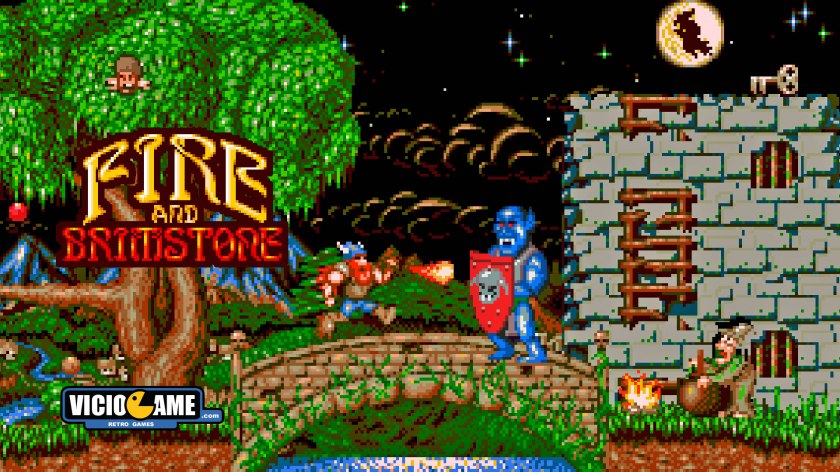
Fire and Brimstone is a 2D platformer with puzzle elements released in 1990 for the Amiga. Players take on the role of Thor, who must journey through the Norse realms and defeat the goddess Hel, saving the kingdom from her evil influence.
Developer: Vectordean
Publisher: Firebird
Release date: 1990
Platform: Commodore Amiga
🇺🇸 Fire & Brimstone is a game for the Commodore Amiga computer released in 1990, developed by the small British studio Vectordean Ltd. and published under the Firebird label, which by then had already been absorbed by the American giant MicroProse. The work occupies a peculiar place in the history of Amiga software: it was the last game to be published under the Firebird banner before MicroProse permanently retired the label from the market, making it an involuntary document of the end of a specific era in the British video game industry. This detail gives the title an aura of rarity — both historical and physical — as the game is considered rare in its original disk form.
Firebird was born as a British Telecom initiative to enter the booming entertainment software market of the 1980s. The company specialized in full-price releases aimed at home computers popular in Europe, such as the ZX Spectrum, the Amstrad CPC, the Commodore 64, and later the Atari ST and the Amiga. With the MicroProse acquisition, Firebird’s identity became increasingly overshadowed by its American parent, until it was finally discontinued. Fire and Brimstone, therefore, is not just a game: it is the swan song of a label that helped shape European tastes in action and adventure games during the second half of the 1980s.
The Vectordean development team was extremely lean. The game was programmed by Tim Coupe, with graphics by Chris Sorrell and music and sound effects composed by David Whittaker. This trio of three people is emblematic of the independent development model that prevailed in the European microcomputer game scene of the period. Compared to the seven-person team behind the original arcade version of Ghouls ‘n Ghosts — not counting the additional teams responsible for each port — having just three people develop Fire and Brimstone for both the Amiga and the Atari ST paints a vivid picture of the European “bedroom coder” reality of the time, where anyone with talent and determination could create and sell a game.
The game’s narrative is anchored in Norse mythology. The Norse realm is being threatened by the treacherous Hel, goddess of Niflheim and mistress of evil, whose influence spreads upward, corrupting the other eight worlds of the Norse cosmos. Thor, the god of thunder, law, and order, is chosen by his divine companions for a nearly impossible mission: to travel through the Norse worlds until he reaches the source of Hel’s evil and extinguishes the satanic flames by destroying the goddess herself. It is a premise that deliberately embraces the fantastical and the mythological without any pretense of academic accuracy — in fact, the programmers even confused “Hel,” the goddess, with “Hell,” the Christian underworld, in one of the introductory screens in some versions. The text on the back of the box promises a story of a journey into the depths of evil, and the plot of Thor hunting Hel sounds like something MicroProse developers might have cooked up after lunch at a local pub.
Despite the light narrative touch, the mythological universe is portrayed with visual care. The land of the Norse gods is made up of nine realms — from Asgard, home of the gods, to Midgard, the land of mortals, all the way to the shadowy realms of Muspell, home of the Dark Elves. Within the game, Thor travels through four of these worlds: Alfheim, Nidavellir, Muspell, and Niflheim. Each of these worlds has a distinct visual and atmospheric identity, with enemies, traps, and puzzles specific to its thematic environment.
To move from one world to the next, Thor must collect four segments of a key that unlocks the exit door. One segment is kept inside a locked room, while the others are scattered in the open. If Thor reaches the exit door without having found all the segments, he is sent back to the beginning of that world to find what’s missing — though already-collected segments remain in the character’s possession. This system creates a mandatory exploration mechanic that considerably raises the game’s difficulty level, as the player must be meticulous on every screen rather than simply surviving to the end of the level.
Fire and Brimstone features nine side-scrolling action screens. The screen does not scroll continuously; instead, it redraws as the player moves into a new section. This technical aspect — the absence of smooth scrolling — drew criticism at the time, with some reviewers suggesting it was a programming limitation. However, this style of discrete, static screens is perfectly consistent with the game’s puzzle-design nature, where each screen functions as an autonomous enigma that demands analysis before action. In total, the game contains 34 screens, distributed across the four worlds, plus boss screens at the end of each region.
Thor is controlled with a joystick, combining basic movement with attacks and item use. Thor can carry two types of weapons simultaneously, switching between them at any time. Available options include fire projectiles and axes, each with distinct range and effectiveness against different enemy types. Strategically choosing the right weapon for the right situation is one of the central elements of gameplay: using the wrong weapon at the wrong moment can mean wasting ammunition on immune enemies or missing the window of opportunity to hit a weak point.
In addition to weapons, Thor can carry two potions at the same time. Potions have varied effects: the blue one creates a magical bridge over certain obstacles; the red one fires a bolt that kills or damages all enemies on screen; the golden one grants Thor the ability to jump higher; and the white one illuminates dark rooms. Potions are obtained by destroying certain flying creatures that patrol the screens, and their smart management is often the key to overcoming seemingly impossible sections. Potions are more important than weapons in Fire and Brimstone.
Thor has four lives to complete his mission. For each life, his health is shown numerically with a maximum value of 99, and graphically by an energy bar. When Thor is hit, his health deteriorates; the numerical counter decreases and the bar shrinks. The impact of each blow on Thor’s health varies depending on the source — enemy creatures, their projectiles, and contact with various environmental elements all have different effects.
One of the most striking — and most controversial — aspects of Fire and Brimstone is its brutal difficulty. The game adopts a design philosophy where the player must frequently discover the correct solution through trial and error, and getting it wrong carries serious consequences. Right on the first screen, the player encounters a sleeping demon. Attacking it with a fireball wakes it up and it kills you. The correct approach is simply to walk up to it, and the demon leaves without attacking. After jumping over lethal flames, the player must turn around, leap upward, and hit a cute bird multiple times. When it finally dies, it drops a potion to create a magic platform. If the player doesn’t collect that potion and use it in the right spot, they won’t be able to get past the fourth screen. This design philosophy — where seemingly harmless actions are punished and counterintuitive solutions are the norm — defines the entire game experience.
Each screen in Fire and Brimstone is a puzzle in itself, requiring both reasoning and dexterity to complete. Reaching the end of a level is one thing; successfully finding all of the key segments and escaping is another. Failing means going back to the beginning. Spread across nine worlds, this amounts to weeks of compulsive play ahead of the player. The upside of this system is that if the player has played before and hasn’t write-protected the disk, the game can be started from the last level reached, functioning as a rudimentary password or checkpoint save system that was quite convenient by the standards of the time.
From an artistic standpoint, Fire and Brimstone represents one of the visual high points of the Amiga‘s early catalog. The graphics are very colorful and were drawn with a well-defined humorous visual language: Thor, rather than being a huge, muscular warrior, is a tiny fellow with a bright red beard. The other characters have an equally cute appearance, and combined with the detailed, atmospheric backgrounds, they give the game a very polished look. Chris Sorrell’s art work is frequently cited as the title’s greatest asset, with each world’s environments conveying a sense of place and atmosphere that transcends the technical limitations of the era’s pixels. Multiple reviewers and players over the decades have repeatedly noted that the game’s graphics were simply stunning for the period.
The audio, however, is of a somewhat lower standard. The game features an animated but tonally mismatched music track on the title screen, and few and underwhelming sound effects during gameplay. The absence of music during the action itself is felt: where are the sounds of battle and the cataclysmic impact of magic spells? The soundtrack was composed by David Whittaker, a legendary figure in music composition for British home computers of the 1980s and 1990s. Whittaker was impressed by the Amiga‘s sound capabilities and explored them in several of his compositions for the platform, with his work appearing in iconic games such as Shadow of the Beast, Obliterator, Beyond the Ice Palace, and Speedball. In the case of Fire and Brimstone, however, his contribution was modest — which may reflect both the project’s time and budget constraints and a deliberate choice to spare the Amiga‘s computational resources for the graphics.
Whittaker was a programmer at heart and typically composed his soundtracks directly in machine code, without using musical composition tools — relying solely on a machine code monitor and later an assembler system. This unusual method resulted in music with a distinctive sonic identity, recognizable to fans of the era. In the case of Fire and Brimstone, the title screen music has that fast-paced, slightly rough-around-the-edges energy that characterizes many compositions from the British game scene of that period.
The comparison with Capcom’s Ghosts ‘n Goblins is inevitable and was made by virtually every reviewer of the time. Fire and Brimstone follows the Capcom structure well, managing to recreate the feel of the classic without copying it so blatantly that it could be dismissed as a mere arcade clone. Thor’s journeys are portrayed in a fun and enjoyable way, which should appeal greatly to those who appreciate mysticism and humor. The fundamental difference, however, is that the Capcom game is a test of reflex-based skill, while Fire and Brimstone is substantially a puzzle game disguised as an action platformer. Fire and Brimstone is more of a puzzle platformer: not only does each screen offer a considerable challenge to get from left to right, but most also hide secrets and power-ups in hard-to-reach locations.
Critical reception from the specialist press of the time was mixed. CU Amiga was the most enthusiastic, giving it 89%; Amiga Format gave it 81%; Zzap! settled at 69%; and the German Amiga Joker was the harshest, awarding only 33%. This spread reflects the title’s polarizing nature well: players who appreciated the careful puzzle design and exuberant graphics tended to enjoy it greatly; those looking for an immediate action experience were frustrated by the need to memorize solutions and the brutal penalty for mistakes. Contemporary reception, decades later, maintains this pattern, with assessments oscillating between enchantment with the aesthetics and exasperation with the difficulty.
The historical transition places the game at the center of an important shift in the European software market: the end of small independent British labels and the growing consolidation around large American and European publishers, which would go on to dominate the scene in the years that followed. Companies like Firebird were the cultural seed of an entire generation of British developers, and their disappearance marked the close of a specific chapter in that history.
The game was physically released on a single disk for the Amiga OCS — the original configuration of the Amiga 500, the most popular version of the computer — and also for the Atari ST, the Amiga‘s main European rival at the time. Publication was jointly credited to Firebird Software and MicroProse Software, Inc., reflecting the ongoing ownership transition. The compact file size — just over 630 kilobytes — is a testament to the efficiency with which the Vectordean team managed the storage resources available on the Amiga‘s standard 880KB floppy disk format.
Fire and Brimstone is a genuinely fascinating title from the early-1990s European game scene: visually exuberant, musically limited, narratively light-hearted, and mechanically punishing. With its often brooding pixel art and an overwhelming number of enemy sprites, it’s easy to assume it’s a platformer in the same vein as Ghouls ‘n Ghosts — which, coincidentally, was also ported to the Amiga that same year. But beneath that familiar surface lies something far more peculiar: a demanding puzzle game that rewards patience, memory, and careful observation far more than quick reflexes. Released as the final breath of a historic label, endowed with artwork that still draws admiration from anyone encountering it for the first time, Fire and Brimstone remains one of the forgotten gems of an extraordinarily fertile period in the history of video games.
🇧🇷 Fire and Brimstone é um jogo para o computador Commodore Amiga lançado no ano de 1990, desenvolvido pelo pequeno estúdio britânico Vectordean Ltd. e publicado sob o rótulo Firebird, que na época já havia sido absorvido pela gigante americana MicroProse. A obra ocupa um lugar peculiar na história do software para o Amiga: foi o último jogo a ser publicado com o selo Firebird antes de a MicroProse retirar definitivamente o rótulo do mercado, tornando-o uma espécie de documento involuntário do fim de uma era específica da indústria britânica de jogos eletrônicos. Esse detalhe confere ao título uma aura de raridade tanto histórica quanto física, uma vez que o jogo é considerado raro em sua versão original em disco.
A Firebird nasceu como uma iniciativa da British Telecom para entrar no florescente mercado de software de entretenimento dos anos 1980. A empresa se especializou em lançamentos de preço cheio voltados a computadores domésticos populares na Europa, como o ZX Spectrum, o Amstrad CPC, o Commodore 64 e, mais tarde, o Atari ST e o Amiga. Com a compra pela MicroProse, a identidade da Firebird passou a coexistir de forma cada vez mais apagada com a da distribuidora americana, até ser definitivamente descontinuada. Fire and Brimstone, portanto, não é apenas um jogo: é o canto do cisne de um rótulo que ajudou a moldar o gosto europeu por jogos de ação e aventura durante a segunda metade dos anos 1980.
A equipe de desenvolvimento da Vectordean era enxuta ao extremo. O jogo foi programado por Tim Coupe, com gráficos assinados por Chris Sorrell e música e efeitos sonoros compostos por David Whittaker. Esse trio de três pessoas é emblema do modelo de desenvolvimento independente que predominava na cena europeia de jogos para microcomputadores naquele período. Comparado ao time de sete pessoas responsável pela versão arcade original de Ghouls ‘n Ghosts — sem contar as equipes adicionais encarregadas de cada port —, ter apenas três pessoas desenvolvendo Fire and Brimstone tanto para o Amiga quanto para o Atari ST ilustra bem a realidade do “bedroom coder” europeu da época, onde qualquer pessoa com talento e determinação podia criar e vender um jogo.
A narrativa do jogo é ancorada na mitologia nórdica. O reino nórdico está sendo ameaçado pela pérfida Hel, deusa de Niflheim e senhora da maldade, cuja influência se expande para cima, contaminando os outros oito mundos dos nórdicos. Thor, o deus do trovão, da lei e da ordem, é escolhido pelos seus companheiros divinos para uma missão quase impossível: viajar pelos mundos nórdicos até alcançar a fonte da maldade de Hel e extinguir as chamas satânicas destruindo a própria deusa. É uma premissa que abraça deliberadamente o fantástico e o mitológico sem qualquer pretensão de fidelidade acadêmica — aliás, os programadores chegaram a confundir “Hel”, a deusa, com “Hell”, o inferno cristão, numa das telas introdutórias em algumas versões. O texto no verso da embalagem promete uma história de jornada às profundezas do mal, e a trama sobre Thor caçando Hel lembra algo que os desenvolvedores da MicroProse teriam inventado depois do almoço num pub local.
Apesar da leveza narrativa, o universo mitológico é retratado com esmero visual. A terra dos deuses nórdicos é composta por nove reinos — de Asgard, lar dos deuses, passando por Midgard, a Terra dos mortais, até os reinos sombrios de Muspell, lar dos Elfos das Trevas. Dentro do jogo, Thor percorre efetivamente quatro desses mundos: Alfheim, Nidavellir, Muspell e Niflheim. Cada um desses mundos possui uma identidade visual e atmosférica distinta, com inimigos, armadilhas e quebra-cabeças específicos ao seu ambiente temático.
Para passar de um mundo ao outro, Thor precisa coletar os quatro segmentos de uma chave que desbloqueia a porta de saída. Um dos segmentos fica dentro de uma sala fechada, enquanto os demais estão espalhados ao ar livre. Se Thor chegar à porta de saída sem ter encontrado todos os segmentos, ele volta ao início daquele mundo para procurar o que está faltando — embora os segmentos já coletados permaneçam em posse do personagem. Esse sistema cria uma mecânica de exploração obrigatória que eleva consideravelmente o nível de dificuldade do jogo, já que o jogador precisa ser meticuloso em cada tela, não apenas sobreviver até o final do nível.
Fire and Brimstone oferece nove telas de ação com movimentação lateral. A tela não faz scroll contínuo; em vez disso, é redesenhada à medida que o jogador avança para uma nova seção. Esse aspecto técnico — a ausência de scrolling suave — foi alvo de críticas à época, com alguns revisores sugerindo que se tratava de uma limitação de programação. No entanto, esse estilo de telas discretas e estáticas é perfeitamente coerente com a natureza do design de quebra-cabeças do jogo, onde cada tela funciona como um enigma autônomo que exige análise antes da ação. No total, o jogo contém 34 telas, distribuídas pelos quatro mundos, mais as telas de chefes ao fim de cada região.
O controle de Thor é feito com joystick e combina movimentação básica com ataques e uso de itens. Thor pode carregar dois tipos de armas simultaneamente, alternando entre elas a qualquer momento. Dentre as opções disponíveis estão projéteis de fogo e machados, cada um com características distintas de alcance e eficácia contra diferentes tipos de inimigos. A escolha estratégica da arma certa para a situação certa é um dos elementos centrais da jogabilidade: usar a arma errada no momento errado pode significar desperdiçar munição em inimigos imunes a ela ou perder a janela de oportunidade para atingir um ponto fraco.
Além das armas, Thor pode carregar duas poções ao mesmo tempo. As poções têm efeitos variados: a azul cria uma ponte mágica sobre certos obstáculos; a vermelha dispara um raio que mata ou danifica todos os inimigos na tela; a dourada concede a Thor a habilidade de pular mais alto; e a branca ilumina salas escuras. As poções são obtidas destruindo certas criaturas voadoras que patrulham as telas, e sua gestão inteligente é muitas vezes a chave para superar secções aparentemente impossíveis. As poções são mais importantes que as armas em Fire and Brimstone.
Thor possui quatro vidas para completar sua missão. Para cada vida, seu estado de saúde é mostrado numericamente com um valor máximo de 99, e graficamente por uma barra de energia. Quando Thor é atingido, sua saúde piora; o marcador numérico diminui e a barra encolhe. O impacto de cada golpe sobre a saúde de Thor varia conforme o objeto agressor — criaturas inimigas, seus projéteis e o contato com vários itens do cenário têm efeitos diferentes.
Um dos aspectos mais marcantes — e mais controversos — de Fire and Brimstone é sua dificuldade brutal. O jogo adota uma filosofia de design onde o jogador frequentemente precisa descobrir a solução correta por tentativa e erro, e errar tem consequências sérias. Logo na primeira tela, o jogador se depara com um demônio dormindo. Atacá-lo com uma bola de fogo o acorda e ele te mata. A abordagem correta é simplesmente caminhar até ele, e o demônio vai embora sem atacar. Depois de pular por cima de chamas letais, o jogador precisa se virar, saltar para cima e acertar um pássaro fofo diversas vezes. Quando ele finalmente morre, deixa para trás uma poção para criar uma plataforma mágica. Se o jogador não coletar essa poção e usá-la no lugar certo, não conseguirá passar da quarta tela. Essa filosofia de design — onde ações aparentemente inofensivas são punidas e soluções contraintuitivas são a norma — define toda a experiência do jogo.
Cada tela de Fire and Brimstone é um quebra-cabeça em si mesmo, exigindo tanto raciocínio quanto destreza para ser completada. Chegar ao fim do nível é uma coisa; encontrar com sucesso todos os segmentos da chave e escapar é outra. Falhar significa voltar ao início. Distribuído por nove mundos, isso representa semanas de jogo compulsivo à frente do jogador. O aspecto positivo desse sistema é que se o jogador tiver jogado anteriormente e não tiver protegido o disco contra escrita, o jogo pode ser iniciado a partir do último nível alcançado, funcionando como um rudimentar sistema de save por senha ou checkpoint que era bastante conveniente para os padrões da época.
Do ponto de vista artístico, Fire and Brimstone representa um dos pontos altos visuais do catálogo inicial do Amiga. Os gráficos são muito coloridos e foram desenhados com uma linguagem humorística bem definida: Thor, em vez de ser um guerreiro enorme e musculoso, é um sujeito pequenino com uma barba vermelha brilhante. Os outros personagens têm uma aparência igualmente fofa, e combinados com os cenários detalhados e atmosféricos, conferem ao jogo uma aparência muito polida. O trabalho de Chris Sorrell na arte é frequentemente citado como o maior trunfo do título, com os cenários de cada mundo transmitindo uma sensação de lugar e atmosfera que transcende as limitações técnicas dos pixels da época. Múltiplos revisores e jogadores ao longo das décadas repetiram que os gráficos do jogo eram simplesmente deslumbrantes para o período.
O padrão sonoro, no entanto, é de nível um pouco inferior. O jogo conta com uma trilha musical animada mas inadequada ao tom da narrativa na tela de título, e poucos e fracos efeitos sonoros durante o jogo. A ausência de música durante a ação em si é sentida: onde estão os sons de batalha e o impacto cataclísmico dos feitiços mágicos? A trilha foi composta por David Whittaker, figura lendária da composição para computadores domésticos britânicos dos anos 1980 e 1990. Whittaker ficou impressionado com as capacidades sonoras do Amiga e as explorou em várias de suas composições para a plataforma, com seu trabalho aparecendo em jogos icônicos como Shadow of the Beast, Obliterator, Beyond the Ice Palace e Speedball. No caso de Fire and Brimstone, porém, sua contribuição foi modesta — o que pode refletir tanto as limitações de tempo e orçamento do projeto quanto uma escolha deliberada de poupar os recursos computacionais do Amiga para os gráficos.
Whittaker era um programador de coração e costumava compor suas trilhas diretamente em código de máquina, sem usar ferramentas de composição musical, empregando apenas um monitor de código de máquina e depois um sistema assembler. Esse método incomum resultava em músicas com uma identidade sonora peculiar, reconhecível por fãs da época. No caso de Fire and Brimstone, a música da tela de título possui aquela energia acelerada e um pouco desajeitada que caracteriza muitas composições da cena britânica de jogos daquele período.
A comparação com Ghosts ‘n’ Goblins da Capcom é inevitável e foi feita por praticamente todos os revisores da época. Fire and Brimstone segue a estrutura de Capcom bem, conseguindo recriar o clima do clássico sem copiar o jogo de forma tão óbvia que pudesse ser descartado como um simples clone de arcade. As jornadas de Thor são retratadas de maneira divertida e agradável, o que deveria agradar enormemente a quem tem apreço pelo misticismo e pelo humor. A diferença fundamental, no entanto, é que o jogo da Capcom é um desafio de habilidade reflexa, enquanto Fire and Brimstone é substancialmente um jogo de quebra-cabeça disfarçado de plataforma de ação. Fire and Brimstone é mais um puzzle platformer: não apenas cada tela oferece um desafio considerável para ir da esquerda à direita, como a maioria também esconde segredos e power-ups em locais de difícil acesso.
As avaliações da imprensa especializada da época foram variadas. A CU Amiga foi a mais entusiasta, com 89%; a Amiga Format deu 81%; a Zzap ficou com 69%; e a Amiga Joker alemã foi mais severa, com apenas 33%. Essa dispersão reflete bem a natureza polarizante do título: jogadores que apreciavam o design de quebra-cabeça cuidadoso e os gráficos exuberantes tendiam a gostar muito; quem buscava uma experiência de ação imediata ficava frustrado com a necessidade de memorizar soluções e a penalização brutal por erros. A recepção contemporânea, décadas depois, mantém esse padrão, com avaliações oscilando entre o encantamento pela estética e a exasperação pela dificuldade.
A transição histórica coloca o jogo no centro de uma mudança importante no mercado europeu de software: o fim dos pequenos rótulos independentes britânicos e a concentração crescente nas grandes distribuidoras americanas e europeias, que passariam a dominar o cenário nos anos seguintes. Empresas como a Firebird foram a semente cultural de uma geração inteira de desenvolvedores britânicos, e seu desaparecimento marcou o encerramento de um capítulo específico dessa história.
O jogo foi lançado fisicamente em um único disco para o Amiga OCS — a configuração original do Amiga 500, a versão mais popular do computador —, e também para o Atari ST, o principal concorrente do Amiga na Europa à época. A publicação foi assinada conjuntamente pela Firebird Software e pela MicroProse Software, Inc., refletindo a transição de propriedade em andamento. O tamanho compacto do arquivo — pouco mais de 630 kilobytes — é uma demonstração da eficiência com que a equipe da Vectordean gerenciou os recursos de armazenamento disponíveis no formato de disquete de 880KB padrão do Amiga.
Fire and Brimstone é um título genuinamente fascinante da cena de jogos europeia do início dos anos 1990: visualmente exuberante, musicalmente limitado, narrativamente descontraído e mecanicamente cruel. Com sua arte pixel muitas vezes sombria e uma quantidade avassaladora de sprites de inimigos, é fácil pensar que se trata de um platformer no mesmo estilo de Ghouls ‘n Ghosts — que por coincidência também foi portado para o Amiga naquele mesmo ano. Mas debaixo dessa superfície familiar se esconde algo mais peculiar: um jogo de quebra-cabeça exigente, que recompensa a paciência, a memória e a observação atenta muito mais do que os reflexos rápidos. Lançado como o último suspiro de um rótulo histórico, dotado de uma arte que ainda hoje arranca admiração de quem o encontra pela primeira vez, Fire and Brimstone permanece como uma das joias esquecidas de um período extraordinariamente fértil na história dos jogos eletrônicos.
🤑💲Earn money without doing anything! Just leave these apps open:
✓ https://r.honeygain.me/CONTA9DB02
✓ https://packetstream.io/?psr=1uPb
🤑💲1-Click button earns Bitcoin every 1 hour: https://freebitco.in/?r=53528449
⬛ 𝗧𝗶𝗸𝗧𝗼𝗸: https://www.tiktok.com/@viciogame
🟧 𝗜𝗻𝘀𝘁𝗮𝗴𝗿𝗮𝗺: http://www.instagram.com/viciogame
🟥 𝗬𝗼𝘂𝘁𝘂𝗯𝗲: http://www.youtube.com/viciogame
🟦 𝗙𝗮𝗰𝗲𝗯𝗼𝗼𝗸: http://www.facebook.com/viciogame
🔳 𝗧𝗵𝗿𝗲𝗮𝗱𝘀: https://www.threads.net/@viciogame
🟪 𝗧𝘄𝗶𝘁𝗰𝗵: https://www.twitch.tv/ViciogameRetroGames
🟨 𝗕𝗹𝗼𝗴: http://www.viciogameblog.com/
🟦𝗧𝘄𝗶𝘁𝘁𝗲𝗿: http://www.twitter.com/viciogame
#Viciogame #Gameplay #LetsPlay #Playthrough #Games #Gaming #Videogames #Review #Game #Detonado #Walkthrough #Ending #Reviews #Facts #Retro #RetroGaming #Roms #Emulator #Longplay #Speedrun #NoCommentary #FireAndBrimstone #Amiga #Commodore #GhostsnGoblins #GhoulsnGhosts #oldcomputers #pcgaming #Amiga500 #Amiga1200 #medieval #vikings #ghosts #Vectordean #Firebird #Thor
 VICIOGAME