
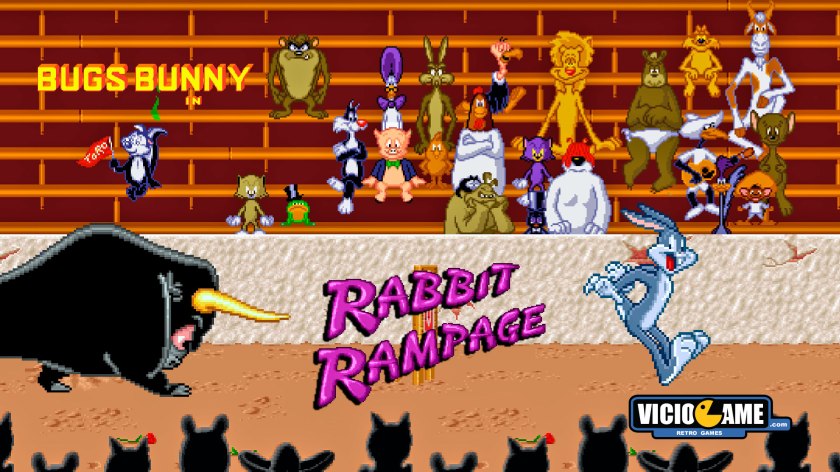
Bugs Bunny: Rabbit Rampage is a 2D platformer released in 1994 for the Super Nintendo. A mysterious animator is trying to “erase” Bugs Bunny at all costs, throwing him into dangerous situations and ever-changing cartoon scenarios. The game features stunning graphics and brings together the most famous Looney Tunes characters.
Developer: Viacom New Media
Publisher: SunSoft
Release date: 1994
Platform: Super Nintendo / Super Famicom
🇺🇸 Bugs Bunny: Rabbit Rampage is a side-scrolling action platformer released exclusively for the Super Nintendo in 1994, developed by Viacom New Media and published by Sunsoft. The game puts the player in control of the iconic Bugs Bunny — the most famous gray rabbit in the history of animation — as he faces a series of classic villains from the Looney Tunes universe, with the ultimate goal of confronting the true antagonist of the story: Daffy Duck, who takes on the role of a scheming animator capable of manipulating the very world of the cartoon. The title became one of the most beloved and well-executed experiences among all licensed games released for the SNES, celebrated both for its visual faithfulness to the source material and for its creative, well-tuned gameplay.
The story behind the game’s name is directly tied to the tradition of classic Warner Bros. theatrical shorts. The title Bugs Bunny: Rabbit Rampage is derived from the 1955 animated short of the same name, “Rabbit Rampage,” which features a very similar premise: Bugs Bunny is at the mercy of a hostile animator who manipulates the animation to torment the rabbit, and at the end of the original short, the villain is revealed to be Elmer Fudd himself. In the game, this idea is reused and expanded upon, but with an important twist — the antagonist animator is not Elmer Fudd, but Daffy Duck, whose jealousy and long-standing rivalry with Bugs serve as the perfect motivation for the plot. The entire narrative structure draws heavily from the equally famous short “Duck Amuck” (1953), in which Daffy Duck was tormented by an anonymous animator who, at the end, was revealed to be Bugs himself. The game cleverly inverts this dynamic in a meta-narrative fashion, creating an experience where the conventions of the cartoon become part of the game’s mechanics.
The production of the game involved a collaboration between two companies with very different histories. Viacom New Media was, at the time, a sister company of Nickelodeon, which had aired Looney Tunes cartoons to American audiences during the game’s development period. Sunsoft, in turn, is the video game division of Sun Electronics Corporation, a Japanese company founded in 1971 that began its journey in arcades and expanded into home consoles from the mid-1980s onward, when it started releasing games for the Nintendo (NES). Sunsoft built a solid reputation for publishing several high-quality licensed series, including the Batman games and an extensive line of titles based on Looney Tunes characters for the Game Boy and the SNES, with Bugs Bunny: Rabbit Rampage being one of the standout entries in that partnership. Other Looney Tunes games published by Sunsoft included Daffy Duck: The Marvin Missions, Porky Pig’s Haunted Holiday, Road Runner’s Death Valley Rally, Speedy Gonzales: Los Gatos Bandidos, and Looney Tunes B-Ball, all for the Super Nintendo.
The game was first released in Japan on June 24, 1993, where it received the alternative title Bakkusu Banī Hachamecha Daibōken (バックス・バニーはちゃめちゃ大冒険), which can be loosely translated as “Bugs Bunny’s Wild and Crazy Great Adventure.” In the United States, the game hit shelves in February 1994, and in Europe it launched on September 29, 1994. Despite minor regional release date differences, the game’s content remained essentially the same, with only the title and some text elements adapted for the Japanese market. The development process was carried out with special attention to faithfully reproducing the visual aesthetic of the original Warner Bros. shorts, and the Viacom New Media team invested considerable effort into ensuring the game’s sprites and backgrounds captured the exaggerated, colorful, and caricatured animation style that defines the visual identity of Looney Tunes.
The game’s artistic and production direction featured figures such as Jeff Troutman, who served as producer and lead animator, overseeing the adaptation of Looney Tunes’ classic two-dimensional animation styles into SNES sprites, and Paul Hellier, who served as lead programmer responsible for the game’s core code. The art team focused on recreating the exaggerated and comedic essence of the original cartoons through vibrant and fluid visuals that captured Bugs Bunny’s signature spirit. The production emphasized preserving the comedic timing and inherent absurdity of the franchise, integrating elements such as sudden environmental changes to mirror the trope of animator interference found in the source animations. Technically, the implementation involved challenges typical of SNES side-scrolling platformers.
The gameplay mechanics in Bugs Bunny: Rabbit Rampage offer a diverse set of actions that go beyond the simple “jump and run” formula common to most platformers of the era. Bugs can jump, dive into holes in the ground, kick enemies, throw cream pies, perform a spinning attack, and navigate hidden passages scattered throughout the levels. The spinning attack, in particular, is a double-edged sword: while powerful, it drains the player’s health bar, visually represented by a carrot. To recover energy, the player must collect carrots scattered throughout the stages, but these items become progressively scarcer as the game advances, gradually increasing the difficulty and requiring more careful resource management. In addition to carrots, the player can find single-use special items that stun or instantly defeat enemies, all drawn from the iconic ACME universe — the fictional company that supplied gadgets and contraptions in so many Looney Tunes shorts.
The game’s item system is one of its richest and most creative elements. Among the objects Bugs can collect and use are cream pies (available in “high arc” versions to hit enemies on upper platforms), dynamite, tanks, a white paintbrush, a dog bone, and a special item called the “Wild Turkey Surprise Bomb.” The white paintbrush has a particularly inventive function: when used on a black cat, Pepé Le Pew — the famous lovesick skunk from Looney Tunes — appears to carry the cat away, thus eliminating the hazard caused by the black cat’s bad luck effect in the game. Items can be switched even while the game is paused, a smart design decision that adds an extra layer of strategy to the most chaotic situations. The player is also graded at the end of each stage based on their performance, with the highest rating being called “Super Rabbit.” To achieve the best rankings, the player must make use of the ACME items collected throughout the level rather than relying solely on basic attacks like kicks and jumps.
The game’s enemies were carefully selected and designed to reflect the variety of the classic Looney Tunes roster. Beyond the main villains who serve as bosses at the end of each stage, there is a gallery of common enemies that includes brown and red hunting dogs, squirrels that throw acorns, pigs that shoot projectiles with slingshots, robots that electrocute Bugs when they get close, black cats that bring bad luck in the form of objects falling on the character, and even Sylvester the Cat appearing randomly aboard a train in certain stretches of one stage. Each enemy has its own movement patterns and behaviors that the player must learn, and some can only be defeated with specific items, adding a puzzle element to combat.
The game’s stage structure is divided into ten levels, each based on specific Looney Tunes theatrical shorts, creating a sort of tour through the historic legacy of classic American animation. The first level takes place in a snowy forest where Bugs faces Elmer Fudd and his hunting dogs, inspired by shorts such as “Duck! Rabbit, Duck!” (1953) and “The Heckling Hare.” The second level is based on “Bully for Bugs” (1953) and features Toro the Bull as the boss. In this stage, the player must strategically use anvils and other objects to defeat the bull by making it collide with walls and metal structures. The third level is based on “Bunny Hugged” (1951) and pits Bugs against The Crusher, a massive wrestling champion. The fourth level draws from “Hiawatha’s Rabbit Hunt” and “Buckaroo Bugs,” featuring characters such as Red Hot Ryder and Hiawatha. The fifth level takes Bugs to outer space, inspired by “Hare-Way to the Stars” (1958), where Marvin the Martian and his Instant Martians are the main obstacles. The sixth level is a dense forest stage based on “Bedevilled Rabbit” (1957), with Taz — the Tasmanian Devil — as the boss. The seventh level features a vertical descent filled with robots and is one of the most technically challenging in the game. The eighth level is based on “Bewitched Bunny” (1954), with references to the tale of Hansel and Gretel and featuring Hansel, Gretel, and the Big Bad Wolf as characters. The ninth level is the infamous “Level 13,” associated with Friday the 13th and set in a superstition-themed environment where black cats cause objects to fall on Bugs. Finally, the tenth and final level is the ultimate showdown with Daffy Duck.
The final level of Bugs Bunny: Rabbit Rampage is by far the most creative and meta-narrative stage in the entire game. It makes explicit that Daffy Duck is the animator behind everything that has happened, and Bugs’ goal is to spill all the ink Daffy uses to keep drawing the scenery and enemies. During this confrontation, three of Daffy Duck’s alter-egos try to stop Bugs: Duck Dodgers (based on the short “Duck Dodgers in the 24½th Century,” 1953), Robin Hood Daffy (based on the 1958 short of the same name), and Drip-Along Daffy (based on the 1951 short). Duck Dodgers is particularly dangerous as he is invincible and can eliminate Bugs with a single blast from his ray gun. After spilling all the ink and defeating the final alter-ego (Robin Hood Daffy if all the ink was spilled; Drip-Along Daffy otherwise), the game comes to its end. During the ending credits, several sticks of dynamite are displayed on screen, and as the credits finish, Daffy appears and delivers his signature line: “You’re despicable!” The classic “That’s All Folks” card then appears, followed by an explosion that shakes the camera, closing the game with the humor that is trademark Looney Tunes.
The audiovisual presentation of Bugs Bunny: Rabbit Rampage is unanimously considered one of the game’s greatest strengths. Visually, the title manages to impressively replicate the aesthetic of the original cartoons within the hardware limitations of the Super Nintendo. The game makes extensive use of parallax scrolling, with multiple background layers moving at different speeds to create a convincing sense of depth. This technique is especially evident in the first stage, where snowy mountains in the background move slowly while the main foreground scrolls more quickly, producing an elegant three-dimensional effect. The outer space setting of the fifth level features planets slowly drifting in the background, while the forest stage with Taz boasts lush and detailed vegetation. The game opens impressively with a sequence in which a paintbrush paints the scenery of the first level before Bugs is awakened by an alarm clock, immediately establishing the concept of the animation being created in real time.
The soundtrack and sound effects of Bugs Bunny: Rabbit Rampage were crafted to evoke the chaotic auditory spirit of classic cartoons. The sound design incorporated iconic cartoon sound effects, including the splat of a cream pie, exaggerated squashing sounds, and direct callbacks from the show, such as Bugs Bunny’s famous “What’s up, Doc?”, Elmer Fudd’s laugh, and Marvin the Martian’s “BOOM!” Voice acting was performed by Greg Burson, who at the time was the primary replacement for the original voices immortalized by the legendary Mel Blanc — the original “Man of a Thousand Voices” responsible for bringing virtually every Looney Tunes character to life until his death in 1989. Greg Burson voiced Bugs Bunny, Daffy Duck, Porky Pig, Elmer Fudd, and other characters across several Looney Tunes games developed by Sunsoft, and was recognized as the official reference voice actor for this line of licensed franchise products. The music itself was composed to suit the different environments of each level, featuring relatively lengthy compositions that loop throughout, though some critics noted the absence of a sound test mode as an omission that left players without an easy way to fully appreciate all of the tracks.
The critical reception of Bugs Bunny: Rabbit Rampage was largely positive. Nintendo Power — the official Nintendo magazine in the United States and one of the most influential gaming publications of the era — gave the game a highly favorable rating of 4.3 out of 5, specifically praising the graphics, animation, variety of stage types, and audio, writing that “Sunsoft uses the Looney Tunes license to maximum effect and fun.” The same publication also featured early coverage of the game, which included a screenshot of a stage showing Bosko — one of Warner Bros. Animation’s earliest characters, created before Bugs Bunny — as part of the audience watching a fight; however, Bosko does not appear in the final version of the game, suggesting that content was cut during development. Electronic Gaming Monthly offered a more mixed review, averaging 6.75 out of 10, acknowledging the game’s visual and audio authenticity while criticizing repetitive combat sequences and a relatively short playtime of approximately two to three hours. GamePro highlighted the variety in stage designs as one of the game’s strong points. On GameRankings, the game finished with a score of 75.50%. In Famitsu, the leading Japanese gaming publication, the game received scores of 5/10, reflecting a more reserved reception in Japan compared to the West.
A notable aspect of the game’s reception is how much it stood out in the context of licensed games from the 16-bit era. Throughout the 1990s, the video game industry was flooded with titles based on film, TV, and cartoon licenses that were frequently considered low-quality products rushed to market to capitalize on the popularity of a given intellectual property. Bugs Bunny: Rabbit Rampage managed to escape that trap thanks to the genuine care that the Viacom New Media team and Sunsoft dedicated to the project, resulting in a product that honored the creative legacy of Looney Tunes rather than simply using the characters as a facade for a generic experience. This commitment to quality made the game one of the most frequently cited examples of a successful licensed game from the Super Nintendo generation.
The historical context in which Bugs Bunny: Rabbit Rampage was released is also important for understanding its place in the industry. The SNES era was a period of intense competition between Nintendo and Sega, with the latter aggressively marketing its Mega Drive (known as the Sega Genesis in the United States) as a more “mature” and technically superior alternative for audiences. Nintendo responded in part with its robust lineup of licensed software and exclusive titles. In this environment, games like Bugs Bunny: Rabbit Rampage played an important role in attracting a family and children’s audience who had grown up watching Looney Tunes on television. Sunsoft, which had also developed titles such as Batman: Return of the Joker for the NES and Game Boy, had well-established experience in developing games based on high-profile licensed properties, which certainly contributed to the final product’s quality.
It is also worth mentioning that Sunsoft went through significant financial difficulties shortly after the release period of Bugs Bunny: Rabbit Rampage. In 1995, the company nearly went bankrupt and was forced to sell some of its games to Acclaim Entertainment to help alleviate its debts. An even steeper decline became evident around 2001, when its international distribution channels were shut down. The company survived in part thanks to the advent of online gaming services and the re-release of classic titles through Nintendo’s Virtual Console and other digital platforms. This context makes Bugs Bunny: Rabbit Rampage a title from a specific and turbulent period in Sunsoft’s history — one when the company was still at its creative peak in the West and capable of producing high-quality licensed games.
Looking at the work as a whole, Bugs Bunny: Rabbit Rampage represents far more than a simple platformer based on a famous character. It is a carefully crafted celebration of decades of classic American animation — a tribute to the smart humor, calculated absurdity, and irreverent spirit that made Bugs Bunny and his Looney Tunes companions truly timeless characters. The decision to base each stage on specific theatrical shorts, to include visual and audio references faithful to the original material, to build a narrative around the very nature of animation itself — all of this reveals a development team that not only understood Looney Tunes intellectually, but genuinely loved that universe and wanted to pass that love on to the player. For the Super Nintendo — a console that already boasted an exceptionally rich library — Bugs Bunny: Rabbit Rampage still managed to stand out as one of the best licensed games ever produced, and its place in the history of 16-bit gaming is well secured.
🇧🇷 Bugs Bunny: Rabbit Rampage é um jogo de ação em plataforma lançado exclusivamente para o Super Nintendo no ano de 1994, desenvolvido pela Viacom New Media e publicado pela Sunsoft. O jogo coloca o jogador no controle do icônico personagem Pernalonga, o coelho cinza mais famoso da história da animação, enquanto ele enfrenta uma série de vilões clássicos do universo Looney Tunes com o objetivo de confrontar o verdadeiro antagonista da trama: o Patolino, que assume o papel de um animador maligno capaz de manipular o próprio mundo do desenho animado. O título se tornou uma das experiências mais queridas e bem executadas dentre todos os jogos licenciados lançados para o SNES, sendo celebrado tanto por sua fidelidade visual ao material original quanto por sua jogabilidade criativa e bem ajustada para a época.
A história por trás do nome do jogo é diretamente vinculada à tradição dos curtas-metragens clássicos da Warner Bros. O título Bugs Bunny: Rabbit Rampage é derivado do curta animado homônimo de 1955, intitulado “Rabbit Rampage”, que apresenta uma premissa muito semelhante: Pernalonga está à mercê de um animador hostil que manipula a animação para torturar o coelho, e ao final do curta original, o vilão é revelado como o próprio Hortelino Troca-Letras. No jogo, essa ideia é reaproveitada e expandida, mas com uma reviravolta importante — o animador antagonista não é Hortelino Troca-Letras, mas sim Patolino, cujo ciúme e rivalidade histórica com Pernalonga servem de motivação perfeita para a trama. Toda a estrutura narrativa bebe diretamente do também famoso curta “Duck Amuck” (1953), no qual Patolino era torturado por um animador anônimo que, no final, era revelado como o próprio Pernalonga. O jogo inverte essa dinâmica de maneira inteligente e meta-narrativa, criando uma experiência onde as convenções do desenho animado tornam-se parte da mecânica do jogo.
A produção do jogo envolveu uma colaboração entre duas empresas com histórias bem distintas. A Viacom New Media era, à época, uma empresa irmã da Nickelodeon, que havia transmitido os desenhos da Looney Tunes para o público americano durante o período de desenvolvimento do jogo. A Sunsoft, por sua vez, é a divisão de videogames da Sun Electronics Corporation, uma empresa japonesa fundada em 1971 que começou sua trajetória em arcades e expandiu para os consoles domésticos a partir de meados dos anos 1980, quando passou a lançar jogos para o Nintendo (NES). A Sunsoft construiu uma reputação sólida por publicar diversas séries licenciadas de alta qualidade, incluindo os jogos do Batman e uma extensa linha de títulos baseados nos personagens Looney Tunes para o Game Boy e para o SNES, sendo Bugs Bunny: Rabbit Rampage um dos títulos mais incríveis dessa parceria. Entre outros jogos da Looney Tunes publicados pela Sunsoft estavam Daffy Duck: The Marvin Missions, Porky Pig’s Haunted Holiday, Road Runner’s Death Valley Rally, Speedy Gonzales: Los Gatos Bandidos e Looney Tunes B-Ball, todos para o Super Nintendo.
O jogo foi lançado primeiro no Japão em 24 de junho de 1993, onde recebeu o título alternativo de Bakkusu Banī Hachamecha Daibōken (バックス・バニーはちゃめちゃ大冒険), que pode ser traduzido livremente como “A Grande e Insana Aventura de Pernalonga”. Nos Estados Unidos, o jogo chegou às prateleiras em fevereiro de 1994, e na Europa o lançamento ocorreu em 29 de setembro de 1994. Apesar das pequenas diferenças nas datas de lançamento entre as regiões, o conteúdo do jogo permaneceu essencialmente o mesmo, com apenas o título e alguns elementos textuais sendo adaptados para o mercado japonês. O processo de desenvolvimento foi conduzido com atenção especial à reprodução fiel da estética visual dos curtas originais da Warner Bros., e a equipe da Viacom New Media investiu considerável esforço para que os sprites e cenários do jogo capturassem o estilo de animação exagerado, colorido e caricato que define a identidade visual dos Looney Tunes.
A direção artística e de produção do jogo contou com figuras como Jeff Troutman, que atuou como produtor e animador principal, sendo responsável por supervisionar a adaptação dos estilos clássicos de animação bidimensional da Looney Tunes em sprites para o SNES, e Paul Hellier, que atuou como programador principal responsável pelo código central do jogo. A equipe de artistas concentrou-se em recriar a essência exagerada e humorística dos desenhos animados originais por meio de visuais vibrantes e fluidos que capturavam o espírito característico de Pernalonga. A produção enfatizou a preservação do tempo cômico e do absurdo inerente à franquia, integrando elementos como mudanças ambientais repentinas para espelhar o tropo da interferência do animador nas animações de origem. Tecnicamente, a implementação envolveu desafios típicos dos jogos de plataforma de rolagem lateral do SNES.
A mecânica de jogo em Bugs Bunny: Rabbit Rampage é um conjunto de ações diversificadas que vão além do simples “pular e correr” comum à maioria dos plataformas da época. Pernalonga pode pular, mergulhar em tocas no chão, chutar inimigos, arremessar tortas de creme, realizar um ataque giratório e passar por passagens secretas espalhados pelos cenários. O ataque giratório, em particular, é uma faca de dois gumes: embora seja poderoso, ele consome a barra de saúde do personagem, representada visualmente por uma cenoura. Para recuperar energia, o jogador deve coletar cenouras espalhadas pelas fases, mas esses itens se tornam progressivamente mais escassos à medida que o jogo avança, aumentando gradualmente a dificuldade e exigindo um gerenciamento mais cuidadoso dos recursos disponíveis. Além das cenouras, o jogador pode encontrar itens especiais de uso único que atordoam ou eliminam inimigos imediatamente com um único acerto, e esses itens provêm do universo icônico da ACME, a empresa fictícia que fornecia engenhocas e armadilhas em tantos curtas da Looney Tunes.
O sistema de itens do jogo é um dos seus elementos mais ricos e criativos. Entre os objetos que Pernalonga pode coletar e utilizar estão tortas de creme (disponíveis em versões “altas” para acertar inimigos em plataformas superiores), dinamites, tanques, pincel branco, osso de cachorro e um item especial chamado “Wild Turkey Surprise Bomb”. O pincel branco tem uma função particularmente inventiva: ao ser usado sobre um gato preto, Pepe Le Gambá — o famoso gambá apaixonado da Looney Tunes — aparece para levar o gato embora, eliminando assim o problema causado pela superstição associada a gatos pretos no jogo. Os itens são comutáveis pelo jogador mesmo com o jogo pausado, uma decisão de design inteligente que adiciona uma camada estratégica extra às situações mais caóticas. O jogador também é avaliado ao final de cada fase com uma classificação que varia conforme seu desempenho, sendo a classificação máxima chamada de “Super Rabbit”. Para alcançar as melhores classificações, o jogador deve utilizar os itens ACME coletados ao longo do nível e evitar depender apenas de ataques básicos, como chutes e pulos.
Os inimigos do jogo foram cuidadosamente selecionados e desenhados para refletir a variedade do elenco clássico da Looney Tunes. Além dos vilões principais que servem de chefes ao final de cada fase, há uma galeria de inimigos comuns que incluem cães de caça marrons e vermelhos, esquilos que atiram bolotas, porcos que disparam projéteis com estilingues, robôs que eletrocutam Pernalonga ao se aproximarem, gatos pretos que invocam má sorte na forma de objetos caindo sobre o personagem, e até mesmo o personagem Frajola aparecendo aleatoriamente a bordo de um trem em determinados trechos de uma fase. Cada inimigo possui padrões de movimento e comportamento próprios que o jogador precisa aprender, e alguns deles só podem ser derrotados com itens específicos, adicionando um elemento de puzzle ao combate.
A estrutura de fases do jogo é dividida em dez níveis, cada um baseado em curtas-metragens específicos da Looney Tunes, o que cria uma espécie de tour pelo patrimônio histórico da animação clássica americana. O primeiro nível se passa em uma floresta nevada onde Pernalonga enfrenta Hortelino Troca-Letras e seus cães de caça, baseado em curtas como “Duck! Rabbit, Duck!” (1953) e “The Heckling Hare”. O segundo nível é inspirado no curta “Bully for Bugs” (1953) e apresenta Toro, o touro, como chefe. Nessa fase, o jogador precisa usar estrategicamente bigornas e outros objetos para derrotar o touro, fazendo-o colidir contra paredes e estruturas metálicas. O terceiro nível é baseado em “Bunny Hugged” (1951) e coloca Pernalonga em confronto com O Esmagador, um lutador de wrestling enorme. O quarto nível bebe da fonte de “Hiawatha’s Rabbit Hunt” e “Buckaroo Bugs”, apresentando personagens como Ruivo de Marte e Hiawatha. O quinto nível leva Pernalonga ao espaço, inspirado em “Hare-Way to the Stars” (1958), onde Marvin, o Marciano e seus Marcianos Instantâneos são os principais obstáculos. O sexto nível é uma fase de floresta densa baseada em “Bedevilled Rabbit” (1957), com Taz — o Diabo da Tasmânia — como chefe. O sétimo nível apresenta uma descida vertical repleta de robôs e é um dos mais tecnicamente desafiadores do jogo. O oitavo nível é baseado em “Bewitched Bunny” (1954), com referências aos contos “João e Maria” e” “Os Três Porquinhos”, tendo o Lobo Mau como chefe. O nono nível é o famoso “Nível 13”, associado à sexta-feira 13 e ambientado em um cenário de superstição onde os gatos pretos causam objetos a cair sobre Pernalonga. Por fim, o décimo e último nível é o confronto derradeiro com Patolino.
O nível final de Bugs Bunny: Rabbit Rampage é, de longe, o mais criativo e meta-narrativo de todo o jogo. Nele, fica explícito que Patolino é o animador por trás de tudo o que aconteceu, e o objetivo de Pernalonga é derramar toda a tinta que Patolino usa para continuar desenhando o cenário e os inimigos. Durante esse confronto, três alter-egos de Patolino tentam impedir Pernalonga: Duck Dodgers (baseado no curta “Duck Dodgers in the 24½th Century”, de 1953), Robin Hood Patolino (baseado no curta homônimo de 1958) e Patolino, o Xerife (baseado no curta de 1951). Duck Dodgers é particularmente perigoso pois é invencível e pode eliminar Pernalonga com um único tiro de seu blaster. Após derramar toda a tinta e derrotar o alter-ego final (Robin Hood Patolino, se toda a tinta foi derramada; Patolino, o Xerife, caso contrário), o jogo chega ao seu fim. Durante os créditos finais, várias dinamites são exibidas na tela, e ao encerrar os créditos, Patolino aparece e profere sua célebre frase: “You’re despicable!” (“Você é desprezível!”). A cena clássica “That’s All Folks” aparece, e então uma explosão sacode a câmera, encerrando o jogo com o humor característico da Looney Tunes.
A apresentação audiovisual de Bugs Bunny: Rabbit Rampage é unanimemente considerada um dos pontos mais fortes do jogo. Visualmente, o título consegue replicar de forma impressionante a estética dos cartoons originais dentro das limitações do hardware do Super Nintendo. O jogo faz uso extensivo de rolagem paralaxe, com múltiplas camadas de plano de fundo se movendo em velocidades distintas para criar uma sensação convincente de profundidade. Essa técnica é especialmente evidente na primeira fase, onde montanhas nevadas ao fundo se movem lentamente enquanto o cenário principal rola mais rapidamente, criando um efeito tridimensional elegante. O espaço sideral do quinto nível apresenta planetas se movendo lentamente no fundo, enquanto a fase da floresta com o Taz ostenta uma vegetação exuberante e detalhada. O jogo começa de forma impressionante com uma sequência onde um pincel pinta o cenário do primeiro nível antes de Pernalonga ser acordado por um despertador, estabelecendo imediatamente o conceito da animação sendo criada em tempo real.
A trilha sonora e os efeitos sonoros de Bugs Bunny: Rabbit Rampage foram criados para evocar o espírito auditivo caótico dos desenhos animados clássicos. O design de som incorporou efeitos sonoros icônicos de cartoons, incluindo o ruído do impacto de uma torta, sons exagerados de esmagamento, e citações diretas do programa, como o famoso “What’s up, Doc?” de Pernalonga, a gargalhada de Hortelino Troca-Letras e o “BOOM!” do Marvin, o Marciano. A dublagem foi realizada pelo ator Greg Burson, que à época era o principal substituto das vozes originais imortalizadas pelo lendário Mel Blanc — o original “homem de mil vozes” responsável por dar vida a praticamente todos os personagens da Looney Tunes até sua morte em 1989. Greg Burson interpretou Pernalonga, Patolino, Gaguinho, Hortelino Troca-Letras e outros personagens em vários jogos da Looney Tunes desenvolvidos pela Sunsoft, e foi reconhecido como o dublador oficial de referência para essa linha de produtos licenciados da franquia. As músicas em si foram compostas para se adequar aos diferentes ambientes de cada nível e possuem composições relativamente longas que se repetem em loop, embora alguns críticos tenham apontado a ausência de um modo de teste de som como uma omissão que deixou os jogadores sem uma forma fácil de apreciar todas as composições por completo.
A recepção crítica de Bugs Bunny: Rabbit Rampage foi amplamente positiva. A revista Nintendo Power, que era a publicação oficial da Nintendo nos Estados Unidos e uma das mais influentes do mercado de games da época, concedeu ao jogo uma avaliação altamente favorável de 4,3 pontos em 5, elogiando especificamente os gráficos, a animação, a variedade nos tipos de fases e o áudio, e escrevendo que “Sunsoft usa a licença da Looney Tunes ao máximo efeito e diversão“. A mesma publicação também apresentou cobertura antecipada do jogo, que incluía uma captura de tela de uma fase que mostrava Bosko — um dos primeiros personagens da Warner Bros. Animation, criado antes de Pernalonga — como parte da audiência assistindo a uma luta; contudo, Bosko não aparece na versão final do jogo, sugerindo que houve cortes de conteúdo durante o desenvolvimento. A revista Electronic Gaming Monthly ofereceu uma avaliação mais mista, com uma média de 6,75 pontos em 10, que reconheceram a autenticidade visual e sonora do jogo mas criticaram sequências de combate repetitivas e uma duração relativamente curta de aproximadamente duas a três horas. A publicação GamePro destacou a variedade nos designs de fases como um ponto forte do jogo. No agregador GameRankings, o jogo terminou com uma nota de 75,50%. Na Famitsu, o periódico japonês de referência para o mercado de games, o jogo recebeu pontuações de 5/10, refletindo uma recepção mais contida no Japão em comparação ao Ocidente.
Um aspecto notável da recepção do jogo é o quanto ele se destacou no contexto dos jogos licenciados da era 16-bit. Durante os anos 1990, a indústria de videogames estava repleta de títulos baseados em licenças de filmes, séries e desenhos animados que frequentemente eram considerados produtos de baixa qualidade desenvolvidos às pressas para capitalizar sobre a popularidade de uma propriedade intelectual. Bugs Bunny: Rabbit Rampage conseguiu escapar dessa armadilha graças ao cuidado genuíno que a equipe da Viacom New Media e a Sunsoft dedicaram ao projeto, resultando em um produto que honrava a herança criativa da Looney Tunes em vez de simplesmente usar os personagens como fachada para uma experiência genérica. Esse compromisso com a qualidade fez do jogo um dos exemplos mais frequentemente citados de jogos licenciados bem-sucedidos da geração do Super Nintendo.
O contexto histórico em que Bugs Bunny: Rabbit Rampage foi lançado é também importante para compreender seu lugar na indústria. A era do SNES foi um período de intensa competição entre Nintendo e Sega, com a segunda promovendo agressivamente seu Mega Drive (conhecido como Sega Genesis nos Estados Unidos) como uma alternativa mais “adulta” e tecnicamente superior para o público. A Nintendo respondia em parte com sua linha robusta de softwares licenciados e títulos exclusivos. Nesse ambiente, jogos como Bugs Bunny: Rabbit Rampage desempenhavam um papel importante ao atrair um público familiar e de crianças que crescia assistindo à Looney Tunes na televisão. A Sunsoft, que também desenvolveu títulos como Batman: Return of the Joker para o NES e Game Boy, tinha experiência consolidada no desenvolvimento de jogos baseados em propriedades licenciadas de alto perfil, o que certamente contribuiu para a qualidade final do produto.
É válido mencionar também que a Sunsoft atravessou dificuldades financeiras significativas logo após o período de lançamento de Bugs Bunny: Rabbit Rampage. Em 1995, a empresa quase faliu e precisou vender alguns de seus jogos para a Acclaim Entertainment como forma de aliviar suas dívidas. Um declínio ainda mais severo tornou-se evidente por volta de 2001, quando seus canais internacionais de distribuição foram fechados. A empresa sobreviveu graças em parte ao advento dos serviços de jogos online e ao relançamento de clássicos por meio do Virtual Console da Nintendo e outras plataformas digitais. Esse contexto torna Bugs Bunny: Rabbit Rampage um título de um período específico e turbulento da história da Sunsoft, quando a empresa ainda estava em seu auge criativo no Ocidente e capaz de produzir jogos licenciados de alta qualidade.
Olhando para a obra como um todo, Bugs Bunny: Rabbit Rampage representa muito mais do que um simples jogo de plataforma baseado em um personagem famoso. Ele é uma celebração cuidadosamente construída de décadas de animação clássica americana, um tributo ao humor inteligente, ao absurdo calculado e ao espírito irreverente que tornaram Pernalonga e seus companheiros da Looney Tunes personagens verdadeiramente atemporais. A decisão de basear cada fase em curtas-metragens específicos, de incluir referências visuais e sonoras fiéis ao material original, de construir uma narrativa sobre a própria natureza da animação — tudo isso revela uma equipe de desenvolvimento que não apenas entendia a Looney Tunes intelectualmente, mas que genuinamente amava aquele universo e quis transmitir esse amor ao jogador. Para o Super Nintendo, um console que já possuía um catálogo excepcionalmente rico, Bugs Bunny: Rabbit Rampage ainda assim conseguiu se destacar como um dos melhores jogos licenciados já produzidos, e seu lugar na história dos videogames de 16 bits está bem assegurado.
🤑💲Earn money without doing anything! Just leave these apps open:
✓ https://r.honeygain.me/CONTA9DB02
✓ https://packetstream.io/?psr=1uPb
🤑💲1-Click button earns Bitcoin every 1 hour: https://freebitco.in/?r=53528449
⬛ 𝗧𝗶𝗸𝗧𝗼𝗸: https://www.tiktok.com/@viciogame
🟧 𝗜𝗻𝘀𝘁𝗮𝗴𝗿𝗮𝗺: http://www.instagram.com/viciogame
🟥 𝗬𝗼𝘂𝘁𝘂𝗯𝗲: http://www.youtube.com/viciogame
🟦 𝗙𝗮𝗰𝗲𝗯𝗼𝗼𝗸: http://www.facebook.com/viciogame
🔳 𝗧𝗵𝗿𝗲𝗮𝗱𝘀: https://www.threads.net/@viciogame
🟪 𝗧𝘄𝗶𝘁𝗰𝗵: https://www.twitch.tv/ViciogameRetroGames
🟨 𝗕𝗹𝗼𝗴: http://www.viciogameblog.com/
🟦𝗧𝘄𝗶𝘁𝘁𝗲𝗿: http://www.twitter.com/viciogame
#Viciogame #Gameplay #LetsPlay #Playthrough #Games #Gaming #Videogames #Review #Game #Detonado #Walkthrough #Ending #Reviews #Facts #Retro #RetroGaming #Roms #Emulator #Longplay #Speedrun #NoCommentary #BugsBunny #RabbitRampage #SNES #LooneyTunes #SuperNes #DaffyDuck #SuperNintendo #SunSoft #SuperFamicom #Viacom #Nintendo #Pernalonga #Disney #Patolino #TinyToon #Cartoon #スーパーファミコン #任天堂
 VICIOGAME