
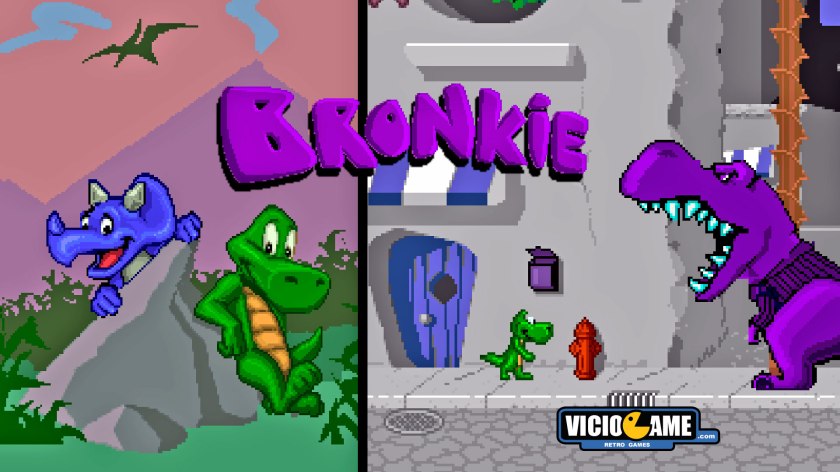
Bronkie the Bronchiasaurus is a 2D platformer released in 1995 for the Super Nintendo. Bronkie is a dinosaur with asthma who must track down the missing parts needed to power the only machine capable of clearing the skies of the dust unleashed by a meteor strike.
Developer: WaveQuest
Publisher: Raya Systems
Release date: 1995
Platform: Super Nintendo / Super Famicom
🇺🇸 Bronkie the Bronchiasaurus is a game that defies easy categorization, having been born from the bowels of the American healthcare industry. It is an educational platformer developed by American studio WaveQuest and published by Raya Systems for the Super Nintendo. Released in the United States in September 1995, the title carries a dual statement of intent in its very name: Bronkie is a direct reference to the medical term “bronchi” — the two channels that carry air from the trachea into the lungs, and where the pathophysiological process of asthma manifests most intensely — while “Bronchiasaurus” is a pun on the famous dinosaurs of the Jurassic Period, the brachiosauruses, which loom so large in the popular imagination. Bronkie is a homonym of bronchi, the Latin plural form of the two channels that carry air from the trachea into the lungs, and it is precisely in the bronchi that the respiratory complication known as asthma occurs with the greatest intensity.
To understand the existence of Bronkie the Bronchiasaurus, it is essential to understand the company behind its publication. Raya Systems was a company based in Mountain View, California, whose president and founder, Steve Brown, had previously worked with medical companies providing them with software applications. His interactions with those companies led him to the conclusion that there was an urgent need to create new ways of conveying medical information to children. With this vision, Raya Systems carved out an absolutely unique niche in the video game market of the 1990s: that of so-called “edutainment” games aimed specifically at children with chronic illnesses. The company, which would later become known as Health Hero Network, published a series of educational health games for the SNES that became its trademark. Bronkie the Bronchiasaurus is part of a series of four titles produced under this concept, each addressing a distinct medical condition with the goal of educating young players in a fun and engaging way.
The other titles in Raya Systems’ series are equally fascinating and reveal the company’s ambition — or audacity — in using video games as a therapeutic tool. Captain Novolin, released in 1992, was developed by Sculptured Software and featured a superhero with type 1 diabetes on a mission to save the mayor of Pineville from the clutches of the villain Blubberman. Funding for that game came from Novo Nordisk, the manufacturer of the Novolin insulin brand, and from the National Institutes of Health. Novo Nordisk even distributed 10,000 free copies of the game to hospitals across the United States. Rex Ronan: Experimental Surgeon, from 1994, also developed by Sculptured Software, put players in the role of a miniaturized surgeon traveling inside the body of a smoker to combat the devastating effects of tobacco, with initial financial backing from the U.S. Agency for Healthcare Research and Quality. Packy and Marlon, in turn, was developed by the same WaveQuest responsible for Bronkie and starred two diabetic elephants as protagonists, with the goal of improving self-care behavior in children with type 1 diabetes. Together, these four games form a unique franchise in the history of video games — a serious, well-funded experiment in the therapeutic and educational power of interactive media.
The creative team behind Bronkie the Bronchiasaurus brought together professionals who, while not household names at the major studios of the era, had sufficient technical command to deliver a functional product. Game design was handled by Gabriel B. Manriquez, programming was the responsibility of Donald E. Cherf Jr., and musical composition fell to John Bartlet. None of them went on to notable careers in the video game industry, which underscores the peripheral and specialized nature of the project — a work developed outside the mainstream game development circuit, closer in spirit to public health initiatives than to pure entertainment productions.
The game’s narrative is as creative as it is functionally instructive. Long ago, meteors struck the prehistoric city of San Saurian. The explosions covered the Earth with clouds of dust, causing asthma throughout the dinosaur world. To combat this problem, the inhabitants of San Saurian built a powerful wind machine capable of cleaning the air and restoring breathable conditions. However, their plans were sabotaged by the villain Mr. Rexo — a Tyrannosaurus Rex, naturally, since the cultural convention of casting the T-Rex as antagonist seems irresistible — who stole the machine’s parts and hid them across the four corners of the city, placing other dinosaurs as guardians of each component. Now it falls to Bronkie and Trakie, along with their companions Sam and Kyla, to recover the parts and rebuild the machine. The choice of dinosaurs as protagonists is no accident: beyond their obvious visual appeal to children, the metaphor of enormous, powerful creatures being vulnerable to something as invisible as airborne dust serves as a subtle but powerful message that asthma is not a shameful weakness, but a condition that any living being can face.
In the game, Bronkie and Trakie must explore each stage to find all the wind machine parts, avoiding asthma triggers such as cigarette smoke, tar, and furry animals. Coming into contact with these triggers causes the characters to start coughing, which gradually darkens the screen, simulating the “gray-out” vision an asthmatic might experience during an attack. The player loses when the screen goes completely black. This “interface screw” mechanic — as game designers call deliberate interference with the player’s visual perception — is a surprisingly sophisticated design choice, as it transforms the game’s mechanics into an empathetic experience: the player literally sees the world as an asthmatic child in crisis might see it, with vision growing progressively more hazy and threatening with each exposure to harmful elements.
At the start of each stage, the player receives their “Daily Meds” — that is, facts about asthma and its treatment — while Bronkie demonstrates the correct use of an inhaler. The player then sets off as Bronkie — or, in two-player mode, as their friend Trakie — walking through a “Flintstones”-style city in search of parts to rebuild the great wind machine. Asthma triggers such as cigarette smoke, dust, and chemical drips must be avoided, as contact with too many of them darkens the screen. This can be remedied by using the inhaler or “asking for help,” which restarts the level. This “ask for help” mechanic is particularly interesting from a pedagogical standpoint: rather than punishing the player with a simple game over, the game teaches that seeking assistance when struggling is the right thing to do — a valuable lesson for children who often feel ashamed to admit they need help during an asthmatic episode.
There are also dinosaur henchmen of Mr. Rexo attacking Bronkie to stop him from completing his mission. The player defeats them by poking them with a stick or blowing a strong gust of wind in their direction. Tragically, Bronkie has a limited number of strong blows at his disposal, which can be replenished by collecting lung icons scattered throughout the levels. Other, friendlier dinosaurs offer transportation, items, or wind machine parts if the player correctly answers their asthma-related questions. This trivia dynamic integrated into the gameplay flow is one of the most effective features of the game’s educational design: knowledge is not presented as an interruption to entertainment, but as a condition for progress, making learning organically rewarding.
The questions are multiple-choice and cover the respiratory system, asthma self-management, identification of the main triggers, immediate recognition of early symptoms and how to act in emergencies, knowledge of medication active ingredients, and much more. This quiz-embedded-in-gameplay approach anticipated by decades the “serious games” mechanics that are now widely studied and used in the field of health education. The game also includes specific minigames dedicated to the correct use of an inhaler, teaching the procedure step by step in an interactive way.
A concern raised at the time was that the game contained a series of product placements from pharmaceutical companies and medical device manufacturers, which raised questions about whether it was simply being used as a promotional tool. However, the revenue generated by the sponsors was necessary to fund the game’s development, according to Click Health CEO Alan Miller. This tension between the educational ideal and the reality of corporate funding would be a defining characteristic of the entire Raya Systems game series — a company that depended on partnerships with the pharmaceutical industry to make its projects viable, while simultaneously seeking scientific and pedagogical credibility.
The distribution of Bronkie the Bronchiasaurus followed an unusual path for the time. Although Raya Systems games were released on conventional retail shelves, the primary marketing effort was directed at doctors’ offices and other healthcare professionals. The idea was that the games would be used as entertainment in waiting rooms, during therapy sessions, and even rented out to patients. However, educational titles were traditionally avoided by enthusiast gamers, and it must have been difficult to convince healthcare professionals of the merits of video game therapy. As a result, titles in the “Health Hero” series received limited and uneven distribution at launch. This distribution strategy through medical channels, directly inspired by what Novo Nordisk had done with Captain Novolin, positioned Bronkie the Bronchiasaurus in a fascinating hybrid territory: neither a purely cultural product nor a purely therapeutic device, but something situated between two worlds.
From a scientific standpoint, the experience with Bronkie the Bronchiasaurus produced results that the academic community took seriously. Researchers at the Stanford University Medical Center conducted a study with 200 asthmatic children from Oakland and Washington who played the title. This study, led by researcher Debra Lieberman and referenced in scientific publications from 1997 and 2001, analyzed the game’s impact on the young participants’ knowledge, attitudes, and behaviors related to asthma. The results pointed to a measurable improvement in children’s understanding of their condition, environmental triggers, and proper management strategies. The game is endorsed by the American Academy of Pediatrics, the Juvenile Diabetes Foundation, and the Asthma and Allergy Foundation of America. These institutional endorsements confer upon the title a scientific legitimacy rare in the video game world of that era.
The game’s relevance to the emerging field of “serious games” cannot be understated, and it is considered significant in the history of therapeutic gaming since the 1990s. Decades before the games industry began systematically discussing the therapeutic potential of digital games, Raya Systems was already running this experiment in real time, with real children, in real doctors’ offices. Bronkie the Bronchiasaurus is one of the rare games to introduce environmental concerns into asthma education, since its central premise — that the wind machine dispersing the dust cloud covering San Saurian must be repaired to restore the environment — is a holistic approach that connects the individual condition of asthma to broader questions of air quality and environmental health.
Graphically, Bronkie the Bronchiasaurus reveals the limitations of a project that was not developed by major studios with large budgets, but also demonstrates a reasonable visual functionality for its purposes. The visual aesthetic is reminiscent of The Flintstones, featuring a modernized prehistoric city inhabited by anthropomorphic dinosaurs. The sprites are colorful and recognizable, the environments clearly communicate which elements are dangerous — cigarette smoke, dust clouds, chemical splashes — and which are beneficial. The character animation is basic but functional, and the collectible item icons, especially the lungs that replenish the protagonist’s blowing ability, are interesting for the strangeness of their anatomical realism contrasted against the game’s generally cartoonish look.
The soundtrack, composed by John Bartlet, stays true to the edutainment game tradition of the era: melodic enough not to immediately irritate, but repetitive and lacking the musical depth that distinguished the great SNES compositions. Sound effects are mostly limited to huffs, puffs, coughs, and simple attack sounds, which actually works well within the game’s thematic coherence — after all, a game about respiratory problems deserves a soundscape dominated by breathing sounds. It is not music that would appear on any list of the console’s greatest compositions, but it fulfills its functional role without provoking immediate aversion.
In terms of mechanical gameplay, Bronkie the Bronchiasaurus is a relatively conventional side-scrolling 2D platformer, but with additional layers that set it apart from purely entertainment-driven titles. Beyond the curiosity factor, Bronkie’s blow attack is notable for being even more useless than his regular attack, possibly because a dinosaur with asthma probably shouldn’t be relying on his lung capacity to survive. This mechanical paradox — being forced to use the very organ that is compromised as the primary offensive resource — is inadvertently comic but also laden with metaphorical meaning: managing asthma means learning to use the lungs as best as possible, even when they function in a limited way.
The character of Trakie, Bronkie’s companion available to a second player in co-op mode, adds a social dimension to the game that distinguishes it from many edutainment titles of the era, which were strictly individual experiences. The name Trakie is equally a reference to the respiratory system, derived from “trachea,” the channel that carries air from the throat to the bronchi. Having two playable characters with names derived from anatomical terms related to breathing reveals a conceptual care that goes beyond simple character design — the creators wanted children, by playing the game and pronouncing the protagonists’ names, to be inadvertently introduced to the basic medical vocabulary of respiration.
The conceptual model the game represented anticipated debates that academia, the pharmaceutical industry, and game developers are still waging today, decades later. The fact that prominent researchers took the time to conduct formal studies on the game’s impact attests that there was something more there than a mere market curiosity: there was a scientific hypothesis being tested, with methodology, controls, and subsequent publication in peer-reviewed journals.
The title has never been re-released on modern platforms, has never made it to any Virtual Console service, and remains accessible only through original physical copies or emulation. Its legacy is that of an honest, well-intentioned, and surprisingly well-grounded experiment, born in an era when faith in the transformative power of video games was as naive as it was inspiring. In a universe where Super Mario and Donkey Kong defined what a platformer could be, Bronkie the Bronchiasaurus chose a radically different path — not to entertain, but to heal, or at least to teach children to live better with a condition that no doctor had yet managed to make interesting enough to be remembered between one appointment and the next. In that sense, regardless of its merits or limitations as an entertainment product, it deserves its singular place in the history of video games as proof that not every game needs to be made for the masses — sometimes it is enough to be made for the right children, at the right moment, with the right message.
🇧🇷 Bronkie the Bronchiasaurus é um jogo que desafia qualquer categorização simples por ter nascido das entranhas do setor de saúde norte-americano. Trata-se de um jogo educacional de plataforma desenvolvido pelo estúdio americano WaveQuest e publicado pela empresa Raya Systems para o Super Nintendo. Lançado nos Estados Unidos em setembro de 1995, o título carrega em seu próprio nome uma declaração de intenções dupla: Bronkie é uma referência direta ao termo médico “bronchi” — os dois canais que conduzem o ar da traqueia até os pulmões, e nos quais o processo fisiopatológico da asma se manifesta com maior intensidade — enquanto “Bronchiasaurus” é um trocadilho com os famosos dinossauros do Período Jurássico, os braquiossauros, que tanto dominam o imaginário popular. Bronkie é um homônimo de bronchi, a forma plural latina dos dois canais que conduzem o ar da traqueia até os pulmões, e é justamente nos brônquios que a complicação respiratória conhecida como asma ocorre com maior intensidade.
Para compreender a existência de Bronkie the Bronchiasaurus, é imprescindível entender a empresa por trás de sua publicação. A Raya Systems era uma companhia baseada em Mountain View, Califórnia, cujo presidente e fundador, Steve Brown, havia trabalhado anteriormente com empresas médicas fornecendo-lhes aplicações de software. Suas interações com essas companhias o levaram à conclusão de que havia uma necessidade urgente de criar novas formas de transmitir informações médicas às crianças. Com essa visão, a Raya Systems se posicionou em um nicho absolutamente único no mercado de videogames dos anos 1990: o dos chamados jogos “edutainment” voltados especificamente para crianças com doenças crônicas. A empresa, que mais tarde seria conhecida como Health Hero Network, publicou uma série de jogos educacionais de saúde para SNES que se tornaram sua marca registrada. Bronkie the Bronchiasaurus faz parte de uma série de quatro títulos produzidos sob esse conceito, e cada um deles aborda uma condição médica distinta com o intuito de educar seus jovens jogadores de forma lúdica e envolvente.
Os outros títulos da série da Raya Systems são igualmente curiosos e revelam a ambição — ou ousadia — da empresa em utilizar o videogame como ferramenta terapêutica. Captain Novolin, lançado em 1992, foi desenvolvido pela Sculptured Software e trazia um super-herói com diabetes tipo 1 em uma missão para salvar o prefeito da cidade de Pineville das garras do vilão Blubberman. O financiamento para aquele jogo veio da Novo Nordisk, fabricante da marca de insulina Novolin, e do National Institutes of Health. A Novo Nordisk chegou a distribuir 10.000 cópias gratuitas do jogo para hospitais nos Estados Unidos. Rex Ronan: Experimental Surgeon, de 1994, foi desenvolvido pela Sculptured Software e colocava o jogador no papel de um cirurgião em miniatura que viajava pelo interior do corpo de um fumante para combater os efeitos devastadores do tabaco, com apoio financeiro inicial da Agência de Pesquisa e Qualidade em Saúde dos EUA. Packy and Marlon, por sua vez, foi desenvolvido pela mesma WaveQuest responsável por Bronkie e trazia dois elefantes diabéticos como protagonistas, com o objetivo de melhorar o comportamento de autocuidado em crianças com diabetes tipo 1. Juntos, esses quatro jogos formam uma franquia única na história dos videogames — um experimento sério e bem financiado sobre o poder terapêutico e educacional das mídias interativas.
A equipe criativa responsável por Bronkie the Bronchiasaurus reunia profissionais que, embora não fossem nomes consagrados nos grandes estúdios da época, tinham domínio técnico suficiente para entregar um produto funcional. O design do jogo ficou a cargo de Gabriel B. Manriquez, a programação foi responsabilidade de Donald E. Cherf Jr., e a composição musical coube a John Bartlet. Eles não tiveram trajetórias relevantes na indústria do videogame, o que reforça o caráter periférico e especializado do projeto — um trabalho desenvolvido fora do circuito mainstream de desenvolvimento de games, mais próximo das iniciativas de saúde pública do que das produções de entretenimento puro.
A narrativa do jogo é tão criativa quanto funcionalmente didática. Há muito tempo, meteoros atingiram a cidade pré-histórica de San Saurian. As explosões cobriram a Terra com nuvens de poeira, causando asma no mundo dos dinossauros. Para combater esse problema, os habitantes de San Saurian construíram uma poderosa máquina de vento capaz de limpar o ar e restaurar condições respiratórias adequadas à vida. No entanto, seus planos foram sabotados pelo vilão Mr. Rexo — um tiranossauro, naturalmente, já que a convenção cultural de colocar o T-Rex como antagonista parece irresistível — que roubou as peças da máquina e as escondeu pelos quatro cantos da cidade, colocando outros dinossauros como guardiões de cada componente. Agora cabe a Bronkie e Trakie, junto com seus companheiros Sam e Kyla, recuperar as peças para reconstruir a máquina. A escolha de dinossauros como protagonistas não é aleatória: além do apelo visual óbvio para crianças, a metáfora de criaturas gigantescas e poderosas sendo vulneráveis a algo tão invisível quanto a poeira no ar serve como uma mensagem sutil e poderosa de que a asma não é uma fraqueza vergonhosa, mas uma condição que qualquer ser pode enfrentar.
No jogo, Bronkie e Trakie devem explorar cada fase para encontrar todas as peças da máquina de vento, evitando gatilhos da asma como fumaça de cigarro, alcatrão e animais peludos. Entrar em contato com esses gatilhos faz com que os personagens comecem a tossir, o que escurece gradualmente a tela, simulando a “visão cinza” que um asmático pode experimentar durante um ataque. O jogador perde quando a tela fica completamente preta. Esse mecanismo de “interface screw” — como os game designers costumam chamar interferências deliberadas na percepção visual do jogador — é uma escolha de design surpreendentemente sofisticada, pois transforma a mecânica do jogo em uma experiência empática: o jogador literalmente vê o mundo como uma criança asmática em crise poderia vê-lo, com a visão se tornando progressivamente mais nebulosa e ameaçadora a cada contato com os elementos nocivos.
No início de cada estágio, o jogador recebe suas “Meds Diárias”, ou seja, fatos sobre asma e seu tratamento, enquanto Bronkie demonstra o uso correto de um inalador. Em seguida, como Bronkie — ou, no modo para dois jogadores, como seu amigo Trakie — o jogador caminha por uma cidade de estética “Flintstones” em busca de peças para reconstruir a grande máquina de vento. É necessário evitar gatilhos da asma como fumaça de cigarro, poeira e gotejamentos químicos, que escurecem a tela quando contatados em excesso. Isso pode ser remediado usando o inalador ou “pedindo ajuda”, o que reinicia o nível. Essa mecânica de “pedir ajuda” é particularmente interessante do ponto de vista pedagógico: ao invés de punir o jogador com um simples “game over”, o jogo ensina que buscar auxílio quando se está em dificuldade é a atitude correta — uma lição valiosa para crianças que muitas vezes sentem vergonha de admitir que precisam de ajuda durante um episódio asmático.
Há também dinossauros capangas de Mr. Rexo atacando Bronkie para tentar impedir que ele cumpra sua missão. O jogador os derrota cutucando-os com um bastão ou soprando vento forte em sua direção. Tragicamente, Bronkie tem um número limitado de sopros fortes à sua disposição, que podem ser reabastecidos coletando ícones de pulmão espalhados pelos níveis. Outros dinossauros mais amigáveis oferecem transporte, itens ou peças da máquina de vento caso o jogador responda corretamente a suas perguntas sobre asma. Essa dinâmica de trivia integrada ao fluxo do gameplay é um dos recursos mais eficazes do design educacional do jogo: o conhecimento não é apresentado como uma interrupção do entretenimento, mas como uma condição para o progresso, tornando o aprendizado organicamente recompensador.
São questões de múltipla escolha sobre o sistema respiratório, autogerenciamento da asma, identificação dos principais gatilhos, reconhecimento imediato dos primeiros sintomas e como agir em emergências, conhecimento dos princípios ativos dos medicamentos, e muito mais. Essa abordagem de quiz embutida no gameplay antecipou em décadas as mecânicas de “serious games” que hoje são amplamente estudadas e utilizadas no campo da educação em saúde. O jogo também inclui minigames específicos dedicados ao uso correto do inalador, ensinando o procedimento passo a passo de forma interativa.
Uma preocupação levantada na época era que o jogo continha uma série de inserções de produtos de empresas farmacêuticas e fabricantes de dispositivos médicos, o que gerou questionamentos sobre se estava sendo usado simplesmente como ferramenta promocional. No entanto, os recursos gerados pelos patrocinadores eram necessários para financiar o desenvolvimento do jogo, segundo o CEO da Click Health, Alan Miller. Essa tensão entre o ideal educacional e a realidade do financiamento corporativo seria uma característica definidora de toda a série de jogos da Raya Systems — empresa que dependia de parcerias com a indústria farmacêutica para viabilizar seus projetos, ao mesmo tempo em que buscava credibilidade científica e pedagógica.
A distribuição de Bronkie the Bronchiasaurus seguiu um caminho incomum para a época. Embora os jogos da Raya Systems fossem lançados nas prateleiras convencionais do varejo, o principal esforço de marketing era voltado para consultórios médicos e outros profissionais de saúde. A ideia era que os jogos fossem usados como entretenimento em salas de espera, durante terapias, e até alugados para pacientes. No entanto, títulos educativos eram tradicionalmente evitados por jogadores entusiastas, e deve ter sido difícil convencer profissionais de saúde sobre os méritos da terapia por videogame. Assim, os jogos da série “Health Hero” receberam distribuição limitada e desigual no lançamento. Essa estratégia de distribuição via canal médico, inspirada diretamente no que a Novo Nordisk havia feito com Captain Novolin, posicionava Bronkie the Bronchiasaurus em um território híbrido fascinante: nem puramente produto cultural, nem puramente dispositivo terapêutico, mas algo situado entre os dois mundos.
Do ponto de vista científico, a experiência com Bronkie the Bronchiasaurus gerou resultados que a academia levou a sério. Pesquisadores do Stanford University Medical Center conduziram um estudo com 200 crianças com asma provenientes de Oakland e Washington que jogaram o título. Esse estudo, conduzido pela pesquisadora Debra Lieberman e referenciado em publicações científicas de 1997 e 2001, analisou o impacto do jogo nos conhecimentos, atitudes e comportamentos relacionados à asma nos jovens participantes. Os resultados apontaram para uma melhora mensurável na compreensão que as crianças tinham sobre sua condição, sobre os gatilhos ambientais e sobre as estratégias corretas de manejo. O jogo é apoiado pela American Academy of Pediatrics, pela Juvenile Diabetes Foundation e pela Asthma and Allergy Foundation of America. Esses apoios institucionais conferem ao título uma legitimidade científica rara no mundo dos videogames da época.
A relevância do jogo para o campo emergente dos “serious games” não pode ser subestimada, sendo considerado importante na história dos jogos terapêutico desde os anos 1990. Décadas antes de a indústria dos games começar a discutir sistematicamente o potencial terapêutico dos jogos digitais, a Raya Systems já estava conduzindo esse experimento em tempo real, com crianças reais, em consultórios médicos reais. Bronkie the Bronchiasaurus é um dos raros jogos que introduz preocupações ambientais na educação sobre asma, já que sua premissa central é que a máquina de vento que dissipar a nuvem de poeira que cobre a cidade de San Saurian precisa ser reparada para restaurar o meio ambiente — uma abordagem holística que conecta a condição individual da asma às questões mais amplas de qualidade do ar e saúde ambiental.
Graficamente, Bronkie the Bronchiasaurus revela as limitações de um projeto que não foi desenvolvido pelos grandes estúdios com orçamentos expressivos, mas também demonstra uma funcionalidade visual razoável para seus propósitos. O visual tem uma estética reminiscente de Os Flintstones, com uma cidade pré-histórica modernizada habitada por dinossauros antropomórficos. Os sprites são coloridos e identificáveis, os cenários comunicam claramente quais elementos são perigosos — fumaça de cigarro, nuvens de poeira, respingos químicos — e quais são benéficos. A animação dos personagens é básica mas funcional, e os ícones de itens coletáveis, especialmente os pulmões que repõem os sopros do protagonista, são interessantes pela estranheza de seu realismo anatômico em contraste com o visual cartunesco geral do jogo.
A trilha sonora, composta por John Bartlet, permanece fiel à tradição dos edutainment games da época: melódica o suficiente para não irritar imediatamente, mas repetitiva e desprovida da profundidade musical que distinguia as grandes composições do SNES. Os efeitos sonoros se limitam principalmente a bufidos, assopros, tosses e simples sons de ataque, o que na verdade funciona bem dentro da coerência temática do jogo — afinal, um jogo sobre problemas respiratórios merece uma paisagem sonora dominada justamente por sons de respiração. Não é música que entraria em uma lista das melhores composições do console, mas cumpre seu papel funcional sem causar aversão imediata.
Em termos de jogabilidade mecânica, Bronkie the Bronchiasaurus é um jogo de plataforma 2D de rolagem lateral relativamente convencional, mas com camadas adicionais que o diferenciam dos títulos puramente de entretenimento. Para além do fator de curiosidade, o ataque de sopro de Bronkie é notável por ser ainda mais inútil do que seu ataque regular, possivelmente porque um dinossauro com asma provavelmente não deveria estar dependendo de sua capacidade pulmonar para sobreviver. Esse paradoxo mecânico — ser forçado a usar exatamente o órgão comprometido como principal recurso ofensivo — é involuntariamente cômico mas também carregado de sentido metafórico: gerenciar a asma significa justamente aprender a usar os pulmões da melhor forma possível, mesmo quando eles funcionam de forma limitada.
O personagem de Trakie, companheiro de Bronkie disponível para o segundo jogador no modo cooperativo, acrescenta uma dimensão social ao jogo que o diferencia de muitos edutainments da época, que eram estritamente experiências individuais. O nome Trakie é igualmente uma referência ao sistema respiratório, derivado de “traqueia”, o canal que conduz o ar da garganta para os brônquios. Ter dois personagens jogáveis com nomes derivados de termos anatômicos relacionados à respiração revela um cuidado conceitual que vai além do simples design de personagem — os criadores queriam que as próprias crianças, ao jogarem e pronunciarem os nomes dos protagonistas, estivessem sendo involuntariamente introduzidas ao vocabulário médico básico da respiração.
O modelo conceitual que o jogo representava antecipou debates que a academia, a indústria farmacêutica e os desenvolvedores de jogos ainda travam hoje, décadas depois. O fato de pesquisadores de renome se darem ao trabalho de conduzir estudos formais sobre o impacto do jogo, atesta que havia ali algo mais do que uma mera curiosidade de mercado: havia uma hipótese científica sendo testada, com metodologia, controle e publicação posterior em periódicos revisados por pares.
O título nunca foi relançado em plataformas modernas, não chegou a qualquer serviço de Virtual Console e permanece acessível apenas através de cópias físicas originais ou emulação. Seu legado é o de um experimento honesto, bem-intencionado e surpreendentemente bem fundamentado, nascido de uma época em que a fé no poder transformador dos videogames era tão ingênua quanto inspiradora. Em um universo onde Super Mario e Donkey Kong definiam o que um jogo de plataforma poderia ser, Bronkie the Bronchiasaurus escolheu um caminho radicalmente diferente — não para divertir, mas para curar, ou ao menos para ensinar crianças a viver melhor com uma condição que nenhum médico ainda havia conseguido tornar interessante o suficiente para ser lembrada entre uma consulta e outra. Nesse sentido, independentemente de seus méritos ou limitações como produto de entretenimento, merece seu lugar singular na história dos videogames como prova de que nem todo jogo precisa ser feito para as massas — às vezes basta ser feito para as crianças certas, no momento certo, com a mensagem certa.
🤑💲Earn money without doing anything! Just leave these apps open:
✓ https://r.honeygain.me/CONTA9DB02
✓ https://packetstream.io/?psr=1uPb
🤑💲1-Click button earns Bitcoin every 1 hour: https://freebitco.in/?r=53528449
⬛ 𝗧𝗶𝗸𝗧𝗼𝗸: https://www.tiktok.com/@viciogame
🟧 𝗜𝗻𝘀𝘁𝗮𝗴𝗿𝗮𝗺: http://www.instagram.com/viciogame
🟥 𝗬𝗼𝘂𝘁𝘂𝗯𝗲: http://www.youtube.com/viciogame
🟦 𝗙𝗮𝗰𝗲𝗯𝗼𝗼𝗸: http://www.facebook.com/viciogame
🔳 𝗧𝗵𝗿𝗲𝗮𝗱𝘀: https://www.threads.net/@viciogame
🟪 𝗧𝘄𝗶𝘁𝗰𝗵: https://www.twitch.tv/ViciogameRetroGames
🟨 𝗕𝗹𝗼𝗴: http://www.viciogameblog.com/
🟦𝗧𝘄𝗶𝘁𝘁𝗲𝗿: http://www.twitter.com/viciogame
#Viciogame #Gameplay #LetsPlay #Playthrough #Games #Gaming #Videogames #Review #Game #Detonado #Walkthrough #Ending #Reviews #Facts #Retro #RetroGaming #Roms #Emulator #Longplay #Speedrun #NoCommentary #Bronkie #SNES #Bronchiasaurus #SuperNes #Dino #SuperNintendo #Dinosaur #SuperFamicom #Trex #Nintendo #asthma #dinossauro #asma #CaptainNovolin #edutainment #スーパーファミコン #任天堂
 VICIOGAME