
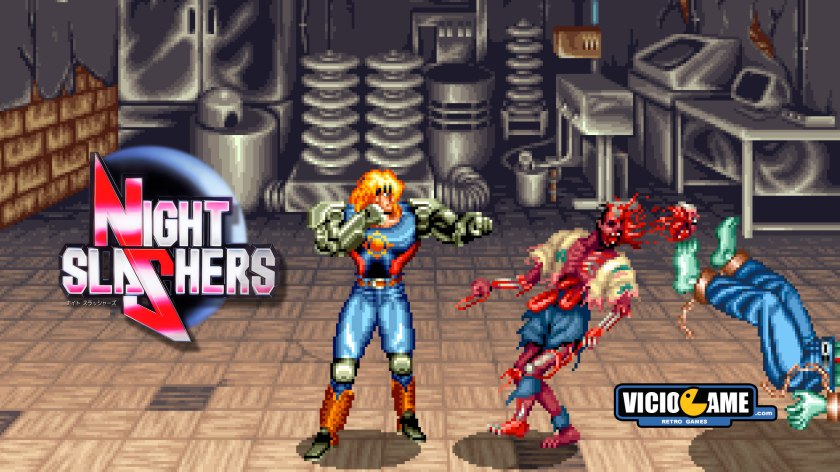
Night Slashers is a horror-themed beat ‘em up arcade game released in 1993. Evil creatures have ravaged countless cities, leaving even the military powerless to stop them. Now, the last hope for humanity rests on the shoulders of three warriors who must hunt down and destroy the mastermind behind this curse.
Developer/Publisher: Data East
Release date: 1993
Platform: Arcade
🇺🇸 Night Slashers is one of the most peculiar and memorable titles in arcade history — a game that masterfully blended the beat ‘em up genre, then at the peak of its commercial popularity, with a visceral horror aesthetic shamelessly inspired by the classics of zombie cinema. Developed and published by Data East, the game was released in September 1993 exclusively for arcades, at a time when the arcade market was living through its last great moment before the definitive rise of home consoles. Data East, a Japanese company headquartered in Tokyo, was known for titles such as Fighter’s History, Heavy Smash, and Boogie Wings, and Night Slashers represented one of their boldest bets that year.
The story driving the game is simple but sufficiently atmospheric for its arcade context. One day, monsters that supposedly existed only in fantasy began appearing all over the world. These creatures expanded their power instantaneously, armies were destroyed, and many cities were completely devastated. Three months have passed since then, and survivors live in constant terror of the monsters. In this supernatural apocalypse scenario, humanity finds hope in three special warriors — the so-called Night Slashers, those who cut through the night — whose goal is to stop the dark plans of the villain King Zarutz, an infernal king who inhabits a colossal robot and intends to turn the entire planet into a kingdom of the dead.
The three playable characters are Jake Hunter, Christopher Smith, and Hong Hua Zhao, each with different strengths and weaknesses, as well as distinct elemental powers. The game also features different endings, one for each character. Jake Hunter, nicknamed “Psychic Cyborg,” is an American monster hunter equipped with cybernetic arms — the most powerful character of the trio — with lightning as his element. Christopher Smith is a British vampirologist and martial artist, described as the most balanced character in terms of speed and power, with the elements of water and ice. Hong Hua Zhao is a Chinese martial artist versed in the mystic arts who, though smaller in stature compared to the others, is the most agile of the group, with fire as her element. Each of these characters has a backstory consistent with the game’s universe; Christopher, for example, is driven by a personal vendetta, having lost his father and grandfather to the third stage’s boss — the Lord of Vampires — 21 years prior.
The characters differ not only in their attributes but also in being more effective against certain types of enemies and in having favorite foods, which affects how much health is restored when picking up healing items. This seemingly minor detail adds a strategic layer to the game, as a player who chooses Hong Hua Zhao, for example, recovers far more energy by picking up meat buns — her favorite food — than the other characters would. Steaks and curry, however, work well for any character, being universally effective at restoring vitality.
From a mechanical standpoint, Night Slashers rigorously follows the formula established by the beat ‘em up era. One, two, or three players move from left to right through each stage — most of which are divided into three or more scenes — fighting enemies that appear until a more powerful boss confrontation at the end of the level. Once the boss is defeated, players automatically advance to the next stage. If players attempt to move forward without eliminating the enemies present, the screen stops scrolling until all threats have been neutralized. The game features seven stages in total, each subdivided into multiple sections, ensuring a relatively lengthy experience by the arcade standards of the time.
The first button is used for attacks; pressing it repeatedly executes a simple combo, while holding it charges energy for a stronger strike. The second button is used to jump, while pressing attack and jump simultaneously performs a dodge maneuver. The third button is used for special attacks — powerful moves that hit all enemies on screen at once, but cost a portion of the player’s health to execute. Additionally, the characters have specific moves performed with directional and button combinations, similar to fighting games. It is possible to run by double-tapping the directional input, perform grabs and throw enemies in different directions, and execute various types of aerial attacks.
The third button, when pressed, causes your character to perform an elemental screen-clearing attack — in the style of Golden Axe. Each character has their own thematic elemental attack: Jake unleashes electric discharges, Christopher invokes the power of water and ice, and Hong Hua lets loose bursts of fire. These attacks are extremely useful in tight situations, but require caution, as they consume a significant portion of the player’s vital energy. There is also a notably refined charged attack system: holding the attack button causes the character to build up energy, and upon release, unleashes a high-powered strike. In Christopher’s case, for example, there is the Tiger Kick Knee Spark — a charged special attack executed by releasing the charge after pressing the stick — which deals 2.5 times the damage of a normal charged attack, features sliding, and a stunning effect, making it considered the character’s main move.
One aspect that sets Night Slashers apart from other beat ‘em ups of the era is its critical hit system. The game features a unique critical judgment. During a strike, the effect appears as in an American cartoon, labeled “SMASH!” At that moment, the damage is tremendous — most enemies die almost instantly from a single SMASH hit, and even resilient enemies will fall in two hits, no exceptions. Bosses, though far more durable, also take massive damage when struck by these criticals. This system adds an element of excitement and unpredictability to combat, rewarding skilled players with bursts of cartoonish violence worthy of an 1980s American animated show.
The very first thing you see when starting the opening stage is the player character’s van running over about two dozen zombies before crashing into a wall. Needless to say, it’s quite a first impression. This cinematic opening immediately establishes the game’s tone: over-the-top, fun, and unapologetically violent. The first stage takes place in a devastated urban environment — streets covered in rubble and the undead — where Dr. Ripper, a mad scientist and zombie creator, serves as a miniboss and initial villain.
The following stages take players through a series of themed settings: an abandoned hospital repurposed as a secret laboratory, a haunted graveyard, a Gothic castle, an underground enemy base, and finally the fortress of King Zarutz himself. In the sixth stage, players infiltrate the enemy’s secret headquarters to destroy the evil army, and the Grim Reaper reanimates three previous bosses before facing the players himself. In the seventh stage, players face multiple waves of the undead and werewolves pouring out of elevators.
The bosses deserve special attention for their variety and their caricatured references to iconic figures from classic horror films. They include monsters such as a mummy, a golem, a mad scientist, and figures resembling Count Dracula, Death, and Frankenstein. The Count of Vampires, for example, can unleash a cloud of bats from beneath his heavy cape upon the player. The third stage features an animated suit of armor controlled by a sword demon as a miniboss. Defeating the armor also destroys the blade. An enhanced version of this enemy appears as the miniboss of the fifth stage. The final villain, King Zarutz, inhabits a colossal robot and constitutes the ultimate confrontation of the adventure.
Each character also has a short, unique conversation before each boss fight. These exchanges are gloriously cheesy, with lines like “The only thing that’s going to need a makeover is your face after I’m done with it!” and “I have the power to destroy you!” These interactions, delivered with exaggerated and deliberately over-the-top voice acting, contribute to the game’s affectionate parody of horror cinema.
There are also two bonus stages in the game. In one of them, the player tries to kick as many fallen zombies as possible within a time limit. The other — far more interesting — is essentially zombie bowling. Here, you press the attack button to see how far you can fling a zombie into a row of other zombies lined up like bowling pins. The better your performance, the more of them explode, and the bigger the bonus you receive. These interludes serve as moments of comic relief that reinforce the game’s playful and unpretentious spirit, while also giving the player a chance to recover some extra health before subsequent challenges.
The level of graphic violence in Night Slashers was, by 1993 standards, surprisingly high. Blood and gore were not entirely new to beat ‘em ups, but Night Slashers was excessive nonetheless, never hesitating to show intestines flying out as enemies go down. This aesthetic choice was not gratuitous; it directly engages with the tradition of the horror film subgenre focused on explicit violence, creating a visual style that blends exaggerated cartoonishness with outright gore. The Japanese version takes this even further, featuring explicit red blood and more elaborate death animations. In the American version, the blood remains red, but in other international versions the blood was recolored green and some of the most violent death animations were removed. Both international versions also lack a special touch where the “Go” arrow would flip around to reveal the words “To Hell!” written in blood. The Japanese version also includes additional images in the between-stage cutscenes and extra dialogue.
At the end of a melee attack, Christopher holds a cross in the Japanese version — instead of a crystal ball present in the international version. This detail reflects concerns about religious sensitivities in certain markets. Arcade operators in the Western versions could, through the board’s settings menu, adjust the violence level and blood color, offering a level of flexibility that was uncommon for the time.
Night Slashers uses the custom DE99 chip — also known as the “Ace” chip — a graphics processor that handles alpha blending operations. This chip is found in only two other games: Boogie Wings and Tattoo Assassins. This component was responsible for some of the game’s most elaborate visual effects, such as transparencies and layered overlays that were sophisticated for arcade hardware of the time. The scarcity of this chip makes original boards particularly difficult to convert or repair, which partly explains the relatively high value original PCBs command on the collector’s market. Night Slashers uses an encrypted version of the CPU found on the Fighter’s History board, meaning the code would need to be decrypted or patched for any conversion.
The game’s soundtrack is another element worthy of praise. Musically, the soundtrack is a blend of sampled guitars and spooky organs, and it is excellent. The combination of heavy guitar riffs with Gothic organ chords created a unique atmosphere that perfectly complemented the game’s horror-comedy aesthetic. The game’s soundtrack was officially released on CD in 1993, published by Pony Canyon in partnership with Scitron, in a compilation that also featured the soundtrack to Flower Busters. This CD contained the game’s original tracks, an arranged version, character voice collections, and multiple tracks from each title, totaling 35 tracks across the full album.
In 2013, Night Slashers was ranked the 20th best beat ‘em up of all time by Heavy.com. This belated recognition reflects how the game has carved out a special place in the hearts of arcade enthusiasts and collectors over the decades, even without the exposure or mainstream commercial appeal of titles like Final Fight or Streets of Rage. From a pure mechanics standpoint, it is good but not extraordinary — any of Capcom’s beat ‘em ups such as Alien vs. Predator or Battle Circuit are slightly better. That said, what makes up for the relatively typical gameplay is simply the way the game presents itself.
Night Slashers is a love letter to several tongue-in-cheek horror films, from Evil Dead to Braindead (known in the US as Dead Alive). This lineage of influences is perceptible in every aspect of the design: the over-the-top enemies, the spectacular death animations, the cartoonishly epic character dialogue, and the very choice of pairing mindless zombies with archetypal classic horror figures like Dracula and Frankenstein within a single cohesive universe. The game does not fear looking ridiculous — on the contrary, it embraces the ridiculous as an integral part of its charm.
The multiplayer mode is particularly well-implemented. The game has genuine fun for two or three players. When playing solo, you can simply rely on the basic skills of your chosen character, but with two or more players, a powerful “aerial cooperation” system between characters comes into play. The game’s difficulty scales dynamically according to the number of players, also increasing enemy aggressiveness.
For many years, Night Slashers remained one of the most inaccessible gems of the golden age of arcades. Without any port to home consoles throughout the 1990s and early 2000s, the game could only be experienced on original physical machines or through emulation. The game was released digitally on the Nintendo Switch in 2018 by FTE Games as part of their Johnny Turbo’s Arcade line (discontinued in 2023), and on Steam and GOG in 2021 by Ziggurat Interactive as part of their Retro Classix line. The Switch release was especially significant, as it marked the first time the game was legally available in a home format — a fact that generated enormous excitement in the beat ‘em up community. The original Western arcade version had been heavily censored, so the Nintendo console release was anticipated as the first official chance to play the game in its original form in the West.
A remake for major platforms — PlayStation 4, Xbox One, Nintendo Switch, and PC — was licensed to Forever Entertainment, developed by Storm Trident, and released in September 2024. This remake brought redesigned graphics in a cartoon style, new game modes, and rule customization. In Remake Mode, players can define their own rules beyond the classic difficulty levels, including time limits and exploding zombies. The remake also introduced a fourth playable character: Feilin, a character exclusive to the remake who originally hails from the Fighter’s History fighting game series — a direct reference to Data East’s own shared universe. The reception to the remake was mixed, with the community appreciating the fidelity to the source material, but some critics pointing to issues with the animation and the brevity of the experience.
The legacy of Night Slashers is undeniable within the beat ‘em up enthusiast subcommunity. It arrived at a moment when the genre was saturated with Final Fight clones set in urban environments packed with street thugs, and it proposed something fundamentally different: facing the very creatures of horror’s collective imagination. That thematic proposition, combined with solid mechanics, exuberant gore, and an incredible soundtrack, secured the game a cult status that only grows with the passing of time. For anyone who grew up spending afternoons at the arcade in the ’90s, Night Slashers means Friday evenings full of quarters, conspiratorial shouts between friends, and the satisfaction of throwing a zombie into a wall with the full force of a charged punch.
🇧🇷 Night Slashers é um dos títulos mais peculiares e marcantes da história dos fliperamas, um jogo que soube combinar com maestria o gênero beat ‘em up — então em pleno apogeu comercial — com uma estética de terror, visceral e descaradamente inspirada nos clássicos do cinema de zumbis. Desenvolvido e publicado pela Data East, a obra foi lançada em setembro de 1993 exclusivamente para arcades, em um período em que o mercado de fliperamas vivia seu último grande momento antes da consolidação definitiva dos consoles domésticos. A Data East, empresa japonesa com sede em Tóquio, era conhecida por títulos como Fighter’s History, Heavy Smash e Boogie Wings, e Night Slashers representou uma de suas apostas mais ousadas naquele ano.
A história que norteia o jogo é simples mas suficientemente atmosférica para o contexto arcade. Certo dia, monstros que supostamente só existiriam na fantasia começaram a aparecer pelo mundo inteiro. Essas criaturas expandiram seu poder de forma instantânea, e até os exércitos foram destruídos, com muitas cidades sendo completamente devastadas. Três meses se passaram desde então, e os sobreviventes vivem em constante terror diante dos monstros. Nesse cenário de apocalipse sobrenatural, a humanidade encontra esperança em três guerreiros especiais — os chamados Night Slashers, aqueles que cortam através da noite — cujo objetivo é deter os planos sombrios do vilão King Zarutz, um rei infernal que habita um robô colossal e pretende transformar o planeta inteiro em um reino dos mortos.
Os três personagens jogáveis são Jake Hunter, Christopher Smith e Hong Hua Zhao, cada um com diferentes pontos fortes e fraquezas, bem como poderes elementais distintos. O jogo também oferece diferentes finais, um para cada personagem. Jake Hunter, apelidado de “Psychic Cyborg”, é um caçador de monstros americano dotado de braços cibernéticos, sendo o personagem mais poderoso do trio, com seu elemento sendo o raio. Christopher Smith é um vampirologista inglês e artista marcial, descrito como o personagem mais equilibrado em termos de velocidade e poder, com elementos de água e gelo. Hong Hua Zhao é uma artista marcial chinesa versada nas artes místicas que, embora menor em estatura comparada aos outros, é a mais ágil do grupo, com o elemento fogo. Cada um desses personagens possui uma narrativa de fundo coerente com o universo do jogo; Christopher, por exemplo, é motivado por uma vingança pessoal, pois perdeu seu pai e avô para o chefão do terceiro estágio — o Senhor dos Vampiros — há 21 anos.
Os personagens se diferenciam não apenas por seus atributos, mas também por serem mais eficazes contra certos tipos de inimigos e por possuírem alimentos favoritos, o que afeta a quantidade de vida recuperada ao pegar itens de cura. Esse detalhe, aparentemente menor, adiciona uma camada estratégica ao jogo, pois o jogador que escolher Hong Hua Zhao, por exemplo, recupera muito mais energia ao pegar bolinhos de carne — seu alimento favorito — do que os outros personagens fariam. Steaks e curry, no entanto, funcionam bem para qualquer personagem, sendo universalmente eficazes na recuperação de vitalidade.
Do ponto de vista mecânico, Night Slashers segue com rigor a fórmula consagrada pelos beat ‘em ups da era. Um, dois ou três jogadores se movem da esquerda para a direita em cada fase — a maioria das quais é dividida em três ou mais cenas —, lutando contra os inimigos que aparecem até alcançar uma confrontação com um chefão mais poderoso ao final do nível. Assim que o chefão é derrotado, os jogadores avançam automaticamente para o próximo estágio. Se os jogadores tentarem avançar sem eliminar os inimigos presentes, a tela para de rolar até que todas as ameaças sejam neutralizadas. O jogo conta com sete estágios no total, cada um subdividido em múltiplas seções, garantindo uma experiência relativamente extensa para os padrões de arcade da época.
O primeiro botão é usado para ataques; pressionando-o continuamente o personagem executa um combo simples, enquanto segurar o botão acumula energia para um ataque forte. O segundo botão é usado para pular, enquanto pressionar ataque e pulo simultaneamente executa uma manobra de esquiva. O terceiro botão é usado para ataques especiais — poderosos ataques que atingem todos os inimigos na tela de uma vez, mas custam uma porção da saúde do jogador para serem executados. Além disso, os personagens possuem movimentos específicos executados com combinações de direções e botões, semelhantes aos jogos de luta. É possível correr dando dois toques rápidos no direcional, realizar agarrões e arremessar inimigos em diferentes direções, além de executar ataques aéreos de diferentes tipos.
O terceiro botão, quando pressionado, fará com que o seu personagem execute um ataque elemental que limpa a tela — no estilo de Golden Axe. Cada personagem possui seu próprio ataque elemental temático: Jake dispara descargas elétricas, Christopher invoca o poder da água e do gelo, e Hong Hua desencadeia rajadas de fogo. Esses ataques são extremamente úteis em situações de aperto, mas demandam cautela, pois consomem uma parcela significativa da energia vital do jogador. Há também um sistema de ataque carregado bastante refinado: mantendo o botão de ataque pressionado, o personagem acumula energia e, ao soltar, deflagra um golpe de alta potência. No caso de Christopher, por exemplo, existe o Tiger Kick Knee Spark — um ataque especial carregado executado ao liberar a carga depois de pressionar o alavanca — que causa 2,5 vezes o dano do ataque carregado normal, possui sliding e um efeito de atordoamento, sendo considerado o golpe principal do personagem.
Um aspecto que diferencia Night Slashers de outros beat ‘em ups da época é o sistema de golpes críticos. O jogo possui um julgamento crítico único. Durante o golpe, o efeito aparece como em um cartoon americano, sendo chamado de “SMASH!“. Nesse momento, o dano é tremendo — a maioria dos inimigos morre quase imediatamente com um golpe SMASH, e mesmo inimigos resistentes morrem em dois golpes incondicionalmente. Chefões, embora possuam muito mais resistência, também sofrem danos enormes quando acertados por esses criticals. Esse sistema adiciona um elemento de excitação e imprevisibilidade aos combates, recompensando jogadores habilidosos com explosões de violência caricata dignas de uma animação americana dos anos 80.
A primeira coisa que se vê ao começar o estágio inicial é a van do personagem atropelando cerca de duas dúzias de zumbis antes de bater em uma parede. Desnecessário dizer que é uma primeira impressão interessante. Essa abertura cinematográfica estabelece imediatamente o tom do jogo: exagerado, divertido e despudoradamente violento. O primeiro estágio se passa em um ambiente urbano devastado — ruas cobertas de entulho e mortos-vivos —, onde o Dr. Ripper, um cientista louco criador de zumbis, atua como minichefe e vilão inicial.
Os estágios seguintes levam os jogadores por uma série de cenários temáticos: um hospital abandonado e reapropriado como laboratório secreto, um cemitério assombrado, um castelo gótico, uma base inimiga subterrânea e, finalmente, a fortaleza do próprio King Zarutz. No sexto estágio, os jogadores infiltram o quartel-general secreto do inimigo para destruir o exército maligno, e o Grim Reaper reanima três chefões anteriores antes de enfrentá-lo pessoalmente. No sétimo estágio, os jogadores enfrentam múltiplas ondas de mortos-vivos e lobisomens vindos de elevadores.
Os chefões merecem atenção especial pela variedade e pela referência caricata que fazem a figuras icônicas dos filmes de terror clássico. Incluem monstros como uma múmia, um golem, um cientista louco, e figuras parecidas com o Conde Drácula, a Morte, e o Frankenstein. O Conde de Vampiros, por exemplo, pode lançar sobre o jogador uma nuvem de morcegos que emerge de dentro de sua pesada capa. O terceiro estágio apresenta como minichefe uma armadura animada controlada por um demônio-espada. Derrotar a armadura destrói também a lâmina. Uma versão aprimorada desse inimigo aparece como minichefe do quinto estágio. O vilão final, King Zarutz, habita um robô colossal e constitui o confronto definitivo da aventura.
Cada personagem também tem uma curta e única conversa antes de cada luta contra chefão. Essas conversas são bregas, com falas como “A única coisa que vai precisar de transformação é o seu rosto depois que eu terminar com ele!” e “Eu tenho o poder de destruir você!“. Essas interações, entregues com atuação de voz exagerada e deliberadamente dramática, contribuem para o caráter de paródia afetiva do jogo em relação ao cinema.
Há também dois estágios bônus no jogo. Em um deles, o jogador tenta chutar o maior número possível de zumbis caídos dentro de um limite de tempo. O outro — bem mais interessante — é basicamente um boliche com zumbis. Aqui, você aperta o botão de ataque para ver o quão longe consegue arremessar um zumbi contra uma fileira de outros zumbis enfileirados como pinos de boliche. Quanto melhor for o desempenho, mais deles explodem, e maior é o bônus obtido. Esses intermeios são momentos de alívio cômico que reforçam o espírito lúdico e despretensioso da obra, além de oferecer ao jogador a chance de recuperar um pouco de saúde extra antes dos desafios subsequentes.
O nível de violência gráfica em Night Slashers era, para os padrões de 1993, surpreendentemente alto. Sangue e gore não eram algo inteiramente novo para os beat ‘em ups, mas Night Slashers era ainda assim exagerado, não hesitando em mostrar intestinos se projetando para fora à medida que os inimigos caem. Essa escolha estética não foi gratuita; ela dialoga diretamente com a tradição do subgênero do cinema de terror focado em violência explícita, criando um visual que mescla cartoonismo exagerado com gore descarado. A versão japonesa leva esse aspecto ainda mais longe, com sangue vermelho explícito e animações de morte mais elaboradas. Na versão americana, o sangue é mantido vermelho, mas em outras versões internacionais o sangue foi recolorido para verde e algumas das animações de morte mais violentas foram removidas. Ambas as versões internacionais também não possuem um toque especial onde a seta de “Go” se viraria para revelar as palavras “To Hell!” escritas em sangue. A versão japonesa conta ainda com imagens adicionais nas cutscenes entre fases e diálogos extras.
No final de um ataque corpo a corpo, Christopher segura uma cruz na versão japonesa — em vez de uma bola de cristal presente na versão internacional. Esse detalhe reflete a preocupação com sensibilidades religiosas em determinados mercados. O operador de arcade nas versões ocidentais podia, através do menu de configurações da placa, ajustar o nível de violência e a cor do sangue, dando uma flexibilidade incomum para a época.
Night Slashers usa o chip customizado DE99 — também chamado de “Ace” chip —, um processador gráfico que realiza operações de alpha blending. Esse chip é encontrado em apenas outros dois jogos: Boogie Wings e Tattoo Assassins. Esse componente era responsável por alguns dos efeitos visuais mais elaborados do jogo, como transparências e sobreposições de camadas que eram sofisticadas para hardware arcade da época. A escassez desse chip torna as placas originais particularmente difíceis de converter ou reparar, o que explica em parte o valor relativamente alto que as PCBs originais atingem no mercado de colecionadores. Night Slashers utiliza uma versão criptografada do CPU que está na placa de Fighters History, portanto seria necessário descriptografar ou corrigir o código para qualquer conversão.
A trilha sonora do jogo é outro elemento digno de elogio. Musicalmente, a trilha sonora é uma mistura de guitarras sampledas e órgãos assustadores, e é excelente. A combinação de riffs de guitarra pesados com acordes de órgão gótico criava uma atmosfera única que complementava perfeitamente a estética terror-cômico do jogo. A trilha sonora do jogo foi lançada oficialmente em CD em 1993, publicado pela Pony Canyon em conjunto com a Scitron, numa compilação que também trazia a trilha do jogo Flower Busters. Esse CD continha as faixas originais do jogo, uma versão arranjada, coleções de vozes dos personagens e múltiplas faixas de cada título, totalizando 35 faixas no álbum completo.
Em 2013, Night Slashers foi classificado como o 20º melhor beat ‘em up de todos os tempos pelo site Heavy.com. Essa menção tardia reflete como o jogo conquistou um lugar especial no coração de entusiastas e colecionadores de arcades ao longo das décadas, mesmo sem ter tido a exposição ou o apelo comercial mainstream de títulos como Final Fight ou Streets of Rage. Do ponto de vista da mecânica pura, é bom mas não extraordinário — qualquer um dos beat ‘em ups da Capcom como Alien vs. Predator ou Battle Circuit são um pouco melhores. Dito isso, o que compensa a jogabilidade relativamente típica é simplesmente a forma como o jogo se apresenta.
Night Slashers é um produto de homenagem a vários filmes de terror irônicos, do Evil Dead ao BrainDead. Essa linhagem de influências é perceptível em cada aspecto do design: nos inimigos exagerados, nas animações de morte espalhafatosas, nas falas caricaturalmente épicas dos personagens e na própria escolha de emparelhar zumbis sem cérebro com figuras arquetípicas do terror clássico como Drácula e Frankenstein dentro de um mesmo universo coeso. O jogo não teme parecer ridículo — pelo contrário, abraça o ridículo como parte integrante de seu charme.
O modo multiplayer é particularmente bem-implementado. O jogo tem diversão verdadeira para dois ou três jogadores. Quando se joga sozinho, você pode simplesmente usar as habilidades básicas do personagem escolhido, mas se houver dois ou mais jogadores, existe uma poderosa “cooperação aérea” entre os personagens. A dificuldade do jogo aumenta dinamicamente de acordo com o número de jogadores, aumentando também a agressividade dos inimigos .
Por muitos anos, Night Slashers permaneceu como uma das pérolas mais inacessíveis da era de ouro dos arcades. Sem qualquer port para consoles domésticos durante os anos 90 e início dos anos 2000, o jogo só podia ser experimentado em máquinas físicas originais ou através de emulação. O jogo foi lançado digitalmente no Nintendo Switch em 2018 pela FTE Games como parte de sua linha Johnny Turbo’s Arcade (descontinuada em 2023), e para Steam e GOG em 2021 pela Ziggurat Interactive como parte de sua linha Retro Classix. O lançamento no Switch foi especialmente significativo, pois foi a primeira vez que o jogo esteve legalmente disponível em formato doméstico — um fato que gerou grande entusiasmo na comunidade de beat ‘em ups. A versão ocidental original do arcade era fortemente censurada, então o lançamento no console da Nintendo era esperado como a primeira chance de se jogar oficialmente o jogo em sua forma original no Ocidente.
Um remake para as principais plataformas — PlayStation 4, Xbox One, Nintendo Switch e PC — foi licenciado para a Forever Entertainment, desenvolvido pela Storm Trident, e lançado em setembro de 2024. Esse remake trouxe gráficos redesenhados em estilo cartoon, novos modos de jogo e customização de regras. No modo Remake, é possível definir suas próprias regras para o jogo além dos níveis de dificuldade clássicos, incluindo limites de tempo e zumbis que explodem. O remake também introduziu um quarto personagem jogável: Feilin, um personagem exclusivo do remake que originalmente é proveniente da série de jogos de luta Fighter’s History — uma referência direta ao universo compartilhado da própria Data East. A recepção ao remake foi mista, com a comunidade apreciando a fidelidade ao material original, mas alguns críticos apontando problemas na animação e na brevidade da experiência.
O legado de Night Slashers é inegável dentro da subcomunidade de entusiastas de beat ‘em ups. Ele chegou em um momento em que o gênero estava saturado de clones de Final Fight ambientados em contextos urbanos com valentões de rua, e propôs algo fundamentalmente diferente: enfrentar as próprias criaturas do imaginário coletivo do terror. Essa proposta temática, aliada a uma mecânica sólida, ao gore exuberante e a uma trilha sonora incrível, garantiu ao jogo um status cult que só cresce com o passar do tempo. Para quem cresceu frequentando fliperamas nos anos 90, Night Slashers é sinônimo de tardes de sexta-feira repletas de fichas, gritos cúmplices entre amigos e a satisfação de arremessar um zumbi contra uma parede com toda a força de um soco carregado.
🤑💲Earn money without doing anything! Just leave these apps open:
✓ https://r.honeygain.me/CONTA9DB02
✓ https://packetstream.io/?psr=1uPb
🤑💲1-Click button earns Bitcoin every 1 hour: https://freebitco.in/?r=53528449
⬛ 𝗧𝗶𝗸𝗧𝗼𝗸: https://www.tiktok.com/@viciogame
🟧 𝗜𝗻𝘀𝘁𝗮𝗴𝗿𝗮𝗺: http://www.instagram.com/viciogame
🟥 𝗬𝗼𝘂𝘁𝘂𝗯𝗲: http://www.youtube.com/viciogame
🟦 𝗙𝗮𝗰𝗲𝗯𝗼𝗼𝗸: http://www.facebook.com/viciogame
🔳 𝗧𝗵𝗿𝗲𝗮𝗱𝘀: https://www.threads.net/@viciogame
🟪 𝗧𝘄𝗶𝘁𝗰𝗵: https://www.twitch.tv/ViciogameRetroGames
🟨 𝗕𝗹𝗼𝗴: http://www.viciogameblog.com/
🟦𝗧𝘄𝗶𝘁𝘁𝗲𝗿: http://www.twitter.com/viciogame
#Viciogame #Gameplay #LetsPlay #Playthrough #Games #Gaming #Videogames #Review #Game #Detonado #Walkthrough #Ending #Reviews #Facts #Retro #RetroGaming #Roms #Emulator #Longplay #Speedrun #NoCommentary #NightSlashers #Arcade #DataEast #Zumbie #Monster #Horror #Fliperama #Terror #BeatEmUp #FinalFight #GoldenAxe #StreetsOfRage
 VICIOGAME