
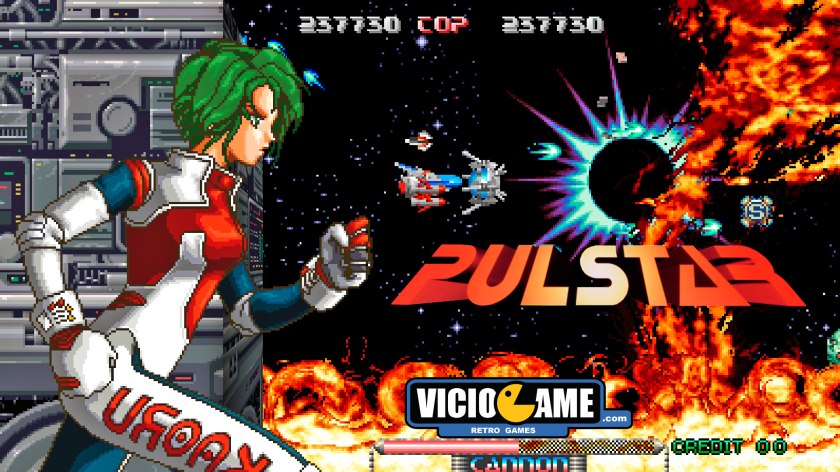
Pulstar, from 1995, complete gameplay.
Developer: Aicom
Publisher: SNK
Neo Geo MVS arcade system board version.
Pulstar: The Ultimate Guide
Pulstar emerged in 1995 as one of the most impressive horizontal shooting games ever released for the Neo Geo system. Developed by Aicom Co. Ltd and published by SNK, the game quickly stood out for its unique combination of pre-rendered graphics with traditional pixel art, creating a visual experience that remains striking to this day. As the first Neo Geo game to incorporate pre-rendered graphics, Pulstar established new technical standards for the platform and left an indelible mark on the history of shooting games.
The plot of Pulstar takes place in a distant future, specifically in the year 2248, when Earth scientists detect the first confirmed signal of extraterrestrial life coming from Mars. This mysterious signal emanates from the red planet and, from it, an unknown object travels through space at the speed of light, leaving the Solar System. Earth scientists, unable to determine the exact nature of this signal, alert world defenses about the possibility of aliens tracking the signal and following its path to Earth with hostile intentions.
The scientists’ predictions come true eight years later, when alien forces follow the signal to the Solar System and initiate a devastating attack against human spacecraft positioned in Neptune’s orbit. The conflict quickly spreads throughout the Solar System, resulting in catastrophic consequences: in just two years of intense combat, Neptune is completely disintegrated, Jupiter is transformed into a star, and more than half of Earth’s continents submerge due to rising ocean levels and alteration of the planetary axis. Amid this apocalyptic scenario, Kaoru Yamazaki emerges as one of humanity’s last hopes. As the lone pilot of the Dino-246 ship, she represents one of the few survivors of the Pulstar attack force, created with the objective of defending the Solar System from alien invasion.
Pulstar’s game system follows the classic horizontal shooting game formula: the player needs to advance through levels controlling a spacecraft, collecting power-ups and avoiding destruction. However, the game incorporates innovative elements that differentiate it from its contemporaries. One of the most notable aspects is the weapon power bar, divided into two distinct halves. The right side of the bar turns blue when the fire button is pressed and held; when fully charged, it allows the ship to release a powerful energy beam capable of causing massive damage. The left side turns red when the button is pressed repeatedly, resulting in a burst of smaller, rapid shots that can be useful against groups of enemies.
The player’s ship can be equipped with different types of weapons, each identified by a Roman letter when it appears as a collectible item. Type N offers a wave-shaped shot, effective against groups of enemies. Type P provides lasers that ricochet off surfaces, ideal for hitting enemies in difficult positions. Type T releases tracking lasers that automatically pursue targets. Type R fires a straight laser with high penetration power. Finally, Type F creates an electric shield around the ship, causing contact damage to enemies, although it’s not capable of stopping projectiles.
In addition to main weapons, the player can collect other essential items to increase their chances of survival. The S item increases the ship’s speed, allowing greater mobility to dodge enemy projectiles. The C item functions as a charge accelerator, reducing the time needed to charge powerful shots, which is particularly useful against bosses and resistant enemies. The I item adds small auxiliary modules, known as “bits,” that float above and below the ship, offering additional firepower and the ability to block enemy projectiles.
One of Pulstar’s most distinctive characteristics is the force module that appears at the front of the ship after collecting a weapon power-up. This module grows in size when a second power-up of the same type is collected, significantly increasing the ship’s frontal protection. The module not only amplifies firepower but also serves as a shield, capable of deflecting or absorbing enemy shots and eliminating small adversaries that collide with it. In desperate situations, the player can sacrifice this module in a panic attack by pressing buttons A and B simultaneously, resulting in an explosion that grants temporary invincibility to the ship.
Pulstar unfolds across eight meticulously designed stages, each with unique characteristics and increasing challenges. The first stage, “Front Line On The Earth,” serves as an introduction to the game’s basic mechanics, allowing the player to familiarize themselves with the controls and weapon system. The second stage, “Water Vein Under Ground,” presents an underwater environment with narrow passages that require precise navigation. The third stage, “The Fire Prominence,” is particularly visually impressive, with flaming arcs crossing the screen while the player faces a huge organic battleship.
The fourth stage, “Attack On Space Station,” involves destroying a large space station, with notable visual effects like screen tremors that simulate the impact of massive destruction. The fifth stage, “The Dangerous Forest,” introduces natural elements to the scenery, including a visually impactful waterfall passage. The sixth stage, “The Terminators,” presents a tight labyrinth populated by block creatures, requiring quick reflexes and pattern memorization. The seventh stage, “Darkness Nebura,” transports the player to deep space, with giant lunar surfaces reminiscent of other classic games in the genre. Finally, the final stage, “Life Or Death,” represents the pinnacle of challenge, with deadly obstacles and a two-part final boss: Mentos and Bhi.
Each stage culminates in a battle against a unique boss, each with distinct attack patterns and specific weak points. The second stage boss, Galla Naga, for example, can be defeated more easily by positioning the ship above its head and firing rapidly. The final boss, divided into two entities, Mentos and Bhi, represents the ultimate challenge, requiring complete mastery of game mechanics and precise knowledge of attack patterns to be overcome.
Pulstar’s difficulty is notoriously high, even by the standards of shooting games of the era. The game offers eight difficulty levels, with level 4 being the default. In this configuration, the player receives an extra life upon reaching 300,000 points, and then every additional 200,000 points. The checkpoint system allows the player to resume the game from specific points after losing a life, although the point bonus for completing a stage is reduced the more times the player is defeated: 50,000 points without deaths, 30,000 points with one death, and only 10,000 points with two or more deaths.
Visually, Pulstar is a true spectacle. The game combines 3D pre-rendered graphics with traditional pixel art, creating detailed environments and expressive characters. The cinematic-style cutscenes and pre-rendered films between stages add depth to the narrative and immersion to the experience. The bosses are particularly impressive, with complex designs and fluid animations that demonstrate the artistic care invested in the game’s development.
Pulstar’s soundtrack, composed by Harumi Fujita and Yasuaki Fujita (both former Capcom employees who worked on the Ghosts’n Goblins series), perfectly complements the visual experience. The music evolves throughout the game, starting with cheerful and animated themes in the early stages and gradually transitioning to darker and more atmospheric compositions in the final phases. This musical progression reflects the player’s journey, which begins on Earth and advances to the depths of space, facing increasingly alien and disturbing threats.
Harumi Fujita, in particular, approached Pulstar’s soundtrack composition with a mentality freed from the technical limitations of sound chips of the era, taking advantage of the Neo Geo hardware’s advanced capabilities to create musical pieces that harmonize perfectly with the game’s environments and convey the narrative’s growing tension. The Neo Geo CD version of the game features an even higher quality soundtrack, benefiting from the CD format to offer richer and more detailed audio tracks.
Pulstar’s development has an interesting history behind it. The game was created by Aicom, a Japanese developer founded by former Irem employees, the company responsible for the R-Type series. This connection explains the evident similarities between the two games, although Pulstar incorporates enough innovations to establish its own identity. During development, the game was known by the codename “Project Dino,” a reference to the protagonist ship Dino-246.
Initially released for arcades on August 28, 1995, Pulstar was later adapted for the home Neo Geo AES system in September of the same year, followed by a Neo Geo CD version in October. In France, distribution of the AES version was handled by Guillemot International.
Over the years, Pulstar received various re-releases that allowed new generations of players to experience this classic. In 2012, the game was made digitally available for the Japanese Wii Virtual Console service by D4 Enterprise. In 2015, it was included in the Neo Geo 25th Anniversary Humble Bundle package. More recently, in 2017, Hamster Corporation re-released Pulstar for Xbox One, PlayStation 4, and Nintendo Switch as part of their Arcade Archives series, ensuring the game’s legacy continues to live on modern platforms.
Pulstar’s critical reception was varied but generally positive. In Japan, Game Machine magazine listed the game as the seventh most popular arcade title in its October 1, 1995 edition, indicating significant commercial success in its home market. Harumi Fujita, one of the soundtrack composers, stated that the game was well received by both SNK and Neo Geo fans.
Maximum magazine gave the Neo Geo AES version an enthusiastic review, particularly praising the visually impressive bosses and the high, intelligently designed challenge level. The publication’s critics also interpreted Pulstar’s release as a sign that SNK was diversifying its catalog beyond the one-on-one fighting games that dominated their lineup at the time.
On the other hand, critic Major Mike from GamePro magazine offered a more mixed analysis, describing Pulstar as an imperfect and unoriginal shooter that managed to distinguish itself mainly through its high difficulty and rendered graphics. He specifically criticized the tendency of objects to blend with backgrounds, although, like Maximum, he positively highlighted the visually impressive bosses.
A reviewer from Next Generation magazine was considerably more critical, claiming that Pulstar’s gameplay mechanics didn’t surpass even early 1980s shooters. He concluded that if it weren’t for the game’s excessively slow pace, Pulstar could have been just another generic shooter, but due to this characteristic, it ended up being even worse.
Despite mixed reviews at the time of its release, Pulstar gained growing recognition over the years. In 2014, HobbyConsolas publication identified the game as one of the twenty best titles available for Neo Geo CD. Similarly, Time Extension magazine also listed it among the best games ever released for the Neo Geo system, consolidating its reputation as a genre classic.
Pulstar presents various peculiarities and curiosities that make it even more interesting for enthusiasts. The game contains several references and homages to other genre classics, such as R-Type (in enemy patterns and game mechanics), Gradius (in the form of the indestructible spider present in one of the stages), and Darius (in the giant lunar surfaces of the seventh stage). These references demonstrate the developers’ respect for the genre’s history and their desire to position themselves as part of this tradition.
A notable technical characteristic of Pulstar is the constant presence of slowdown during particularly intense sections. While this might be considered a technical flaw, many experienced players learned to use this characteristic to their advantage, taking advantage of the deceleration to navigate more precisely through difficult passages and react to complex attack patterns. On the other hand, this same slowdown can negatively affect the game’s rhythm, especially in the first half, where battles against large enemy ships can drastically reduce the action’s speed.
Pulstar’s scoring system offers opportunities for competitive players to maximize their results. Each collected item is worth a few points, and there are techniques to “milk” points from certain enemies and bosses, although this doesn’t add much to the final score. There are also mysterious techniques to obtain more points from the final boss, although they involve intentionally sacrificing the ship, a risky strategy that few players are willing to employ.
A visual curiosity is the abundance of phallic images in Pulstar, notably more explicit than in other shooting games with serious themes. Examples include the tip of the organic battleship in the third stage, the seventh stage boss’s weak point, and a series of pink structures in the final stage that try to crush the player. This unusual characteristic adds a layer of visual subversion to the game’s design that may go unnoticed by casual players.
After Pulstar’s release, developer Aicom merged with an SNK division to form Yumekobo, the company that later created Blazing Star, considered by many as Pulstar’s spiritual successor. Although Blazing Star presents significant differences in terms of gameplay and aesthetics, the connection between the two games is evident, and both are frequently cited among the best shooting games available for Neo Geo.
Pulstar’s legacy extends beyond its direct influence on Blazing Star. As a pioneer in the use of pre-rendered graphics on Neo Geo, the game demonstrated the hardware’s technical possibilities and paved the way for other titles that would explore similar visual approaches. The combination of traditional pixel art with pre-rendered elements established a visual style that would be emulated by various subsequent games, not only on Neo Geo but on other platforms as well.
For players interested in experiencing Pulstar today, several options are available. In addition to the official re-releases for modern platforms mentioned earlier, the game can be found in various collections and legal emulation services. Hamster Corporation’s Arcade Archives version, in particular, offers a faithful reproduction of the original arcade experience, with additional options like state saving and difficulty settings that can make the game more accessible to newcomers.
Mastering Pulstar requires practice, patience, and familiarity with its unique mechanics. For beginner players, it’s recommended to start with a lower difficulty level and focus on learning enemy and boss patterns before attempting more challenging configurations. Weapon choice is also crucial: Type N (wave shot) is generally considered the most versatile for beginners, while Type R (straight laser) offers greater penetration power for more experienced players who can aim precisely.
The first stage serves as a relatively gentle introduction to the game’s concepts, allowing the player to experiment with different weapons and get accustomed to the charging system. The second stage increases difficulty with narrow passages that require precise navigation, while the third stage tests the player’s ability to deal with enemies coming from multiple directions simultaneously. From the fourth stage onward, the game becomes significantly more challenging, requiring quick reflexes, pattern memorization, and strategic use of the force module and auxiliary bits.
The second stage boss, Galla Naga, can be defeated more easily by positioning the ship just above its head and firing as rapidly as possible, especially if the player has the force shield. For the third stage boss, Carellpi, it’s recommended to maintain distance and use fully charged shots, aiming at its central weak point. The fourth stage boss, Kira-Ge-Woiare, requires constant movement to avoid its shooting patterns, while the fifth stage boss, Eira-Beera, can be faced more effectively with wide-dispersion weapons like Type N.
The final stages’ bosses represent the game’s most intense challenges. Iveprowfent, the sixth stage boss, requires precise timing to navigate between its attacks while maintaining concentrated fire on its vulnerable points. Kuuka, the seventh stage boss, has an explicit weak point that must be attacked with charged shots to maximize damage. Finally, the two-part final boss, Mentos and Bhi, requires complete mastery of all game aspects, including precise positioning, resource management, and detailed knowledge of attack patterns.
Beyond the main campaign, Pulstar offers little variation in terms of game modes. There’s no cooperative mode for two players, unlike many other shooting games of the era. The focus is entirely on the single-player experience, with replayability coming from pursuing higher scores and attempting to complete the game at increasing difficulty levels. For truly dedicated players, the ultimate challenge is managing to complete the game with only one continue, a feat that requires exceptional skill and deep knowledge of every aspect of the game.
Pulstar remains as a testament to the golden age of 2D shooting games, combining stunning visuals, challenging gameplay, and creative level design in a package that continues to impress even decades after its original release. Its legacy lives not only through its spiritual successor, Blazing Star, but also in the influence it exerted over the genre as a whole and in the lasting affection it receives from fans and collectors around the world. For those willing to face its high difficulty level, Pulstar offers a deeply rewarding gaming experience that exemplifies the best the genre has to offer.
Pulstar: O Guia Definitivo
Pulstar surgiu em 1995 como um dos jogos de tiro horizontal mais impressionantes já lançados para o sistema Neo Geo. Desenvolvido pela Aicom Co. Ltd e publicado pela SNK, o jogo rapidamente se destacou por sua combinação única de gráficos pré-renderizados com pixel art tradicional, criando uma experiência visual que permanece marcante até os dias atuais. Como primeiro jogo do Neo Geo a incorporar gráficos pré-renderizados, Pulstar estabeleceu novos padrões técnicos para a plataforma e deixou uma marca indelével na história dos jogos de tiro.
A trama de Pulstar se passa em um futuro distante, especificamente no ano 2248, quando cientistas terrestres detectam o primeiro sinal confirmado de vida extraterrestre vindo de Marte. Este sinal misterioso emana do planeta vermelho e, a partir dele, um objeto desconhecido viaja pelo espaço à velocidade da luz, deixando o Sistema Solar. Os cientistas da Terra, incapazes de determinar a natureza exata deste sinal, alertam as defesas mundiais sobre a possibilidade de alienígenas rastrearem o sinal e seguirem seu caminho até a Terra com intenções hostis.
A previsão dos cientistas se concretiza oito anos depois, quando forças alienígenas seguem o sinal até o Sistema Solar e iniciam um ataque devastador contra as naves espaciais humanas posicionadas na órbita de Netuno. O conflito rapidamente se espalha por todo o Sistema Solar, resultando em consequências catastróficas: em apenas dois anos de combate intenso, Netuno é completamente desintegrado, Júpiter é transformado em uma estrela, e mais da metade dos continentes terrestres submergem devido ao aumento dos níveis oceânicos e à alteração do eixo planetário. Em meio a este cenário apocalíptico, Kaoru Yamazaki emerge como uma das últimas esperanças da humanidade. Como piloto solitária da nave Dino-246, ela representa um dos poucos sobreviventes da força de ataque Pulstar, criada com o objetivo de defender o Sistema Solar da invasão alienígena.
O sistema de jogo de Pulstar segue a fórmula clássica dos jogos de tiro horizontal: o jogador precisa avançar pelos níveis controlando uma nave espacial, coletando power-ups e evitando a destruição. Entretanto, o jogo incorpora elementos inovadores que o diferenciam de seus contemporâneos. Um dos aspectos mais notáveis é a barra de poder de arma, dividida em duas metades distintas. O lado direito da barra fica azul quando o botão de disparo é pressionado e mantido; quando totalmente carregado, permite que a nave libere um poderoso raio de energia capaz de causar danos massivos. Já o lado esquerdo fica vermelho quando o botão é pressionado repetidamente, resultando em uma rajada de tiros menores e rápidos que podem ser úteis contra grupos de inimigos.
A nave do jogador pode ser equipada com diferentes tipos de armas, cada uma identificada por uma letra romana quando aparece como item coletável. O tipo N oferece um tiro em forma de onda, eficaz contra grupos de inimigos. O tipo P proporciona lasers que ricocheteiam nas superfícies, ideais para atingir inimigos em posições difíceis. O tipo T libera lasers perseguidores que rastreiam os alvos automaticamente. O tipo R dispara um laser reto de alto poder de penetração. Por fim, o tipo F cria um escudo elétrico ao redor da nave, causando dano por contato aos inimigos, embora não seja capaz de deter projéteis.
Além das armas principais, o jogador pode coletar outros itens essenciais para aumentar suas chances de sobrevivência. O item S incrementa a velocidade da nave, permitindo maior mobilidade para esquivar de projéteis inimigos. O item C funciona como um acelerador de carga, reduzindo o tempo necessário para carregar tiros poderosos, o que é particularmente útil contra chefes e inimigos resistentes. Já o item I adiciona pequenos módulos auxiliares, conhecidos como “bits”, que flutuam acima e abaixo da nave, oferecendo poder de fogo adicional e capacidade de bloquear projéteis inimigos.
Uma das características mais distintivas de Pulstar é o módulo de força que aparece na parte frontal da nave após a coleta de um power-up de arma. Este módulo cresce de tamanho quando um segundo power-up do mesmo tipo é coletado, aumentando significativamente a proteção frontal da nave. O módulo não apenas amplifica o poder de fogo, mas também serve como escudo, capaz de defletir ou absorver tiros inimigos e eliminar pequenos adversários que colidem com ele. Em situações desesperadoras, o jogador pode sacrificar este módulo em um ataque de pânico, pressionando os botões A e B simultaneamente, o que resulta em uma explosão que concede invencibilidade temporária à nave.
Pulstar se desenvolve ao longo de oito estágios meticulosamente projetados, cada um com características únicas e desafios crescentes. O primeiro estágio, “Front Line On The Earth”, serve como introdução aos mecanismos básicos do jogo, permitindo que o jogador se familiarize com os controles e o sistema de armas. O segundo estágio, “Water Vein Under Ground”, apresenta um ambiente subaquático com passagens estreitas que exigem navegação precisa. O terceiro estágio, “The Fire Prominence”, é particularmente impressionante visualmente, com arcos flamejantes cruzando a tela enquanto o jogador enfrenta uma enorme nave de batalha orgânica.
O quarto estágio, “Attack On Space Station”, envolve a destruição de uma grande estação espacial, com efeitos visuais notáveis como tremores de tela que simulam o impacto da destruição massiva. O quinto estágio, “The Dangerous Forest”, introduz elementos naturais ao cenário, incluindo uma passagem de cachoeira visualmente impactante. O sexto estágio, “The Terminators”, apresenta um labirinto apertado povoado por criaturas em blocos, exigindo reflexos rápidos e memorização de padrões. O sétimo estágio, “Darkness Nebura”, transporta o jogador para o espaço profundo, com superfícies lunares gigantes reminiscentes de outros jogos clássicos do gênero. Finalmente, o estágio final, “Life Or Death”, representa o ápice do desafio, com obstáculos mortais e um chefe final em duas partes: Mentos e Bhi.
Cada estágio culmina em uma batalha contra um chefe único, cada um com padrões de ataque distintos e pontos fracos específicos. O chefe do segundo estágio, Galla Naga, por exemplo, pode ser derrotado mais facilmente posicionando a nave acima de sua cabeça e disparando rapidamente. Já o chefe final, dividido em duas entidades, Mentos e Bhi, representa o desafio definitivo, exigindo domínio completo dos mecanismos de jogo e conhecimento preciso dos padrões de ataque para ser superado.
A dificuldade de Pulstar é notoriamente elevada, mesmo para os padrões dos jogos de tiro da época. O jogo oferece oito níveis de dificuldade, com o nível 4 sendo o padrão. Nesta configuração, o jogador recebe uma vida extra ao atingir 300.000 pontos, e depois a cada 200.000 pontos adicionais. O sistema de checkpoints permite que o jogador retome o jogo a partir de pontos específicos após perder uma vida, embora o bônus de pontuação ao completar um estágio seja reduzido quanto mais vezes o jogador for derrotado: 50.000 pontos sem mortes, 30.000 pontos com uma morte, e apenas 10.000 pontos com duas ou mais mortes.
Visualmente, Pulstar é um verdadeiro espetáculo. O jogo combina gráficos pré-renderizados em 3D com pixel art tradicional, criando ambientes detalhados e personagens expressivos. As cutscenes em estilo cinematográfico e os filmes pré-renderizados entre estágios adicionam profundidade à narrativa e imersão à experiência. Os chefes são particularmente impressionantes, com designs complexos e animações fluidas que demonstram o cuidado artístico investido no desenvolvimento do jogo.
A trilha sonora de Pulstar, composta por Harumi Fujita e Yasuaki Fujita (ambos ex-funcionários da Capcom que trabalharam na série Ghosts’n Goblins), complementa perfeitamente a experiência visual. A música evolui ao longo do jogo, começando com temas alegres e animados nos primeiros estágios e gradualmente transitando para composições mais sombrias e atmosféricas nas fases finais. Esta progressão musical reflete a jornada do jogador, que começa na Terra e avança para as profundezas do espaço, enfrentando ameaças cada vez mais alienígenas e perturbadoras.
Harumi Fujita, em particular, abordou a composição da trilha sonora de Pulstar com uma mentalidade liberta das limitações técnicas dos chips de som da época, aproveitando as capacidades avançadas do hardware Neo Geo para criar peças musicais que se harmonizam perfeitamente com os ambientes do jogo e transmitem a tensão crescente da narrativa. A versão Neo Geo CD do jogo apresenta uma trilha sonora de qualidade ainda maior, beneficiando-se do formato CD para oferecer faixas de áudio mais ricas e detalhadas.
O desenvolvimento de Pulstar tem uma história interessante por trás. O jogo foi criado pela Aicom, uma desenvolvedora japonesa fundada por ex-funcionários da Irem, empresa responsável pela série R-Type. Esta conexão explica as semelhanças evidentes entre os dois jogos, embora Pulstar incorpore inovações suficientes para estabelecer sua própria identidade. Durante o desenvolvimento, o jogo era conhecido pelo codinome “Project Dino”, uma referência à nave protagonista Dino-246.
Lançado inicialmente para arcades em 28 de agosto de 1995, Pulstar foi posteriormente adaptado para o sistema doméstico Neo Geo AES em setembro do mesmo ano, seguido por uma versão para Neo Geo CD em outubro. Na França, a distribuição da versão AES ficou a cargo da Guillemot International.
Ao longo dos anos, Pulstar recebeu diversos relançamentos que permitiram que novas gerações de jogadores experimentassem este clássico. Em 2012, o jogo foi disponibilizado digitalmente para o serviço Wii Virtual Console japonês pela D4 Enterprise. Em 2015, foi incluído no pacote Neo Geo 25th Anniversary Humble Bundle. Mais recentemente, em 2017, a Hamster Corporation relançou Pulstar para Xbox One, PlayStation 4 e Nintendo Switch como parte de sua série Arcade Archives, garantindo que o legado do jogo continue vivo nas plataformas modernas.
A recepção crítica de Pulstar foi variada, mas geralmente positiva. No Japão, a revista Game Machine listou o jogo como o sétimo título de arcade mais popular em sua edição de 1º de outubro de 1995, indicando um sucesso comercial significativo em seu mercado de origem. Harumi Fujita, uma das compositoras da trilha sonora, afirmou que o jogo foi bem recebido tanto pela SNK quanto pelos fãs do Neo Geo.
A revista Maximum concedeu à versão Neo Geo AES uma crítica entusiástica, elogiando particularmente os chefes visualmente impressionantes e o nível de desafio elevado e inteligentemente projetado. Os críticos da publicação também interpretaram o lançamento de Pulstar como um sinal de que a SNK estava diversificando seu catálogo para além dos jogos de luta um contra um que dominavam seu lineup na época.
Por outro lado, o crítico Major Mike, da revista GamePro, ofereceu uma análise mais mista, descrevendo Pulstar como um shooter imperfeito e pouco original que conseguia se distinguir principalmente por sua alta dificuldade e gráficos renderizados. Ele criticou especificamente a tendência de objetos se confundirem com os fundos, embora, assim como a Maximum, tenha destacado positivamente os chefes visualmente impressionantes.
Um revisor da revista Next Generation foi consideravelmente mais crítico, alegando que os mecanismos de jogabilidade de Pulstar não superavam nem mesmo os shooters do início dos anos 1980. Concluiu que, se não fosse pelo ritmo excessivamente lento do jogo, Pulstar poderia ter sido apenas mais um shooter genérico, mas que, devido a essa característica, acabava sendo ainda pior.
Apesar das críticas mistas na época de seu lançamento, Pulstar ganhou reconhecimento crescente com o passar dos anos. Em 2014, a publicação HobbyConsolas identificou o jogo como um dos vinte melhores títulos disponíveis para o Neo Geo CD. De forma similar, a revista Time Extension também o listou entre os melhores jogos já lançados para o sistema Neo Geo, consolidando sua reputação como um clássico do gênero.
Pulstar apresenta diversas peculiaridades e curiosidades que o tornam ainda mais interessante para os entusiastas. O jogo contém várias referências e homenagens a outros clássicos do gênero, como R-Type (nos padrões de inimigos e mecânicas de jogo), Gradius (na forma da aranha indestrutível presente em um dos estágios) e Darius (nas superfícies lunares gigantes do sétimo estágio). Estas referências demonstram o respeito dos desenvolvedores pela história do gênero e seu desejo de se posicionar como parte dessa tradição.
Uma característica técnica notável de Pulstar é a presença constante de slowdown (desaceleração) durante seções particularmente intensas. Embora isso possa ser considerado uma falha técnica, muitos jogadores experientes aprenderam a usar essa característica a seu favor, aproveitando a desaceleração para navegar com mais precisão por passagens difíceis e reagir a padrões de ataque complexos. Por outro lado, esse mesmo slowdown pode afetar negativamente o ritmo do jogo, especialmente na primeira metade, onde batalhas contra grandes naves inimigas podem reduzir drasticamente a velocidade da ação.
O sistema de pontuação de Pulstar oferece oportunidades para jogadores competitivos maximizarem seus resultados. Cada item coletado vale alguns pontos, e existem técnicas para “ordenhar” pontos de certos inimigos e chefes, embora isso não adicione muito à pontuação final. Existem também técnicas misteriosas para obter mais pontos no chefe final, embora envolvam o sacrifício intencional da nave, uma estratégia arriscada que poucos jogadores estão dispostos a empregar.
Uma curiosidade visual é a abundância de imagens fálicas em Pulstar, notavelmente mais explícitas do que em outros jogos de tiro com temática séria. Exemplos incluem a ponta da nave de batalha orgânica no terceiro estágio, o ponto fraco do chefe do sétimo estágio e uma série de estruturas rosa no estágio final que tentam esmagar o jogador. Esta característica inusitada adiciona uma camada de subversão visual ao design do jogo que pode passar despercebida para jogadores casuais.
Após o lançamento de Pulstar, a desenvolvedora Aicom se fundiu com uma divisão da SNK para formar a Yumekobo, empresa que posteriormente criou Blazing Star, considerado por muitos como o sucessor espiritual de Pulstar. Embora Blazing Star apresente diferenças significativas em termos de jogabilidade e estética, a conexão entre os dois jogos é evidente, e ambos são frequentemente citados entre os melhores jogos de tiro disponíveis para o Neo Geo.
O legado de Pulstar se estende além de sua influência direta em Blazing Star. Como pioneiro no uso de gráficos pré-renderizados no Neo Geo, o jogo demonstrou as possibilidades técnicas do hardware e abriu caminho para outros títulos que explorariam abordagens visuais similares. A combinação de pixel art tradicional com elementos pré-renderizados estabeleceu um estilo visual que seria emulado por diversos jogos subsequentes, não apenas no Neo Geo, mas em outras plataformas também.
Para jogadores interessados em experimentar Pulstar hoje, existem diversas opções disponíveis. Além dos relançamentos oficiais para plataformas modernas mencionados anteriormente, o jogo pode ser encontrado em várias coletâneas e serviços de emulação legal. A versão Arcade Archives da Hamster Corporation, em particular, oferece uma reprodução fiel da experiência original de arcade, com opções adicionais como salvamento de estado e configurações de dificuldade que podem tornar o jogo mais acessível para novatos.
Dominar Pulstar requer prática, paciência e familiaridade com seus mecanismos únicos. Para jogadores iniciantes, recomenda-se começar com um nível de dificuldade mais baixo e focar em aprender os padrões de inimigos e chefes antes de tentar configurações mais desafiadoras. A escolha da arma também é crucial: o tipo N (tiro em onda) é geralmente considerado o mais versátil para iniciantes, enquanto o tipo R (laser reto) oferece maior poder de penetração para jogadores mais experientes que podem mirar com precisão.
O primeiro estágio serve como uma introdução relativamente gentil aos conceitos do jogo, permitindo que o jogador experimente diferentes armas e se acostume com o sistema de carga. O segundo estágio aumenta a dificuldade com passagens estreitas que exigem navegação precisa, enquanto o terceiro estágio testa a capacidade do jogador de lidar com inimigos vindos de múltiplas direções simultaneamente. A partir do quarto estágio, o jogo se torna significativamente mais desafiador, exigindo reflexos rápidos, memorização de padrões e uso estratégico do módulo de força e dos bits auxiliares.
O chefe do segundo estágio, Galla Naga, pode ser derrotado mais facilmente posicionando a nave logo acima de sua cabeça e disparando o mais rapidamente possível, especialmente se o jogador tiver o escudo de força. Para o chefe do terceiro estágio, Carellpi, é recomendável manter distância e usar tiros totalmente carregados, mirando em seu ponto fraco central. O chefe do quarto estágio, Kira-Ge-Woiare, requer movimentação constante para evitar seus padrões de tiro, enquanto o chefe do quinto estágio, Eira-Beera, pode ser enfrentado mais eficazmente com armas de ampla dispersão como o tipo N.
Os chefes dos estágios finais representam os desafios mais intensos do jogo. Iveprowfent, o chefe do sexto estágio, exige timing preciso para navegar entre seus ataques enquanto se mantém o fogo concentrado em seus pontos vulneráveis. Kuuka, o chefe do sétimo estágio, possui um ponto fraco explícito que deve ser atacado com tiros carregados para maximizar o dano. Finalmente, o chefe final em duas partes, Mentos e Bhi, requer domínio completo de todos os aspectos do jogo, incluindo posicionamento preciso, gerenciamento de recursos e conhecimento detalhado dos padrões de ataque.
Além da campanha principal, Pulstar oferece pouca variação em termos de modos de jogo. Não há modo cooperativo para dois jogadores, diferentemente de muitos outros jogos de tiro da época. O foco está inteiramente na experiência single-player, com a rejogabilidade vindo da busca por pontuações mais altas e da tentativa de completar o jogo em níveis de dificuldade crescentes. Para jogadores verdadeiramente dedicados, o desafio definitivo é conseguir completar o jogo com apenas uma continuação, façanha que requer habilidade excepcional e conhecimento profundo de cada aspecto do jogo.
Pulstar permanece como um testemunho da era de ouro dos jogos de tiro 2D, combinando visuais deslumbrantes, jogabilidade desafiadora e design de níveis criativo em um pacote que continua a impressionar mesmo décadas após seu lançamento original. Seu legado vive não apenas através de seu sucessor espiritual, Blazing Star, mas também na influência que exerceu sobre o gênero como um todo e no carinho duradouro que recebe de fãs e colecionadores ao redor do mundo. Para aqueles dispostos a enfrentar seu alto nível de dificuldade, Pulstar oferece uma experiência de jogo profundamente gratificante que exemplifica o melhor que o gênero tem a oferecer.
🤑💲Earn money without doing anything! Just leave the Honeygain app open: https://r.honeygain.me/CONTA9DB02
🤑💲1-Click button earns Bitcoin every 1 hour: https://freebitco.in/?r=53528449
⬛ 𝗧𝗶𝗸𝗧𝗼𝗸: https://www.tiktok.com/@viciogame
🟧 𝗜𝗻𝘀𝘁𝗮𝗴𝗿𝗮𝗺: http://www.instagram.com/viciogame
🟥 𝗬𝗼𝘂𝘁𝘂𝗯𝗲: http://www.youtube.com/viciogame
🟦 𝗙𝗮𝗰𝗲𝗯𝗼𝗼𝗸: http://www.facebook.com/viciogame
🔳 𝗧𝗵𝗿𝗲𝗮𝗱𝘀: https://www.threads.net/@viciogame
🟪 𝗧𝘄𝗶𝘁𝗰𝗵: https://www.twitch.tv/ViciogameRetroGames
🟨 𝗕𝗹𝗼𝗴: http://www.viciogameblog.com/
🟦𝗧𝘄𝗶𝘁𝘁𝗲𝗿: http://www.twitter.com/viciogame
#Viciogame #Gameplay #LetsPlay #Gamer #Playthrough #Games #News #Videogames #Review #Game #Detonado #Walkthrough #Ending #Reviews #Facts #Retro #Record #Roms #Emulator #Longplay #Speedrun #Pulstar #Arcade #NeoGeo #MVS #SNK #Shmup #ShootEmUp #Shooter #AES #NeoGeoCD #パルスター #Rtype #Gradius #BlazingStar #ネオジオ
 VICIOGAME