
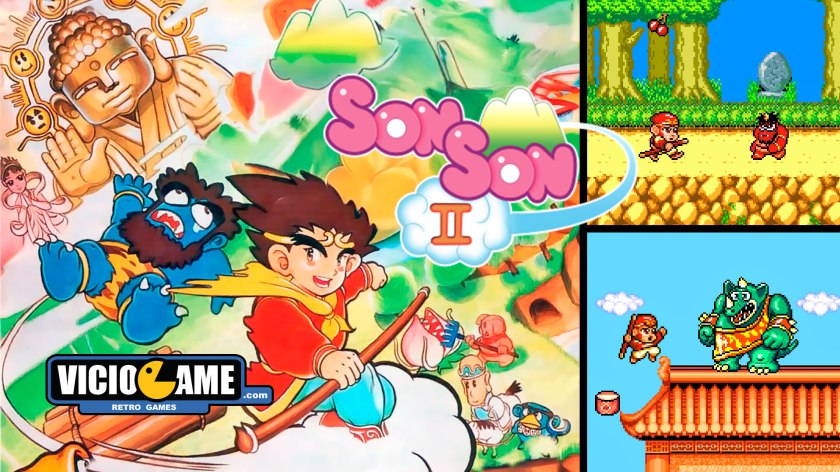
Son Son II is a 2D platformer released in 1989 exclusively for the PC Engine. Based on an ancient Chinese legend, the game blends action and RPG elements. Son Goku must collect money and weapon upgrades so he can finally take on the powerful villain who kidnapped his friends.
Developer: Capcom
Publisher: NEC Avenue
Release Date: 1989
Platform: NEC PC Engine / TurboGrafx-16
🇺🇸 On Friday, January 27, 1989, a HuCard called SonSon II (ソンソンII) hit Japanese store shelves. The PC Engine had received Vigilante two weeks earlier and would get Nectaris soon after, and the latest card came from a still-new publisher: NEC Avenue, the music and games division of NEC, which had debuted on the console with ports of two Sega arcade games, Fantasy Zone and Space Harrier, and was now releasing what is usually counted as its first original title. Original, it should be said, only up to a point. Anyone expecting a follow-up to Capcom’s 1984 arcade game, with its monkey and pig running along auto-scrolling lanes, found instead an action game built around exploring enormous maps, with shops, spells, and an extendable staff, all assembled on the skeleton of a grim barbarian arcade game called Black Tiger. The Roman numeral in the title is the game’s first mystery. The second, far more interesting, is that the mix works.
To understand the detour, you have to go back to 1984. SonSon was born at a Capcom that, until shortly before, had only distributed games and had just assembled its development department with people who had left Konami. Yoshiki Okamoto, who at his old company had handled the game mechanics while his colleague Tokuro Fujiwara handled the characters, decided to swap roles: Fujiwara would take on Vulgus, and Okamoto would make a game with lovable characters, inspired by an illustrated Japanese edition of Journey to the West, the Chinese novel. The hero is named SonSon, a pun that works in two languages: in English it is simply “son,” while 孫, the character that opens the name Son Goku, means “grandson.” The scrolling was automatic and the playfield was divided into six continuous lanes, with the monkey and his partner Tonton, the pig, hopping between them and firing bursts of energy from their staffs. It was Capcom’s second game, the first sold in the United States, and the company’s first with simultaneous co-op play; by August 1984 it was already among the five most successful cocktail-table cabinets in Japan, and in 1986 it received a version for the Famicom.
A little over three years later, on August 1, 1987, Capcom released Black Tiger, known as Black Dragon in Japan. Produced by Okamoto and programmed by Masayuki Akahori, it was a Western-fantasy platformer in which a barbarian warrior armed with a flail fought through eight maze-like stages, freed petrified old sages in exchange for rewards, and collected zenny, the currency Capcom introduced there and never stopped using. It was the company’s first arcade game with shops; the maximum vitality bar grew with the score, and the hero’s armor was stripped away before his life bar began to drop. The plan was to bring it to the PC Engine. At some point in development, though, the port gave way to a new game, built on the arcade game’s foundation and dressed in the cast of the old SonSon. The reason was never explained, but the most plausible theory has to do with the tastes of the day: on the PC Engine itself, Bikkuriman World had already applied the formula, swapping the hero of Sega’s arcade game Monster Land (Wonder Boy in Monster Land in the West) for characters from a popular brand, and Black Tiger couldn’t withstand that kind of makeover without losing its menace. Capcom, on the other hand, had a friendly monkey close at hand. Anyone who plays the two back to back will notice that what carried over is structure more than content: the shops, the score-based progression, and the exploration logic survive, while the stages, enemies, and pacing are all different.
The credits show that Capcom treated the project as an in-house affair. The card carries the NEC Avenue label, but it was developed by Capcom itself, which makes it one of the few PC Engine games the company made directly. Okamoto is credited with the planning, alongside Masaya Higashitani. Black Tiger‘s programmer, Masayuki Akahori, shares the code with Yoshito Itoh; Susumu Ueda and Takashi Shouno handle the sprites, and Naoe Nonomura, Yuki Kyoutani, Yukiyo Kuramoto, and Miki Mikami the backgrounds. Sound duties go to Yoshihiro Sakaguchi, who headed the department, and Manami Gotoh, the maiden name of Manami Matsumae, composer of the first Mega Man. She recalls that the department, made up almost entirely of women, worked in a separate building and saw the stages only when they were close to finished, and she sums it up by saying the project was Okamoto’s. The special thanks include Akira Yasuda, known as Akiman, who two years later would draw a good share of the fighters in Street Fighter II; he also did the card’s cover art, after having made the flyer and the final illustration for Black Tiger.
The reskin left scars. In the manual, the hero is SonSon; in the game’s text, he is Son Goku; on the cover, he is a human boy, a close relative of the Goku from Dragon Ball; on screen, he reverts to the little arcade monkey. Tonton, the pig who was the second player in the arcade game, becomes Hakkai and is demoted to prisoner, so SonSon II can only be played solo. The opening shows Son Goku’s friends, among them Sanzo, Hakkai, and Sa Gojo, being abducted by a giant silhouette with a question mark in the middle, which the story reveals to be Gyumao, the bull demon of the legend; it is the only moment that recalls its predecessor, which also began with a kidnapping. Hakkai and Sa Gojo wait hidden away in the stages. Only a single echo of the 1984 arcade game survives: the cloud that, there, brought the hero back onto the screen after a death, invulnerable for a few seconds, and which here becomes a flying mount in the boss duels.
Once the player takes control, it becomes clear that this is an exploration game dressed up as a platformer. There are seven stages, each a sprawling, interlocking map, with poles to climb, locked doors, hidden rooms, and a key to find before you can reach the boss. The first stages are compact and almost straightforward; the later ones grow, picking up teleporters and false walls and floors, until spending twenty minutes on a single map hunting for a key stops being an exaggeration. Breakable walls hide items but only give way to a player with the right glove, an item that wears out after just a few uses. Some find the result excessive from the halfway point on, and it’s hard to disagree when the corridors start looking alike and the status panel takes up a good chunk of the screen, narrowing the field of view. Still, it is precisely the scale of the maps that gives the card a character of its own next to the console’s linear platformers.
The heart of the game is its economy, inherited from Black Tiger. Defeated enemies drop fruit, and every piece of fruit is worth zenny. At points on the map, characters set up shop: a young woman who also hands out hints and, in the later stages, Hakkai and Sa Gojo. Each shop sells four items, and the price goes up with every purchase, in the manner of Fantasy Zone, which forces you to choose rather than carry off everything. The expense that weighs the most is the Nyoibo staff, the hero’s only weapon, which comes in six power levels: the starting one, three for sale at prices between 2,000 and 7,000 zenny, and two hidden in the stages. Score stands in for experience and expands the magic bar, and the Yashichi, the pinwheel Capcom scatters throughout its games, extends the life bar. Anyone who finishes a stage quickly pockets a bonus that, in the early ones, can reach 5,000 zenny, so speed pays better than a thorough sweep of the map.
Spells come into play as a tactical tool. Button I attacks and Button II jumps, and the offensive spells (peaches, bombs, and a bolt that clears the screen) require pressing both together, a control choice that draws frequent complaints from players; support spells, such as the shield and the time stop, help in the tougher duels. A trading sequence runs through the game: the pork bun bought from Sa Gojo in stage three goes to Hakkai (the cannibalism joke writes itself) and then through other characters until it finally yields an outfit that boosts defense. On the cruel side, skulls dropped by enemies take 100 zenny out of your pocket.
This is where the friendly packaging falls apart. The player starts with a single life and no continues; the continue lamp has to be bought beforehand, with the same money that should go toward the staff, the hearts, and the spells, and the shops never forgive a bad choice. Regular enemies attack with less fury than in Black Tiger, and that is the key difference: the challenge here comes from attrition, not reflexes. Finishing a stage restores only part of your life, hearts dropped by enemies are rare, and the clock works out of sight: there is no counter on screen, but after ten minutes in the same stage, a nearly indestructible Raijin shows up on a cloud and chases the hero across the entire map, and if he’s knocked down, he returns about a minute later. The message is clear: no running in circles to farm fruit. In the final stage, a boss rush brings back all the earlier bosses without restoring any life between duels, and anyone who reaches the end without having found the strongest staff, hidden in a wall, feels its absence with every swing. A full playthrough takes, for someone who already knows the way, forty minutes to an hour, and losing it to a single death is the kind of punishment arcades charged in quarters and the PC Engine now charges in time.
The roster of bosses works like a tour through the novel: the fake Goku, who returns later disguised as Hakkai; Kogaiji, Gyumao’s son; his mother, Rasetsunyo; the brothers Kinkaku and Ginkaku; and, to close out the list, Gyumao himself. The constraints of a mere 2-megabit card show in the recycling: Kinkaku is little more than a recolor of Ginkaku, the fake Goku is the hero in a different color, and enemies and backdrops reuse palettes throughout the stages, palette swapping pushed to its limit. Even so, the visuals are where the game places its clearest bet: bright colors, childlike character proportions, and pastel backgrounds, the opposite of the heavy tone of Black Tiger, and it is this cartoon look that leads many people to underestimate what lies ahead. The soundtrack, credited to Sakaguchi and Matsumae, is light, with a poppy flavor and a comic tone, more charming than unforgettable.
Reception at the time ranged from lukewarm to good. Famitsu gave it 25 out of 40 points in its February 3, 1989 cross review, a week after release, an above-average score that stops short of a rave. The title never left Japan, not even for the TurboGrafx-16, which would have made good use of a game like this, but it circulated as an import and was reviewed by the European press: Britain’s Computer and Video Games gave it 71% in June 1989 and cautioned that the game would please platformer fans without winning over anyone else; The Games Machine reached 80% in August; Germany’s Power Play awarded it 86% and, in its year-end retrospective, ranked it second among the best games for the system in 1989; Video Games, also German, went all the way to 88%. Taking all the reviews cataloged over the decades together, the average lands near 78%: a good game with rough edges, a picture that modern reviews only confirm.
Over time, the community mapped the game down to the last button press. Players found that the boss Kogaiji only shoots upward and loses all his bite when attacked from below; that the time stop makes the duel with Rasetsunyo easier, since her fan is hard to dodge; that, in the middle of stage six, a pig asks a question, and answering “no” costs you every bit of the zenny you’ve collected; and that you can start with the continue lamp already in hand by holding Up, Select, and Button I on the title screen before pressing Run. Other combinations turn the screen black-and-white or swap the enemies for the hero himself. There is even a known bug in the final stage: climbing down a certain pole leaves the character stuck under spikes, and in a one-life run that amounts to starting over from scratch.
Seen from a distance, SonSon II sits on a curious side branch of Capcom’s family tree. The zenny-and-shops system that Black Tiger introduced would carry over into bigger arcade games, such as Forgotten Worlds, and the mix of explored maps, purchases, and score-based progression gives the game a dash of RPG that sets it apart from the linear platformers of its day, even without a single declared experience point. Within the company itself, the SonSon brand survived as a fond memory more than as a series: a shop with that name appears in Ryu’s and Guy’s stages in Street Fighter Alpha and in backdrops in Super Puzzle Fighter II Turbo, and a granddaughter of the hero, also named SonSon, joined the cast of Marvel vs. Capcom 2: New Age of Heroes. The 1984 arcade game and Black Tiger circulate today in official collections such as Capcom Arcade 2nd Stadium, while the second SonSon, always far less remembered than the first, still has no official re-release and was once a regular fixture in the bargain bins of Japanese used-game stores.
SonSon II is a rough-edged exploration game with a tight economy, dressed up as a cartoon and saddled with the wrong name. Anyone looking for the second SonSon won’t find it, and neither will anyone looking for a brightly colored Black Tiger, because the borrowings added up to a third thing entirely, with a personality of its own and the flaws of something born of a last-minute decision. It’s a game that takes two or three failures before it yields, and that rewards persistence with one of the most curious combinations Capcom ever handed to an outside publisher.
🇧🇷 Em 27 de janeiro de 1989, uma sexta-feira, chegou às lojas japonesas um HuCard chamado SonSon II (ソンソンII). O PC Engine tinha recebido Vigilante duas semanas antes e receberia Nectaris logo depois, e o cartão da vez vinha de uma editora ainda nova: a NEC Avenue, divisão de música e jogos da NEC, que estreara no console com as conversões de Fantasy Zone e Space Harrier, dois arcades da Sega, e agora publicava aquele que costuma ser contado como seu primeiro título original. Original, diga-se, só até certo ponto. Quem esperava a continuação do fliperama da Capcom de 1984, com macaco e porco correndo por pistas de rolagem automática, encontrava um jogo de ação e exploração de mapas enormes, com lojas, magias e um bastão extensível, montado sobre o esqueleto de um arcade sombrio de bárbaros chamado Black Tiger. O numeral romano no título é o primeiro mistério do jogo. O segundo, bem mais interessante, é que a mistura funciona.
Para entender o desvio é preciso voltar a 1984. SonSon nasceu numa Capcom que até pouco antes só distribuía jogos e acabava de montar seu departamento de desenvolvimento com gente egressa da Konami. Yoshiki Okamoto, que na antiga casa cuidava do lado mecânico dos jogos enquanto o colega Tokuro Fujiwara cuidava dos personagens, resolveu trocar de posto: Fujiwara tocaria Vulgus, e Okamoto faria um jogo de personagens simpáticos, inspirado numa versão ilustrada japonesa de Jornada ao Oeste, o romance chinês. O herói se chama SonSon, trocadilho que funciona em duas línguas: “son” é filho em inglês, e 孫, o ideograma que abre o nome de Son Goku, significa neto. A rolagem era automática e o cenário tinha seis pistas contínuas, entre as quais o macaco e seu parceiro Tonton, o porco, saltavam disparando rajadas de energia pelos bastões. Foi o segundo jogo da Capcom, o primeiro vendido nos Estados Unidos e o primeiro da casa com cooperativo simultâneo; em agosto de 1984 já figurava entre os cinco gabinetes de mesa mais bem-sucedidos do Japão, e em 1986 ganhou versão para o Famicom.
Pouco mais de três anos depois, em 1º de agosto de 1987, a Capcom lançava Black Tiger, batizado Black Dragon no Japão. Produzido por Okamoto e programado por Masayuki Akahori, era um jogo de plataforma de fantasia ocidental em que um guerreiro bárbaro, armado de mangual, atravessava oito fases em forma de labirinto, libertava velhos sábios petrificados em troca de recompensas e juntava zenny, a moeda que a Capcom estreou ali e nunca mais largou. Era o primeiro jogo de arcade da empresa com lojas, a vitalidade máxima crescia com a pontuação e a armadura se perdia antes que a vida começasse a diminuir. O plano era levá-lo ao PC Engine. Em algum ponto do desenvolvimento, porém, a conversão cedeu lugar a um jogo novo, construído sobre a base do arcade e vestido com o elenco do velho SonSon. O motivo nunca foi explicado, mas a hipótese mais razoável tem a ver com o gosto da época: no próprio PC Engine, Bikkuriman World já aplicara a receita ao trocar o herói do arcade Monster Land, da Sega (Wonder Boy in Monster Land no Ocidente), por personagens de uma marca popular, e Black Tiger não aguentava esse tipo de deformação sem perder a ameaça. A Capcom, em compensação, tinha à mão um macaco simpático. Quem joga os dois em sequência percebe que o aproveitamento é de estrutura mais do que de conteúdo: as lojas, a evolução por pontuação e a lógica de exploração sobrevivem, enquanto fases, inimigos e ritmo são outros.
A ficha técnica demonstra que a Capcom tratou o projeto como assunto de casa. O cartão leva o selo da NEC Avenue, mas foi desenvolvido pela própria Capcom, o que o torna um dos poucos jogos de PC Engine feitos diretamente por ela. Okamoto assina o planejamento ao lado de Masaya Higashitani. O programador de Black Tiger, Masayuki Akahori, divide o código com Yoshito Itoh; Susumu Ueda e Takashi Shouno respondem pelos sprites, e Naoe Nonomura, Yuki Kyoutani, Yukiyo Kuramoto e Miki Mikami, pelos cenários. No som estão Yoshihiro Sakaguchi, que chefiava o departamento, e Manami Gotoh, nome de solteira de Manami Matsumae, a compositora do primeiro Mega Man. Ela lembra que o setor, formado quase só por mulheres, trabalhava num prédio à parte e via as fases apenas quando estavam perto de ficar prontas, e resume que o projeto era de Okamoto. Nos agradecimentos especiais aparece Akira Yasuda, o Akiman, que dois anos depois desenharia boa parte dos lutadores de Street Fighter II; ele assina também a capa do cartão, depois de ter feito o flyer e a ilustração final de Black Tiger.
A troca de pele deixou cicatrizes. No manual, o herói é SonSon; nos textos do jogo, é Son Goku; na capa, é um garoto humano, parente próximo do Goku de Dragon Ball; na tela, volta a ser o macaquinho do fliperama. Tonton, o porco que no arcade era o segundo jogador, vira Hakkai e passa à condição de prisioneiro, de modo que SonSon II só se joga sozinho. A abertura mostra os amigos de Son Goku, entre eles Sanzo, Hakkai e Sa Gojo, sendo raptados por uma silhueta gigante com um ponto de interrogação no meio, que o enredo revela ser Gyumao, o demônio-touro da lenda; é o único trecho que lembra o antecessor, que também começava com um sequestro. Hakkai e Sa Gojo esperam escondidos pelas fases. Do arcade de 1984 sobrevive um único eco, a nuvem que lá trazia o herói de volta à tela, invulnerável por alguns segundos, depois de uma morte, e que aqui vira montaria de voo nos duelos contra chefes.
Ao assumir o controle, o jogador percebe que está num jogo de exploração vestido de plataforma. São sete fases, cada uma um mapa extenso e entrelaçado, com varas para escalar, portas trancadas, salas escondidas e uma chave a encontrar para chegar ao chefe. As primeiras são compactas e quase diretas; as seguintes crescem, ganham teletransportes, paredes e pisos falsos, e passar vinte minutos num único mapa atrás de uma chave deixa de ser exagero. Paredes frágeis escondem itens, mas só cedem a quem tem a luva certa, item que se gasta em poucos usos. Há quem ache o resultado excessivo a partir da metade, e é difícil discordar quando os corredores se parecem e o painel de status ocupa boa parte da tela, estreitando o campo de visão. Mas é justamente a dimensão dos mapas que dá ao cartão caráter próprio diante das plataformas lineares do console.
O coração do jogo é a economia, herdada de Black Tiger. Inimigos derrotados largam frutas, e cada fruta vale zenny. Em pontos do mapa, personagens abrem lojas: uma moça que também distribui dicas e, nas fases finais, Hakkai e Sa Gojo. Cada loja vende quatro itens e o preço sobe a cada compra, à maneira de Fantasy Zone, o que obriga a escolher em vez de levar tudo. O gasto que pesa é o do bastão Nyoibo, única arma do herói, que tem seis níveis de potência: o inicial, três à venda por valores entre 2.000 e 7.000 zenny e dois escondidos pelos cenários. A pontuação faz as vezes de experiência e amplia a barra de magia, e o Yashichi, o cata-vento que a Capcom espalha por seus jogos, aumenta a barra de vida. Quem termina uma fase depressa embolsa um bônus que, nas primeiras, pode chegar a 5.000 zenny, de modo que a pressa rende mais do que a faxina completa.
As magias entram como ferramenta tática. O botão I ataca e o II salta, e as magias ofensivas (pêssegos, bombas e um raio que limpa a tela) pedem os dois ao mesmo tempo, uma escolha de controle que rende queixa recorrente a quem joga; as de apoio, como o escudo e a parada de tempo, ajudam nos duelos mais travados. Uma cadeia de trocas atravessa o jogo: o pãozinho de porco comprado de Sa Gojo na fase três passa por Hakkai (a piada sobre canibalismo é inevitável) e por outros personagens até render uma roupa que reforça a defesa. Do lado cruel, caveiras largadas por inimigos subtraem 100 zenny do bolso.
É aqui que a simpatia da embalagem se desfaz. O jogador começa com uma única vida e nenhum continue; a lâmpada precisa ser comprada antes, com o mesmo dinheiro que deveria ir para o bastão, os corações e as magias, e as lojas nunca perdoam a escolha errada. Os inimigos comuns atacam com menos fúria do que em Black Tiger, e é essa a diferença: a dificuldade aqui nasce do desgaste, não do reflexo. Terminar uma fase restaura só parte da vida, os corações largados pelos inimigos são raros e o relógio age sem aparecer: não há contador na tela, mas passados dez minutos numa mesma fase surge um Raijin quase indestrutível, montado numa nuvem, que persegue o herói por todo o mapa e, se derrubado, volta cerca de um minuto depois. O recado é claro: nada de rodar em círculos para juntar fruta. Na última fase, um boss rush reúne os chefes anteriores sem devolver vida entre os duelos, e quem chega ao fim sem ter achado o bastão mais forte, escondido numa parede, sente a falta em cada golpe. Uma partida completa leva, para quem já conhece o caminho, de quarenta minutos a uma hora, e perdê-la numa morte é o tipo de punição que os arcades cobravam em moedas e que o PC Engine passa a cobrar em tempo.
O elenco de chefes funciona como um passeio pelo romance: o falso Goku, que volta mais tarde disfarçado de Hakkai, Kogaiji, filho de Gyumao, a mãe dele, Rasetsunyo, os irmãos Kinkaku e Ginkaku e, para fechar a lista, o próprio Gyumao. As limitações de um cartão de apenas 2 megabits aparecem no reaproveitamento: Kinkaku é quase uma troca de cores de Ginkaku, o falso Goku é o herói em outra cor, e inimigos e cenários repetem paletas ao longo das fases, num recurso de palette swap levado ao limite. Ainda assim, o visual é a aposta mais clara do jogo: cores vivas, personagens de proporção infantil e fundos pastel, o oposto do tom pesado de Black Tiger, e é essa aparência de desenho animado que faz muita gente subestimar o que vem pela frente. A trilha, assinada por Sakaguchi e Matsumae, é leve, de sabor pop e tom cômico, mais simpática do que inesquecível.
A recepção de época foi de morna a boa. A Famitsu deu 25 de 40 pontos no cross review de 3 de fevereiro de 1989, uma semana depois do lançamento, nota de jogo acima da média que não chega a empolgar. O título nunca saiu do Japão, nem para o TurboGrafx-16, que teria aproveitado bem um jogo assim, mas circulou como importado e foi avaliado pela imprensa europeia: a britânica Computer and Video Games deu 71% em junho de 1989 e avisou que o jogo agradaria aos fãs de plataforma sem converter ninguém mais; a The Games Machine chegou a 80% em agosto; a alemã Power Play concedeu 86% e, na retrospectiva do ano, o colocou em segundo lugar entre os melhores jogos do console em 1989; a Video Games, também alemã, foi a 88%. Somadas as avaliações catalogadas ao longo das décadas, a média fica perto de 78%: um bom jogo com arestas, retrato que as revisões modernas só confirmam.
Com o tempo, a comunidade foi mapeando o cartão até o último botão. Descobriu-se que o chefe Kogaiji só dispara para cima e perde a graça quando atacado por baixo; que a parada de tempo facilita o duelo com Rasetsunyo, cujo leque é difícil de desviar; que, no meio da fase seis, um porco faz uma pergunta cuja resposta “não” custa todo o zenny acumulado; e que dá para começar já com a lâmpada de continue, bastando segurar cima, select e o botão 1 na tela de título antes de apertar Run. Outras combinações passam a tela para preto e branco ou trocam os inimigos pelo próprio herói. Existe até um bug conhecido na fase final: descer por uma certa vara deixa o personagem preso sob espetos, e numa partida de vida única isso equivale a recomeçar do zero.
Visto à distância, SonSon II ocupa um desvio curioso da árvore da Capcom. O sistema de zenny e lojas que Black Tiger estreou seguiria para arcades maiores, como Forgotten Worlds, e a mistura de mapas explorados, compras e evolução por pontuação dá ao título um traço de RPG que o diferencia das plataformas lineares da época, ainda que sem um único ponto de experiência declarado. Na própria empresa, a marca SonSon sobreviveu como lembrança carinhosa mais do que como série: uma loja com o nome aparece nas fases de Ryu e de Guy em Street Fighter Alpha e em cenários de Super Puzzle Fighter II Turbo, e uma neta do herói, também chamada SonSon, entrou no elenco de Marvel vs. Capcom 2: New Age of Heroes. O fliperama de 1984 e Black Tiger circulam hoje em coletâneas oficiais como Capcom Arcade 2nd Stadium, enquanto o segundo SonSon, sempre bem menos lembrado que o primeiro, segue sem reedição oficial e já foi figurinha fácil nas cestas de promoção das lojas japonesas de usados.
SonSon II é um jogo de exploração áspero, de economia apertada, vestido de desenho animado e batizado com o nome errado. Quem procura o segundo SonSon não o encontra, e quem procura um Black Tiger de cores alegres também não, porque os empréstimos resultaram numa terceira coisa, com personalidade própria e os defeitos de quem nasceu de uma decisão de última hora. É um jogo que pede dois ou três fracassos antes de ceder, e que recompensa a insistência com uma das combinações mais curiosas que a Capcom já entregou a uma editora de fora.
🤑💲Earn money without doing anything! Just leave the Honeygain app open: https://r.honeygain.me/CONTA9DB02
⬛ 𝗧𝗶𝗸𝗧𝗼𝗸: https://www.tiktok.com/@viciogame
🟧 𝗜𝗻𝘀𝘁𝗮𝗴𝗿𝗮𝗺: http://www.instagram.com/viciogame
🟥 𝗬𝗼𝘂𝘁𝘂𝗯𝗲: http://www.youtube.com/viciogame
🟦 𝗙𝗮𝗰𝗲𝗯𝗼𝗼𝗸: http://www.facebook.com/viciogame
🔳 𝗧𝗵𝗿𝗲𝗮𝗱𝘀: https://www.threads.net/@viciogame
🟪 𝗧𝘄𝗶𝘁𝗰𝗵: https://www.twitch.tv/ViciogameRetroGames
🟨 𝗕𝗹𝗼𝗴: http://www.viciogameblog.com/
🟦𝗧𝘄𝗶𝘁𝘁𝗲𝗿: http://www.twitter.com/viciogame
#Viciogame #Gameplay #LetsPlay #Gamer #Playthrough #Games #News #Videogames #Review #Game #Detonado #Walkthrough #Ending #Reviews #Facts #Retro #Record #Roms #Emulator #Longplay #Speedrun #SonSon2 #PcEngine #SonSonII #TurboGrafx16 #Nec #Capcom #SonSon #BlackTiger #Wukong #BlackMyth #ソンソン #PCエンジン #エヌイーシー #日本電気

