
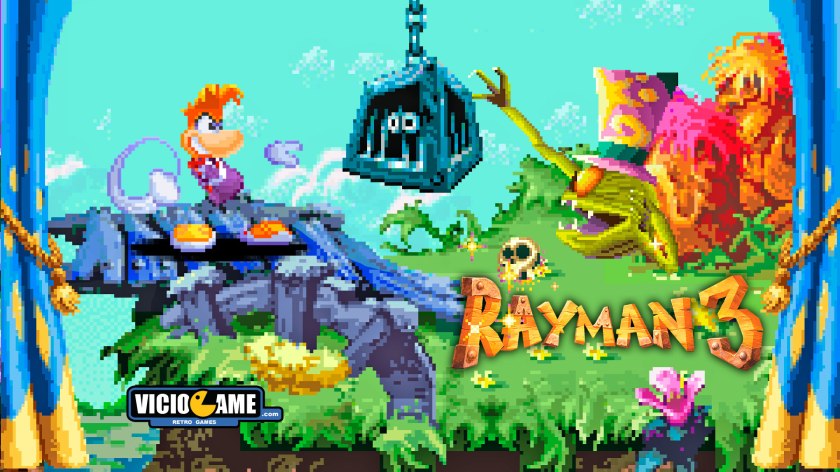
Rayman 3 is a 2D platformer game released for Game Boy Advance in 2003. Globox, Rayman’s best friend, has put the world in danger. By devouring the terrifying black Lum, he has angered the Hoodlums, who plan to rescue their master at any cost. It’s up to Rayman to save the day and find a cure to free his friend from this curse.
Developer/Publisher: Ubisoft
Release date: 2003
Platform: Game Boy Advance
Rayman 3: The Ultimate Guide
Rayman 3 for Game Boy Advance, released on February 20, 2003 in Europe and March 21, 2003 in North America, is a portable adaptation of the Rayman universe, developed by Ubisoft. Unlike the 3D version of Rayman 3: Hoodlum Havoc for GameCube, PlayStation 2 and Xbox, this version is a 2D side-scrolling platformer that combines elements from Rayman 2: The Great Escape with touches of Rayman 3, but maintains gameplay closer to the original Rayman. Originally conceived as a Game Boy Advance version of Rayman 2, the game incorporated Rayman 3 elements late in development to align with the console title’s release, resulting in a unique blend that doesn’t carry the “Hoodlum Havoc” subtitle due to the limited presence of Hoodlums, which appear only in three levels: Hoodlum Hideout, Wretched Ruins and Scaleman’s Keep. With 50 levels, including 11 multiplayer ones, and a structure that requires collecting 1000 Lums to unlock the final level, Rayman 3 offers a challenging and visually rich experience, establishing itself as one of the best of its kind on the GBA.
Rayman 3‘s narrative on the GBA is a simplified adaptation that mixes elements from Rayman 2 and Rayman 3. The game begins with chaos at the Crossroads of Dreams, where Globox, Rayman’s best friend, accidentally swallows a Black Lum, a source of great evil. This causes Globox to disappear, and Rayman sets out on a mission to find him and seek a cure. Meanwhile, Admiral Razorbeard, the main antagonist from Rayman 2, plans to capture Globox to harness the Black Lum’s power and defeat Rayman, aiming to dominate the world. Razorbeard, accompanied by his Robot-Pirates, is the central villain, different from the console version where André, the Black Lum, leads the Hoodlums. The story is told through cutscenes and simple dialogues, maintaining the light and humorous tone characteristic of the series, but with less narrative depth due to the console’s limitations.
The gameplay is centered on classic platform mechanics, with Rayman navigating through levels filled with obstacles, enemies and collectible items. The player must collect yellow Lums (25 to 55 per level, totaling 1000 in the game) to progress and unlock the final level, Lum Challenge. Other items include red Lums, which restore health; white Lums, which grant extra lives; green Lums, which serve as checkpoints; blue Lums, which activate the “Super Helicopter” for temporary flight; and purple Lums, which allow swinging at specific points. Enemies like Robot-Pirates, Hoodlums and zombie chickens require specific strategies, such as jumping over shots or hitting Hoodlums when unprotected. Obstacles like lava, mines and spiders test the player’s precision, while special sections, such as piloting flying barrels or running on rails, add variety. The game also includes bonus challenges, such as Ly’s Punch Challenges, which reward with multiplayer stages, and Mega Havoc stages (1, 2 and 3), unlocked by collecting all Lums from a world.
The controls are intuitive, but require practice to master. The directional pad controls movement: up to look or move upward in vehicles like flying barrels, left and right for displacement, and down to crouch or descend. Combining down with left or right allows Rayman to crawl. The A button is used to jump, and holding it in the air activates the helicopter movement, allowing gliding. The B button fires Rayman’s fists, with the option to charge a stronger punch by holding and releasing B. The Start button pauses the game, while the L and R buttons are used for specific actions, such as hanging on walls (pressing L after jumping) or breaking the ground (pressing R in the air in specific areas). As the game progresses, Rayman acquires abilities such as shooting with both fists (pressing B twice), grabbing purple Lums (firing the fist and pressing A to jump) and using the Super Helicopter with blue Lums. These abilities are introduced gradually, allowing the player to adapt to increasing challenges.
The stages are organized into four thematic worlds, each with multiple parts and unique challenges. The first world, Forgotten Forests, includes Wanderwood Forest (2 parts, 30 Lums total), Shining Glade (2 parts, 30 Lums), Swamps of Begoniax (1 part, 50 Lums) and Hoodlum Hideout (2 parts, 35 Lums each). The second world, Haunted Dreams, features Magma Mayhem (3 laps, 45 Lums), Vertigo Wastes (2 parts, 20 Lums each), Void of Bones (2 parts, 25 Lums each), Prickly Passage (2 parts, 17-25 Lums) and Swamps of Begoniax 2 (1 part, 45 Lums). The third world, Magmacosm, contains River of Fire (3 parts, 15-12-12 Lums), The Underlands (2 parts, 25 Lums each), Boulder Brink (2 parts, 20 Lums each), Wretched Ruins (2 parts, 20 Lums each) and Wicked Flow (3 parts, 20-15-15 Lums). The fourth world, Pirate Stronghold, includes Creeping Chaos (2 parts, 30 Lums each), The Mettleworks (2 parts, 30 Lums each), Magma Mayhem 2 (3 laps, 55 Lums) and Razor Slide (2 parts, 25 Lums each). Additionally, the bonus levels Mega Havoc 1 (20 Lums), Mega Havoc 2 (20 Lums) and Mega Havoc 3 (12 partial Lums) offer additional challenges, while the Lum Challenge, unlocked by collecting all 1000 Lums, tests all of the player’s skills with sliding sections, moving platforms and timers.
Boss battles are crucial moments, requiring the player to learn attack patterns and use specific strategies. Bosses like Garish Gears, Jano, Rocky and Scaleman appear in levels such as Garish Gears, Jano’s Nest, Den of Rocky and Scaleman’s Keep. For example, in Scaleman’s Keep, hitting Scaleman when he turns sideways is effective, as he remains motionless for a moment. Against Razorbeard, in the final confrontation on his Grolgoth, the player must dodge shots and attack at the right moments, a challenge that can be prolonged if the player is hit. These battles, while less inspired, are varied and require mastery of the game’s mechanics, such as using charged punches and the helicopter movement.
The graphics are one of the game’s highlights, especially considering the hardware limitations of 2003. The scenery is vibrant, with a rich color palette that varies from lush forests to volcanic areas and industrial fortresses. Rayman and Globox are well animated, with detailed sprites that capture the series’ charm. Enemies have distinct designs, while obstacles add visual tension. The soundtrack is understated but effective, with music that adapts to the tone of each level, from cheerful melodies in forests to darker tones in areas like Wicked Flow. Sound effects, such as the sounds of punches, jumps and Lum collections, are clear and reinforce immersion, although they are not particularly special. Compared to other Game Boy Advance games, such as Super Mario Advance or Castlevania: Aria of Sorrow, Rayman 3 stands out for its visual quality, but the soundtrack is less memorable.
The difficulty level is an aspect that divides opinions. The game is notoriously challenging, with deaths that restart the level, requiring the player to repeat long sections. The limited visibility of the handheld’s screen can cause unexpected deaths, especially in areas with many projectiles or obstacles. The final stages, such as Razor Slide and Lum Challenge, test the player’s patience and skill, with sections that require precise timing and mastery of all of Rayman’s abilities. However, the learning curve is well designed, with each world introducing new challenges that prepare the player for the more difficult levels. For casual players, the difficulty can be frustrating, but for platformer fans, the feeling of overcoming a level is highly rewarding.
The game offers some configuration options, such as sound adjustments and full-screen mode, but is relatively simple in this aspect. A notable feature is the connectivity with the GameCube version of Rayman 3: Hoodlum Havoc, which allows unlocking additional multiplayer stages via link cable between the consoles. These multiplayer stages, 11 in total, offer cooperative or competitive challenges, although they require additional hardware and are less accessible today.
The game itself includes hints on how to play, triggered by using the Murfy Stones, which offer contextual advice, such as avoiding swimming in certain areas or using barrels to progress. Returning to previous levels with new abilities, such as wall climbing or swinging on purple Lums, allows collecting missed Lums.
The game’s reception was widely positive, with critics praising its solid gameplay and impressive visuals. A review from The Game Boy Abyss website described the game as “a solid platformer, a beautiful example of GBA visuals and the first true follow-up to the original Rayman,” highlighting it as one of the system’s best games. The publication noted occasional problems but praised the rich color palette and variety of stages. However, the boss battles were criticized for being “bland and quick,” with the final confrontation against Razorbeard being described as “torture if the player gets hit.” In some magazines of the time, the game was praised for its magnificent graphics and solid duration, offering good longevity, although it was noted that it lacked innovation compared to Super Mario Advance 3: Yoshi’s Island. The average score from reviews is 3.9/5, reflecting a positive reception, but with criticism for the lack of originality compared to other titles in the genre.
Its legacy is marked by technical quality and faithfulness to the Rayman series. Released during a competitive period for the GBA, with titles like Metroid Fusion and Castlevania, the game stood out for its classic gameplay and vibrant visuals. Its inclusion on the Wii U Virtual Console in 2017 expanded its reach, allowing new players to experience the title. In the collectibles market, used copies of Rayman 3 are found for $20 to $50, while complete editions with box and manual can cost up to $100. Availability on emulators has made the game accessible, but using an original console offers the most complete experience, especially regarding extras.
For modern players, Rayman 3 on the Game Boy Advance is an opportunity to revisit a portable classic that captures the charm of the Rayman series. With its engaging story, well-designed stages and challenges that reward skill, Rayman 3 remains as an example of the quality of portable games from the early 2000s.
Rayman 3: O Guia Definitivo
Rayman 3 para Game Boy Advance, lançado em 20 de fevereiro de 2003 na Europa e 21 de março de 2003 na América do Norte, é uma adaptação portátil do universo Rayman, desenvolvida pela Ubisoft. Diferente da versão 3D de Rayman 3: Hoodlum Havoc para GameCube, PlayStation 2 e Xbox, esta versão é um platformer 2D de rolagem lateral que combina elementos de Rayman 2: The Great Escape com toques de Rayman 3, mas mantém uma jogabilidade mais próxima do Rayman original. Originalmente concebido como uma versão do Game Boy Advance de Rayman 2, o jogo incorporou elementos de Rayman 3 tardiamente para alinhar-se com o lançamento do título de consoles, resultando em uma mistura única que não carrega o subtítulo “Hoodlum Havoc” devido à presença limitada de Hoodlums, que aparecem apenas em três níveis: Hoodlum Hideout, Wretched Ruins e Scaleman’s Keep. Com 50 níveis, incluindo 11 multijogador, e uma estrutura que exige a coleta de 1000 Lums para desbloquear o nível final, Rayman 3 oferece uma experiência desafiadora e visualmente rica, consolidando-se como um dos melhores do estilo no GBA.
A narrativa de Rayman 3 no GBA é uma adaptação simplificada que mistura elementos de Rayman 2 e Rayman 3. O jogo começa com um caos na Croisée des Rêves, onde Globox, o melhor amigo de Rayman, engole acidentalmente um Lum negro, uma fonte de grande mal. Isso faz com que Globox desapareça, e Rayman parte em uma missão para encontrá-lo e buscar uma cura. Enquanto isso, o Almirante Razorbeard, o principal antagonista de Rayman 2, planeja capturar Globox para aproveitar o poder do Lum negro e derrotar Rayman, visando dominar o mundo. Razorbeard, acompanhado de seus Robôs-Piratas, é o vilão central, diferente da versão de consoles onde André, o Lum negro, lidera os Hoodlums. A história é contada por meio de cutscenes e diálogos simples, mantendo o tom leve e humorístico característico da série, mas com menos profundidade narrativa devido às limitações do console.
A jogabilidade é centrada em mecânicas clássicas de plataforma, com Rayman navegando por níveis repletos de obstáculos, inimigos e itens colecionáveis. O jogador deve coletar Lums amarelos (25 a 55 por nível, totalizando 1000 no jogo) para progredir e desbloquear o nível final, Lum Challenge. Outros itens incluem Lums vermelhos, que restauram saúde; Lums brancos, que concedem vidas extras; Lums verdes, que servem como checkpoints; Lums azuis, que ativam o “Super Helicóptero” para voo temporário; e Lums roxos, que permitem balançar em pontos específicos. Inimigos como Robôs-Piratas, Hoodlums e galinhas zumbis exigem estratégias específicas, como pular sobre tiros ou acertar Hoodlums quando desprotegidos. Obstáculos como lava, minas e aranhas testam a precisão do jogador, enquanto seções especiais, como pilotar barris voadores ou correr em trilhos, adicionam variedade. O jogo também inclui desafios bônus, como os Ly’s Punch Challenges, que recompensam com fases multijogador, e fases Mega Havoc (1, 2 e 3), desbloqueados ao coletar todos os Lums de um mundo.
Os controles são intuitivos, mas exigem prática para dominar. O direcional controla a movimentação: cima para olhar ou mover em direção ao alto em veículos como barris voadores, esquerda e direita para deslocamento, e baixo para agachar ou descer. Combinar baixo com esquerda ou direita permite que Rayman rasteje. O botão A é usado para pular, e segurá-lo no ar ativa o movimento de helicóptero, permitindo planar. O botão B dispara os punhos de Rayman, com a opção de carregar um soco mais forte ao segurar e soltar B. O botão Start pausa o jogo, enquanto os botões L e R são usados para ações específicas, como pendurar-se em paredes (pressionar L após pular) ou quebrar o chão (pressionar R no ar em áreas específicas). À medida que o jogo avança, Rayman adquire habilidades como atirar com ambos os punhos (pressionar B duas vezes), agarrar Lums roxos (disparar o punho e pressionar A para pular) e usar o Super Helicóptero com Lums azuis. Essas habilidades são introduzidas gradualmente, permitindo que o jogador se adapte aos desafios crescentes.
As fases são organizadas em quatro mundos temáticos, cada um com múltiplas partes e desafios únicos. O primeiro mundo, Forgotten Forests, inclui Wanderwood Forest (2 partes, 30 Lums no total), Shining Glade (2 partes, 30 Lums), Swamps of Begoniax (1 parte, 50 Lums) e Hoodlum Hideout (2 partes, 35 Lums cada). O segundo mundo, Haunted Dreams, apresenta Magma Mayhem (3 voltas, 45 Lums), Vertigo Wastes (2 partes, 20 Lums cada), Void of Bones (2 partes, 25 Lums cada), Prickly Passage (2 partes, 17-25 Lums) e Swamps of Begoniax 2 (1 parte, 45 Lums). O terceiro mundo, Magmcosm, contém River of Fire (3 partes, 15-12-12 Lums), The Underlands (2 partes, 25 Lums cada), Boulder Brink (2 partes, 20 Lums cada), Wretched Ruins (2 partes, 20 Lums cada) e Wicked Flow (3 partes, 20-15-15 Lums). O quarto mundo, Pirate Stronghold, inclui Creeping Chaos (2 partes, 30 Lums cada), The Mettleworks (2 partes, 30 Lums cada), Magma Mayhem 2 (3 voltas, 55 Lums) e Razor Slide (2 partes, 25 Lums cada). Além disso, os níveis bônus Mega Havoc 1 (20 Lums), Mega Havoc 2 (20 Lums) e Mega Havoc 3 (12 Lums parciais) oferecem desafios adicionais, enquanto o Lum Challenge, desbloqueado ao coletar todos os 1000 Lums, testa todas as habilidades do jogador com seções de deslizamento, plataformas móveis e cronômetros.
As batalhas contra chefes são momentos cruciais, exigindo que o jogador aprenda padrões de ataque e use estratégias específicas. Chefes como Garish Gears, Jano, Rocky e Scaleman aparecem em níveis como Garish Gears, Jano’s Nest, Den of Rocky e Scaleman’s Keep. Por exemplo, em Scaleman’s Keep, acertar Scaleman quando ele vira de lado é eficaz, pois ele fica imóvel por um momento. Contra Razorbeard, no confronto final em seu Grolgoth, o jogador deve esquivar-se de tiros e atacar nos momentos certos, um desafio que pode ser prolongado se o jogador for atingido. Essas batalhas, embora menos inspiradas, são variadas e exigem domínio das mecânicas do jogo, como o uso de socos carregados e o movimento de helicóptero.
Os gráficos são um dos pontos altos do jogo, especialmente considerando as limitações do hardware de 2003. Os cenários são vibrantes, com uma paleta de cores rica que varia de florestas verdejantes a áreas vulcânicas e fortalezas industriais. Rayman e Globox são bem animados, com sprites detalhados que capturam o charme da série. Inimigos têm designs distintos, enquanto obstáculos adicionam tensão visual. A trilha sonora é discreta, mas eficaz, com músicas que se adaptam ao tom de cada nível, desde melodias alegres em florestas até tons mais sombrios em áreas como Wicked Flow. Os efeitos sonoros, como os sons de socos, pulos e coletas de Lums, são claros e reforçam a imersão, embora não sejam particularmente especiais. Comparado a outros jogos de Game Boy Advance, como Super Mario Advance ou Castlevania: Aria of Sorrow, Rayman 3 se destaca por sua qualidade visual, mas a trilha sonora é menos marcante.
O nível de dificuldade é um aspecto que divide opiniões. O jogo é notoriamente desafiador, com mortes que reiniciam o nível, exigindo que o jogador repita seções longas. A visibilidade limitada da tela do portátil pode causar mortes inesperadas, especialmente em áreas com muitos projéteis ou obstáculos. As fases finais, como Razor Slide e Lum Challenge, testam a paciência e a habilidade do jogador, com seções que exigem timing preciso e domínio de todas as habilidades de Rayman. No entanto, a curva de aprendizado é bem projetada, com cada mundo introduzindo novos desafios que preparam o jogador para os níveis mais difíceis. Para jogadores casuais, a dificuldade pode ser frustrante, mas para fãs de platformers, a sensação de superar um nível é altamente recompensadora.
O jogo oferece algumas opções de configuração, como ajustes de som e modo de tela cheia, mas é relativamente simples nesse aspecto. Um recurso notável é a conectividade com a versão de GameCube de Rayman 3: Hoodlum Havoc, que permite desbloquear fases multijogador adicionais via cabo de link entre os consoles. Essas fases multijogador, 11 no total, oferecem desafios cooperativos ou competitivos, embora exijam hardware adicional e sejam menos acessíveis hoje.
O próprio jogo inclui dicas de como jogar, acionadas ao usar os Murfy Stones, que oferecem conselhos contextuais, como evitar nadar em certas áreas ou usar barris para progredir. Voltar a níveis anteriores com novas habilidades, como escalar paredes ou balançar em Lums roxos, permite coletar Lums perdidos.
A recepção do jogo foi amplamente positiva, com críticos elogiando sua jogabilidade sólida e visuais impressionantes. Uma resenha do site The Game Boy Abyss descreveu o jogo como “um platformer sólido, um belo exemplo dos visuais do GBA e o primeiro verdadeiro seguimento do Rayman original”, destacando-o como um dos melhores jogos do sistema. A publicação notou problemas ocasionais, mas elogiou a paleta de cores rica e a variedade de fases. No entanto, as batalhas contra chefes foram criticadas por serem “sem graça e rápidas”, com o confronto final contra Razorbeard sendo descrito como “um sofrimento se o jogador for atingido”. Em algumas revistas da época o jogo foi elogiado por seus gráficos magníficos e duração sólida, oferecendo boa longevidade, embora tenha sido notado que faltava inovação em relação a Super Mario Advance 3: Yoshi’s Island. A pontuação média das avaliações é de 3.9/5, refletindo uma recepção positiva, mas com críticas à falta de originalidade em comparação com outros títulos do gênero.
Seu legado é marcado pela qualidade técnica e fidelidade à série Rayman. Lançado em um período competitivo para o GBA, com títulos como Metroid Fusion e Castlevania, o jogo se destacou por sua jogabilidade clássica e visuais vibrantes. Sua inclusão no Wii U Virtual Console em 2017 ampliou seu alcance, permitindo que novos jogadores experimentassem o título. No mercado de colecionáveis, cópias usadas de Rayman 3 são encontradas por 20 a 50 dólares, enquanto edições completas com caixa e manual podem custar até 100 dólares. A disponibilidade em emuladores tornou o jogo acessível, mas utilizar um console original oferece a experiência mais completa, principalmente com relação aos extras.
Para jogadores modernos, Rayman 3 no Game Boy Advance é uma oportunidade de revisitar um clássico portátil que captura o charme da série Rayman. Com sua história envolvente, fases bem projetadas e desafios que recompensam a habilidade, Rayman 3 permanece como um exemplo da qualidade dos jogos portáteis do início dos anos 2000.

