
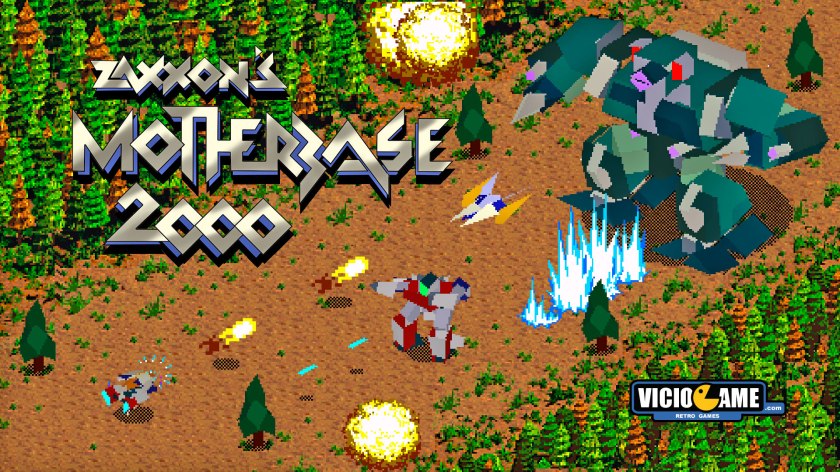
Zaxxon’s Motherbase 2000, also known as Parasquad in Japan, is an isometric shoot-‘em-up game released for the Sega 32X in 1995. An intelligent insectoid clan has created a computer system designed to manufacture weapons and enslave beings from various planets. As part of a rebel force, your mission is to fight through the clan’s defenses and destroy the computer core that’s causing all this evil.
Developer: CSK Research Institute Corp.
Publisher: Sega Enterprises, Ltd. / Sega of America
Release date: 1995
Platform: Sega 32X
Zaxxon’s Motherbase 2000: The Ultimate Guide
Zaxxon’s Motherbase 2000, known as Motherbase in Europe and Parasquad (パラスコード) in Japan, is an isometric perspective shooter released in 1995 for the Sega 32X. Developed by CSK Research Institute and published by Sega Enterprises, Ltd. (Japan and Europe) and Sega of America (USA), the game was an attempt to modernize the shoot-‘em-up genre for the 32-bit era. Despite carrying the Zaxxon name in North America, it has no direct connection to the 1982 arcade classic, except for the isometric perspective and space setting. Exclusive to the Sega 32X, the game is remembered both for its innovative mechanics and technical shortcomings.
The narrative takes place in the Hive Confederation, a planetary system inhabited by intelligent insectoid races that lived in harmony for 50 years. This peace was disrupted by the Gingliii clan, which developed a central computer capable of coordinating mass weapons production. The Gingliii conquered various planets, enslaved several races, and threaten to extinguish the Confederation. A rebel force launches a final mission, called “Motherbase 2000,” to liberate the enslaved colonies and destroy the Gingliii central computer. The player takes control of the Stinger, the only ship capable of penetrating enemy defenses, with the fate of the Confederation depending on their piloting skills and ability to learn to use Gingliii weapons against themselves.
The gameplay is centered on an auto-scrolling shoot-‘em-up format with isometric perspective. The player pilots the Stinger through enemy bases, with the main objective of destroying robots and enemy ships while advancing through nine stages to reach and destroy the Gingliii central computer. One of the game’s most distinctive features is the “hacking” mechanic, which allows the player to dock the Stinger to certain enemy ships to control them and use their weapons against other enemies. This mechanic adds a strategic layer, as the initial Stinger has limited firepower and can only withstand one hit before exploding. Capturing enemy ships grants secondary weapons and bonus points for “Hacking” and “Learning,” increasing the score when completing stages.
The player starts with the Stinger but can switch to different ships, called “couriers,” by docking them during gameplay. Each courier has unique attributes.
Allied ships:
| Ship | Speed | Armor | Primary Weapon | Secondary Weapon |
|---|---|---|---|---|
| Pincer | Medium | Light | Light Cannon | Ripper Missiles |
| Beetle 16-B | Slow | Heavy | Type 12 Cannon | Plasma Mines |
| R95 Mantis | Medium | Medium | Twin Heavy Lasers | Air-to-Air Spitter Missiles |
| T159 Wasp | Fast | Light | Medium Laser | Thermal Seeking Missiles |
Enemy ships:
| Ship | Durability | Normal Weapon | Learning Weapon |
|---|---|---|---|
| Chip | 10 | Simple shot | Projectile that hits nearby enemies |
| Ninja Chip | 25 | Shuriken | Shuriken at nearby enemies |
| Option Owner | 30 | Projectile that hits nearby enemies with large range | Can obtain options and power-ups |
| Twin Shooter | 15 | Two beam shots simultaneously | Two beam shots simultaneously |
| Shooter | 15 | Beam shot in 3 directions simultaneously | Beam shot in 3 directions simultaneously |
| Gunner | 15 | Beam shot | Beam shot |
| Charger | 10 | Beam shot | Multi-wave projectile |
| Twin Missile Carrier | 20 | Two beam shots simultaneously | Two automatically guided missiles |
| Capturer | 25 | Pulsing projectile | Pulsing projectile |
| Battler | 30 | Fires in 5 front directions | Hyper laser |
| Side Shooter | 50 | Beam shot | Left and right beam shots |
If a ship takes excessive damage, it explodes, but the player can use the jump button to abandon couriers and save the Stinger before the explosion. Losing all ships results in game over, but the player can continue if “continues” are available. The absence of a clear damage indicator on ships is a notable flaw, and attempting to dock the Stinger to incompatible enemy ships results in its destruction, requiring caution.
The controls are highly customizable, allowing adjustments in the options menu. The player can choose between two movement schemes: NORMAL, where the directional pad moves the ship relative to the player’s perspective, and ON BOARD, which follows the classic Zaxxon style. The firing mode can be set as AUTO (semi-automatic) or MANUAL (single shots). Buttons A, B, and C, along with the directional pad, control actions like primary fire, jump, and secondary fire, with six possible control configurations. The options menu also allows adjusting difficulty (Easy, Normal, or Hard) and listening to music tracks or sound effects, accessible with A/C buttons (start) and B (stop).
Graphically, it combines 2D scrolling backgrounds with 3D objects, such as ships and enemies, rendered with untextured polygons. The game runs at approximately 20 frames per second, with noticeable drops when many objects are on screen, which was criticized for causing slowdown. The sound uses the SMPS Z80 driver, offering a soundtrack and effects adequate for the time, but without special distinction. The combination of rudimentary polygonal graphics and unstable performance contributed to many players’ disappointment.
The reception of Zaxxon’s Motherbase 2000 was predominantly negative. The Sega Retro average is 64/100. North American critics, such as those from Electronic Gaming Monthly, gave low scores, with an average of 5.3/10, criticizing the removal of the altitude mechanic present in Zaxxon, the perceived uselessness of the jump button, and the crude polygonal graphics. The Japanese magazine Famicom Tsūshin gave 25/40, indicating mixed reception. Despite criticism, some praised the ship capture mechanic as an innovative strategic element, though insufficient to compensate for technical flaws.
The game features nine stages, each with unique maps and bosses, designed to take the player through different environments of Gingliii defenses, such as space stations and planetary surfaces. The first stage serves as an introduction, teaching basic mechanics, including ship capture. Subsequent stages, like 2-1 and 2-2, increase enemy density and introduce new types of ships to capture. More advanced stages feature larger bosses and more complex level designs, challenging the player’s skills and strategic use of captured ships. Additionally, the game includes four arenas for two-player versus mode, each with unique obstacles, such as falling trees and space slugs, where players compete to destroy the opponent’s five ships first. The game ends when one player wins or if both last ships are destroyed simultaneously, resulting in a tie.
The title occupies a special place in the Zaxxon series as the only title to use polygonal graphics. It represents an ambitious but unsuccessful attempt to modernize the franchise for the 32-bit era. The ship capture mechanic, though underappreciated at the time, can be seen as a precursor to more complex gameplay elements in later shoot-‘em-ups. Compared to other games in the series, such as the original Zaxxon or Super Zaxxon, it lacks the altitude mechanic that defined the strategic gameplay of its predecessors, which was a recurring point of criticism.
Its legacy is limited, largely due to the commercial failure of the Sega 32X and criticism of the game. It remains a niche title, more appreciated by collectors and retro gaming fans than the general public. Its inclusion in the Zaxxon series was merely a marketing decision to capitalize on the franchise name, but the lack of connection to previous games alienated some fans.
Zaxxon’s Motherbase 2000 is a game that, while not meeting the expectations set by its name, offers a unique approach to the shoot-‘em-up genre with its ship capture mechanic and isometric perspective. For retro gaming fans and Sega 32X enthusiasts, it remains an interesting, though imperfect, curiosity in the history of the Zaxxon series. Despite its flaws, it provides a challenging and engaging experience for those willing to explore its depths.
Zaxxon’s Motherbase 2000: O Guia Definitivo
Zaxxon’s Motherbase 2000, conhecido como Motherbase na Europa e Parasquad (パラスコード) no Japão, é um jogo de tiro com perspectiva isométrica lançado em 1995 para o Sega 32X. Desenvolvido pela CSK Research Institute e publicado pela Sega Enterprises, Ltd. (Japão e Europa) e Sega of America (EUA), o jogo foi uma tentativa de modernizar o gênero shoot-‘em-up para a era de 32 bits. Apesar de carregar o nome Zaxxon na América do Norte, ele não tem conexão direta com o clássico arcade de 1982, exceto pela perspectiva isométrica e ambientação espacial. Exclusivo para o Sega 32X, o jogo é lembrado tanto por sua mecânica inovadora quanto por suas falhas técnicas.
A narrativa se passa na Confederação Hive, um sistema planetário habitado por raças insetoides inteligentes que viviam em harmonia por 50 anos. Essa paz foi interrompida pelo clã Gingliii, que desenvolveu um computador central capaz de coordenar a produção de armas em massa. Os Gingliii conquistaram diversos planetas, escravizaram várias raças e ameaçam extinguir a Confederação. Uma força rebelde lança uma missão final, chamada “Motherbase 2000”, para libertar as colônias escravizadas e destruir o computador central dos Gingliii. O jogador assume o controle da Stinger, a única nave capaz de penetrar as defesas inimigas, com o destino da Confederação dependendo de suas habilidades de pilotagem e da capacidade de aprender a usar as armas dos Gingliii contra eles próprios.
A jogabilidade é centrada em um formato de shoot-‘em-up com rolagem automática e perspectiva isométrica. O jogador pilota a Stinger através de bases inimigas, com o objetivo principal de destruir robôs e naves adversárias enquanto avança por nove fases para alcançar e destruir o computador central dos Gingliii. Uma das características mais distintivas do jogo é a mecânica de “hacking”, que permite ao jogador acoplar a Stinger a certas naves inimigas para controlá-las e usar suas armas contra outros inimigos. Essa mecânica adiciona uma camada estratégica, já que a Stinger inicial tem poder de fogo limitado e pode suportar apenas um golpe antes de explodir. Capturar naves inimigas concede armas secundárias e pontos de bônus por “Hacking” e “Learning”, aumentando a pontuação ao completar fases.
O jogador começa com a Stinger, mas pode alternar para diferentes naves, chamadas de “couriers”, ao acoplá-las durante o jogo. Cada courier possui atributos únicos.
Naves aliadas:
| Nave | Velocidade | Armadura | Arma Principal | Arma Secundária |
|---|---|---|---|---|
| Pincer | Média | Leve | Canhão Leve | Mísseis Ripper |
| Beetle 16-B | Lenta | Pesada | Canhão Tipo 12 | Minas de Plasma |
| R95 Mantis | Média | Média | Lasers Pesados Gêmeos | Mísseis Spitter Ar-Ar |
| T159 Wasp | Rápida | Leve | Laser Médio | Mísseis de Busca Térmica |
Naves inimigas:
| Nave | Durabilidade | Arma Normal | Arma de Aprendizado |
|---|---|---|---|
| Chip | 10 | Tiro simples | Projétil que atinge inimigos próximos |
| Ninja Chip | 25 | Shuriken | Shuriken em inimigos próximos |
| Option Owner | 30 | Projétil que atinge inimigos próximos de grande porte | Pode obter options e power-ups |
| Twin Shooter | 15 | Dois tiros de feixe simultaneamente | Dois tiros de feixe simultaneamente |
| Shooter | 15 | Tiro de feixe em 3 direções simultaneamente | Tiro de feixe em 3 direções simultaneamente |
| Gunner | 15 | Tiro de feixe | Tiro de feixe |
| Charger | 10 | Tiro de feixe | Projétil com múltiplas ondas |
| Twin Missile Carrier | 20 | Dois ttiros de feixe simultaneamente | Dois mísseis teleguiados automaticamente |
| Capturer | 25 | Projétil pulsante | Projétil pulsante |
| Battler | 30 | Dispara em 5 direções frontais | Hiper laser |
| Side Shooter | 50 | Tiro de feixe | Tiro de feixe para esquerda e direita |
Se uma nave sofrer dano excessivo, ela explode, mas o jogador pode usar o botão de salto para abandonar os couriers e salvar a Stinger antes da explosão. Perder todas as naves resulta no fim do jogo, mas o jogador pode continuar se tiver “continues” disponíveis. A ausência de um indicador claro de dano nas naves é uma falha notável, e tentar acoplar a Stinger a naves inimigas não compatíveis resulta em sua destruição, exigindo cautela.
Os controles são altamente personalizáveis, permitindo ajustes no menu de opções. O jogador pode escolher entre dois esquemas de movimento: NORMAL, onde o direcional move a nave em relação à perspectiva do jogador, e ON BOARD, que segue o estilo clássico de Zaxxon. O modo de disparo pode ser configurado como AUTO (semiautomático) ou MANUAL (disparos únicos). Os botões A, B e C, junto com o direcional, controlam ações como disparo principal, salto e disparo secundário, com seis configurações possíveis para os controles. O menu de opções também permite ajustar a dificuldade (Fácil, Normal ou Difícil) e ouvir trilhas musicais ou efeitos sonoros, acessíveis com os botões A/C (iniciar) e B (parar).
Graficamente, combina fundos 2D com rolagem e objetos 3D, como naves e inimigos, renderizados com polígonos sem textura. O jogo roda a aproximadamente 20 quadros por segundo, com quedas perceptíveis quando muitos objetos estão na tela, o que foi alvo de críticas por causar lentidão. O som utiliza o driver SMPS Z80, oferecendo uma trilha sonora e efeitos adequados para a época, mas sem destaque especial. A combinação de gráficos poligonais rudimentares e desempenho instável contribuiu para a decepção de muitos jogadores.
A recepção de Zaxxon’s Motherbase 2000 foi predominantemente negativa. A média do Sega Retro é de 64/100. Críticos norte-americanos, como os da Electronic Gaming Monthly, deram notas baixas, com uma média de 5,3/10, criticando a remoção da mecânica de altitude presente em Zaxxon, a inutilidade percebida do botão de salto e os gráficos poligonais grosseiros. A revista japonesa Famicom Tsūshin deu 25/40, indicando uma recepção mista. Apesar das críticas, alguns elogiaram a mecânica de captura de naves como um elemento estratégico inovador, embora insuficiente para compensar as falhas técnicas.
O jogo possui nove fases, cada uma com mapas e chefes únicos, projetadas para levar o jogador por diferentes ambientes das defesas dos Gingliii, como estações espaciais e superfícies planetárias. A primeira fase serve como introdução, ensinando mecânicas básicas, incluindo a captura de naves. As fases subsequentes, como 2-1 e 2-2, aumentam a densidade de inimigos e introduzem novos tipos de naves para capturar. Fases mais avançadas apresentam chefes maiores e designs de níveis mais complexos, desafiando as habilidades do jogador e o uso estratégico de naves capturadas. Além disso, o jogo inclui quatro arenas para o modo versus de dois jogadores, cada uma com obstáculos únicos, como árvores caindo e lesmas espaciais, onde os jogadores competem para destruir as cinco naves do oponente primeiro. O jogo termina quando um jogador vence ou se ambas as últimas naves são destruídas simultaneamente, resultando em empate.
O título ocupa um lugar especial na série Zaxxon como o único título a usar gráficos poligonais. Ele representa uma tentativa ambiciosa, mas malsucedida, de modernizar a franquia para a era dos 32 bits. A mecânica de captura de naves, embora subestimada na época, pode ser vista como precursora de elementos de jogabilidade mais complexos em shoot-‘em-ups posteriores. Comparado a outros jogos da série, como o original Zaxxon ou Super Zaxxon, falta a ele a mecânica de altitude que definia a jogabilidade estratégica dos predecessores, o que foi um ponto de crítica recorrente.
Seu legado é limitado, em grande parte devido ao fracasso comercial do Sega 32X e às críticas ao jogo. Ele permanece como um título de nicho, mais apreciado por colecionadores e fãs de jogos retrô do que pelo público geral. Sua inclusão na série Zaxxon foi apenas uma decisão de marketing para capitalizar o nome da franquia, mas a falta de conexão com os jogos anteriores alienou alguns fãs.
Zaxxon’s Motherbase 2000 é um jogo que, embora não tenha alcançado as expectativas estabelecidas por seu nome, oferece uma abordagem única ao gênero shoot-‘em-up com sua mecânica de captura de naves e perspectiva isométrica. Para fãs de jogos retrô e do Sega 32X, ele permanece como uma curiosidade interessante, embora imperfeita, na história da série Zaxxon. Apesar de suas falhas, proporciona uma experiência desafiadora e envolvente para aqueles dispostos a explorar suas profundezas.
🤑💲Earn money without doing anything! Just leave these apps open:
   ✓ https://r.honeygain.me/CONTA9DB02

   ✓ https://packetstream.io/?psr=1uPb
🤑💲1-Click button earns Bitcoin every 1 hour: https://freebitco.in/?r=53528449
⬛ 𝗧𝗶𝗸𝗧𝗼𝗸: https://www.tiktok.com/@viciogame
🟧 𝗜𝗻𝘀𝘁𝗮𝗴𝗿𝗮𝗺: http://www.instagram.com/viciogame
🟥 𝗬𝗼𝘂𝘁𝘂𝗯𝗲: http://www.youtube.com/viciogame
🟦 𝗙𝗮𝗰𝗲𝗯𝗼𝗼𝗸: http://www.facebook.com/viciogame
🔳 𝗧𝗵𝗿𝗲𝗮𝗱𝘀: https://www.threads.net/@viciogame
🟪 𝗧𝘄𝗶𝘁𝗰𝗵: https://www.twitch.tv/ViciogameRetroGames
🟨 𝗕𝗹𝗼𝗴: http://www.viciogameblog.com/
🟦𝗧𝘄𝗶𝘁𝘁𝗲𝗿: http://www.twitter.com/viciogame
#Viciogame #Gameplay #LetsPlay #Gamer #Playthrough #Games #News #Videogames #Review #Game #Detonado #Walkthrough #Ending #Reviews #Facts #Retro #Record #Roms #Emulator #Longplay #Speedrun #ZaxxonsMotherbase2000 #Zaxxon #Motherbase2000 #Motherbase #Parasquad #パラスコード #SegaGenesis #MegaDrive #Sega #Genesis #ShootEmUp #Shooter #Shmup #JogoDeNavinha #セガ #セガ #メガドライブ #Viewpoint #spaceship #StarFox
 VICIOGAME