
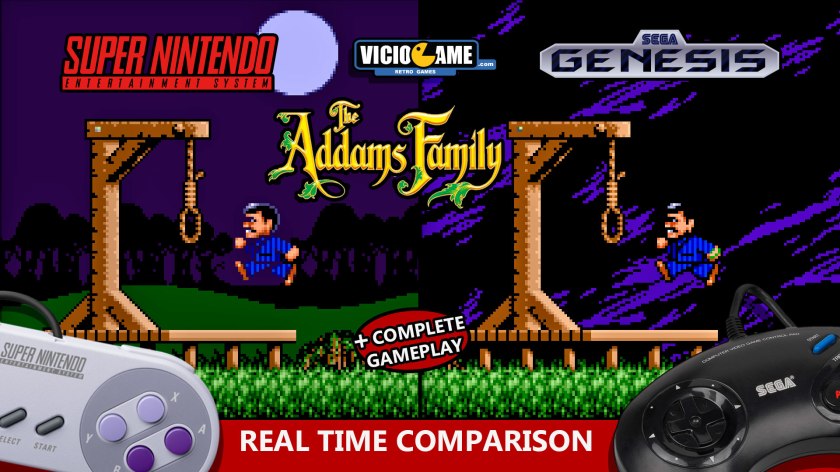
The Addams Family is a 2D platformer released in 1992 for the Super Nintendo and the following year for the Sega Genesis. The story was loosely inspired by the film of the same name. Several family members have been imprisoned in the most dangerous corners of the mansion. Gomez must rescue them all, recover the stolen fortune, and defeat the villains.
Developer: Ocean Software
Publisher: Ocean / Flying Edge
Release date: 1992 / 1993
Platform: Super Nintendo / Sega Genesis / Super Famicom / Mega Drive
The Addams Family – The Ultimate Guide
The Addams Family, released by Ocean Software in 1992 for Super Nintendo Entertainment System and later in 1993 for Sega Genesis through Flying Edge, represents a surprising example of how a European developer known for film adaptations of questionable quality managed to create a solid and technically competent platformer. The story of this game begins in April 1991, when Ocean initiated development of the adaptation of Barry Sonnenfeld’s film of the same name, months before the film changed studios from 20th Century Fox to Paramount Pictures. The development team included James Higgins as programmer, Warren Lancashire responsible for design and graphics, Simon Butler on additional graphics, and Jonathan Dunn on musical composition, completing the project in just four months to coincide with the SNES launch in the PAL region in 1992.
Development went through significant changes in its conception. The project initially planned as a puzzle game exclusive to home computers was completely reconfigured when Paramount requested Ocean, within two weeks after development began, to create a version for the SNES. This request radically transformed the project’s scope, converting all versions, including those for computers, into arcade-style platformers with typical console game elements: collectible items, extra lives, shortcuts between stages, secret areas and bonuses. After completing the Super Nintendo version in November 1991, Ocean reviewed the code for the computer version and, from a perspective influenced by console games, completely rejected it for having insufficient graphic colors, too slow a frame rate, and absence of parallax scrolling. Ocean wanted to be the first company to develop and release a 16-bit game for computers that was a Mario-style platformer, leading them to make the computer versions identical to the console releases.
The game’s plot is loosely based on the last twenty minutes of the 1991 film, a necessary choice due to the limitations of working only with the script throughout development. Uncle Fester has lost his memory and fallen under the spell of Abigail Craven, a cunning character eager to get her greedy hands on the Addams’ hidden fortune. Having recruited a disoriented Uncle Fester and aided by her accomplices Tully Alford (the family lawyer) and The Judge, she manages to capture and imprison the other members of the Addams Family inside the enormous Addams Mansion. Only Gomez can save the day by freeing his son Pugsley, his daughter Wednesday and Granny, as well as restoring Uncle Fester’s memory. Accomplishing these tasks is scary enough, but then Gomez must seek out Morticia in the mansion’s underground chambers and confront the evil Judge in a peculiar and frightening climax.
The only resource Gomez possesses is a cryptic note delivered by Thing: “Free everyone to give Lurch the melody that opens the way to the Supreme Treasure.” Additional information will be provided by Thing along the way, as he is the player’s only ally.
The control system varies slightly between the SNES and Genesis versions, reflecting differences in layouts. On Nintendo’s console, the directional pad moves Gomez left and right in the respective directions, while pressing it up makes Gomez enter doors or openings and climb ropes or vines, in addition to allowing upward strikes with the sword when combined with the X or Y buttons. Pressing the directional pad down makes Gomez crouch, descend ropes or vines, and access entrances below him like pipes. The A and B buttons execute jumps, with the duration of the press determining jump height, and can be combined with left or right directions to control trajectory in the air. When submerged, repeatedly pressing these buttons helps Gomez swim, and when equipped with the “Fezi-copter,” this action helps him fly. The X and Y buttons make Gomez strike with his sword or throw golf balls, in addition to clearing the pause message. The L and R triggers make small adjustments to Gomez’s position left and right respectively, useful for precise positioning. The START button pauses the game and confirms menu options, while the SELECT button selects menu options and, in conjunction with pause, allows abandoning the current game.
On Sega’s console, the configuration differs slightly due to the Mega Drive controller layout. The directional pad functions identically, but only the C button is used to strike with the sword or throw golf balls, also allowing upward strikes when combined with the directional pad. The A and B buttons control jumping with the same press duration mechanics. The START button pauses the game and confirms options like passwords or game start. The action of entering doors or climbing ropes involves upward strikes with the sword using the C button.
The game begins with Gomez possessing only two heart units, meaning he can sustain two hits before losing a life. These units can be replenished along the way, but there are opportunities to collect three extra energy units by defeating some of the large guardians, raising the heart quota to a potential of five, now allowing him to sustain five hits. The upper left corner of the screen displays energy information: the number of hearts shows how many energy units the player has in total, while filled hearts show how many hits remain before losing a life. Small hearts scattered throughout the game replenish one energy unit but do not add to the total heart quota.
Along the way, Gomez can collect money shown as dollar signs. For every 25 dollars collected, one heart will be replenished if necessary. Upon collecting 100 dollars, the player earns an extra life (1-UP). Collected dollars are displayed in the lower left corner of the screen. Gomez has an infinite number of lives due to the continue option, but he has only a certain number of attempts per session before being placed back at the start. These lives are displayed next to the dollars in the lower left corner of the screen. Additional 1-UPs can be collected along the way and obtained through the scoring system. The game begins with five lives.
Points are scored each time the player collects an object or jumps on an enemy. If able to jump on multiple enemies consecutively (that is, leap from one to the next), the points scored for each will double. The player will be rewarded with an extra life every 50,000 points. The score is displayed in the lower right corner of the screen. Besides earning points by collecting items and jumping on enemies, there are “invisible” points scattered throughout the Mansion that cannot be seen, but upon touching them, an indication will appear on screen in units of 1,000.
The game begins at the front door of the Addams Mansion, a point where the player can explore the outdoor surroundings or enter through the main door by pressing the directional pad up. This action is used each time one wishes to enter an entrance or opening. Upon entering the Mansion, Gomez has a choice of doors to enter, each accessing a different and very large area of the house. These can be played in any order, but some are better and easier to complete than others. The Mansion is enormous, and your journey will take you inside, outside, above and below. Walking, flying and swimming, Gomez must maintain his attention at all times, as danger lurks in every setting.
Within each area there are numerous strange creatures that will do everything to stop Gomez. The main way to eliminate these adversaries is to jump on them, but beware: if any of them have pointed heads or spikes, they must be avoided. Each door in the main hall will ultimately lead to one of the great villains, and therefore to a significant reward, whether a captured member of the Addams Family or an extra heart. The Mansion, if anything can be said, is even stranger than the Family, and nothing is exactly as it seems. Careful exploration of walls and other features can prove very rewarding. Secret doors exist everywhere, and of course, these entrances are usually invisible to the human eye, making exploration of walls and floors highly recommended. Look especially for inconsistencies in appearance, as everything is very deceptive, but highly rewarding if discovered.
Each time the player rescues a family member, they will make their way immediately to the music room. Here Lurch sits at his piano and plays a melody. Each family member gives Lurch a portion of music to play. This melody will gradually accumulate as Pugsley, Granny, Wednesday and Uncle Fester are rescued. Once everyone is congregated at the location, Lurch will have the entire melody to play, which will open the secret passage leading to the underground chambers and, eventually, to Morticia.
Through some of the doors, the player will see a box marked with “A”. These are Thing’s boxes, and if the player jumps beneath them, Thing will emerge and reveal a hint for the section being played. These can be really useful, providing information about the challenges ahead. Thing is the player’s only ally and will provide more information along the way.
In strategic places within the mansion are switches, sometimes marked as ON or OFF, and sometimes only shown as standardized blocks. The player must jump to hit and toggle the state of these blocks. The result can be discovered further along the way or perhaps back the way they came. These usually make platforms appear or provide access to otherwise inaccessible places. The player must discover whether they should be on or off through experimentation. Platforms can materialize in the air as the player walks, requiring courage to proceed.
At the end of each main area of the mansion, the player will confront a great villain. To defeat him, one must jump on his head several times while avoiding him and any projectiles he may launch. An energy meter will appear on the right side of the screen to display how many hits are needed to defeat the villain. Accomplishing this makes the reward valuable. Bosses include giant creatures from folklore like a goblin, a witch, and the final enemy being a judge who throws hammers. There is always a “safe spot” when confronted by a great villain; finding it will allow defeating him easily.
The sword allows Gomez to eliminate enemies by striking them, both laterally and from below. The player retains this weapon until being hit by a creature, at which point he will lose only the weapon, not energy. The golf ball allows Gomez to throw golf balls at his enemies to destroy them, functioning the same way as the sword, except he cannot throw upward. Running shoes make Gomez move faster and jump farther, and can be lost the same way as the sword.
The Fezi-copter is particularly interesting: if Gomez jumps into this floating hat, it becomes a portable helicopter and allows him to fly for a limited time by repeatedly pressing the jump button. The item will remain operational until the player enters through a door, at which point it will flash to indicate the few remaining seconds of operation. This item represents one of the most creative elements of the game’s design, allowing extensive vertical exploration and access to secret areas.
When the player loses all their lives, they are allowed to continue the game if desired. When this option is selected, the player will restart from the mansion’s main hall. However, they will retain how many heart units they had when they last played and any family members they had rescued. The system does not include save functionality but uses a password system. When the player marks an important achievement, such as gaining an extra heart or rescuing a Family member, they will receive a password. It is crucial to make careful note of this code.
The game’s visual presentation clearly reflects its European development, with each area having its own descriptive name at the top of the screen, a common feature in many 1980s microcomputer games. Most zones consist of short areas with single-screen scrolling, enormous maze-like areas with horizontal and vertical scrolling, or auto-scrolling obstacle courses like Gomez’s toy train tracks (one of the few references to the film and franchise in general) and the cave gondola at the end.
The graphics are typical of European games, with small but detailed sprites and equally detailed but repetitive backgrounds. The art team included Warren Lancashire and Simon Butler, with Butler’s surreal sense leading to the creation of peculiar enemies like flying teacups and frogs riding tricycles. While it was natural for the game, starring a gothic family, to have horror fiction tropes like skulls and ghosts as enemies, the team’s creativity resulted in unique adversaries including walking teapots, animated aquariums, monkeys on unicycles, armless goblins, rabbits with spiked collars, penguins, floating yogis and clowns inspired by Tim Curry’s Pennywise from IT.
The Genesis version, released alongside the SNES version, is more or less identical in terms of gameplay and stage structure. However, there are subtle technical differences between the two console versions. The Amiga version suffered significant compromises: it’s missing the introduction after the title screen (as in the Super Nintendo) and has smooth scrolling, but poorer graphics, with backgrounds replaced by absolute black darkness. It also lacks the area names at the top of the screen, only scores. The Atari ST version maintains the backgrounds but not the stage names, with points at the bottom of the screen and life and energy indicators in a black bar on the left of the screen, resulting in a slightly more compressed play area. Single-screen scrolling makes everything even more difficult.
The removal of backgrounds in the Amiga generated mixed response among critics. Neil West of Amiga Format felt this removed the game’s atmosphere, while Jonathan Maddock of Amiga Computing argued it was easier to see sprites without backgrounds. The Amiga version doesn’t have the speed to handle the parallax scrolling present in console versions. Critics appreciated the game’s upbeat music, with some highlighting the bass parts in the SNES version specifically.
The musical tracks were composed by Jonathan Dunn, an Ocean Software veteran known for his work on Platoon, Total Recall, RoboCop and Jurassic Park. Dunn created music and sound drivers for all platforms Ocean worked on, including Amstrad CPC, Atari ST, Amiga, Commodore 64, Game Boy, Nintendo Entertainment System and SNES. The soundtrack for The Addams Family represented a highlight in his career. Dunn wrote his own music driver for Nintendo’s 16-bit platform and also created a converter that allowed composing most of it using MIDI and then converting to data statements he could adjust later. The music perfectly captures that feeling of harmless terror and Halloween that the franchise’s main theme exemplifies so well.
An interesting interactive detail: on the SNES version’s title screen, pressing the L and R triggers creates a finger-snapping sound along with the Addams Family main theme, adding an extra layer of interactivity that references the series’ iconic gesture.
Gomez moves in a slippery manner, requiring perfect timing, a common characteristic in European platformers of the time. Collision detection isn’t always up to standard, making the game unnecessarily difficult at times, with spikes and traps everywhere. The developers apparently realized this and hid many secret areas and invisible doors leading to an enormous amount of money, extra lives and items to make the experience a bit more manageable. Going back through the same door doesn’t always lead back to the same place, a stage design quirk that can confuse players.
Jumping and striking upward with the sword (or using the golf ball) can allow grabbing an item that’s normally out of reach. Creatures can be used as trampolines to reach an otherwise inaccessible point. The recommendation to map progress is crucial, remembering that the mansion is enormous and the player doesn’t want to forget where they’re going or where they’ve been. Within the first five minutes, it’s possible to earn twelve lives with little effort, and the reason is that the player will need them. The game’s generosity with extra lives hides the fact that it is very difficult.
The difficulty level is high, and contrasts with many licensed game platformers of the era. Even being able to expand to five the number of hearts, the game remains arduous. The game is creative at times, but quickly plunges into advanced territory. Due to slippery controls, the player will constantly receive unfair hits. Depending on the area visited first, the player will face difficult moments. Despite this, The Addams Family is fair in its difficulty. It is extremely generous with its extra lives and the player respawns a few meters from where they died. Life-restoring hearts are also placed after problematic areas.
Specific areas present unique challenges. Jester’s Jump is a cramped room that forces the player to make difficult jumps in tight spaces, with one-hit death as penalty. The Conservatory and its various plant-themed rooms balance precision and free action. Frozen areas highlight the worst aspects of the controls, as ice stages in games are already frustrating, but with already slippery controls, they become particularly irritating. If there’s a weak point in stage design, it would be the kitchen.
The challenge may be unconventional for a licensed title, but it’s manageable overall. Even though it closely resembles games of that era, The Addams Family is still a beautiful game. Individual areas are named and often provide clues about what to expect. Careful exploration reveals that nothing is as straightforward as it seems. The Addams Family and everything associated with them is strange, especially their house.
Reviews for The Addams Family were mixed but generally positive for the SNES and Amiga versions, with some critics awarding scores up to 95%. The NES and Game Boy versions received significantly lower scores. Jonathan Davies of Super Play called it one of the most beautiful and imaginative SNES titles. Brian Sharp of Amiga Action rated the game as one of the three best film-to-video game adaptations. Jonathan Maddock of Amiga Computing called it one of the best platform games on the Amiga. A Joystick critic called it the best platformer on the Atari ST.
Michael Foster disagreed that The Addams Family was a clone of other platform games, feeling it had “plenty of variety, and it’s complex without being impossible.” Reviews also felt that stage design had enough exciting elements to maintain player attention, such as funny enemy sprites, hidden areas, creative power-ups and a constant barrage of enemies. At the other end of the spectrum, Andy Dyer of Mega magazine dismissed The Addams Family as irrelevant with uninspired graphics, repetitive stage design and enemies that annoy rather than challenge.
Critics appreciated the game’s backgrounds, specifically their amount of detail, color and diversity. Brian Sharp and others noted the smooth parallax scrolling. Garth Sumpter of Computer and Video Games highlighted the family photos in the hallway and the use of beer mats and armor as hazards. Sprites were also highlighted for their animation and cute style. Maddock was surprised at how strangely well the Amiga executed the Addams Family theme.
The Game Boy version deserves specific mention because it is fundamentally a different game. The basic concept is the same, finding the other family members while exploring the mansion, but gameplay underwent significant changes. Gomez (whose sprite looks more like Oliver Hardy) doesn’t defeat enemies by jumping on them, which only stuns them, but rather by throwing knives. Due to system limitations, zones are much shorter, emptier and more linear compared to the hellish mazes of the 16-bit versions, full of enemies and traps.
The success of The Addams Family led to multiple subsequent games in the franchise. Pugsley’s Scavenger Hunt was released for SNES, NES and Game Boy, shifting focus to Pugsley as protagonist. Addams Family Values, based on the 1993 film, was released for Super Nintendo and Genesis in 1994-1995, featuring Uncle Fester as a playable character in a format closer to an action RPG. This game featured more complex mechanics, including a cookie system with various effects, non-linear exploration of the mansion and property, and a significantly darker atmosphere than the original game.
Within the context of licensed game history, The Addams Family for SNES and Genesis represents a rare example of when a film adaptation transcended the typical expectations of the genre. Ocean Software, known primarily for flooding the market with licensed games of questionable quality, managed to create a technically solid platform game that, despite its flaws in controls and sometimes unfair difficulty, offers sufficient depth, secrets and visual polish to justify players’ attention. The rapid four-month development, which would normally result in a rushed and poorly made product, paradoxically produced a game with intricate stage design, detailed graphics and a soundtrack that remains one of Jonathan Dunn’s most praised works.
The Addams Family remains challenging, rewarding meticulous exploration and patience. It possesses its own identity through its gothic theme, labyrinthine stage design and high difficulty. The game offers a substantial adventure that captures the peculiar and macabre spirit of the Addams Family while delivering a solid platform experience by the standards of the time.
The Addams Family – O Guia Definitivo
The Addams Family, lançado pela Ocean Software em 1992 para Super Nintendo Entertainment System e posteriormente em 1993 para Sega Genesis através da Flying Edge, representa um exemplo surpreendente de como uma desenvolvedora europeia conhecida por adaptações cinematográficas de qualidade duvidosa conseguiu criar um platformer sólido e tecnicamente competente. A história deste jogo começa em abril de 1991, quando a Ocean iniciou o desenvolvimento da adaptação do filme homônimo de Barry Sonnenfeld, meses antes do filme mudar de estúdio da 20th Century Fox para a Paramount Pictures. A equipe de desenvolvimento incluiu James Higgins como programador, Warren Lancashire responsável pelo design e gráficos, Simon Butler em gráficos adicionais, e Jonathan Dunn na composição musical, completando o projeto em apenas quatro meses para coincidir com o lançamento do SNES na região PAL em 1992.
O desenvolvimento atravessou mudanças significativas em sua concepção. O projeto inicialmente planejado como um jogo de quebra-cabeças exclusivo para computadores domésticos foi completamente reconfigurado quando a Paramount solicitou à Ocean, dentro de duas semanas após o início do desenvolvimento, que criasse uma versão para o SNES. Esta solicitação transformou radicalmente o escopo do projeto, convertendo todas as versões, incluindo as de computadores, em platformers de estilo arcade com elementos típicos de jogos de console: itens colecionáveis, vidas extras, atalhos entre fases, áreas secretas e bônus. Após finalizar a versão Super Nintendo em novembro de 1991, a Ocean revisou o código da versão para computadores e, sob uma perspectiva influenciada por jogos de console, rejeitou-o completamente por considerar que tinha cores gráficas insuficientes, taxa de quadros muito lenta e ausência de rolagem parallax. A Ocean desejava ser a primeira empresa a desenvolver e lançar um jogo de 16 bits para computadores que fosse um platformer ao estilo Mario, levando-os a tornar as versões para computador idênticas aos lançamentos de console.
A trama do jogo baseia-se vagamente nos últimos vinte minutos do filme de 1991, uma escolha necessária devido às limitações de trabalhar apenas com o roteiro durante todo o desenvolvimento. Uncle Fester perdeu sua memória e caiu sob o feitiço de Abigail Craven, uma personagem ardilosa ansiosa para colocar suas mãos gananciosas na fortuna escondida dos Addams. Tendo recrutado um Uncle Fester desorientado e auxiliada por seus cúmplices Tully Alford (o advogado da família) e The Judge, ela consegue capturar e aprisionar os outros membros da Família Addams dentro da enorme Mansão Addams. Apenas Gomez pode salvar o dia libertando seu filho Pugsley, sua filha Wednesday e Granny, além de restaurar a memória de Uncle Fester. Realizar essas tarefas já é assustador o suficiente, mas então Gomez deve buscar Morticia nas câmaras subterrâneas da mansão e confrontar o malévolo Judge em um clímax peculiar e assustador.
O único recurso que Gomez possui é uma nota críptica entregue por Mãozinha: “Liberte todos para dar ao Lurch a melodia que abre o caminho para o Tesouro Supremo.” Informações adicionais serão fornecidas por Mãozinha ao longo do caminho, já que ele é a única aliada do jogador.
O sistema de controles varia ligeiramente entre as versões SNES e Genesis, refletindo as diferenças nos layouts. No console da Nintendo, o direcional movimenta Gomez para esquerda e direita nas respectivas direções, enquanto pressioná-lo para cima faz Gomez entrar em portas ou aberturas e subir cordas ou vinhas, além de permitir golpes para cima com a espada quando combinado com os botões X ou Y. Pressionar o direcional para baixo faz Gomez agachar, descer cordas ou vinhas, e acessar entradas abaixo dele como tubulações. Os botões A e B executam o salto, sendo que a duração do pressionamento determina a altura do salto, e podem ser combinados com as direções esquerda ou direita para controlar a trajetória no ar. Quando submerso, pressionar repetidamente esses botões ajuda Gomez a nadar, e quando equipado com o “Fezi-copter”, essa ação o ajuda a voar. Os botões X e Y fazem Gomez golpear com sua espada ou arremessar bolas de golfe, além de apagar a mensagem de pausa. Os gatilhos L e R realizam pequenos ajustes na posição de Gomez para esquerda e direita respectivamente, úteis para posicionamento preciso. O botão START pausa o jogo e confirma opções de menu, enquanto o botão SELECT seleciona opções de menu e, em conjunto com a pausa, permite abandonar o jogo atual.
No console da Sega, a configuração difere ligeiramente devido ao layout do controle Mega Drive. O direcional funciona identicamente, mas apenas o botão C é usado para golpear com a espada ou arremessar bolas de golfe, também permitindo golpes para cima quando combinado com o direcional. Os botões A e B controlam o salto com a mesma mecânica de duração de pressionamento. O botão START pausa o jogo e confirma opções como passwords ou início de jogo. A ação de entrar em portas ou subir cordas envolve golpes para cima com a espada usando o botão C.
O jogo começa com Gomez possuindo apenas duas unidades de coração, significando que ele pode sustentar dois golpes antes de perder uma vida. Estas unidades podem ser reabastecidas ao longo do caminho, mas há oportunidades de coletar três unidades extras de energia ao derrotar alguns dos grandes guardiões, elevando a cota de corações para um potencial de cinco, permitindo agora sustentar cinco golpes. O canto superior esquerdo da tela exibe as informações de energia: o número de corações mostra quantas unidades de energia o jogador possui no total, enquanto os corações preenchidos mostram quantos golpes restam antes de perder uma vida. Pequenos corações espalhados pelo jogo reabastece uma unidade de energia, mas não adicionam à cota total de corações.
Ao longo do caminho, Gomez pode coletar dinheiro mostrado como cifrões. Para cada 25 dólares coletados, um coração será reabastecido se necessário. Ao coletar 100 dólares, o jogador ganha uma vida extra (1-UP). Os dólares coletados são exibidos no canto inferior esquerdo da tela. Gomez possui um número infinito de vidas devido à opção de continuar, mas ele tem apenas um determinado número de tentativas por sessão antes de ser colocado de volta ao início. Estas vidas são exibidas ao lado dos dólares no canto inferior esquerdo da tela. 1-UPs adicionais podem ser coletados ao longo do caminho e obtidos através do sistema de pontuação. O jogo começa com cinco vidas.
Pontos são marcados cada vez que o jogador coleta um objeto ou pula sobre um inimigo. Se conseguir pular sobre vários inimigos consecutivamente (isto é, saltar de um para o próximo), os pontos marcados para cada um dobrarão. O jogador será premiado com uma vida extra a cada 50.000 pontos. A pontuação é exibida no canto inferior direito da tela. Além de ganhar pontos coletando itens e pulando sobre inimigos, existem pontos “invisíveis” espalhados por toda a Mansão que não podem ser vistos, mas ao tocá-los, uma indicação aparecerá na tela em unidades de 1.000.
O jogo começa na porta da frente da Mansão Addams, ponto onde o jogador pode explorar os arredores externos ou entrar pela porta principal pressionando o direcional para cima. Esta ação é usada cada vez que se deseja entrar em uma entrada ou abertura. Ao entrar na Mansão, Gomez tem uma escolha de portas para entrar, cada uma acessando uma área diferente e muito grande da casa. Estas podem ser jogadas em qualquer ordem, mas algumas são melhores e mais fáceis de completar do que outras. A Mansão é enorme, e sua jornada o levará para dentro, para fora, acima e abaixo. Caminhando, voando e nadando, Gomez deve manter sua atenção a todo momento, pois o perigo espreita em cada cenário.
Dentro de cada área há inúmeras criaturas estranhas que farão de tudo para impedir Gomez. A principal maneira de eliminar esses adversários é pular sobre eles, mas cuidado: se algum deles tiver cabeça pontiaguda ou espinhos, deve ser evitado. Cada porta do salão principal levará, em última instância, a um dos grandes vilões, e portanto a uma recompensa significativa, seja um membro capturado da Família Addams ou um coração extra. A Mansão, se é que algo pode ser dito, é ainda mais estranha do que a Família, e nada é exatamente como parece. A exploração cuidadosa de paredes e outros recursos pode se mostrar muito recompensadora. Portas secretas existem em todos os lugares, e claro, estas entradas geralmente são invisíveis ao olho humano, tornando a exploração de paredes e pisos altamente recomendada. Procure especialmente por inconsistências na aparência, pois tudo é muito enganoso, mas altamente gratificante se descoberto.
Cada vez que o jogador resgata um membro da família, eles farão seu caminho imediatamente para a sala de música. Aqui Lurch senta-se em seu piano e toca uma melodia. Cada membro da família dá a Lurch uma porção de música para tocar. Esta melodia se acumulará gradualmente conforme Pugsley, Granny, Wednesday e Uncle Fester forem resgatados. Uma vez que todos estejam congregados no local, Lurch terá a melodia inteira para tocar, o que abrirá a passagem secreta levando às câmaras subterrâneas e, eventualmente, a Morticia.
Por algumas das portas, o jogador verá uma caixa marcada com “A”. Estas são as caixas de Mãozinha, e se o jogador pular sob elas, Mãozinha surgirá e revelará uma dica para a seção que está jogando. Estas podem ser realmente úteis, fornecendo informações sobre os desafios à frente.
Em lugares estratégicos dentro da mansão estão os interruptores, às vezes marcados como ON ou OFF, e às vezes apenas mostrados como blocos padronizados. O jogador deve pular para acertar e alternar o estado desses blocos. O resultado pode ser descoberto mais adiante no caminho ou talvez de volta pelo caminho que veio. Estes geralmente fazem plataformas aparecerem ou fornecem acesso a lugares de outra forma inacessíveis. O jogador deve descobrir se eles devem estar ligados ou desligados através de experimentação. Plataformas podem se materializar no ar enquanto o jogador caminha, exigindo coragem para prosseguir.
No final de cada área principal da mansão, o jogador confrontará um grande vilão. Para derrotá-lo, deve pular sobre sua cabeça várias vezes enquanto o evita e quaisquer projéteis que ele possa lançar. Um medidor de energia aparecerá no lado direito da tela para exibir quantos golpes são necessários para derrotar o vilão. Realizar isso torna a recompensa valiosa. Os chefes incluem criaturas gigantes do folclore como um goblin, uma bruxa, e o inimigo final sendo um juiz que arremessa martelos. Existe sempre um “ponto seguro” quando confrontado por um grande vilão; encontrá-lo permitirá derrotá-lo facilmente.
A espada permite a Gomez eliminar inimigos golpeando-os, tanto lateralmente quanto por baixo. O jogador retém esta arma até ser atingido por uma criatura, momento em que perderá apenas a arma, não a energia. A bola da golfe permite a Gomez arremessar bolas de golfe em seus inimigos para destruí-los, funcionando da mesma maneira que a espada, exceto que ele não pode arremessar para cima. Os tênis de corrida fazem Gomez mover-se mais rápido e pular mais longe, podendo ser perdidos da mesma maneira que a espada.
O Fezi-copter é particularmente interessante: se Gomez pular neste chapéu flutuante, ele se torna um helicóptero portátil e permite que ele voe por tempo limitado pressionando repetidamente o botão de pulo. O item permanecerá operacional até que o jogador entre por uma porta, momento em que piscará para indicar os poucos segundos restantes de operação. Este item representa um dos elementos mais criativos do design do jogo, permitindo exploração vertical extensiva e acesso a áreas secretas.
Quando o jogador perde todas as suas vidas, é permitido continuar o jogo se desejado. Quando esta opção é selecionada, o jogador reiniciará do salão principal da mansão. No entanto, reterá quantas unidades de coração tinha quando jogou pela última vez e quaisquer membros da família que tinha resgatado. O sistema não inclui funcionalidade de salvamento, mas usa um sistema de password. Quando o jogador marca uma conquista importante, como ganhar um coração extra ou resgatar um membro da Família, receberá um password. É crucial fazer uma anotação cuidadosa deste código.
A apresentação visual do jogo reflete claramente seu desenvolvimento europeu, com cada área tendo seu próprio nome descritivo no topo da tela, uma característica comum em muitos jogos de microcomputadores dos anos 1980. A maioria das zonas consiste em áreas curtas com rolagem em tela única, áreas enormes semelhantes a labirintos com rolagem horizontal e vertical, ou cursos de obstáculos com rolagem automática como os trilhos do trem de brinquedo de Gomez (uma das poucas referências ao filme e à franquia em geral) e a gôndola das cavernas no final.
Os gráficos são típicos de jogos europeus, com sprites pequenos mas detalhados e fundos igualmente detalhados mas repetitivos. A equipe de arte incluiu Warren Lancashire e Simon Butler, sendo que o senso surreal de Butler levou à criação de inimigos peculiares como xícaras de chá voadoras e sapos andando em triciclos. Embora fosse natural que o jogo, estrelando uma família gótica, tivesse tropos de ficção de horror como caveiras e fantasmas como inimigos, a criatividade da equipe resultou em adversários únicos incluindo bules de chá ambulantes, aquários animados, macacos em monociclos, goblins sem braços, coelhos com coleiras espinhadas, pinguins, iogues flutuantes e palhaços inspirados no Pennywise de IT interpretado por Tim Curry.
A versão Genesis, lançada junto com a versão SNES, é mais ou menos idêntica em termos de jogabilidade e estrutura de fases. No entanto, existem diferenças técnicas sutis entre as duas versões de console. A versão Amiga sofreu comprometimentos significativos: está faltando a introdução após a tela de título (assim como no Super Nintendo) e possui rolagem fluida, mas gráficos mais pobres, com os fundos substituídos por escuridão negra absoluta. Também não possui os nomes das áreas no topo da tela, apenas as pontuações. A versão Atari ST mantém os fundos mas não os nomes das fases, com os pontos na parte inferior da tela e os indicadores de vidas e energia em uma barra preta à esquerda da tela, resultando em uma área de jogo ligeiramente mais comprimida. A rolagem em tela única torna tudo ainda mais difícil.
A remoção do fundo no Amiga gerou resposta mista entre os críticos. Neil West da Amiga Format sentiu que isso removeu a atmosfera do jogo, enquanto Jonathan Maddock da Amiga Computing argumentou que era mais fácil ver os sprites sem os fundos. A versão Amiga não tem velocidade para lidar com a rolagem parallax presente nas versões de console. Os críticos apreciaram a música otimista do jogo, com alguns destacando as partes de baixo na versão SNES especificamente.
As faixas musicais foram compostas por Jonathan Dunn, um veterano da Ocean Software conhecido por seu trabalho em Platoon, Total Recall, RoboCop e Jurassic Park. Dunn criou música e drivers de som para todas as plataformas em que a Ocean trabalhou, incluindo Amstrad CPC, Atari ST, Amiga, Commodore 64, Game Boy, Nintendo Entertainment System e SNES. A trilha sonora para The Addams Family representou um destaque em sua carreira. Dunn escreveu seu próprio driver de música para a plataforma 16 bits da Nintendo e também criou um conversor que permitia compor a maior parte usando MIDI e então converter para declarações de dados que podia ajustar posteriormente. A música captura perfeitamente aquele sentimento de terror e halloween inofensivo que o tema principal da franquia exemplifica tão bem.
Um detalhe interativo interessante: na tela de título da versão SNES, pressionar os gatilhos L e R cria um som de estalar de dedos ao longo do tema principal da Família Addams, adicionando uma camada extra de interatividade que referencia o icônico gesto da série.
Gomez se move de maneira escorregadia, exigindo um timing perfeito, característica comum em platformers europeus da época. A detecção de colisão nem sempre está à altura do padrão, tornando o jogo desnecessariamente difícil em alguns momentos, com espinhos e armadilhas em todos os lugares. Os desenvolvedores aparentemente perceberam isso e esconderam muitas áreas secretas e portas invisíveis que levam a uma enorme quantidade de dinheiro, vidas extras e itens para tornar a experiência um pouco mais gerenciável. Voltar pela mesma porta nem sempre leva de volta ao mesmo lugar, uma peculiaridade do design de fases que pode confundir jogadores.
Pular e golpear para cima com a espada (ou usar a bola de golfe) pode permitir pegar um item que normalmente está fora de alcance. As criaturas podem ser usadas como trampolins para alcançar um ponto de outra forma inacessível. A recomendação de mapear o progresso é crucial, lembrando que a mansão é enorme e o jogador não quer esquecer para onde está indo ou onde esteve. Dentro dos primeiros cinco minutos, é possível ganhar doze vidas com pouco esforço, e a razão é que o jogador precisará delas. A generosidade do jogo com vidas extras esconde o fato de que ele é muito difícil.
O nível de dificuldade é elevado, e contrasta com muitos platformers de jogos licenciados da época. Mesmo podendo expandir para cinco o número de corações, o jogo permanece árduo. O jogo é criativo às vezes, mas rapidamente mergulha em território avançado. Devido aos controles escorregadios, o jogador receberá golpes injustos constantemente. Dependendo da área visitada primeiro, o jogador enfrentará momentos difíceis. Apesar disso, The Addams Family é justo em sua dificuldade. É extremamente generoso com suas vidas extras e o jogador reaparece alguns metros de onde morreu. Corações restauradores de vida também são colocados após áreas problemáticas.
Áreas específicas apresentam desafios únicos. Jester’s Jump é uma sala apertada que força o jogador a fazer saltos difíceis em espaços apertados, com a morte em um golpe como penalidade. O Conservatory e suas várias salas temáticas de plantas equilibram precisão e ação livre. As áreas congeladas destacam os piores aspectos dos controles, pois estágios de gelo em jogos já são frustrantes, mas com os controles já escorregadios, tornam-se particularmente irritantes. Se há um ponto fraco no design de fases, seria a cozinha.
O desafio pode ser não convencional para um título licenciado, mas é gerenciável no geral. Mesmo que se assemelhe muito aos jogos daquela era, The Addams Family ainda é um jogo bonito. Áreas individuais são nomeadas e frequentemente fornecem pistas sobre o que esperar. A exploração cuidadosa revela que nada é tão direto quanto parece. A Família Addams e tudo associado a eles é estranho, especialmente sua casa.
As avaliações para The Addams Family foram mistas, mas geralmente positivas para as versões SNES e Amiga, com alguns críticos concedendo notas de até 95%. As versões para NES e Game Boy receberam pontuações significativamente mais baixas. Jonathan Davies da Super Play chamou-o de um dos títulos SNES mais bonitos e imaginativos. Brian Sharp da Amiga Action classificou o jogo como uma das três melhores adaptações de filmes em videogame. Jonathan Maddock da Amiga Computing chamou-o de um dos melhores jogos de plataforma no Amiga. Um crítico da Joystick o chamou de melhor de plataforma no Atari ST.
Michael Foster discordou que The Addams Family fosse um clone de outros jogos de plataforma, sentindo que tinha “muita variedade, e é complexo sem ser impossível“. As avaliações também sentiram que o design de fases tinha elementos emocionantes suficientes para manter a atenção do jogador, como sprites inimigos engraçados, áreas escondidas, power-ups criativos e uma enxurrada constante de inimigos. No outro extremo do espectro, Andy Dyer da revista Mega descartou The Addams Family como um irrelevante com gráficos sem inspiração, design de fases repetitivo e inimigos que irritam ao invés de desafiar.
Os críticos apreciaram os fundos do jogo, especificamente sua quantidade de detalhes, cor e diversidade. Brian Sharp e outros notaram a rolagem parallax suave. Garth Sumpter da Computer and Video Games destacou as fotos da família no corredor e o uso de tapetes de cerveja e armaduras como perigos. Os sprites também foram destacados por sua animação e estilo fofo. Maddock ficou surpreso com o quão estranhamente bem o Amiga executou o tema da Família Addams.
A versão Game Boy merece menção específica porque é fundamentalmente um jogo diferente. O conceito básico é o mesmo, encontrar os outros membros da família enquanto explora a mansão, mas a jogabilidade passou por mudanças significativas. Gomez (cujo sprite se parece mais com Oliver Hardy) não derrota inimigos pulando sobre eles, o que apenas os atordoa, mas sim arremessando facas. Devido às limitações do sistema, as zonas são muito mais curtas, vazias e lineares em comparação aos labirintos infernais das versões 16 bits, cheios de inimigos e armadilhas.
O sucesso de The Addams Family levou a múltiplos jogos subsequentes na franquia. Pugsley’s Scavenger Hunt foi lançado para SNES, NES e Game Boy, mudando o foco para Pugsley como protagonista. Addams Family Values, baseado no filme de 1993, foi lançado para Super Nintendo e Genesis em 1994-1995, apresentando Uncle Fester como personagem jogável em um formato mais próximo de um RPG de ação. Este jogo apresentava mecânicas mais complexas, incluindo um sistema de biscoitos com vários efeitos, exploração não-linear da mansão e propriedade, e uma atmosfera significativamente mais escura do que o jogo original.
Dentro do contexto da história dos jogos licenciados, The Addams Family para SNES e Genesis representa um exemplo raro de quando uma adaptação cinematográfica transcendeu as expectativas típicas do gênero. A Ocean Software, conhecida principalmente por inundar o mercado com jogos licenciados de qualidade questionável, conseguiu criar um jogo de plataforma tecnicamente sólido que, apesar de suas falhas em controles e dificuldade às vezes injusta, oferece suficiente profundidade, segredos e polimento visual para justificar a atenção dos jogadores. O desenvolvimento rápido de quatro meses, que normalmente resultaria em um produto apressado e malfeito, paradoxalmente produziu um jogo com design de fases intrincado, gráficos detalhados e uma trilha sonora que permanece como um dos trabalhos mais elogiados de Jonathan Dunn.
The Addams Family permanece desafiador, recompensando a exploração meticulosa e a paciência. Possui identidade própria através de seu tema gótico, design de fases labiríntico e dificuldade elevada. O jogo oferece uma aventura substancial que captura o espírito peculiar e macabro da Família Addams enquanto entrega uma experiência de plataforma sólida para os padrões da época.
🤑💲Earn money without doing anything! Just leave these apps open:
   ✓ https://r.honeygain.me/CONTA9DB02

   ✓ https://packetstream.io/?psr=1uPb
🤑💲1-Click button earns Bitcoin every 1 hour: https://freebitco.in/?r=53528449
⬛ 𝗧𝗶𝗸𝗧𝗼𝗸: https://www.tiktok.com/@viciogame
🟧 𝗜𝗻𝘀𝘁𝗮𝗴𝗿𝗮𝗺: http://www.instagram.com/viciogame
🟥 𝗬𝗼𝘂𝘁𝘂𝗯𝗲: http://www.youtube.com/viciogame
🟦 𝗙𝗮𝗰𝗲𝗯𝗼𝗼𝗸: http://www.facebook.com/viciogame
🔳 𝗧𝗵𝗿𝗲𝗮𝗱𝘀: https://www.threads.net/@viciogame
🟪 𝗧𝘄𝗶𝘁𝗰𝗵: https://www.twitch.tv/ViciogameRetroGames
🟨 𝗕𝗹𝗼𝗴: http://www.viciogameblog.com/
🟦𝗧𝘄𝗶𝘁𝘁𝗲𝗿: http://www.twitter.com/viciogame
#Viciogame #Gameplay #LetsPlay #Gamer #Playthrough #Games #News #Videogames #Review #Game #Detonado #Walkthrough #Ending #Reviews #Facts #Retro #Record #Roms #Emulator #Longplay #Speedrun #TheAddamsFamily #SNES #SegaGenesis #SuperNintendo #Genesis #SuperFamicom #Sega #MegaDrive #Nintendo #Ocean #SuperNes #Comparison #スーパーファミコン #任天堂 #メガドライブ #セガ
 VICIOGAME