
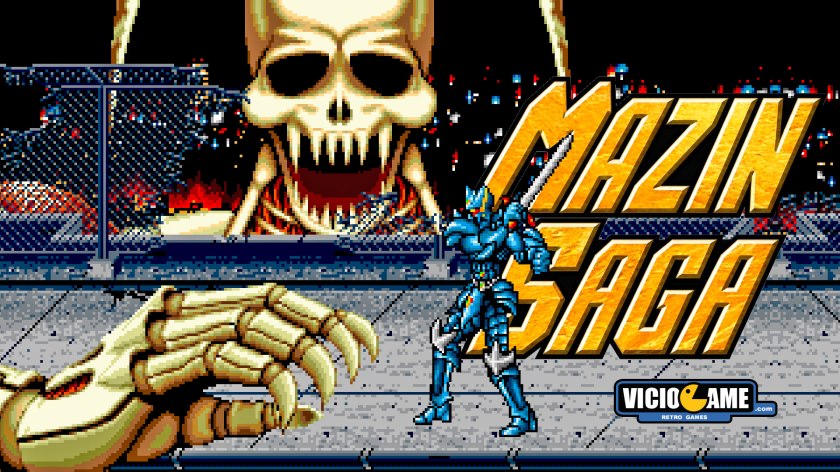
Mazin Saga: Mutant Fighter is a beat ‘em up game with one-on-one fighting segments, released in 1993 for Sega Genesis. After an evil force invades Earth, one of the few survivors receives a special super-powered armor to combat the evil and attempt to save humanity.
Developer: Almanic, / Team Saga / ALU
Publisher: VIC Tokai Inc.
Release date: 1993
Platform: Sega Genesis / Mega Drive
Mazin Saga – The Ultimate Guide
Mazin Saga: Mutant Fighter arrived on the Sega Genesis in 1993 as a bold experiment by Almanic Corporation, developed in conjunction with ALU and Team Saga. Distributed by Vic Tokai Inc. in the United States in February 1993, the game represents a peculiar fusion between the beat ‘em up genre and one-on-one fighting game elements. Published by Sega itself in Japan and Europe, where it received the title Mazin Wars, the game carries with it the legacy of Go Nagai’s MazinSaga manga, a work that blended elements from the same author’s Mazinger Z and Devilman franchises.
Development of the title was handled by much of the team that had worked on previous Almanic Corporation projects, including E.V.O.: Search for Eden. The soundtrack and sound effects were the responsibility of Kazuo Sawa, known for his work on the Kunio-kun series.
The narrative premise of Mazin Saga is set in an apocalyptic future of 1999, where humanity faces imminent extinction. The attack came without prior warning, and within days the inhabitants of Earth found themselves desperately fighting against an insidious force from outer space. The measures taken were drastic and varied: nuclear explosions, biological warfare, and tactics that completely destabilized the terrestrial ecosystem. Despite all efforts, Earth’s armies were no match for the invaders. Survivors of the global holocaust fled to underground shelters while city after city was devastated by the armored biocreatures of the force known as Steelmask Force, commanded by Hell Mazinger. Biological and nuclear warfare left the population disfigured, the environment completely out of control, and transformed countless creatures into mutant biological horrors that compose the invading army.
Only one man foresaw and prepared for the invasion: Professor Kabuto. After years of research and experiments, the Professor developed the only weapon capable of destroying the invaders: a bio-special armor that, with the help of his son Koji Kabuto, becomes the super-warrior known as Mazinger-Z. This unique combat equipment represents humanity’s last hope, a revolutionary technology that allows the user to face the biobeasts on equal footing. Koji Kabuto dons the Z armor and assumes his heroic identity to combat the legions of mutant monsters through multiple stages, confronting the villain’s personal henchmen before facing Hell Mazinger himself.
In the screens where Mazinger-Z faces waves of Steelmask soldiers, Button A executes the Special Attack, a spinning, slashing charge that devastates enemies but drains energy from the player’s life meter, making it impossible to use when energy is too low. Button B performs sword attacks, which can be pressed repeatedly for a series of attacks that vary depending on enemy proximity. Mazinger-Z begins with a vertical and horizontal slash, finishing with different movements: a throw when close, a kick at medium distance, and a thrust when distant. By pressing Button B quickly and repeatedly, the player executes the Steel Wall, a rapid attack guaranteed to subdue the opponent. Button C allows jumping, and combinations with other buttons significantly expand the available move repertoire.
The jumping mechanics offer various tactical possibilities. A simple jump followed by Button B executes the Aerial Slash, a descending strike from the air. Pressing Button B together with the down directional during mid-jump, Mazinger-Z performs the Descending Thrust, ideal for hitting enemies directly below. The Somersault is executed by pressing the directional left or right together with Button C, allowing the player to guide the jump’s direction. During a Somersault, pressing Button B executes the Aerial Kick, effective for stunning enemies in the air.
The Dash system adds another layer of strategy. By pressing the directional twice in the same direction, Mazinger-Z runs across the screen, continuing the movement while the directional is held down. This run can be combined with attacks and jumps for advanced moves. The Charge combines the Dash with a sword slash for extra impact. The Long Jump, performed during the Dash by pressing C, is useful for crossing long falls or covering great distances quickly. The Spinning Blade, executed during a Dash followed by jump and attack, knocks down enemies with a whirlwind attack.
When Mazinger-Z finally reaches the stage boss and the battle transfers to the one-on-one confrontation screen, the combat system undergoes significant changes. The player and stage boss are ready to duel on their own terms, with Mazinger-Z’s size change reflecting a transformation in available fighting techniques. The basic sword attack, executed with Button B, becomes a simple but powerful vertical strike. The directional can guide the sword in different movements: the Rising Slash, pressing up together with B, hits the opponent from below while they jump over the player’s head. The Side Slash, pressing in the direction opposite the opponent together with B, is excellent for breaking through the enemy’s guard and hitting their midsection.
The Knee Strike is executed by pressing the directional down together with B, making Mazinger-Z crouch and attack simultaneously. The Descending Thrust in boss battles requires pressing down and in the direction opposite the opponent together with B, making the character crouch and thrust. Button A, which executed the Special Attack in regular stages, now serves as Guard, protecting against opponent attacks. By pressing A and the down directional simultaneously, Mazinger-Z crouches and protects the legs. It’s important to note that the guard position only reduces damage from strong attacks, not eliminating it completely.
The Vertical Jump, executed with Button C, allows evading enemy strikes or attacking from above by pressing B in the air. The Somersault in boss battles works by pressing the directional left or right together with C, allowing jump guidance and pressing B during aerial movement for additional attacks. This control change between the beat ‘em up sections and one-on-one fighting battles would be one of the game’s most criticized points, with many reviewers pointing out the confusing transition and the apparent loss of moves that Mazinger-Z was executing moments before.
Items scattered throughout the game stages offer strategic advantages and are collected simply by walking over them. The Life Chakra restores a small portion of the life meter, appearing as a bright golden item. The Super Chakra completely restores the life meter, being significantly rarer and more valuable. The invincibility item makes Mazin Saga flash for a short period, during which the player is invulnerable to attacks. The Gold Dust offers a bonus of 1,000 points, while the Crystal rewards 5,000 points.
The game’s structure consists of seven stages, normally divided into multiple sections. There are five main stages with a boss awaiting at the end, one stage revisiting the bosses in sequence, and a final stage with the final battle. The player fights through ruined cities around the globe in an attempt to repel Godkaiser Hell’s forces.
Stage 1 takes place in Tokyo, where the sun sets over the Japanese metropolis and flames from skyscrapers illuminate the night. The player faces the first adversary, Garada K7, in the middle of a city street. Stage 2 occurs in India, where the unbalanced ecosystem transformed the subcontinent into a winter desert. The player faces various surprising opponents in the catacombs before battling against “Slughead” in an abandoned temple. Stage 3 unfolds in Europe, where some of the world’s most beautiful monuments lie buried under acres of sand and a scorching sun. In Spain, the player faces the Dinobeast, requiring quick feet to overcome its vicious and elusive charging attacks. Stage 4 takes place in New York, where the city changed from a concrete jungle to a jungle of a different kind. Under clouds of pollution, the battle against the biobeast known as Buster Claw awaits. Stage 5 takes place in Egypt, among ancient and new ruins, where the player encounters an enemy that will seem horribly familiar: Negative Mazinger. Stage 6, titled “The Counter Attack” is an endurance test, where you face the previous bosses in sequence. Stage 7 represents the Final Battle, where you must face Hell Mazinger.
The soundtrack of Mazin Saga, composed by Kazuo Sawa, follows the percussion-heavy techno pattern typical of the era, evoking comparisons with titles like Bio-Hazard Battle. Enemies emit death screams when defeated, although these sounds seem somewhat muffled. The composition works adequately during gameplay, creating an appropriate atmosphere for the post-apocalyptic setting without becoming particularly amazing or irritating.
The graphics of the beat ‘em up sections are pleasant but nothing spectacular. Everything is relatively small, but the game manages to display multiple different enemies on screen with little to no slowdown, an impressive technical achievement for the Genesis. While the graphics don’t demonstrate constant exuberant brilliance, there are numerous small touches in sprite animations that make this a visually pleasing game. The background environments are better than average for the time, presenting interesting locations like ruined cities half-submerged in sand that shimmer in the intense heat.
Objects like pillars or translucent walls appear in the foreground of stages during battles, and while it’s appreciable that designers tried to immerse the player in the level, the view of the action is sometimes obscured by these barriers. The visuals increase in quality when the game shifts to fighting battles against bosses, enlarging the characters and giving the involved parties more detail. A redeeming aspect of the fighting sections is that the sprites look absolutely wonderful, being large and full of detail. The visual design of Mazinger-Z in the game more closely resembles Mazinkaiser, curiously, considering the game was released long before the 2003 Mazinkaiser OVA.
During the beat ‘em up sections, Mazinger-Z is fluid and responsive, with relatively good collision detection and a surprising amount of available moves. The gameplay is great, providing considerable fun in knocking down various enemies. The variety of available moves is impressive, as one doesn’t expect much depth from a three-button control scheme. As the game progresses, more strategy is needed to overcome enemies, with unique attack patterns that make certain moves more suitable for combating particular adversaries.
The auto-scrolling sections, where the player must constantly run to avoid being killed, bring a welcome change of pace and prevent things from becoming too repetitive. However, these sections aren’t interesting and can be potentially frustrating, especially considering the number of lives the player will lose in them. At least the designers placed an extra life at the beginning of these stages to compensate for the anticipated deaths.
The most controversial and universally criticized aspect of Mazin Saga are the one-on-one fighting battles against stage bosses. This is where the game goes down the drain. The abrupt shift to Street Fighter II style not only awkwardly alters the controls, transforming the special attack into a guard button, but makes Mazinger-Z forget all the impressive moves it was executing moments before. The bosses are incredibly unbalanced, dealing much more damage than the player and possessing greater reach, not to mention the artificial intelligence with horrible programming.
Later bosses love to block everything, with no way to break their guard, but when the player tries to block they still receive some damage. The need to replay all battles before facing the final boss is a significant problem. These fighting sections are sloppy, difficult, with terrible collision detection, ending up as a true black mark on an otherwise solid game. We can classify Mazin Saga’s difficulty level as “merciless.” Even on easy mode, the final boss battles are absolute torture.
The lack of a two-player cooperative mode was one of the most consistent criticisms. In 1993, a growing number of console beat ‘em ups included two-player co-op, making its absence in Mazin Saga particularly noticeable. Reviewers suggested that with the fighting sections improved or completely removed, and a two-player mode added, the title had potential to be a true classic. While the game is fun most of the time, it doesn’t possess tremendous appeal to bring players back after completing it.
The legacy and impact of Mazin Saga on the gaming industry are modest but interesting. Former Treasure member Tetsuhiko Kikuchi was inspired by Mazin Saga: Mutant Fighter to program enemies manually instead of with mathematical algorithms during the development of Gunstar Heroes. This technical influence demonstrates that, despite its flaws, Mazin Saga offered valuable insights about game design that informed subsequent acclaimed titles.
The enemy variety is considerable, with designs ranging from armored soldiers with flamethrowers to giant insects and even the colossal foot of the stage boss. There are cybernetic cyclops with cannons on their right arm, which they use to shoot projectiles at Mazinger-Z, whether laser beams or grenades. Female soldiers and even ninjas appear among the biobeast forces. The sprite animations are high quality, partially compensating for the smaller character size in the beat ‘em up sections.
The four-part structure of each stage, with three traditional beat ‘em up sections followed by a one-on-one fighting section, creates a unique but problematic rhythm. The format works well in theory, offering variety within each level and culminating in a climactic confrontation against a giant boss. In practice, the awkward transition between gameplay styles and the perceived inferiority of the fighting sections harm the overall experience.
The game remains a curiosity for those seeking life after Streets of Rage 2, or perhaps is only remembered by those with masochistic love for unfortunate Street Fighter II clones. For fans of the Mazinger anime and manga, the game offers an opportunity to experience the franchise in interactive form, although the representation is more inspired by the source material than a faithful adaptation. The fact that Go Nagai has his name listed immediately when the credits begin to roll establishes that this isn’t just coincidence, but an official license supervised by the creator.
Mazin Saga: Mutant Fighter remains a unique title in the Sega Genesis library, representing an ambition that wasn’t fully realized but still offers genuine moments of excellence. The beat ‘em up sections demonstrate that Almanic Corporation possessed the technical and creative capacity to create a first-rate game, with responsive controls, move variety, and solid enemy design. The failure to properly execute the fighting sections, whether due to lack of time, resources, or genre expertise, transformed the game into a divided experience that frustrates as much as it entertains.
For players willing to forgive its mechanical flaws and persevere through the punishing difficulty, Mazin Saga offers a competent experience packaged with an apocalyptic science fiction premise and the opportunity to control one of the most iconic giant robots from Japanese manga and anime. It’s a game worth experiencing. While it doesn’t reach the heights of great classics, it occupies its own peculiar niche as a bold experiment that partially achieved its objectives, leaving players imagining what could have been if its ambitions were fully realized.
Mazin Saga – O Guia Definitivo
Mazin Saga: Mutant Fighter chegou ao Sega Genesis em 1993 como um experimento ousado da Almanic Corporation, desenvolvido em conjunto com ALU e Team Saga. Distribuído pela Vic Tokai Inc. nos Estados Unidos em fevereiro de 1993, o jogo representa uma fusão peculiar entre o gênero beat ‘em up e elementos de jogos de luta um contra um. Publicado pela própria Sega no Japão e na Europa, onde recebeu o título Mazin Wars, o jogo carrega consigo a herança do mangá MazinSaga de Go Nagai, uma obra que mesclava elementos das franquias Mazinger Z e Devilman do mesmo autor.
O desenvolvimento do título ficou a cargo de grande parte da equipe que havia trabalhado em projetos anteriores da Almanic Corporation, incluindo E.V.O.: Search for Eden. A trilha sonora e os efeitos sonoros ficaram sob responsabilidade de Kazuo Sawa, conhecido por seu trabalho na série Kunio-kun.
A proposta narrativa de Mazin Saga situa-se em um futuro apocalíptico de 1999, onde a humanidade enfrenta sua extinção iminente. O ataque veio sem aviso prévio, e em poucos dias os habitantes da Terra se viram lutando desesperadamente contra uma força insidiosa vinda do espaço sideral. As medidas tomadas foram drásticas e variadas: explosões nucleares, guerra bacteriológica e táticas que desestabilizaram completamente o ecossistema terrestre. Apesar de todos os esforços, os exércitos terrestres não foram páreo para os invasores. Os sobreviventes do holocausto global fugiram para abrigos subterrâneos enquanto cidade após cidade era devastada pelas biocriaturas blindadas da força conhecida como Steelmask Force, comandada por Hell Mazinger. A guerra biológica e nuclear deixou a população desfigurada, o ambiente completamente fora de controle e transformou inúmeras criaturas em horrores biológicos mutantes que compõem o exército invasor.
Apenas um homem previu e se preparou para a invasão: o Professor Kabuto. Após anos de pesquisa e experimentos, o Professor desenvolveu a única arma capaz de destruir os invasores: uma armadura bio-especial que, com a ajuda de seu filho Koji Kabuto, torna-se o super-guerreiro conhecido como Mazinger-Z. Este equipamento de combate único representa a última esperança da raça humana, uma tecnologia revolucionária que permite ao usuário enfrentar os biobestas em pé de igualdade. Koji Kabuto veste a armadura Z e assume sua identidade heróica para combater as legiões de monstros mutantes através de múltiplas fases, confrontando os capangas pessoais do vilão antes de enfrentar o próprio Hell Mazinger.
Nas telas onde Mazinger-Z enfrenta ondas de soldados Steelmask, o Botão A executa o Ataque Especial, uma investida giratória e cortante que devasta os inimigos, mas drena energia do medidor de vida do jogador, impossibilitando seu uso quando a energia está muito baixa. O Botão B realiza ataques com a espada, podendo ser pressionado repetidamente para uma série de ataques que variam dependendo da proximidade do inimigo. Mazinger-Z começa com um corte vertical e horizontal, finalizando com diferentes movimentos: um arremesso quando próximo, um chute a média distância e uma estocada quando distante. Pressionando o Botão B rapidamente e repetidamente, o jogador executa a Muralha de Aço, um ataque rápido garantido para subjugar o oponente. O Botão C permite saltar, e combinações com outros botões expandem significativamente o repertório de movimentos disponíveis.
A mecânica de salto oferece diversas possibilidades táticas. Um salto simples seguido do Botão B executa o Corte Aéreo, um golpe descendente do ar. Pressionando o Botão B junto com o direcional para baixo durante o meio do salto, Mazinger-Z realiza a Estocada Descendente, ideal para acertar inimigos diretamente abaixo. O Salto Mortal é executado pressionando o direcional para esquerda ou direita junto com o Botão C, permitindo ao jogador guiar a direção do salto. Durante um Salto Mortal, pressionar o Botão B executa o Chute Aéreo, eficaz para atordoar inimigos no ar.
O sistema de Dash adiciona outra camada de estratégia. Pressionando o direcional duas vezes na mesma direção, Mazinger-Z corre pela tela, continuando o movimento enquanto o direcional for mantido pressionado. Esta corrida pode ser combinada com ataques e saltos para movimentos avançados. A Carga combina o Dash com um corte de espada para impacto extra. O Salto Longo, realizado durante o Dash pressionando C, é útil para atravessar quedas longas ou cobrir grandes distâncias rapidamente. A Lâmina Giratória, executada durante um Dash seguido de salto e ataque, derruba os inimigos com um ataque turbilhão.
Quando Mazinger-Z finalmente alcança o chefe da fase e a batalha se transfere para a tela de confronto um contra um, o sistema de combate sofre alterações significativas. O jogador e o chefe da fase estão prontos para duelar em termos próprios, com a mudança de tamanho de Mazinger-Z refletindo uma transformação nas técnicas de luta disponíveis. O ataque de espada básico, executado com o Botão B, torna-se um golpe vertical simples mas poderoso. O direcional pode guiar a espada em diferentes movimentos: o Corte Ascendente, pressionando para cima junto com B, acerta o oponente por baixo enquanto ele salta sobre a cabeça do jogador. O Corte Lateral, pressionando na direção contrária ao oponente junto com B, é excelente para romper a guarda do inimigo e atingir sua seção média.
O Joelhada é executado pressionando o direcional para baixo junto com B, fazendo Mazinger-Z agachar e atacar simultaneamente. A Estocada Descendente nas batalhas de chefe requer pressionar para baixo e na direção contrária ao oponente junto com B, fazendo o personagem agachar e estocar. O Botão A, que executava o Ataque Especial nas fases regulares, agora serve como Guarda, protegendo contra os ataques do oponente. Pressionando A e o direcional para baixo simultaneamente, Mazinger-Z agacha e protege as pernas. É importante notar que a posição de guarda apenas reduz o dano de ataques fortes, não o eliminando completamente.
O Salto Vertical, executado com o Botão C, permite evadir golpes inimigos ou atacar de cima pressionando B no ar. O Salto Mortal nas batalhas de chefe funciona pressionando o direcional para esquerda ou direita junto com C, permitindo guiar o salto e pressionar B durante o movimento aéreo para ataques adicionais. Esta mudança de controles entre as seções de beat ‘em up e as batalhas de luta um contra um seria um dos pontos mais criticados do jogo, com muitos revisores apontando a transição confusa e a aparente perda de movimentos que Mazinger-Z executava momentos antes.
Os itens espalhados pelas fases de jogo oferecem vantagens estratégicas e são coletados simplesmente caminhando sobre eles. O Life Chakra restaura uma pequena porção do medidor de vida, aparecendo como um item dourado brilhante. O Super Chakra restaura completamente o medidor de vida, sendo significativamente mais raro e valioso. O item de invencibilidade faz Mazin Saga piscar por um curto período, durante o qual o jogador é invulnerável a ataques. O Pó de Ouro oferece um bônus de 1.000 pontos, enquanto o Cristal premia com 5.000 pontos.
A estrutura do jogo consiste em sete fases, normalmente dividida em múltiplas seções. São cinco fases principais com um chefe aguardando no final, uma fase revisitando os chefes em sequência, e uma última fases com a batalha final. O jogador luta através de cidades em ruínas ao redor do globo na tentativa de repelir as forças de Godkaiser Hell.
A Fase 1 se passa em Tóquio, onde o sol se põe sobre a metrópole japonesa e as chamas dos arranha-céus iluminam a noite. O jogador enfrenta o primeiro adversário, Garada K7, no meio de uma rua da cidade. A Fase 2 ocorre na Índia, onde o ecossistema desequilibrado transformou o subcontinente em um deserto de inverno. O jogador enfrenta diversos oponentes surpreendentes nas catacumbas antes de batalhar contra “Slughead” em um templo abandonado. A Fase 3 se desenrola na Europa, onde alguns dos mais belos monumentos do mundo jazem enterrados sob hectares de areia e um sol escaldante. Na Espanha, o jogador enfrenta a Dinobesta, exigindo rapidez nos pés para vencer seus ataques de investida viciosos e elusivos. A Fase 4 acontece em Nova York, onde a cidade mudou de uma selva de concreto para uma selva de tipo diferente. Sob nuvens de poluição, a batalha contra a biobesta conhecida como Buster Claw aguarda. A Fase 5 se passa no Egito, entre ruínas antigas e novas, onde o jogador encontra um inimigo que parecerá horrivelmente familiar: Negative Mazinger. A fase 6, intitulada “The Counter Attack” é um teste de resistência, onde você enfrenta os chefes anteriores em sequência. A Fase 7 representa a Batalha Final, onde você deve enfrentar Hell Mazinger.
A trilha sonora de Mazin Saga, composta por Kazuo Sawa, segue o padrão techno pesado em percussão típico da era, evocando comparações com títulos como Bio-Hazard Battle. Os inimigos emitem gritos de morte ao serem derrotados, embora estes sons pareçam um tanto abafados. A composição funciona adequadamente durante o jogo, criando uma atmosfera apropriada para o cenário pós-apocalíptico sem se tornar particularmente incrível ou irritante.
Os gráficos das seções de beat ‘em up são agradáveis, mas nada espetaculares. Tudo é relativamente pequeno, mas o jogo consegue exibir múltiplos inimigos diferentes na tela com pouca ou nenhuma desaceleração, uma conquista técnica impressionante para o Genesis. Embora os gráficos não demonstrem um brilho exuberante constante, há inúmeros pequenos toques nas animações dos sprites que tornam este um jogo visualmente agradável. Os ambientes de fundo são melhores que a média para a época, apresentando locações interessantes como cidades em ruínas meio submersas em areia que cintilam no calor intenso.
Objetos como pilares ou paredes translúcidas aparecem no primeiro plano das fases durante as batalhas, e embora seja apreciável que os designers tentaram imergir o jogador no nível, a visão da ação às vezes fica obscurecida por essas barreiras. Os visuais aumentam em qualidade quando o jogo muda para as batalhas de luta contra chefes, aumentando o tamanho dos personagens e dando às partes envolvidas mais detalhes. Um aspecto redentor das seções de luta é que os sprites parecem absolutamente maravilhosos, sendo grandes e cheios de detalhes. O design visual de Mazinger-Z no jogo se assemelha mais ao Mazinkaiser, curiosamente, considerando que o jogo foi lançado muito antes do OVA Mazinkaiser de 2003.
Durante as seções de beat ‘em up, Mazinger-Z é fluido e responde bem, com detecção de colisão relativamente boa e uma quantidade surpreendente de movimentos disponíveis. A jogabilidade é ótima, proporcionando diversão considerável ao derrubar vários inimigos. A variedade de movimentos disponíveis impressiona, pois não se espera muita profundidade de um esquema de controle de três botões. À medida que o jogo progride, mais estratégia é necessária para superar os inimigos, com padrões de ataque únicos que tornam certos movimentos mais adequados para combater determinados adversários.
As seções de auto-rolagem, onde o jogador deve correr constantemente para evitar ser morto, trazem uma mudança agradável de ritmo e impede que as coisas se tornem muito repetitivas. No entanto, essas seções não são interessantes e podem ser potencialmente frustrantes, especialmente considerando o número de vidas que o jogador perderá nelas. Pelo menos os designers colocaram uma vida extra no início dessas fases para compensar as mortes previstas.
O aspecto mais controverso e universalmente criticado de Mazin Saga são as batalhas de luta um contra um contra os chefes de fase. É aqui onde o jogo vai por água abaixo. A mudança abrupta para o estilo de Street Fighter II não apenas altera desajeitadamente os controles, transformando o ataque especial em um botão de guarda, mas faz com que Mazinger-Z esqueça todos os movimentos impressionantes que executava momentos antes. Os chefes são incrivelmente desequilibrados, causando muito mais dano que o jogador e possuindo maior alcance, sem contar a inteligência artificial com programação horrível.
Os chefes posteriores amam bloquear tudo, sem que haja qualquer maneira de quebrar sua guarda, mas quando o jogador tenta bloquear ainda recebe algum dano. A necessidade de rejogar todas as batalhas antes de enfrentar o chefe final é um problema significativo. Estas seções de luta são desleixadas, difíceis, com detecção de colisão terrível, terminando como uma verdadeira mancha negra em um jogo que de outra forma seria sólido. Podemos classificar o nível de dificuldade de Mazin Saga como “impiedoso”. Mesmo no modo fácil, as últimas batalhas de chefe são uma tortura absoluta.
A falta de um modo cooperativo para dois jogadores foi uma das críticas mais consistentes. Em 1993, um número crescente de beat ‘em ups de console incluíam co-op para dois jogadores, tornando sua ausência em Mazin Saga particularmente perceptível. Revisores sugeriram que com as seções de luta melhoradas ou removidas completamente, e um modo para dois jogadores adicionado, o título tinha potencial para ser um verdadeiro clássico. Embora o jogo seja divertido na maior parte do tempo, não possui uma atração tremenda para trazer os jogadores de volta após completá-lo.
O legado e impacto de Mazin Saga na indústria de jogos são modestos mas interessantes. Ex-membro da Treasure, Tetsuhiko Kikuchi, foi inspirado por Mazin Saga: Mutant Fighter a programar os inimigos manualmente ao invés de com algoritmos matemáticos durante o desenvolvimento de Gunstar Heroes. Esta influência técnica demonstra que, apesar de suas falhas, Mazin Saga ofereceu insights valiosos sobre design de jogos que informaram títulos subsequentes aclamados.
A variedade de inimigos é considerável, com designs que vão de soldados blindados com lança-chamas a insetos gigantes e até o pé colossal do chefe da fase. Há ciclopes cibernéticos com canhões no braço direito, que usam para atirar projéteis em Mazinger-Z, seja raios laser ou granadas. Soldados femininas e até ninjas aparecem entre as forças biobestas. As animações dos sprites são de alta qualidade, compensando parcialmente pelo tamanho menor dos personagens nas seções de beat ‘em up.
A estrutura de quatro partes de cada estágio, com três seções de beat ‘em up tradicional seguidas por uma seção de luta um contra um, cria um ritmo único, mas problemático. O formato funciona bem na teoria, oferecendo variedade dentro de cada nível e culminando em um confronto climático contra um chefe gigante. Na prática, a transição desajeitada entre estilos de jogo e a inferioridade percebida das seções de luta prejudicam a experiência geral.
O jogo permanece como uma curiosidade para aqueles que buscam vida após Streets of Rage 2, ou talvez seja lembrado apenas por aqueles com amor masoquista por clones infelizes de Street Fighter II. Para fãs do anime e mangá Mazinger, o jogo oferece uma oportunidade de experienciar a franquia em forma interativa, embora a representação seja mais inspirada pelo material fonte do que uma adaptação fiel. O fato de Go Nagai ter seu nome listado imediatamente quando os créditos começam a rolar estabelece que isto não é apenas coincidência, mas uma licença oficial supervisionada pelo criador.
Mazin Saga: Mutant Fighter permanece um título único na biblioteca do Sega Genesis, representando uma ambição que não foi totalmente realizada mas que ainda oferece momentos genuínos de excelência. As seções de beat ‘em up demonstram que a Almanic Corporation possuía a capacidade técnica e criativa para criar um jogo de primeira linha, com controles responsivos, variedade de movimentos e design de inimigos sólido. O fracasso em executar adequadamente as seções de luta, seja por falta de tempo, recursos ou expertise no gênero, transformou o jogo em uma experiência dividida que frustra tanto quanto diverte.
Para jogadores dispostos a perdoar suas falhas mecânicas e perseverar através da dificuldade punitiva, Mazin Saga oferece uma experiência competente embalada com uma premissa de ficção científica apocalíptica e a oportunidade de controlar um dos robôs gigantes mais icônicos do mangá e anime japonês. É um jogo que vale a pena experimentar. Embora não atinja as alturas de grandes clássicos, ocupa seu próprio nicho peculiar como um experimento ousado que alcançou parcialmente seus objetivos, deixando os jogadores imaginando o que poderia ter sido se suas ambições fossem totalmente realizadas.
🤑💲Earn money without doing anything! Just leave these apps open:
   ✓ https://r.honeygain.me/CONTA9DB02

   ✓ https://packetstream.io/?psr=1uPb
🤑💲1-Click button earns Bitcoin every 1 hour: https://freebitco.in/?r=53528449
⬛ 𝗧𝗶𝗸𝗧𝗼𝗸: https://www.tiktok.com/@viciogame
🟧 𝗜𝗻𝘀𝘁𝗮𝗴𝗿𝗮𝗺: http://www.instagram.com/viciogame
🟥 𝗬𝗼𝘂𝘁𝘂𝗯𝗲: http://www.youtube.com/viciogame
🟦 𝗙𝗮𝗰𝗲𝗯𝗼𝗼𝗸: http://www.facebook.com/viciogame
🔳 𝗧𝗵𝗿𝗲𝗮𝗱𝘀: https://www.threads.net/@viciogame
🟪 𝗧𝘄𝗶𝘁𝗰𝗵: https://www.twitch.tv/ViciogameRetroGames
🟨 𝗕𝗹𝗼𝗴: http://www.viciogameblog.com/
🟦𝗧𝘄𝗶𝘁𝘁𝗲𝗿: http://www.twitter.com/viciogame
#Viciogame #Gameplay #LetsPlay #Gamer #Playthrough #Games #News #Videogames #Review #Game #Detonado #Walkthrough #Ending #Reviews #Facts #Retro #Record #Roms #Emulator #Longplay #Speedrun #MazinSaga #SegaGenesis #MutantFighter #MegaDrive #マジンサーガ #Sega #MazinWars #Genesis #BeatEmUp #Mazinger #TecToy #Mecha #Gundam #robot #ninja #メガドライブ #セガ

