
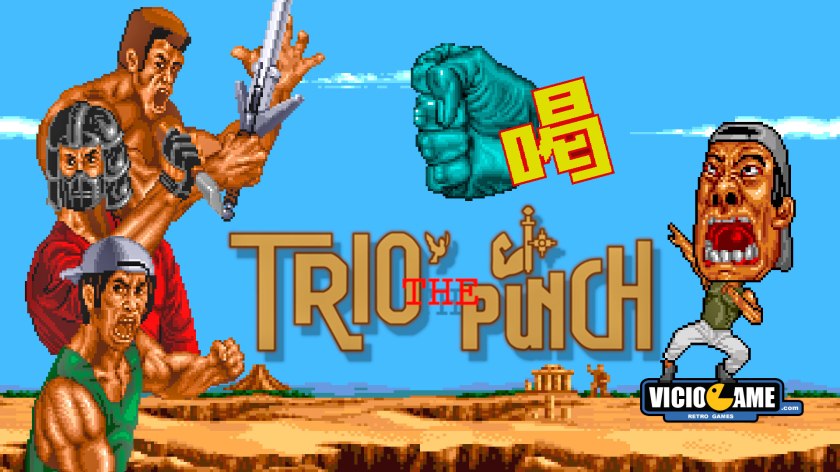
Trio the Punch: Never Forget Me is a beat ‘em up style game released in 1990 for arcades. Even without a narrative, the game stands out for its surreal, confusing, and bizarre nature. You simply need to choose one of three characters and embark on a journey facing increasingly strange enemies.
Developer/Publisher: Data East
Release date: 1990
Platform: Arcade Data East Act-Fancer board
Trio the Punch: Never Forget Me – The Ultimate Guide
Trio the Punch: Never Forget Me (トリオ・ザ・パンチ) represents one of the most peculiar and bewildering products ever released by Data East, a Japanese developer known for titles like Bad Dudes vs. DragonNinja and Karnov. Originally released in arcades in April 1990, despite the title screen indicating 1989 as the production year, this side-scrolling action fighting game defies all conventions established by the beat ‘em up genre and has become an iconic example of a bad game and stupidity in Japanese gaming culture. The title was developed by the same team responsible for Karnov and Atomic Runner Chelnov, forming with these the so-called Deco-gē Trio (デコゲー3トリオ), an informal trilogy of Data East games connected by the same creative director and sharing visual elements and characters.
The development history of Trio the Punch is as unusual as the final result. The game was originally conceived as a sugoroku, a traditional Japanese board game similar to backgammon, with the working title “TV Sugoroku Trio the Punch” (TVすごろく トリオ・ザ・パンチ). During location testing, the project still maintained this board game concept, where players would advance through a stage map based on dice rolls, with bosses of different difficulty levels placed depending on where the player landed. According to Toshikazu Ii, the game’s designer, after witnessing a child trying to play Chelnov and being unable to complete even the first stage, he decided that the next project needed to have simpler and more accessible content. Citing his hobby of board games, he developed this two-layered system. However, during development, the concept was completely transformed into the final product we know, almost entirely abandoning the sugoroku structure except for the roulette mechanic between stages and the random arrangement of stage difficulty.
The game uses a specific Data East arcade board, operating with sound chips that enable a soundtrack that, characteristically, is never interrupted during stages. The Japanese magazine Game Machine listed Trio the Punch: Never Forget Me in its May 15, 1990 edition as being the twenty-fourth most successful upright arcade cabinet of the month in Japan.
The control system is relatively straightforward but has its peculiarities. The 8-way directional allows complete movement through the scenery, while the A button executes the normal attack with the equipped weapon, the B button performs the jump, and the C button activates the special attack or “sub-weapon,” which can only be used once per stage. Normal attacks have curious internal nomenclatures, being called “bishi bishi” for quick strikes and “pacchi” for jumps. Special attacks have the generic name “dokan!”, a Japanese onomatopoeia for explosions. Most characters’ standard special attacks invoke lightning that falls from the sky, comically increasing the character’s head size during the animation. The jump system has unconventional physics, as when jumping over enemy projectiles, the character will bounce as if they had jumped on a trampoline, a mechanic that occurs frequently during the game and contributes to its surreal feeling of ignoring the laws of physics.
The three playable characters available from the start are Santos, Kamakura-kun, and Rosesub (also called Rose Sub). Santos is identified as a Tough Guy who wears a backwards cap and sportswear. He is the only character capable of attacking upward, which can be crucial in certain situations. His primary attacks begin with punches, evolving to strikes with a punching bag at the second upgrade level, then iron claws at the third level that slightly increase range, and finally at the fourth level he gains a dash punch where he slides forward infinitely with his fist extended until hitting something, plus a powerful ascending uppercut called Seungryongfist. The problem with the dash punch is that it’s too fast, making it easy to collide with crawling enemies or hit bosses during their invincibility period. His basic special attack makes lightning fall while his head expands and he shouts “OOF,” damaging all enemies on screen. When upgraded, the attack gains Japanese characters that emerge and chase opponents after the initial lightning. Santos can also fire star-shaped projectiles, an ability only seen when he is miniaturized. His appearances in other Data East games include cameos in Boogie Wings (The Great Ragtime Show in Japan), and his exclusive musical theme accompanies him during stages. From the name and dialogue in the Japanese version of the ending (“HEY! HEY! HEY! HEY!”), it’s speculated that Santos is a foreigner, possibly Hispanic.
Kamakura-kun (カマクラくん) is the obligatory ninja of the trio, wearing a samurai mask covering his face. He attacks with throwing knives and shurikens, being the only character who can use long-range attacks from the start. One of his most distinctive characteristics is that he automatically transforms into a wooden log every time he receives damage from enemy characters, during which he cannot move or attack. His weapon upgrades progress through different sizes of shurikens to a short-range dagger. Unlike Santos and Rosesub who merely enhance their special attacks, Kamakura-kun receives completely different special attacks with each upgrade. His basic special is the standard lightning. The “Rock” special makes a giant stone fall that splits in half, with both halves flying in opposite directions hitting everyone on the field, and they can also block projectiles. The “Fire” special creates multiple flaming rings that bounce around the screen. The “Double” special creates a clone of himself to fight alongside him. The “Bomb” special is particularly grotesque, making him explode with his body parts flying across the screen. The “Katana” special makes eight katanas emerge from the ground at different angles. Lastly, the “Sicke” special summons frogs to attack opponents. Kamakura-kun’s musical theme is exclusive to him, and his jump animation shows him curled up like a ball, appearing to be the smallest of the three characters in stature.
Rosesub (ローズサブ) is the muscular swordsman of the group, whose appearance and way of holding his weapons strongly resemble Rastan from Taito. He starts with a torch as a weapon, progressing to a sword, then a larger sword, followed by a morning star, and finally returns to a torch but this time capable of firing fireballs. His first special attack is the standard lightning. The “Clash 1” special creates four energy spheres that fly in different directions across the screen. “Clash 2” increases to six spheres, and “Bravo” creates eight spheres flying in multiple directions.
All three characters were trained by Master Chin (Chin-san or Mr. Chin), a stereotype of martial arts masters who appear in old kung-fu films, and this training presumes they all possess martial arts knowledge beyond their weapon skills. Master Chin (チンさん) is a complex figure who serves as mentor and occasional antagonist. He appears as a boss in stages 7 and 24, where his body stretches or grows gigantically, and attacks by firing projectiles shaped like the Chinese character 痛 (meaning “pain” or “hurt”). In some stages he hides inside a turtle shell for inexplicable reasons before attacking with giant feet or making his head grow massively like Santos. His ability to manipulate the size of different body parts is impressive, being able to elongate his arms across the entire width of the screen, expand his foot to enormous proportions, or drastically increase the size of his head. He can also attack by shouting, creating huge “OUCH” onomatopoeias that fly toward opponents as projectiles.
Between each stage, Master Chin appears with a roulette wheel where players can upgrade their capabilities or change characters. The roulette offers some possible bonus types: HP recovery (LIFE UP), main weapon upgrade (MAIN UP), level reduction (DOWN), special attack upgrade (SUB UP), and character change. Curiously, the roulette has two positions for reduction and two for upgrades, creating a balance of risk. When the roulette activates an upgrade, Chin shouts his characteristic catchphrase “Lucky! Cha cha cha!” or in the Japanese version “Atari! Yokattanou!” (Hit! How great!). This roulette system is probably the last remnant of the original sugoroku concept, allowing elements of luck and randomness between stages. Life recovery can only happen through this roulette or by collecting specific power-ups during stages, as there is no automatic regeneration system. If a player completely reduces their weapons through consecutive bad results, they return to level 1, and the same happens with special attacks. This possibility of losing conquered power adds tension to the progression system. The roulette timing can be influenced but not completely controlled, and there are two different positions in the cycle where values appear, allowing experienced players some level of intentional manipulation to achieve the desired result, particularly useful for avoiding the dreaded DOWN or for changing characters when necessary.
The objective in each stage is to defeat enemies until collecting a specific number of yellow hearts they drop when defeated. The bottom of the screen indicates how many hearts are needed before the boss appears. Once the required number of hearts is collected, the stage boss emerges and must be defeated to complete the stage. Some bosses appear from the beginning of certain stages, making heart collection unnecessary in these cases. If players don’t collect enough hearts, some stages simply repeat infinitely until the requirement is met, making the scenery loop. Other stages contain no scrolling at all, while some allow vertical scrolling through jumps, and most scroll horizontally from left to right, although some stages loop at the left and right edges of the screen.
The game consists of 35 stages in total, each presenting radically different environments, enemies, and bosses. The first stage, which takes place in a tropical environment, already establishes the surreal tone with its boss being a giant bronze statue of Karnov carried on the shoulders of four smaller Karnovs. The word “Mamorigami” (守神, meaning “guardian god”) is engraved on the base of the statue, which attacks by spitting fire from its foot. The statue’s facial expression changes after receiving damage. The second stage features an enormous floating bronze fist as a boss. The third stage has peculiar texts, with the phrase “very large” appearing before the start and the boss being literally “the giant’s hand” as announced by the interface itself. The following stages take players through jungles, canals with giant crocodiles, deserts, cities full of ninjas, medieval Japan scenery, futuristic space environments, and eventually a peaceful public park.
Among the most bizarre stages is one that displays the phrase “WEEBLES FALL DOWN!” appearing gradually on the screen, letter by letter. When the exclamation point appears, all action freezes momentarily, including both enemies and players. This is a phenomenon based on the Daruma doll and references a Japanese children’s game called “Daruma-san ga koronda” (The Daruma doll fell), similar to the Western game “Red Light, Green Light” where players must freeze their movements. The implementation of this temporal stop mechanic deliberately programmed by the developers adds another layer of strangeness to the game. The “Curse of Sheeps” stage is particularly cruel, as regardless of whether the player wins or loses against the pink sheep boss, they will be cursed and transformed into a sheep for the next stage. This forced transformation replaces the character model with a sheep with the same abilities as the boss, including invincibility when crouching, although the special bomb cannot be used. The transformation only ends after completing the following stage.
Common enemies include various variations of Karnov, the title character from Data East’s 1987 game of the same name. Karnov appears as a generic enemy in several incarnations: normal, with wings, wearing a diving helmet, and in a purple version that shoots projectiles. He is bald, bearded, obese and semi-nude, and can inflate his body to expel small fireballs from his mouth. The ninjas come in multiple colors, each with different abilities. Green ninjas are basic. Red ninjas are more resistant and shoot consecutive shurikens, with one specific red ninja displaying the ability to transform into a floating sword serving as a mini-boss. Yellow ninjas are the most proficient in transformation, being able to become various animals like frogs and snakes in addition to occasionally shooting shurikens. Blue ninjas prefer to stay on platforms and drop a blade attached to a rope from top to bottom onto players. Slimes appear in various colors with distinct behaviors. Blue slimes walk forward and attack by collision. Red slimes are much more durable and can jump. Green slimes simply bounce. Yellow slimes can jump and change the shape of their structure, including a lizard-man form. Certain yellow slimes operate robot mechas, with the Slime Mecha MK I attacking with very short-range lasers and hovering capability, while the Slime Mecha MK II is stronger and has two powerful missiles on its back.
Among the most extraordinary bosses is Chelnov (チェルノブ), the title character from Atomic Runner Chelnov who appears as a boss wearing armor and wielding a giant hammer (a weapon that wasn’t present in his original game). Another infamous boss is a figure resembling Colonel Sanders, founder of KFC. In his base form he just hovers and collides with players, but after receiving enough damage, a peculiar purple bird emerges exploding from his head. This bird flies around firing chicken drumsticks and can shrink players when touching them. One stage features zombies dressed in red riding motorcycles in front of a carousel, while the moon in the background violates the laws of perspective by bouncing around the screen. During this sequence players are shrunk. A giant totem topped by an evil knight chess piece serves as another boss. The giant bronze leg labeled “TAROSUNOASHI” (foot of Talos, reference to Greek mythology) is a boss that can destroy parts of the scenery when stepping, and shrinks players if it steps on them, and can be defeated similarly to Bowser at the end of Super Mario Bros. 3 by repeatedly attacking the sole of the foot. A lucky cat (Maneki Neko) also appears as a boss. The volcano stage allows players to dodge and react to debris fired by eruptions.
The final stages of the game completely abandon the previous madness for a strangely peaceful sequence. The final stage, preceded by the message “The Very End,” takes place in a serene park with a bird flying innocently. A flash and text appear along with a fountain. To complete the game, players must kill this harmless bird, as well as a dog, a butterfly, and another bird. Cryptic messages appear during these killings, including one that spells “CRUETY” (clearly a spelling error of “CRUELTY”), seeming to condemn the player’s actions, although this is necessary to finish the game. Upon eliminating all these animals, a giant pair of frightening eyes emerges beneath the player, the camera pulls back revealing that the character is on top of an enormous cosmic entity that then sinks back into the ground and presumably disappears forever. This enigmatic ending is followed only by the credits and a brief victory animation, leaving players without any resolution or narrative explanation.
Each stage has a time limit that only becomes visible when 30 seconds remain, creating sudden tension in stages that seemed to have no temporal urgency. The text messages that appear between and during stages often make no sense at all, resulting from poor translations from Japanese to English or simply being absurd by nature. Examples include “THAT WAS GREAT” appearing in random contexts, “REALLY JAPAN” as a stage title with no apparent relation to the content, “CLEAR” being written as “ACORN” after completing certain stages, and phrases like “HOW ARE YOU” appearing without provocation. The medieval Japanese stage contains a particularly confusing section where text states “A FRIEND COMES” followed by bamboo clearly being an enemy. One stage displays “FULL OF SMILE” while featuring intense combat against multiple Karnovs. Another simply declares “MYSTERIOUS” before starting, as if admitting that even the developers don’t know what’s happening.
Technically, Trio the Punch has several evident flaws. The collision hitbox is often imprecise, making it extremely difficult to hit certain enemies. There is a well-documented glitch in the early stages where players can fall through the floor and get stuck, forcing an arcade restart. Some bosses are simply regular enemies with more hit points, making them tedious instead of challenging. Certain sections require platform jumping that behaves erratically due to inconsistent physics. Taking damage can result in involuntary combos of multiple hits rapidly draining life. Some items and hearts fall in inaccessible locations or are sent off-screen by enemies, occasionally making it impossible to collect the necessary number to make the boss appear, trapping players in infinite stage loops. The background music is never interrupted during transitions or special events, creating a continuous soundtrack that can become repetitive but adds to the game’s hypnotic nature.
Visually, Trio the Punch presents colorful and detailed sprites typical of Data East arcades of the time, but the art direction is deliberately chaotic and incongruous. Realistic enemies like ninjas and zombies appear alongside giant bronze statues, colorful slimes, and miniaturized or gigantic versions of known characters. The backgrounds vary from serene bamboo forests to industrial factories, active volcanoes, and lunar fields without any transition or thematic logic. The color palettes are vibrant but often outrageously contrasting, particularly in the space stages where neon slimes battle gleaming mechas. Character animations are fluid, especially the special attacks that feature elaborate effects of lightning, explosions, and flying kanji characters. The overall aesthetic seems like a feverish collage of disconnected ideas executed with technical competence but zero conceptual coherence.
The soundtrack composed for Trio the Punch is surprisingly energetic and appropriately frenetic, with each character having their exclusive theme and each stage having its own background music. The compositions range from military marches to ethnic melodies and futuristic electronic synthesizers, but all share a slightly dissonant quality that matches the game’s schizophrenic nature. Sound effects are exaggerated and cartoonish, with screaming explosions, incomprehensible character shouts during special attacks, and amplified impact sounds. The audio direction never allows silence, always filling every moment with some noise or music, contributing to the feeling of sensory overload.
Interviews with the developers demonstrate that the team was consciously experimenting with the beat ‘em up form, trying to create something radically different from contemporary games like Final Fight or Streets of Rage. The decision to include multiple special appearances of Data East characters like Karnov and Chelnov was part of a larger crossover strategy the company was exploring, similar to Konami’s Parodius series and Wai Wai World. However, where those other games maintained some thematic and structural coherence, Trio the Punch took self-reference and parody to absurd extremes, effectively transforming itself into a deconstruction of the very concept of coherent arcade games.
After its initial arcade release, Trio the Punch remained exclusive to this format for many years until being included in the Oretachi Gēsen Zoku (オレたちゲーセン族, literally “We are the arcade race”) series released for PlayStation 2 on February 8, 2007 by Hamster Corporation in Japan. This series ported various arcade games from the 1980s and 1990s to the PS2, but unfortunately the quality of emulation was widely criticized. The PS2 version of Trio the Punch runs with a more unstable frame rate than the original, presents additional bugs not present in the arcade, and was essentially a direct copy of MAME without appropriate optimizations for the console hardware. Despite these technical deficiencies, this version included typical extras from the series such as separate soundtrack, digital inserts, digitized instruction manual, and some kind of additional multimedia disc, providing documentary value even if the gaming experience was inferior.
The mobile game company G-mode acquired the game’s rights after Data East’s bankruptcy in 2003, releasing a version for mobile phones on September 5, 2006 as a download service through the Vodafone EZweb network in Japan. This mobile version made some notable modifications, including the addition of stage selection (absent in the original where progression was linear) and visual changes such as replacing Colonel Sanders with a clown, due to rights issues and brand sensitivities. The mobile version also included V App as execution software, making it relatively accessible for Japanese players with compatible phones of that era.
Much later, on May 19, 2022, Hamster Corporation re-released Trio the Punch: Never Forget Me globally as part of the Arcade Archives series for Nintendo Switch and PlayStation 4, marking the first time the game received an official international digital release. This version cost approximately $8 and features improved emulation compared to the PS2 port, including standard Arcade Archives series configuration options such as CRT screen filters, difficulty adjustments, save state features, replay, and online leaderboards. The availability on modern platforms allowed a new generation of players to discover this infamous title, contributing to its growing cult reputation.
The critical and public reception of Trio the Punch has been consistently polarized since its release. At the time, Gamest magazine, an influential Japanese publication, awarded the game fourth place in the Best Direction category at the 4th Gamest Awards in 1990, recognizing its originality even if questionable. However, in Japanese player circles, Trio the Punch quickly became recognized as one of the prime examples of exceptionally low-quality games with published description as “deliberately absurd game that embraces its own stupidity.” At times incompetence and development failure were attributed, in other publications they blamed intentionality in absurdity, and Trio the Punch occupies both categories simultaneously.
Western reviewers who managed to access the game expressed perplexity mixed with morbid fascination. The site Hardcore Gaming 101 described it as “a visual representation of William S. Burroughs’ writings if he were a Japanese video game designer,” faithfully and immersively reproducing the game’s deliberately disorienting aesthetic. TV Tropes categorized it as “madness in video game form,” while multiple analyses compare its non-existent narrative structure and sequence of random events to the enigmatic endings of Neon Genesis Evangelion or David Lynch’s films. A review for the PS2 version succinctly summarized the experience: “a statue of a naked fat man carried by pygmies, sudden head enlargement, and a battle against Colonel Sanders – what the hell am I playing!?”
The speedrunning community and competitive players generally avoid Trio the Punch due to its inconsistent mechanics, unpredictable physics, luck-based elements through the roulette system, and potential for game-breaking glitches. Completing the 35 stages takes approximately 45 minutes for experienced players, but can extend significantly for novices struggling with bad collision and damage-sponge bosses. The absence of simultaneous two-player cooperative eliminates one of the main attractions of the beat ‘em up genre, reducing appeal in arcade environments where social experiences were paramount.
Culturally, Trio the Punch occasionally appears in pop references. The game had a brief appearance in Danganronpa 2: Goodbye Despair, where the character Chiaki Nanami mentions having had a nightmare she describes as her “Trio the Punch dream,” implying the game as synonymous with disturbing dreamlike experiences. The JoJo’s Bizarre Adventure series with its absurdist aesthetic and narrative has been occasionally compared to the game by fans seeking visual analogies for the inexplicable.
It’s fascinating how games can simultaneously fail by conventional metrics while achieving a peculiar form of artistic success through the pure audacity of their vision. The game’s structure violates established principles: stages without consistent difficulty progression, enemies and bosses without coherent thematization with their environments, mechanics that contradict genre expectations, and a total absence of narrative in a medium increasingly focused on immersive content. This inadvertent (or deliberate, depending on interpretation) deconstruction of the beat ‘em up prefigures later developments in experimental and artistic games that challenge established conventions.
Interestingly, a peculiarity on the continue screen offers one of the game’s various easter eggs: if a player inserts a token in the arcade during the continue screen and presses start, they can observe a statue’s face suddenly transform into a smiling clown mask, without any functional purpose beyond adding another layer of strangeness. This type of detail demonstrates that the developers were consciously seeding inexplicable elements throughout the game, as a form of meta-humor about player expectations.
The way Trio the Punch was marketed at the time also deserves mention. The promotional arcade flyers didn’t try to hide the game’s bizarre nature, featuring chaotic illustrations of characters and bosses without context, hoping that the pure visual singularity would attract curious players in crowded arcades competing for attention. The strategy seems to have worked sufficiently to guarantee its production. The title remained in Japanese arcades for varying periods depending on location, with some operators removing it quickly due to low return on investment while others kept it as a curiosity that occasionally attracted adventurous players.
Playing with friends is recommended, as the shared experience of confusion often makes the game more fun than trying to face it alone. Establishing appropriate expectations is crucial: Trio the Punch is not “so bad it’s good” in the traditional sense, but rather “so strange it transcends normal quality evaluations.”
The subtitle “Never Forget Me” acquires significant irony. Despite all its flaws, it genuinely achieved its titular request – it is truly impossible to forget for anyone who plays it. While technically superior games from the same era disappear into obscurity, Trio the Punch persists in the collective memory of players precisely because of its unparalleled strangeness. This unintentional memorability represents a peculiar type of success, even if it wasn’t the kind of legacy Data East probably desired.
The period of 1989-1991 saw massive proliferation of action arcades and beat ‘em ups, creating a saturated market where differentiating oneself became crucial for commercial survival. Data East’s radical approach, while not resulting in commercial success, definitely achieved differentiation. In terms of game design history, it represents a fascinating data point about the limits of what audiences will accept and what happens when genre conventions are completely abandoned.
The composition of the three playable characters also deserves consideration as an attempt to cover popular archetypes: the street fighter, the mysterious ninja, and the muscular barbarian represent three different fantasies common in action games. This subversion of familiar stereotypes contributes to the cognitive discomfort the game induces.
The 35 stages represent a substantial amount of content compared to other beat ‘em ups of the time, which often had between 6 and 10 longer stages. The decision to have many short stages came from the original sugoroku structure, where each board space would represent a brief encounter. This fragmentation creates a frenetic pace where players barely process one bizarre situation before being thrown into the next, maintaining a constant state of cognitive imbalance that defines the experience.
Trio the Punch: Never Forget Me remains one of the most singularly bewildering games ever commercially produced, defying easy categorization and resisting conventional analysis. Its mechanical flaws are numerous and well-documented, but its accidental artistic ambition and courage to present such a radically unconventional concept deserve recognition. For game historians, it serves as a reminder that not all experiments result in successes, but all contribute to the collective understanding of what video games can be. For casual players, it offers a genuinely unique experience impossible to replicate through description, demanding direct engagement to be truly understood – or at least to personally witness its glorious incoherence.
The game’s legacy lies not in having created a new genre or influenced subsequent developments, but in existing as a pure monument to limitless experimentation, a title from an era when even commercial arcade games could risk completely alienating their audiences in pursuit of absolute originality, deliberate or accidental. Three decades after its release, Trio the Punch: Never Forget Me continues to provoke discussions, confuse new players, and serve as an extreme example of how games can simultaneously fail and triumph in ways that defy established critical conventions.
Trio the Punch: Never Forget Me – O Guia Definitivo
Trio the Punch: Never Forget Me (トリオ・ザ・パンチ) representa um dos produtos mais peculiares e desconcertantes já lançados pela Data East, uma desenvolvedora japonesa conhecida por títulos como Bad Dudes vs. DragonNinja e Karnov. Lançado originalmente nos arcades em abril de 1990, apesar da tela de título indicar 1989 como ano de produção, este jogo de ação e luta lateral desafia todas as convenções estabelecidas pelo gênero beat ‘em up e se tornou um exemplo icônico de jogo ruim e de estupidez na cultura de jogos japonesa. O título foi desenvolvido pela mesma equipe responsável por Karnov e Atomic Runner Chelnov, formando junto com estes o chamado Deco-gē Trio (デコゲー3トリオ), uma trilogia informal de jogos da Data East conectados pelo mesmo diretor criativo e compartilhando elementos visuais e personagens.
A história do desenvolvimento de Trio the Punch é tão incomum quanto o resultado final. O jogo foi originalmente concebido como um sugoroku, um jogo de tabuleiro tradicional japonês similar ao gamão, com o título provisório “TV Sugoroku Trio the Punch” (TVすごろく トリオ・ザ・パンチ). Durante os testes de localização, o projeto ainda mantinha este conceito de tabuleiro, onde os jogadores avançariam por um mapa de fases baseado em rolagens de dados, com chefes de diferentes níveis de dificuldade dispostos dependendo de onde o jogador parasse. Segundo Toshikazu Ii, o designer do jogo, após testemunhar uma criança tentando jogar Chelnov e sendo incapaz de completar sequer a primeira fase, ele decidiu que o próximo projeto precisava ter conteúdo mais simples e acessível. Citando seu hobby por jogos de tabuleiro, ele desenvolveu esse sistema em duas camadas. Contudo, durante o desenvolvimento, o conceito foi completamente transformado no produto final que conhecemos, abandonando quase inteiramente a estrutura de sugoroku exceto pela mecânica de roleta entre as fases e pela disposição aleatória da dificuldade dos estágios.
O jogo utiliza uma placa de arcade específica da Data East, operando com chips de som que possibilitam uma trilha sonora que, caracteristicamente, nunca é interrompida durante as fases. A revista japonesa Game Machine listou Trio the Punch: Never Forget Me em sua edição de 15 de maio de 1990 como sendo o vigésimo quarto gabinete arcade de mesa mais bem-sucedido do mês no Japão.
O sistema de controle é relativamente direto mas possui suas peculiaridades. O direcional de 8 direções permite movimento completo pelo cenário, enquanto o botão A executa o ataque normal com a arma equipada, o botão B realiza o pulo, e o botão C ativa o ataque especial ou “sub-arma”, que pode ser usado apenas uma vez por fase. Os ataques normais possuem nomenclaturas internas curiosas, sendo chamados de “bishi bishi” para os golpes rápidos e “pacchi” para os saltos. Os ataques especiais têm o nome genérico de “dokan!”, uma onomatopeia japonesa para explosões. A maioria dos ataques especiais padrão dos personagens invoca raios que caem do céu, aumentando comicamente o tamanho da cabeça do personagem durante a animação. O sistema de pulo possui física não convencional, já que ao pular sobre projéteis inimigos, o personagem ricocheteará como se tivesse saltado em um trampolim, uma mecânica que ocorre frequentemente durante o jogo e contribui para sua sensação surrealista de ignorar as leis da física.
Os três personagens jogáveis disponíveis desde o início são Santos, Kamakura-kun e Rosesub (também chamado de Rose Sub). Santos é identificado como um lutador durão (Tough Guy) que veste um boné virado para trás e roupas esportivas. Ele é o único personagem capaz de atacar para cima, o que pode ser crucial em certas situações. Seus ataques primários começam com socos, evoluindo para golpes com um saco de pancadas no segundo nível de upgrade, depois garras de ferro no terceiro nível que aumentam ligeiramente o alcance, e finalmente no quarto nível ele ganha um soco em disparada onde desliza infinitamente para frente com o punho estendido até atingir algo, além de um poderoso uppercut ascendente chamado Seungryongfist. O problema com o dash punch é que é rápido demais, facilitando colidir com inimigos rastejantes ou atingir chefes durante seu período de invencibilidade. Seu ataque especial básico faz cair um raio enquanto sua cabeça se expande e ele grita “OOF”, danificando todos os inimigos na tela. Quando melhorado, o ataque ganha caracteres japoneses que surgem e perseguem os oponentes após o raio inicial. Santos também pode disparar projéteis em forma de estrela, uma habilidade vista apenas quando ele está miniaturizado. Suas aparições em outros jogos da Data East incluem cameos em Boogie Wings (The Great Ragtime Show no Japão), e seu tema musical exclusivo o acompanha durante as fases. Pelo nome e pelas falas na versão japonesa do final (“HEY! HEY! HEY! HEY!”), especula-se que Santos seja estrangeiro, possivelmente hispânico.
Kamakura-kun (カマクラくん) é o ninja obrigatório do trio, usando uma máscara de samurai cobrindo seu rosto. Ele ataca com facas de arremesso e shurikens, sendo o único personagem que pode usar ataques de longo alcance desde o início. Uma de suas características mais distintas é que ele automaticamente se transforma em um tronco de madeira toda vez que recebe dano de personagens inimigos, durante o qual não pode se mover ou atacar. Seus upgrades de arma progridem através de diferentes tamanhos de shurikens até uma adaga de curto alcance. Ao contrário de Santos e Rosesub que apenas aprimoram seus ataques especiais, Kamakura-kun recebe ataques especiais completamente diferentes a cada upgrade. Seu especial básico é o raio padrão. O especial “Rock” faz cair uma pedra gigantesca que se divide ao meio, com ambas as metades voando em direções opostas atingindo todos no campo, além de poderem bloquear projéteis. O especial “Fire” cria múltiplos anéis flamejantes que ricocheteiam pela tela. O especial “Double” cria um clone dele mesmo para lutar ao seu lado. O especial “Bomb” é particularmente grotesco, fazendo-o explodir com suas partes corporais voando pela tela. O especial “Katana” faz oito katanas emergirem do chão em diferentes ângulos. Por último, o especial “Sicke” invoca sapos para atacar os oponentes. O tema musical de Kamakura-kun é exclusivo para ele, e sua animação de pulo o mostra enrolado como uma bola, parecendo ser o menor dos três personagens em estatura.
Rosesub (ローズサブ) é o espadachim musculoso do grupo, cuja aparência e forma de segurar suas armas lembram fortemente Rastan da Taito. Ele começa com uma tocha como arma, progredindo para uma espada, depois uma espada maior, seguida por uma estrela da manhã, e finalmente volta para uma tocha mas desta vez capaz de disparar bolas de fogo. Seu primeiro ataque especial é o raio padrão. O especial “Clash 1” cria quatro esferas de energia que voam em diferentes direções pela tela. “Clash 2” aumenta para seis esferas, e “Bravo” cria oito esferas voando em múltiplas direções.
Todos os três personagens foram treinados pelo Mestre Chin (Chin-san ou Sr. Chin), um estereótipo dos mestres de artes marciais que aparecem em filmes antigos de kung-fu, e esse treinamento presume que todos possuam conhecimentos em artes marciais além de suas habilidades com armas. O Mestre Chin (チンさん) é uma figura complexa que serve como mentor e ocasional antagonista. Ele aparece como chefe nas fases 7 e 24, onde seu corpo se estica ou cresce gigantescamente, e ataca disparando projéteis em forma do caractere chinês 痛 (que significa “dor” ou “ferimento”). Em algumas fases ele se esconde dentro de um casco de tartaruga por razões inexplicáveis antes de atacar com pés gigantes ou fazer sua cabeça crescer massivamente como Santos. Sua habilidade de manipular o tamanho de diferentes partes do corpo é impressionante, podendo alongar seus braços através de toda a largura da tela, expandir seu pé a proporções enormes, ou aumentar drasticamente o tamanho de sua cabeça. Ele também pode atacar gritando, criando enormes onomatopeias “OUCH” que voam em direção aos oponentes como projéteis.
Entre cada fase, Mestre Chin aparece com uma roleta onde os jogadores podem melhorar suas capacidades ou mudar de personagem. A roleta oferece alguns tipos de bônus possíveis: recuperação de HP (LIFE UP), melhoria de arma principal (MAIN UP), redução de nível (DOWN), melhoria de ataque especial (SUB UP), e troca de personagem. Curiosamente, a roleta tem duas posições para redução e duas para melhorias, criando um balanço de risco. Quando a roleta ativa uma melhoria, Chin grita seu bordão característico “Lucky! Cha cha cha!” ou na versão japonesa “Atari! Yokattanou!” (Acerto! Que bom!). Este sistema de roleta é provavelmente o último remanescente do conceito original de sugoroku, permitindo elementos de sorte e aleatoriedade entre as fases. A recuperação de vida só pode acontecer através desta roleta ou coletando power-ups específicos durante as fases, pois não há sistema de regeneração automática. Se um jogador reduz completamente suas armas através de resultados ruins consecutivos, elas retornam ao nível 1, e o mesmo acontece com os ataques especiais. Esta possibilidade de perder poder conquistado adiciona tensão ao sistema de progressão. O timing da roleta pode ser influenciado mas não completamente controlado, e há duas posições diferentes no ciclo onde os valores aparecem, permitindo aos jogadores experientes algum nível de manipulação intencional para alcançar o resultado desejado, particularmente útil para evitar os temidos DOWN ou para trocar de personagem quando necessário.
O objetivo em cada fase é derrotar inimigos até coletar um número específico de corações amarelos que eles soltam ao serem derrotados. A parte inferior da tela indica quantos corações são necessários antes que o chefe apareça. Uma vez que o número requisitado de corações seja coletado, o chefe da fase emerge e deve ser derrotado para completar o estágio. Alguns chefes aparecem desde o início de certas fases, tornando a coleta de corações desnecessária nesses casos. Se os jogadores não coletarem corações suficientes, algumas fases simplesmente repetem infinitamente até que o requisito seja cumprido, fazendo o cenário dar loop. Outras fases não contêm rolagem alguma, enquanto algumas permitem rolagem vertical através de pulos, e a maioria rola horizontalmente da esquerda para a direita, embora algumas fases façam loop nas bordas esquerda e direita da tela.
O jogo consiste em 35 fases no total, cada uma apresentando ambientes, inimigos e chefes radicalmente diferentes. A primeira fase, que se passa em um ambiente tropical, já estabelece o tom surrealista com seu chefe sendo uma estátua gigante de bronze de Karnov carregada nos ombros por quatro Karnovs menores. A palavra “Mamorigami” (守神, que significa “deus guardião”) está gravada na base da estátua, que ataca cuspindo fogo por seu pé. A expressão facial da estátua muda após receber dano. A segunda fase apresenta um enorme punho de bronze flutuante como chefe. A terceira fase tem textos peculiares, com a frase “muito grande” aparecendo antes do início e o chefe sendo literalmente “a mão do gigante” conforme anunciado pela própria interface. As fases seguintes levam os jogadores através de selvas, canais com crocodilos gigantes, desertos, cidades cheias de ninjas, cenários de Japão medieval, ambientes espaciais futuristas, e eventualmente um pacífico parque público.
Entre as fases mais bizarras está aquela que exibe a frase “WEEBLES FALL DOWN!” aparecendo gradualmente na tela, letra por letra. Quando o ponto de exclamação aparece, toda a ação congela momentaneamente, incluindo tanto inimigos quanto jogadores. Este é um fenômeno baseado na boneca Daruma e referencia um jogo infantil japonês chamado “Daruma-san ga koronda” (A boneca Daruma caiu), similar ao jogo ocidental “Red Light, Green Light” onde jogadores devem congelar seus movimentos. A implementação desta mecânica de parada temporal programada deliberadamente pelos desenvolvedores adiciona mais uma camada de estranheza ao jogo. A fase “Curse of Sheeps” é particularmente cruel, pois independentemente de o jogador vencer ou perder contra o chefe de ovelha rosa, ele será amaldiçoado e transformado em ovelha para a próxima fase. Esta transformação forçada substitui o modelo do personagem por uma ovelha com as mesmas habilidades do chefe, incluindo invencibilidade ao agachar, embora a bomba especial não possa ser usada. A transformação se desfaz apenas após completar a fase seguinte.
Os inimigos comuns incluem diversas variações de Karnov, o personagem-título do jogo homônimo da Data East de 1987. Karnov aparece como inimigo genérico em várias encarnações: normal, com asas, usando capacete de mergulho, e em versão roxa que atira projéteis. Ele é careca, barbudo, obeso e seminu, e pode inflar seu corpo para expelir pequenas bolas de fogo de sua boca. Os ninjas vêm em múltiplas cores, cada uma com habilidades diferentes. Ninjas verdes são básicos. Ninjas vermelhos são mais resistentes e atiram shurikens consecutivas, com um ninja vermelho específico exibindo a habilidade de se transformar em uma espada flutuante servindo como minichefe. Ninjas amarelos são os mais proficientes em transformação, podendo se tornar vários animais como sapos e cobras além de ocasionalmente atirar shurikens. Ninjas azuis preferem ficar em plataformas e soltar uma lâmina presa a uma corda de cima para baixo sobre os jogadores. Os slimes aparecem em várias cores com comportamentos distintos. Slimes azuis caminham para frente e atacam por colisão. Slimes vermelhos são muito mais duráveis e podem pular. Slimes verdes simplesmente quicam. Slimes amarelos podem pular e mudar a forma de sua estrutura, incluindo uma forma de homem-lagarto. Certos slimes amarelos operam mechas robóticos, com o Slime Mecha MK I atacando com lasers de alcance muito curto e capacidade de pairar, enquanto o Slime Mecha MK II é mais forte e possui dois mísseis poderosos nas costas.
Entre os chefes mais extraordinários está Chelnov (チェルノブ), o personagem-título de Atomic Runner Chelnov que aparece como chefe usando uma armadura e brandindo um martelo gigantesco (arma que não estava presente no seu jogo original). Outro chefe infame é uma figura que se assemelha ao Coronel Sanders, fundador do KFC. Em sua forma base ele apenas paira e colide com os jogadores, mas após receber dano suficiente, um pássaro roxo peculiar emerge explodindo de sua cabeça. Este pássaro voa ao redor disparando coxinhas de frango e pode encolher os jogadores ao tocá-los. Uma fase apresenta zumbis vestidos de vermelho andando de motocicleta em frente a um carrossel, enquanto a lua no fundo viola as leis de perspectiva ricocheteando pela tela. Durante esta sequência os jogadores são encolhidos. Um totem gigante encimado por uma peça de xadrez de cavaleiro maligno serve como outro chefe. A perna gigante de bronze rotulada “TAROSUNOASHI” (pé de Talos, referência à mitologia grega) é um chefe que pode destruir partes do cenário ao pisar, e encolhe os jogadores se pisá-los, podendo ser derrotado de forma similar ao Bowser no final de Super Mario Bros. 3 ao atacar repetidamente a sola do pé. Um gato da sorte (Maneki Neko) também aparece como chefe. A fase de vulcão permite que os jogadores desviem e reajam aos detritos disparados pelas erupções.
Os estágios finais do jogo abandonam completamente a loucura anterior por uma sequência estranhamente pacífica. A fase final, precedida pela mensagem “The Very End”, ocorre em um parque sereno com um pássaro voando inocentemente. Um flash e texto aparecem junto com uma fonte. Para completar o jogo, os jogadores devem matar este pássaro inofensivo, bem como um cachorro, uma borboleta e outro pássaro. Mensagens crípticas aparecem durante esses assassinatos, incluindo uma que soletra “CRUETY” (claramente um erro de ortografia de “CRUELTY”), parecendo condenar as ações do jogador, embora isso seja necessário para terminar o jogo. Ao eliminar todos esses animais, um par gigantesco de olhos assustadores surge sob o jogador, a câmera se afasta revelando que o personagem está no topo de uma entidade cósmica enorme que então afunda de volta no chão e presumivelmente desaparece para sempre. Este final enigmático é seguido apenas pelos créditos e uma breve animação de vitória, deixando os jogadores sem qualquer resolução ou explicação narrativa.
Cada fase possui um limite de tempo que só se torna visível quando restam 30 segundos, criando tensão repentina em fases que pareciam não ter urgência temporal. As mensagens de texto que aparecem entre e durante as fases frequentemente não fazem sentido algum, resultantes de traduções ruins do japonês para o inglês ou simplesmente sendo absurdas por natureza. Exemplos incluem “THAT WAS GREAT” aparecendo em contextos aleatórios, “REALLY JAPAN” como título de fase sem relação aparente com o conteúdo, “CLEAR” sendo escrito como “ACORN” após completar certas fases, e frases como “HOW ARE YOU” aparecendo sem provocação. A fase japonesa medieval contém um trecho particularmente confuso onde texto afirma “A FRIEND COMES” seguido de bambu claramente sendo inimigo. Uma fase exibe “FULL OF SMILE” enquanto apresenta combate intenso contra múltiplos Karnovs. Outra simplesmente declara “MYSTERIOUS” antes de começar, como se admitisse que nem os desenvolvedores sabem o que está acontecendo.
Tecnicamente, Trio the Punch possui várias falhas evidentes. O hitbox de colisão é frequentemente impreciso, tornando extremamente difícil acertar certos inimigos. Existe um glitch bem documentado nas fases iniciais onde os jogadores podem cair através do chão e ficarem presos, forçando um reinício do arcade. Alguns chefes são simplesmente inimigos regulares com mais pontos de vida, tornando-os tediosos ao invés de desafiadores. Certas seções requerem saltos de plataforma que se comportam de forma errática devido à física inconsistente. Receber dano pode resultar em combos involuntários de múltiplos hits rapidamente drenando a vida. Alguns itens e corações caem em locais inacessíveis ou são enviados para fora da tela por inimigos, ocasionalmente tornando impossível coletar o número necessário para fazer o chefe aparecer, prendendo os jogadores em loops infinitos da fase. A música de fundo nunca é interrompida durante as transições ou eventos especiais, criando uma trilha sonora contínua que pode se tornar repetitiva mas adiciona à natureza hipnótica do jogo.
Visualmente, Trio the Punch apresenta sprites coloridos e detalhados típicos dos arcades Data East da época, mas a direção artística é deliberadamente caótica e incongruente. Inimigos realistas como ninjas e zumbis aparecem ao lado de estátuas de bronze gigantes, slimes coloridos, e versões miniaturizadas ou gigantescas de personagens conhecidos. Os fundos variam de florestas de bambu serenas a fábricas industriais, vulcões ativos e campos lunares sem qualquer transição ou lógica temática. As paletas de cores são vibrantes mas frequentemente escandalosamente contrastantes, particularmente nas fases espaciais onde slimes neon batalham contra mechas reluzentes. As animações dos personagens são fluidas, especialmente os ataques especiais que apresentam efeitos elaborados de raios, explosões e caracteres kanji voadores. A estética geral parece uma colagem febril de ideias desconexas executadas com competência técnica mas zero coerência conceitual.
A trilha sonora composta para Trio the Punch é surpreendentemente energética e apropriadamente frenética, com cada personagem possuindo seu tema exclusivo e cada fase tendo sua própria música de fundo. As composições variam de marchas militares a melodias étnicas e sintetizadores eletrônicos futuristas, mas todas compartilham uma qualidade ligeiramente dissonante que combina com a natureza esquizofrênica do jogo. Os efeitos sonoros são exagerados e cartunescos, com explosões gritantes, gritos incompreensíveis dos personagens durante ataques especiais, e sons de impacto amplificados. A direção de áudio nunca permite silêncio, sempre preenchendo cada momento com algum ruído ou música, contribuindo para a sensação de sobrecarga sensorial.
Entrevistas com os desenvolvedores demonstram que a equipe estava conscientemente experimentando com a forma do beat ‘em up, tentando criar algo radicalmente diferente dos jogos contemporâneos como Final Fight ou Streets of Rage. A decisão de incluir múltiplas participações especiais de personagens da Data East como Karnov e Chelnov foi parte de uma estratégia maior de crossover que a companhia estava explorando, similar às séries Parodius da Konami e Wai Wai World. No entanto, onde esses outros jogos mantinham alguma coerência temática e estrutural, Trio the Punch levou a autorreferência e paródia a extremos absurdos, transformando-se efetivamente em uma desconstrução do próprio conceito de jogos de arcade coerentes.
Após seu lançamento arcade inicial, Trio the Punch permaneceu exclusivo deste formato por muitos anos até ser incluído na série Oretachi Gēsen Zoku (オレたちゲーセン族, literalmente “Nós somos a raça do centro de jogos”) lançada para PlayStation 2 em 8 de fevereiro de 2007 pela Hamster Corporation no Japão. Esta série portou vários jogos de arcade dos anos 1980 e 1990 para o PS2, mas infelizmente a qualidade da emulação foi amplamente criticada. A versão PS2 de Trio the Punch roda com taxa de quadros mais instável que o original, apresenta bugs adicionais não presentes no arcade, e foi essencialmente uma cópia direta do MAME sem otimizações apropriadas para o hardware do console. Apesar dessas deficiências técnicas, esta versão incluía extras típicos da série como trilha sonora separada, inserts digitais, manual de instruções digitalizado, e algum tipo de disco multimídia adicional, proporcionando valor documentacional mesmo que a experiência de jogo fosse inferior.
A companhia de jogos mobile G-mode adquiriu os direitos do jogo após a falência da Data East em 2003, lançando uma versão para telefones celulares em 5 de setembro de 2006 como serviço de download através da rede Vodafone EZweb no Japão. Esta versão mobile fez algumas modificações notáveis, incluindo a adição de seleção de fases (ausente no original onde progressão era linear) e mudanças visuais como substituir o Coronel Sanders por um palhaço, devido a questões de direitos e sensibilidades de marca. A versão mobile também incluía V App como software de execução, tornando-a relativamente acessível para jogadores japoneses com telefones compatíveis da época.
Muito mais tarde, em 19 de maio de 2022, Hamster Corporation relançou Trio the Punch: Never Forget Me globalmente como parte da série Arcade Archives para Nintendo Switch e PlayStation 4, marcando a primeira vez que o jogo recebeu lançamento digital internacional oficial. Esta versão custava aproximadamente 8 dólares e apresenta emulação melhorada comparada ao port de PS2, incluindo opções de configuração padrão da série Arcade Archives como filtros de tela CRT, ajustes de dificuldade, recursos de save state, replay, e leaderboards online. A disponibilidade em plataformas modernas permitiu que uma nova geração de jogadores descobrisse este título infame, contribuindo para sua crescente reputação cult.
A recepção crítica e pública de Trio the Punch tem sido consistentemente polarizada desde seu lançamento. Na época, a revista Gamest, uma publicação japonesa influente, concedeu ao jogo o quarto lugar na categoria de Melhor Direção no 4º Gamest Awards de 1990, reconhecendo sua originalidade mesmo que questionável. Contudo, em círculos de jogadores japoneses, Trio the Punch rapidamente se tornou reconhecido como um dos principais exemplos de jogo de qualidade excepcionalmente baixa com descrição publicada como “jogo deliberadamente absurdo que abraça sua própria estupidez“. Em alguns momentos foi atribuída incompetência e falha de desenvolvimento, em outras publicações culparam a intencionalidade na absurdidade, e Trio the Punch ocupa ambas categorias simultaneamente.
Revisores ocidentais que conseguiram acesso ao jogo expressaram perplexidade misturada com fascínio mórbido. O site Hardcore Gaming 101 descreveu-o como “uma representação visual dos escritos de William S. Burroughs se ele fosse um designer de videogames japonês“, reproduzindo de forma fiel e imersiva a estética deliberadamente desorientadora do jogo. A TV Tropes categorizou-o como “loucura em forma de videogame“, enquanto múltiplas análises comparam sua estrutura narrativa inexistente e sequência de eventos aleatórios aos finais enigmáticos de Neon Genesis Evangelion ou aos filmes de David Lynch. Uma revisão para a versão PS2 resumiu sucintamente a experiência: “uma estátua de um homem gordo nu carregado por pigmeus, aumento repentino de cabeça, e uma batalha contra o Coronel Sanders – que diabos estou jogando!?“
A comunidade de speedrunning e jogadores competitivos geralmente evita Trio the Punch devido à suas mecânicas inconsistentes, física imprevisível, elementos baseados em sorte através do sistema de roleta, e potencial para glitches que quebram o jogo. Completar as 35 fases leva aproximadamente 45 minutos para jogadores experientes, mas pode estender-se significativamente para novatos lutando contra a colisão ruim e chefes sugadores de dano. A ausência de cooperativo para dois jogadores simultâneos elimina uma das principais atrações do gênero beat ‘em up, reduzindo o apelo em ambientes de arcade onde experiências sociais eram primordiais.
Culturalmente, Trio the Punch ocasionalmente aparece em referências pop. O jogo teve uma breve aparição em Danganronpa 2: Goodbye Despair, onde a personagem Chiaki Nanami menciona ter tido um pesadelo que ela descreve como seu “sonho de Trio the Punch”, implicando o jogo como sinônimo de experiências oníricas perturbadoras. A série JoJo’s Bizarre Adventure com sua estética e narrativa absurdista foi ocasionalmente comparada ao jogo por fãs que buscam analogias visuais para o inexplicável.
É fascinante como jogos podem simultaneamente falhar em métricas convencionais enquanto atingem uma forma peculiar de sucesso artístico através da pura audácia de sua visão. A estrutura do jogo viola princípios estabelecidos: fases sem progressão de dificuldade consistente, inimigos e chefes sem tematização coerente com seus ambientes, mecânicas que contradizem expectativas de gênero, e uma total ausência de narrativa em um meio cada vez mais focado em conteúdo imersivo. Esta desconstrução inadvertida (ou deliberada, dependendo da interpretação) do beat ‘em up prefigura desenvolvimentos posteriores em jogos experimentais e artísticos que desafiam convenções estabelecidas.
Interessantemente, uma peculiaridade na tela de continue oferece um dos vários easter eggs do jogo: se um jogador inserir uma ficha no fliperama durante a tela de continue e pressionar start, pode observar o rosto de uma estátua repentinamente se transformar em uma máscara de palhaço sorridente, sem qualquer propósito funcional além de adicionar mais uma camada de estranheza. Este tipo de detalhe demonstra que os desenvolvedores estavam conscientemente semeando elementos inexplicáveis ao longo do jogo, como uma forma de meta-humor sobre as expectativas dos jogadores.
A forma como Trio the Punch foi comercializado na época também merece menção. Os flyers arcade promocionais não tentavam esconder a natureza bizarra do jogo, apresentando gravuras caóticas de personagens e chefes sem contexto, esperando que a pura singularidade visual atraísse jogadores curiosos em arcades superlotados competindo por atenção. A estratégia parece ter funcionado suficientemente para garantir sua produção. O título permaneceu em fliperamas japoneses por períodos variáveis dependendo da localização, com alguns operadores removendo-o rapidamente devido ao baixo retorno de investimento enquanto outros o mantiveram como curiosidade que ocasionalmente atraia jogadores aventureiros.
Jogar com amigos é recomendado, pois a experiência compartilhada de confusão frequentemente torna o jogo mais divertido do que tentar enfrentá-lo sozinho. Estabelecer expectativas apropriadas é crucial: Trio the Punch não é “tão ruim que é bom” no sentido tradicional, mas sim “tão estranho que transcende avaliações normais de qualidade”.
O subtítulo “Never Forget Me” adquire ironia significativa. Apesar de todas suas falhas, genuinamente alcançou seu pedido titular – é verdadeiramente impossível de esquecer para qualquer um que o jogue. Enquanto jogos tecnicamente superiores da mesma era desaparecem na obscuridade, Trio the Punch persiste na memória coletiva dos jogadores precisamente por causa de sua estranheza sem paralelo. Esta memorabilidade não intencional representa um tipo peculiar de sucesso, mesmo que não fosse o tipo de legado que a Data East provavelmente desejava.
O período de 1989-1991 viu proliferação massiva de arcades de ação e beat ‘em ups, criando um mercado saturado onde diferenciar-se tornou-se crucial para sobrevivência comercial. A abordagem radical da Data East, embora não resultando em sucesso comercial, definitivamente atingiu diferenciação. Em termos de história de design de jogos, representa um ponto de dados fascinante sobre os limites do que audiências aceitarão e o que acontece quando convenções de gênero são abandonadas completamente.
A composição dos três personagens jogáveis também merece consideração como tentativa de cobrir arquétipos populares: o lutador de rua, o ninja misterioso, e o bárbaro musculoso representam três fantasias diferentes comuns em jogos de ação. Esta subversão de esteriótipos familiares contribui para o desconforto cognitivo que o jogo induz.
As 35 fases representam quantidade substancial de conteúdo comparado a outros beat ‘em ups da época, que frequentemente tinham entre 6 e 10 fases mais longas. A decisão de ter muitas fases curtas veio da estrutura original de sugoroku, onde cada espaço do tabuleiro representaria um breve encontro. Esta fragmentação cria ritmo frenético onde jogadores mal processam uma situação bizarra antes de serem jogados na próxima, mantendo constante estado de desequilíbrio cognitivo que define a experiência.
Trio the Punch: Never Forget Me permanece como um dos jogos mais singularmente desconcertantes já produzidos comercialmente, desafiando categorização fácil e resistindo a análise convencional. Suas falhas mecânicas são numerosas e bem documentadas, mas sua ambição artística acidental e coragem de apresentar conceito tão radicalmente não convencional merecem reconhecimento. Para historiadores de jogos, serve como lembrança de que nem todos os experimentos resultam em sucessos, mas todos contribuem para a compreensão coletiva do que os videogames podem ser. Para jogadores casuais, oferece experiência genuinamente única impossível de replicar através de descrição, demandando engajamento direto para ser verdadeiramente compreendida – ou pelo menos para testemunhar pessoalmente sua gloriosa incoerência.
O legado do jogo reside não em ter criado novo gênero ou influenciado desenvolvimentos subsequentes, mas em existir como um monumento puro à experimentação sem limites, um título de uma era onde até mesmo jogos comerciais arcade podiam arriscar alienar completamente suas audiências em busca de originalidade absoluta, deliberada ou acidental. Três décadas após seu lançamento, Trio the Punch: Never Forget Me continua provocando discussões, confundindo novos jogadores, e servindo como exemplo extremo de como jogos podem simultaneamente falhar e triunfar de maneiras que desafiam convenções de crítica estabelecidas.
🤑💲Earn money without doing anything! Just leave these apps open:
   ✓ https://r.honeygain.me/CONTA9DB02

   ✓ https://packetstream.io/?psr=1uPb
🤑💲1-Click button earns Bitcoin every 1 hour: https://freebitco.in/?r=53528449
⬛ 𝗧𝗶𝗸𝗧𝗼𝗸: https://www.tiktok.com/@viciogame
🟧 𝗜𝗻𝘀𝘁𝗮𝗴𝗿𝗮𝗺: http://www.instagram.com/viciogame
🟥 𝗬𝗼𝘂𝘁𝘂𝗯𝗲: http://www.youtube.com/viciogame
🟦 𝗙𝗮𝗰𝗲𝗯𝗼𝗼𝗸: http://www.facebook.com/viciogame
🔳 𝗧𝗵𝗿𝗲𝗮𝗱𝘀: https://www.threads.net/@viciogame
🟪 𝗧𝘄𝗶𝘁𝗰𝗵: https://www.twitch.tv/ViciogameRetroGames
🟨 𝗕𝗹𝗼𝗴: http://www.viciogameblog.com/
🟦𝗧𝘄𝗶𝘁𝘁𝗲𝗿: http://www.twitter.com/viciogame
#Viciogame #Gameplay #LetsPlay #Gamer #Playthrough #Games #News #Videogames #Review #Game #Detonado #Walkthrough #Ending #Reviews #Facts #Retro #Record #Roms #Emulator #Longplay #Speedrun #NoCommentary #TrioThePunch #Arcade #NeverForgetMe #DataEast #トリオザパンチ #BadDudes #Karnov #AtomicRunner #Chelnov #Sugoroku #fliperama #アーケードゲーム
 VICIOGAME