
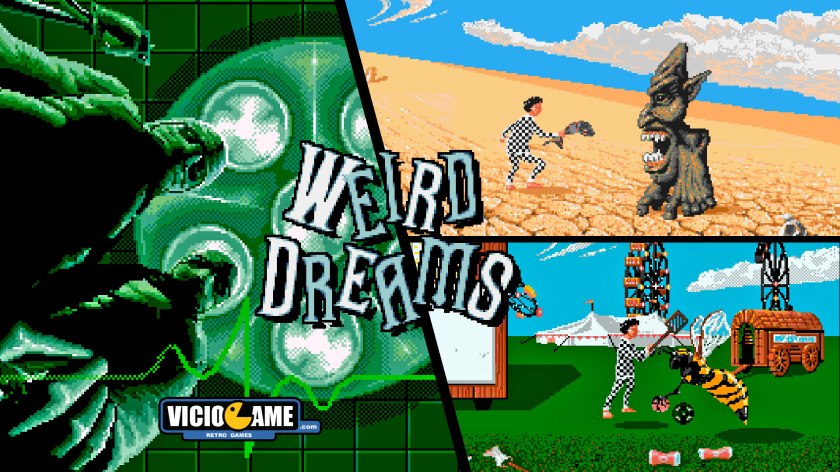
Weird Dreams is a 2D adventure game released in 1989 for the Amiga. After feeling unwell, Steve, takes some pills from a coworker. Unbeknownst to him, she is the host of a demon that chemically alters Steve’s brain, plunging him into a bizarre and surreal dream world.
Developer: Best Ever Games Company
Publisher: Rainbird Software
Release date: 1989
Platform: Commodore Amiga
🇺🇸 Weird Dreams is one of the most singular and unsettling games ever made for the Amiga, and its story begins even before it arrived on Commodore’s computer. The title was developed by the studio Best Ever Games Company and published by Rainbird Software, a Telecomsoft label, originally released for the Atari ST in April 1989, with the Amiga port following in May of the same year. The game was created by James Hutchby and Herman Serrano, with Tony King also credited as co-designer. The music for the Amiga and Atari ST versions was composed by David Whittaker, a veteran composer for the Commodore 64 and Amiga, while Barry Leitch handled the soundtrack for the MS-DOS and Commodore 64 versions.
The game had been planned for release on the Amstrad CPC and the ZX Spectrum as well, but both versions were canceled. Development took over a year, and the final result was something truly unprecedented in the home gaming market of the time. The game’s scenarios are not based on Serrano’s personal nightmares, but were instead inspired by the paintings of Salvador Dalí, Terry Gilliam’s animated sequences for Monty Python, and unusual observations from everyday life. After a visit to the dentist, Serrano developed a phobia of teeth, which is evident in the monster designs — many of them feature mouths full of enormous, threatening teeth.
The game’s backstory is told through one of its most memorable elements: a 64-page, 19-chapter novella written by Rupert Goodwins. Goodwins, a journalist and writer associated with the publication Sinclair User, was invited by the developers to give literary form to the plot they had already conceived. Steve, the protagonist, is in love with a coworker named Emily. What Steve doesn’t know is that Emily is possessed by a demon named Zelloripus, who was banished to Earth, stripped of most of his powers, and imprisoned in the body of a human woman as punishment for unspecified crimes committed against other demons. Emily, bored, sees in Steve an opportunity to make someone suffer. She tricks him into taking three pills she has prepared under the pretense of curing his flu. The pills do cure Steve, but they also grant Zelloripus access to his body and mind. From that point on, Steve’s dreams become increasingly vivid and strange, each one more intense and agonizing than the last. Steve’s psychiatrist can’t explain what’s causing the dreams, and neither can Steve himself. He is then referred to a neurosurgeon. After his condition deteriorates sharply, Steve undergoes brain surgery in an attempt to stop the dreams. Under anesthesia, he slips into yet another dream — possibly his last.
It is exactly where the novella ends that the game begins. Steve is lying on the operating table and slides into the dream world. The player guides Steve through numerous surrealist worlds. He can pick up certain weapons and items throughout the levels, but with few exceptions, cannot carry them into the next one. The novella also served as the game’s copy protection mechanism, as questions about its contents were asked during loading or at certain points in the game — a common practice during the golden age of 8-bit and 16-bit home computers.
The central mechanic of Weird Dreams is built around an unusual and existentially disturbing premise. Steve has no conventional health bar; instead, there is a heart rate monitor that fluctuates between 75 bpm (normal), 100 bpm (in frightening situations), and 170 bpm (just before death). He dies instantly upon contact with any enemy or obstacle. This unforgiving logic — where a single touch ends the protagonist’s life — puts Weird Dreams in the same company as titles like Dragon’s Lair, where progression depends more on memorizing attack patterns and precise timing than on raw reflexes. Steve can also die if he lingers too long in certain areas, such as the Country Garden, where a lawnmower advances and tears him apart.
When Steve dies, the game returns to the operating room scene, where the doctors attempt to revive him. There are no save points in the game, and instead of a score, the player’s progress is indicated as a percentage alongside a timer. The game’s central hub is called the Hall of Mirrors — a corridor of mirrors where each reflection functions as a portal to a different stage. In the Amiga version, the player can run left to the Hall of Mirrors, where five mirrors (two of them temporarily blocked) provide access to the other dream levels. This non-linear structure, unusual for the period, allowed players to choose the order in which they explored the stages, adding an extra layer of depth to the experience. By contrast, in the Commodore 64 version, the player must proceed through the game in a fixed order, to accommodate the loading system.
Everything begins when the game opens with the player crouched inside a gigantic cotton candy machine. As the massive stick spins to gather the cotton candy, the player must jump at exactly the right moment to be lifted out of the drum. Steve must leap at the precise instant to grab the stick without being crushed by it. Once pulled from the drum, he is deposited outside an amusement park, just in time to come face to face with a giant wasp carrying a very useful item — but the wasp has a lethal stinger. The game features bizarre and unconventional activities, including feeding cotton candy to a wasp, clubbing bouncing totem poles using fish that fall from the sky, and an encounter with a roast chicken inside a haunted house.
The cast of enemies is genuinely outlandish: an obese ballerina who spins with surprising agility, rows of killer roses in the garden, and a grinning girl with a ball that bites. There are also totem heads bouncing on kangaroo bodies beneath skies filled with fish, among others. In total, the game features 15 different enemies and challenges, and 7 distinct death animations.
From a technical and visual standpoint, Weird Dreams is widely regarded as one of the most beautiful productions of its era on the Amiga. Programmer James Hutchby and artist Herman Serrano worked together to create environments and characters that impress with their level of detail and the expressive use of the platform’s graphical capabilities. The elaborate visuals stand in sharp contrast to the original Atari ST version.
That said, the criticisms are consistent: the game is slow, both in loading each section and in the movement of the character. The idea was to simulate the feeling of nightmares, where everything moves too slowly and your legs refuse to carry you away from danger. As a gameplay mechanic, however, this makes timing extremely difficult and frustration sets in far too early. Many players lament the difficulty and the awkward controls, even as they acknowledge what the game is trying to achieve as a kind of interactive film.
Weird Dreams received mixed reviews. The One gave it a score of 90%, while ST/Amiga Format rated it 81%, Amiga Action 71%, The Games Machine 64%, Zzap!64 60%, and Computer and Video Games just 31%. The wide gap between scores reflects the divide the game created: those who valued its visual originality and unsettling atmosphere tended to praise it, while those seeking conventional, fluid gameplay came away disappointed.
The game’s ending is deliberately ambiguous and disturbing. After defeating the final boss, Steve wakes up on the operating table — just as he does when he loses a life — except this time the heart rate monitor doesn’t flatline. The surgeon in the lower right corner smiles wildly at the camera while holding a knife. The screen goes black. An evil laugh is then heard before the game abruptly ends, returning the player to the operating system environment. This unsettling conclusion, with no clear resolution, reinforces the feeling that everything may have been just another layer of the nightmare.
A particularly interesting aspect of the game’s history was its appearance on British television. A modified version of Weird Dreams was used as a visual component in a weekly contest on the British children’s TV show MotorMouth, which aired on ITV. Herman Serrano himself acknowledged that the television exposure may have done more harm than good, as the show revealed too many of the game’s secrets and made it seem simpler than it was, while also creating the mistaken impression that it was a quiz-style game. The magazine Computer and Video Games ran a promotion called the “Ooooh What a Nightmare Compo,” in which participants submitted drawings of their worst nightmares to be judged by a professional artist, with winners receiving rubber bath toys shaped like fish and themed T-shirts featuring the game and the MotorMouth show.
There is also a cheat code built into the game. The player must position themselves at the midpoint of the right-hand mirror in the Hall of Mirrors — to the point where Steve appears as a blur — and then enter the Morse code for S.O.S. (three short signals, three long, three short) using a specific key: the “Help” key on the Atari ST and the “+” key on the numeric keypad in MS-DOS. With the cheat activated, pressing that key during any section of a level skips to the next part, and the player respawns immediately at the point of death instead of watching the operating room scene each time. Pressing the key in the Hall of Mirrors deactivates the code.
The Commodore 64 version is often cited as both the easiest and the weakest port, due to its limited graphics and numerous changes, including the replacement of the final cutscene with a simple “Congratulations” screen. The MS-DOS version, meanwhile, was released as early as 1988 — before all other versions — and featured 256-color graphics via VGA and AdLib sound support, making it technically impressive in its own right, though far less remembered than the Amiga version.
Weird Dreams remains a fascinating title from an era when computer games were still figuring out what they could be, without established best practices or proven formulas for success. Its strangeness is neither accidental nor superficial — it stems from a genuine conviction that a game could inhabit the same unsettling territory as Dalí’s surrealism, Gilliam’s dark humor, and nightmare literature. The fact that the game never fully achieved that ideal doesn’t diminish it; if anything, it’s precisely that tension between outsized ambition and imperfect execution that gives it a lasting and inimitable charm. Few games from any era can produce the same sense of genuine disorientation that Weird Dreams delivers within its very first seconds, and it is that quality — the ability to make the player truly feel as though they are trapped inside someone else’s dream — that secures the game a permanent place in the memory of everyone who ever experienced it.
🇧🇷 Weird Dreams é um dos jogos mais singulares e desconcertantes já produzidos para o Amiga, e sua história começa antes mesmo de chegar ao computador da Commodore. O título foi desenvolvido pelo estúdio Best Ever Games Company e publicado pela Rainbird Software, um selo da Telecomsoft, sendo lançado originalmente para o Atari ST em abril de 1989, com o port para o Amiga chegando em maio do mesmo ano. O jogo foi criado por James Hutchby e Herman Serrano, com Tony King também creditado como co-designer. A composição musical para as versões Amiga e Atari ST ficou a cargo de David Whittaker, compositor veterano das plataformas Commodore 64 e Amiga, enquanto Barry Leitch assinou a trilha sonora das versões MS-DOS e Commodore 64.
O jogo foi planejado para ser lançado também no Amstrad CPC e no ZX Spectrum, mas ambas as versões foram canceladas. O processo de desenvolvimento levou mais de um ano, e o resultado final era algo verdadeiramente sem precedentes no mercado de jogos domésticos da época. Os cenários do jogo não são baseados nos pesadelos pessoais de Serrano, mas foram inspirados nas pinturas de Salvador Dalí, nas animações em cartoon de Terry Gilliam para o Monty Python, e em observações inusitadas do cotidiano. Após uma visita ao dentista, Serrano desenvolveu uma fobia de dentes, o que é perceptível no design dos monstros — muitos deles exibem bocas com dentes enormes e ameaçadores.
A narrativa de fundo do jogo é contada por meio de um elemento que se tornou um dos aspectos mais lembrados da obra: uma novela de 64 páginas e 19 capítulos, escrita por Rupert Goodwins. Goodwins, jornalista e escritor ligado à publicação Sinclair User, foi convidado pelos desenvolvedores para dar forma literária ao enredo que eles já haviam concebido. Steve, o protagonista, está apaixonado por uma colega de trabalho chamada Emily. O que Steve não sabe é que Emily é possuída por um demônio chamado Zelloripus, que foi banido para a Terra, despojado da maior parte de seus poderes e aprisionado no corpo de uma mulher humana devido a crimes não especificados cometidos contra outros demônios. Emily, entediada, vê em Steve uma oportunidade de fazer alguém sofrer. Ela o induz a tomar três pílulas que ela misturou sob o pretexto de curar sua gripe. As pílulas de fato curam Steve, mas também concedem a Zelloripus acesso ao seu corpo e à sua mente. A partir daí, os sonhos de Steve se tornam cada vez mais lúcidos e estranhos, cada um mais intenso e doloroso que o anterior. O psiquiatra de Steve não entende o que causa os sonhos, e o próprio Steve tampouco. Ele é então encaminhado a um neurocirurgião. Após seu estado de saúde piorar drasticamente, Steve se submete a uma cirurgia cerebral na tentativa de interromper os sonhos. Sob anestesia, ele mergulha em mais um sonho — possivelmente o último.
É exatamente onde a novela termina que o jogo começa. Steve está deitado na mesa de cirurgia e escorrega para o mundo dos sonhos. O jogador controla Steve por numerosos mundos surrealistas. Ele pode coletar certas armas e itens nesses cenários, mas, com poucas exceções, não pode transportá-los para outro nível. A novela também serviu como mecanismo de proteção de cópia do jogo, já que perguntas sobre seu conteúdo eram feitas durante o carregamento ou em determinados momentos — uma prática comum na era de ouro dos computadores pessoais de 8 e 16 bits.
A mecânica central de Weird Dreams é construída sobre uma premissa incomum e existencialmente perturbadora. Steve não possui um medidor de energia convencional; em vez disso, há um monitor cardíaco que oscila entre 75 bpm (normal), 100 bpm (em situações assustadoras) e 170 bpm (pouco antes da morte). Ele morre imediatamente se entrar em contato com um inimigo ou obstáculo. Essa lógica implacável, onde um único toque fatal já encerra a vida do protagonista, aproxima Weird Dreams de títulos como Dragon’s Lair, em que a progressão depende mais da memorização dos padrões de ataque e de uma precisão absoluta de timing do que de reflexos brutos. Steve pode também morrer se permanecer por tempo excessivo em certas áreas, como no Country Garden, onde um cortador de grama avança e o despedaça.
Quando Steve morre, o jogo retorna à cena na sala de cirurgia, onde os médicos tentam salvá-lo. Não há save points no jogo, e em vez de pontuação, o progresso do jogador é indicado como uma porcentagem e um contador de tempo. O sistema de hub central do jogo é o chamado Hall of Mirrors — um corredor de espelhos onde cada reflexo funciona como portal para uma fase diferente. Na versão Amiga, o jogador pode correr para a esquerda até o Hall of Mirrors, onde cinco espelhos (dois deles temporariamente bloqueados) dão acesso aos demais níveis de sonho. Essa estrutura não linear, incomum para o período, permitia ao jogador escolher em que ordem explorar as fases, o que adiciona uma camada extra de profundidade à experiência. Diferentemente, na versão Commodore 64, o jogador deve percorrer o jogo em uma ordem fixa, para facilitar o carregamento.
Tudo começa quando o jogo abre com o jogador encolhido dentro de uma gigantesca máquina de algodão-doce. Enquanto o imenso palito gira para recolher o algodão, o jogador deve pular no momento certo para ser içado para fora da cuba. Steve deve pular no instante exato para se agarrar ao palito sem ser esmagado por ele. Uma vez içado da cuba, ele é depositado do lado de fora de um parque de diversões, bem a tempo de se deparar com uma gigantesca vespa carregando um objeto muito útil — mas a vespa possui um ferrão letal. O jogo contém atividades bizarras e não convencionais, incluindo alimentar uma vespa com algodão-doce, bater em postes de totem saltitantes usando peixes que caem do céu, e um encontro com um frango assado dentro de uma casa assombrada.
O elenco de inimigos é verdadeiramente extravagante: uma bailarina obesa que realiza piruetas com surpreendente desenvoltura, fileiras de rosas assassinas no jardim, e uma menina sorrindo de forma sinistra com uma bola que morde. Há ainda cabeças de totem pulando em corpos de canguru sob céus repletos de peixes, dentre outros. No total, são 15 inimigos e desafios diferentes, 7 animações de morte distintas.
Do ponto de vista técnico e visual, Weird Dreams é amplamente reconhecido como uma das produções mais belas de seu tempo no Amiga. O programador James Hutchby e o artista Herman Serrano trabalharam juntos para criar cenários e personagens que impressionam pelo nível de detalhe e pelo uso expressivo das capacidades gráficas da plataforma. O visual elaborado destaca-se em relação à versão Atari ST original.
No entanto, as críticas são constantes: o jogo é lento, tanto no carregamento de cada seção do quanto na movimentação do personagem. A ideia era simular a sensação dos pesadelos, onde tudo avança devagar demais e os pés parecem não querer fugir do perigo. Como elemento de jogabilidade, porém, isso torna o timing extremamente difícil e a frustração chega cedo demais. Muitos jogadores lamentam a dificuldade e os controles incômodos, ainda que recoheçam o que o jogo tenta alcançar como uma espécie de filme interativo.
Weird Dreams recebeu avaliações mistas. A publicação The One atribuiu nota 90%, enquanto ST/Amiga Format pontuou em 81%, Amiga Action em 71%, The Games Machine em 64%, Zzap!64 em 60%, e Computer and Video Games em apenas 31%. A discrepância entre as notas reflete bem a divisão que o jogo provocava: quem valorizava a originalidade visual e a atmosfera perturbadora tendia a elogiá-lo, enquanto quem buscava jogabilidade convencional e fluido saía decepcionado.
O desfecho do jogo é propositalmente ambíguo e desconcertante. Após derrotar o chefe final, Steve acorda na mesa de cirurgia como acontece quando perde uma vida, exceto que desta vez o monitor cardíaco não entra em colapso. O cirurgião no canto inferior direito sorri loucamente para a câmera enquanto segura uma faca. A tela fica preta. Em seguida, uma gargalhada maligna é ouvida antes de o jogo ser encerrado abruptamente, devolvendo o jogador ao ambiente do sistema operacional. Essa conclusão perturbadora, sem resolução clara, reforça a sensação de que tudo pode ter sido apenas mais uma camada do pesadelo.
Um aspecto particularmente interessante da trajetória do jogo foi sua aparição na televisão britânica. Uma versão modificada de Weird Dreams foi usada como componente visual de um concurso semanal no programa infantil britânico MotorMouth, exibido na ITV. O próprio Herman Serrano reconhecia que a exposição televisiva pode ter sido mais prejudicial do que benéfica, já que o programa revelava demais os segredos do jogo e o fazia parecer mais simples do que era, além de criar a impressão equivocada de que se tratava de um jogo de perguntas e respostas. A revista Computer and Video Games realizou uma promoção chamada “Ooooh What a Nightmare Compo“, em que os participantes enviavam desenhos de seus piores pesadelos, julgados por um artista profissional, e os vencedores recebiam brinquedos de banho em forma de peixe e camisetas temáticas do jogo e do programa MotorMouth.
Existe também um código de trapaça embutido no jogo. O jogador deve se posicionar na metade do espelho do lado direito no Hall of Mirrors — até o ponto em que Steve parece um borrão — e então inserir o código Morse de S.O.S. (três sinais curtos, três longos, três curtos) usando uma tecla específica do teclado: a tecla “Help” no Atari ST e o “+” do teclado numérico no MS-DOS. Com o cheat ativado, pressionar essa tecla durante qualquer seção de um nível permite pular para a próxima parte, e o jogador respawna imediatamente no ponto de morte em vez de assistir à cena da mesa cirúrgica a cada derrota. Pressionar a tecla no Hall of Mirrors desativa o código.
A versão Commodore 64 é frequentemente apontada como a mais fácil e simultaneamente a pior do jogo, devido aos gráficos limitados e às inúmeras modificações, incluindo a substituição da cutscene final por uma simples tela de “congratulations”. Já a versão MS-DOS foi lançada ainda em 1988, antes de todas as outras, e apresentava gráficos em 256 cores via VGA e suporte a som AdLib, o que a tornava tecnicamente notável por seus próprios méritos, embora menos lembrada do que a versão Amiga.
Weird Dreams permanece como um título fascinante de uma era em que os jogos de computador ainda tentavam descobrir o que podiam ser, sem manuais de boas práticas ou fórmulas de sucesso consolidadas. Sua estranheza não é acidental nem superficial — ela nasce de uma convicção genuína de que o jogo poderia habitar o mesmo território perturbador que o surrealismo de Dalí, o humor negro de Gilliam e a literatura de pesadelo. O fato de o jogo nunca ter alcançado plenamente esse ideal não o diminui; ao contrário, é justamente essa tensão entre ambição descomunal e execução imperfeita que lhe confere um charme duradouro e inimitável. Poucos jogos de qualquer época conseguem provocar a mesma sensação de desorientação genuína que Weird Dreams entrega logo nos primeiros segundos, e é essa qualidade — a de fazer o jogador sentir, de verdade, que está preso dentro de um sonho alheio — que garante ao jogo um lugar permanente na memória de quem um dia o experimentou.
🤑💲Earn money without doing anything! Just leave these apps open:
✓ https://r.honeygain.me/CONTA9DB02
✓ https://packetstream.io/?psr=1uPb
🤑💲1-Click button earns Bitcoin every 1 hour: https://freebitco.in/?r=53528449
⬛ 𝗧𝗶𝗸𝗧𝗼𝗸: https://www.tiktok.com/@viciogame
🟧 𝗜𝗻𝘀𝘁𝗮𝗴𝗿𝗮𝗺: http://www.instagram.com/viciogame
🟥 𝗬𝗼𝘂𝘁𝘂𝗯𝗲: http://www.youtube.com/viciogame
🟦 𝗙𝗮𝗰𝗲𝗯𝗼𝗼𝗸: http://www.facebook.com/viciogame
🔳 𝗧𝗵𝗿𝗲𝗮𝗱𝘀: https://www.threads.net/@viciogame
🟪 𝗧𝘄𝗶𝘁𝗰𝗵: https://www.twitch.tv/ViciogameRetroGames
🟨 𝗕𝗹𝗼𝗴: http://www.viciogameblog.com/
🟦𝗧𝘄𝗶𝘁𝘁𝗲𝗿: http://www.twitter.com/viciogame
#Viciogame #Gameplay #LetsPlay #Playthrough #Games #Gaming #Videogames #Review #Game #Detonado #Walkthrough #Ending #Reviews #Facts #Retro #RetroGaming #Roms #Emulator #Longplay #Speedrun #NoCommentary #WeirdDreams #Amiga #Commodore #A500 #CommodoreAmiga #Atari #AtariST #MsDOS #C64 #Commodore64 #Amstrad #AmstradCPC #ZxSpectrum #DragonsLair
 VICIOGAME