
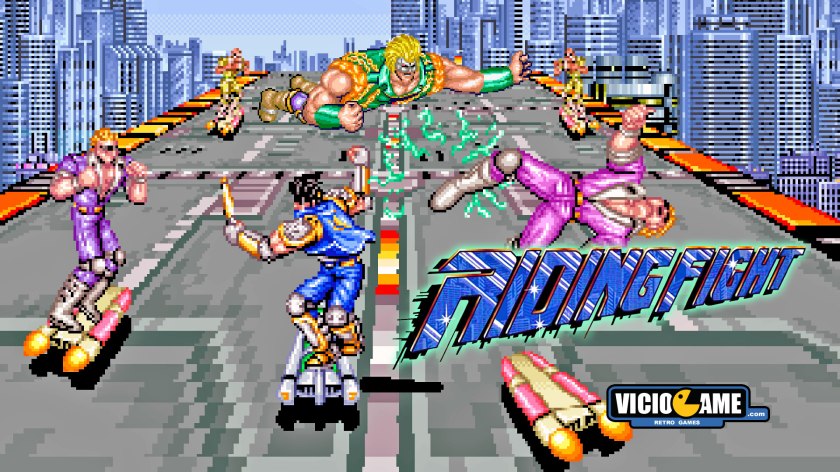
Riding Fight is a game that blends racing and beat ‘em up gameplay, released in 1992 for arcades. Armed with their hoverboards, two bounty hunters take on a criminal organization to rid the city of crime — and collect a hefty reward in return.
Developer/Publisher: Taito Corporation
Release date: 1992
Platform: Arcade Taito F3 System board
🇺🇸 Riding Fight occupies a curious position in arcade history: it is simultaneously a late representative of the golden age of beat ‘em ups and an experience that attempted to fuse two seemingly incompatible genres — the racing game and the classic side-scrolling brawler. The game itself, on its title screen, describes the experience as a “Front View Speed Action Game,” a definition that, while technically accurate, does not immediately reveal the essentially hybrid nature of what it offers the player.
Riding Fight runs on the Taito F3 System hardware, also known by its nickname Cybercore. This board was released by Taito in 1992 and stands out for having most of its games distributed on ROM cartridges that plug into a motherboard — a concept very similar to the Neo Geo or the CPS2. A notable technical characteristic of the system is its physical region scheme: motherboards and game cartridges are region-locked and are not interchangeable between regions, enforced physically by locks on the cartridge connectors, with slots positioned differently depending on the region.
The control scheme consists of an analog dial paired with two buttons: attack and jump. The choice of a dial as the steering mechanism is consistent with the racing component embedded in the game’s design, setting it apart from the purely joystick-based controls adopted by most beat ‘em ups of the era.
The graphical production of Riding Fight was carried out as outsourced work by the companies Natsume and VAP, two Japanese studios with experience in development for arcades and home consoles. The core development and programming, however, were handled by an in-house Taito team identified as Team Revolution — the same team also credited on the unreleased Command War, another title developed for the Taito F3 hardware. The division between in-house programming and outsourced artwork was a relatively common practice in the industry at the time, especially on lower-budget or tight-deadline projects.
The narrative premise of Riding Fight is characteristically unpretentious and typical of the genre. The game casts the player as bounty hunters Burn Bowie (Player 1) or Keith Jager (Player 2), who go up against a criminal organization called Death Serpent. The game displays both protagonists’ biographies with a deadpan seriousness that perfectly reflects the spirit of the era. Burn Bowie is described as a young man from London, gifted with exceptional strength and speed, with a background in rugby — which even serves as his in-game special ability. His “visual power” score is 3.8 Norms, a completely made-up and hilarious unit the game uses to quantify how stylish each character is, where 1 Norm equals an average person in casual clothing. Keith Jager, his partner, scores 2.0 Norms of visual power and has hunting as his special skill — an implicit reference to his surname, since “Jäger” means “hunter” in German. Both protagonists are nods to British rock icons: Burn Bowie is an allusion to David Bowie, and Keith Jager is a mashup of Keith Richards and Mick Jagger.
The characters move continuously away from the camera on their hoverboards, using a sprite-scaling scheme identical to that of perspective racing games, creating the sensation of constant forward movement along a three-dimensional track. The combat component, in turn, draws directly from the playbook of games like Streets of Rage, with one important distinction: the attack system accepts inputs in all eight joystick directions, rather than restricting strikes to the horizontal axis as was standard in conventional beat ‘em ups. The move set includes punch combos, jumping kicks — in which the character lifts the hoverboard and uses it as a weapon — and grabs. There is also the ability to pick up weapons dropped by enemies and use them against other opponents, as well as opportunities to recover health during the game. Since enemies are defeated in a continuously scrolling environment, weapons must be caught mid-air while still in motion, adding an interesting timing element to the combat dynamic.
The racing elements, in practice, function more as moving backdrop than as a standalone game system: there are some sections where the player must dodge obstacles on the track, but the bulk of the experience rests squarely on the combat itself. This design decision is simultaneously the game’s greatest strength and its primary limitation: the fusion creates a visually distinctive and energetic experience, but never fully develops either of the two systems it attempts to combine. The result is a game that impresses in its first few minutes but lacks the combat depth of its direct contemporaries in the beat ‘em up genre. Even so, the freedom to attack in eight directions lends an unusual fluidity to encounters, and the sense of speed provided by the sprite-scaling scroll is genuinely thrilling in its original arcade form.
The game is made up of five stages, each set in a distinct environment that reflects the globetrotting, slightly nonsensical tone of the narrative. The first stage serves as a cinematic opener: the protagonists arrive by helicopter, which is immediately destroyed by a surface-to-air missile, forcing them to leap from the flames directly onto their hoverboards and dive into combat. Subsequent stages take the characters through a variety of settings, including futuristic urban environments, a Middle Eastern-inspired region — where the mid-boss encounter takes place with a character known only as Colonel Abdullah, whose dialogue is marked by grammatical errors and peculiar English expressions that became inadvertently unforgettable — and finally, a secret base located beneath the polar ice cap. The fourth stage is set out at sea, and the range of locations speaks to the team’s narrative ambition, even if the execution proves uneven.
The stage bosses deserve special attention as representatives of the boss design typical of early 1990s arcade games. Abdullah, the Colonel, is an agile boss who jumps frequently, making it difficult for the player to maintain position. The fifth stage saves one of the game’s most impressive moments: a massive mechanical guardian dragon at the polar base, equipped with extendable claws and a flamethrower, which represents the game’s peak difficulty and demands a careful attack rhythm to overcome. The ultimate antagonist of Riding Fight, revealed only at the very end, is the Professor — an international terrorist leader identified only by that title, whose central motivation appears to be kidnapping a young woman for his vast underground fortress. The character is remarkable for the combination of an eccentric design and dialogue that strains for villainous grandeur while ultimately reinforcing the inadvertently comedic tone that permeates the game’s entire narrative.
Riding Fight is considered an extremely rare game, with only one known physical unit documented in the Museum of the Game census. This rarity reflects both the limited distribution the game received at the time and the modest commercial appeal it demonstrated during its brief life in arcades. The Taito F3 hardware in general was less widespread than competing platforms like Capcom’s CPS2 or SNK’s own Neo Geo, which limited the reach of many of its titles in international markets. On top of that, the beat ‘em up segment was in transition in the early 1990s: games like Final Fight, Streets of Rage, and Golden Axe had already set a high bar for the genre, and Riding Fight offered neither the content volume nor the gameplay refinement needed to compete on equal footing with those titles.
Critical reception of the game, even among arcade enthusiasts, hovers around mediocrity — not due to any glaring flaws, but from the perception that its potential was never fully realized. The fusion of racing and beat ‘em up is genuinely innovative as a concept, but the game systems lack the sophistication necessary to sustain the experience. The visuals, while competent by the standards of the era, feature sprites that occasionally exhibit a “visual muddiness” that compromises the clear reading of combat situations. The game’s total running time is short, which, while appropriate to the coin-fed arcade business model, ultimately reduces the impact and memorability of the experience for anyone discovering it today.
Even so, Riding Fight remains a fascinating title from the most inventive and daring era of Japanese arcade gaming. It faithfully captures the spirit of experimentation that Taito demonstrated across many of its early 1990s projects — a period in which the company released titles as varied as Metal Black, Dino Rex, Arabian Magic, and Pu-Li-Ru-La, all within the same window of time.
Riding Fight represents a bold experiment from a relatively small team within a large company, produced during a moment of intense creative energy in the arcade industry, and placed on powerful hardware that the market never adopted as widely as it deserved. Its place in video game history is that of a valuable curiosity — a game that never quite fulfilled its own vision, but that, precisely for that reason, endures as proof of the ambitions, the limitations, and the unintentional charm of an era when innovation was almost an unspoken obligation for any game hoping to earn its spot on the noisy floor of an arcade.
🇧🇷 Riding Fight é uma obra que ocupa uma posição curiosa na história dos fliperamas: é ao mesmo tempo um representante tardio da era dourada dos beat ‘em ups e uma experiência que tentou fundir dois gêneros aparentemente incompatíveis — o jogo de corrida e o clássico jogo de porrada com rolagem lateral. O próprio jogo se autodenomina, na tela de título, como um “Front View Speed Action Game”, uma definição que, embora tecnicamente precisa, não revela de imediato a natureza essencialmente híbrida da experiência que ele oferece ao jogador.
Riding Fight roda no hardware Taito F3 System, também conhecido pelo apelido Cybercore. Esta placa foi lançada pela Taito em 1992 e se destaca por ter a maioria de seus jogos distribuídos em cartuchos ROM plugáveis em uma placa-mãe, em um conceito bastante similar ao do Neo Geo ou do CPS2. Uma característica técnica notória do sistema é seu esquema de região física: as placas-mãe e os cartuchos de jogo são regionalizados e não são intercambiáveis entre regiões, o que é garantido fisicamente por travas nos conectores dos cartuchos, com encaixes em posições distintas dependendo da região.
O sistema de controle é composto por um dial analógico acompanhado de dois botões: ataque e pulo. Essa escolha do dial como mecanismo de direção é coerente com o componente de corrida embutida no design do jogo, diferenciando-o dos controles puramente de joystick adotados pela maioria dos beat ‘em ups da época.
A produção gráfica de Riding Fight foi realizada como trabalho de terceirização pelas empresas Natsume e VAP, duas produtoras japonesas com experiência em desenvolvimento para arcade e consoles domésticos. Já o desenvolvimento e a programação central do jogo foram conduzidos por uma equipe interna da Taito identificada como Team Revolution — a mesma equipe que também aparece creditada no jogo não lançado Command War, outro título desenvolvido para o hardware Taito F3. A divisão entre programação interna e arte terceirizada era uma prática relativamente comum na indústria da época, especialmente em projetos de menor orçamento ou com prazos apertados.
A premissa narrativa de Riding Fight é caracteristicamente despretensiosa e típica do gênero. O jogo coloca o jogador no papel dos caçadores de recompensas Burn Bowie (jogador 1) ou Keith Jager (jogador 2), que enfrentam a organização criminosa chamada Death Serpent. O jogo exibe as biografias dos dois protagonistas com uma seriedade cômica que reflete bem o espírito da época. Burn Bowie é descrito como um jovem de Londres, dotado de força e velocidade excepcionais, com passado no rugby — que serve inclusive como sua habilidade especial dentro do jogo. Sua pontuação de “visual power” é de 3.8 Norms, uma medida absolutamente inventada e hilária que o jogo usa para quantificar o quão “estiloso” é cada personagem, onde 1 Norm equivale a uma pessoa comum em roupas casuais. Keith Jager, o parceiro, soma 2.0 Norms de visual power e tem como habilidade especial a caça, em uma referência implícita ao sobrenome Jager, que em alemão significa “caçador”. Os protagonistas fazem referência a ícones do rock britânico: Burn Bowie é uma alusão a David Bowie, e Keith Jager uma fusão de Keith Richards e Mick Jagger.
Os personagens se movem constantemente para longe com seus hoverboards, em um esquema de escalonamento de sprites idêntico ao dos jogos de corrida em perspectiva, criando a sensação de avanço contínuo sobre uma pista tridimensional. O componente de combate, por sua vez, vem diretamente do repertório de jogos como Streets of Rage, com uma distinção importante: o sistema de ataque aceita entradas em todas as oito direções do joystick, em vez de restringir os golpes à horizontal como era padrão nos beat ‘em ups convencionais. O arsenal de movimentos inclui combos de soco, chutes saltados — em que o personagem ergue o hoverboard e o usa como arma —, e agarrões. Há ainda a possibilidade de usar armas derrubadas pelos inimigos para atacar outros adversários, e de recuperar energia durante o jogo. Como os inimigos são derrotados em um cenário que rola continuamente, as armas precisam ser capturadas no ar enquanto ainda estão em movimento, o que adiciona um elemento de timing interessante à dinâmica de combate.
Os elementos de corrida, na prática, funcionam mais como cenário em movimento do que como um sistema de jogo independente: há algumas seções em que o jogador precisa desviar de obstáculos na pista, mas o peso maior da experiência recai sobre o combate em si. Essa decisão de design é ao mesmo tempo o ponto forte e a principal limitação do jogo: a fusão cria uma experiência visualmente distinta e energética, mas nunca desenvolve plenamente nenhum dos dois sistemas que tenta unir. O resultado é um jogo que impressiona pelos primeiros minutos, mas que carece da profundidade de combate de seus contemporâneos diretos no gênero beat ‘em up. Ainda assim, a liberdade de atacar em oito direções confere uma fluidez incomum aos confrontos, e a sensação de velocidade proporcionada pelo scroll de escalonamento de sprites é genuinamente emocionante em sua versão original de arcade.
O jogo é composto por cinco fases, cada uma ambientada em um cenário distinto que reflete o tom globetrotting e levemente nonsense da narrativa. A primeira fase funciona como abertura cinematográfica: os protagonistas chegam de helicóptero, que é imediatamente destruído por um míssil terra-ar, forçando-os a saltar das chamas diretamente sobre seus hoverboards e iniciar o combate. As fases subsequentes levam os personagens por ambientes variados, incluindo cenários urbanos futuristas, uma região de inspiração árabe — onde ocorre o encontro com o boss intermediário conhecido apenas como Colonel Abdullah, cujos diálogos são marcados por erros gramaticais e expressões peculiares em inglês que se tornaram inadvertidamente inesquecíveis — e, finalmente, uma base secreta localizada sob a calota polar. A quarta fase tem como cenário o mar aberto, e o conjunto de locações demonstra a ambição narrativa da equipe, mesmo que a execução se mostre irregular.
Os chefes de fase merecem atenção especial como representantes do design de bosses característico dos arcades de início dos anos 1990. Abdullah, o Colonel, é um chefe ágil que salta com frequência, dificultando o posicionamento do jogador. A quinta fase reserva um dos momentos mais impressionantes do jogo: um enorme dragão mecânico guardião da base polar, equipado com garras extensíveis e lança-chamas, que representa o pico de dificuldade do jogo e exige um ritmo cuidadoso de ataque para ser superado. O antagonista máximo de Riding Fight, revelado somente ao final, é o Professor — um líder terrorista internacional identificado apenas por esse título, cuja motivação central parece ser a de raptar uma jovem para sua vasta fortaleza subterrânea. O personagem é incrível pela combinação de visual excêntrico e diálogos que tentam transmitir grandiosidade vilã, mas acabam por reforçar o tom involuntariamente cômico que permeia toda a narrativa do jogo.
Riding Fight é considerado um jogo extremamente raro, com apenas um exemplar físico conhecido documentado no censo do Museum of the Game. Essa raridade é reflexo tanto da distribuição limitada que o jogo recebeu à época quanto do apelo comercial modesto que apresentou durante sua breve vida nos fliperamas. O hardware Taito F3 em geral era menos difundido do que plataformas concorrentes como o CPS2 da Capcom ou o próprio Neo Geo da SNK, o que limitou a penetração de muitos de seus títulos em território internacional. Além disso, o segmento de beat ‘em ups estava em transição no início dos anos 1990: jogos como Final Fight, Streets of Rage e Golden Axe já tinham estabelecido um padrão elevado para o gênero, e Riding Fight não oferecia volume de conteúdo ou refinamento de jogabilidade suficientes para competir de igual para igual com esses títulos.
A recepção crítica do jogo, mesmo entre entusiastas de arcade, situa-se em torno da mediocridade — não por falhas graves, mas pela percepção de que seu potencial nunca foi completamente realizado. A fusão entre corrida e beat ‘em up é genuinamente inovadora como conceito, mas os sistemas de jogo carecem da sofisticação necessária para sustentar a experiência. O visual, embora competente para os padrões da época, contém sprites que apresentam ocasionalmente uma “névoa visual” que compromete a leitura precisa das situações de combate. A duração total do jogo é curta, o que, se por um lado é adequado ao modelo de negócios do arcade baseado em fichas, por outro reduz o impacto e a memorabilidade da experiência para quem o descobre hoje.
Ainda assim, Riding Fight permanece como um título fascinante da era mais inventiva e ousada do arcade japonês. Ele captura com fidelidade o espírito de experimentação que a Taito demonstrou em vários de seus projetos de início dos anos 1990 — período em que a empresa lançou títulos tão variados quanto Metal Black, Dino Rex, Arabian Magic e Pu-Li-Ru-La, todos no mesmo espaço de tempo.
Riding Fight representa um experimento corajoso de uma equipe relativamente pequena dentro de uma grande empresa, produzido em um momento de intensa efervescência criativa na indústria de fliperamas e colocado em um hardware poderoso que o mercado não adotou tão amplamente quanto merecia. Seu lugar na história dos jogos eletrônicos é o de uma curiosidade valiosa — um jogo que não chegou a realizar plenamente sua visão, mas que, precisamente por isso, permanece como prova das ambições, dos limites e do charme involuntário de uma época em que inovar era quase uma obrigação implícita de qualquer jogo que quisesse conquistar um espaço no ruidoso salão de um arcade.
🤑💲Earn money without doing anything! Just leave these apps open:
✓ https://r.honeygain.me/CONTA9DB02
✓ https://packetstream.io/?psr=1uPb
🤑💲1-Click button earns Bitcoin every 1 hour: https://freebitco.in/?r=53528449
⬛ 𝗧𝗶𝗸𝗧𝗼𝗸: https://www.tiktok.com/@viciogame
🟧 𝗜𝗻𝘀𝘁𝗮𝗴𝗿𝗮𝗺: http://www.instagram.com/viciogame
🟥 𝗬𝗼𝘂𝘁𝘂𝗯𝗲: http://www.youtube.com/viciogame
🟦 𝗙𝗮𝗰𝗲𝗯𝗼𝗼𝗸: http://www.facebook.com/viciogame
🔳 𝗧𝗵𝗿𝗲𝗮𝗱𝘀: https://www.threads.net/@viciogame
🟪 𝗧𝘄𝗶𝘁𝗰𝗵: https://www.twitch.tv/ViciogameRetroGames
🟨 𝗕𝗹𝗼𝗴: http://www.viciogameblog.com/
🟦𝗧𝘄𝗶𝘁𝘁𝗲𝗿: http://www.twitter.com/viciogame
#Viciogame #Gameplay #LetsPlay #Playthrough #Games #Gaming #Videogames #Review #Game #Detonado #Walkthrough #Ending #Reviews #Facts #Retro #RetroGaming #Roms #Emulator #Longplay #Speedrun #NoCommentary #RidingFight #arcade #Taito #race #racing #racer #fight #fighter #fighting #finalfight #goldenaxe #streetsofrage #moto #motorcycle #motogp #ski #hoverboard #jetski #surf #motorbike #bike #roadrash
 VICIOGAME