
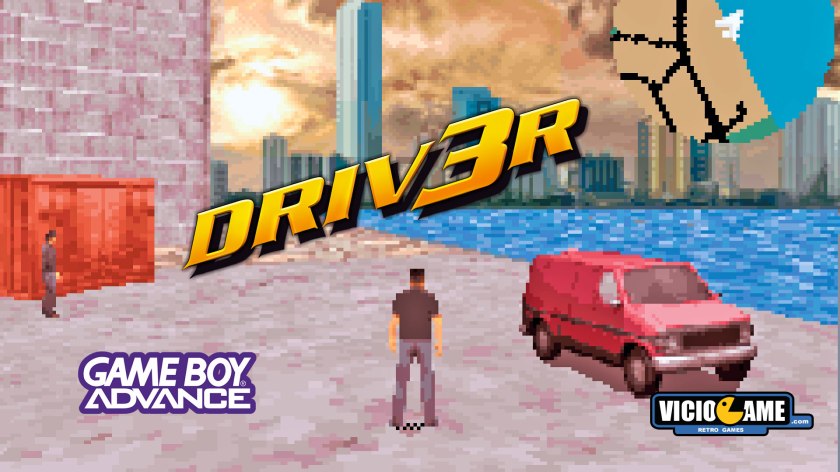
Driv3r (also known as Driver 3) is a 3D game blending action, racing, and third-person shooting, released in 2005 for the Game Boy Advance. You play as Tanner, an undercover cop who infiltrates a car theft ring by posing as a getaway driver — all in pursuit of the mastermind pulling the strings behind the operation.
Developer: Velez & Dubail
Publisher: Atari
Release date: 2005
Platform: Game Boy Advance (GBA)
🇺🇸 DRIV3R for Game Boy Advance is one of the most technically ambitious and simultaneously most curious titles ever released for Nintendo’s handheld, occupying a singular place in the history of portable gaming. Developed by the duo Velez & Dubail and published by Atari, the Game Boy Advance version launched in the United Kingdom on October 14, 2005, in North America on October 25, 2005, and in Australia on October 28 of that same year — more than a year after the original title had arrived on home consoles. This is an adaptation that not only sought to bring the experience of the PlayStation 2 and Xbox to a radically inferior hardware platform, but ultimately became a genuinely impressive technical showcase, albeit one accompanied by serious design shortcomings.
To appreciate the weight of this release, it is necessary to understand the trajectory of the series and the state of the portable market in 2005. Driver 3, officially stylized as DRIV3R, is the third entry in the Driver franchise, whose story follows John Tanner, an undercover FBI agent, as he investigates a car theft and smuggling ring spanning three countries, attempting to identify and arrest the organization’s ringleader and uncover who the stolen cars were being sold to. The original version was developed by Reflections Interactive and received mixed reviews, with many critics accusing Atari of rushing the release to avoid competing with Grand Theft Auto: San Andreas in the same year. By the time Atari decided to bring the title to the Game Boy Advance, Nintendo’s hardware was already visibly in the twilight of its lifespan: the Nintendo DS, with its dual screens, had already hit the market, and few developers were still betting on pushing the limits of the 32-bit handheld’s ARM7 processor.
Fernando Velez and Guillaume Dubail, the two developers behind the game — a duo that would later become known as VD-dev — already had a strong track record of squeezing exceptional graphical performance out of the Game Boy Advance. Games like V-Rally 3 and Stuntman, produced by them, feature some of the best graphics ever seen on the GBA, and that wealth of technical expertise was fully channeled into DRIV3R. The two are also responsible for Asterix & Obelix XXL for the same console, and would later create C.O.P.: The Recruit for the Nintendo DS, cementing their reputation as developers who can get the absolute most out of portable hardware.
The most impressive aspect is, without a doubt, the three-dimensional graphics engine employed. Unlike many games that relied on fake 3D effects such as Mode-7, typical of the Super Nintendo, Driver 3 features a true three-dimensional environment with polygonal world geometry. Everything that is not world geometry — that is, vehicles, characters, and most dynamic elements — is rendered as sprites, but the city itself is built from real polygons. The 3D engine even supports elevation in terrain, meaning not all streets are flat, something that was absent from Driver 2 Advance. Buildings vary in height and color, cars travel through the streets creating the illusion of a living city, and the overall result represents an enormous leap forward compared to what had been attempted previously with the series on the handheld.
Throughout the main mode, the player travels across two cities — Miami and Nice — which can be freely explored in a 3D open environment, with hidden packages to find and side racing missions to complete. The third city present in the console version, Istanbul, was cut. Despite this reduction in scope, the two available cities offer a reasonable density of content and preserve the open-world premise that has always defined the Driver series. Each city features over 30 miles of roads and streets to explore, which is a considerable area for such a small console.
The main mode, called Undercover, consists of 25 missions covering a variety of objectives. Mission types include armed pursuit, interception, destruction and recovery, escape, takedown, and VIP escort. The game saves automatically after completing each story mission, though it also allows for manual saves.
The available arsenal includes 7 different weapons, including pistols, shotguns, and assault rifles. Progression rewards the player with better weapons as driving mini-games are completed: finishing all of Nice’s Slaloms, for example, earns a submachine gun, while completing Miami’s Checkpoints delivers a semi-automatic pistol, and Nice’s Checkpoints grant a heavy rifle. Enemies become progressively tougher as the game advances: in early stages they go down in two hits, while in later stages they may require up to four.
The game’s vehicle roster includes 25 options, among them performance cars, trucks, and motorcycles. The sense of speed is satisfying, especially in the fastest vehicles such as motorcycles and sports cars. The player can exit their vehicle at any time, switch cars, or move on foot for gunfight segments. There are specific sections where the focus shifts to on-foot combat, with enemies that must be chased down and eliminated.
Beyond the Undercover mode, the game offers a series of driving mini-games spread across both cities. Slalom mode requires the player to pass through all gates in the shortest time possible: each successful pass adds one second to the timer, while breaking a gate removes two seconds, and ignoring a gate too long causes an automatic failure. In Miami, the progression ranges from 50 to 98 gates with increasing time limits; in Nice, the structure is similar but with different time caps. Checkpoint mode requires the player to pass through waypoints within a time limit, with between 5 and 10 checkpoints depending on the stage and city. There are also Trailblazer and Destruction modes, additional variations that round out the challenge package.
There are 32 collectible items and objectives in each city, offering an incentive to explore beyond the linear missions. In Miami, for example, there are 16 kiosks that can be destroyed as part of the collectibles tied to the character Calita. These elements reward the player with useful bonuses, making exploration not just optional but strategically worthwhile.
The game’s story follows the general structure of the console version, but is presented in a more condensed form. The opening sequence shows Tanner facing his imminent death before flashing back six months to the beginning of events, serving as an effective dramatic hook. Throughout the game, the story is conveyed through static images and text-based dialogue. The main villain is Jericho, with whom Tanner has a final shootout at the game’s climax after chasing him across the city. Unused text found in the game’s code reveals that narrative recaps were planned to appear when loading a save, such as the line “NICE IS A TOWN FULL OF RUMOURS. THANKS TO A SNITCH, THEY FIND JERICHO. TANNER CHASES HIM ACROSS TOWN” — text that never made it into the final release.
The game’s code also contains text indicating that enemies called “Tommys” were planned at some point during development, with lines such as “I GOT TO FIND THE 4 REMAINING TOMMYS AND WASTE THEM” and “THIS TOWN IS OFFICIALLY TOMMY-FREE.” This unused content connects to one of the series’ most well-known easter eggs: the character Timmy Vermicelli is a parody of Tommy Vercetti, the protagonist of GTA Vice City, created as a dig at Rockstar Games, who had mocked John Tanner in Grand Theft Auto 3 and Vice City. The character wears jeans and a Hawaiian shirt to mimic Vercetti, but sports inflatable swimming armbands as a jab at Tommy Vercetti’s inability to swim in Vice City, along with pink sneakers.
From a technical standpoint, the game has some unavoidable limitations. The draw distance is quite short, which can make it difficult to track other vehicles during chase missions, as the target can quickly disappear from view. The 3D engine also experiences occasional frame rate drops, with brief stutters that, while not game-breaking, are noticeable. Texture popping and polygon aliasing are visible. Enemy AI is inconsistent, and there are bugs and glitches that can derail specific missions.
The game’s difficulty is notoriously high. The mission design is unforgiving: a collision with a car that rendered closer than expected can ruin a chase mission that offers no mid-mission checkpoints. On-foot combat segments demand precise aiming and strict ammo conservation. When the player fails a mission, checkpoints allow restarting from certain points — except when the car falls into water, which results in a complete failure.
Critical reception of DRIV3R on the Game Boy Advance was, broadly speaking, appreciative of the technical achievement, though with reservations about the execution. The previous entry in the series on the handheld, Driver 2 Advance, had received a mixed reception: some critics valued the effort within the hardware’s limitations, while others felt it was too ambitious to attempt a mission-based driving game on a portable device. DRIV3R technically surpassed its predecessor in nearly every respect, but carried with it the sins of overly rigid design. The driving itself is considered solid and fun, especially during chase sequences, but the on-foot sections are seen as clunky and frustrating. Certain bugs can break the story mode, making attempts to complete Undercover more difficult than they should be.
As a technical showcase, only unreleased prototypes have pushed the system further than this game managed. At the same time, Velez and Guillaume Dubail proved that Nintendo’s portable hardware harbored untapped potential that other developers simply could not be bothered to explore — especially at a time when the market had already turned its attention to the Nintendo DS.
The legacy of DRIV3R is therefore paradoxical and fascinating: it is at once a title that failed to win over critics with the same force it impressed technically, and a genuine historical artifact demonstrating what was achievable with determination and skill on hardware the world had all but written off. Whether in the car chases through the virtual streets of Miami or the alleyways of Nice, this remains an unforgettable chapter in the history of portable gaming — a testament to the creative commitment of two developers who refused to accept the limits of what was possible.
🇧🇷 DRIV3R para Game Boy Advance é um dos títulos mais tecnicamente ambiciosos e ao mesmo tempo mais curiosos já lançados para o portátil da Nintendo, ocupando um lugar singular na história dos jogos para plataformas portáteis. Desenvolvido pela dupla Velez & Dubail e publicado pela Atari, a versão para Game Boy Advance foi lançada no Reino Unido em 14 de outubro de 2005, na América do Norte em 25 de outubro de 2005 e na Austrália em 28 de outubro desse mesmo ano — ou seja, mais de um ano após o título original ter chegado aos consoles domésticos. Trata-se de uma adaptação que não apenas buscou transportar a experiência do PlayStation 2 e do Xbox para um hardware radicalmente inferior, mas que acabou por se tornar uma demonstração técnica genuinamente impressionante, ainda que acompanhada de sérias limitações de design.
Para compreender o peso desse lançamento, é necessário contextualizar a trajetória da série e o estado do mercado portátil em 2005. Driver 3, estilizado oficialmente como DRIV3R, é o terceiro capítulo da franquia Driver, cujo enredo acompanha John Tanner, um agente encoberto do FBI, enquanto ele investiga um esquema de roubo e contrabando de automóveis em três países, tentando identificar e prender o chefe da organização e descobrir para quem os carros roubados seriam vendidos. A versão original foi desenvolvida pela Reflections Interactive e recebeu críticas mistas, com muitos críticos acusando a Atari de ter apressado o lançamento para evitar competir com Grand Theft Auto: San Andreas no mesmo ano. Quando a Atari decidiu levar o título ao Game Boy Advance, o hardware da Nintendo já estava visivelmente na fase crepuscular de sua vida útil: o Nintendo DS, com suas duas telas, já havia chegado ao mercado, e poucos desenvolvedores ainda apostavam em empurrar os limites do processador ARM7 da plataforma portátil de 32 bits.
Fernando Velez e Guillaume Dubail, os dois responsáveis pela criação do jogo — duo que posteriormente passaria a ser conhecido como VD-dev — já tinham um histórico sólido de extrair desempenho gráfico excepcional do Game Boy Advance. Jogos como V-Rally 3 e Stuntman produzidos por eles exibem alguns dos melhores gráficos já vistos no GBA, e esse repertório de expertise técnica foi inteiramente canalizado para DRIV3R. Os dois também são responsáveis por Asterix & Obelix XXL para o mesmo console, e mais tarde criariam C.O.P.: The Recruit para o Nintendo DS, consolidando sua reputação de desenvolvedores que conseguem o máximo de hardware portátil.
O aspecto mais impressionante é, sem dúvida, o motor gráfico tridimensional empregado. Ao contrário de muitos jogos que recorriam a efeitos fake 3D como o Mode-7, típico do Super Nintendo, Driver 3 apresenta um verdadeiro ambiente tridimensional com geometria de mundo poligonal. Tudo o que não é geometria do mundo — ou seja, os veículos, os personagens e boa parte dos elementos dinâmicos — é representado como sprites, mas a cidade em si é construída em polígonos reais. O motor 3D suporta inclusive terreno com elevações, de modo que nem todas as ruas são planas, algo que não existia em Driver 2 Advance. As edificações variam em altura e cor, os carros circulam pelas ruas criando a ilusão de uma cidade viva, e o conjunto representa um salto enorme em relação ao que havia sido tentado anteriormente com a série no portátil.
Ao longo do modo principal, o jogador percorre duas cidades — Miami e Nice — que podem ser exploradas livremente em ambiente 3D, com pacotes escondidos para encontrar e missões secundárias de corrida para completar. A terceira cidade presente na versão de consoles, Istanbul, foi cortada. Apesar dessa redução de escopo, as duas cidades disponíveis apresentam uma densidade razoável de conteúdo e mantêm a proposta de open-world que sempre definiu a série Driver. Cada cidade oferece mais de 30 milhas de estradas e ruas para exploração, o que é uma área considerável para o pequeno console.
O modo principal, chamado de Undercover, é composto por 25 missões, que cobrem objetivos variados. Os tipos de missão incluem perseguição armada, interceptação, destruição e recuperação, fuga, abordagem e neutralização e escolta de VIP. O jogo salva automaticamente após a conclusão de cada missão de história, embora também permita salvar manualmente.
O arsenal disponível conta com 7 armas diferentes, incluindo pistolas, espingardas e fuzis de assalto. A progressão no jogo recompensa o jogador com armas melhores à medida que os mini-games de direção são concluídos: completar todos os Slaloms de Nice, por exemplo, rende uma submetralhadora, enquanto os Checkpoints de Miami resultam na entrega de uma pistola semi-automática, e os Checkpoints de Nice concedem um fuzil pesado. Os inimigos ficam progressivamente mais resistentes conforme o jogo avança: nas fases iniciais eles caem com dois acertos, enquanto nos estágios mais avançados podem exigir até quatro.
A frota de veículos do jogo conta com 25 opções, entre carros de desempenho, caminhões e motocicletas. A sensação de velocidade é satisfatória, especialmente nos veículos mais rápidos como as motocicletas e os carros esportivos. O jogador pode deixar seu veículo a qualquer momento, trocar de carro ou se movimentar a pé para confrontos armados. Há segmentos específicos em que o foco recai sobre combates a pé, com inimigos que precisam ser perseguidos e eliminados.
Além do modo Undercover, o jogo oferece uma série de mini-games de direção distribuídos pelas duas cidades. O modo Slalom exige que o jogador passe por todos os portões no menor tempo possível: cada passagem bem-sucedida acrescenta um segundo ao cronômetro, enquanto quebrar um portão retira dois segundos, e ignorar um portão por tempo demais causa falha automática. Em Miami, a progressão vai de 50 a 98 portões com limites de tempo crescentes; em Nice, a estrutura é similar mas com limites de tempo distintos. O modo Checkpoint exige que o jogador passe por pontos de verificação dentro de um limite de tempo, com entre 5 e 10 checkpoints dependendo da etapa e da cidade. Há também os modos Trailblazer e Destruction, variações adicionais que complementam o pacote de desafios.
Há 32 itens coletáveis e objetivos em cada cidade, o que oferece um incentivo para a exploração além das missões lineares. Em Miami, por exemplo, há 16 kiosques que podem ser destruídos como parte dos coletáveis relacionados à personagem Calita. Esses elementos recompensam o jogador com bônus úteis, tornando a exploração não apenas opcional mas estrategicamente vantajosa.
A narrativa do jogo segue a estrutura geral da versão de consoles, mas é apresentada de forma mais condensada. A sequência de abertura mostra Tanner diante de sua iminente morte, voltando seis meses no tempo para o início dos eventos, o que funciona como um gancho dramático eficaz. Ao longo do jogo, a história é comunicada por meio de imagens estáticas e diálogos em texto. O vilão principal é Jericho, com quem Tanner tem um confronto final de tiros no clímax do jogo, depois de persegui-lo pela cidade. Textos não utilizados encontrados no código do jogo revelam que havia planos para recapitulações narrativas ao carregar um save, como a frase “Nice é uma cidade cheia de rumores. Graças a um informante, eles encontram Jericho. Tanner o persegue pela cidade“, textos esses que jamais chegaram a aparecer para o jogador na versão final.
O código do jogo também contém textos que indicam que inimigos chamados de “Tommys” chegaram a ser planejados para o jogo em algum momento do desenvolvimento, com frases como “Preciso encontrar os 4 Tommys restantes e eliminá-los.” e “Esta cidade está oficialmente livre dos Tommys“. Esses conteúdos não utilizados conectam-se ao famoso easter egg da série: o personagem Timmy Vermicelli é uma paródia de Tommy Vercetti, protagonista de GTA Vice City, criado como uma provocação à Rockstar Games, que havia feito piada com John Tanner em Grand Theft Auto 3 e Vice City. O personagem usa jeans e uma camisa havaiana para imitar Vercetti, mas usa braçadeiras infláveis de natação nos braços como deboche à incapacidade de Tommy Vercetti de nadar em Vice City, além de tênis cor-de-rosa.
Do ponto de vista técnico, o jogo apresenta algumas limitações inevitáveis. A distância de renderização é bastante curta, o que pode dificultar o rastreamento de outros veículos em missões de perseguição, pois o alvo pode sumir do campo visual com rapidez. O motor 3D também sofre ocasionais quedas de frame rate, com pausas breves que, embora não destruam a jogabilidade, são perceptíveis. Problemas de texture popping e de suavização de polígonos são visíveis. A inteligência artificial dos inimigos é inconsistente, e há bugs e glitches que podem comprometer missões específicas.
A dificuldade do jogo é notoriamente elevada. O design de missões não perdoa erros: uma colisão com um carro que renderizou mais perto do que o esperado pode arruinar uma missão de perseguição que não conta com checkpoints intermediários. Os segmentos de combate a pé exigem precisão na mira e economia rigorosa de munição. Quando o jogador falha em uma missão, há checkpoints para reiniciar a partir de certos pontos — exceto quando o carro cai na água, o que resulta em falha total.
A recepção crítica do DRIV3R no Game Boy Advance foi, no geral, reconhecedora do feito técnico, ainda que com ressalvas sobre a execução. A versão anterior da série no handheld, Driver 2 Advance, havia recebido uma recepção mista: alguns críticos valorizaram o esforço dentro das limitações do hardware, enquanto outros consideravam ambicioso demais tentar um jogo de missões baseado em direção no portátil. DRIV3R superou tecnicamente esse predecessor em quase todos os aspectos, mas carregou consigo os pecados do design excessivamente rígido. A condução em si é considerada sólida e divertida, especialmente durante as perseguições, mas as seções a pé são vistas como truncadas e frustrantes. Algumas falhas podem arruinar o modo história, tornando as tentativas de concluir o modo Undercover mais difíceis do que deveriam ser.
Como demonstração das capacidades técnicas, apenas protótipos não lançados chegaram a empurrar o sistema ainda mais longe do que esse jogo conseguiu. Ao mesmo tempo, Velez e Guillaume Dubail provaram que o hardware portátil da Nintendo guardava um potencial inexplorado que outros desenvolvedores simplesmente não se deram ao trabalho de aproveitar, especialmente num momento em que o mercado já havia virado sua atenção para o Nintendo DS.
O legado de DRIV3R é, portanto, paradoxal e fascinante: é ao mesmo tempo um título que falhou em conquistar a crítica com a mesma força que impressionou tecnicamente, e uma peça histórica genuína que demonstra o que era possível realizar com determinação e habilidade em um hardware que o mundo havia praticamente descartado. Seja nas perseguições de carro pelas ruas virtuais de Miami ou nos becos de Nice, este permanece como um capítulo inesquecível da história dos jogos portáteis — uma homenagem ao engajamento criativo de dois desenvolvedores que se recusaram a aceitar os limites do possível.
🤑💲Earn money without doing anything! Just leave these apps open:
✓ https://r.honeygain.me/CONTA9DB02
✓ https://packetstream.io/?psr=1uPb
🤑💲1-Click button earns Bitcoin every 1 hour: https://freebitco.in/?r=53528449
⬛ 𝗧𝗶𝗸𝗧𝗼𝗸: https://www.tiktok.com/@viciogame
🟧 𝗜𝗻𝘀𝘁𝗮𝗴𝗿𝗮𝗺: http://www.instagram.com/viciogame
🟥 𝗬𝗼𝘂𝘁𝘂𝗯𝗲: http://www.youtube.com/viciogame
🟦 𝗙𝗮𝗰𝗲𝗯𝗼𝗼𝗸: http://www.facebook.com/viciogame
🔳 𝗧𝗵𝗿𝗲𝗮𝗱𝘀: https://www.threads.net/@viciogame
🟪 𝗧𝘄𝗶𝘁𝗰𝗵: https://www.twitch.tv/ViciogameRetroGames
🟨 𝗕𝗹𝗼𝗴: http://www.viciogameblog.com/
🟦𝗧𝘄𝗶𝘁𝘁𝗲𝗿: http://www.twitter.com/viciogame
#Viciogame #Gameplay #LetsPlay #Playthrough #Games #Gaming #Videogames #Review #Game #Detonado #Walkthrough #Ending #Reviews #Facts #Retro #RetroGaming #Roms #Emulator #Longplay #Speedrun #NoCommentary #Driv3r #Driver3 #GameBoyAdvance #GBA #Nintendo #Driver #极道车魂3 #PlayStation #PSX #PsOne #极道车魂 #PS #PS1 #PS2 #PS3 #PS4 #PS5 #PS6 #GTA #GTAV #GTA5 #GTA6 #Driver2 #Atari #crimsondesert #ゲームボーイアドバンス #任天堂

