
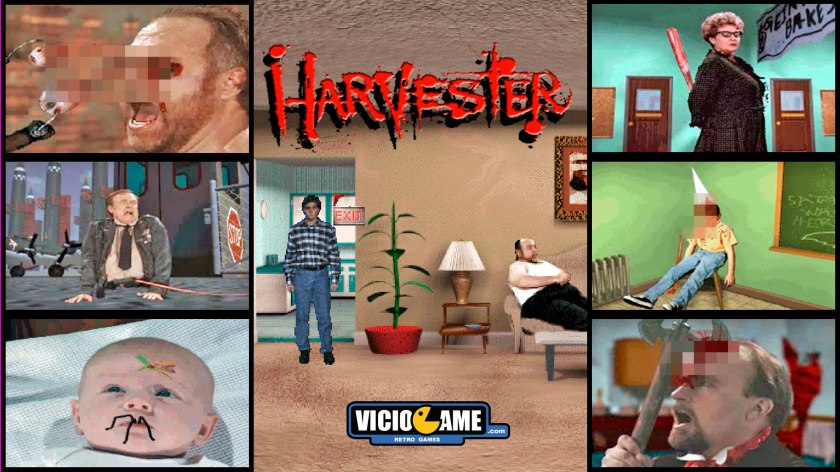
Harvester is a point-and-click adventure game featuring live-action FMV footage with real actors, released in 1996 for MS-DOS PCs. It stands as one of the most disturbing games in history, boldly confronting players with taboo subjects and forcing them to reflect on how far video game violence can bleed into real life.
Developer: DigiFX Interactive
Publisher: Merit Studios
Release: 1996
Platform: PC MS-DOS
🇺🇸 Harvester is one of the most controversial computer games ever made — a work that defies categorization and that, three decades after its release, still sparks heated debates about the limits of interactive art, the nature of violence in games, and the capacity to influence real-world behavior in players. Developed by the Texas-based studio DigiFX Interactive — which still went by the name FutureVision when the project was conceived — and published by Merit Studios, the game was announced to the world in January 1994 at the Consumer Electronics Show (CES) in Las Vegas, where it was presented to the public with the ambitious promise of being “the most violent point-and-click game of all time.” That declaration was no empty marketing: it would truly deliver on its promise, and then some, exceeding the expectations of anyone who dares to enter the fictional town of Harvest.
The game’s creative vision is entirely the work of Gilbert P. Austin, who is credited as the game’s writer and director. According to Austin himself, the central idea for Harvester came to him suddenly and almost fully formed; he jotted it down in a reporter’s notebook in roughly thirty minutes — including the philosophical concept behind the game, its main ending, and the ambition to make players, upon finishing the experience, reflect on whether they had internalized the game’s violence in the same way as the protagonist. Austin described his vision as a “high concept” that a small company like FutureVision could use to compete with the major studios of the era. Although originally hired solely as a writer, Austin volunteered to direct the filming of the live-action sequences, insisting on being present to ensure his vision was preserved intact. All filmed material was shot in the back warehouse of publisher Merit Software itself, with real actors captured in front of green screens in a production process that was, by the standards of the time, genuinely ambitious.
The project’s total budget was one million dollars, and the game was promoted with impressive specs: three CD-ROMs of content, more than 180 locations to explore, a full soundtrack in 16-bit CD quality, over 100 unique characters to interact with, 20 exclusively filmed combat moves, and a dynamic dialogue system with more than 12,000 recorded lines of dialogue. Austin completed all creative work — script, direction, recording and editing of voice acting and video sequences — in the fall of 1994, handing full control of the project over to producer Lee Jacobson. From that point on, development entered a silent crisis: the programming of the game, technically simple for a point-and-click title, took nearly two additional years to complete. Austin, who had no involvement in this phase, revealed in interviews that to this day he doesn’t fully understand how the programming process could have dragged on so long. The result of this delay was devastating for the title’s commercial impact: when Harvester finally hit shelves on September 24, 1996, for MS-DOS, Windows, and Linux, it had already lost the window of notoriety it had earned with its 1994 announcement.
The game follows Steve Mason, an eighteen-year-old who wakes up with no memory of his life in the small Texas town of Harvest, in the year 1953. The opening setting is an exaggerated and sinister caricature of the American suburbs of the 1950s: spotless houses with white picket fences, smiling neighbors, and an air of perfect normalcy painted over something deeply unsettling. Steve doesn’t recognize his mother or his younger brother Hank, and has no memory of his upcoming engagement to Stephanie Pottsdam. As he explores his house, he discovers that his mother lives in a compulsive cycle of baking cookies for a charity event still a week away, throwing out each batch as soon as it comes out of the oven only to start another; and that Hank spends every waking hour glued to the television watching a gratuitously violent cowboy show, the only programming broadcast on Harvest’s TV sets. His father, for reasons never fully explained, is locked in his room, supposedly ill. The entire atmosphere of Steve’s home pulses with an unbearable sense of wrongness, as if every detail is a poorly executed copy of something real.
As he leaves home and explores Harvest, Steve discovers that the entire town shares this quality of unsettling falseness. The residents respond to his state of amnesia with a phrase repeated ad nauseam: “You’ve always been a kidder, Steve.” Nobody believes him, and everyone steers their conversations toward one single topic: the need for Steve to sign up and be accepted into the Lodge, an enormous building that occupies the geometric center of town and whose architecture evokes that of the Hagia Sophia (considered the largest Christian cathedral for nearly a thousand years before becoming a mosque). The Lodge is the headquarters of the Order of the Harvest Moon, an organization that functions simultaneously as the government, religion, and moral authority of Harvest, replacing any form of conventional civil administration. Steve soon meets Stephanie Pottsdam, his fiancée — who also woke up that morning with no memory of who she is, in a situation identical to his own — and the two form an alliance rooted in mutual fear and the shared need to uncover the truth about Harvest.
The game’s core mechanic is that of a classic point-and-click adventure, operated through a point-and-click interface, though it is also possible to move the character using the keyboard. To navigate Harvest, the player uses a top-down map of the city that displays 19 locations arranged in a square around the central Lodge. Upon entering each location, the camera shifts to a cinematic perspective with pre-rendered backgrounds over which the digitized character sprites move. The characters are real actors filmed against green screens and then composited onto the computer-generated environments — a digital rotoscoping technique that was a meaningful differentiator in the mid-1990s. Each non-player character has a mugshot — a close-up portrait of the actor’s face — that appears during conversations and displays up to four different expressions: neutral, happy, angry, and sad. The dialogue system is built on branching trees of choices, but there is always an “OTHER” option that allows the player to type any phrase freely, generating responses that are sometimes surprising and often absurd. Asking certain characters about unexpected words or situations can produce comic or revealing reactions that don’t appear among the conventional options.
The core gameplay loop revolves around the days of the week, Monday through Friday, with time advancing as the player completes certain actions. Some events only occur at night; others, only during the day. The town map becomes noticeably darker at night, and the soundtrack shifts in certain locations depending on the time of day. Harvester offers 25 save slots — a generosity the game makes practically necessary given the permanent consequences of some decisions and the high difficulty level of certain sections. Collected objects form an inventory that the player can manage by combining items with each other — dragging one over another — to create new objects. For example, dragging a pen over the Lodge’s application form creates the filled-out form. The progression system is open-ended: the player can either solve puzzles or, in some cases, simply kill the characters involved to advance the narrative.
In addition to puzzles, Harvester incorporates a rudimentary combat system: the player selects a weapon from the inventory and clicks on an enemy to attack. Both Steve and his opponents have limited health points, and it is possible to both kill and be killed during these confrontations. Healing items are scattered throughout the environments and can be used to restore health. The combat, far from being sophisticated, is essentially an exercise in clicking repeatedly while monitoring the character’s health — which becomes especially challenging and frustrating in the game’s later sections, when the quantity and resilience of enemies increases considerably.
The narrative structure of Harvester is divided into two distinct major phases. The first covers the days spent exploring the town, during which Steve receives daily tasks from the Lodge’s Sergeant at Arms — whose name is never revealed, and who communicates with Steve telepathically — as a condition of his admission to the Order of the Harvest Moon. The tasks begin seemingly innocuous, involving small acts of vandalism or mischief, but progressively escalate toward theft, arson, and increasingly violent consequences: accidental deaths, murders, and suicides are triggered by Steve’s actions over the course of the week. The narrative uses this mechanism with surgical precision to create a growing sense of guilt and complicity in the player, who finds themselves participating in atrocities that began in apparently banal fashion. On the final day, Steve finds a mutilated skull and spinal column in Stephanie’s room — which the Sergeant at Arms reveals to be his formal invitation to enter the Lodge.
The game’s second phase takes place entirely inside the Lodge, an environment completely unlike the rest of Harvest, more akin to a parallel dimension. Here, the game largely abandons the logic of a classic adventure in favor of a pace closer to a dungeon crawler, with constant combat, more elaborate puzzles, and a progression through three floors called “Temples.” Each Temple is a grotesque and macabre parody of a real-world social or institutional space: there are rooms evoking family lounges, kitchens where a cook prepares human flesh, and environments that teach Steve “lessons” that are deliberate inversions of conventional morality — the futility of charity, the uselessness of the elderly, the benefits of lust and vanity. The enemies inhabiting the Lodge include deformed creatures and characters, such as a terrifying clown that appears as a combat monster without any FMV sequence associated with it. The Lodge’s first floor is relatively accessible, but the following floors require constant saving and considerable determination to overcome, making them among the most unforgiving segments in any 1990s point-and-click game.
At the top of the Lodge, the Sergeant at Arms reveals Harvester‘s central truth: Harvest is not a real town. It is an elaborate virtual reality simulation created by a group of scientists with the goal of determining whether it is possible to condition ordinary human beings into becoming serial killers — known as “Harvesters.” Steve and Stephanie are the only real participants in the experiment; all other Harvest residents are constructs of the simulation. The Sergeant presents Stephanie, alive but connected to a torture device that inflicted pain on her every time Steve climbed ropes inside the Lodge, and offers Steve a final choice: kill Stephanie, thereby committing his first real crime and accepting a future as a serial killer; or refuse, in which case the scientists will render both Steve and Stephanie brain-dead in the real-world laboratory. In the second option, however, the Sergeant informs them that they will live out an entire lifetime of happiness inside the Harvest simulation in the moments before they truly die.
Both endings are equally impactful, each in its own way. If the player chooses to kill Stephanie, Steve murders his fiancée in brutal fashion, removes her skull and spinal column, and wakes up in the laboratory, cheerfully informing the scientists that the experience was pleasurable. The camera then shows Steve returning home, murdering the driver who offers him a ride, and later in his room playing a violent video game while his mother scolds him, saying that games like that give him violent impulses. Steve laughs, and the camera plunges into his throat to reveal the driver’s body parts being digested. If the player refuses to kill Stephanie, the Sergeant arranges an impromptu wedding ceremony in the chapel before letting them go. Steve and Stephanie buy a house, have children, and grow old together until they die peacefully, buried in Harvest’s cemetery. In the real-world laboratory, the scientists observe the two lifeless bodies and express disappointment with the results of the experiment.
The layer of real-world influence is the philosophical heart of Harvester. The game is, at its core, a reaction to and a deconstruction of the 1990s public debate over whether video games promote violence. Austin created a game that literally engages with the hypothesis that games can turn ordinary people into killers, takes that idea to its logical extreme, and then subjects it to the player’s scrutiny. The punchline of the bad ending — in which Steve’s mother scolds him for playing violent video games while he is literally digesting his latest victim — is as sharp a piece of satire as any. The title “Harvester” works on multiple levels: it names the serial killers the experiment is designed to create, but also evokes the idea of reaping the consequences of passively consuming violence. The phrase “You’ve always been a kidder, Steve” gains an additional dimension when one realizes that “kidder” and “killer” differ by just a single letter.
Harvester‘s cast is composed entirely of real actors, many of whom played multiple roles in the production. Gilbert P. Austin himself appears in the game as Mr. Moynahan. Travis Miller plays Mr. Pottsdam, Stephanie’s obese and disturbing father, who spies on his daughter through a hole in the bathroom wall. Graham Teschke is Col. Buster Monroe. Bob Cawley appears as Mr. Johnson. Tracy Odell (credited as Tracy Napodano) plays the Dark Exotic Woman. Michael Napodano Jr. appears as Baby Sister. Characters such as Sheriff Dwayne, Steve’s mother, his brother Hank, and the enigmatic Sergeant at Arms complete the cast of a town that feels like it stepped out of a carefully staged nightmare. The Sergeant at Arms, in particular, is one of the most memorable characters — appearing initially as a solemn authority figure who slowly reveals himself as the architect of all the horror Steve experiences.
The soundtrack of Harvester is one of the game’s most well-received features, frequently praised even by critics who were negative about other aspects of the production. Each location in Harvest has its own ambient music, and the score manages to move competently between the jovial and the unsettling. In the town’s slaughterhouse, the music takes on a muted, ominous tone; in the Pottsdam residence, a melody reminiscent of the science fiction film scores of the 1930s. Carefully chosen ambient sounds — the hum of a neon sign, the creak of its spinning structure, the murmur of a parade in the background — create an additional layer of immersion that contrasts with the visual limitations of the engine. The quality of the in-game voice acting received praise, though the performances in the live-action FMV sequences were widely criticized for their evident amateurishness.
On a technical level, Harvester was one of the first games to use digitized real actors as sprites over pre-rendered environments on such a broad scale, following in the footsteps of titles such as Phantasmagoria (Sierra On-Line, 1995), with which it is frequently compared. The process involved filming actors against green screens and then compositing those images over computer-generated backgrounds. The sprites have specific animations for each situation and for combat — there are 5,920 frames of animation for Steve’s character alone, including jump and crouch movements that were never used in the final version. Each enemy has 296 animation cells defined in the engine, regardless of whether they use them. The engine treats Steve himself as a “monster” for combat processing purposes — a curious detail that reflects the experimental nature of the engine developed by the team.
A significant amount of content was cut from the final product: an alternate furnace room inside the Lodge, footage of a character named Mr. Pastorelli who was originally supposed to warn Steve about Harvest’s true nature — in Italian — unaccessed FMV sequences not available under normal gameplay conditions, and a nighttime activity schedule for Sheriff Dwayne that was never implemented. There is also a death animation for Hank, Steve’s brother — who in the game is untouchable, protected by an invisible barrier — whose death animation slot is filled with duplicate sprites as an engine exception mechanism. In pre-release versions of the game, characters were represented by hand-drawn illustrations rather than real actors; the studio discarded almost all of the illustrated actors in favor of live-action during development, including the original depiction of the Sergeant at Arms.
The critical reception of Harvester was decidedly mixed, and the game holds a score of 53/100 on Metacritic, classified as “average.” PC Gamer published a positive review at the original launch, giving it 82/100, but in a 2011 retrospective the publication completely reversed that judgment, describing Harvester as “the bloodiest, most confused and, above all, most idiotic horror game ever made.” GameSpot gave it 6.8/10, praising the FMV sequences as “genuinely disturbing” but noting that “there’s nothing truly revolutionary going on.” AllGame remarked that the delayed release hurt the title’s reception, as it appeared dated by the time it finally reached the market. Entertainment Weekly gave it a B+ and wrote that the game “doesn’t make a whole lot of sense, but it’s a tortuously fun time.” PC Games Magazine, for its part, had been more enthusiastic before launch, describing Harvester as “a radical departure for a rather staid genre, and possibly an industry-defining release.”
The controversy surrounding the game was not limited to the pages of trade publications. Harvester was banned in Germany shortly after its release, indexed by the country’s age-rating authorities and never officially published in that market. In the United Kingdom, the version distributed by Virgin Interactive was submitted to the British Board of Film Classification (BBFC), which demanded the removal of two complete FMV sequences — both belonging to a section called “Mystery of Motherly Love,” inside the Lodge, in which three children cannibalize their own mother in graphic detail while she appears to take pleasure in the process. That scene was removed from the European versions published by Virgin, which also affected the French and Spanish editions, despite being products of different countries. In Australia, the distributor chose not to release the game at all, concluding it would be banned regardless. In the United States, despite all of its content — which addresses pedophilia, cannibalism, rape, murder, incest, and racial discrimination, among other themes — the game received an M rating from the ESRB rather than AO (Adults Only), in part because the violence was rendered through low-resolution digitized sprites and crudely animated blood, rather than realistic makeup effects.
Producer Lee Jacobson actively fueled the controversy surrounding the game. In December 1996, family psychologist David Walsh held a press conference announcing a list of excessively violent games. Harvester was not on the list, and Jacobson publicly demanded that the title be added to it — a marketing maneuver that games journalist Christian Svensson described as “shameless,” refusing to name Jacobson, DigiFX, or Harvester in his piece so as not to positively reinforce that kind of attention-seeking. Jacobson’s move fits within the broader context of U.S. Senate hearings on video game violence, which had been ongoing since 1991 under Senator Joe Lieberman, and which had resulted two years prior in the creation of the ESRB itself, in response to controversy surrounding games such as Mortal Kombat. Harvester was announced in 1994 precisely in that political and cultural climate — almost as an ironic and provocative response to the public debate, transforming the hypothesis of moral panic into a playable narrative structure.
The version with adjustable censorship settings was included in the U.S.-released game itself: there is an option in the settings to turn gore on or off, replacing graphic scenes with a black screen and descriptive text when disabled. This option can even be password-protected, preventing other users of the same computer from changing the setting. It is a level of parental control that, paradoxically, makes the game more self-aware of its own transgressive nature than any other title of its era.
Harvester‘s commercial failure was severe enough to shut down DigiFX Interactive less than a year after the game’s release. The marketing strategy adopted by the publisher — which, according to Austin himself, consisted of advertising the game exclusively via radio — was considered inadequate and counterproductive for reaching the target audience. The window of notoriety that the 1994 CES announcement had opened was squandered by the two years of development delay, and by the time the game reached the market in 1996, titles such as Phantasmagoria had already staked out the FMV horror point-and-click space, and the industry’s graphical advances made Harvester‘s visuals noticeably outdated. The death of DigiFX also meant the end of Gilbert P. Austin’s public career in games; the writer went on to work under the name Gil Austin on other projects, essentially disappearing from the radar of fans for nearly two decades, lending his figure an almost mythical quality.
Harvester‘s resurrection as a cult object began gradually with the proliferation of retro gaming culture on the internet, and accelerated in 2014, when producer Lee Jacobson re-released the game on GOG.com on March 6 of that year for PC and Mac, and when Nightdive Studios — a studio specializing in re-releases of classic games — made it available on Steam on April 4, 2014, for PC and Linux. Both versions use DOSBox as the platform to run the original MS-DOS version on modern hardware and include the uncensored version of the game. The Steam version received a redesigned disc-swap screen using the game’s original box art overlaid on a CG render of a CD — a detail identified as being a disc manufactured specifically at PolyGram’s plant in North Carolina between 1991 and 1992. Harvester‘s presence on these platforms allows the game to be purchased and played by anyone today, introducing it to new generations of players.
Technically, playing Harvester in 2026 requires minimal adjustments for those using the GOG.com or Steam versions, since the bundled DOSBox handles compatibility. The GOG version is compatible with PC and Mac, while the Steam version runs on PC and Linux. Users who want the best experience should pay attention to the included DOSBox configuration, particularly the output rendering line, which may need to be changed from “surface” to “overlay” to avoid display issues on certain systems.
Harvester occupies a unique place in the history of video games: it is simultaneously an example of genuine creative ambition ill-served by the commercial circumstances of its era, a sociological document about the moral debates that surrounded games in the 1990s, and a game that — with all its gratuitous violence, uneven voice acting, sometimes incoherent puzzles, and a narrative that oscillates between the brilliant and the absurd — manages to make players think, to unsettle them, and to question their own relationship with interactive violence in ways that few titles from any era have managed. It is the sum of its contradictions that makes Harvester irreplaceable: a work that chose to be everything its critics feared games could be, and that in doing so built a more sophisticated argument than any academic manifesto could about the limits and possibilities of violence as a language in video games.
🇧🇷 Harvester é um dos jogos de computador mais controversos já produzidos, uma obra que desafia classificações e que, três décadas depois de seu lançamento, ainda provoca discussões acaloradas sobre os limites da arte interativa, a natureza da violência nos jogos e a capacidade de influenciar comportamentos reais em jogadores. Desenvolvido pelo estúdio texano DigiFX Interactive — que ainda atendia pelo nome FutureVision quando o projeto foi concebido — e publicado pela Merit Studios, o jogo foi anunciado ao mundo em janeiro de 1994 durante a Consumer Electronics Show (CES), em Las Vegas, quando foi apresentado ao público com a ambiciosa promessa de ser “o jogo point and click mais violento de todos os tempos“. Essa declaração não era mero marketing vazio: realmente entregaria aquilo que prometia, e ainda superaria as expectativas de qualquer pessoa que ouse entrar na cidade fictícia de Harvest.
A concepção criativa do jogo é obra exclusiva de Gilbert P. Austin, que assina o título como escritor e diretor. Segundo o próprio Austin, a ideia central de Harvester chegou a ele de forma repentina e quase completa, e ele a registrou num bloco de notas de repórter em aproximadamente trinta minutos — incluindo o conceito filosófico por trás do jogo, seu desfecho principal e a ambição de fazer o jogador, ao terminar a experiência, refletir sobre se havia internalizado a violência do jogo da mesma maneira que o protagonista. Austin descreveu sua visão como “conceito elevado” que uma empresa pequena, como a FutureVision, poderia usar para competir com os grandes estúdios da época. Embora contratado originalmente apenas como roteirista, Austin voluntariou-se para dirigir as filmagens das sequências em live-action, insistindo em estar presente para garantir que sua visão fosse preservada na íntegra. Todo o material filmado foi gravado no depósito dos fundos da própria editora Merit Software, com atores reais capturados diante de telas verdes em um processo de produção artesanal que era, para os padrões da época, genuinamente ambicioso.
O orçamento total do projeto foi de um milhão de dólares, e o jogo foi promovido com especificações impressionantes: três CD-ROMs de conteúdo, mais de 180 locais a explorar, uma trilha sonora completa em qualidade CD de 16 bits, mais de 100 personagens únicos com os quais interagir, 20 movimentos de combate exclusivamente filmados e um sistema de diálogo dinâmico com mais de 12.000 linhas de fala gravadas. Austin concluiu todo o trabalho criativo — roteiro, direção, gravação e edição das dublagens e das sequências de vídeo — no outono de 1994, transferindo o controle total do projeto para o produtor Lee Jacobson. A partir desse ponto, o desenvolvimento entrou numa crise silenciosa: a programação do jogo, tecnicamente simples para um point-and-click, levou quase dois anos a mais para ser concluída. Austin, que não participou dessa fase, revelou em entrevistas que até hoje não compreende completamente como o processo de programação pôde ter se prolongado tanto. O resultado desse atraso foi devastador para o impacto comercial do título: quando Harvester finalmente chegou às prateleiras em 24 de setembro de 1996 para MS-DOS, Windows e Linux, ele já havia perdido a janela de notoriedade que havia conquistado com o anúncio em 1994.
O jogo narra a história de Steve Mason, um jovem de dezoito anos que acorda sem nenhuma lembrança de sua vida na pequena cidade texana de Harvest, no ano de 1953. O cenário inicial é uma caricatura exagerada e sinistra da suburbia americana dos anos cinquenta: casas impecáveis com cercas brancas, vizinhos sorridentes e um ar de perfeita normalidade pintado sobre algo profundamente perturbador. Steve não reconhece sua mãe nem seu irmão mais novo, Hank, e não se lembra de seu noivado iminente com Stephanie Pottsdam. Ao explorar sua casa, descobre que sua mãe vive num ciclo compulsivo de assar biscoitos para um evento de caridade que ainda está a uma semana de distância, jogando fora cada leva que sai do forno apenas para começar outra; e que Hank passa todas as horas colado à televisão assistindo a um programa de cowboys gratuitamente violento, a única atração transmitida nos aparelhos de Harvest. Seu pai, por razões nunca totalmente explicadas, está trancado no quarto, supostamente doente. Toda a atmosfera do lar de Steve pulsa com uma estranheza insuportável, como se cada detalhe fosse uma cópia mal-executada de algo real.
Ao sair de casa e explorar Harvest, Steve descobre que a cidade toda compartilha dessa qualidade de falsidade perturbadora. Os habitantes respondem ao seu estado de amnésia com a frase repetida à exaustão: “Você sempre foi brincalhão, Steve“. Ninguém acredita nele, e todos direcionam suas conversas para um único tema: a necessidade de que Steve se inscreva e seja aceito na Lodge, um enorme edifício que ocupa o centro geométrico da cidade e cuja arquitetura evoca a da Hagia Sophia (considerada a maior catedral cristã por quase mil anos antes de se tornar mesquita). A Lodge é a sede da Order of the Harvest Moon, uma organização que funciona como governo, religião e instância moral de Harvest simultaneamente, substituindo qualquer forma de administração civil convencional. Logo Steve conhece Stephanie Pottsdam, sua noiva — que também acordou naquela manhã sem nenhuma memória de quem é, em situação idêntica à dele — e os dois formam uma aliança baseada no medo mútuo e na necessidade de descobrir a verdade sobre Harvest.
A mecânica central do jogo é a de um point-and-click adventure clássico, operada por uma interface de apontar e clicar, embora seja possível mover o personagem com o teclado. Para navegar por Harvest, o jogador usa um mapa de visão superior da cidade, que exibe 19 locais dispostos em forma de quadrado ao redor da Lodge central. Ao entrar em cada local, a câmera muda para uma perspectiva cinematográfica com cenários pré-renderizados sobre os quais os sprites digitalizados dos personagens se movem. Os personagens são atores reais filmados em chroma key e depois superimpostos sobre os ambientes, numa técnica de rotoscopia digital que era um diferencial importante em meados dos anos noventa. Cada personagem não-jogável possui um mugshot — um retrato em close-up do rosto do ator — que aparece durante as conversas e exibe até quatro expressões diferentes: neutra, feliz, irritada e triste. O sistema de diálogo é construído em árvores de escolha, mas existe sempre uma opção “OTHER” que permite ao jogador digitar qualquer frase livremente, gerando respostas às vezes surpreendentes e frequentemente absurdas. Perguntar a determinados personagens sobre palavras ou situações inesperadas pode resultar em reações cômicas ou reveladoras que não aparecem nas opções convencionais.
O ciclo de gameplay principal gira em torno dos dias da semana, de segunda a sexta-feira, com o tempo avançando conforme o jogador realiza determinadas ações. Certos eventos só ocorrem à noite; outros, apenas durante o dia. O mapa da cidade fica visivelmente mais escuro durante a noite, e a trilha sonora muda em determinados locais de acordo com o horário. Harvester oferece 25 slots de salvamento, uma generosidade que o jogo torna praticamente necessária devido às consequências permanentes de algumas decisões e ao alto nível de dificuldade de certas seções. Os objetos coletados formam um inventário que o jogador pode gerenciar combinando itens entre si — arrastando um sobre o outro — para criar novos objetos. Por exemplo, arrastar uma caneta sobre o formulário de inscrição da Lodge resulta na criação do formulário preenchido. O sistema de progressão é aberto: o jogador pode tanto resolver puzzles quanto, em alguns casos, simplesmente matar os personagens envolvidos para avançar a narrativa.
Além dos puzzles, Harvester incorpora um sistema de combate rudimentar: o jogador seleciona uma arma do inventário e clica sobre um inimigo para atacar. Tanto Steve quanto seus oponentes possuem pontos de saúde limitados, e é possível tanto matar quanto ser morto durante esses confrontos. Itens de cura estão espalhados pelos cenários e podem ser usados para recuperar vida. O combate, longe de ser sofisticado, é essencialmente um exercício de clicar repetidamente enquanto monitora a saúde do personagem — o que se torna especialmente desafiador e frustrante nas seções mais avançadas do jogo, quando a quantidade e a resistência dos inimigos aumentam consideravelmente.
A estrutura narrativa de Harvester é dividida em duas grandes fases distintas. A primeira cobre os dias de exploração da cidade, durante os quais Steve recebe tarefas diárias do Sergeant at Arms da Lodge — cujo nome nunca é revelado, e que se comunica com Steve de forma telepática — como condição para sua admissão na Order of the Harvest Moon. As tarefas começam aparentemente inofensivas, envolvendo pequenos atos de vandalismo ou travessuras, mas escalam progressivamente para furto, incêndio criminoso e consequências cada vez mais violentas: mortes acidentais, assassinatos e suicídios são desencadeados pelas ações de Steve ao longo da semana. A narrativa usa esse mecanismo com precisão cirúrgica para criar uma sensação crescente de culpa e cumplicidade no jogador, que se vê participando de atrocidades que começaram de forma aparentemente banal. No último dia, Steve encontra no quarto de Stephanie uma caveira e uma coluna vertebral mutiladas — que o Sergeant at Arms revela ser seu convite formal para adentrar a Lodge.
A segunda fase do jogo transcorre inteiramente dentro da Lodge, um ambiente completamente diferente do restante de Harvest, mais parecido com um universo paralelo. Aqui, o jogo abandona em grande parte a lógica do adventure clássico para adotar um ritmo mais próximo de um dungeon crawler, com combate constante, puzzles mais elaborados e uma progressão por três andares chamados de “Temples”. Cada Temple é uma paródia grotesca e macabra de um espaço social ou institucional do mundo real: há salas que evocam salões de família, cozinhas onde um cozinheiro prepara carne humana, e ambientes que ensinam a Steve “lições” que são inversões deliberadas da moral convencional — a futilidade da caridade, a inutilidade dos idosos, os benefícios da luxúria e da vaidade. Os inimigos que habitam a Lodge incluem criaturas e personagens deformados, como um palhaço aterrorizante que aparece como um monstro de combate sem qualquer sequência de FMV associada. O primeiro andar da Lodge é relativamente acessível, mas os andares seguintes exigem salvamentos constantes e determinação considerável para serem superados, funcionando como um dos segmentos mais impiedosos de um point and click dos anos 90.
No cume da Lodge, o Sergeant at Arms revela a verdade central de Harvester: Harvest não é uma cidade real. É uma elaborada simulação de realidade virtual criada por um grupo de cientistas com o objetivo de determinar se é possível condicionar seres humanos comuns a se tornarem serial killers — os chamados “Harvesters”. Steve e Stephanie são os únicos participantes reais do experimento; todos os outros habitantes de Harvest são construções da simulação. O Sergeant apresenta Stephanie, viva mas conectada a um aparelho de tortura que lhe infligia dor cada vez que Steve subia cordas dentro da Lodge, e oferece a Steve uma escolha final: matar Stephanie, cometendo assim seu primeiro crime real e aceitando um futuro como assassino serial; ou recusar, caso em que os cientistas renderão tanto Steve quanto Stephanie em estado de morte cerebral no laboratório do mundo real. Na segunda opção, no entanto, o Sergeant informa que eles viverão toda uma vida de felicidade dentro da simulação de Harvest nos instantes antes de morrer de verdade.
Os dois desfechos são igualmente impactantes, cada um à sua maneira. Se o jogador escolhe matar Stephanie, Steve assassina sua noiva de forma brutal, remove sua caveira e coluna vertebral e acorda no laboratório, informando com alegria aos cientistas que a experiência foi prazerosa. A câmera então mostra Steve retornando para casa, assassinando a motorista que lhe oferece carona, e depois em seu quarto jogando um videogame violento enquanto sua mãe o repreende dizendo que jogos assim induzem impulsos violentos nele. Steve ri, e a câmera penetra em sua garganta para revelar as partes do corpo da motorista sendo digeridas. Se o jogador recusa matar Stephanie, o Sergeant promove uma cerimônia de casamento improvisada na capela antes de deixá-los partir. Steve e Stephanie compram uma casa, têm filhos e envelhecem juntos até morrerem de forma pacífica, sendo enterrados no cemitério de Harvest. No laboratório do mundo real, os cientistas observam os dois corpos sem vida e expressam decepção com os resultados do experimento.
A camada de influência real é o coração filosófico de Harvester. O jogo é, em sua essência, uma reação e uma desconstrução do debate público dos anos noventa sobre se os videogames promovem a violência. Austin criou um jogo que literalmente trata da hipótese de que jogos podem transformar pessoas comuns em assassinos, levando essa ideia ao seu extremo lógico, e depois a submete ao crivo do jogador. A frase de efeito do final ruim — em que a mãe de Steve o repreende por jogar videogames violentos enquanto ele digere literalmente sua última vítima — é uma sátira tão afiada quanto pode ser. O título “Harvester” funciona em múltiplos níveis: é o nome dado aos serial killers que o experimento pretende criar, mas também evoca a ideia de colher as consequências de se consumir violência de forma passiva. A frase “Você sempre foi brincalhão, Steve” ganha uma dimensão adicional quando se percebe que em inglês as palavras “kidder” e “killer” diferem por apenas uma letra.
O elenco de personagens de Harvester é inteiramente composto por atores reais, muitos dos quais desempenharam múltiplos papéis na produção. O próprio Gilbert P. Austin aparece no jogo como Mr. Moynahan. Travis Miller interpreta Mr. Pottsdam, o pai obeso e perturbador de Stephanie, que espia a filha através de um buraco na parede do banheiro. Graham Teschke é Col. Buster Monroe. Bob Cawley aparece como Mr. Johnson. Tracy Odell (creditada como Tracy Napodano) interpreta a Dark Exotic Woman. Michael Napodano Jr. aparece como Baby Sister. Os personagens como o Sheriff Dwayne, a mãe de Steve, o irmão Hank e o enigmático Sergeant at Arms completam o elenco de uma cidade que parece saída de um pesadelo cuidadosamente encenado. O Sergeant at Arms, em particular, é um dos personagens mais marcantes — aparecendo inicialmente como uma figura de autoridade solene que lentamente se revela como o arquiteto de todo o horror que Steve experimenta.
A trilha sonora de Harvester é uma das características mais bem recebidas do jogo, frequentemente elogiada mesmo por críticos que se mostraram negativos em relação a outros aspectos da produção. Cada localização de Harvest possui sua própria música ambiente, e a composição consegue transitar com competência entre o jovial e o inquietante. No matadouro da cidade, a música adota um tom apagado e ominoso; na residência dos Pottsdam, uma melodia que lembra as trilhas dos filmes de ficção científica da década de trinta. Sons ambientes cuidadosamente escolhidos — o zumbido de um letreiro de neon, o rangido de sua estrutura girando, o murmúrio de um desfile ao fundo — criam uma camada adicional de imersão que contrasta com as limitações visuais da engine. A qualidade da dublagem durante o jogo recebeu elogios, embora as performances nas sequências de FMV em live-action tenham sido amplamente criticadas por seu amadorismo evidente.
No aspecto técnico, Harvester foi um dos primeiros jogos a utilizar atores reais digitalizados em sprites sobre cenários pré-renderizados de forma tão abrangente, seguindo na esteira de títulos como Phantasmagoria (Sierra On-Line, 1995), com o qual frequentemente é comparado. O processo envolvia filmar os atores contra telas verdes e depois superimpor essas imagens sobre os fundos criados em computador. Os sprites possuem animações específicas para cada situação e para o combate — existem 5.920 frames de animação apenas para o personagem de Steve, incluindo movimentos de pulo e agachamento que nunca foram utilizados na versão final. Cada inimigo possui 296 células de animação definidas na engine, independentemente de utilizá-las ou não. O motor do jogo trata o próprio Steve como um “monstro” para fins de processamento de combate, o que é um detalhe curioso que reflete a natureza experimental da engine desenvolvida pela equipe.
Muito conteúdo foi cortado do produto final: um cômodo de fornalha alternativo dentro da Lodge, imagens de um personagem chamado Mr. Pastorelli que originalmente avisaria Steve sobre a verdadeira natureza de Harvest em italiano, sequências de FMV não acessíveis em condições normais de jogo e um cronograma de atividades noturnas do Sheriff Dwayne que nunca chegou a ser implementado. Há também uma animação de morte para o personagem Hank, irmão de Steve — que no jogo é intocável, protegido por uma barreira invisível — cujo slot de animação de morte é preenchido com sprites duplicados como um mecanismo de exceção da engine. Em versões pré-lançamento do jogo, os personagens eram representados por ilustrações desenhadas em vez de atores reais; o estúdio descartou quase todos os atores desenhados em favor de live-action durante o desenvolvimento, inclusive a representação inicial do Sergeant at Arms.
A recepção crítica de Harvester foi decididamente mista, e o jogo recebe até hoje uma pontuação de 53/100 no Metacritic, classificada como “média”. A PC Gamer publicou uma crítica positiva no lançamento original, chegando a dar 82/100, mas numa revisão de 2011 a publicação reverteu completamente esse julgamento, descrevendo Harvester como “o jogo de teror mais sangrento, mais confuso e, acima de tudo, mais idiota já feito“. A GameSpot deu 6,8/10, elogiando as sequências de FMV como “genuinamente perturbadoras” mas apontando que “não há nada verdadeiramente revolucionário acontecendo“. A AllGame comentou que o lançamento atrasado prejudicou a recepção do título, que parecia datado quando finalmente chegou ao mercado. A Entertainment Weekly deu uma nota B+ e escreveu que o jogo “não faz muito sentido, mas é de uma diversão tortuosa“. A publicação PC Games Magazine, por sua vez, havia sido mais entusiasmada antes do lançamento, descrevendo Harvester como “uma partida radical para um gênero bastante sisudo, e possivelmente um lançamento divisor de águas para a indústria como um todo“.
A controvérsia em torno do jogo não se limitou às páginas das revistas especializadas. Harvester foi proibido na Alemanha pouco tempo após seu lançamento, indexado pelas autoridades de classificação etária do país e nunca publicado oficialmente naquele mercado. No Reino Unido, a versão distribuída pela Virgin Interactive foi submetida ao British Board of Film Classification (BBFC), que exigiu o corte de duas sequências de FMV inteiras — ambas pertencentes à seção chamada “Mystery of Motherly Love”, dentro da Lodge, na qual três crianças canibalizam sua própria mãe de forma gráfica e ela aparenta sentir prazer no processo. Essa cena foi removida das versões europeias publicadas pela Virgin, o que afetou também as edições francesa e espanhola, apesar de serem produtos de países distintos. Na Austrália, o distribuidor optou por não lançar o jogo, considerando que seria banido de qualquer forma. Nos Estados Unidos, apesar de todo o conteúdo — que aborda pedofilia, canibalismo, estupro, assassinato, incesto e discriminação racial entre outros temas — o jogo recebeu a classificação M do ESRB em vez de AO (Adults Only), em parte porque a violência estava representada por sprites digitalizados de baixa resolução e sangue animado de forma rudimentar, em vez de efeitos realistas de maquiagem.
O próprio produtor Lee Jacobson alimentou ativamente a polêmica ao redor do jogo. Em dezembro de 1996, o psicólogo familiar David Walsh realizou uma conferência de imprensa anunciando uma lista de jogos excessivamente violentos. Harvester não constava da lista, e Jacobson exigiu publicamente que o título fosse adicionado a ela — uma manobra de marketing que o jornalista de games Christian Svensson descreveu como “descarada“, recusando-se a nomear Jacobson, a DigiFX ou Harvester em seu texto para não reforçar positivamente esse tipo de busca por publicidade. O gesto de Jacobson se insere no contexto mais amplo das audiências do Senado americano sobre violência nos videogames, que vinham ocorrendo desde 1991 com o senador Joe Lieberman, e que haviam resultado dois anos antes na criação do próprio ESRB em resposta à polêmica em torno de jogos como Mortal Kombat. Harvester foi anunciado em 1994 precisamente nesse clima político e cultural — quase como uma resposta irônica e provocativa ao debate público, transformando a hipótese do pânico moral em estrutura narrativa jogável.
A versão com conteúdo de censura ajustável foi incluída no próprio jogo lançado nos Estados Unidos: há uma opção nas configurações para ativar ou desativar as cenas de gore, substituindo-as por uma tela preta com texto descritivo quando desativadas. Essa opção pode ainda ser protegida por senha, impedindo que outros usuários do mesmo computador alterem a configuração. É um nível de controle parental que, paradoxalmente, torna o jogo mais autoconsciente de sua própria transgressividade do que qualquer outro título da época.
O fracasso comercial de Harvester foi severo o suficiente para encerrar as atividades da DigiFX Interactive menos de um ano após o lançamento do jogo. A estratégia de marketing adotada pela editora — que, segundo o próprio Austin, consistiu em anunciar o jogo exclusivamente via rádio — foi considerada inadequada e contraproducente para atingir o público-alvo. A janela de notoriedade que o anúncio na CES de 1994 havia aberto foi desperdiçada pelos dois anos de atraso no desenvolvimento, e quando o jogo chegou ao mercado em 1996, títulos como Phantasmagoria já haviam explorado o espaço de point and click de terror com FMV, e os avanços gráficos da indústria tornavam os visuais de Harvester perceptivelmente desatualizados. A morte da DigiFX também significou o fim da carreira pública de Gilbert P. Austin no mundo dos games; o escritor passou a trabalhar sob o nome Gil Austin em outros projetos, essencialmente desaparecendo do radar dos fãs por quase duas décadas, o que alimentou um elemento quase mítico à sua figura.
A ressurreição de Harvester como objeto de culto começou gradualmente com a proliferação da cultura de jogos retro na internet e se acelerou em 2014, quando o produtor Lee Jacobson relançou o jogo no GOG.com em 6 de março daquele ano para PC e Mac, e quando a Nightdive Studios — estúdio especializado em re-releases de clássicos — o disponibilizou no Steam em 4 de abril de 2014 para PC e Linux. Ambas as versões utilizam o DOSBox como plataforma para executar a versão MS-DOS original em hardware moderno, e incluem a versão sem censura do jogo. O Steam recebeu uma tela de troca de disco redesenhada que usa a arte da caixa original do jogo sobreposta a um render em CG de um CD — um detalhe identificado como sendo um disco fabricado especificamente na planta da PolyGram na Carolina do Norte entre 1991 e 1992. A presença de Harvester nessas plataformas permite que o jogo seja adquirido e jogado por qualquer pessoa hoje em dia, introduzindo-o a novas gerações de jogadores.
Tecnicamente, jogar Harvester em 2026 requer algumas adaptações mínimas para quem opta pela versão disponível no GOG.com ou no Steam, já que o DOSBox embutido cuida da compatibilidade. A versão GOG é compatível com PC e Mac, enquanto a versão Steam roda em PC e Linux. Usuários que desejam a melhor experiência devem atentar para a configuração do DOSBox incluída, especialmente a linha de renderização de saída, que pode precisar ser ajustada de “surface” para “overlay” para evitar problemas de exibição em determinados sistemas.
Harvester ocupa um lugar único na história dos jogos eletrônicos: é simultaneamente um exemplo de ambição criativa genuína mal servida pelas circunstâncias comerciais de sua época, um documento sociológico sobre os debates morais que cercavam os jogos nos anos 90, e um jogo que — com toda a sua violência gratuita, sua dublagem irregular, seus puzzles por vezes incoerentes e sua narrativa que oscila entre o brilhante e o absurdo — consegue fazer o jogador pensar, desconfortar e questionar a própria relação com a violência interativa de maneiras que poucos títulos de qualquer era conseguiram. É a soma de suas contradições que faz de Harvester algo insubstituível: uma obra que escolheu ser tudo aquilo que seus críticos temiam que os jogos pudessem ser, e que ao fazê-lo construiu um argumento mais sofisticado do que qualquer manifesto acadêmico poderia sobre os limites e as possibilidades da violência como linguagem nos jogos eletrônicos.
🤑💲Earn money without doing anything! Just leave these apps open:
✓ https://r.honeygain.me/CONTA9DB02
✓ https://packetstream.io/?psr=1uPb
🤑💲1-Click button earns Bitcoin every 1 hour: https://freebitco.in/?r=53528449
⬛ 𝗧𝗶𝗸𝗧𝗼𝗸: https://www.tiktok.com/@viciogame
🟧 𝗜𝗻𝘀𝘁𝗮𝗴𝗿𝗮𝗺: http://www.instagram.com/viciogame
🟥 𝗬𝗼𝘂𝘁𝘂𝗯𝗲: http://www.youtube.com/viciogame
🟦 𝗙𝗮𝗰𝗲𝗯𝗼𝗼𝗸: http://www.facebook.com/viciogame
🔳 𝗧𝗵𝗿𝗲𝗮𝗱𝘀: https://www.threads.net/@viciogame
🟪 𝗧𝘄𝗶𝘁𝗰𝗵: https://www.twitch.tv/ViciogameRetroGames
🟨 𝗕𝗹𝗼𝗴: http://www.viciogameblog.com/
🟦𝗧𝘄𝗶𝘁𝘁𝗲𝗿: http://www.twitter.com/viciogame
#Viciogame #Gameplay #LetsPlay #Playthrough #Games #Gaming #Videogames #Review #Game #Detonado #Walkthrough #Ending #Reviews #Facts #Retro #RetroGaming #Roms #Emulator #Longplay #Speedrun #NoCommentary #Harvester #PC #MsDOS #Adventure #pointAndClick #FMV #Horror #Harvest #Terror #phantasmagoria #gabrielknight #sierra #lucasarts #PcGaming #PcGamer

