
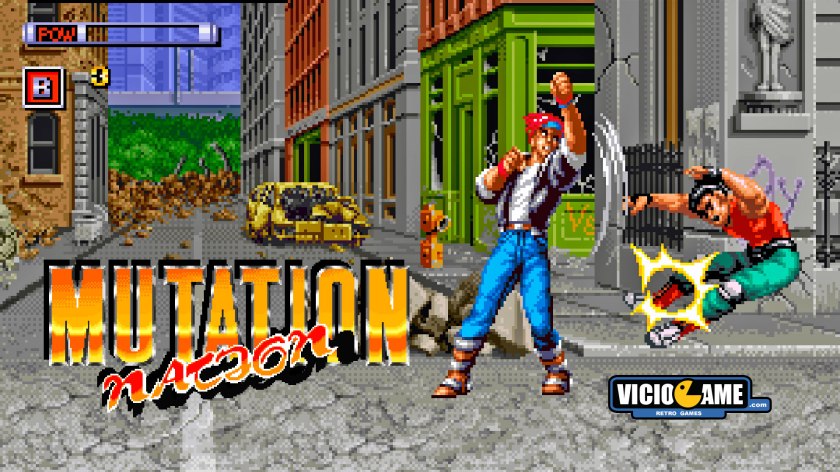
Mutation Nation is a Beat ‘em Up game released in 1992 for the Neo Geo. A mad scientist vanishes following a massive explosion at his laboratory. For years, the virus unleashed by the accident has been turning ordinary people into horrifying monsters. Your mission: wipe out these biologically mutated creatures and save the city from a full-blown epidemic.
Developer/Publisher: SNK
Release date: 1992
Platform: Neo Geo AES / Neo Geo MVS
🇺🇸 Mutation Nation was originally released in arcades (Neo Geo MVS) on March 16, 1992, followed by the home version (Neo Geo AES) on April 17 of the same year. The game carries a rather unusual development history: its original title was Dream Over, and the plan was to launch it between late 1990 and early 1991, which would have made it a launch title for the console. However, the project ended up missing that release window and nearly got cancelled altogether. The SNK team resumed work and finished the game, which ultimately reached the public under its current name — a title that had gone through a long gestation before finding its ultimate identity.
Development was handled by SNK’s Tokyo office, a short-lived division within the company. The iconic cover art and promotional materials were illustrated by Toshiaki Mori, better known by his pen name Shinkiro — the same artist who would later become renowned for his visual work on The King of Fighters series.
The story is set in the year 2050, when a mad scientist is stopped by his superiors from continuing his bizarre biological experiments. Shortly afterward, his laboratory explodes and the scientist mysteriously disappears. Years later, new buildings are constructed over the forgotten slums where the experiments once took place, and a genetic virus begins spreading among the residents, transforming them into violent and dangerous mutants. Two young local fighters, Ricky Jones and Johnny Hart, return to the city after a long absence and, witnessing the chaos that has taken hold, decide to take it upon themselves to clean up this new nation of mutants before the infection spreads any further. Along the way, they encounter not only mutants but also mechanically modified creatures that the scientist created to stop them.
One or two players — Player 1 as Ricky and Player 2 as Johnny — must fight through six stages packed with enemies, each containing one or more sub-bosses before a main boss appears at the end of the stage. Ricky’s default attack is a rapid flurry of kicks, while Johnny performs a spinning strike as his primary move, giving the two characters a slight difference in style, though both share the same overall move set. The game follows the classic beat ‘em up formula, allowing players to perform combos, jump attacks, grapples, and special moves against enemies. The controls use only two functional buttons: button A for attacks and special attacks, and button B for jumping — an extremely accessible scheme that doesn’t overwhelm the player with complex inputs.
Rather than the traditional system of letting players pick up objects from the environment to use as weapons — a common solution in other games of the genre — Mutation Nation adopts an alternative system based on elemental orbs that the player can collect and use to unleash screen-filling super attacks. Each orb is identified by a letter and a specific color. The Light orb is yellow and carries the letter A: when used, the character splits into two bodies of light that shoot off in opposite directions and merge back together after knocking down enemies — the fastest attack but the one that deals the least damage. The Fire orb is red and carries the letter B: it unleashes a massive explosion from the character’s hands, dealing heavy damage to all enemies on screen. The Thunder orb is blue and carries the letter C: the character leaps off the screen and returns moments later crashing into the ground, sending lightning bolts in every direction — the slowest attack, but one that keeps the character completely invulnerable throughout the entire animation. The Wind orb is green and carries the letter D: it is the most powerful attack in the game, transforming the character into a massive green tornado that tears across the screen from one side to the other, sweeping everything in its path and frequently hitting enemies multiple times for massive damage.
There is also a special golden orb called the Deathblow, which can only be used once before disappearing. To activate a special attack using the orbs, the player must hold down the attack button to charge a special meter and release it when full. If the player has no orbs available, it is still possible to trigger a special attack at the cost of a portion of the health bar. There are also neutral orbs that restore health and increase the number of special attacks available, functioning as support items throughout the stages.
Mutation Nation‘s stages span a variety of decaying urban environments and scientific facilities, including run-down neighborhood streets, subway stations, absurdly vast sewer areas, and finally the mad scientist’s laboratory. Before facing the main villain, players must get through a Boss Rush — a stage in which all previously defeated bosses reappear in rapid succession, requiring the player to reach that point with enough resources to survive. One of the most memorable bosses is the stage set in a nightclub: a four-armed mutant woman whose belly houses a mouth that releases flying insects to attack the player characters. The final boss bears a resemblance to the aliens of the Alien film universe, with massive bladed arms, and represents the climax of the biological horror that runs throughout the entire game.
Mutation Nation‘s enemy roster is incredibly varied: the first enemies encountered are mustachioed men who, despite exploding into a puddle of green slime, have a relatively human appearance. Next come men with shrimp heads, and the enemy designs grow progressively more outlandish and disturbing as the stages advance. Mechanical creatures, robots, mutant dogs, and flying enemies also make up the cast. The cicada-men enemies wield sickle-shaped arms, while a particular elite enemy has disproportionately long arms that stretch even further to reach players at a distance, with two upgrades that appear together as a dual boss. In the laboratory stages, lizard-human hybrids are recurring enemies, looking more animal than humanoid. Mutant enemies bleed green slime when defeated and explode into chunks of flesh, while mechanical enemies burst into small fireballs. Enemies appear in different color variations — there are green and red werewolves, for example — and attack in distinct ways, constantly forcing the player to adapt their tactics.
The game’s soundtrack has an energetic, heavy style, with music that matches the on-screen action well. While it can become repetitive during longer sessions, it never grates, and was praised by specialist critics for its energy and how well it fits the game’s atmosphere. Sound effects include growls, howls, and moans that effectively bring to life a world overrun by deformed creatures. The graphics are rich in background detail, with a vibrant and saturated color palette: oranges, greens, purples, and other intense colors appear throughout the entire journey — whether on the streets or in the subway — without ever feeling excessive. Character sprites are large and detailed, a hallmark of the Neo Geo hardware, which was well known for its ability to display graphics far superior in quality to its home console competitors at the time.
The home cartridge version for the Neo Geo AES supports the use of the platform’s memory card, allowing players to save their progress and continue where they left off in a later session, should they choose not to rely on the available continues. On February 25, 1995, the game was released for the Neo Geo CD in Japan, with the North American version of that format arriving in October 1996, bringing the advantages of optical disc loading and some improvements in content access, albeit with the load times inherent to that format.
From a commercial standpoint, Mutation Nation was a considerable success. The trade magazine RePlay reported the game as the fifth most popular arcade in operation at the time of its release. In Japan, the publication Game Machine listed it in its May 1, 1992 issue as the sixteenth most popular arcade in the country at that time. Critical reception was generally favorable, with praise focused mainly on the audiovisual presentation, though some critics pointed out limitations compared to other entries in the genre. GamePro praised the colorful visuals, background detail, enemy variety, and controls, but criticized the absence of a throw move. Hobby Consolas made positive remarks about the multiplayer, digitized sounds, and gameplay, but noted the lack of additional moves for the main characters. The French magazines Joypad and Joystick offered complimentary remarks about the graphics, character animations, controls, and sound. Nintendo Life praised the varied character designs and the rock-style music. Electronic Gaming Monthly praised the graphics and sound but criticized the Neo Geo AES version for its unlimited continues. AllGame considered the orb-based super attack system innovative, but criticized issues with the controls, repetitive gameplay, enemy AI, and rated the overall audiovisual presentation as middling. Player One praised the stages and animations, but classified it as an average game compared to other beat ‘em ups on the same platform.
The game received modern ports through the work of Hamster Corporation via the ACA NEOGEO series, arriving on PlayStation 4 and Nintendo Switch on October 26, 2017, on Xbox One on January 11, 2018, on Neo Geo Mini on October 15, 2018, on iOS and Android devices on July 14, 2022, on the Prime Gaming service on June 16, 2023, and on Microsoft Windows via GOG on April 8, 2024. The ACA NEOGEO series faithfully recreates Neo Geo classics, allowing players to adjust various settings such as difficulty and replicate the atmosphere of arcade CRT monitors from the era. Players can also compete globally through an online high score leaderboard.
Mutation Nation holds an important place within the Neo Geo library. It is one of the few beat ‘em ups developed for the platform, which was far more widely recognized for its one-on-one fighting games. In that context, the game draws an inevitable comparison with titles such as Ninja Combat, Burning Fight, Robo Army, and the Sengoku series, and is frequently cited by enthusiasts as the best representative of the genre on the system, thanks to the balance between accessible controls and the tactical depth offered by the orb system. The dystopian sci-fi setting, with its blend of biological horror and mindless action, gives the game a personality of its own that sets it apart from most beat ‘em ups of the 16-bit era, making it a title that continues to draw in players looking for a fast, straightforward, and visually creative experience on one of the most expressive hardware platforms in video game history.
🇧🇷 Mutation Nation foi lançado originalmente nas máquinas de fliperama (Neo Geo MVS) em 16 de março de 1992, e em seguida para a versão doméstica (Neo Geo AES) em 17 de abril do mesmo ano. O jogo carrega uma história de desenvolvimento bastante peculiar: seu título original era Dream Over, e a intenção era lançá-lo entre o final de 1990 e o início de 1991, o que o tornaria um título de lançamento do console. No entanto, o projeto acabou perdendo o prazo de estreia e quase foi cancelado. A equipe da SNK retomou o trabalho e finalizou o jogo, que chegou ao público em com o nome atual, revelando uma produção que passou por uma longa gestação antes de encontrar sua identidade definitiva.
O desenvolvimento ficou por conta do escritório de Tóquio da SNK, uma divisão de curta duração dentro da empresa. A icônica arte de capa e material promocional foi ilustrada por Toshiaki Mori, mais conhecido pelo pseudônimo Shinkiro, o mesmo artista que ficaria célebre pelos trabalhos visuais da série The King of Fighters.
A história se passa no ano de 2050, quando um cientista louco é impedido por seus superiores de continuar realizando experimentos biológicos bizarros. Pouco depois, seu laboratório explode e o cientista desaparece misteriosamente. Anos mais tarde, novos prédios são construídos sobre os cortiços esquecidos onde os experimentos aconteciam, e um vírus genético começa a se espalhar entre os moradores, transformando-os em mutantes violentos e perigosos. Dois jovens lutadores locais, Ricky Jones e Johnny Hart, retornam à cidade após uma longa ausência e, ao testemunharem o caos instaurado, decidem por conta própria limpar essa nova nação de mutantes antes que a infecção se espalhe ainda mais. Ao longo da jornada, eles se deparam não apenas com mutantes, mas também com criaturas mecanicamente modificadas que o cientista criou para detê-los.
Um ou dois jogadores — o Jogador 1 como Ricky e o Jogador 2 como Johnny — precisam atravessar seis fases repletas de inimigos, cada uma contendo um ou mais sub-bosses antes de um boss principal aparecer ao final do estágio. Ricky executa por padrão uma série de chutes rápidos, enquanto Johnny realiza um golpe giratório como ataque principal, o que confere uma leve diferença de estilo entre os dois personagens, embora ambos partilhem do mesmo conjunto geral de movimentos. O jogo segue a fórmula clássica do gênero beat ‘em up, permitindo ao jogador executar combos, ataques em salto, agarrões e movimentos especiais contra os inimigos. O controle utiliza apenas dois botões funcionais: o botão A para ataque e ataque especial, e o botão B para pulo, resultando em um esquema extremamente acessível que não sobrecarrega o jogador com combinações complexas.
Em vez do sistema tradicional de permitir que os jogadores peguem objetos do cenário para usar como armas — solução comum em outros jogos do gênero —, Mutation Nation adota um sistema alternativo baseado em esferas elementais que o jogador pode coletar e usar para desencadear super ataques que preenchem toda a tela. Cada esfera é identificada por uma letra e uma cor específica. A esfera de Luz é amarela e carrega a letra A: ao ser usada, o personagem se divide em dois corpos de luz que partem em direções opostas e voltam a se unir após derrubar os inimigos, sendo o ataque mais rápido mas o de menor dano. A esfera de Fogo é vermelha e carrega a letra B: desencadeia uma grande explosão a partir das mãos do personagem, causando dano pesado a todos os inimigos na tela. A esfera de Raio é azul e carrega a letra C: o personagem salta para fora da tela e retorna instantes depois atingindo o chão para criar relâmpagos em todas as direções, sendo o ataque mais lento mas que mantém o personagem completamente invulnerável durante toda a animação. A esfera de Vento é verde e carrega a letra D: é o ataque mais poderoso do jogo, transformando o personagem em um enorme tornado verde que atravessa a tela de um lado a outro, varrendo tudo em seu caminho e frequentemente acertando os inimigos mais de uma vez por dano massivo.
Há ainda uma esfera dourada especial, chamada de Deathblow, que pode ser usada apenas uma vez antes de desaparecer. Para ativar um ataque especial com as esferas, o jogador precisa manter pressionado o botão de ataque para carregar um medidor especial e soltá-lo quando estiver cheio. Caso o jogador não possua nenhuma esfera disponível, ainda é possível ativar um ataque gastando parte da barra de vida. Existem também esferas neutras que restauram energia vital e aumentam o número de ataques especiais disponíveis, funcionando como itens de suporte ao longo das fases.
Os cenários de Mutation Nation percorrem uma variedade de ambientes urbanos em decomposição e instalações científicas, incluindo ruas de bairros degradados, estações de metrô, áreas de esgoto de dimensões absurdas e, finalmente, o laboratório do cientista louco. Antes de enfrentar o vilão principal, os jogadores precisam passar por um Boss Rush, estágio em que todos os bosses anteriores reaparecem em sequência, em rápida sucessão, exigindo que o jogador chegue nesse ponto com recursos suficientes para sobreviver. Um dos bosses mais marcantes é a chefe da fase ambientada numa boate: uma mulher mutante com quatro braços cuja barriga abriga uma boca que libera insetos voadores para atacar os personagens. O boss final possui aparência reminiscente aos alienígenas do universo do filme Alien, com enormes lâminas nos braços, e representa o ponto culminante da escalada de terror biológico que perpassa todo o jogo.
O bestiário de Mutation Nation é incrivelmente variado: os primeiros inimigos encontrados são homens de bigode que, apesar de explodirem em uma poça de gosma verde, têm aparência relativamente humana. Em seguida surgem homens com cabeças de camarão, e o design dos inimigos vai ficando progressivamente mais extravagante e perturbador ao longo das fases. Criaturas mecânicas, robôs, cães mutantes e inimigos voadores também fazem parte do elenco. Os inimigos do tipo cicada-men possuem braços em forma de foice, enquanto um inimigo de elite específico tem braços desproporcionalmente longos que se esticam ainda mais para atingir os jogadores a distância, chegando a ter dois upgrades que aparecem como duplo boss. Nos estágios do laboratório, híbridos de lagartos e humanos são inimigos recorrentes, com aparência mais animal do que humanóide. Os inimigos mutantes sangram gosma verde quando derrotados e explodem em pedaços de carne, enquanto os inimigos mecânicos explodem em pequenas bolas de fogo. Os inimigos aparecem em variações de cores diferentes — há lobisomens verdes e vermelhos, por exemplo — e atacam de maneiras distintas, forçando o jogador a adaptar suas táticas constantemente.
A trilha sonora do jogo tem um estilo energético e pesado, com músicas que combinam com a ação na tela. Embora possa se tornar repetitiva em sessões longas, não chega a incomodar, e foi elogiada por críticos especializados pela sua energia e adequação ao clima do jogo. Os efeitos sonoros incluem rosnados, uivos e gemidos que ambientam adequadamente o mundo repleto de criaturas deformadas. Os gráficos apresentam muita riqueza de detalhes nos cenários, com uma paleta vibrante e saturada: laranjas, verdes, roxos e outras cores intensas são vistas ao longo de toda a jornada, seja pelas ruas ou no metrô, sem chegar ao ponto de parecer excessivo. Os sprites dos personagens são grandes e detalhados, característica marcante do hardware Neo Geo, que era notório pela capacidade de exibir gráficos de qualidade muito superior à dos concorrentes domésticos da época.
A versão doméstica em cartucho para o Neo Geo AES suporta o uso do cartão de memória da plataforma, permitindo que o jogador salve o progresso e continue de onde parou em uma sessão posterior, caso opte por não usar os continues disponíveis. Em 25 de fevereiro de 1995, o jogo foi lançado para o Neo Geo CD no Japão, chegando à versão norte-americana desse formato em outubro de 1996, trazendo o benefício do carregamento por disco óptico e eventuais melhorias de acesso ao conteúdo, ainda que com os tempos de loading inerentes ao formato.
Do ponto de vista comercial, Mutation Nation foi um sucesso considerável. A revista RePlay reportou o jogo como o quinto arcade mais popular em operação no momento de seu lançamento. No Japão, a publicação Game Machine o listou em sua edição de 1º de maio de 1992 como o décimo sexto arcade mais popular do país naquele momento. A recepção crítica foi geralmente favorável, com elogios concentrados principalmente na apresentação visual e sonora, embora alguns críticos apontassem limitações em relação a outros representantes do gênero. A publicação GamePro elogiou os visuais coloridos, os detalhes dos cenários de fundo, a variedade de inimigos e os controles, mas criticou a ausência de um movimento de arremesso. A revista Hobby Consolas fez comentários positivos sobre o multiplayer, os sons digitalizados e a jogabilidade, mas notou a falta de movimentos adicionais para os personagens principais. As revistas francesas Joypad e Joystick fizeram comentários elogiosos sobre os gráficos, as animações dos personagens, os controles e o som. A Nintendo Life elogiou os designs variados dos personagens e a música de estilo rock. A Electronic Gaming Monthly elogiou os gráficos e o som, mas criticou a versão Neo Geo AES pelo uso de continues ilimitados. A AllGame considerou o sistema de super ataques baseado em esferas inovador, mas criticou problemas nos controles, a jogabilidade repetitiva, a inteligência artificial dos inimigos e a apresentação audiovisual como mediana. A Player One elogiou os cenários e as animações, mas o classificou como um jogo médio em comparação com outros beat ‘em ups da mesma plataforma.
O jogo recebeu portes modernos pelo trabalho da Hamster Corporation por meio da série ACA NEOGEO, chegando ao PlayStation 4 e ao Nintendo Switch em 26 de outubro de 2017, ao Xbox One em 11 de janeiro de 2018, ao Neo Geo Mini em 15 de outubro de 2018, a dispositivos iOS e Android em 14 de julho de 2022, ao serviço Prime Gaming em 16 de junho de 2023 e ao Microsoft Windows via GOG em 8 de abril de 2024. A série ACA NEOGEO reproduz fielmente os clássicos do Neo Geo, permitindo ao jogador ajustar diversas configurações como dificuldade e reproduzir a atmosfera dos monitores de arcade da época. Os jogadores também podem competir mundialmente por meio de placar online de high scores.
Mutation Nation ocupa um lugar importante dentro do catálogo do Neo Geo. É um dos poucos beat ‘em ups desenvolvidos para a plataforma, que era muito mais reconhecida pelos jogos de luta um contra um. Nesse contexto, o jogo estabelece um paralelo inevitável com títulos como Ninja Combat, Burning Fight, Robo Army e as séries Sengoku, sendo frequentemente citado por entusiastas como o melhor representante do gênero no sistema, graças ao equilíbrio entre acessibilidade nos controles e profundidade tática oferecida pelo sistema de esferas. A ambientação de ficção científica distópica, com sua mistura de terror biológico e ação descerebrada, confere ao jogo uma personalidade própria que o distingue da maioria dos beat ‘em ups da era 16-bit, tornando-o uma obra que continua a atrair jogadores à procura de uma experiência rápida, direta e visualmente criativa dentro de um dos hardwares mais expressivos da história dos videogames.
🤑💲Earn money without doing anything! Just leave these apps open:
✓ https://r.honeygain.me/CONTA9DB02
✓ https://packetstream.io/?psr=1uPb
🤑💲1-Click button earns Bitcoin every 1 hour: https://freebitco.in/?r=53528449
⬛ 𝗧𝗶𝗸𝗧𝗼𝗸: https://www.tiktok.com/@viciogame
🟧 𝗜𝗻𝘀𝘁𝗮𝗴𝗿𝗮𝗺: http://www.instagram.com/viciogame
🟥 𝗬𝗼𝘂𝘁𝘂𝗯𝗲: http://www.youtube.com/viciogame
🟦 𝗙𝗮𝗰𝗲𝗯𝗼𝗼𝗸: http://www.facebook.com/viciogame
🔳 𝗧𝗵𝗿𝗲𝗮𝗱𝘀: https://www.threads.net/@viciogame
🟪 𝗧𝘄𝗶𝘁𝗰𝗵: https://www.twitch.tv/ViciogameRetroGames
🟨 𝗕𝗹𝗼𝗴: http://www.viciogameblog.com/
🟦𝗧𝘄𝗶𝘁𝘁𝗲𝗿: http://www.twitter.com/viciogame
#Viciogame #Gameplay #LetsPlay #Playthrough #Games #Gaming #Videogames #Review #Game #Detonado #Walkthrough #Ending #Reviews #Facts #Retro #RetroGaming #Roms #Emulator #Longplay #Speedrun #NoCommentary #MutationNation #NeoGeo #MVS #AES #SNK #BeatEmUp #Arcade #FinalFight #StreetsOfRage #GoldenAxe #ネオジオ #NeoGeoAES #NeoGeoMVS

