
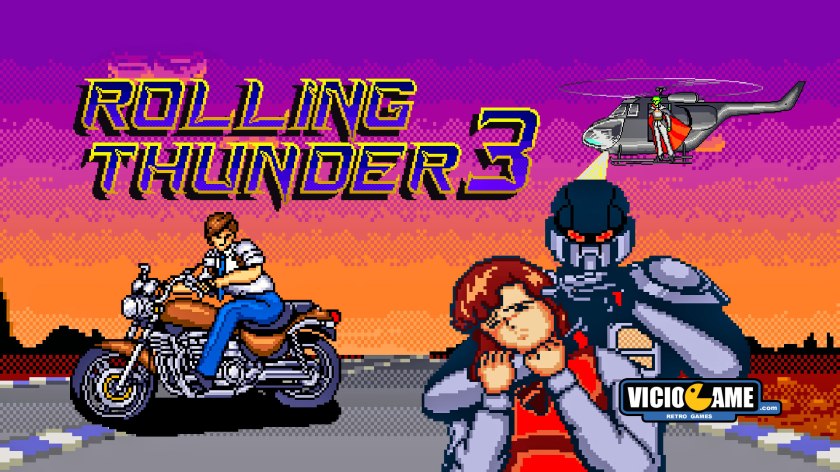
Rolling Thunder 3 is an action-platformer run-and-gun game released in 1993 exclusively for the Sega Genesis. Secret agent Jay must neutralize a terrorist threat unfolding in parallel with the events of the second game.
Developer: Now Production
Publisher: Namco Hometek
Release: 1993
Platform: Sega Genesis / Mega Drive
🇺🇸 Rolling Thunder 3 was developed by Japanese studio Now Production and published by Namco Hometek in North America. It is the third and final entry in the Rolling Thunder series, which began with the arcade game of the same name in 1986 and continued with Rolling Thunder 2 in 1990. Unlike the two previous games — which originated as arcade titles and were later ported to home consoles — Rolling Thunder 3 was conceived entirely as an exclusive Sega Genesis product, with no arcade version or ports to other platforms. This distinction gives it a unique place within the franchise: freed from the need to replicate a coin-op experience, the developers enjoyed greater creative freedom to adapt and expand the series’ formula in line with the specific capabilities of Sega’s 16-bit hardware.
The Rolling Thunder series was created with heavy influence from the spy films of the 1960s and 1970s, particularly the aesthetic of James Bond-inspired productions. The first game introduced Agent Albatross, a member of a secret organization called the WCPO (World Crime Police Organization), on a mission to rescue his partner Leila from the clutches of the criminal organization Geldra, led by the villain Maboo. Rolling Thunder 2 expanded the narrative with both Albatross and Leila playable in a two-player co-op mode, introduced boss battles, and allowed the action to unfold across multiple countries. Rolling Thunder 3 sets its story parallel to the events of the second game: while agents Albatross and Leila are busy tracking the criminal organization Gimdo, the agency detects a new Geldra threat on American soil. The creature behind these terrorist attacks is Dread, Geldra’s second-in-command — a green-skinned humanoid with a monocle whose appearance directly echoes Maboo from the first game, establishing a visual and narrative continuity across the titles. To deal with Dread, the organization assigns an agent new to the series: Jay, whose operational codename is JC-KAL, a 35-year-old described as the agency’s last available resource. Jay is assisted by a radio contact named Ellen, who provides mission objectives and tactical information throughout the entire adventure.
The story is presented in a more cinematic fashion than any previous entry in the series, with animated cutscenes between stages and dialogue displayed as on-screen text. There are even a few moments of synthesized voice acting — a rarity by Sega Genesis standards of the time. The adventure takes Jay through a variety of settings: it begins at an oil refinery off the southern California coast, moves through the streets of Las Vegas, crosses the Pacific Ocean, and eventually reaches Easter Island. One of the game’s most clever narrative devices is a dramatic fake ending after the eighth stage, in which the player apparently defeats Dread, only to discover that the plane meant to carry Jay home has been hijacked by terrorists — forcing two additional levels before the definitive showdown with the true, final form of Dread. This kind of narrative surprise was uncommon in action games of the era and reflects the development team’s commitment to crafting an experience with more storytelling depth than earlier entries.
In terms of gameplay, Rolling Thunder 3 maintains the shoot-and-take-cover formula that has defined the series since its arcade origins: the player moves laterally through two-dimensional environments, takes out enemies with precision, ducks or crouches behind objects like crates to avoid projectiles, and replenishes ammunition by entering specially marked doors scattered across each of the game’s ten stages.
One of the most significant innovations in Rolling Thunder 3 over its predecessors is the expanded arsenal. Before starting each level, the player can choose a special weapon from nine options: submachine gun, shotgun, bazooka, flamethrower, a laser pistol similar to the one found in the Sega Genesis version of Rolling Thunder 2, three types of grenades — standard, flash (which temporarily blinds enemies), and fragmentation — and a “cannon” that fires incendiary grenades in a parabolic arc. If the player chooses not to select any special weapon, Jay is equipped with a dagger for close-quarters combat. This strategic pre-stage weapon selection is permanent for that session: once a special weapon’s ammo is depleted in a stage, it can no longer be selected in subsequent stages. This forces the player to vary their choices and carefully plan which tools to save for the hardest moments of the journey. In addition to the weapons chosen at the start of each stage, special weapons can be found hidden behind specific doors throughout the levels; picking them up replaces the special weapon the player had brought in.
The control scheme also receives considerable improvements. For the first time in the series, shooting is separated into two distinct buttons: one for the standard pistol — which has theoretically unlimited ammo but still needs to be restocked at doors — and one for the special weapon, allowing the player to conserve more powerful rounds with greater care. Another key addition is the ability to fire diagonally — a feature that substantially expands tactical possibilities in combat, one that series fans celebrated as a very welcome upgrade. Jay can also jump and shoot simultaneously, something that was impossible under the stricter mechanics of previous titles. The health system has also been overhauled: instead of the energy bar from earlier entries that killed the character in one or just a few hits, Jay now has three health units, allowing him to absorb more damage before being defeated. Some enemy projectiles, however, drain two units at once, keeping the need for caution very much intact. When Jay dies, the game lets the player restart from exactly the point where they fell, rather than sending them back to a fixed checkpoint or restarting the entire stage as in previous games — a concession to the home console audience that makes the experience significantly less punishing.
Another departure from the classic formula is the removal of the per-stage time limit. In earlier games, a countdown clock pressured the player to keep pushing forward. In Rolling Thunder 3, that restriction has been removed, but it has been replaced by an alternative pressure mechanic: if Jay lingers too long in a single stage, an invisible sniper begins firing at him relentlessly, forcing forward progress without the need for an on-screen timer. This solution is elegant because it preserves tension without the somewhat arbitrary nature of a countdown, resulting in a more fluid stage design.
Rolling Thunder 3 also introduces two vehicle stage types that break up the rhythm of conventional action: in one, Jay speeds along the highways between California and Nevada on a motorcycle; in the other, he pilots a jet ski across the waters of the Pacific Ocean. These segments are reminiscent of the vehicle stages found in Shinobi III: Return of the Ninja Master, also on the Sega Genesis, and while they aren’t particularly complex, they function as bursts of high-speed action that balance out the more measured pacing of the standard stages. Boss battles had been introduced in Rolling Thunder 2; in Rolling Thunder 3, boss encounters are fewer in number, but they are notoriously challenging — especially the final boss — demanding pattern recognition and strategic use of the available arsenal.
The game features a password system that allows players to save their progress. After completing the game for the first time, the player receives a password that unlocks Hard Mode, which reduces Jay’s health to just two blocks, increases the number and aggressiveness of enemies in each stage, and changes the color palette of the environments to depict different times of day — a clever way to make the same locations feel visually fresh for a second playthrough. There is also a hidden secret password that replaces Jay as the playable character with Ellen, the female agent who normally serves only as a radio support voice. Ellen plays identically to Jay, has no unique cutscenes, and the game’s ending remains unchanged, but the option to play as her is a nod to devoted fans — especially given that Leila, one of the protagonists of Rolling Thunder 2, is not playable in this entry.
The absence of two-player co-op was one of the game’s most criticized shortcomings. Rolling Thunder 2 had introduced co-op as one of its headline features, making the experience more social and dynamic; Rolling Thunder 3 regresses to a single-player-only mode with no apparent technical or narrative justification, and this decision is a genuine letdown. Likewise, replacing the iconic Albatross and Leila with Jay — a fairly generic protagonist — represents a loss of identity for the franchise. In exchange, the game offers more varied stages, a more elaborate narrative, and refined mechanics that make the experience more accessible without stripping away the challenge inherent to the series.
Visually, the game sits at roughly the same level as Rolling Thunder 2 on Sega Genesis, with detailed sprites, distinct environments, and reasonably fluid animations by 1993 standards. The cartridge holds 12 megabits of storage — a considerable size for the time, proudly touted in the game’s marketing material under the slogan “12 Packed Megs!” The levels travel through creative environments including oil platforms, casinos, open ocean, and exotic island locations, all of which contribute to the feeling of a globe-trotting spy adventure.
Critical reception at launch was modest but generally positive. Electronic Gaming Monthly gave the game a score of 6.4 out of 10, while GamePro covered it prominently in its June 1993 issue. The general consensus among contemporary critics was that Rolling Thunder 3 was a solid, well-executed title, but one that represented a step back from the potential established by its predecessors, with the formula made more accessible at the expense of the strategic depth characteristic of the series. Modern reviews from retro gaming outlets such as Hardcore Gaming 101 and Sega-16 tend to classify it as a good Sega Genesis action game, noting the same points mentioned above.
One aspect that fuels collector interest is the fact that Rolling Thunder 3 was released exclusively in North America, with limited distribution, and never received a release in Japan — a curious fact for a franchise of Japanese origin. The game was never ported to any other platform, never included in any official Namco compilation, and has never been made available through digital distribution services. While Rolling Thunder 2 reached the Wii via Virtual Console and was included in the Namco Museum collection for the Nintendo Switch, Rolling Thunder 3 remains exclusive to the original Sega Genesis cartridge, making it a sought-after item among collectors that regularly commands high prices.
The Rolling Thunder series as a whole never received a follow-up after the third game, concluding in 1993. In 2012, the online publisher Shifty Look, in partnership with Namco, released a series of short comic strips called Rapid Thunder as a tribute to the franchise. The strips featured a basic spy storyline with some nominal references to the original series — such as characters codenamed Albatross and Leila — but with no real narrative connection to the games. Notably, the transliterated names differed from those used in the series: “Maboo” became “Mabu” and “Geldra” was rendered as “Gerudora.” The final strip was published in October 2012, with the story apparently abandoned before its conclusion. No new game in the series has been developed since.
Rolling Thunder 3 stands, therefore, as one of the most influential action franchises of the transitional period between 8-bit and 16-bit gaming — a series that, even without achieving the mainstream recognition of contemporaries like Contra or Shinobi, laid the groundwork for the subgenre of tactical side-scrollers that demanded precision, patience, and the gradual mastery of enemy patterns. With its generous weapon system, more ambitious narrative, refined mechanics, and platform exclusivity, the game closed out the trilogy with dignity — and remains, decades later, a worthwhile experience for any action game enthusiast still picking up a Sega Genesis controller in search of thrills and a genuine challenge.
🇧🇷 Rolling Thunder 3 foi desenvolvido pelo estúdio japonês Now Production e publicado pela Namco Hometek na América do Norte. Trata-se do terceiro e último capítulo da série Rolling Thunder, iniciada com o jogo de arcade homônimo em 1986 e continuada com Rolling Thunder 2 em 1990. Ao contrário dos dois jogos anteriores, que nasceram como títulos de arcade e receberam conversões para consoles domésticos, Rolling Thunder 3 foi concebido inteiramente como um produto exclusivo para o Sega Genesis, sem qualquer versão de arcade ou port para outras plataformas. Essa distinção lhe confere uma posição singular dentro da franquia: por não precisar replicar a experiência de uma máquina de fliperama, os desenvolvedores desfrutaram de maior liberdade criativa para adaptar e expandir a fórmula da série de acordo com os recursos específicos do hardware de 16 bits da Sega.
A série Rolling Thunder foi criada com forte influência nos filmes de espionagem dos anos 1960 e 1970, especialmente na estética das produções inspiradas em James Bond. O primeiro jogo apresentou o agente Albatross, membro de uma organização secreta chamada WCPO (World Crime Police Organization), em uma missão para resgatar sua parceira Leila das garras da organização criminosa Geldra, liderada pelo vilão Maboo. Rolling Thunder 2 expandiu a narrativa com Albatross e Leila jogáveis em modo cooperativo para dois jogadores, introduziu batalhas contra chefes e permitiu que a ação se espalhasse por múltiplos países. Rolling Thunder 3 estabelece sua história de forma paralela aos eventos do segundo jogo: enquanto os agentes Albatross e Leila estão ocupados rastreando a organização criminosa Gimdo, a agência detecta uma nova ameaça da Geldra em solo norte-americano. A criatura responsável por esses ataques terroristas é Dread, o segundo em comando da Geldra, descrito como um humanoide de pele verde com um monóculo, cuja aparência remete diretamente à de Maboo do primeiro jogo, estabelecendo uma continuidade visual e narrativa entre os títulos. Para lidar com Dread, a organização designa um agente até então inédito na série: Jay, cujo codinome operacional é JC-KAL, um homem de 35 anos descrito como o último recurso disponível da agência. Jay é assistido por uma contato de rádio chamada Ellen, que lhe fornece objetivos de missão e informações táticas ao longo de toda a aventura.
A narrativa é apresentada de forma mais cinematográfica do que qualquer jogo anterior da série, com cutscenes animadas entre as fases e diálogos exibidos em texto na tela. Há inclusive alguns momentos de vozes sintetizadas, uma raridade para o padrão dos jogos de Sega Genesis da época. A aventura leva Jay por cenários variados: começa em uma refinaria de petróleo na costa sul da Califórnia, avança pelas ruas de Las Vegas, atravessa o Oceano Pacífico e chega até a Ilha de Páscoa. Um dos recursos narrativos mais engenhosos do jogo é um falso fim dramático após o oitavo estágio, no qual o jogador aparentemente derrota Dread, apenas para descobrir que o avião que deveria levá-lo de volta é sequestrado por terroristas, forçando mais dois níveis adicionais antes do confronto definitivo com o verdadeiro Dread em sua forma final. Esse elemento de surpresa narrativa era incomum para jogos de ação da época e demonstra a preocupação da equipe de desenvolvimento em criar uma experiência com mais profundidade no roteiro do que as entradas anteriores.
Em termos de jogabilidade, Rolling Thunder 3 mantém a fórmula “shoot-and-take-cover” que define a série desde sua origem no arcade: o jogador avança lateralmente por cenários bidimensionais, elimina inimigos com precisão, se esquiva ou se agacha atrás de objetos como caixotes para evitar projéteis, e repõe munição entrando em portas especialmente sinalizadas espalhadas pelas pelas dez fases.
Uma das inovações mais significativas de Rolling Thunder 3 em relação aos seus predecessores é a expansão do arsenal. Antes de iniciar cada nível, o jogador pode escolher uma arma especial dentre nove opções: submetralhadora, espingarda, bazuca, lança-chamas, uma pistola a laser semelhante à encontrada na versão de Sega Genesis de Rolling Thunder 2, três tipos de granada — comum, de luz (que cega temporariamente os inimigos) e de fragmentação — e um “canhão” que dispara granadas incendiárias em trajetória parabólica. Caso o jogador opte por não escolher nenhuma arma especial, Jay fica equipado com uma adaga para combate corpo a corpo. Essa decisão estratégica de seleção de arma antes de cada fase é permanente durante aquela sessão: uma vez que a munição de determinada arma especial é esgotada em um estágio, ela não pode mais ser selecionada nos estágios subsequentes. Isso obriga o jogador a variar suas escolhas e planejar com cuidado quais ferramentas reservar para os momentos mais difíceis da jornada. Além das armas escolhidas no início de cada fase, é possível encontrar armas especiais escondidas atrás de portas específicas ao longo dos estágios; ao coletá-las, elas substituem a arma especial que o jogador havia trazido.
O sistema de controle também recebe melhorias consideráveis. Pela primeira vez na série, o jogo separa o disparo em dois botões distintos: um para a pistola padrão, de munição teoricamente ilimitada (mas que precisa ser reposta pelas portas), e outro para a arma especial, permitindo que o jogador conserve os projéteis mais poderosos com mais cuidado. Outra novidade fundamental é a capacidade de disparar em diagonal — um recurso que amplia substancialmente as possibilidades táticas em combate e que os fãs da série celebraram como uma adição muito bem-vinda. Jay também pode pular e atirar simultaneamente, algo impossível nas mecânicas mais rígidas dos títulos anteriores. O sistema de saúde também foi reformulado: em vez da barra de energia que matava o personagem com um único ou poucos golpes das entradas anteriores, Jay possui três unidades de saúde, permitindo absorver mais impactos antes de ser derrotado. Alguns projéteis inimigos, no entanto, drenam duas unidades de uma vez, mantendo a necessidade de cautela. Quando Jay morre, o jogo permite que o jogador recomece exatamente do ponto onde caiu, ao invés de recuar para um checkpoint fixo ou reiniciar o estágio inteiro como nos jogos anteriores — uma concessão ao público do console que torna a experiência significativamente menos punitiva.
Outra mudança em relação à fórmula clássica é a remoção do limite de tempo por fase. Nos jogos anteriores, um cronômetro pressionava o jogador a avançar com urgência. Em Rolling Thunder 3, essa restrição foi eliminada, mas foi substituída por um mecanismo de pressão alternativo: se Jay demorar demais em um único estágio, um sniper (atirador de elite) invisível começa a disparar contra ele de forma implacável, forçando o avanço sem precisar de um temporizador explícito na tela. Essa solução é elegante porque mantém a tensão sem o aspecto arbitrário de um contador regressivo, tornando o design das fases mais fluido.
Rolling Thunder 3 introduz também dois tipos de estágio de veículo que quebram o ritmo da ação convencional: em um deles, Jay pilota uma motocicleta em alta velocidade pelas rodovias entre Califórnia e Nevada; no outro, ele conduz um jet ski pelas águas do Oceano Pacífico. Esses segmentos lembram os estágios de veículo presentes em Shinobi III: Return of the Ninja Master, também do Sega Genesis, e, embora não sejam particularmente complexos, funcionam como intervalos de ação acelerada que equilibram o ritmo mais medido dos estágios convencionais. A inclusão de chefes já havia sido introduzida em Rolling Thunder 2; em Rolling Thunder 3, os confrontos com chefes são em número reduzido, mas são notoriamente difíceis — especialmente o chefe final —, exigindo aprendizado de padrões de ataque e uso estratégico do arsenal disponível.
O jogo possui um sistema de password que permite ao jogador salvar seu progresso. Após completar o jogo pela primeira vez, o jogador recebe um password que desbloqueia o Hard Mode, que reduz as unidades de saúde de Jay para apenas dois blocos, aumenta a quantidade e agressividade dos inimigos em cada estágio e altera a paleta de cores dos cenários para retratar diferentes períodos do dia — uma forma engenhosa de tornar os mesmos ambientes visualmente mais variados para um segundo turno. Existe ainda um password secreto escondido que substitui Jay como personagem jogável por Ellen, a agente feminina que normalmente funciona apenas como voz de apoio via rádio. Ellen joga de forma idêntica a Jay, não possui cutscenes próprias e o final do jogo permanece inalterado, mas a possibilidade de jogar com ela representa um aceno ao público fiel, principalmente considerando que Leila — uma das protagonistas de Rolling Thunder 2 — não está jogável nesta entrada.
A ausência do modo cooperativo para dois jogadores foi uma das principais críticas recebidas pelo jogo. Rolling Thunder 2 havia introduzido o co-op como uma de suas grandes novidades, tornando a experiência mais social e dinâmica; Rolling Thunder 3 regride para o modo single-player exclusivo sem qualquer justificativa técnica ou narrativa aparente, e essa decisão é lamentável. Da mesma forma, a substituição dos icônicos Albatross e Leila por Jay — um personagem genérico — é uma perda de identidade para a série. Em compensação, o jogo possui fases mais variadas, uma narrativa mais elaborada e mecânicas refinadas que tornam a experiência mais acessível sem eliminar o desafio inerente à franquia.
Graficamente, o jogo está no mesmo patamar visual de Rolling Thunder 2 na versão de Sega Genesis, com sprites detalhados, cenários distintos e animações razoavelmente fluidas para os padrões de 1993. O cartucho ocupa 12 megabits de armazenamento — um tamanho considerável para a época, indicado com orgulho no material de marketing do jogo sob o slogan “12 Packed Megs!“. Os cenários percorrem ambientes criativos, como plataformas de petróleo, cassinos, oceano aberto e locações insulares exóticas, o que contribui para a sensação de uma aventura global de espionagem.
A recepção crítica ao lançamento foi modesta porém positiva. A revista Electronic Gaming Monthly atribuiu ao jogo uma nota de 6,4 sobre 10, enquanto a publicação GamePro cobriu-o com destaque em sua edição de junho de 1993. A percepção geral da crítica especializada foi a de que Rolling Thunder 3 era um título sólido e bem executado, mas que representava um passo atrás em relação ao potencial estabelecido pelos dois jogos anteriores, sendo que a fórmula havia sido tornada mais acessível em detrimento da profundidade estratégica característica da série. Revisões contemporâneas de sites especializados em jogos retrô, como o site Hardcore Gaming 101 e o Sega-16, tendem a classificá-lo como um bom jogo de ação para o Sega Genesis, relatando os mesmos pontos citados anteriormente.
Um aspecto que contribui para o interesse de colecionadores é o fato de que Rolling Thunder 3 foi lançado apenas na América do Norte, em distribuição limitada, e nunca recebeu lançamento no Japão — o que é estranho tratando-se de uma franquia originalmente japonesa. O jogo nunca foi portado para nenhuma outra plataforma, nunca foi incluído em nenhuma coletânea oficial da Namco e jamais foi disponibilizado em serviços de distribuição digital. Enquanto Rolling Thunder 2 chegou ao Wii através do Virtual Console e foi incluído no pacote Namco Museum para Nintendo Switch, Rolling Thunder 3 permanece restrito ao cartucho original para Sega Genesis, o que o torna um item buscado por colecionadores de cartuchos, atingindo preços elevados.
A série Rolling Thunder como um todo nunca recebeu uma continuação após o terceiro jogo, encerrando-se em 1993. Em 2012, a editora online Shifty Look, em parceria com a Namco, publicou uma série de curtas histórias em quadrinhos chamada Rapid Thunder, como homenagem à franquia. As tiras apresentavam um enredo básico de espionagem com algumas referências nominais à série original — como personagens codinominados Albatross e Leila — mas sem conexão narrativa real com os jogos. Curiosamente, os nomes transliterados diferiam dos utilizados na série: “Maboo” tornou-se “Mabu” e “Geldra” foi grafado como “Gerudora”. A última tira foi publicada em outubro de 2012, com a história aparentemente abandonada antes de sua conclusão. Nenhum novo jogo da série foi desenvolvido desde então.
Rolling Thunder 3 representa, portanto, uma das franquias de ação mais influentes do período de transição entre 8 e 16 bits — uma série que, mesmo sem atingir o mesmo reconhecimento popular de contemporâneos como Contra ou Shinobi, estabeleceu as bases do subgênero de side-scrollers táticos que demandavam precisão, paciência e domínio progressivo de padrões inimigos. Com seu sistema de armas generoso, sua narrativa mais ambiciosa, suas mecânicas refinadas e sua exclusividade para o console, o jogo encerrou a trilogia com dignidade — e continua sendo, décadas depois, uma experiência valiosa para qualquer aficionado por jogos de ação que ainda segura um controle de Sega Genesis em busca de adrenalina e desafio.
🤑💲Earn money without doing anything! Just leave these apps open:
✓ https://r.honeygain.me/CONTA9DB02
✓ https://packetstream.io/?psr=1uPb
🤑💲1-Click button earns Bitcoin every 1 hour: https://freebitco.in/?r=53528449
⬛ 𝗧𝗶𝗸𝗧𝗼𝗸: https://www.tiktok.com/@viciogame
🟧 𝗜𝗻𝘀𝘁𝗮𝗴𝗿𝗮𝗺: http://www.instagram.com/viciogame
🟥 𝗬𝗼𝘂𝘁𝘂𝗯𝗲: http://www.youtube.com/viciogame
🟦 𝗙𝗮𝗰𝗲𝗯𝗼𝗼𝗸: http://www.facebook.com/viciogame
🔳 𝗧𝗵𝗿𝗲𝗮𝗱𝘀: https://www.threads.net/@viciogame
🟪 𝗧𝘄𝗶𝘁𝗰𝗵: https://www.twitch.tv/ViciogameRetroGames
🟨 𝗕𝗹𝗼𝗴: http://www.viciogameblog.com/
🟦𝗧𝘄𝗶𝘁𝘁𝗲𝗿: http://www.twitter.com/viciogame
#Viciogame #Gameplay #LetsPlay #Playthrough #Games #Gaming #Videogames #Review #Game #Detonado #Walkthrough #Ending #Reviews #Facts #Retro #RetroGaming #Roms #Emulator #Longplay #Speedrun #NoCommentary #RollingThunder3 #SegaGenesis #Namco #MegaDrive #Sega #Genesis #RollingThunder #ローリングサンダー #007 #contra #shinobi #jamesbond #メガドライブ #セガ

