
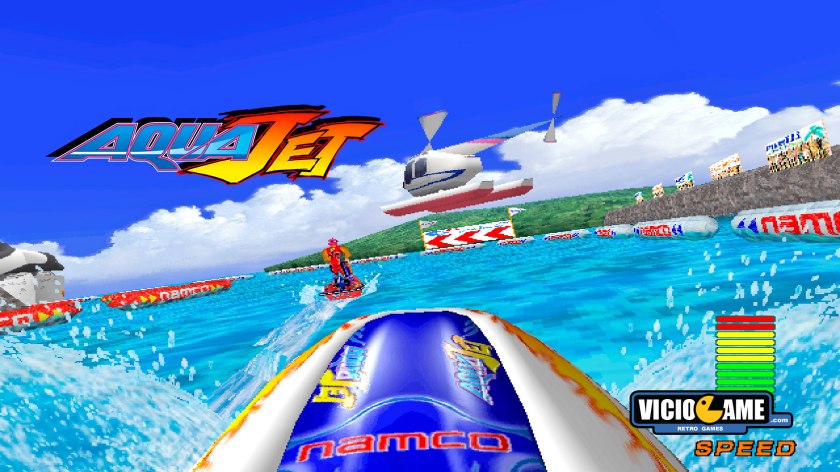
Aqua Jet is a first-person 3D jet ski racing game released in 1996 for arcades. It was a pioneer not only for its above-average graphics for the time, but also for its one-of-a-kind cabinet — featuring a full-size, fully functional replica of a jet ski used to control the watercraft in the game.
Developer/Publisher: Namco
Release: 1996
Platform: Arcade Namco System Super 22 board
🇺🇸 Aqua Jet emerged in the bustling, competitive arcade scene of the mid-1990s, representing Namco’s ambition to create not just a different racing title, but an immersive aquatic simulation experience that combined cutting-edge graphics technology, innovative control physics, and a cabinet design capable of engaging the player on every sensory level. Unlike the vast majority of games of its era — which still relied on sprites or rudimentary polygons — Aqua Jet bet on the most sophisticated hardware the company had available, positioning itself as a technological showcase as much as an entertainment product.
The game runs on the Namco System Super 22, an enhanced revision of the Namco System 22 released in 1995. The original System 22, developed in partnership with graphics and simulation company Evans & Sutherland, was a historic milestone as the first arcade system — and the first video game system of any kind — to offer hardware-accelerated real-time texture mapping, accompanied by Gouraud shading, transparency effects, depth cueing, and anti-aliasing. The hardware architecture used the Evans & Sutherland TR3 GPU chipset (short for Texture Mapping, Real-Time, Real-Visual, Rendering System) to handle three-dimensional graphics calculations, with geometric performance exceeding 240,000 quadrilateral polygons per second. The Super System 22 — the specific version used by Aqua Jet — brought slightly higher polygon rates and additional graphical effects, and was retired after roughly five years of service, with Prop Cycle (1996) as the final title in the family. This architecture placed its games in a position of graphical superiority over contemporary home consoles such as the Sony PlayStation, the Sega Saturn, and the Nintendo 64, though they fell well short of what the Dreamcast would later produce.
In this aquatic race, the player faces 11 CPU-controlled opponents. The premise is straightforward: the player chooses between two courses and must outpace the competition, navigating open waters filled with obstacles, crossing checkpoints to extend the available time, and ideally reaching first place by the finish line. Obstacles include turbulent waves, sand bars, and jump ramps, and the physics system — while arcade-oriented — delivers a satisfying sense of speed and control. At the end of any course, the distances reached on each ramp jump are displayed on screen for the player.
The two available courses are the 550cc Novice Course, aimed at beginners, and the 1100cc Expert Course, designed for more experienced players. The “cc” designation clearly evokes the world of motorsports and motorized water sports, reinforcing the simulation tone Namco sought to convey. The novice course offers a more accessible experience with calmer waves and lower precision demands, while the expert course adds layers of mechanical complexity that make for a significantly richer experience. Aqua Jet presented itself as the only game to allow the execution of “drift turns” — a mechanic that, in the aquatic context, simulates the lateral slide characteristic of jet skis at high speed during sharp maneuvers. There is also the ability to briefly submerge the watercraft after ramp jumps, mimicking the real behavior of jet skis re-entering the water at high speed (complete with stunning visuals that depict the marine environment in rich detail).
The game’s camera responds directly to the position of the cabinet’s physical handlebars: when the grips are raised, the viewpoint rises proportionally; when lowered, the camera drops. In the Expert Course, if the player raises and lowers the handlebars in a rhythmic cadence, it is possible to make the virtual watercraft perform smaller jumps at positions other than the three fixed ramps present in both courses. Additionally, holding the handlebars at the precise moment the jet ski lands on the water after a jump allows it to briefly dive beneath the surface — just as happens in real life. These mechanics reveal a degree of technical depth unusual for an arcade title, where the general rule tends to be simplification in favor of immediate accessibility.
The Aqua Jet cabinet is one of the game’s most celebrated aspects, and for good reason. It seated the player atop a giant replica of a jet ski, which could be tilted side to side to simulate the action of leaning into turns, while a fan blew air directly into the player’s face to simulate the sensation of speed. The “air spring” control system was described by Namco as revolutionary, offering the best available electronic simulation of the sport, with the player feeling every jump, every wave, and every swell as they pushed toward the finish line. The throttle was activated by pressure on the handlebars — a trigger grip — making the act of riding physically engaging in a way that very few arcades of the era could replicate. An optional bill validator kit was available for operators who wished to accommodate paper currency, reflecting the growing sophistication of the American arcade market in the second half of the 1990s.
Aqua Jet‘s soundtrack was composed by Keiichi Okabe, who was working at Namco at the time. Okabe would go on to achieve worldwide recognition years later for his work on games such as the NieR series. The music adopts an electronic, dance-oriented tone in keeping with the sun-drenched resort and water sports aesthetic the game sought to project. The tracks match the breakneck pace of the race with energy and buoyancy, contributing to the vibrant, summertime atmosphere that is one of the title’s defining characteristics.
Aqua Jet received some media exposure in its day. The game was featured on an episode of the British video game TV show GamesMaster, in which celebrity Samantha Fox gave it a try — a moment that stuck in the memories of fans of the program. That kind of exposure on specialty television shows was crucial for building anticipation around arcade titles before the internet era, and the visual impact of the jet ski replica certainly helped the game stand out even among those without direct access to arcades.
Despite all its technical ingenuity and undeniable visual appeal, Aqua Jet never received a home console port during its commercial life in arcades. This absence was partially understandable: the Super System 22 hardware was capable of generating graphics superior to those of the PlayStation, the Saturn, and the Nintendo 64 of the era, making a faithful conversion for home audiences difficult — if not impossible — without substantially compromising the visual experience. Beyond that, the very nature of the cabinet — with its tilt system, fan, and physically responsive handlebars — was inherently impossible to replicate with a conventional home controller. Over time, the title became an increasingly rare find.
It was not until August 2025 that Aqua Jet received its first official release outside of arcades, courtesy of Hamster Corporation and its Arcade Archives series. The title was made available digitally on August 14, 2025, for Nintendo Switch, PlayStation 4, Nintendo Switch 2, PlayStation 5, and Xbox Series X|S. The game was the third release in the Arcade Archives 2 series, which marked Hamster’s expansion beyond sprite-based games into polygon-rendered titles — a series that began with the original Ridge Racer in June and continued with Air Combat 22 in July, both running on Namco’s System 22 hardware. For Nintendo Switch and PlayStation 4, the released version is titled Arcade Archives AQUA JET, priced at $14.99. For Nintendo Switch 2, PlayStation 5, and Xbox Series X|S, the version is called Arcade Archives 2 AQUA JET and costs $16.99. Players who purchased the Nintendo Switch and PlayStation 4 version are eligible for an ownership discount, allowing them to pick up the Arcade Archives 2 version for Nintendo Switch 2 and PlayStation 5 for $2.99.
The Arcade Archives series is developed with the concept of faithfully reproducing classic arcade games while staying true to the originals. In Original Mode, players have access to convenient features such as difficulty adjustment, screen settings, button remapping, turbo options, the ability to create multiple saves at any time, and even a rewind function. Some titles also offer special settings that recreate the nostalgic atmosphere of CRT tube televisions. In Hi Score Mode and Caravan Mode, players can compete for top scores against players worldwide through online leaderboards. The Arcade Archives 2 version further adds a Time Attack Mode — which measures completion speed independent of score — multiple save slots, the rewind function, and VRR (Variable Refresh Rate) support, enabling an even more accurate reproduction of the original arcade experience.
Aqua Jet holds a distinct place in Namco’s catalog and in the history of mid-1990s arcades. It is a contemporary of other iconic System 22 and Super System 22 titles such as Ridge Racer, Air Combat 22, Alpine Racer, Cyber Cycles, Dirt Dash, Ace Driver: Victory Lap, Alpine Surfer, and Prop Cycle — a constellation of experiences that showcased the hardware’s versatility and Namco’s commitment to sports and vehicle simulations that went beyond the conventional joystick. Within that group, Aqua Jet stands out for exploring an even more specific niche: motorized water sports, then riding a wave of popularity fueled by the rise of jet skiing as mass leisure at beaches and resorts around the world. The combination of a sun-soaked visual style, aquatic mechanics with their own physics, and a cabinet that literally put the player astride the machine made for an experience unlike anything else in the arcade environment — an invitation to a fantasy of wave-cutting speed that few other games have been able to offer with such technical and physical commitment.
Decades after its original release, Aqua Jet continues to be embraced warmly both by those who discovered it in arcade halls in the 1990s and by new players encountering it on modern platforms. The ability to play today a title that remained inaccessible to home audiences for nearly thirty years is, in itself, a lasting testament to the originality of its conception — and to the enduring appeal of an experience that managed to capture, with textured polygons and air blown by a fan, something genuine: the raw, exhilarating sensation of cutting through waves at full speed under a summer sun.
🇧🇷 Aqua Jet apareceu no cenário movimentado e competitivo dos fliperamas da metade da década de 1990, representando a ambição da Namco em criar não apenas um título de corrida diferente, mas uma experiência de simulação aquática imersiva que combinava tecnologia gráfica de ponta, mecânicas físicas de controle inovadoras e um design de gabinete capaz de envolver o jogador em todos os sentidos. Ao contrário da grande maioria dos jogos de sua época, que ainda recorria a sprites ou polígonos rudimentares, o Aqua Jet apostou no hardware mais sofisticado que a empresa tinha disponível, posicionando-se como uma vitrine tecnológica tanto quanto um produto de entretenimento.
O jogo roda sobre o Namco System Super 22, uma revisão aprimorada do Namco System 22 lançada em 1995. O System 22 original, desenvolvido em parceria com a empresa de computação gráfica e simulação Evans & Sutherland, foi um marco histórico ao se tornar o primeiro sistema de arcade — e o primeiro sistema de videogame de qualquer tipo — a oferecer mapa de texturas acelerado por hardware em tempo real, acompanhado de Gouraud shading, efeitos de transparência, depth cueing e anti-aliasing. A arquitetura do hardware utilizava o chipset GPU Evans & Sutherland TR3 (sigla para Texture Mapping, Real-Time, Real-Visual, Rendering System) para lidar com os cálculos gráficos tridimensionais, com desempenho geométrico que ultrapassava 240.000 polígonos quadrilaterais por segundo. O Super System 22, versão utilizada especificamente pelo Aqua Jet, trazia taxas de polígonos ligeiramente superiores e efeitos gráficos adicionais, e foi aposentado após cerca de cinco anos de serviço, tendo o Prop Cycle (1996) como último título da família. Essa arquitetura colocava os jogos em posição de superioridade gráfica frente a consoles domésticos contemporâneos como o Sony PlayStation, o Sega Saturn e o Nintendo 64, embora ficassem muito aquém do que o Dreamcast viria a produzir.
Nesta corrida aquática o jogador enfrenta 11 adversários controlados pela CPU. A proposta é simples e direta: o jogador escolhe entre dois percursos e deve superar os oponentes, navegando por águas abertas com obstáculos, cruzando checkpoints para estender o tempo disponível e, se possível, alcançar a primeira colocação ao cruzar a linha de chegada. Os obstáculos incluem ondas turbulentas, faixas de areia e rampas de salto, e o sistema de física, embora voltado ao estilo arcade, oferece uma sensação satisfatória de velocidade e controle. Ao término de qualquer percurso, as distâncias alcançadas em cada salto nas rampas são exibidas na tela para o jogador.
Os dois percursos disponíveis são o 550cc Novice Course, voltado para iniciantes, e o 1100cc Expert Course, destinado a jogadores mais experientes. A denominação em “cc” evoca claramente o universo do motociclismo e dos esportes aquáticos motorizados, reforçando o tom simulacionista que a Namco pretendia transmitir. O percurso para novatos apresenta uma experiência mais acessível, com ondas mais comportadas e menor exigência de precisão, enquanto o curso expert adiciona camadas de complexidade mecânica que tornam a experiência muito mais rica. O Aqua Jet se apresentava como o único jogo a permitir a execução de “drift turns”, uma mecânica que, no contexto aquático, simula o deslize lateral característico das motos aquáticas em alta velocidade ao realizar manobras bruscas. Há ainda a possibilidade de submergir brevemente a embarcação após os saltos nas rampas, imitando o comportamento real das jet skis ao reentrar na água em alta velocidade (com direito a um visual incrível demonstrando com riqueza de detalhes a natureza marinha).
A câmera do jogo responde diretamente à posição do guidão físico do gabinete: quando os punhos são erguidos, o ponto de vista sobe proporcionalmente; quando são abaixados, a câmera desce. Se o jogador no Expert Course erguer e abaixar o guidão em ritmo cadenciado, é possível fazer a embarcação virtual realizar saltos menores em posições diferentes das três rampas fixas presentes nos dois percursos. Além disso, segurar o guidão no momento exato em que a jet ski repousa sobre a água após um salto permite que ela mergulhe brevemente, assim como acontece na vida real. Essas mecânicas revelam um grau de profundidade técnica incomum para um título de arcade, onde a regra geral costuma ser a simplificação em prol da acessibilidade imediata.
O gabinete do Aqua Jet é um dos aspectos mais celebrados do jogo, e não por acaso. Ele posicionava o jogador sobre uma réplica gigante de um jet ski, que podia ser inclinada de um lado para o outro para simular a ação de guinar nas curvas, enquanto um ventilador soprava ar diretamente no rosto do jogador para simular a sensação de velocidade. O sistema de controle baseado em “air spring” era descrito pela Namco como revolucionário, oferecendo a melhor simulação disponível do esporte no meio eletrônico, com o jogador sentindo cada salto, cada onda e cada vaga enquanto avançava rumo à linha de chegada. O acelerador era ativado por pressão no guidão — um gatilho —, tornando a ação de pilotar fisicamente envolvente de uma forma que pouquíssimos arcades da época conseguiam replicar. Um kit opcional de validador de cédulas estava disponível para os operadores que desejassem facilitar a inserção de créditos em forma de papel-moeda, algo que refletia a crescente sofisticação do mercado de fliperamas nos Estados Unidos na segunda metade dos anos 1990.
A trilha sonora do Aqua Jet foi composta por Keiichi Okabe, que trabalhava na Namco à época. Okabe viria a se tornar mundialmente reconhecido anos mais tarde por suas obras em jogos como a série NieR. A música adota um tom eletrônico e dançante, condizente com a estética de resort banhado de sol e esporte aquático que o jogo buscava representar. As faixas acompanham o ritmo acelerado da corrida com energia e leveza, contribuindo para a atmosfera vibrante e de verão que é uma das marcas registradas do título.
O Aqua Jet chegou a ganhar alguma exposição midiática em sua época. O jogo foi exibido em um episódio do programa britânico de videogames GamesMaster, no qual a celebridade Samantha Fox o experimentou — um momento que ficou na memória de fãs do programa. Esse tipo de exposição em programas televisivos especializados era crucial para criar expectativa em torno de títulos de arcade antes da era da internet, e o impacto visual da réplica de jet ski certamente contribuía para que o jogo chamasse atenção mesmo entre aqueles que não tinham acesso direto aos fliperamas.
Apesar de toda a sua engenhosidade técnica e do apelo visual inegável, o Aqua Jet nunca recebeu um port para consoles domésticos durante sua vida comercial nos arcades. Essa ausência era parcialmente compreensível: o hardware System Super 22 era capaz de gerar gráficos superiores aos do PlayStation, do Saturn e do Nintendo 64 da época, tornando difícil — senão impossível — uma conversão fiel para os lares sem comprometer substancialmente a experiência visual (de qualquer forma, é impossível não comparar com o jogo Wave Race 64 de Nintendo 64). Além disso, a própria natureza do gabinete — com seu sistema de inclinação, o ventilador e o guidão com resposta física — era intrinsecamente impossível de replicar em um controle doméstico convencional. Com o tempo, o título tornou-se uma raridade crescente.
Foi somente em agosto de 2025 que o Aqua Jet recebeu seu primeiro lançamento oficial fora dos arcades, graças à Hamster Corporation e sua série Arcade Archives. O título foi disponibilizado digitalmente em 14 de agosto de 2025 para Nintendo Switch, PlayStation 4, Nintendo Switch 2, PlayStation 5 e Xbox Series X|S. O jogo foi o terceiro lançamento da série Arcade Archives 2, que marcou a expansão da Hamster para além dos jogos em sprites para títulos em gráficos poligonais — iniciada com o Ridge Racer original em junho e seguida pelo Air Combat 22 em julho, todos rodando sobre o hardware System 22 da Namco. Para o Nintendo Switch e o PlayStation 4, a versão lançada foi intitulada Arcade Archives AQUA JET, ao preço de US$ 14,99. Para o Nintendo Switch 2, o PlayStation 5 e o Xbox Series X|S, a versão é chamada Arcade Archives 2 AQUA JET e custa US$ 16,99. Os usuários que compraram a versão para Nintendo Switch e PlayStation 4 são elegíveis para um desconto de posse, podendo adquirir a versão Arcade Archives 2 para Nintendo Switch 2 e PlayStation 5 por US$ 2,99.
A série Arcade Archives é desenvolvida com o conceito de reproduzir fielmente os jogos clássicos de arcade, mantendo-se fiel aos originais. No Original Mode, o jogador encontra recursos convenientes como ajuste de dificuldade, configurações de tela, remapeamento de botões, opção de turbo, criação de múltiplos saves a qualquer momento e até uma função de voltar no tempo. Alguns títulos também oferecem configurações especiais que recriam a atmosfera nostálgica das TVs de tubo CRT. Nos modos Hi Score Mode e Caravan Mode, é possível competir pelos melhores scores com jogadores do mundo inteiro através de rankings online. A versão Arcade Archives 2 adiciona ainda um Time Attack Mode — que mede a velocidade de conclusão do jogo independentemente do score —, múltiplos slots de save, a função rewind e suporte a VRR (Variable Refresh Rate), permitindo uma reprodução ainda mais precisa da experiência original do arcade.
O Aqua Jet ocupa um lugar distinto no catálogo da Namco e na história dos arcades da metade dos anos 1990. Ele é contemporâneo de outros títulos icônicos da família System 22 e Super System 22, como Ridge Racer, Air Combat 22, Alpine Racer, Cyber Cycles, Dirt Dash, Ace Driver: Victory Lap, Alpine Surfer e Prop Cycle — uma constelação de experiências que demonstrava a versatilidade do hardware e o compromisso da Namco com simulações de esportes e veículos que transcendiam o joystick convencional. Dentro desse grupo, o Aqua Jet se distingue por explorar um nicho ainda mais específico: o esporte aquático motorizado, então em plena popularidade graças ao crescimento do jet ski como lazer de massa nas praias e resorts ao redor do mundo. A combinação de um visual ensolarado, mecânicas aquáticas com física própria e um gabinete que colocava literalmente o jogador sobre a máquina tornava a experiência única no ambiente de arcade — um convite a uma fantasia de velocidade sobre as ondas que poucos outros jogos foram capazes de oferecer com tal grau de comprometimento técnico e físico.
Décadas após seu lançamento original, o Aqua Jet continua sendo uma obra que recebe com carinho tanto os que o descobriram nas salas de arcade nos anos 1990 quanto os novos jogadores que o encontram nas plataformas modernas. A possibilidade de jogar hoje um título que permaneceu inacessível para o público doméstico por quase trinta anos é, por si só, um testemunho duradouro da originalidade de sua concepção — e da resistência de uma experiência que soube capturar, com polígonos texturizados e ar soprado por um ventilador, algo genuíno: a sensação crua e euforizante de cortar ondas em alta velocidade sob um sol de verão.
🤑💲Earn money without doing anything! Just leave these apps open:
✓ https://r.honeygain.me/CONTA9DB02
✓ https://packetstream.io/?psr=1uPb
🤑💲1-Click button earns Bitcoin every 1 hour: https://freebitco.in/?r=53528449
⬛ 𝗧𝗶𝗸𝗧𝗼𝗸: https://www.tiktok.com/@viciogame
🟧 𝗜𝗻𝘀𝘁𝗮𝗴𝗿𝗮𝗺: http://www.instagram.com/viciogame
🟥 𝗬𝗼𝘂𝘁𝘂𝗯𝗲: http://www.youtube.com/viciogame
🟦 𝗙𝗮𝗰𝗲𝗯𝗼𝗼𝗸: http://www.facebook.com/viciogame
🔳 𝗧𝗵𝗿𝗲𝗮𝗱𝘀: https://www.threads.net/@viciogame
🟪 𝗧𝘄𝗶𝘁𝗰𝗵: https://www.twitch.tv/ViciogameRetroGames
🟨 𝗕𝗹𝗼𝗴: http://www.viciogameblog.com/
🟦𝗧𝘄𝗶𝘁𝘁𝗲𝗿: http://www.twitter.com/viciogame
#Viciogame #Gameplay #LetsPlay #Playthrough #Games #Gaming #Videogames #Review #Game #Detonado #Walkthrough #Ending #Reviews #Facts #Retro #RetroGaming #Roms #Emulator #Longplay #Speedrun #NoCommentary #AquaJet #Arcade #Namco #JetSki #Race #racer #racing #beach #summer #waveracer #wave #nintendo64 #playstation #nintendo #fliperama

