
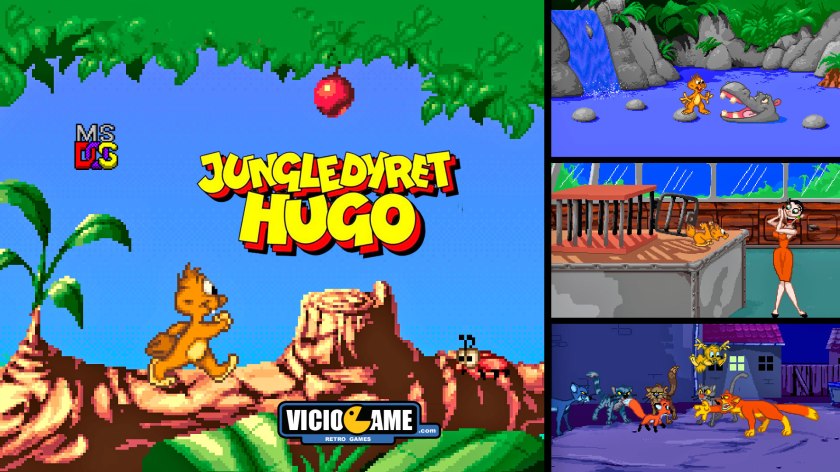
Jungledyret Hugo (released in the US as Jungle Jack) is a 2D platformer released in 1995 for MS-DOS. Based on the film of the same name, the game follows Hugo — a rare jungle creature who has been captured and put on display for commercial exploitation. His mission is to escape the city and find his way back to the wild.
Developer: Sweatbox Animation
Publisher: A. Film ApS / Per Holst Film A/S
Release date: 1995
Platform: PC MS-DOS
🇺🇸 Jungledyret Hugo was developed by the Danish studio Sweatbox Animation and released in 1995 as a merchandising product tied to the universe of the animated franchise of the same name, created by author and filmmaker Flemming Quist Møller. The Jungledyret Hugo franchise was born from a lullaby that Møller wrote for his own son, and that humble origin grew into one of the most beloved Scandinavian cultural products of the 1990s, spawning films, TV series, books, and, inevitably, a video game. The title was published by A. Film ApS and Per Holst Film A/S — the same production companies behind the franchise’s feature films — and was originally released in Denmark, Finland, Norway, and Sweden in 1995, remaining exclusive to Scandinavian countries and never receiving any official wide-scale distribution outside that region. This geographic limitation was a decisive factor in keeping the game virtually unknown to the rest of the world for decades, turning it into one of the most curious rarities in the history of MS-DOS games.
The first film in the franchise, released in 1993, was an animated feature produced by A. Film and became a landmark of Danish animation: it was the first Danish film to pioneerly use CGI backgrounds and digital painting software, and cost approximately 17 million Danish kroner to produce, with 150 animators working on it for a full year. Internationally known under titles such as “Jungle Jack” and “Go Hugo Go,” the film introduces Hugo — an apparently one-of-a-kind creature who lives in the forest in a carefree and playful existence, full of mischief alongside his monkey companions Zik and Zak. His idyllic lifestyle is shattered when he is captured by the wife of a famous film company’s director to star in a Hollywood-style movie. The game draws directly from this narrative universe, transposing the events and characters of the feature film into the interactive mechanics of a classic side-scrolling platformer.
Hugo escapes this obsessed villainess and faces a series of dangers throughout the city, including cats and other obstacles. With the help of Rita the fox, he must reach a boat that will take him back home. This premise, faithful to the spirit of the original film, gives the game a narrative of escape and survival that spans distinct environments — from lush jungle to the streets and buildings of Copenhagen — visually replicating the characters’ journey on the big screen.
Hugo is described as a young and rare fictional mammal of the previously unknown species Hugus Primiticus. He has the appearance of a teddy bear — or a koala — with yellowish fur, large fluffy ears, three-fingered prehensile hands with a thumb, and four-toed feet. He is bipedal, though he can run on all fours for greater speed. He is known for his cleverness, his kind heart, his love of food, his tendency to boast, and his mischievous nature. Rita the fox is Hugo’s main ally, helping him navigate the dangers of the city and find his way to the harbor. Her presence in the game mirrors the companionship arc that defines the film, and her appearances serve both as a narrative element and as motivation for the player to push forward.
Development of the game began in the spring of 1995, when the Sweatbox Animation team was hired to create a CD-ROM game as a sort of merchandising product for Hugo’s animated productions — the second of which was in production at the time. Dan Harder took on the role of game director and art director for the project, drawing heavy inspiration from Disney’s recently released The Lion King game, which featured high-quality classic animation. Harder had worked on the animation for the first feature film just a few years prior, putting him in an ideal position to maintain visual consistency with the source material. He was responsible for the majority of the character animation, often working at night when he wasn’t occupied with other duties such as directing, gameplay planning, and production. Danish animator Martin Madsen contributed additional work on the Hugo character, and both had prior experience animating the first feature film, ensuring stylistic fidelity to the original material.
The animation process was rigorous: once a raw animation segment was completed, the drawings were scanned and resized to fit the screen’s low resolution. Each pose was then meticulously colored pixel by pixel — a process known as pixelation. Since the pixels were quite large on screen — at a resolution of 320 x 200 pixels — each one had to be carefully considered to achieve the ideal visual effect. The pixelation work was carried out primarily by Karsten Lund, with contributions from twins Jesper and Thomas Colding-Jørgensen. Each character bitmap also included positioning data that allowed the program to correctly execute each pose within the animation sequence. Hugo’s in-game movements cover actions such as stopping, walking, stumbling, running, jumping, grabbing a horizontal line, performing tree movements, and swinging — showing an uncommon attention to motion fluidity given the technical and budgetary standards of the time.
The game was published by Per Holst Film for the DOS platform and released in Europe in 1995. The choice of CD-ROM format — still relatively new to the games market in the early 1990s — allowed for significantly more data storage and richer audiovisual content than traditional floppy disk-distributed games. This was crucial in allowing the team to include detailed backgrounds, fluid animations, and an elaborate soundtrack — a combination that set the title apart from most low-budget productions of the era. The game was also registered under the alternative names Viidakkovekara Juuso (in the Finnish version), Jungle Jack, Jungledyret, and Jungeldyret, reflecting its distribution across multiple Scandinavian languages.
In terms of gameplay, Jungledyret Hugo is a platformer with no weapons: Hugo can jump on enemies’ heads to avoid or defeat them. The game’s power-ups are Hugo’s favorite fruits, which replenish energy and boost the score. The scoring system encourages players to collect as many fruits as possible while progressing through the stages, adding a layer of strategy to level navigation. The mechanic of jumping on enemies draws directly from the style popularized by franchises like Super Mario Bros., adapting the familiar formula to Hugo’s visual and narrative context. The game features both lush jungle environments and urban settings, and includes a skateboarding stage with a parallax scrolling effect — a technique that simulates depth of field by moving different layers of the background at different speeds — which the developers themselves considered one of the most technically sophisticated and well-executed moments in the entire production.
The game’s soundtrack was composed by Johannes Bjerregaard, a musician who worked on several Danish productions of the era. The music matches the light and adventurous tone of the Hugo universe, with themes that evoke both the tropical atmosphere of the jungle stages and a more urban, tense feel in the city-based levels. The soundtrack was produced to the typical audio standards of MS-DOS, making use of the audio chips available in PCs of the time, including support for the Sound Blaster card and the Yamaha OPL2/OPL3 chip — the most common audio resources in home computers throughout the 1990s.
The game contains a curious easter egg: by replacing the HIGHSCORE file located in the EXEC folder with the equivalent file found in the DATA folder, a previous high score ranking is revealed — one left behind by the developers themselves during the creation process. One of the entries in this development leaderboard contains the phrase “Kalle er dum ha,” which in Danish means “Kalle is dumb, ha” — a classic internal joke of the kind that development teams rarely leave in final game builds. This type of hidden content reveals the human and lighthearted side of the small team that made the title. Additionally, during gameplay, players can simultaneously press Caps Lock, F12, and Insert to skip directly to the next level — a cheat code that functions as a hidden stage select, most likely inserted during internal development testing to make it easier to check each stage individually.
Jungledyret Hugo is considered a rather obscure game, released exclusively in Scandinavian countries, which drastically limited its visibility and, consequently, its sales. Dan Harder himself lamented the game’s poor sales figures, even recounting reports of people who couldn’t find it in stores at all. This weak commercial performance stands in stark contrast to the technical and artistic quality the team clearly aspired to achieve. It is an exemplary case of a licensed market product that exceeded creative expectations but failed at distribution — a recurring phenomenon in the segment of games based on niche intellectual properties.
Despite the obvious visual and nominal similarities, it is essential not to confuse this title with the famous TV Troll franchise. Although both are Danish icons born in the late 1980s, they are entirely distinct intellectual properties that coexisted thanks to a curious cultural loophole: while Flemming Quist Møller’s Hugo originated in literature as a rare jungle animal, ITE’s Hugo was conceived as a folkloric being (a troll) for the interactive technology market. Legally, the distinction between their “species” and their registration in different media (cinema vs. interactive software) prevented litigation, though the coexistence was never exactly friendly. The creator of Jungledyret Hugo was, in fact, known for his purist stance, even publicly dismissing his TV “cousin” as a purely commercial creation aesthetically inferior to his own authorial work.
The franchise that gave rise to the game continued to expand after 1995: a second animated feature film was produced, followed by an animated television series and a third film made entirely in CGI. The first two films were translated, edited, and released in the United States on a single DVD in 1998 by Miramax Family, under the titles “Go Hugo Go” and “Hugo the Movie Star,” respectively. The third film was released on Region 1 DVD on August 12, 2014, under the title “Amazon Jack.”
The PC game was the only interactive product directly derived from the first feature film, occupying a special place in the franchise’s timeline — a point of contact between animation and video games that reflects both the entrepreneurial spirit of Scandinavian studios and the technical and commercial challenges of independent game development in the first half of the 1990s. For anyone who grew up in Scandinavia during that period and followed Hugo’s adventures on screen and at the computer, Jungledyret Hugo represents a nostalgic chapter of a creative era that knew how to transform simple, heartfelt stories into lasting experiences.
🇧🇷 Jungledyret Hugo foi desenvolvido pelo estúdio dinamarquês Sweatbox Animation e lançado em 1995 como produto de merchandising atrelado ao universo da franquia de animação homônima criada pelo autor e cineasta Flemming Quist Møller. A franquia Jungledyret Hugo nasceu de uma canção de ninar que Møller criou para o próprio filho, e essa origem singela evoluiu até se tornar um dos produtos culturais escandinavos mais queridos dos anos 1990, gerando filmes, séries, livros e, inevitavelmente, um jogo eletrônico. O título foi publicado por A. Film ApS e Per Holst Film A/S, as mesmas produtoras responsáveis pelos longas-metragens da franquia, e foi lançado originalmente na Dinamarca, Finlândia, Noruega e Suécia em 1995, permanecendo restrito aos países escandinavos e nunca tendo recebido uma distribuição oficial em larga escala fora dessa região. Essa limitação geográfica foi determinante para que o jogo permanecesse praticamente desconhecido do restante do mundo durante décadas, transformando-o em uma das raridades mais curiosas da história dos jogos para MS-DOS.
O primeiro filme da franquia, lançado em 1993, foi uma animação produzida pela A. Film e se tornou um marco da animação dinamarquesa: foi o primeiro filme dinamarquês a pioneiramente utilizar fundos em CGI e software de pintura digital, e custou cerca de 17 milhões de coroas dinamarquesas para ser produzido, envolvendo 150 animadores trabalhando por um ano. Conhecido internacionalmente sob títulos como “Jungle Jack” e “Go Hugo Go”, o filme apresenta Hugo, uma criatura aparentemente única em seu tipo, que vive na floresta numa existência jovial e despreocupada, repleta de travessuras com seus companheiros macacos Zik e Zak. Seu estilo de vida perfeito é interrompido quando ele é capturado pela esposa do diretor de uma famosa companhia cinematográfica para estrelar um filme ao estilo hollywoodiano. O jogo parte precisamente deste universo narrativo, transpondo os eventos e personagens do longa para a mecânica interativa de um clássico jogo de plataforma de rolagem lateral.
Hugo foge dessa vilã obcecada e se depara com uma série de perigos na cidade, incluindo gatos e outros obstáculos. Com a ajuda de Rita, a raposa, ele precisa chegar a um barco que o levará de volta para casa. Essa premissa, fiel ao espírito do filme original, empresta ao jogo uma narrativa de fuga e sobrevivência que percorre ambientes distintos, passando da selva exuberante até as ruas e construções urbanas de Copenhagen, replicando visualmente a jornada dos personagens na tela grande.
Hugo é descrito como um jovem e raro mamífero fictício da espécie anteriormente desconhecida Hugus Primiticus. Ele tem aparência de ursinho de pelúcia — ou de coala —, com pelo amarelado, grandes orelhas felpudas, mãos preênseis com três dedos e um polegar, e pés com quatro dedos. É bípede, embora possa correr em modo quadrúpede para maior velocidade. É famoso por sua esperteza, seu coração bondoso, seu amor por comida, sua tendência a se vangloriar e suas travessuras. Rita, a raposa, é a aliada principal de Hugo, que o ajuda a atravessar os perigos da cidade e a encontrar o caminho para o porto. A presença dela no jogo replica o arco de companheirismo que define o filme, e sua aparição serve tanto como elemento narrativo quanto como motivação para o jogador avançar.
O desenvolvimento do jogo começou na primavera de 1995, quando a equipe da Sweatbox Animation foi contratada para criar um jogo em CD-ROM como uma espécie de produto de merchandising para as produções animadas de Hugo — a segunda delas estava em produção naquele momento. Dan Harder assumiu o papel de diretor do jogo e diretor de arte do projeto, inspirando-se fortemente no jogo do The Lion King recém-lançado pela Disney, que trazia animações clássicas de alta qualidade. Harder havia trabalhado na animação do primeiro longa apenas alguns anos antes, o que o colocou em posição privilegiada para manter a coerência visual com o material de origem. Ele foi responsável pela maior parte da animação do personagem, trabalhando frequentemente à noite, quando não estava ocupado com outras funções como a direção, o planejamento da jogabilidade e a produção da obra. O animador dinamarquês Martin Madsen colaborou com trabalho adicional no personagem de Hugo, e ambos tinham experiência prévia na animação do primeiro longa, o que garantiu fidelidade estilística ao material original.
O processo de animação era rigoroso: quando um segmento de animação bruta era concluído, os desenhos eram digitalizados e redimensionados para se adequar à baixa resolução da tela. Em seguida, cada pose era meticulosamente colorida pixel por pixel — um processo conhecido como pixelation. Como os pixels eram bastante grandes na tela — numa resolução de 320 x 200 pixels —, cada um deles precisava ser cuidadosamente considerado para se obter o efeito visual ideal. O trabalho de pixelation foi realizado principalmente por Karsten Lund, com a participação dos gêmeos Jesper e Thomas Colding-Jørgensen. Cada bitmap do personagem também incluía informações de posicionamento que permitiam ao programa executar corretamente cada pose dentro da sequência de animação. Os movimentos de Hugo no jogo cobrem ações como parar, caminhar, tropeçar, correr, saltar, agarrar uma linha horizontal, fazer movimentos em árvores e balançar, demonstrando uma atenção incomum à fluidez de movimentos para os padrões técnicos e orçamentários da época.
O jogo foi publicado pela Per Holst Film para a plataforma DOS, lançado na Europa em 1995. A escolha do formato CD-ROM, ainda relativamente novo para o mercado de jogos no início dos anos 1990, permitia armazenar uma quantidade maior de dados e oferecer conteúdo audiovisual mais rico do que os tradicionais jogos distribuídos em disquete. Isso foi determinante para que a equipe pudesse incluir fundos detalhados, animações fluidas e uma trilha sonora elaborada — uma combinação que distinguia o título da maioria das produções de baixo orçamento da época. O título ficou também registrado sob os nomes alternativos Viidakkovekara Juuso (na versão finlandesa), Jungle Jack, Jungledyret e Jungeldyret, evidenciando sua distribuição em múltiplos idiomas escandinavos.
Em termos de gameplay, Jungledyret Hugo é um jogo de plataforma no qual não existem armas: Hugo pode saltar sobre a cabeça dos inimigos para evitá-los ou eliminá-los. Os power-ups do jogo são as frutas favoritas de Hugo, que reabastece energia e aumenta a pontuação. O sistema de pontuação encoraja o jogador a coletar o maior número possível de frutas enquanto avança pelos estágios, adicionando uma camada de estratégia à navegação pelas fases. A mecânica de saltar sobre inimigos remete diretamente ao estilo popularizado por franquias como Super Mario Bros., adaptando a fórmula já conhecida ao contexto visual e narrativo de Hugo. O jogo apresenta tanto ambientes de selva exuberante quanto cenários urbanos, e inclui uma fase de skate com efeito de parallax scrolling — uma técnica que simula profundidade de campo movimentando diferentes camadas do cenário em velocidades distintas —, que foi considerado pelos próprios desenvolvedores como um dos momentos técnicos mais sofisticados e bem-executados de toda a produção.
A trilha sonora do jogo foi composta por Johannes Bjerregaard, um músico que atuou em várias produções dinamarquesas da época. A música acompanha o tom leve e aventureiro do universo de Hugo, com temas que remetem tanto à atmosfera tropical das fases de selva quanto a um clima mais urbano e tenso nas fases que se passam pela cidade. A trilha foi produzida para os padrões sonoros típicos do MS-DOS, utilizando os chips de áudio disponíveis nos PCs da época, incluindo suporte à placa Sound Blaster e ao chip OPL2/OPL3 da Yamaha, que eram os recursos de áudio mais comuns nos computadores domésticos dos anos 1990.
O jogo guarda um easter egg curioso: ao substituir o arquivo HIGHSCORE localizado na pasta EXEC pelo arquivo equivalente encontrado na pasta DATA, é revelado um ranking de pontuação anterior, deixado pelos próprios desenvolvedores durante o processo de criação. Uma das entradas desse ranking de desenvolvimento contém a frase “Kalle er dum ha”, que em dinamarquês significa “Kalle é burro, ha” — uma piada interna típica de equipes de desenvolvimento que raras vezes se mantém em versões finais de jogos. Esse tipo de conteúdo oculto, revela o lado humano e descontraído da pequena equipe que produziu o título. Além disso, durante o jogo é possível pressionar simultaneamente as teclas Caps Lock, F12 e Insert para avançar diretamente ao próximo nível, um cheat code que funciona como um seletor de fase oculto e que provavelmente foi inserido durante os testes internos de desenvolvimento para facilitar a verificação de cada estágio.
Jungledyret Hugo é considerado um jogo bastante obscuro, lançado exclusivamente nos países escandinavos, o que limitou drasticamente sua visibilidade e, consequentemente, suas vendas. O próprio Dan Harder lamentou as baixas vendas do jogo, mencionando inclusive relatos de pessoas que nem conseguiram encontrá-lo nas lojas. Esse fraco desempenho comercial contrasta com a qualidade técnica e artística que a equipe claramente ambicionou alcançar. Trata-se de um caso exemplar de produto de mercado licenciado que superou as expectativas criativas mas falhou na distribuição, um fenômeno recorrente no segmento de jogos baseados em propriedades intelectuais de nicho.
Apesar da óbvia semelhança visual e nominal, é fundamental não confundir este título com a franquia do famoso Troll da TV. Embora ambos sejam ícones dinamarqueses nascidos no final dos anos 80, tratam-se de propriedades intelectuais distintas que coexistiram graças a uma curiosa brecha cultural: enquanto o Hugo de Flemming Quist Møller nasceu na literatura como um animal raro da selva, o Hugo da ITE foi concebido como um ser folclórico (troll) para o mercado de tecnologia. Juridicamente, a distinção de suas ‘espécies’ e o registro em meios diferentes (cinema vs. software interativo) evitaram litígios, embora a convivência nunca tenha sido exatamente amigável. O criador do Jungledyret Hugo, inclusive, era conhecido por sua postura purista, chegando a desdenhar publicamente do ‘primo’ da TV, classificando-o como uma criação puramente comercial e esteticamente inferior à sua obra autoral.
A franquia que originou o jogo continuou a se expandir após 1995: um segundo longa-metragem de animação foi produzido, seguido por uma série animada para televisão e por um terceiro filme realizado inteiramente em CGI. Os dois primeiros filmes foram traduzidos, editados e lançados nos Estados Unidos em um único DVD em 1998 pela Miramax Family, sob os títulos “Go Hugo Go” e “Hugo the Movie Star”, respectivamente. Já o terceiro filme, foi lançado em DVD para a região 1 em 12 de agosto de 2014 sob o título “Amazon Jack”.
O jogo de PC foi o único produto interativo diretamente derivado do primeiro longa-metragem, ocupando um lugar especial na cronologia da franquia — um ponto de contato entre a animação e os jogos eletrônicos que reflete tanto o espírito empreendedor dos estúdios escandinavos quanto os desafios técnicos e comerciais do desenvolvimento de jogos independentes na primeira metade dos anos 1990. Para quem cresceu na Escandinávia naquele período e acompanhou as aventuras de Hugo nas telas e nos computadores, Jungledyret Hugo representa uma fase nostálgica de uma era criativa que soube transformar histórias simples e afetivas em experiências duradouras.
🤑💲Earn money without doing anything! Just leave these apps open:
✓ https://r.honeygain.me/CONTA9DB02
✓ https://packetstream.io/?psr=1uPb
🤑💲1-Click button earns Bitcoin every 1 hour: https://freebitco.in/?r=53528449
⬛ 𝗧𝗶𝗸𝗧𝗼𝗸: https://www.tiktok.com/@viciogame
🟧 𝗜𝗻𝘀𝘁𝗮𝗴𝗿𝗮𝗺: http://www.instagram.com/viciogame
🟥 𝗬𝗼𝘂𝘁𝘂𝗯𝗲: http://www.youtube.com/viciogame
🟦 𝗙𝗮𝗰𝗲𝗯𝗼𝗼𝗸: http://www.facebook.com/viciogame
🔳 𝗧𝗵𝗿𝗲𝗮𝗱𝘀: https://www.threads.net/@viciogame
🟪 𝗧𝘄𝗶𝘁𝗰𝗵: https://www.twitch.tv/ViciogameRetroGames
🟨 𝗕𝗹𝗼𝗴: http://www.viciogameblog.com/
🟦𝗧𝘄𝗶𝘁𝘁𝗲𝗿: http://www.twitter.com/viciogame
#Viciogame #Gameplay #LetsPlay #Playthrough #Games #Gaming #Videogames #Review #Game #Detonado #Walkthrough #Ending #Reviews #Facts #Retro #RetroGaming #Roms #Emulator #Longplay #Speedrun #NoCommentary #JungledyretHugo #Jungledyret #Hugo #JungleJack #PC #PcGaming #msdos #windows #dosgames #DanHarder #FlemmingQuistMoller #Disney #animation #cartoon

