
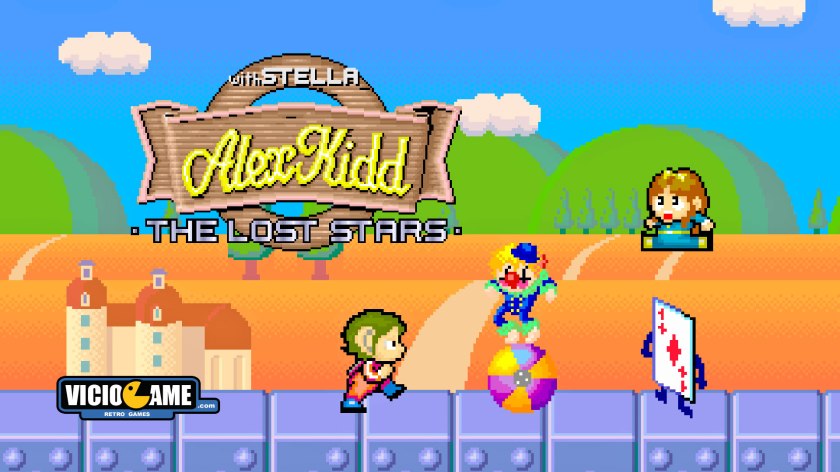
Alex Kidd With Stella: The Lost Stars is a 2D platformer released in 1986 for arcades. Shortly after the events of Miracle World, Alex Kidd discovers that the twelve stars of the Aries constellation have been stolen from the sky, and must follow in the footsteps of an ancient ancestor to get them back.
Developer: Sega R&D 1
Publisher: Sega Enterprises, Ltd.
Release date: 1986
Platform: Arcade Sega System 16 board
🇺🇸 Alex Kidd: The Lost Stars was originally released in December 1986, exclusively in Japan for the arcade format, becoming an important piece both in the company’s history and in the trajectory of its first official mascot. The full Japanese title is アレックスキッド ザ・ロストスターズ (Arekkusu Kiddo Za Rosuto Sutāzu), and the game also circulated in arcades under the compound name Alex Kidd With Stella: The Lost Stars, a direct reference to the cooperative mode the version offers. Released just a few months after Alex Kidd in Miracle World for the Sega Master System, this title represents the character’s only foray into the arcade universe, setting itself apart from the entire series through certain design choices and a distinct visual and sonic identity shaped by the hardware capabilities of the era.
From a technical standpoint, Alex Kidd: The Lost Stars runs on the Sega System 16A board, one of the most respected arcade platforms of the second half of the 1980s. It was based on a 16-bit Motorola 68000 processor capable of displaying colorful graphics, detailed sprites, and smooth screen scrolling — the same technological foundation that powered classics such as Altered Beast, Golden Axe, and Shinobi.
The creative team behind the game featured Hiroshi Kawaguchi as composer of the soundtrack. He is one of the most revered names in Sega’s musical history: in 1986, one of his most prolific years, he simultaneously worked on the soundtracks for OutRun, Fantasy Zone, and Alex Kidd: The Lost Stars, as well as a track for Enduro Racer — an incredible feat considering how distinctly different all three main projects sound from one another. The game’s music is characterized by cheerful, fast-paced compositions with a festive energy that perfectly matches the unusual settings the player travels through. The soundtrack is extremely catchy, and the graphics stand out for being bright, colorful, and full of detail. A soundtrack album was released in a limited edition by Sony Music Entertainment in partnership with Scitron on February 19, 2003, titled Sega Arcade 80’s Vol.1, compiling Kawaguchi’s compositions for Sega’s classics from that period.
The game’s narrative is set in the fantastical universe of Miracle World, the planet Aries where Alex Kidd lives. The twelve stars of the Aries constellation have been stolen from the sky, and Alex climbs to the top of Mount Eternal in search of answers, where he encounters the elderly wizard Daleda reading a magical scroll. Daleda reveals that more than five thousand years ago, an evil creature named Ziggurat committed the same crime, and that one of Alex’s ancestors — Halifax Kidd — traveled beyond the limits of space and time to defeat Ziggurat and return the stars to the sky. Now Ziggurat has returned to fulfill his promise of darkness, and Alex must follow in Halifax’s footsteps on this interdimensional journey. The premise, while presented simply given the arcade format, offers a consistent mythology for the Alex Kidd universe and connects the game directly to the context established in Alex Kidd in Miracle World.
One of the most distinctive characteristics of Alex Kidd: The Lost Stars compared to other titles in the series is the complete absence of Alex’s famous punch. Unlike the other entries in the series, Alex and Stella have no means of directly attacking enemies — except for the rare power-up that allows them to fire a burst shaped like the character’s own body — making it necessary to dodge, maneuver around, and avoid obstacles and adversaries throughout the entire journey. This radical change in gameplay mechanics turned the game into an exercise in mobility and timing, bringing it closer to the structure of pure platformer runner games. The player dies from a single touch by any enemy or projectile, making progression demanding and requiring memorization of each stage’s patterns.
The central objective is to collect six Miracle Balls scattered throughout the stages, each hidden inside unusual objects such as golden eggs, Christmas presents, clam shells, pumpkins, and hotel desk bells. One of the Miracle Balls is hidden inside Opa-Opa, the iconic character from Fantasy Zone — another Sega classic — appearing specifically in Round 2 of the game. It’s an affectionate reference that reinforces the shared universe Sega cultivated across its 1980s arcades. At the start of each stage, a digitized voice announces “FIND THE MIRACLE BALL!”, and when inserting credits into the machine, another digitized message greets the player with “THE CUSTOMER IS KING!” — a personality detail that made the experience feel more lively inside Japanese arcades of the era.
The game’s stages travel through themed settings with considerable visual creativity for the technical standards of 1986. Locations include Toy World, Machine World, World of Make Believe, Water World, and Monster World, in addition to a section set inside the body of a giant. After collecting all six Miracle Balls, Alex must face all previously completed stages again, now with different or more numerous enemies — a second loop that functions as an additional layer of difficulty for more skilled players. At the end of this journey, Alex enters Ziggurat’s pyramid — called the Shrine of Jiggarat — and the constellations are returned to the sky, though without a direct confrontation with the villain, unlike what happens in the Sega Master System version.
The game’s enemies feature extravagant designs befitting the surreal tone of the settings. One of the bosses is a fleshless bear head wearing a party hat, attacking with musical notes blown from its trumpet; in the Halloween-themed stage, a punk rocker fires skulls at the player. This gallery of absurd and well-animated antagonists gives the game a distinct visual identity within the arcade landscape of the era — even by Sega’s own standards, a company known for embracing unusual characters and situations.
The game’s power-up system is simple yet strategic. The item marked with the letter “J” temporarily increases Alex’s jump height, allowing him to reach higher platforms or avoid hard-to-dodge enemies. The “S” item grants a limited number of shots — the so-called shadow shots — capable of eliminating most enemies. The “SP” item replenishes the available time, which is a critical resource: the player operates under a constant time limit, and if it expires, a life is lost. Careful management of these items is essential for progressing through the more advanced stages, especially during the enemy rush sequences at the end of each level, where multiple foes attempt to block the player’s path simultaneously.
The arcade version comes with three lives by default, making it significantly more punishing than the home version. The most important distinguishing feature is the simultaneous two-player cooperative mode — the only title in the entire franchise to feature this — as well as being the only game to present Stella as a playable character. Stella, controlled by the second player, is a female counterpart to Alex, with similar appearance and movements. She does not appear in any other game in the series, making The Lost Stars her sole canonical appearance. Interestingly, both Alex and Stella appear as names on gravestones in the first level of Altered Beast, another Sega arcade from the same period — a humorous (or peculiar) cross-reference between the two titles.
The Sega Master System version, released in Japan on March 10, 1988, and in the West in the following months, brought considerable adaptations compared to the arcade original. The soundtrack was arranged by Kawaguchi himself for the domestic hardware’s sound capabilities, as confirmed by the liner notes of the Alex Kidd Complete Album. Despite the evident reduction in color palette and audio quality compared to the original, the home version still holds up as a functional game, though the stage design and relatively short time limits can be sources of frustration. The title grants the player unlimited lives, but being hit or falling into pits reduces the available time and sends the character back to the last visited checkpoint. The cooperative mode and the character Stella were not included in the port.
The game was later made available on the Wii Virtual Console in Japan on February 17, 2009, in North America on March 9, 2009, and in PAL regions on April 17 of the same year — always in the Sega Master System version. The original arcade version, however, remained inaccessible to the general public outside Japanese arcades for decades — until Sega released the Astro City Mini, a dedicated miniature console with a selection of classic titles. Alex Kidd: The Lost Stars is part of its library, with the device launching in Japan on December 17, 2020, in North America on March 26, 2021, and in Europe on June 22, 2021 — marking the first time the arcade version was officially made available to consumers outside Japan. This represented an important milestone, allowing an entire generation of fans to experience the original version of the game for the first time on legitimate hardware.
In the broader context of the franchise, it continued with Alex Kidd BMX Trial (1987, Japan only), Alex Kidd: High-Tech World (1987), Alex Kidd in the Enchanted Castle (1989, for the Sega Mega Drive), and finally Alex Kidd in Shinobi World (1990), before Alex was gradually replaced by Sonic the Hedgehog as the company’s mascot starting in 1991. Despite the obscurity that followed, Alex Kidd resurfaced as a playable character in titles such as Sega Superstars Tennis, Sonic & Sega All-Stars Racing, and Sonic & Sega All-Stars Racing Transformed, as well as appearing as a collectible in Shenmue and as a support character in Project X Zone 2. In 2021, the character received a major tribute with the release of Alex Kidd in Miracle World DX, a remake of the game that launched him to fame — though The Lost Stars was not given a similar treatment.
Alex Kidd: The Lost Stars represents a rarely remembered yet genuinely fascinating chapter from one of Sega’s most creative periods. The game transcends its reputation as a “step back” from Miracle World to reveal itself as a product perfectly coherent with the environment for which it was conceived: the loud, luminous, and fleeting world of 1980s Japanese arcades. It endures as a reflection of Sega’s inventive spirit and the remarkable career of the big-eared mascot who, for a few golden years, carried on his shoulders the weight of representing one of the most important video game companies of all time.
🇧🇷 Alex Kidd: The Lost Stars foi lançado originalmente em dezembro de 1986 exclusivamente no Japão para o formato arcade, tornando-se uma peça importante tanto na história da empresa quanto na trajetória de seu primeiro mascote oficial. O título completo em japonês é アレックスキッド ザ・ロストスターズ (Arekkusu Kiddo Za Rosuto Sutāzu), e o jogo também circulou nos fliperamas sob o nome composto Alex Kidd With Stella: The Lost Stars, em referência direta ao modo cooperativo que a versão oferece. Lançado poucos meses após Alex Kidd in Miracle World para o Sega Master System, o título representa a única incursão do personagem no universo dos fliperamas, diferenciando-se de toda a série por algumas escolhas de design e por uma identidade visual e sonora própria, moldada pelas capacidades do hardware da época.
Do ponto de vista técnico, Alex Kidd: The Lost Stars roda sobre a placa Sega System 16A, uma das plataformas de arcade mais respeitadas da segunda metade da década de 1980. Era baseada em um processador Motorola 68000 de 16 bits, capaz de exibir gráficos coloridos, sprites detalhados e rolagem de tela suave, e foi o mesmo substrato tecnológico que sustentou clássicos como Altered Beast, Golden Axe e Shinobi.
A equipe criativa por trás do jogo contou com Hiroshi Kawaguchi no papel de compositor da trilha sonora. Ele é um dos nomes mais reverenciados da história musical dos jogos da Sega: em 1986, um de seus anos mais prolíficos, ele trabalhou simultaneamente na trilha sonora de OutRun, de Fantasy Zone e de Alex Kidd: The Lost Stars, além de uma faixa para Enduro Racer, uma façanha incrível considerando como os três projetos principais soam completamente distintos entre si. A música do jogo é marcada por composições alegres, aceleradas e com uma energia de festa que combina perfeitamente com os cenários inusitados que o jogador percorre. A trilha é extremamente cativante, e os gráficos se destacam por serem brilhantes, coloridos e repletos de detalhes. Um álbum de trilhas sonoras foi lançado em edição limitada pela Sony Music Entertainment em parceria com a Scitron em 19 de fevereiro de 2003, intitulado Sega Arcade 80’s Vol.1, reunindo composições de Kawaguchi para os clássicos da Sega desse período.
A narrativa do jogo situa-se no universo fantástico de Miracle World, o planeta Aries onde Alex Kidd vive. As doze estrelas da constelação de Aries foram roubadas do céu, e Alex sobe ao topo do Monte Eternal em busca de respostas, onde encontra o ancião mago Daleda lendo um pergaminho mágico. Daleda revela que há mais de cinco mil anos uma criatura maligna chamada Ziggurat havia cometido o mesmo crime, e que um ancestral de Alex chamado Halifax Kidd viajou além dos limites do espaço e do tempo para derrotar Ziggurat e devolver as estrelas ao céu. Agora, Ziggurat retornou para cumprir sua promessa de escuridão, e Alex precisa seguir os passos de Halifax nessa jornada interdimensional. A premissa, embora apresentada de forma simples pela natureza do suporte arcade, oferece uma mitologia consistente para o universo de Alex Kidd e conecta o jogo diretamente ao contexto estabelecido em Alex Kidd in Miracle World.
Uma das características mais marcantes de Alex Kidd: The Lost Stars em relação aos outros títulos da série é a completa ausência do famoso soco de Alex. Diferentemente dos demais títulos da série, Alex e Stella não têm meios de atacar diretamente os inimigos, exceto pelo raro power-up que permite disparar uma rajada em formato do próprio corpo do personagem, sendo necessário desviar, contornar e evitar obstáculos e adversários ao longo de toda a jornada. Essa mudança radical de mecânica transformou o jogo em um exercício de mobilidade e timing, aproximando-o da estrutura do gênero runner de plataforma pura. O jogador morre com um único toque de qualquer inimigo ou projétil, o que torna a progressão exigente e demanda memorização dos padrões de cada fase.
O objetivo central é coletar seis Miracle Balls espalhadas pelas fases, cada uma escondida dentro de objetos inusitados como ovos dourados, presentes de Natal, conchas de mariscos, abóboras e sinos de balcão. Uma das Miracle Balls está escondida dentro de Opa-Opa, o icônico personagem de Fantasy Zone, outro clássico da Sega, aparecendo especificamente no Round 2 do jogo — uma referência afetiva que reforça o senso de universo compartilhado que a Sega cultivava em seus arcades dos anos 1980. No início de cada fase, uma voz digitalizada anuncia “FIND THE MIRACLE BALL!“, e ao inserir créditos na máquina, outra mensagem digitalizada saúda o jogador com “THE CUSTOMER IS KING!“, um detalhe de personalidade que tornava a experiência mais viva dentro dos fliperamas japoneses da época.
As fases do jogo percorrem cenários temáticos com uma criatividade visual considerável para os padrões técnicos de 1986. Os locais incluem Toy World, Machine World, World of Make Believe, Water World e Monster World, além de uma seção ambientada no interior do corpo de um gigante. Após coletar as seis Miracle Balls, Alex precisa enfrentar novamente todas as fases já percorridas, agora com inimigos diferentes ou em maior quantidade, numa segunda volta que funciona como uma camada adicional de dificuldade para os jogadores mais habilidosos. Ao final dessa jornada, Alex entra na pirâmide de Ziggurat — denominada Shrine of Jiggarat — e as constelações são devolvidas ao céu, sem que haja um confronto direto com o vilão, ao contrário do que acontece na versão para Sega Master System.
Os inimigos do jogo têm um design extravagante, condizente com o tom surreal dos cenários. Um dos bosses é uma cabeça de urso descarnada com chapéu de festa, que ataca com notas musicais vindas de sua trombeta; na fase temática de Halloween, um punk rocker dispara caveiras em direção ao jogador. Essa galeria de antagonistas absurdos e bem animados conferem ao jogo uma identidade visual bastante distinta dentro do panorama dos fliperamas da época, mesmo para os padrões da Sega, conhecida por não fugir de personagens e situações incomuns.
O sistema de power-ups do jogo é simples, porém estratégico. O item identificado pela letra “J” aumenta temporariamente a altura do salto de Alex, permitindo alcançar plataformas mais altas ou evitar inimigos difíceis de contornar. O item “S” concede um número limitado de disparos, os chamados shadow shots, capazes de eliminar a maioria dos inimigos. O item “SP” reabastece o tempo disponível, que é um recurso crítico: o jogador está sob um limite de tempo constante, e caso o tempo expire, uma vida é perdida. O gerenciamento cuidadoso desses itens é essencial para progredir nas fases mais avançadas, especialmente nas sequências de encontro ao final de cada nível, onde múltiplos inimigos tentam bloquear a passagem simultaneamente.
A versão de arcade possui três vidas por padrão, o que a torna significativamente mais punitiva do que a versão doméstica. O diferencial mais importante é o modo cooperativo para dois jogadores simultâneos (o único título de toda a franquia a ter este recurso), além de ser o único jogo a apresentar Stella como personagem jogável. Stella, controlada pelo segundo jogador, é uma contrapartida feminina de Alex, com visual e movimentos semelhantes. Ela não aparece em nenhum outro jogo da série, tornando The Lost Stars sua única aparição canônica. Curiosamente, tanto Alex quanto Stella figuram como nomes de lápides no primeiro nível de Altered Beast, outro arcade da Sega do mesmo período, numa referência cruzada bem-humorada (ou bizarra) entre os dois títulos.
A versão para o Sega Master System, lançada no Japão em 10 de março de 1988 e no Ocidente nos meses seguintes, trouxe adaptações consideráveis em relação ao arcade. A trilha sonora foi arranjada pelo próprio Kawaguchi para as capacidades de som do hardware doméstico, conforme confirmado pelo encarte do Alex Kidd Complete Album. Apesar da redução evidente na paleta de cores e na qualidade sonora em comparação ao original, a versão doméstica ainda se sustenta como um jogo funcional, embora o design de fases e os limites de tempo relativamente curtos possam ser fontes de frustração. O título concede vidas ilimitadas ao jogador, porém ser atingido ou cair em buracos reduz o tempo disponível e retrocede o personagem até o último checkpoint visitado. O modo cooperativo e a personagem Stella não foram incluídos no port.
O jogo foi posteriormente disponibilizado no Wii Virtual Console no Japão em 17 de fevereiro de 2009, na América do Norte em 9 de março de 2009 e nas regiões PAL em 17 de abril do mesmo ano, sempre na versão para Sega Master System. A versão original de arcade, no entanto, permaneceu por décadas inacessível ao grande público fora dos fliperamas japoneses — até que a Sega lançou o Astro City Mini, um console dedicado em miniatura com uma seleção de títulos clássicos. Alex Kidd: The Lost Stars integra a biblioteca, com o aparelho lançado no Japão em 17 de dezembro de 2020, na América do Norte em 26 de março de 2021 e na Europa em 22 de junho de 2021, sendo essa a primeira vez que a versão arcade foi oficialmente disponibilizada ao consumidor fora do Japão. Isso representou um marco importante, pois permitiu que uma geração inteira de fãs experimentasse a versão original do jogo pela primeira vez em hardware legítimo.
No contexto mais amplo da franquia, ela continuou com Alex Kidd BMX Trial (1987, apenas no Japão), Alex Kidd: High-Tech World (1987), Alex Kidd in the Enchanted Castle (1989, para o Sega Mega Drive) e finalmente Alex Kidd in Shinobi World (1990), antes de Alex ser gradualmente substituído por Sonic the Hedgehog como mascote da empresa a partir de 1991. Apesar do ostracismo que se seguiu, Alex Kidd reapareceu como personagem jogável em títulos como Sega Superstars Tennis, Sonic & Sega All-Stars Racing e Sonic & Sega All-Stars Racing Transformed, além de uma aparição como colecionável em Shenmue e como personagem-suporte no Project X Zone 2. Em 2021, o personagem recebeu uma grande homenagem com o lançamento de Alex Kidd in Miracle World DX, um remake do game que o lançou à fama, embora The Lost Stars não tenha sido contemplado com um tratamento semelhante.
Alex Kidd: The Lost Stars representa uma fase raramente lembrada, mas genuinamente fascinante, de um dos períodos mais criativos da Sega. O jogo transcende sua reputação de “passo atrás” em relação a Miracle World para revelar-se um produto coerente com o ambiente para o qual foi concebido: o barulhento, luminoso e efêmero mundo dos fliperamas japoneses dos anos 1980. Ele segue como reflexo do espírito inventivo da Sega e da carreira deslumbrante do mascote de grandes orelhas que, por alguns anos dourados, carregou nas costas o peso de representar uma das mais importantes empresas de videogames de todos os tempos.
🤑💲Earn money without doing anything! Just leave these apps open:
✓ https://r.honeygain.me/CONTA9DB02
✓ https://packetstream.io/?psr=1uPb
🤑💲1-Click button earns Bitcoin every 1 hour: https://freebitco.in/?r=53528449
⬛ 𝗧𝗶𝗸𝗧𝗼𝗸: https://www.tiktok.com/@viciogame
🟧 𝗜𝗻𝘀𝘁𝗮𝗴𝗿𝗮𝗺: http://www.instagram.com/viciogame
🟥 𝗬𝗼𝘂𝘁𝘂𝗯𝗲: http://www.youtube.com/viciogame
🟦 𝗙𝗮𝗰𝗲𝗯𝗼𝗼𝗸: http://www.facebook.com/viciogame
🔳 𝗧𝗵𝗿𝗲𝗮𝗱𝘀: https://www.threads.net/@viciogame
🟪 𝗧𝘄𝗶𝘁𝗰𝗵: https://www.twitch.tv/ViciogameRetroGames
🟨 𝗕𝗹𝗼𝗴: http://www.viciogameblog.com/
🟦𝗧𝘄𝗶𝘁𝘁𝗲𝗿: http://www.twitter.com/viciogame
#Viciogame #Gameplay #LetsPlay #Playthrough #Games #Gaming #Videogames #Review #Game #Detonado #Walkthrough #Ending #Reviews #Facts #Retro #RetroGaming #Roms #Emulator #Longplay #Speedrun #NoCommentary #AlexKidd #TheLostStars #Arcade #Stella #MiracleWorld #Mastersystem #Sega #Sonic #アレックスキッド #AlteredBeast #GoldenAxe #Shinobi #アーケードゲーム
 VICIOGAME