
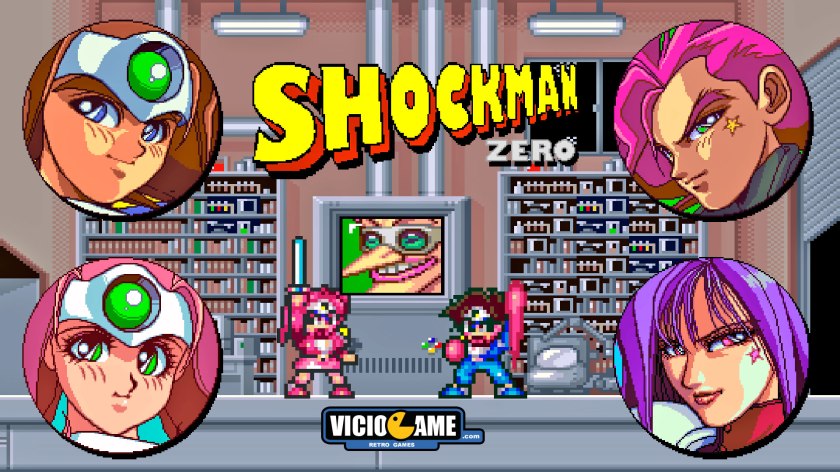
Shockman Zero (known in Japan as Kaizou Choujin Shubibinman Zero) is an action-platformer released in 1994 for the Super Nintendo. A heroic duo must stop a criminal organization from stealing a scientist’s invention — a creation so powerful that, in the wrong hands, it could lead to the catastrophic domination of the world.
Developer: Masaya Games
Publisher: NCS (Nippon Computer Systems)
Release date: 1994
Platform: Super Nintendo / Super Famicom
🇺🇸 Shockman Zero crossed decades and technological barriers to finally reach the hands of players around the world. Its original Japanese name is Kaizou Choujin Shubibinman Zero (改造町人シュビビンマン零), which can be loosely translated as “Remodeled Super-Human Shubibinman Zero,” and the game carries with it a development history just as fascinating as the gameplay it offers. This was the fourth and final entry in the Cyber Citizen Shockman series, and the first in the franchise to run on the Super Famicom. The previous games in the series were exclusive to the PC Engine, making the 16-bit Nintendo console entry a historic turning point within the franchise itself.
To understand the weight of Shockman Zero, it is necessary to go back to the series’ origins. Kaizou Choujin Schbibinman is a four-game series produced by NCS/Masaya, a developer far better known for its strategy RPGs, such as Langrisser. The franchise takes a satirical approach to the world of henshin anime and tokusatsu, like Kamen Rider, cranking the absurdity and exaggeration of those genres’ clichés up to the maximum — including heroes who transform into armored warriors and strike dramatic poses. This exaggerated, comedic identity is one of the greatest charms of the entire series, and Shockman Zero inherits that personality masterfully. Unfortunately, the series is almost completely unknown in the United States, with only its second entry reaching the Western market under the name Shockman.
The first game in the franchise, Kaizou Choujin Shubibinman, was developed by Winds for the PC Engine and published by NCS in 1989, serving as the series’ inaugural sci-fi title. The story follows Tasuke and Kyapiko, two Japanese students transformed into androids by an eccentric scientist named Doc (Dr. Gotokuji in Japanese), gifted with the ability to transform into armored superheroes. The second game, Kaizou Choujin Shubibinman 2: Aratanaru Teki, drops the world map of the first and adopts a stage-by-stage format, while also removing melee weapons in favor of shooting-focused action. The third chapter, Kaizou Choujin Shubibinman 3: Ikai no Princess, was released for the PC Engine CD-ROM and brings Tasuke and Kyapiko — now on vacation — being called upon to help an alien princess. This entry stands out for featuring animated cutscenes with voice acting and CD-quality music.
It is then that the story of Shockman Zero begins to get truly peculiar. The game was originally developed for the Super Famicom with a planned release in 1994. However, the finished game was held back and ultimately made available on the Satellaview as a downloadable title via internet satellite in March 1997. That three-year delay results in one of the most unusual circumstances in game development history: a fully completed title, ready to be released on a physical cartridge, that simply never makes it to market and instead gets “relegated” to a satellite distribution platform. The game’s own title screen still displays the year 1994, a silent witness to its original development.
The Satellaview, the platform that ultimately became Shockman Zero‘s first home, is a chapter unto itself in Japanese gaming history. The collaboration between Nintendo and satellite company St.GIGA produced the Satellaview, an add-on for the Super Famicom that allowed owners to download and play various titles or access media through special satellite-connected cartridges. It was a visionary idea for the time, but with an extremely limited reach: available only in Japan and dependent on specific broadcast schedules, the service operated similarly to a radio or television channel, where content was made available within predetermined time windows. Shubibinman Zero was broadcast for a one-month period on four occasions throughout 1997 and into early 1998, with players competing for high scores to win prizes. This meant that anyone who missed those specific windows simply lost the opportunity — a distribution model radically different from anything the Western world knew.
The Satellaview service shut down in June 2000, with several exclusive titles lost forever. Shockman Zero, fortunately, survived thanks to the preservation efforts of the fan community, which managed to capture the game’s data before the service permanently closed. That community was responsible for keeping the game accessible for years, long before any official re-release. In 2014, the company Extreme acquired the game’s copyright from Nippon Computer Systems.
From a narrative standpoint, Shockman Zero is not a direct sequel to the previous games in the series. The game introduces two new protagonists: Raita and Azuki. The story begins with the criminal group B.B. Dan invading the city with their cybernetic henchmen to steal the experimental engine invented by Dr. Gotokuji — the Gotokuji Engine. Behind it all is Dr. Shen Kung, an evil scientist leading the organization with the goal of world domination. It falls to the Schbibinman duo to stop these plans, working through eight stages filled with unique enemies and boss battles. The narrative is deliberately light and comedic, packed with over-the-top dialogue that references the world of Japanese tokusatsu — where absurd heroes face equally absurd villains with complete seriousness — creating a humorous contrast that is an essential part of the series’ charm.
Raita and Azuki are contrasting characters both visually and mechanically. Raita unleashes a Kamehameha-style attack that hits multiple times, while Azuki fires off an energy ball. Each also has a distinct special attack: Azuki’s energy kick is easier to execute and more powerful than Raita’s uppercut. Raita presents as a blue-themed boxer fighter, while Azuki is a pink-styled sword warrior — a clear nod to the Super Sentai universe, where the male hero and female hero pairing is a classic trope. Azuki has a slightly longer reach thanks to her sword, making her easier to control for beginner players. Together, the two can perform especially powerful combined attacks when played cooperatively.
The gameplay of Shockman Zero represents the most refined evolution of the entire franchise. Unlike previous entries, this is essentially a brawler. Both Raita and Azuki have a variety of melee moves that are easy to execute. Holding down the attack button allows players to charge an energy attack. The mechanics are straightforward, making the game easy to pick up, and — above all — it is free from the technical issues that affected the fluidity and responsiveness of its predecessors. The game plays like Mega Man with beat-‘em-up elements — or a beat-‘em-up with Mega Man elements, depending on your perspective. The brisk pacing, the absence of frustrating mechanics, and the varied enemy design keep players engaged from start to finish in every stage.
The single-player mode offers only one life and three continues, and with no save system, the player must complete the game in a single session. This arcade-style design is consistent with the game’s Satellaview origins, where the primary objective was to rack up the highest score possible. Avoiding killing enemies prevents the health bar from growing, making some boss battles more challenging. This system encourages players to engage every enemy, ensuring both survival and a competitive score. The two-player cooperative mode adds the ability to perform exclusive combined attacks, further enriching the experience.
Kaizou Choujin Schbibinman Zero makes playful, sweeping use of Japanese tokusatsu television clichés. Players guide a character through stages, punching, kicking, and firing special attacks at enemies reminiscent of Super Sentai’s “putty patrol,” scrolling left to right or bottom to top until reaching the boss. The boss battles are one of the game’s greatest strengths, displaying a creativity and variety that rivals titles from more prominent developers of the era, such as Treasure. The stage design is inventive in the way it regularly introduces new enemies and integrates them in welcome ways.
From a technical standpoint, Shockman Zero makes competent use of the console hardware’s capabilities, featuring well-animated sprites, varied backdrops, and a soundtrack that perfectly fits the game’s laid-back, high-energy tone. The color palette is vibrant and expressive, and the main characters’ sprites have fluid animations that communicate their personalities well. The game’s source code still holds some curiosities: two character portraits are stored after all other character portraits but are never referenced anywhere in the game’s event data. One features the text “代理” (substitute) written above a portrait resembling Doraemon, while the other depicts Hebe/Bop-Louie from the Hebereke series. There are also unused Japanese glyphs that would have allowed developers to write item names in hiragana and katakana rather than romaji.
The re-release saga of Shockman Zero is just as fascinating as its development history. To celebrate the 20th anniversary of the game’s release, Columbus Circle gave it a limited Japan-exclusive physical release on a Super Famicom cartridge on June 30, 2017, priced at 6,998 yen and distributed via Amazon. This was the first official physical release in the game’s entire history, instantly becoming a coveted item for collectors inside and outside Japan. In 2024, the game was released worldwide by Ratalaika Games for Nintendo Switch, PlayStation 4, PlayStation 5, Xbox One, and Xbox Series X/S on July 5.
On June 25, 2024, Retro-Bit Publishing announced it would bring the classic game to North America and Europe for the first time, as a collectible physical cartridge release for the Super Nintendo (SNES), priced at $59.99 in North America and €64.99 in Europe. This release is remarkable for featuring new exclusive artwork commissioned from Moises Juarez, known as DANMAKUMAN, displayed on the packaging and full-color manual. The package includes elaborate cover art, a numbered hardcover magnetic box, and a 16-bit cartridge in vibrant Shock Yellow for NTSC versions and Shock Orange for PAL versions. It was later revealed that the re-release used a 2023 fan translation by Svambo without proper credit. Retro-Bit publicly acknowledged the situation, sparking discussion in the retrogaming community about the practices surrounding classic game re-releases.
Today, Shockman Zero is fully playable through multiple avenues. The Retro-Bit physical cartridges for SNES work perfectly on original Nintendo consoles, the Analogue Super Nt, and other compatible third-party consoles, operating at either 60Hz (NTSC) or 50Hz (PAL) depending on the detected console. The digital versions for Nintendo Switch, PlayStation 4, PlayStation 5, Xbox One, and Xbox Series X/S, published by Ratalaika Games, allow anyone to access the title without the need for specific hardware or rare cartridges. The game that for years was accessible only to a tiny slice of Japanese enthusiasts who happened to have the Satellaview at exactly the right time is now available to virtually any player in the world.
The journey of Kaizou Choujin Shubibinman Zero is a rare and moving example of a great game that simply refuses to be forgotten. After being held back for years, quietly released via satellite to a limited audience, rediscovered by the fan community, re-released on a limited cartridge, and finally officially translated and distributed worldwide, the game proves that genuine quality eventually finds its audience. Shockman Zero is not just the final chapter of a beloved franchise — it is one of the greatest action-platformers available for the Super Nintendo.
🇧🇷 Shockman Zero cruzou décadas e barreiras tecnológicas para finalmente chegar às mãos dos jogadores do mundo todo. Seu nome original em japonês é Kaizou Choujin Shubibinman Zero (改造町人シュビビンマン零), o que pode ser traduzido livremente como “Super-Humano Remodelado Shubibinman Zero”, e o jogo carrega consigo uma história de desenvolvimento tão fascinante quanto a própria jogabilidade que oferece. Este foi o quarto e último título da série Cyber Citizen Shockman, e o primeiro da franquia a rodar no Super Famicom. Os jogos anteriores da série eram exclusivos do PC Engine, tornando o título no console de 16 bits da Nintendo uma virada histórica dentro da própria franquia.
Para compreender o peso de Shockman Zero, é necessário voltar às origens da série. Kaizou Choujin Schbibinman é uma série de quatro jogos produzida pela NCS/Masaya, uma desenvolvedora muito mais conhecida por seus RPGs de estratégia, como Langrisser. A franquia adota uma visão satírica sobre o universo dos animes e tokusatsu de henshin, como Kamen Rider, amplificando ao máximo a loucura e o exagero dos clichês desses gêneros — incluindo heróis que se transformam em guerreiros blindados e fazem poses dramáticas. Essa identidade exagerada e cômica é um dos maiores charmes de toda a série, e Shockman Zero herda essa personalidade com maestria. Infelizmente, a série é quase completamente desconhecida nos Estados Unidos, sendo que apenas seu segundo título chegou ao mercado ocidental sob o nome Shockman.
O primeiro jogo da franquia, Kaizou Choujin Shubibinman, foi desenvolvido pela Winds para o PC Engine e publicado pela NCS em 1989, sendo o título inaugural da série de ficção científica. A história gira em torno de Tasuke e Kyapiko, dois estudantes japoneses transformados em andróides por um cientista excêntrico chamado Doc (Dr. Gotokuji, em japonês), dotados da habilidade de se transformarem em super-heróis blindados. O segundo jogo, Kaizou Choujin Shubibinman 2: Aratanaru Teki, abandona o mapa de mundo do primeiro e adota um formato estágio por estágio, além de remover as armas de combate corpo a corpo, apostando em ação de tiro. O terceiro capítulo, Kaizou Choujin Shubibinman 3: Ikai no Princess, foi lançado para o PC Engine CD-ROM e traz Tasuke e Kyapiko, agora em férias, sendo convocados para ajudar uma princesa alienígena. Esse título se destaca por apresentar cutscenes animadas com dublagem e música em qualidade de CD.
É então que a história de Shockman Zero começa a se tornar verdadeiramente peculiar. O jogo foi originalmente desenvolvido para o Super Famicom com previsão de lançamento em 1994. Contudo, o jogo finalizado foi retido e acabou sendo disponibilizado no Satellaview como parte de download via internet em março de 1997. Esse atraso de três anos resulta em uma das circunstâncias mais incomuns da história do desenvolvimento de games: um título inteiramente concluído, pronto para ser lançado em cartucho físico, que simplesmente não chega ao mercado e acaba sendo “relegado” a uma plataforma de distribuição via satélite. A tela de título do próprio jogo, inclusive, ainda exibe o ano de 1994, testemunha silenciosa de seu desenvolvimento original.
O Satellaview, plataforma que acabou sendo o primeiro lar de Shockman Zero, é um capítulo à parte da história dos jogos no Japão. A colaboração entre a Nintendo e a empresa de satélites St.GIGA resultou no Satellaview, um acessório para o Super Famicom que permitia a seus proprietários baixar e jogar vários títulos ou acessar mídia por meio de cartuchos especiais conectados via satélite. Era uma ideia visionária para a época, mas com alcance extremamente limitado: disponível apenas no Japão e dependente de horários específicos, o serviço funcionava de forma similar a um canal de rádio ou televisão, onde o conteúdo era disponibilizado em janelas de tempo predeterminadas. Shubibinman Zero foi disponibilizado por um período de um mês em quatro ocasiões ao longo de 1997 e início de 1998, onde os jogadores competiam por pontuações para ganhar prêmios. Isso significa que, quem não jogou durante essas janelas específicas, simplesmente perdeu a oportunidade — um modelo de distribuição radicalmente diferente de tudo que o mundo ocidental conhecia.
O serviço Satellaview foi encerrado em junho de 2000, com alguns títulos exclusivos sendo perdidos para sempre. Shockman Zero, felizmente, sobreviveu graças aos esforços de preservação da comunidade de fãs, que conseguiu capturar os dados do jogo antes do encerramento definitivo. Essa comunidade foi responsável por manter o jogo acessível por anos, muito antes de qualquer relançamento oficial. Em 2014, a empresa Extreme adquiriu os direitos autorais do jogo da Nippon Computer Systems.
Do ponto de vista da narrativa, Shockman Zero não é uma sequência direta dos jogos anteriores da série. O jogo apresenta dois novos protagonistas: Raita e Azuki. A história começa com o grupo criminoso B.B. Dan invadindo a cidade com seus capangas cibernéticos para roubar o motor experimental inventado pelo Dr. Gotokuji — o Gotokuji Engine. Por trás de tudo está o Dr. Shen Kung, um cientista maligno que lidera a organização com o objetivo de dominar o mundo. Cabe ao duo de Schbibinman impedir esses planos, percorrendo oito estágios repletos de inimigos únicos e batalhas de boss. A narrativa é propositalmente leve e cômica, repleta de diálogos exagerados que fazem referências ao universo tokusatsu japonês, onde heróis absurdos enfrentam vilões igualmente absurdos com toda a seriedade do mundo — criando um contraste humorístico que é parte essencial do charme da série.
Raita e Azuki são personagens contrastantes tanto visual quanto mecanicamente. Raita lança um ataque estilo Kamehameha que acerta várias vezes, enquanto Azuki desencadeia uma bola de energia. Cada um também possui um ataque especial distinto: o energy kick de Azuki é mais fácil de executar e mais forte do que o uppercut de Raita. Raita se apresenta como um lutador boxeador de estética azul, enquanto Azuki é uma guerreira de espada com visual rosado — uma clara referência ao universo Super Sentai, em que a dupla de herói masculino e herói feminino é um clássico. Azuki possui um alcance ligeiramente maior por conta de sua espada, tornando-a mais fácil de controlar para jogadores iniciantes. Juntos, os dois podem executar ataques combinados especialmente poderosos quando jogados cooperativamente.
A jogabilidade de Shockman Zero representa a evolução mais refinada de toda a franquia. Ao contrário dos títulos anteriores, este é essencialmente um brawler. Tanto Raita quanto Azuki dispõem de uma variedade de golpes corpo a corpo de fácil execução. Segurando o botão de ataque, é possível carregar um energy attack. A mecânica é simples, tornando o jogo fácil de aprender, e, acima de tudo, não possui os problemas técnicos que afetam a fluidez e a responsividade de seus antecessores. O jogo se comporta como Mega Man com elementos de beat-‘em-up — ou um beat-‘em-up com elementos de Mega Man, dependendo da perspectiva. O ritmo ágil, a ausência de mecânicas frustrantes e o design de inimigos variado fazem com que cada estágio mantenha o jogador engajado do início ao fim.
O modo single-player oferece apenas uma vida e três continues, e sem um sistema de save, o jogador precisa completar o jogo em uma única sessão. Esse design arcade é coerente com a origem do jogo no Satellaview, onde o objetivo central era acumular a maior pontuação possível. Evitar matar inimigos faz com que a barra de vida não cresça, tornando algumas batalhas de boss mais complicadas. Esse sistema incentiva o jogador a se empenhar com todos os inimigos, garantindo tanto a sobrevivência quanto uma pontuação competitiva. O modo cooperativo para dois jogadores adiciona a possibilidade de executar ataques combinados exclusivos, enriquecendo ainda mais a experiência.
Kaizou Choujin Schbibinman Zero faz uso amplo de clichês da televisão tokusatsu japonesa de forma lúdica. O jogador guia um personagem por estágios, socando, chutando e lançando ataques especiais contra inimigos que lembram os “putty-patrol” dos Super Sentai, percorrendo as fases da esquerda para a direita ou de baixo para cima até chegar ao chefão. As batalhas de boss são um dos pontos mais fortes do jogo, apresentando criatividade e variedade que rivalizam com títulos de desenvolvedoras de maior renome da época, como a Treasure. O design de estágios é criativo pela forma como introduz novos inimigos regularmente e os integra de maneira bem-vinda.
Do ponto de vista técnico, Shockman Zero tira proveito das capacidades do hardware do console de forma competente, apresentando sprites bem animados, cenários variados e uma trilha sonora que se encaixa perfeitamente no tom descontraído e acelerado do jogo. A paleta de cores é vibrante e expressiva, e os sprites dos personagens principais possuem animações fluidas que comunicam bem suas personalidades. O código-fonte do jogo ainda guarda curiosidades: dois retratos de personagens são armazenados após todos os outros retratos de personagens, mas não são referenciados em nenhum momento pelos dados de eventos do jogo. Um deles tem o texto “代理” (substituto) escrito acima de um retrato que se parece com Doraemon, enquanto o outro mostra Hebe/Bop-Louie da série Hebereke. Há também glifos japoneses não utilizados que teriam permitido aos desenvolvedores escrever os nomes dos itens em hiragana e katakana, em vez de romaji.
A saga dos relançamentos de Shockman Zero é tão fascinante quanto sua história de desenvolvimento. Para comemorar o 20º aniversário do lançamento do jogo, a Columbus Circle deu ao game um relançamento físico limitado exclusivo para o Japão em cartucho de Super Famicom, lançado em 30 de junho de 2017, com preço de 6.998 ienes e distribuição via Amazon. Esse foi o primeiro lançamento físico oficial em toda a sua história, tornando-se imediatamente um item cobiçado por colecionadores dentro e fora do Japão. Em 2024, o jogo foi lançado mundialmente pela Ratalaika Games para Nintendo Switch, PlayStation 4 e 5, Xbox One e Xbox Series X/S em 5 de julho.
Em 25 de junho de 2024, a Retro-Bit Publishing anunciou que traria o clássico o jogo para a América do Norte e Europa pela primeira vez, em um lançamento em cartucho físico colecionável para o Super Nintendo (SNES), com preços de US$ 59,99 na América do Norte e €64,99 na Europa. Esse lançamento é incrível por apresentar nova arte exclusiva encomendada de Moises Juarez, conhecido como DANMAKUMAN, exibida na embalagem e no manual em cores. O pacote inclui uma capa elaborada, uma embalagem magnética hardcover numerada e um cartucho de 16 bits em amarelo vibrante (Shock Yellow) para versões NTSC e laranja (Shock Orange) para versões PAL. Posteriormente, foi revelado que o relançamento utilizou uma tradução feita por fãs de 2023, criada por Svambo, sem os devidos créditos. A Retro-Bit reconheceu a situação publicamente, gerando discussão na comunidade retrogaming sobre as práticas de relançamento de jogos clássicos.
Hoje, Shockman Zero continua completamente jogável por múltiplos caminhos. Os cartuchos físicos da Retro-Bit para SNES funcionam perfeitamente em consoles originais da Nintendo, na Super Nt da Analogue e em outros consoles de terceiros compatíveis, operando tanto em 60Hz (NTSC) quanto em 50Hz (PAL), dependendo do console detectado. As versões digitais para Nintendo Switch, PlayStation 4, PlayStation 5, Xbox One e Xbox Series X/S, publicadas pela Ratalaika Games, permitem que qualquer pessoa acesse o título sem a necessidade de hardware específico ou cartuchos raros. O jogo que por anos foi acessível apenas a uma parcela minúscula de entusiastas japoneses que tinham o Satellaview no momento certo agora está disponível para praticamente qualquer jogador do mundo.
A trajetória de Kaizou Choujin Shubibinman Zero é um exemplo raro e comovente da resiliência de um grande jogo que simplesmente se recusa a ser esquecido. Depois de ser retido por anos, lançado às escondidas via satélite para uma audiência limitada, redescoberto pela comunidade de fãs, relançado em cartucho limitado e finalmente traduzido e distribuído oficialmente para o mundo todo, o jogo prova que qualidade genuína eventualmente encontra o seu público. Shockman Zero não é apenas o capítulo final de uma franquia querida — é um dos grandes jogos de plataforma e ação disponíveis para o Super Nintendo.
🤑💲Earn money without doing anything! Just leave these apps open:
✓ https://r.honeygain.me/CONTA9DB02
✓ https://packetstream.io/?psr=1uPb
🤑💲1-Click button earns Bitcoin every 1 hour: https://freebitco.in/?r=53528449
⬛ 𝗧𝗶𝗸𝗧𝗼𝗸: https://www.tiktok.com/@viciogame
🟧 𝗜𝗻𝘀𝘁𝗮𝗴𝗿𝗮𝗺: http://www.instagram.com/viciogame
🟥 𝗬𝗼𝘂𝘁𝘂𝗯𝗲: http://www.youtube.com/viciogame
🟦 𝗙𝗮𝗰𝗲𝗯𝗼𝗼𝗸: http://www.facebook.com/viciogame
🔳 𝗧𝗵𝗿𝗲𝗮𝗱𝘀: https://www.threads.net/@viciogame
🟪 𝗧𝘄𝗶𝘁𝗰𝗵: https://www.twitch.tv/ViciogameRetroGames
🟨 𝗕𝗹𝗼𝗴: http://www.viciogameblog.com/
🟦𝗧𝘄𝗶𝘁𝘁𝗲𝗿: http://www.twitter.com/viciogame
#Viciogame #Gameplay #LetsPlay #Playthrough #Games #Gaming #Videogames #Review #Game #Detonado #Walkthrough #Ending #Reviews #Facts #Retro #RetroGaming #Roms #Emulator #Longplay #Speedrun #NoCommentary #ShockmanZero #SNES #KaizouChoujinShubibinmanZero #SuperNintendo #CyberCitizenShockman #SuperNes #PcEngine #SuperFamicom #KaizouChoujinSchbibinman #Nintendo #KamenRider #Shockman #Satellaview #SuperSentai #改造町人シュビビンマン零 #スーパーファミコン #任天堂

