
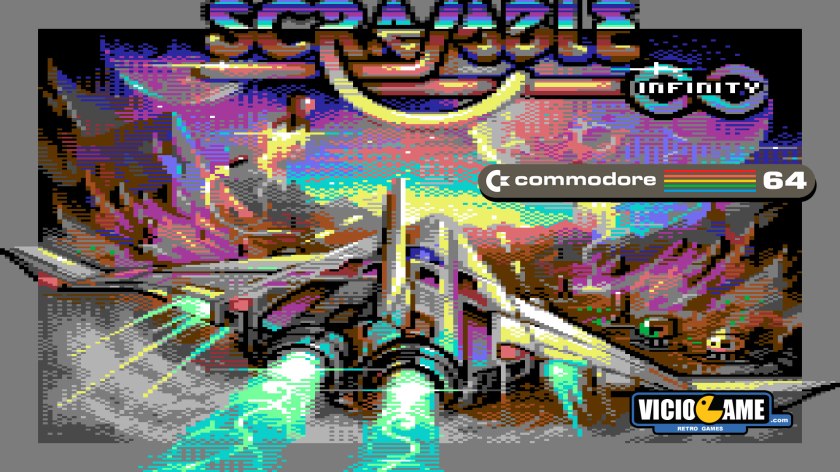
Scramble is the pioneering title that laid the groundwork for the horizontal scrolling shoot ‘em up genre in arcades. Among its many ports, we put together a comparison of the most notable versions released for the Commodore 64, showcasing the system’s technical capabilities.
Developer: Thomas Kite “Kebby” (2015) / Mirage (Booze Design / 5 O’Clock Software) (2021)
Publisher: Independent – Freeware (2015) / RGCD – Psytronik Software (2021)
Release Date: 2015/2021
Platform: Commodore 64
🇺🇸 To understand the relevance of Scramble and Scramble Infinity for the Commodore 64, we must go back to the origins of the horizontal scrolling shoot ‘em up genre itself — a genre whose birth certificate was signed in 1981 with the release of the original Scramble in arcades. Developed by Konami and distributed by Stern Electronics in North America and by Leijac in Japan, Scramble is unanimously recognized as the first side-scrolling shooter with forced scrolling and multiple clearly distinct stages, inaugurating a progression structure that would become the absolute standard for an entire generation of games. Before it, existing shooters — such as Space Invaders and Galaxian — operated on static screens, where the player remained fixed while enemies advanced in predictable patterns. Konami flipped that logic on its head by making the scenery continuously scroll from right to left, forcing the player to react non-stop to obstacles, enemies, and the terrain’s own topography — a conceptual breakthrough with no precedent at the time.
The player takes control of a spaceship equipped with two independent attack systems: a forward-firing weapon capable of destroying enemies on the same horizontal plane, and a bomb system that drops vertically to eliminate ground installations. The distinction between these two fire buttons introduced for the first time in the genre the need for a combined strategy of aerial fire and ground attack — a concept that would be refined and expanded upon by decades of subsequent games.
One of the most innovative and central mechanical elements of Scramble is the fuel system. The ship continuously consumes fuel throughout the game, and if the gauge hits zero, it crashes and the player loses a life. To refuel, players must destroy fuel depots scattered across the ground of each stage, visually identified and each worth 150 points. This mechanic added a layer of strategic pressure that had never before existed in an arcade game of the genre: the player must balance aggression in attacking with caution in fuel conservation, since charging ahead at full speed without refueling is essentially a death sentence. Ground missiles are worth 50 points when destroyed on the ground and 80 when shot down in flight; UFOs are worth 100 points; mystery bases yield between 100 and 300 points; and the main base is worth 800 points. The ship earns a bonus jet upon reaching 10,000 points, and only once per game.
Commercially, Scramble was a phenomenon: it sold 15,136 arcade cabinets in the United States in just five months, making it Stern’s second best-selling game, behind only Berzerk. The title appears on the Guinness World Records Gamer’s Edition list of the 100 greatest arcade games and was even at the center of a landmark legal precedent in intellectual property law — the Stern Electronics case — which established that video game images and sounds could be protected by copyright independently of the source code.
The creative impact of Scramble was monumental. Its direct sequel, Super Cobra, was released in the same month of 1981 and adapted the formula for a helicopter across even more demanding stages. More significantly, Konami’s own Gradius (1985) had the working title “Scramble 2” and extensively reused materials and mechanics from the original game, being considered by many official guides as a direct descendant of the series. The hardware on which Scramble ran — based on the Z80 processor — was used in several other later Konami titles, such as Super Cobra, Lost Tomb, and The End, and due to the complete absence of copy protection, the hardware was widely pirated and repurposed by alternative manufacturers around the world.
On the Commodore 64, the Scramble phenomenon materialized in multiple unofficial versions, produced by different studios and developers over the decades, each with its own technical quirks, design decisions, and degree of faithfulness to the original arcade. The first and most celebrated conversion is Skramble, released in 1983 by Anirog Software — the name slightly altered to avoid legal disputes with Konami’s original title, even though the content was undeniably a reproduction of the arcade’s gameplay. It laid the groundwork for the game’s experience on the Commodore computer, replicating all six sectors, the fuel system, the forward fire and vertical bombs, the typical enemies such as ground-launched rockets, UFOs, and fireballs, and structuring the game loop that resets after the base is destroyed. The game features satisfying explosion sound effects and a hypnotic engine hum from the ship in flight, though it completely lacks a musical soundtrack during gameplay — a shortcoming that compares unfavorably to Beta Lyrae, an Atari clone from the same year that had both music and slightly superior graphics. The main technical criticism of the original Skramble is its unstable, choppy scrolling that hurts visual fluidity and makes precise reactions difficult in tighter passages, especially in Sector 5. This issue would be partially addressed years later with the release, on July 4, 2008, of a crack produced by the Walker Group (TWG), which added optional smooth scrolling, alternate graphics, slightly increased difficulty through faster meteors, an integrated manual, and high score saving. The TWG version itself became an object of nostalgic appreciation, as it includes an intro from the Eagle Soft group that delights fans of the 1980s cracker scene.
The second major conversion for the Commodore 64 is Scramble 64, published in 1983 by Interceptor Software, also known under the alternate name “Scramble Wars” in some listings, and physically distributed on cassette tape. This game makes distinct design choices: bombs fall horizontally rather than following an angled trajectory, which makes hitting targets directly below the ship considerably easier. This detail substantially changes the aiming dynamic, making the destruction of fuel depots more predictable and straying from the appeal of the original game. The graphics are well drawn for the year of release, featuring a visually distinct spaceship, and the audio is on par with the platform’s standard for that period. The title retains the sectors and fuel mechanic but distributes targets more evenly throughout the stages, which was a welcome refinement.
A third version, simply titled Scramble, emerged in 2015 as a public domain project developed by Thomas Kite “Kebby”, notable for being the most faithful to the original arcade of all Commodore 64 conversions produced up to that point. With graphics that more accurately capture the aesthetic of the 1981 cabinet and gameplay very close to Konami’s original product, this version earned admirers among genre purists, who consider it superior in authenticity — though they acknowledge it is more modest in visual ambition compared to what would be released years later. This is the version used in our comparison video available at the top of this article.
It is in this context of multiple conversions — none of them fully satisfying by every measure — that the most ambitious project ever undertaken for the genre on the Commodore 64 was born: Scramble Infinity. The story begins in 2009, when a developer known in the community as Mirage, a member of the group 5 O’Clock Software and with ties to the demo group Booze Design, began developing a new version of the Konami classic for Commodore’s 8-bit hardware. Preliminary screenshots and videos of the project briefly circulated within the community, generating enormous excitement by showcasing bitmap-mode graphics of unprecedented quality for a game of the genre on that system — with a level of visual detail that seemed to challenge the computer’s technical limitations. The project then completely vanished from the radar, with no news, updates, or announcements for over a decade, and was catalogued by the site Games That Weren’t (GTW64) — a repository dedicated to documenting and attempting to recover cancelled and unreleased games — as one of the most unfortunate cases of a title that appeared to have been definitively abandoned.
The surprise came on December 21, 2021, just a few days before Christmas: Mirage and his team released the complete Scramble Infinity, without any prior announcement, as a free non-commercial release on the CSDb (Commodore 64 Scene Database), the main online repository for the Commodore 64 demo scene and software community. The release was celebrated by the community as one of the best Christmas gifts in the system’s recent history, coinciding with the 40th anniversary of the original Scramble arcade and arriving on the heels of another historic December release from that same year, Sonic the Hedgehog. GTW64 closed the case with a happy ending note, and Scramble Infinity was subsequently included in the annual coverdisk of the Zzap! 64 magazine in 2022, part of an annual Kickstarter that funds the print publication of that magazine — legendary for having been one of the leading British publications dedicated to the Commodore 64 in the 1980s, which was relaunched in physical format in the 2010s and 2020s. This is the other game featured in our comparison video available at the top of this article, so you can draw your own conclusions about the visual and audio “upgrade.”
The Scramble Infinity development team brings together respected names from the Commodore 64 scene and the European demoscene. The musical score is the work of Dane, from Booze Design, and Jammer, from 1mandivision, MultiStyle Labs, and Protovision — groups with a solid track record in SID music production, the system’s native audio format generated by the SID 6581/8580 chip. The custom disk loader, a fundamental piece of the game’s technical architecture, was developed by Krill, from the group Plush, recognized in the scene for his specialization in extremely efficient fast loaders for the 1541 disk drive. Additional technical support came from JackAsser, of Booze Design, and WVL, of Slash Design and Xenon.
From a technical standpoint, Scramble Infinity represents an extraordinary achievement within the original Commodore 64 hardware’s limitations. The game renders full-screen bitmap-mode scrolling — meaning every pixel of the scenery is rendered individually rather than using the platform’s standard tile or sprite system — while simultaneously streaming stage data from the disk during play, with no noticeable pauses or intermediate loading screens. This continuous streaming is an extremely complex technique for 8-bit hardware, and its implementation without lockups or sync failures demonstrates the team’s exceptional mastery of the platform’s internal mechanisms and its disk drive. The resulting graphics display a level of detail and visual richness rarely seen, with elaborate terrain and stage backgrounds that surpass any previous conversion of the game visually. The main menu music is one of the production’s highlights.
The gameplay of Scramble Infinity remains faithful to the structure of the original 1981 arcade: the player pilots their ship through the six characteristic sectors of Scramble, facing ground-launched rockets, UFOs, fireballs, and the varied terrain topography, while managing fuel by destroying depots marked “FUEL” through the combined system of forward fire and bombs. Control is handled via a single-button joystick in port 2 — the same button alternates between forward fire and bomb drop depending on when it is pressed, a controversial design decision, especially considering that the Atari version of the game allowed two separate buttons for each action, making the controls more intuitive. That said, Scramble Infinity is technically the most impressive version of Scramble available for the Commodore 64. The game’s short runtime and faithful adherence to the 1981 structure — without the addition of original stages, power-ups, or gameplay variations — do limit its replayability and could have been used as an opportunity to craft a more substantial experience by modern standards.
Skramble, Scramble 64, Scramble (2015), and Scramble Infinity together form a complete picture of the evolution of the horizontal scrolling shoot ‘em up genre on the Commodore 64: from the rushed-but-functional clone, through the progressive refinement of mechanics across new versions over the decades, all the way to a project that proves the hardware released in 1982 still has the capacity to surprise in the hands of sufficiently dedicated and talented programmers.
The trajectory of Scramble on the Commodore 64 is a perfect reflection of the unique relationship this platform established with its developers and enthusiasts over more than four decades: a machine that was never abandoned, continuously rediscovered, explored, and pushed beyond its limits by a passionate community that finds in technical challenge and faithfulness to the classics a form of artistic expression that transcends the simple act of playing.
🇧🇷 Para compreender a relevância dos jogos Scramble e Scramble Infinity para o Commodore 64, é indispensável retornar às origens do próprio gênero de shoot’em up de rolagem horizontal, cuja certidão de nascimento foi assinada em 1981 com o lançamento do Scramble original nos fliperamas. Desenvolvido pela Konami e distribuído pela Stern Electronics na América do Norte e pela Leijac no Japão, o Scramble é unanimemente reconhecido como o primeiro shooter de rolagem lateral com scrolling forçado e com múltiplas fases claramente distintas, inaugurando uma estrutura de progressão que se tornaria padrão absoluto para toda uma geração de jogos. Antes dele, os shooters existentes — como Space Invaders e Galaxian — operavam em telas estáticas, nas quais o jogador permanecia fixo enquanto os inimigos avançavam em padrões previsíveis. A Konami subverteu essa lógica ao fazer o cenário rolar continuamente da direita para a esquerda, obrigando o jogador a reagir a obstáculos, inimigos e à topografia do próprio terreno de forma ininterrupta, o que representou uma ruptura conceitual sem precedentes para a época.
O jogador assume o controle de uma aeronave espacial equipada com dois sistemas de ataque independentes: uma arma de disparo frontal, capaz de destruir inimigos no mesmo plano horizontal, e um sistema de bombas que caem verticalmente para eliminar instalações terrestres. A distinção entre esses dois botões de disparo introduziu pela primeira vez no gênero a necessidade de estratégia combinada entre tiro aéreo e ataque ao solo, um conceito que viria a ser refinado e expandido por décadas de jogos subsequentes.
Um dos elementos mecânicos mais inovadores e centrais do Scramble é o sistema de combustível. A nave consome combustível continuamente ao longo da partida, e se o marcador chegar a zero, ela cai e o jogador perde uma vida. Para reabastecer, é necessário destruir depósitos de combustível espalhados pelo chão dos cenários, identificados visualmente e cujos pontos de valor são de 150 pontos cada. Essa mecânica adicionou uma camada de pressão estratégica que jamais havia existido em um jogo arcade do gênero: o jogador precisa equilibrar a agressividade no ataque com a cautela na preservação de combustível, pois avançar a toda velocidade sem reabastecer equivale a uma sentença de morte. Misseis no solo valem 50 pontos quando destruídos em terra e 80 quando abatidos em voo, os UFOs valem 100 pontos, as bases misteriosas rendem entre 100 e 300 pontos, e a base principal vale 800 pontos. A aeronave recebe um “bonus jet” ao atingir 10.000 pontos, e apenas uma vez durante a partida.
Comercialmente, o Scramble foi um fenômeno: vendeu 15.136 gabinetes de arcade nos Estados Unidos em apenas cinco meses, tornando-se o segundo jogo mais vendido da Stern, atrás apenas de Berzerk. O título consta da lista dos 100 melhores jogos de arcade do Guinness World Records Gamer’s Edition e protagonizou inclusive um importante precedente legal no campo da propriedade intelectual, no caso Stern Electronics, em que foi estabelecido que imagens e sons de videogames podiam ser protegidos por direitos autorais independentemente do código-fonte.
O impacto criativo do Scramble foi monumental. Seu sequencial direto, Super Cobra, foi lançado no mesmo mês de 1981 e adaptou a fórmula para um helicóptero em cenários ainda mais exigentes. Mais significativamente, o próprio Gradius (1985) da Konami teve como título de trabalho “Scramble 2” e reutilizou amplamente materiais e mecânicas do jogo original, sendo considerado por muitos guias oficiais como um descendente direto da série. O hardware sobre o qual Scramble rodava — baseado no processador Z80 — foi usado em vários outros títulos posteriores da própria Konami, como Super Cobra, Lost Tomb e The End, e devido à completa ausência de proteção contra cópia, o hardware foi amplamente pirateado e reaproveitado por fabricantes alternativos ao redor do mundo.
No Commodore 64, o fenômeno Scramble se materializou em múltiplas versões não oficiais, produzidas por diferentes estúdios e desenvolvedores ao longo das décadas, cada uma com suas peculiaridades técnicas, decisões de design e grau de fidelidade ao original arcade. A primeira e mais célebre conversão é Skramble, lançada em 1983 pela Anirog Software — nome ligeiramente modificado para evitar disputas legais com o título original da Konami, embora o conteúdo fosse inegavelmente uma reprodução da jogabilidade do fliperama. Ele estabeleceu as bases da experiência do jogo no computador da Commodore, replicando os seis setores, o sistema de combustível, os disparos frontais e as bombas verticais, os inimigos típicos como foguetes lançados do solo, os UFOs e as bolas de fogo, além de estruturar o loop de jogo que se reinicia após a destruição da base. O jogo apresenta efeitos sonoros de explosão satisfatórios e um zumbido hipnótico da nave em voo, embora careça completamente de trilha musical durante o gameplay — uma ausência comparável desfavoravelmente à Beta Lyrae, clone do Atari do mesmo ano, a qual possuía música e gráficos ligeiramente superiores. A principal crítica técnica ao Skramble original é o scrolling instável e entrecortado que prejudica a fluidez visual e dificulta reações precisas em passagens mais estreitas, especialmente no Setor 5. Esse problema seria parcialmente resolvido anos depois com o lançamento, em 4 de julho de 2008, de um crack produzido pelo grupo Walker Group (TWG), que adicionou rolagem suave opcional, gráficos alternativos, dificuldade levemente aumentada por meio de meteoritos mais rápidos, um manual integrado e gravação de recordes. A versão TWG tornou-se ela própria um objeto de apreciação nostálgica, por incluir uma introdução do grupo Eagle Soft que agrada fãs da cena de crackers dos anos 1980.
A segunda grande conversão para o Commodore 64 é Scramble 64, publicada em 1983 pela Interceptor Software, também conhecida pelos nomes alternativos “Scramble Wars” em algumas listagens e distribuída fisicamente em fita cassete. Este jogo adota escolhas de design distintas: as bombas caem em linha horizontal em vez de seguir uma trajetória angular, o que facilita consideravelmente o ataque a alvos diretamente abaixo da nave. Esse detalhe muda substancialmente a dinâmica de pontaria, tornando a destruição dos depósitos de combustível mais previsível e fogem do apelo do jogo original. Os gráficos são bem desenhados para o ano de lançamento, incluindo uma nave espacial visualmente distinta, e o nível sonoro é compatível com o padrão dos jogos da plataforma daquele período. O título mantém os setores e a mecânica de combustível, mas distribui os alvos de forma mais uniforme ao longo dos cenários, o que foi um refinamento positivo.
Uma terceira versão, simplesmete intitulada Scramble, surgiu em 2015 como um projeto de domínio público desenvolvido por Thomas Kite “Kebby”, notável por ser a mais fiel ao arcade original dentre todas as conversões para o Commodore 64 produzidas até então. Com gráficos que capturam mais fielmente a estética do gabinete de 1981 e uma jogabilidade bastante próxima do produto da Konami, essa versão ganhou admiradores entre os puristas do gênero, que a consideram superior em autenticidade, embora o reconheçam como mais modesto em termos de ambição visual comparado ao que seria lançado anos depois. Esta é a versão utilizada em nosso vídeo comparativo disponível no topo deste artigo.
É nesse contexto de múltiplas conversões — nenhuma delas plenamente satisfatória a todos os critérios — que surge o projeto mais ambicioso já empreendido para o gênero no Commodore 64: o Scramble Infinity. A história começa em 2009, quando um desenvolvedor conhecido na conhecido como Mirage, membro do grupo 5 O’Clock Software e com vínculos também com o grupo de demo Booze Design, iniciou o desenvolvimento de uma nova versão do clássico da Konami para o hardware de 8 bits da Commodore. Imagens e vídeos preliminares do projeto circularam brevemente pela comunidade, causando enorme entusiasmo por exibirem gráficos em modo bitmap de qualidade inédita para um jogo do gênero no sistema — com um nível de detalhe visual que parecia desafiar as limitações técnicas do computador. O projeto então desapareceu completamente do radar, sem notícias, atualizações ou comunicados por mais de uma década, sendo catalogado pelo site Games That Weren’t (GTW64) — repositório dedicado a registrar e tentar recuperar jogos cancelados e não lançados — como um dos casos mais lamentáveis de um título que parecia ter sido definitivamente abandonado.
A surpresa chegou em 21 de dezembro de 2021, poucos dias antes do Natal: Mirage e sua equipe lançaram o Scramble Infinity completo, sem aviso prévio, como uma liberação não-comercial gratuita na CSDb (Commodore 64 Scene Database), o principal repositório online da cena de demos e software do Commodore 64. O lançamento foi celebrado pela comunidade como um dos melhores presentes de Natal da história recente do sistema, coincidindo com o 40º aniversário do Scramble arcade original e chegando na esteira de outro lançamento histórico de dezembro daquele mesmo ano, o Sonic the Hedgehog. O GTW64 fechou o caso com uma nota de encerramento feliz, e o Scramble Infinity foi posteriormente incluído no coverdisk anual da revista Zzap! 64 de 2022, parte de um Kickstarter anual que financia a publicação impressa dessa revista — lendária por ter sido uma das principais publicações britânicas dedicadas ao Commodore 64 nos anos 1980 e que foi relançada em formato físico nas décadas de 2010 e 2020. Este é o outro jogo presente em nosso vídeo comparativo disponível no topo deste artigo, para que você possa tirar suas próprias conclusões sobre o “upgrade” visual e sonoro.
A equipe de desenvolvimento do Scramble Infinity reúne nomes respeitados da cena do Commodore 64 e da demoscene europeia. A trilha musical é obra de Dane, do Booze Design, e de Jammer, do 1mandivision, MultiStyle Labs e Protovision — grupos com histórico sólido em produção de música SID, o formato nativo de áudio do sistema gerado pelo chip SID 6581/8580. O loader de disco customizado, peça fundamental da arquitetura técnica do jogo, foi desenvolvido por Krill, do grupo Plush, reconhecido na cena por sua especialização em fast loaders extremamente eficientes para o sistema de disco 1541. Apoio técnico adicional veio de JackAsser, do Booze Design, e de WVL, dos grupos Slash Design e Xenon.
Do ponto de vista técnico, o Scramble Infinity representa um feito extraordinário dentro dos limites do hardware original do Commodore 64. O jogo executa scroll de telas inteiras em modo bitmap — o que significa que cada pixel do cenário é renderizado individualmente em vez de usar o sistema de tiles ou sprites padrão da plataforma — enquanto carrega simultaneamente os dados da fase a partir do disco durante a partida, sem pausas perceptíveis ou telas de loading intermediárias. Esse streaming contínuo é uma técnica de altíssima complexidade para o hardware de 8 bits, e sua implementação sem travamentos ou falhas de sincronização demonstra o domínio técnico excepcional da equipe sobre os mecanismos internos do plataforma e sua unidade de disco . Os gráficos resultantes apresentam um nível de detalhe e riqueza visual raramente visto, com terrenos e fundos de cenários elaborados que superam visualmente qualquer conversão anterior do jogo. A música do menu principal é um dos pontos altos da produção.
A jogabilidade do Scramble Infinity permanece fiel à estrutura do original arcade de 1981: o jogador pilota sua nave pelos seis setores característicos do Scramble, enfrentando foguetes lançados do solo, UFOs, bolas de fogo e a topografia variada dos cenários, enquanto gerencia o combustível destruindo os depósitos marcados como “FUEL” através do sistema combinado de tiro frontal e bombas. O controle é feito através de joystick de um único botão na porta 2 — o mesmo botão alterna entre o tiro frontal e a largada de bomba dependendo do momento de acionamento, uma decisão polêmica, tendo em vista que a versão no sistema da Atari permitia dois botões separados para as duas ações, tornando o controle mais intuitivo. Apesar disso, Scramble Infinity é tecnicamente a versão mais impressionante de Scramble disponível para o Commodore 64. A duração curta do jogo e a manutenção fiel da estrutura de 1981 — sem adição de fases originais, power-ups ou variações de jogabilidade — limitam a longevidade e poderiam ter sido aproveitadas para criar uma experiência mais substancial para os padrões atuais.
Tanto Skramble, Scramble 64, Scramble (2015), quanto Scramble Infinity formam um panorama completo da evolução do gênero shoot’em up de rolagem horizontal no Commodore 64: do clone apressado mas funcional, passando pelo refinamento progressivo das mecânicas em novas versões ao longo das décadas, até chegar a um projeto que demonstra que o hardware lançado em 1982 ainda tem capacidade de surpreender nas mãos de programadores suficientemente dedicados e talentosos.
A trajetória de Scramble no Commodore 64 é um reflexo perfeito da relação única que essa plataforma estabeleceu com seus desenvolvedores e entusiastas ao longo de mais de quatro décadas: uma máquina que nunca foi abandonada, continuamente redescoberta, explorada e empurrada além de seus limites por uma comunidade apaixonada que encontra no desafio técnico e na fidelidade aos clássicos uma forma de expressão artística que transcende o simples ato de jogar.
🤑💲Earn money without doing anything! Just leave these apps open:
✓ https://r.honeygain.me/CONTA9DB02
✓ https://packetstream.io/?psr=1uPb
🤑💲1-Click button earns Bitcoin every 1 hour: https://freebitco.in/?r=53528449
⬛ 𝗧𝗶𝗸𝗧𝗼𝗸: https://www.tiktok.com/@viciogame
🟧 𝗜𝗻𝘀𝘁𝗮𝗴𝗿𝗮𝗺: http://www.instagram.com/viciogame
🟥 𝗬𝗼𝘂𝘁𝘂𝗯𝗲: http://www.youtube.com/viciogame
🟦 𝗙𝗮𝗰𝗲𝗯𝗼𝗼𝗸: http://www.facebook.com/viciogame
🔳 𝗧𝗵𝗿𝗲𝗮𝗱𝘀: https://www.threads.net/@viciogame
🟪 𝗧𝘄𝗶𝘁𝗰𝗵: https://www.twitch.tv/ViciogameRetroGames
🟨 𝗕𝗹𝗼𝗴: http://www.viciogameblog.com/
🟦𝗧𝘄𝗶𝘁𝘁𝗲𝗿: http://www.twitter.com/viciogame
#Viciogame #Gameplay #LetsPlay #Playthrough #Games #Gaming #Videogames #Review #Game #Detonado #Walkthrough #Ending #Reviews #Facts #Retro #RetroGaming #Roms #Emulator #Longplay #Speedrun #NoCommentary #Scramble #Commodore64 #ScrambleInfinity #Commodore #Skramble #computer #Scramble64 #pcgaming #Amiga #Atari #shootEmup #Gradius #Rtype #shmup #konami

