
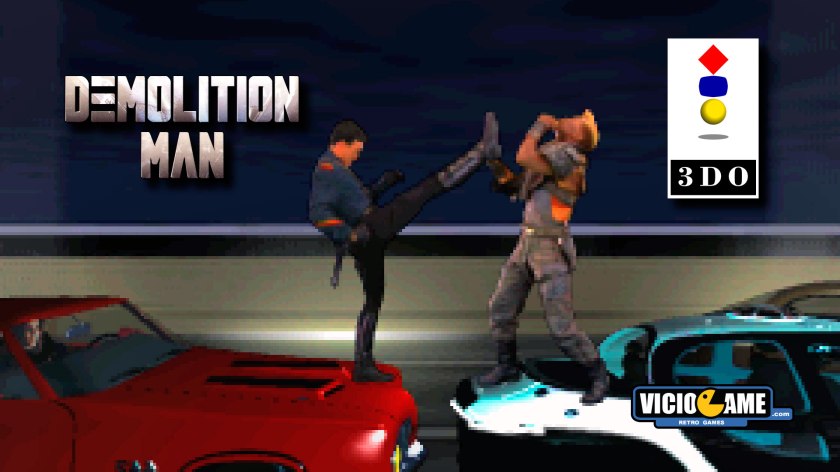
Demolition Man is a game released in 1994 for the 3DO, based on the film of the same name. It blends genres like shooter, fighting, first-person shooter, and racing all into one package. Future cops are no match for a ruthless villain, so John Spartan is thawed out of cryogenic freeze — the only man tough enough to take him down.
Developer: Alexandria / Virgin
Publisher: Virgin Interactive
Release: 1994
Platform: 3DO
🇺🇸 Demolition Man is one of the most ambitious, controversial, and technically curious titles in the brief history of the 3DO. Developed by the Alexandria studio (an internal group at Virgin), the game arrived on the market at a moment when the gaming industry was swept up in the euphoria of so-called “interactive games” based on Hollywood films, betting heavily on full motion video (FMV) and the presence of real actors to create an experience positioned somewhere between cinema and electronic gaming. No other platform of the era embodied this proposition as completely as the 3DO, and Demolition Man is, in many respects, its most emblematic representative.
The starting point is the 1993 film of the same name, directed by Marco Brambilla — then a feature film newcomer coming from a career in TV commercials — and produced by Joel Silver for Warner Bros. Starring Sylvester Stallone as Sergeant John Spartan, a Los Angeles cop nicknamed “Demolition Man” for the trail of destruction he leaves behind in every operation, and Wesley Snipes as the villain Simon Phoenix, a dangerously volatile criminal, the film builds a sci-fi premise saturated with action and social satire. In 1996, following a failed hostage rescue mission that results in the hostages’ deaths, both Spartan and Phoenix are sentenced to cryogenic prison. Decades later, in 2032, Phoenix is mysteriously awakened in a radically transformed Los Angeles — now a pacified, politically controlled megalopolis called San Angeles — and resumes his reign of violence in a society that has never had to deal with anything of the sort. Without the resources to contain the criminal, the authorities wake Spartan for a mission he understands far better than any cop from the future. The cast also includes Sandra Bullock as Lieutenant Lenina Huxley, an obsessive fan of 20th-century antiquities, Nigel Hawthorne as the ambiguous Dr. Raymond Cocteau, and Denis Leary as Edgar Friendly, leader of an underground resistance movement. The film became a cult classic of 1990s action cinema, admired both for its physical action sequences and for its satire of political correctness culture and state control, having found renewed cultural relevance decades after its release.
The 3DO, launched in 1993 by The 3DO Company founded by Trip Hawkins, was a console that bet big on CD-ROM, multimedia capabilities, and hardware that — at least on paper — considerably surpassed the competition from the 16-bit generation. Manufactured by Panasonic (in its most common versions, the FZ-1 and the FZ-10), Sanyo, and GoldStar under license, the system launched at $699 — a prohibitive price that severely limited its adoption. But the hardware was genuinely advanced for its time, and combined with a sophisticated sound chip, made the 3DO the ideal platform for the kind of experience Virgin wanted to deliver with Demolition Man.
The game was developed in parallel with the film, meaning part of the production ran simultaneously with the original shoot. This allowed the development team access to assets, actors, and materials directly from the set. Both Sylvester Stallone and Wesley Snipes filmed exclusive green screen scenes with added CGI to bridge the transition between FMV and actual gameplay sequences. In the game’s credits, you can find the names of the actors who participated in these shoots: in addition to Stallone and Snipes, Jesse Ventura appears — reprising his role from the film as one of Simon Phoenix’s henchmen — along with others including Sage Stallone, Sylvester’s son, and a then-unknown Paul Walker, before he became famous. The direction of the green screen sequences was handled by Mark Yamada, Rebecca Allen, John Alvarado, and Robb Hart, while the fight choreography was conducted by John Alvarado and Brandon Humphreys. Tommy Tallarico, the celebrated composer and industry personality, participated as video production coordinator and also composed original sound elements for the game.
The console’s power was extraordinary for its time: hearing a film’s original soundtrack in CD quality directly in a video game was something virtually no other platform of the era could do satisfactorily. The Sega CD, for example, used FMV with visibly degraded quality; the Super Nintendo and the Mega Drive simply lacked the capability altogether.
The gameplay is radically different from the versions released by Acclaim for Nintendo and Sega consoles. While those 16-bit versions are side-scrolling action and platformer games (run and gun) with some top-down perspective segments — competent, but generic — the 32-bit version combined several distinct styles into a single package, an ambition that would prove to be both its greatest draw and its main weakness. The game has 16 stages in total: nine are light gun or mouse shooting stages (like Mad Dog McCree) where you control only a cursor on the screen, four are one-on-one fighting stages (like Street Fighter), two are first-person shooter stages (FPS, like Doom), and one is a 3D car racing stage with a rear-view perspective (quite rudimentary, with no curves — you only need to move sideways to avoid collisions).
The nine gun stages form the backbone of the experience and are, by consensus, the best-executed part of the game. They are built on static backgrounds where digitized enemy sprites appear randomly in various locations. The environments cover locations inspired by the film’s settings: burning urban rooftops, museums, cryogenic prison corridors, and the streets of San Angeles. The enemies are digitized sprites of real actors, giving the game the characteristic visual aesthetic of the 1990s, similar to what Mortal Kombat did with its characters. Between action screens, CGI sequences show Spartan in motion — the famous “Stallone running on a treadmill,” as enthusiasts came to call it, a sequence in which the actor is visibly running on an actual treadmill while the background is computer-generated. Charming in its own way, but technically cringe-inducing even by 1994 standards.
Although it’s possible to play with the original controller — or with a compatible mouse (as seen in the video at the top of this article) — it’s recommended to use the 3DO Gamegun pistol accessory for a more immersive experience. This accessory can be connected in series to the standard controller, which then acts as an extension cable, allowing the player to navigate the pause menu and play non-light gun stages without swapping controllers. The game does not recognize the gun if plugged directly into the console’s controller port.
The four one-on-one combat stages are the most divisive sections. They follow a format similar to Mortal Kombat, with digitized sprites viewed from a side perspective. In all four stages, the player controls John Spartan and fights against Simon Phoenix, but Phoenix’s AI is different in each level. The three action buttons make Spartan punch high, punch low, and kick, while Phoenix has equivalent moves. The central problem with these sections is that the combat system is radically shallow: there are no combos, no special moves, no strategic depth. The mechanic essentially boils down to waiting for Phoenix to attack and then counter-attacking, since attempting to attack proactively usually results in taking a hit first due to animation lag. As described by publications of the time, the gameplay feels more like “rock-paper-scissors” than a proper fighting game. GamePro magazine harshly criticized the delayed attacks and limited move set.
The first-person shooter stages are extremely simple compared to most games in the genre: there are no doors, switches, or health or ammo pickups, and the player has only a single weapon (a pistol) with unlimited ammunition. John Spartan recovers health gradually over time. The map design is based on a square two-dimensional grid with a labyrinthine structure and a large number of branching paths. The player’s objective is to reach a specific location. These first-person tunnels are visually rudimentary even by 1994 standards — Doom had launched the previous year and was defining the state of the art for the genre — but they serve their purpose as a change of pace, even if the repetitive corridors and absence of any more elaborate design elements make them tedious quickly. To put it simply: just follow the villain (marked as a yellow dot on the radar) to the exit.
The racing stage is rather odd. The player must reach Simon Phoenix’s car before their own car runs out of fuel, dodging other vehicles on the road while collecting fuel refills. The track is completely straight, set on a Southern California freeway, and the entire dynamic boils down to swerving around cars and keeping the accelerator pressed. After catching up to Phoenix, the game transitions directly into another one-on-one combat stage, this time on top of the moving cars. Hardcore Gaming 101 described this sequence as “the most boring racing game ever made,” and the criticism is fair: there is an enormous gulf between the ambition of the concept and the technical execution.
Connecting all of these stages is an extensive use of FMV that functions as narrative glue. The video sequences extracted from the film are presented with remarkable quality for the era — the 3DO‘s CD-ROM drive and its video decompression engine were genuinely superior to what the Sega CD offered — and the exclusive green screen scenes of Stallone and Snipes insert the characters into synthetic environments that serve as transitions between stages. Unlike similar games of the era, such as the Jurassic Park adaptation for the 3DO, Demolition Man features every real actor from the film. Jesse Ventura, who in the film plays one of the cryo-cons (cryogenic prisoners) under Phoenix’s command, appears in the stages set in the underground prison and the cryo-prison, making him the only film actor besides Stallone and Snipes to have his character represented in the game.
The game’s progression system uses passwords to save progress, while the 3DO‘s internal memory is used exclusively to store the high score list. The game offers three difficulty levels, and choosing the easiest one results in a humorous moment where Spartan himself mocks the player. This brief breaking of the fourth wall is characteristic of the irreverent tone that permeates the entire production.
Demolition Man features a collection of secrets and easter eggs that reveal the personality of the development team. Some of these secrets include first-person shooting stages set inside the Virgin office where you can shoot Tommy Tallarico himself, game over FMV segments, a mode that enables blood during deaths, and achieving a high score allows the player to watch the virtual sex scene between Spartan and Lenina Huxley. This last element is a direct reference to the film, in which the concept of physical sex has been banned in San Angeles’s sanitized society and replaced by a virtual reality interface. The presence of this content in a 1994 game says a great deal about the industry’s appetite for marketing provocations at the time. You can see all of these secrets in our video available at the top of this article.
From a critical reception standpoint, Demolition Man for the 3DO led a divided existence. GamePro gave the game a positive review, praising the variety of gameplay styles, the digitized graphics, the high-quality audio, and the realism conveyed by the game’s level of detail, despite criticizing the fighting sections. Next Generation magazine was less generous, awarding only two out of five stars and stating that “if any of the individual stages had been executed very well, it might have worked. Unfortunately, that didn’t happen.” In contrast to the mixed press reception, the game received the “Movie Translation Game of the Year” award for 1994 from Die Hard Game Fan magazine, a recognition that reflects the scarcity of truly ambitious film adaptations during the period. Hardcore Gaming 101, in retrospect, adopts a more critical stance, classifying the game as “terrible” for its excessive reliance on FMV novelty and its inability to satisfactorily execute any of its multiple genres.
The game’s production context is enriched by its place in the history of the relationship between Hollywood and video games. Virgin Interactive and Acclaim Entertainment released Demolition Man across several home systems. While Acclaim handled the 16-bit versions with a more conservative approach oriented toward traditional gameplay, Virgin bet everything on the 3DO as the platform for a cinematic experience. This dichotomy is revealing: on one side, games that function as games; on the other, a product that attempts to be an interactive film and accepts the costs of that ambition. A version was in development by Virgin Interactive to be published by Atari Corporation on the Atari Jaguar CD, but was cancelled after multiple delays. A PlayStation version was also in development but was never released. These cancelled projects demonstrate that there was genuine commercial interest in expanding the more elaborate version to other platforms, but the turbulence of the 1990s market prevented that from materializing.
Tommy Tallarico’s role in the project deserves special attention. He, who would go on to become one of the most recognized composers in the games industry of the 1990s and later the founder of Video Games Live, served as video production coordinator and contributed sound elements to the game. The fact that he appears as a secret target in the Virgin Office easter eggs is evidence of the level of camaraderie and internal humor within the development team — the kind of inside joke that only a small, close-knit team could slip into a commercial product.
From a game design perspective, Demolition Man raises a question that remains relevant to this day: is it possible to create a game that is simultaneously five different genres, all executed masterfully? The answer, in the case of this title, is no. The game works best as a historical reflection of an era in which the industry was still trying to define what it meant to “play a movie,” testing the limits of then-available hardware and the player’s patience with imperfect controls and shallow mechanics. In that sense, it is a fascinating title: a product that was clearly made with genuine enthusiasm and real creative ambition, even if the technical resources and development time were not sufficient to translate that ambition into excellence.
The game is today considered a must-have title for 3DO collectors due to its historical importance and the combination of qualities and flaws that make it representative of the best and worst the console had to offer. More than three decades after its release, Demolition Man remains a singular example of a moment when Hollywood and Silicon Valley met in an ambitious and unprecedented way, producing an imperfect work that tells more about its era than any technically flawless game ever could.
🇧🇷 Demolition Man é um dos títulos mais ambiciosos, controversos e tecnicamente curiosos da breve história do 3DO. Com o desenvolvimento conduzido pelo estúdio Alexandria (grupo interno da Virgin), o jogo chegou ao mercado num momento em que a indústria de videogames vivia a euforia dos chamados “jogos interativos” baseados em filmes de Hollywood, apostando pesadamente no uso de full motion video (FMV) e na presença de atores reais para criar uma experiência que se posicionava a meio caminho entre o cinema e o jogo eletrônico. Nenhuma outra plataforma da época encarnava essa proposta tão completamente quanto o 3DO, e Demolition Man é, em muitos aspectos, o seu representante mais emblemático.
O ponto de partida é o filme homônimo de 1993, dirigido por Marco Brambilla — então estreante em longas-metragens, vindo de uma carreira em comerciais de TV — e produzido por Joel Silver para a Warner Bros. Estrelado por Sylvester Stallone no papel do Sargento John Spartan, um policial de Los Angeles apelidado de “Demolition Man” pelo rastro de destruição que deixa em cada operação, e por Wesley Snipes como o vilão Simon Phoenix, um criminoso de extrema periculosidade, o filme constrói uma premissa de ficção científica saturada de ação e sátira social. Em 1996, após uma missão fracassada de resgate de reféns que resulta em suas mortes, tanto Spartan quanto Phoenix são condenados à prisão criogênica. Décadas depois, em 2032, Phoenix é misteriosamente acordado numa Los Angeles radicalmente transformada — agora uma megalópole pacificada e politicamente controlada chamada San Angeles — e recomeça sua onda de violência numa sociedade que jamais precisou lidar com algo parecido. Sem recursos para conter o criminoso, as autoridades despertam Spartan para uma missão que ele compreende muito melhor do que qualquer policial do futuro. O elenco conta ainda com Sandra Bullock como a tenente Lenina Huxley, fã obcecada de antiguidades do século XX, Nigel Hawthorne como o ambíguo Dr. Raymond Cocteau, e Denis Leary como Edgar Friendly, líder de uma resistência subterrânea. A obra tornou-se um clássico cult do cinema de ação dos anos 1990, admirada tanto por suas sequências de ação físicas quanto pela sua sátira à cultura do politicamente correto e ao controle estatal, tendo encontrado renovada relevância cultural décadas depois de seu lançamento.
O 3DO, lançado em 1993 pela The 3DO Company fundada por Trip Hawkins, era um console que apostava alto em CD-ROM, capacidade multimídia e hardware que — pelo menos no papel — superava consideravelmente os concorrentes da geração de 16 bits. Fabricado por Panasonic (na versão mais comum, o FZ-1 e o FZ-10), Sanyo e GoldStar sob licença, o sistema custava US$ 699 no lançamento, um preço proibitivo que limitou severamente sua adoção. Mas o hardware era genuinamente avançado para a época, e combinado com um chip de som sofisticado, fazia do 3DO a plataforma ideal para o tipo de experiência que Virgin queria entregar com Demolition Man.
O jogo foi desenvolvido em paralelo com o filme, o que significa que parte da produção correu simultaneamente à filmagem original. Isso permitiu que a equipe de desenvolvimento tivesse acesso a ativos, atores e materiais diretamente do set. Tanto Sylvester Stallone quanto Wesley Snipes gravaram cenas exclusivas em green screen com CGI adicionado para fazer a transição entre o FMV e as sequências de gameplay propriamente ditas. Nos créditos do jogo, é possível ver os nomes dos atores que participaram dessas filmagens: além de Stallone e Snipes, aparecem Jesse Ventura — que reprisa seu papel do filme como um dos capangas de Simon Phoenix — e outros como Sage Stallone, filho de Sylvester, e o então jovem Paul Walker, antes de se tornar famoso. A direção das cenas em green screen ficou a cargo de Mark Yamada, Rebecca Allen, John Alvarado e Robb Hart, enquanto a coreografia de luta foi conduzida por John Alvarado e Brandon Humphreys. Tommy Tallarico, o célebre compositor e personalidade da indústria, participou como coordenador da produção de vídeo, além de ter composto elementos sonoros originais para o jogo.
O poder do console era algo extraordinário para a época: ouvir a trilha sonora original de um filme, com qualidade de CD, diretamente num videogame era algo que praticamente nenhuma outra plataforma da época conseguia fazer de forma satisfatória. O Sega CD, por exemplo, usava FMV com qualidade visivelmente degradada; o Super Nintendo e o Mega Drive simplesmente não tinham capacidade para isso.
A jogabilidade é radicalmente diferente das versões lançadas pela Acclaim para os consoles da NIntendo e Sega. Enquanto essas versões 16-bit são jogos de ação e plataforma laterais (run and gun) com alguns segmentos em perspectiva top-down — competentes, mas genéricos —, a versão 32 bits combinou vários estilos distintos em um único pacote, numa ambição que seria tanto seu maior atrativo quanto seu principal ponto fraco. O jogo tem 16 fases no total: nove são de tiro com pistola light gun ou mouse (como em Mad Dog McCree) onde você controla apenas um cursor na tela, quatro são de luta um contra um (como em Street Fighter), dois são de tiro em primeira pessoa (FPS como em Doom) e uma é um jogo de corrida de carro em 3D com vista traseira (bem rudimentar, sem curvas e você precisa apenas se deslocar lateralmente para evitar colisões).
As nove fases de pistola constituem a espinha dorsal da experiência e são, consensualmente, a parte mais bem executada do jogo. São baseados em fundos estáticos, onde inimigos digitalizados aparecem aleatoriamente em locações variadas. Os cenários cobrem locações inspiradas nos ambientes do filme: telhados urbanos em chamas, museus, corredores de prisão criogênica e ruas de San Angeles. Os inimigos são sprites digitalizados de atores reais, o que confere uma estética visual característica dos anos 1990, similar ao que Mortal Kombat fez com seus personagens. Entre as telas de ação, cenas em CGI mostram Spartan em movimento — o famoso “Stallone correndo na esteira”, como ficou conhecido entre os aficionados, uma sequência em que é evidente que o ator está literalmente sobre uma esteira ergométrica enquanto o fundo é computadorizado. Charmoso à sua maneira, mas tecnicamente constrangedor até para os padrões de 1994.
Embora seja possível jogar com o controle original – ou com um mouse compatível (como no caso do vídeo que está no topo deste artigo) -, é recomendado utilizar a pistola do modelo 3DO Gamegun para uma maior imersão. Este acessório pode ser conectado em série ao controle padrão, que então funciona como um cabo extensor e permite ao jogador navegar pelo menu de pausa e jogar os níveis que não são de light gun sem ter que trocar de controle. O jogo não reconhece o pistola se for plugada diretamente na porta de controle do console.
As quatro fases de combate um contra um são as que mais dividem opiniões. Elas têm formato similar ao Mortal Kombat, com sprites digitalizados vistos em perspectiva lateral. Em todos as quatro fases o jogador controla John Spartan e luta contra Simon Phoenix, mas a IA de Phoenix é diferente em cada nível. Os três botões de ação fazem Spartan socar alto, socar baixo e chutar, e Phoenix dispõe de movimentos equivalentes. O problema central dessas seções é que o sistema de combate é radicalmente superficial: não há combos, não há movimentos especiais, não há profundidade estratégica. A mecânica se reduz essencialmente a esperar que Phoenix ataque para então contra-atacar, pois tentar atacar proativamente geralmente resulta em receber um golpe primeiro devido à latência das animações. Como descrito por publicações da época, a jogabilidade parece um “pedra-papel-tesoura” mais do que um jogo de luta propriamente dito. A revista GamePro criticou duramente os ataques atrasados e o número limitado de movimentos.
As fases de first-person shooter são extremamente simples em comparação à maioria dos jogos do gênero: não há portas, interruptores, ou itens de saúde ou munição, e o jogador dispõe apenas de uma arma (uma pistola) com munição ilimitada. John Spartan recupera vida gradualmente com o tempo. O design dos mapas é baseado numa grade bidimensional quadrada e tem estrutura labiríntica, com uma grande quantidade de caminhos ramificados. O objetivo do jogador é alcançar um local específico. Esses túneis em primeira pessoa são visualmente rudimentares mesmo para 1994 — o Doom havia sido lançado no ano anterior e definia o estado da arte do gênero —, mas cumprem sua função de variação de ritmo, ainda que a repetição dos corredores e a ausência de qualquer elemento de design mais elaborado os tornem desgastantes rapidamente. Resumindo friamente o objetivo, basta seguir o vilão (destacado como um ponto amarelo no radar) até a saída.
A fase de corrida é bem estranha. O jogador deve alcançar o carro de Simon Phoenix antes que seu próprio carro fique sem combustível, desviando de outros veículos na estrada enquanto coleta reabastecimentos de combustível. A pista é absolutamente reta, ambientada numa autoestrada da Califórnia do Sul, e toda a dinâmica se resume a desviar de carros e manter o acelerador pressionado. Após alcançar Phoenix, o jogo transaciona diretamente para mais uma fase de combate um contra um, desta vez em cima dos carros em movimento. A Hardcore Gaming 101 descreveu essa sequência como “o jogo de corrida mais entediante de todos os tempos“, e a crítica é justa: há uma distinção abissal entre a ambição da proposta e a execução técnica.
Conectando todos essas fases há um uso extensivo de FMV que funciona como cola narrativa. As sequências de vídeo extraídas do filme são apresentadas com qualidade notável para a época — o leitor de CD-ROM do 3DO e seu motor de descompressão de vídeo eram genuinamente superiores ao que o Sega CD oferecia —, e as cenas exclusivas de Stallone e Snipes gravadas em green screen inserem os personagens em ambientes sintéticos que servem como transições entre as fases. Diferentemente de jogos similares da época, como a adaptação de Jurassic Park para o 3DO, Demolition Man apresenta todos os atores reais do filme. Jesse Ventura, que no filme interpreta um dos cryo-cons (prisioneiros criogênicos) subordinados a Phoenix, aparece nas fases ambientadas na prisão subterrânea e na cryo-prison, sendo o único ator do filme além de Stallone e Snipes a ter seu personagem representado no jogo.
O sistema de progressão do jogo usa passwords para salvar o avanço, enquanto a memória interna do 3DO é utilizada exclusivamente para armazenar a lista de high scores. O jogo oferece três níveis de dificuldade, e escolher o mais fácil resulta num momento humorístico em que o próprio Spartan debocha do jogador. Essa quebra da quarta parede, embora breve, é característica do tom irreverente que permeia toda a produção.
Demolition Man conta com um conjunto de segredos e easter eggs que revelam a personalidade da equipe de desenvolvimento. Alguns desses segredos incluem jogos de tiro em primeira pessoa ambientados no escritório da Virgin onde é possível atirar no próprio Tommy Tallarico, segmentos de FMV do game over, um modo que ativa sangue durante as mortes, e atingir uma pontuação alta permite ao jogador assistir à cena de sexo virtual entre Spartan e Lenina Huxley. Esse último elemento é uma referência direta ao filme, no qual o conceito de sexo físico foi proibido na sociedade higiênica de San Angeles, sendo substituído por uma interface de realidade virtual. A presença desse conteúdo num jogo de 1994 diz muito sobre o apetite da indústria por provocações de marketing naquele momento. Você pode ver todos estes segredos em nosso vídeo disponível no topo deste artigo.
Do ponto de vista da recepção crítica, Demolition Man para 3DO viveu uma existência dividida. A GamePro deu ao jogo uma avaliação positiva, elogiando a variedade de estilos de gameplay, os gráficos digitalizados, o áudio de alta qualidade e o realismo invocado pelo nível de detalhe do jogo, apesar de criticar as seções de luta. Já a revista Next Generation foi menos generosa, atribuindo apenas duas estrelas em cinco e declarando que “se alguma das fases individuais tivesse sido muito bem elaborada, poderia ter funcionado. Infelizmente, isso não aconteceu“. Em contraste com a recepção mista da imprensa especializada, o jogo recebeu o prêmio de “Movie Translation Game of the Year” de 1994 pela revista Die Hard Game Fan, um reconhecimento que reflete a escassez de adaptações cinematográficas verdadeiramente ambiciosas no período. A Hardcore Gaming 101, em retrospectiva, adota uma postura mais crítica, classificando o jogo como “terrível” pela sua excessiva dependência da novidade do FMV e pela incapacidade de executar satisfatoriamente qualquer um dos seus múltiplos gêneros.
O contexto de produção do jogo é enriquecido pelo seu lugar na história da relação entre Hollywood e videogames. A Virgin Interactive e a Acclaim Entertainment lançaram Demolition Man em diversos sistemas domésticos. Enquanto a Acclaim cuidava das versões 16-bit com uma abordagem mais conservadora e orientada à jogabilidade tradicional, a Virgin apostou tudo no 3DO como plataforma para uma experiência cinemática. Essa dicotomia é reveladora: de um lado, jogos que funcionam como jogos; de outro, um produto que tenta ser um filme interativo e aceita os custos dessa ambição. Uma versão estava em desenvolvimento pela Virgin Interactive para ser publicada pela Atari Corporation no Atari Jaguar CD, mas foi cancelada após vários atrasos. Uma versão para PlayStation também estava em desenvolvimento mas nunca foi lançada. Esses projetos cancelados demonstram que havia interesse comercial genuíno em expandir a versão mais elaborada para outras plataformas, mas as turbulências do mercado dos anos 1990 impediram que isso se concretizasse.
O papel de Tommy Tallarico no projeto merece atenção especial. Ele, que viria a se tornar um dos compositores mais reconhecidos da indústria de games dos anos 1990 e posteriormente fundador do Video Games Live, atuou como coordenador da produção de vídeo e contribuiu com elementos sonoros para o jogo. O fato de ele aparecer como alvo secreto nos easter eggs da Virgin Office é uma evidência do nível de camaradagem e humor interno da equipe de desenvolvimento — é o tipo de piada interna que apenas uma equipe pequena e coesa conseguiria inserir num produto comercial.
Sob a perspectiva do design de jogo, Demolition Man levanta uma questão que permanece relevante: é possível criar um jogo que seja, simultaneamente, cinco gêneros diferentes, todos executados com maestria? A resposta, no caso deste título, é não. O jogo funciona melhor como um reflexo histórico de uma era em que a indústria ainda buscava definir o que significava “jogar um filme”, testando os limites do hardware então disponível e a paciência do jogador com controles imperfeitos e mecânicas rasas. Nesse sentido, é um título fascinante: um produto que claramente foi feito com entusiasmo genuíno e ambição criativa real, mesmo que os recursos técnicos e o tempo de desenvolvimento não tenham sido suficientes para traduzir essa ambição em excelência.
O jogo é hoje considerado um título obrigatório para colecionadores do 3DO pela sua importância histórica e pelo conjunto de qualidades e defeitos que o tornam representativo do que o console oferecia de melhor e de pior. Mais de três décadas após seu lançamento, Demolition Man permanece como um exemplo singular de um momento em que Hollywood e Silicon Valley se encontraram de forma ambiciosa e inédita, produzindo uma obra imperfeita que conta mais sobre sua época do que qualquer jogo tecnicamente irrepreensível jamais poderia.
🤑💲Earn money without doing anything! Just leave these apps open:
✓ https://r.honeygain.me/CONTA9DB02
✓ https://packetstream.io/?psr=1uPb
🤑💲1-Click button earns Bitcoin every 1 hour: https://freebitco.in/?r=53528449
⬛ 𝗧𝗶𝗸𝗧𝗼𝗸: https://www.tiktok.com/@viciogame
🟧 𝗜𝗻𝘀𝘁𝗮𝗴𝗿𝗮𝗺: http://www.instagram.com/viciogame
🟥 𝗬𝗼𝘂𝘁𝘂𝗯𝗲: http://www.youtube.com/viciogame
🟦 𝗙𝗮𝗰𝗲𝗯𝗼𝗼𝗸: http://www.facebook.com/viciogame
🔳 𝗧𝗵𝗿𝗲𝗮𝗱𝘀: https://www.threads.net/@viciogame
🟪 𝗧𝘄𝗶𝘁𝗰𝗵: https://www.twitch.tv/ViciogameRetroGames
🟨 𝗕𝗹𝗼𝗴: http://www.viciogameblog.com/
🟦𝗧𝘄𝗶𝘁𝘁𝗲𝗿: http://www.twitter.com/viciogame
#Viciogame #Gameplay #LetsPlay #Playthrough #Games #Gaming #Videogames #Review #Game #Detonado #Walkthrough #Ending #Reviews #Facts #Retro #RetroGaming #Roms #Emulator #Longplay #Speedrun #NoCommentary #DemolitionMan #3DO #Shooter #FPS #Racing #firstpersonshooter #FMV #virgin #stallone #sylvesterstallone #WesleySnipes #Warner #movie
 VICIOGAME