
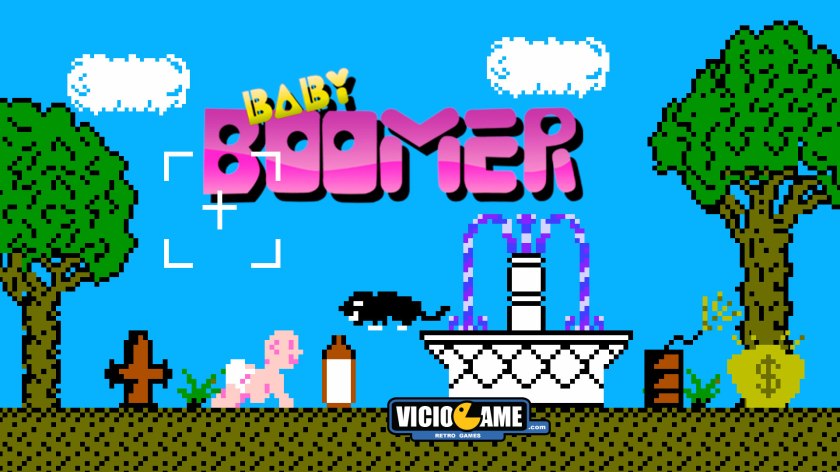
Baby Boomer is a shooter game released in 1989 for the Nintendo. One day, a baby crawls out of its crib and starts making its way through a bizarre, surreal world. The player’s goal is to act as the baby’s protector — blasting away every danger in sight — until the little one is reunited with its mother. Or not.
Developer/Publisher: Color Dreams
Release date: 1989
Platform: Nintendo (NES) / Famicom
🇺🇸 Baby Boomer was developed and published by Color Dreams, an American company based in Brea, California, founded in 1988 by Daniel Lawton, a self-taught programmer and vocal critic of the licensing policies imposed by Nintendo. The game carries the historical weight of being the company’s very first release — a fact that makes it not merely a curiosity in the unlicensed games market, but also a starting point for an entire chain of events that would shape the fringes of the NES game industry as the 1990s approached.
Color Dreams figured out how to bypass the 10NES lockout chip — a security mechanism that restricted unauthorized software — operating in a legal gray area, yet was never sued by Nintendo. Color Dreams used distinctive baby-blue cartridges equipped with a custom “stunner” chip that circumvented the lockout mechanism by delivering a brief electrical shock to temporarily disable the 10NES, allowing the game to load without triggering the console’s security reset. This pastel-blue design was also intentional from a commercial standpoint, visually differentiating their cartridges from Nintendo’s official gray standard and making them easier to spot on store shelves — shelves that, for the most part, were reluctant to carry unlicensed products for fear of pressure from Nintendo itself.
By avoiding licensing fees, the company was able to release a large number of games at lower prices than other publishers. This strategy, while economically attractive on paper, never translated into meaningful commercial success — largely because Nintendo threatened to cut off game supply to any retailer that dared carry unlicensed titles, a pressure that drove away most major toy store chains, which relied heavily on sales of Big N products. Color Dreams went so far as to manufacture 200,000 copies in anticipation of Baby Boomer‘s supposed success, but 80,000 units remained unsold when the company decided to pivot its strategy toward Christian-themed games under the Wisdom Tree label.
The game was developed by Jim Meuer, who served as lead programmer, with the soundtrack composed by John Borchert. Development of Baby Boomer took place in the late 1980s as the first test program for Color Dreams’ internal development system, with the project completed in 1988. Meuer’s work during this period focused on building efficient systems for NES game production, allowing the team to prototype and refine titles quickly. The experience gained through this process would form the foundation for the company’s subsequent releases — which eventually reached a pace of 6 games in a single year.
The narrative premise of Baby Boomer is equal parts simple and surreal. The central plot revolves around a baby named Boomer who escapes his crib and embarks on a dangerous, surreal journey through diverse and increasingly supernatural environments — including a wilderness area, a cemetery, the Gates of Heaven, and Hell — while facing various environmental hazards along the way. The player’s goal is to protect him throughout this unlikely odyssey, acting as a sort of armed guardian angel. The game ends with a twist: Boomer reunites with someone he believes to be his mother, but who turns out not to be. This unexpected conclusion, combined with the sheer strangeness of the plot, gives the game an eccentric character that decades later continues to captivate collectors and retrogaming enthusiasts.
The game is a scrolling shooter in which the player protects the baby as he automatically crawls from left to right across the screen. The player uses the Zapper light gun (or the standard controller’s d-pad) to shoot enemies and environmental obstacles before they deplete Boomer’s health or block his progress. Up to two players can participate simultaneously: Player 1 uses the Zapper to shoot enemies, while Player 2 uses a standard controller to move the character and control the speed of his crawl. This two-player option was unusual among light gun games of the era and added a layer of cooperative dynamic to the gameplay.
The game features a “milk meter” that functions as a hunger timer; if the meter empties, the baby dies of starvation. This mechanic forces the player to split their attention between protecting Boomer from enemies and making sure he feeds regularly, creating a constant tension that becomes especially difficult to manage in the later stages. Shooting baby bottles that appear on screen refills the meter. In addition to milk, the game features items called nuggets: collecting 12 of them grants an extra life, but the player must not shoot them directly — they must be picked up by Boomer as he crawls past. Flowers are another collectible, causing the character to briefly pause his movement. An additional interactive mechanic involves shooting clouds positioned over gaps, causing them to release rain that freezes and forms ice bridges, allowing Boomer to safely cross the chasms.
The game’s stages begin at Golden Park, move through Gruesome Cemetery, and then present the player with a choice: escort Boomer to the Region of Heavenly Clouds or descend into the Evil Caverns. From there, the path continues through the Crypts, the Mine Shaft, and the Waterworks Worlds, which the player must seek out. Each of these environments features its own enemies and challenges. In the first stage, enemies include rats, snakes, spiders, and firecrackers. The second stage pits the player against cats, skeletons, and bats, requiring them to shoot gravestones and clouds to fill in gaps, and the moon for bonus points. The third stage features spiders, faces, birds, and rockets, with stars, harps, suns, and hearts available to shoot for extra points. The fourth stage broadens the roster with firecrackers, demons, fish, rocks, flames, ghosts, and fireballs.
The fifth stage is short but densely packed with enemies, including ghosts, pickaxes, fireballs, and firecrackers. The sixth stage introduces a particular mechanic: some ghosts split into four upon being hit. The seventh stage is widely considered the game’s cruelist, thanks to vampire bats that circle Boomer and drain his milk supply on every contact, making them extremely difficult to hit. Mine carts also appear, and can only be stopped by shooting the block at the end of the track. The eighth and final stage blends firecrackers, bats, cats, demons, and ghosts.
Only two unlicensed Zapper games were ever released, and Baby Boomer is one of them. The other is Chiller, a horror game published by SETA in 1990. This rarity within the light gun game category carries considerable historical value. Physical copies of the game are highly collectible due to its unlicensed status and limited production run. The black cartridge variant is significantly rarer, further increasing interest among specialized collectors.
In Brazil, the game had a distinct commercial trajectory. Color Dreams licensed the game to Gradiente, the company responsible for the official distribution of Nintendo in the country and one of the key players in the Brazilian video game market at the time. Baby Boomer‘s presence in the Gradiente catalog represents one of the few formal bridges between an unlicensed title and the original console.
Critical reception of Baby Boomer was predominantly negative, both at the time of its release and in the retrospective reviews that accumulated over the following decades. NintendoAge eZine wrote that it was unique and vaguely reminiscent of the 1986 game Gumshoe, and while it wasn’t the worst of Color Dreams’ releases, it was still very bad, rating it 2 out of 10 — and calling that score generous. Specialty outlet The A.V. Club ranked it last on a list of multiple Zapper games, describing it as broken and unplayable for offering no visual feedback on what the player is actually shooting at, and citing its high difficulty, irritating music, ugly graphics, and the overall appearance of a rushed product.
The portal VGJUNK described the gameplay as a continuous ordeal, with poor graphics, repetitive audio, and mechanics that amplify frustration. Hit detection between shots and on-screen targets was identified as one of the game’s most serious problems. The Zapper light gun, by its very nature, depended on precise alignment between the peripheral, the television set, and ambient lighting; in Baby Boomer, this inherent imprecision was made worse by a stage design that failed to clearly communicate to the player which objects were interactive and which were merely background. The only instruction the game provides is “Don’t shoot the nuggets!” — woefully insufficient to orient anyone on its rules and mechanics.
The quality issues in the game were partly a result of the reverse engineering required to develop unlicensed NES games, which effectively forced the company’s programmers to work within tighter technical constraints than those available to licensed developers — including fewer sprites displayed simultaneously on screen. This limitation is visible in Baby Boomer‘s enemies, whose animations are sparse and whose sprites frequently overlap in irregular ways. The color palette is limited, and while the stages vary in theme, they are functionally simple, lacking the visual depth that licensed titles of the era were able to achieve.
The soundtrack, composed by John Borchert, is repetitive and tonally monotonous, with short musical loops that quickly become grating during longer play sessions. Unlike most Zapper games, which often prioritized sound effects over music, Baby Boomer maintains a constant musical track that contributes to the sense of cacophony critics point to in the overall experience. The sound effects for shots fired and enemy deaths are equally basic, offering no auditory satisfaction to compensate for the gameplay’s shortcomings.
Color Dreams published games at an accelerated pace, the vast majority for the Nintendo. After the initial phase, the company formed subsidiaries. In 1990, it established Wisdom Tree, which produced some of the company’s best-selling titles — with its first release, Bible Adventures, moving over 350,000 copies. The strategy of selling Christian games through religious bookstores, which didn’t feel the same pressure from Nintendo that conventional retailers did, proved far more successful than Color Dreams’ original secular titles. The company then began distancing itself from video games, launching a division called StarDot Technologies in 1996 focused on surveillance equipment. In 1997, an employee named Brenda Huff purchased Wisdom Tree and spun it off as an independent company.
The legacy of Baby Boomer is therefore deeply intertwined with the history of Color Dreams as a whole. The game represents both the beginning of a bold company and a record of its limitations. The ending of the game teases the player with a promise of Baby Boomer 2 — a promise that went unfulfilled for more than three decades, until, surprisingly, it was kept. Baby Boomer 2: 35 Years Too Soon was released digitally on August 16, 2024, for PlayStation 4, PlayStation 5, and PC via the Epic Games Store. The game was developed by independent studio Kimulator’s Films, which struck a deal with Piko Interactive — the current holder of the Baby Boomer IP — to produce the long-overdue sequel. The concept of the sequel revolves around a satirical exploration of games with extremely long gaps between entries, humorously acknowledging the 35-year gap since the original — setting a record for the longest interval between a game and its direct sequel.
The narrative of Baby Boomer 2 begins 35 years after the ending of the original, in which Boomer believed he had found his mother only to discover she wasn’t. Now Boomer is trying to find his mother again — but as a 35-year-old adult still wearing a diaper and clutching a pacifier. Enemies include demons, skeletons, and even walking chainsaws. The gameplay mirrors the original: the player controls the aim of a character named Guy, who shoots enemies trying to attack Boomer, and must also shoot clouds or other environmental elements to release milk bottles or gold nuggets for Boomer to collect. The game supports up to four players in local cooperative mode. The sequel also preserves the chaotic, deliberately frustrating spirit of the original, embracing its strangeness as a core part of its identity.
Baby Boomer holds a special place in video game history: it is simultaneously a symbol of the technical and commercial rebelliousness that defined the early years of unlicensed Nintendo games, a clear example of the design and technical limitations that plagued developers operating outside Nintendo’s official ecosystem, and a collectible relic whose value has only grown over time — not because of its quality, but precisely because of its imperfection. It is a game that failed commercially, was torn apart by critics, and yet survived decades as an object of curiosity, revisitation, and debate — accessible today to those who own an original cartridge and a CRT television, completing the experience that Jim Meuer envisioned in 1988 while protecting, shot by shot, the most unlikely of heroes crawling through the chaos of the world.
🇧🇷 Baby Boomer foi desenvolvido e publicado pela Color Dreams, uma empresa americana sediada em Brea, Califórnia, fundada em 1988 por Daniel Lawton, um programador autodidata e vocal crítico das políticas de licenciamento impostas pela Nintendo. O jogo carrega o peso histórico de ser o primeiro título lançado pela empresa, um fato que o torna não apenas uma curiosidade do mercado de jogos não licenciados, mas também um ponto de partida para toda uma cadeia de eventos que moldaria a periferia da indústria de jogos de NES na virada para os anos 1990.
A Color Dreams descobriu como contornar o sistema de bloqueio 10NES (um chip de segurança) que restringia softwares não autorizados, operando em uma zona legal cinzenta, mas nunca foi processada judicialmente pela Nintendo. A Color Dreams empregou cartuchos de cor azul bebê distintos, equipados com um chip “stunner” personalizado que contornava o mecanismo de bloqueio, entregando um breve choque elétrico para desabilitar temporariamente o 10NES, permitindo que o jogo carregasse sem acionar o reset de segurança do console. Esse design azul pastel era proposital também do ponto de vista comercial, diferenciando visualmente os cartuchos deles do padrão cinza oficial da Nintendo, facilitando sua identificação nas prateleiras de lojas de varejo que, em geral, relutavam em estocar produtos não licenciados por temer pressões da própria Nintendo.
Ao evitar taxas de licenciamento, a companhia conseguia lançar uma grande quantidade de jogos com preços mais baixos do que outras publicadoras. Essa estratégia, embora economicamente atraente no papel, nunca se converteu em sucesso comercial expressivo, em grande parte porque a Nintendo ameaçava cortar o fornecimento de jogos a qualquer varejista que ousasse vender títulos não licenciados — uma pressão que afastava a maioria das grandes redes de lojas de brinquedos, que dependiam fortemente das vendas de produtos Big N. A Color Dreams chegou a produzir 200.000 cópias em antecipação ao suposto sucesso de Baby Boomer, mas ainda restavam 80.000 unidades quando a empresa decidiu redirecionar sua estratégia para a produção de jogos com temática cristã, sob a marca Wisdom Tree
O jogo foi desenvolvido por Jim Meuer, que atuou como programador principal, e a trilha sonora foi composta por John Borchert. O desenvolvimento de Baby Boomer ocorreu no final dos anos 1980, como o primeiro programa de teste do sistema de desenvolvimento interno da Color Dreams, com o projeto concluído em 1988. O trabalho de Meuer durante esse período focou em criar sistemas eficientes para a produção de jogos de NES, permitindo à equipe prototipar e refinar títulos rapidamente. A experiência adquirida nesse processo se tornaria base para os títulos subsequentes da empresa — que chegou a lançar 6 jogos em um ano.
A premissa narrativa de Baby Boomer é ao mesmo tempo simples e surreal. A trama central gira em torno de um bebê chamado Boomer, que escapa de seu berço e embarca em uma jornada perigosa e surreal por ambientes diversos e progressivamente sobrenaturais, incluindo uma área selvagem, um cemitério, os Portões do Paraíso e o Inferno, enquanto encontra vários perigos ambientais ao longo do caminho. O objetivo do jogador é protegê-lo dessa odisseia improvável, atuando como uma espécie de anjo da guarda armado. O jogo termina com uma reviravolta: Boomer reencontra alguém que acredita ser sua mãe, mas que, na verdade, não é. Esse desfecho inesperado, combinado à estranheza do enredo, confere ao jogo um caráter excêntrico que décadas depois continuaria a fascinar colecionadores e entusiastas do retrogaming.
O jogo é um scrolling shooter no qual o jogador protege o bebê que engatinha automaticamente pela tela da esquerda para a direita. O jogador usa a pistola Zapper (ou o direcional do controle original) para atirar em inimigos e obstáculos ambientais antes que reduzam a vida de Boomer ou impeçam seu progresso. Até dois jogadores podem participar simultaneamente: o jogador 1 usa a Zapper para atirar nos inimigos, enquanto o jogador 2 usa um controle padrão para mover o personagem e controlar a velocidade de seu movimento. Essa possibilidade de dois jogadores era incomum entre os jogos de pistola da época e acrescentava uma camada de dinâmica cooperativa ao gameplay.
O jogo apresenta um “medidor de leite” que funciona como um temporizador de fome; se o medidor se esvaziar, o bebê morre de inanição. Essa mecânica obriga o jogador a dividir sua atenção entre proteger Boomer dos inimigos e garantir que ele se alimente regularmente, criando uma tensão constante difícil de administrar, especialmente nos estágios mais avançados. Atirando em mamadeiras que aparecem em cena, o jogador reabastece o medidor. Além do leite, o jogo apresenta itens chamados nuggets: coletar 12 deles concede uma vida extra, mas o jogador não deve atirar neles diretamente — devem ser colhidos por Boomer enquanto ele engatinha. Flores são outros itens presentes, que fazem o personagem pausar brevemente seu movimento. Uma mecânica interativa adicional envolve atirar em nuvens posicionadas sobre buracos, fazendo-as liberar chuva que congela e forma pontes de gelo, permitindo que Boomer atravesse os abismos com segurança.
Os cenários do jogo partem do Golden Park, avançam pelo Gruesome Cemetery, e apresentam ao jogador a escolha de escoltar Boomer até a Region of Heavenly Clouds ou descer até as Evil Caverns. A partir daí, o percurso continua pelos Crypts, pelo Mine Shaft e pelos Waterworks Worlds, que exigem que o jogador os encontre. Cada um desses ambientes possui inimigos e desafios próprios. Na primeira fase os inimigos são ratos, cobras, aranhas e fogos de artifício. Na segunda fase o jogador enfrenta gatos, esqueletos e morcegos, devendo atirar nas lápides e nuvens para preencher os buracos, e na lua para pontos extras. Na terceira fase os inimigos são aranhas, rostos, pássaros e foguetes, e o jogador pode atirar em estrelas, harpas, sóis e corações para pontos adicionais. Na quarta fase a variedade cresce com fogos de artifício, demônios, peixes, rochas, chamas, fantasmas e bolas de fogo.
A quinta fase é um estágio curto mas com muitos inimigos, incluindo fantasmas, picaretas, bolas de fogo e fogos de artifício. A sexta fase introduz uma mecânica particular: alguns fantasmas se dividem em quatro ao serem atingidos. A sétima fase é considerada a mais cruel do jogo pela presença dos morcegos-vampiro que giram em torno de Boomer e drenam seu suprimento de leite a cada contato, sendo muito difíceis de acertar. Além deles, conta com carrinhos de mina que só podem ser parados atirando no bloco ao final do trilho. A oitava fase mistura fogos de artifício, morcegos, gatos, demônios e fantasmas.
Apenas dois jogos de Zapper não licenciados foram lançados, e Baby Boomer é um deles. O outro é Chiller, um jogo de terror lançado pela SETA em 1990. Essa raridade na categoria dos jogos de pistola tem valor histórico considerável. Cópias físicas do jogo são altamente colecionáveis devido ao seu status não licenciado e à produção limitada. O cartucho preto é uma variante muito mais rara, aumentando ainda mais o interesse de colecionadores especializados.
No Brasil, o jogo teve uma trajetória comercial distinta. A Color Dreams licenciou o jogo para a Gradiente. A empresa era responsável pela distribuição oficial do Nintendo no país, sendo um dos principais agentes do mercado de videogames brasileiro na época. A presença de Baby Boomer no catálogo da Gradiente representa uma das poucas pontes formais entre um título não licenciado e o console original.
A recepção crítica de Baby Boomer foi predominantemente negativa, tanto à época quanto nas revisões retrospectivas que se multiplicaram ao longo das décadas seguintes. A NintendoAge eZine escreveu: “É único e vagamente semelhante ao jogo Gumshoe de 1986. Embora não seja o pior dos lançamentos da Color Dreams, ainda é muito ruim, nota 2/10, e isso é generoso“. A mídia especializada The A.V. Club o classificou em último lugar em uma lista de vários jogos de Zapper, descrevendo-o como “quebrado e injogável por não oferecer nenhum feedback visual sobre o que o jogador está atirando, combinando dificuldade alta, música irritante, gráficos feios e a aparência de um produto produzido às pressas“.
O portal VGJUNK descreveu a jogabilidade como “um tormento contínuo, com gráficos ruins, áudio repetitivo e mecânicas que amplificam a frustração. A detecção de colisão entre os disparos e os alvos na tela é um dos problemas mais graves do jogo“. A pistola Zapper, por sua natureza, dependia de um alinhamento preciso entre o periférico, a televisão e a luz ambiente; em Baby Boomer, essa imprecisão era agravada por um design de fases que não comunicava claramente ao jogador quais objetos eram interativos e quais eram apenas cenário. A única instrução dada pelo jogo ao jogador é “Não atire nos nuggets!”, o que é amplamente insuficiente para orientar alguém sobre as regras e mecânicas do jogo.
Os problemas de qualidade dos jogos eram em parte devidos à engenharia reversa necessária para desenvolver jogos não licenciados de NES, o que efetivamente forçava os programadores da empresa a trabalhar dentro de limitações técnicas mais estritas do que as disponíveis para desenvolvedores licenciados, como menos sprites exibidos simultaneamente na tela. Essa restrição é visível nos inimigos de Baby Boomer, cujas animações são esparsas e os sprites frequentemente se sobrepõem de forma irregular. A paleta de cores é limitada e os cenários, embora variados em temática, são funcionalmente simples, sem a profundidade visual que títulos licenciados da época conseguiam apresentar.
A trilha sonora, composta por John Borchert, é repetitiva e tonalmente monocórdia, com loops musicais curtos que rapidamente se tornam irritantes durante sessões de jogo mais longas. Ao contrário da maioria dos jogos de Zapper, que muitas vezes priorizavam efeitos sonoros sobre a música, Baby Boomer mantém uma trilha constante que contribui para o senso de cacofonia que críticos apontam na experiência geral. Os efeitos de som para disparos e mortes de inimigos são igualmente básicos, sem oferecer qualquer satisfação auditiva que compensasse as falhas de jogabilidade.
A Color Dreams publicou jogos em ritmo acelerado, e a vasta maioria era para o Nintendo. Após a fase inicial, a empresa formou subsidiárias. Em 1990, formou a Wisdom Tree, que produziu alguns dos títulos mais vendidos da empresa, com seu primeiro lançamento, Bible Adventures, vendendo mais de 350.000 cópias. A estratégia de vender jogos cristãos em livrarias religiosas, que não sentiam a pressão da Nintendo sobre os varejistas convencionais, provou ser muito mais bem-sucedida do que os títulos seculares originais da Color Dreams. Então assim a empresa começou a se afastar dos videogames, lançando uma divisão chamada StarDot Technologies em 1996 focada em equipamentos de vigilância. Em 1997, uma funcionária chamada Brenda Huff comprou a Wisdom Tree e a separou como empresa independente.
O legado de Baby Boomer está, portanto, profundamente entrelaçado com a história da Color Dreams como um todo. O jogo representa tanto o começo de uma empresa audaciosa quanto um registro de suas limitações. O final do jogo incita o jogador a aguardar um Baby Boomer 2, uma promessa que permaneceu esquecida por mais de três décadas — até que, surpreendentemente, foi cumprida. Baby Boomer 2: 35 Years Too Soon foi lançado digitalmente em 16 de agosto de 2024 para PlayStation 4, PlayStation 5 e PC via Epic Games Store. O jogo foi desenvolvido pelo estúdio independente Kimulator’s Films, que fez um acordo com a Piko Interactive, detentora do IP de Baby Boomer, para produzir a sequência do jogo de 35 anos atrás. O conceito da sequência gira em torno de uma exploração satírica das sequências de jogos com longos atrasos, reconhecendo humoristicamente o intervalo de 35 anos desde o original — o que estabelece um recorde pelo maior intervalo entre um jogo e sua continuação.
A narrativa de Baby Boomer 2 começa 35 anos após o final do original, no qual Boomer acreditou ter encontrado sua mãe mas descobriu que não era ela. Agora Boomer tenta encontrar sua mãe novamente, mas como um adulto de 35 anos — ainda usando fraldas e chupeta. Os inimigos incluem demônios, esqueletos e até motosserras andando. A jogabilidade é similar ao original: o jogador controla a mira de um personagem chamado Guy, que atira nos inimigos que tentam atacar Boomer, e também deve atirar em nuvens ou outros elementos do ambiente para liberar garrafas de leite ou pepitas de ouro para Boomer coletar. O jogo suporta até quatro jogadores em modo cooperativo local. A sequência também mantém o espírito caótico e deliberadamente frustrante do original, abraçando sua estranheza como uma característica de identidade.
Baby Boomer ocupa um lugar especial na história dos videogames: é ao mesmo tempo um símbolo da rebeldia técnica e comercial que marcou os primeiros anos dos jogos não licenciados para o Nintendo, um exemplo claro das limitações técnicas e de design que afligiam os desenvolvedores que operavam à margem do ecossistema oficial da Nintendo, e uma relíquia colecionável cujo valor só cresceu com o tempo — não por sua qualidade, mas exatamente por sua imperfeição. É um jogo que falhou comercialmente, foi destruído pela crítica, e ainda assim sobreviveu décadas como objeto de curiosidade, revisitas e debate, sendo hoje acessível a quem possui um cartucho original e uma televisão CRT, completando assim a experiência que Jim Meuer imaginou em 1988 ao proteger, disparo a disparo, o mais improvável dos heróis engatinhando pelo caos do mundo.
🤑💲Earn money without doing anything! Just leave these apps open:
✓ https://r.honeygain.me/CONTA9DB02
✓ https://packetstream.io/?psr=1uPb
🤑💲1-Click button earns Bitcoin every 1 hour: https://freebitco.in/?r=53528449
⬛ 𝗧𝗶𝗸𝗧𝗼𝗸: https://www.tiktok.com/@viciogame
🟧 𝗜𝗻𝘀𝘁𝗮𝗴𝗿𝗮𝗺: http://www.instagram.com/viciogame
🟥 𝗬𝗼𝘂𝘁𝘂𝗯𝗲: http://www.youtube.com/viciogame
🟦 𝗙𝗮𝗰𝗲𝗯𝗼𝗼𝗸: http://www.facebook.com/viciogame
🔳 𝗧𝗵𝗿𝗲𝗮𝗱𝘀: https://www.threads.net/@viciogame
🟪 𝗧𝘄𝗶𝘁𝗰𝗵: https://www.twitch.tv/ViciogameRetroGames
🟨 𝗕𝗹𝗼𝗴: http://www.viciogameblog.com/
🟦𝗧𝘄𝗶𝘁𝘁𝗲𝗿: http://www.twitter.com/viciogame
#Viciogame #Gameplay #LetsPlay #Playthrough #Games #Gaming #Videogames #Review #Game #Detonado #Walkthrough #Ending #Reviews #Facts #Retro #RetroGaming #Roms #Emulator #Longplay #Speedrun #NoCommentary #BabyBoomer #Nintendo #NES #Famicom #Baby #Zapper #LightGun #boomer #shoot #shooting #ファミリーコンピュータ #任天堂
 VICIOGAME