
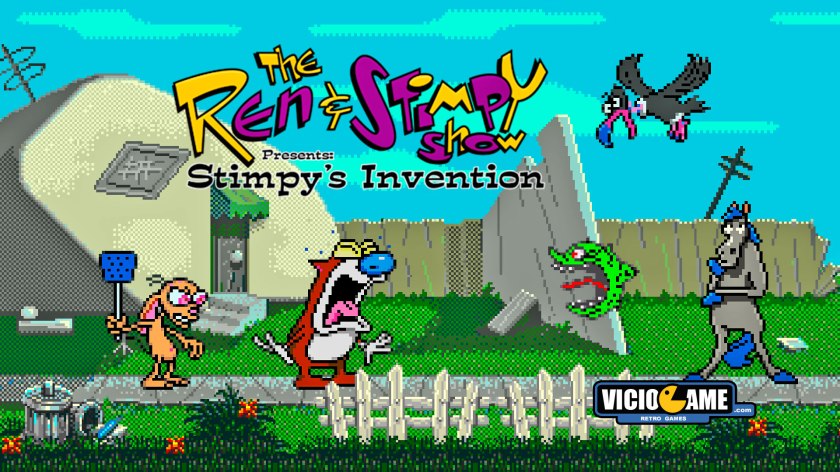
The Ren & Stimpy Show Presents: Stimpy’s Invention is a 2D platformer released in 1993 for the Sega Genesis. Stimpy shows Ren his latest invention, but cranking it up to full power causes a massive explosion. Now the duo must track down all the scattered pieces.
Developer: BlueSky Software
Publisher: Sega
Release date: 1993
Platform: Sega Genesis / Mega Drive
🇺🇸 The Ren & Stimpy Show Presents: Stimpy’s Invention arrived on the market at a moment of absolute peak popularity for the television franchise on which it is based: The Ren & Stimpy Show premiered in August 1991 and quickly became one of the most-watched and controversial animated series in American television, originally created by John Kricfalusi and produced by the studio Spümcø for Nickelodeon. The series blended absurdist humor, adult-oriented references, exaggerated body close-ups, and repulsive situations with a deliberately crude aesthetic that evoked the classic animation style of the 1940s — all centered on a neurotic chihuahua named Ren Höek and his loyal companion Stimpson J. Cat, the naive and endlessly enthusiastic cat known simply as Stimpy.
The commercial landscape surrounding the game was shaped by a peculiar split in licensing rights: while THQ held the exclusive license to publish titles based on the series on the Super Nintendo, Sega itself was responsible for bringing the characters to its own console. This resulted in a scenario where Nickelodeon fans were divided between versions for competing platforms developed by entirely different teams, with equally distinct levels of quality. THQ’s titles for the SNES — Veediots!, Time Warp, Fire Dogs!, and Quest for the Shaven Yak — were generally criticized for imprecise controls and questionable faithfulness to the spirit of the show. On Sega’s side, however, the situation was a different story: Stimpy’s Invention represents the fifth entry in the franchise across interactive media, preceded by Veediots! on the Genesis itself and followed by Fire Dogs, and is unanimously considered not only the best game in the series, but also one of the rare examples of a TV tie-in executed with genuine competence on 16-bit consoles.
BlueSky Software was, at the time, a developer closely aligned with Sega of America, responsible for notable titles such as Jurassic Park for the Genesis — released that same year — and later went on to produce Vectorman and its sequel. On Stimpy’s Invention, the team had the creative contribution of Doug TenNapel as game designer, the same professional who would shortly thereafter create the character Earthworm Jim and who helped define the visual identity of many of the most striking games in the 16-bit library of the ’90s. Mark Lorenzen, design director, also worked on the project and, like TenNapel, would later move on to Shiny Entertainment. The soundtrack was composed by Sam Powell, who delivers a remarkably faithful recreation of the show’s sonic identity.
The game’s story, while sharing its title with the same-named episode produced by the Spümcø studio — an episode that also served as the basis for a level in Veediots! for the Genesis — presents a completely different plot. In the opening cutscene, we find Stimpy diligently working on his latest invention: the Mutate-O-Matic, a machine capable of converting household garbage, including food scraps, into actual food. Ren, ever the skeptic, demands a demonstration. Stimpy, eager to impress his friend, activates the device on its most extreme setting, labeled “No Way!”, triggering a catastrophic explosion that scatters the machine’s parts across the city and surrounding areas. The duo then sets off on a journey to recover the scattered components, reassemble the Mutate-O-Matic, and shut it down before things spiral further out of control. This simple premise serves as a springboard for a series of diverse and inventive levels, with no direct connection to specific episodes of the animated series — a decision that, according to critics of the time, was one of the developers’ smartest calls, as it allowed them to create original environments without the constraints of faithfulness to pre-existing scripts.
Stimpy’s Invention‘s gameplay sets itself apart from its contemporaries through its dual-character system. In single-player mode, the player takes control of either Ren or Stimpy while the computer controls the other character in real time, keeping him close on screen at all times. At virtually any moment — barring a few very specific situations — the player can swap between characters by pausing and pressing any button. In two-player mode, each player controls one of the protagonists simultaneously, with no split screen: both characters share the same play space and the same health bar. It’s worth noting that this was the first title in the series to feature this simultaneous cooperative mode, making it an innovation within the franchise. Critics at Electronic Gaming Monthly praised the concept, but noted that the two-player mode tended to be “more frustrating than fun and twice as difficult,” due to the unified camera and the constant need to keep the characters close together.
The control scheme uses the three main buttons on the controller in a creative way. The A button triggers special moves that depend on the partner’s proximity, the B button performs offensive attacks, and the C button handles jumping. Each character has his own set of abilities, and most of the more powerful moves require Ren and Stimpy to be near each other, encouraging constant cooperation even in solo play. Ren, whose attacks are generally faster, can yank off Stimpy’s nose and hurl it as an arcing projectile — and the nose immediately begins growing back, allowing unlimited use of the move. It’s also possible to use Stimpy as a sort of boomerang, launching him horizontally to strike enemies. Ren’s double jump is accompanied by one of the game’s most iconic mechanics: Stimpy propels both of them skyward using flatulence, one of the many body-humor moments directly inspired by the tone of the animated series. Another available move simulates Ren’s “helicopter ears,” allowing players to glide and control their descent. Stimpy, meanwhile, can fire hairballs as projectiles, and while his attacks are slower than Ren’s, they have a larger hit area. One of the more curious moves — and one that is entirely unnecessary from a gameplay standpoint — has Ren repeatedly slapping Stimpy while yelling “You stupid idiot!”, with no practical effect beyond satisfying the chihuahua’s destructive sense of humor. Stimpy can also be thrown by the player to cover large horizontal distances, especially over pits — a tag-move system that anticipates mechanics later seen in games like Donkey Kong Country.
The game is structured around large stages divided into themed sub-areas, totaling six main levels with multiple sections each, which enhances the visual variety and mechanical diversity throughout the experience. The first level, The Neighborhood, begins on the streets of the protagonists’ neighborhood and takes the player into a house, moving through a kitchen dripping with green slime, climbing countertops, and eventually entering a freezer that functions as a classic ice stage — the floor is slippery and demands extra care with movement. The objective here is to find the first piece of the Mutate-O-Matic while dodging lawn mowers that hurl projectiles and other domestic hazards.
The second level, The Zoo, is frequently cited as one of the game’s high points thanks to its internal diversity. In the first section, the protagonists traverse the zoo’s hippodrome, leaping over hippos. Shortly after, the game presents one of the campaign’s most memorable moments: the giraffes, which appear harmless and even friendly from a distance, transform into aggressive and ferocious creatures when the player gets too close, biting with alarming force. The official strategy for getting through this stretch is to sprint at full speed by holding forward and the action button, positioning yourself between two specimens and waiting for the exact right moment to push ahead. In the Monkey Lair section, large and invulnerable monkeys continuously hurl banana peels; while they can’t be defeated, normal attacks temporarily stun them. Smaller monkeys, on the other hand, are vulnerable to projectiles. The zoo’s final section, called The Aviary, has the player fill Ren and Stimpy with helium using an air pump, making them lighter and allowing them to navigate by floating and using flatulence to maneuver mid-air — one of the most original and entertaining platforming sequences in the entire experience.
The third level, The City, starts out as a conventional platformer set amid urban construction, but at a certain point transforms into a bicycle chase sequence. The dogcatcher’s cart pursues the protagonists as they pedal frantically through the city streets, forcing the player to leap over cars and obstacles scattered along the path. After the dogcatcher gives up, a steep downhill section littered with potholes and uneven pavement awaits — a stretch most players recall as one of the most frustrating in the entire game. Musically, this level uses a dizzying arrangement of Khachaturian’s “Sabre Dance” to score the bicycle race, an ironic nod that perfectly matches the chaos of the scene.
The fourth level, The Pound, sets the action in a dog shelter designed visually as a prison, with gloomy corridors, cells, and an oppressive atmosphere that sharply contrasts with the irreverent humor of the earlier levels. The Pound Dungeon subsection deepens that tone before culminating in an encounter with enemies Lump and Loaf, two characters who appear in a wrestling ring, forcing the player into a wrestling match — one of the game’s most atypical sequences, where the combat mechanics take on a different weight. This confrontation is one of the few moments in the game that comes close to a traditional boss battle.
The fifth level, The Outdoors, is arguably the most disturbing and surreal of the entire adventure. Despite its name, it is not a conventional outdoor area: the scenery features rows of giant teeth as the floor, exposed nerve endings scattered throughout, enormous Stimpy noses with visible nose hairs, and trees from which eyeballs grow. The environment functions as a womb level — a stage set entirely inside the body of a colossal creature — with a Lovecraftian tone tempered by the series’ signature nonsense humor, and is considered one of the most original levels in the entire Genesis platformer catalog. The player must leap between anatomical outcroppings without triggering the nerve endings — which cause the massive jaws above to snap shut suddenly — while dodging a ceiling of teeth that descends progressively.
The sixth and final level, The Mutate-O-Matic, takes the protagonists into the interior of Stimpy’s machine itself, now running completely out of control. The level has a factory structure, complete with electrical systems, blinking Christmas lights, candles that must be extinguished to progress, and at the final climax, a room with four switches that must all be flipped simultaneously without the player getting electrocuted — a challenge that demands quick reflexes and precise timing. When all four switches are thrown, the machine shuts down and the game displays its most iconic ending screen: Ren and Stimpy performing the beloved “Happy Happy Joy Joy” song and dance, a direct reference to the original episode that inspired the game’s name.
Throughout the levels, players encounter collectible items that contribute to the score. Upon reaching 50,000 points, an extra life is awarded. The health bar is shared regardless of which character is being controlled, and only the active character loses health when hit — a strategic incentive to swap characters and take advantage of the post-hit invincibility frames. If either character falls into a pit or strays too far from the other, the Powdered Toast Man — a beloved supporting character from the series, a parody of advertising superheroes — swoops in to rescue the fallen one, charging one health point as payment for his services. This system ensures that falling into pits doesn’t result in instant death, but rather accumulates gradual damage over the course of the campaign. If the health bar is critically low, the Powdered Toast Man still performs the rescue without charging his usual fee.
The soundtrack composed by Sam Powell is one of the game’s most celebrated aspects and a rare example of musical faithfulness in a licensed product. Powell recreates iconic themes from the series with impressive accuracy, including the Log jingle — the fictional product advertised with over-the-top enthusiasm in the show’s bumpers — the theme of Muddy Mudskipper, the fictional cartoon-within-a-cartoon character, and naturally “Happy Happy Joy Joy” itself, which plays over the final credits screen. Each level features its own original composition matched to its tone: The Neighborhood’s music is upbeat and fast-paced; the Zoo’s has a more exotic, percussive texture; The Pound’s is dark and oppressive; The Aviary’s sounds ethereal and slightly eerie. The complete track list, including music for the title screen, map, continue screen, and level transitions, totals twenty distinct compositions — a generous number by the Genesis‘s technical standards in 1993. The console’s YM2612 sound chip was used skillfully to extract timbres that faithfully evoke the character of the series.
From a visual standpoint, Stimpy’s Invention is frequently praised for how faithfully its sprites capture the animation style of the series. The facial expressions of Ren and Stimpy nail the exaggerated quality drawn by Kricfalusi and his team, with sudden close-ups, eyes popping out of their sockets, and hyperbolic poses. The character animation during special moves — particularly Stimpy’s throw and the helicopter-ear flight — is smoother than the average licensed game of the era. The game also makes use of animated cutscenes at the start of each level, presenting the characters with dialogue faithful to the show’s tone and animations that rival segments from the cartoon itself.
Critical reception at the time of release was mixed to positive. Electronic Gaming Monthly praised the visual quality and the show-accurate sound design, but leveled criticism at the two-player mode, describing it as excessively difficult and unsatisfying compared to the solo experience. Among players, however, and retrospectively among enthusiast critics, the game is considered the best title ever produced under the Ren & Stimpy license — and the only one in the franchise widely recognized as genuinely good — in contrast to the Super Nintendo entries published by THQ and the rest of the catalog across other platforms. The game’s brevity is its primary weak point, creating the feeling that it could have been longer given the potential of its mechanics. The Retro Oasis review nicely sums up the consensus: “this is a solid game that would be excellent even without the license, and BlueSky Software used the intellectual property to craft a varied and inventive adventure.”
Stimpy’s Invention holds a special place in the nostalgic memory of an entire generation that grew up watching the Nickelodeon show and for whom the Sega Genesis was the console of choice. In a market saturated with licensed games rushed to shelves without care or creativity, BlueSky Software delivered a platformer that genuinely honored its source material, translated the show’s absurd humor and chaotic aesthetic into fun and original mechanics, and has stood the test of time as a worthy representative of the very best the 16-bit era had to offer.
🇧🇷 The Ren & Stimpy Show Presents: Stimpy’s Invention chegou ao mercado em um momento de absoluta ebulição da franquia televisiva na qual se baseia: The Ren & Stimpy Show estreou em agosto de 1991 e rapidamente se tornou um dos desenhos animados mais assistidos e controversos da televisão norte-americana, criado originalmente por John Kricfalusi e produzido pelo estúdio Spümcø para a Nickelodeon. A série misturava humor absurdo, referências para adultos, closes exagerados de corpos e situações repulsivas com uma estética deliberadamente desleixada que remetia às animações clássicas dos anos 1940, tudo protagonizado por um chihuahua nervoso chamado Ren Höek e por seu fiel companheiro Stimpson J. Cat, o gato ingênuo e de entusiasmo inesgotável conhecido simplesmente como Stimpy.
O contexto comercial que cercava o jogo era marcado por uma divisão curiosa de direitos: enquanto a THQ detinha a licença exclusiva para publicar jogos da série no Super Nintendo, cabia à própria Sega explorar o personagem em seu console. Isso resultou em um cenário onde os fãs da Nickelodeon se dividiam entre versões para plataformas concorrentes desenvolvidas por equipes totalmente diferentes, com qualidades igualmente distintas. Os títulos da THQ para o SNES — Veediots!, Time Warp, Fire Dogs! e Quest for the Shaven Yak — eram em geral criticados por controles imprecisos e fidelidade questionável ao espírito da série. Do lado da Sega, a situação era outra: Stimpy’s Invention representa o quinto título da franquia em meios interativos, sendo precedido por Veediots! no próprio Genesis e seguido por Fire Dogs, e é unanimemente considerado não apenas o melhor jogo da série, mas também um dos raros exemplos de licença televisiva executada com competência real em consoles de 16 bits.
A BlueSky Software era, à época, uma desenvolvedora estreitamente ligada à Sega of America, responsável por títulos relevantes como Jurassic Park para o Genesis — lançado no mesmo ano — e que mais tarde produziria Vectorman e sua sequência. Em Stimpy’s Invention, a equipe contou com a contribuição artística de Doug TenNapel como game designer, o mesmo profissional que pouco depois criaria o personagem Earthworm Jim e que ajudou a definir a identidade visual de muitos dos jogos mais incríveis do catálogo dos 16 bits nos anos 90. Mark Lorenzen, diretor de design, também participou do projeto e, assim como TenNapel, migraria posteriormente para a Shiny Entertainment. A trilha sonora foi composta por Sam Powell, que assina um trabalho de fidelidade notável à identidade sonora da série televisiva.
A história do jogo, embora compartilhe o título com o episódio homônimo produzido pelo estúdio Spümcø — episódio esse que foi inclusive base para uma fase do Veediots! para Genesis —, apresenta um enredo completamente diferente. Na tela de abertura, acompanhamos Stimpy trabalhando laboriosamente em sua mais recente invenção, o Mutate-O-Matic, uma máquina capaz de transformar lixo doméstico, incluindo restos de comida, em alimentos de verdade. Ren, cético como sempre, exige uma demonstração. Stimpy, ansioso por impressionar o amigo, aciona o dispositivo no modo mais extremo, denominado “No Way!”, causando uma explosão catastrófica que espalha as peças da máquina por toda a cidade e arredores. A dupla então embarca em uma jornada para recuperar os componentes espalhados, remontar o Mutate-O-Matic e desligá-lo antes que a situação piore ainda mais. Essa premissa simples serve de pretexto para uma sequência de fases diversificadas e inventivas, sem qualquer relação direta com episódios específicos da animação — o que, segundo críticos da época, foi uma das decisões mais acertadas dos desenvolvedores, pois permitiu criar ambientes originais sem as limitações de fidelidade a roteiros pré-existentes.
A jogabilidade de Stimpy’s Invention se diferencia dos títulos contemporâneos pelo sistema de duplo personagem. No modo para um jogador, o player assume o controle de Ren ou Stimpy enquanto o computador controla o outro personagem em tempo real, mantendo-o sempre próximo na tela. A qualquer momento, exceto em situações muito específicas, é possível trocar o personagem controlado pausando o jogo e pressionando qualquer botão. No modo para dois jogadores, cada um controla um dos protagonistas simultaneamente, sem divisão de tela — ambos compartilham o mesmo espaço de jogo e a mesma barra de energia. Vale notar que este foi o primeiro título da série a permitir esse modo cooperativo simultâneo, uma inovação dentro da franquia. Críticos da publicação Electronic Gaming Monthly elogiaram a proposta, mas ressaltaram que o modo a dois jogadores tendia a ser “mais frustrante do que divertido e duas vezes mais difícil“, em função da câmera unificada e da necessidade de manter os personagens próximos.
O sistema de controle utiliza os três botões principais do controle de forma criativa. O botão A aciona movimentos especiais dependentes da proximidade do parceiro, o botão B executa ataques ofensivos, e o botão C é responsável pelo pulo. Cada personagem possui um conjunto de habilidades próprias, e a maioria dos movimentos mais poderosos exige que Ren e Stimpy estejam um próximo do outro, incentivando a cooperação constante mesmo no modo solo. Ren, cujos ataques são mais rápidos em geral, pode arrancar o nariz de Stimpy e lançá-lo como projétil em arco — e o nariz recomeça a crescer instantaneamente, permitindo uso irrestrito do golpe. Também é possível usar Stimpy como um tipo de bumerangue, lançando-o horizontalmente para atingir inimigos. O double jump de Ren é acompanhado de uma das mecânicas mais emblemáticas do jogo: Stimpy propele ambos para o alto por meio de flatulências, em um dos muitos momentos de humor corporal diretamente inspirados no tom da série animada. Outra das movimentações disponíveis simula as “helicopter ears” de Ren, permitindo planagem e controle do salto. Para Stimpy, há a possibilidade de disparar hairballs como projéteis, e seus ataques, embora mais lentos que os de Ren, possuem uma área de colisão maior. Um dos movimentos mais curiosos — e completamente desnecessário do ponto de vista funcional — é o de Ren esbofetear Stimpy repetidamente enquanto grita “You stupid idiot!“, sem qualquer efeito prático além de satisfazer o humor destrutivo do chihuahua. Estimpy também pode ser arremessado pelo jogador para cobrir grandes distâncias horizontais, especialmente sobre buracos, em um sistema de tag move que antecipa mecânicas vistas posteriormente em jogos como Donkey Kong Country.
O jogo é estruturado em grandes estágios que se subdividem em subáreas temáticas, totalizando seis fases principais com múltiplas seções cada, o que aumenta a variedade visual e de mecânicas. A primeira fase, The Neighborhood, começa pelas ruas do bairro onde vivem os protagonistas e leva o jogador para o interior de uma casa, transitando pela cozinha cheia de gosma verde, subindo balcões e eventualmente entrando em um freezer que funciona como uma clássica fase de gelo — o chão é escorregadio e exige atenção redobrada nos movimentos. O objetivo aqui é encontrar a primeira peça do Mutate-O-Matic enquanto se desvia de cortadores de grama arremessadores e outros perigos domésticos.
A segunda fase, The Zoo, é frequentemente citado como um dos pontos altos do jogo graças à sua diversidade interna. Na primeira seção, os protagonistas percorrem o hipódromo do zoológico, precisando pular sobre hipopótamos. Em seguida, o jogo apresenta um dos momentos mais curiosos da campanha: as girafas, que à distância parecem inofensivas e até simpáticas, transformam-se em criaturas agressivas e ferozes quando o jogador se aproxima demais, mordendo com violência. A estratégia oficial para superar esse trecho é correr em velocidade máxima pressionando frente e o botão de ação, posicionando-se entre dois espécimes e aguardando o momento exato para avançar novamente. Na seção do Monkey Lair, macacos grandes e invulneráveis arremessam cascas de banana continuamente; embora não possam ser eliminados, ataques normais os atordoam temporariamente. Macacos menores, por sua vez, são vulneráveis a projéteis. A seção final do zoológico, chamada The Aviary, é aquela em que o jogador enche Ren e Stimpy de hélio por meio de uma bomba de ar, tornando-os mais leves e permitindo que se locomovam flutuando e usando flatulências para manobrar no ar — uma das sequências de plataforma mais originais e divertidas de toda a experiência.
A terceira fase, The City, começa como um jogo de plataforma convencional em meio à construção civil, mas em determinado ponto transforma-se em uma perseguição de bicicleta. O carrinho do caçador de cães persegue os protagonistas que pedalam desesperadamente sobre as ruas da cidade, obrigando o jogador a saltar sobre carros e obstáculos dispostos no caminho. Após o caçador desistir, há uma descida íngreme repleta de buracos e irregularidades no asfalto que a maioria dos jogadores recorda como um dos trechos mais frustrantes do jogo inteiro. Musicalmente, essa fase usa uma adaptação vertiginosa da “Sabre Dance” de Khachaturian para acompanhar a corrida de bicicleta, um aceno irônico que combina perfeitamente com o caos da cena.
A quarta fase, The Pound, ambienta a ação em um canil que foi projetado visualmente como uma prisão, com corredores sombrios, celas e uma sensação opressiva que contrasta com o humor irreverente das fases anteriores. A subseção do Pound Dungeon aprofunda esse tom, antes de culminar no encontro com os inimigos Lump e Loaf, dois personagens que surgem em um ringue de luta livre, obrigando o jogador a disputar um wrestling match — uma das sequências mais atípicas do jogo, onde as mecânicas de combate ganham um peso diferente. Esse confronto é uma das poucas situações no jogo que se aproxima de uma batalha de chefe clássica.
A quinta fase, The Outdoors, é provavelmente o mais perturbador e surreal de toda a aventura. Ao contrário do que o nome sugere, não se trata de uma área campestre convencional: o cenário apresenta fileiras de dentes gigantes como chão, terminações nervosas ao redor, narizes de Stimpy de tamanho colossal com pelos nasais visíveis e árvores das quais crescem globos oculares. O ambiente funciona como um womb level (área inteiramente ambientada dentro do corpo de uma criatura colossal) de tom lovecraftiano temperado com o humor nonsense característico da série, e é considerado uma das fases mais originais do catálogo de plataformas do Genesis. O jogador precisa saltar entre as saliências anatômicas sem acionar as terminações nervosas — que provocam fechamento repentino das mandíbulas enormes — enquanto desvia de um teto de dentes que se abaixa progressivamente.
A sexta fase, The Mutate-O-Matic, leva os protagonistas para o interior da própria máquina de Stimpy, que agora está em funcionamento descontrolado. O nível tem estrutura de fábrica, com sistemas elétricos, Luzes de natal piscando, velas que precisam ser apagadas para avançar e, no clímax final, uma sala com quatro interruptores que precisam ser acionados simultaneamente sem que o jogador leve choques elétricos — desafio que exige agilidade e timing preciso. Ao desligar todos os quatro interruptores, a máquina para e o jogo exibe sua tela de encerramento mais icônica: Ren e Stimpy performando a célebre canção e dança do “Happy Happy Joy Joy”, em referência ao episódio original que inspirou o nome do jogo.
No decorrer das fases, o jogador encontra itens colecionáveis que incrementam a pontuação. Ao atingir 50.000 pontos, uma vida extra é concedida. A barra de energia é compartilhada independentemente de qual personagem está sendo controlado, e somente o personagem ativo perde energia ao ser atingido — o que cria uma estratégia interessante de troca de personagens para aproveitar os frames de invencibilidade pós-dano. Se algum personagem cair em um buraco ou ficar muito distante do outro, o Powdered Toast Man — personagem secundário famoso da série, paródia de super-heróis de propaganda — surge para resgatar o caído, cobrando um ponto de energia como pagamento pelo serviço. Esse sistema garante que quedas em abismos não resultem em morte instantânea, mas acumulam dano gradual ao longo da campanha. Caso a energia esteja criticamente baixa, o Powdered Toast Man ainda realiza o resgate sem cobrar o custo habitual.
A trilha sonora composta por Sam Powell é um dos aspectos mais celebrados do jogo e um exemplo raro de fidelidade musical em um produto licenciado. Powell recria com precisão temas icônicos da série, incluindo a canção do Log — o produto fictício anunciado com entusiasmo exagerado nas vinhetas do programa —, o tema do Muddy Mudskipper, personagem fictício de desenho dentro do desenho, e naturalmente a própria “Happy Happy Joy Joy”, que soa na tela de créditos finais. Cada fase possui uma composição própria que casa com seu tom: a música do The Neighborhood é animada e acelerada; a do Zoo tem uma textura mais exótica e percussiva; a do The Pound é sombria e opressiva; a do The Aviary soa etérea e ligeiramente estranha. A lista completa de faixas, incluindo músicas de tela de título, mapa, continue e transições de fase, totaliza vinte composições distintas — um número generoso para os padrões técnicos do Genesis em 1993. O chip de som YM2612 do console foi usado com habilidade para extrair timbres que evocam fielmente o caráter da série.
Do ponto de vista gráfico, Stimpy’s Invention é frequentemente elogiado pela fidelidade dos sprites em relação ao estilo de animação da série. As expressões faciais de Ren e Stimpy capturam o exagero característico desenhado por Kricfalusi e sua equipe, com closes repentinos, olhos que saem das órbitas e poses hiperbólicas. A animação dos personagens durante os movimentos especiais — especialmente o arremesso de Stimpy e o voo com as orelhas de helicóptero — tem fluidez acima da média dos jogos licenciados da época. O jogo também faz uso de cutscenes animadas no início, apresentando os personagens com diálogos fiéis ao tom da série e animações que rivalizam com trechos do próprio desenho.
A recepção crítica na época do lançamento foi mista a positiva. A Electronic Gaming Monthly elogiou a qualidade visual e o design sonoro fiel à série, mas teceu críticas ao modo para dois jogadores, descrevendo-o como excessivamente difícil e pouco satisfatório em comparação com a experiência solo. Já entre os jogadores e retrospectivamente entre críticos especializados, o jogo é considerado o melhor título já produzido com a licença de Ren & Stimpy, sendo também o único da franquia amplamente reconhecido como genuinamente bom — ao contrário dos concorrentes para Super Nintendo publicados pela THQ e do restante do catálogo para plataformas diversas. A brevidade do jogo é seu principal ponto fraco, gerando a percepção de que o produto poderia ter sido mais extenso dado o potencial de suas mecânicas. A crítica da Retro Oasis resume bem o consenso: “trata-se de um jogo sólido que seria excelente mesmo sem a licença, e que a BlueSky Software usou a propriedade intelectual para criar uma aventura variada e inventiva“.
Stimpy’s Invention ocupa um lugar especial na memória afetiva de toda uma geração que cresceu assistindo ao programa da Nickelodeon e que tinha no Sega Genesis o seu console de referência. Em um mercado saturado de games licenciados produzidos às pressas, sem cuidado nem criatividade, a BlueSky Software entregou um jogo de plataforma que honrou genuinamente o material de origem, traduziu o humor absurdo e a estética caótica do programa em mecânicas divertidas e originais, e resistiu ao teste do tempo como um representante digno do melhor que a geração de 16 bits tinha a oferecer.
🤑💲Earn money without doing anything! Just leave these apps open:
✓ https://r.honeygain.me/CONTA9DB02
✓ https://packetstream.io/?psr=1uPb
🤑💲1-Click button earns Bitcoin every 1 hour: https://freebitco.in/?r=53528449
⬛ 𝗧𝗶𝗸𝗧𝗼𝗸: https://www.tiktok.com/@viciogame
🟧 𝗜𝗻𝘀𝘁𝗮𝗴𝗿𝗮𝗺: http://www.instagram.com/viciogame
🟥 𝗬𝗼𝘂𝘁𝘂𝗯𝗲: http://www.youtube.com/viciogame
🟦 𝗙𝗮𝗰𝗲𝗯𝗼𝗼𝗸: http://www.facebook.com/viciogame
🔳 𝗧𝗵𝗿𝗲𝗮𝗱𝘀: https://www.threads.net/@viciogame
🟪 𝗧𝘄𝗶𝘁𝗰𝗵: https://www.twitch.tv/ViciogameRetroGames
🟨 𝗕𝗹𝗼𝗴: http://www.viciogameblog.com/
🟦𝗧𝘄𝗶𝘁𝘁𝗲𝗿: http://www.twitter.com/viciogame
Viciogame #Gameplay #LetsPlay #Playthrough #Games #Gaming #Videogames #Review #Game #Detonado #Walkthrough #Ending #Reviews #Facts #Retro #RetroGaming #Roms #Emulator #Longplay #Speedrun #NoCommentary #TheRenAndStimpyShow #StimpysInvention #SegaGenesis #MegaDrive #Sega #Genesis #メガドライブ #セガ #BlueSky #JurassicPark #Vectorman #EarthwormJim

